|
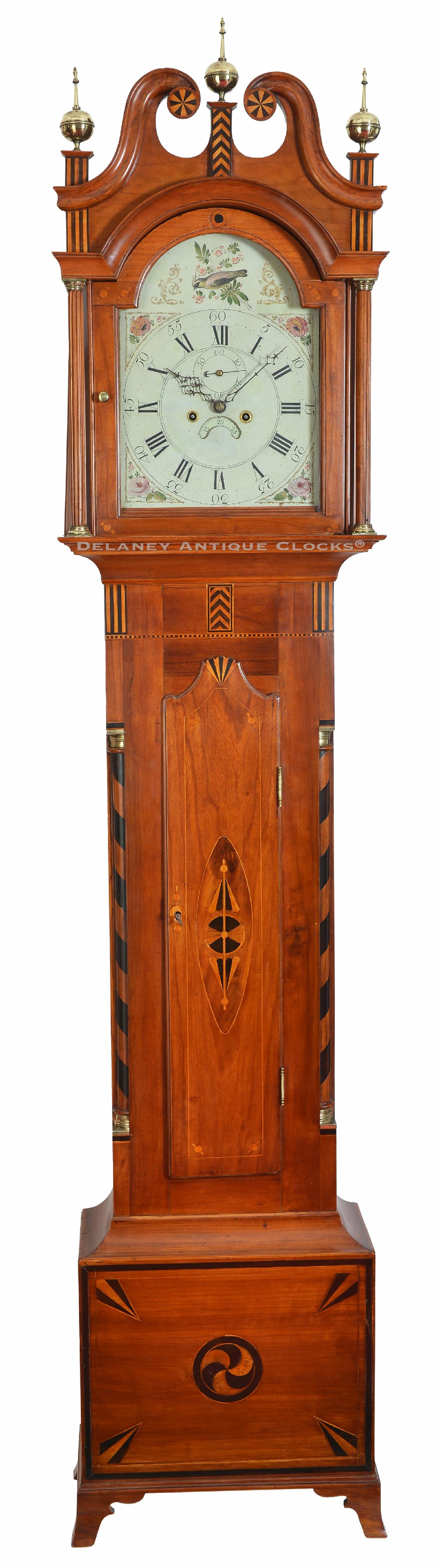
Constructed largely of cherry, with New England white pine as a secondary wood, this dazzling Vermont tall case clock, made circa 1800, reflects an uncommon level of ambition in early American cabinetmaking. Mahogany, birch, and maple are used throughout the stunning decorative program, their contrasting tones arranged in a dense pattern of fans, chevrons, and bookend motifs. The case retains an orange shellac finish that intensifies the color and sharpens the visual interplay between wood grain and inlay.
Only a small number of closely related cases are known, but this example appears to be the most elaborate. Its proportions are distinctly New England, with applied French feet and a molded swan’s-neck pediment typical of regional work at the turn of the 19th century. The choice of cherrywood is also telling. Coastal makers more often used mahogany, whereas inland shops frequently used native woods. Taken together, the form and ornamentation point most convincingly to southwestern Vermont.
The inlay patterns suggest a link to the cabinetmaking tradition associated with Oliver Wight of Sturbridge, Massachusetts, who trained several craftsmen, including Nathan Lumbard, who later became active in Sutton. Lumbard’s furniture is documented in Crafting Excellence: The Furniture of Nathan Lumbard and His Circle by Christine Jackson, Brock Jobe, and Clark Pearce. Although the inlay work directly attributed to Lumbard is often even more complex, the overall structure and decorative vocabulary here align closely enough to suggest production within the broader Wight–Lumbard sphere, perhaps by one of the many craftsmen working in that orbit.
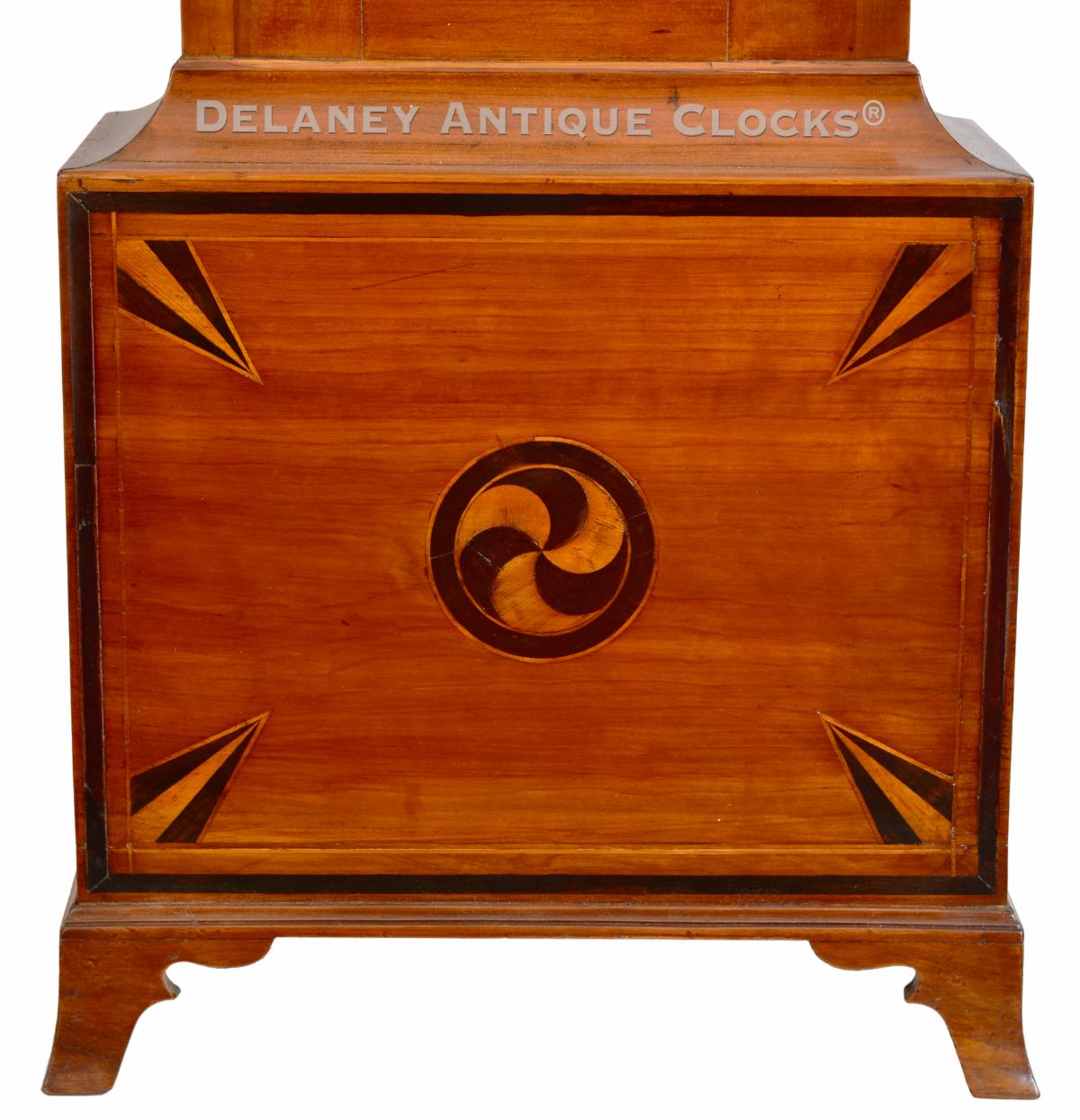
The base stands on four unusually flared French feet with pronounced returns, delicate in profile and remarkable for their survival. Above the feet, the base panel is framed by a narrow ebonized border that sets off the cherry's warm reddish tones. Within this frame, string inlay outlines the panel, while alternating light-and-dark fans anchor each corner. At the center, an inlaid pinwheel echoes the carefully balanced palette.
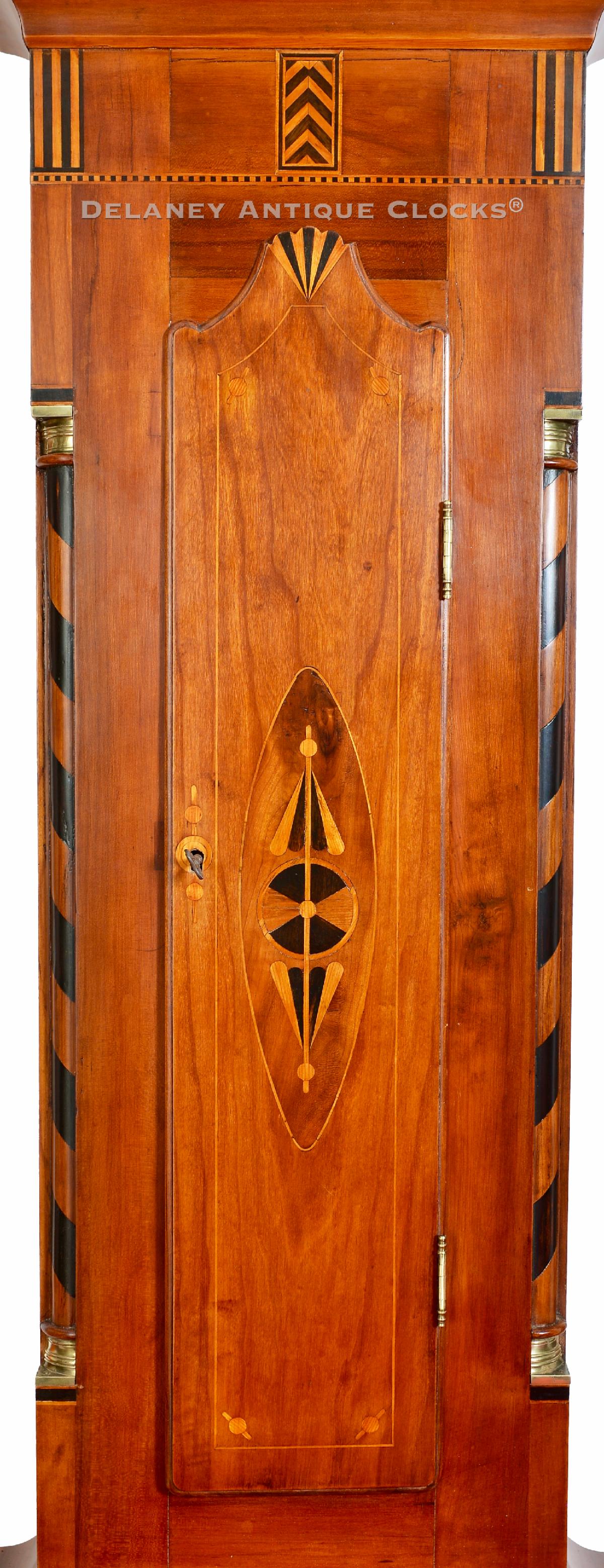
The waist is long and fitted with an access door whose ornament is among the case’s most distinctive features. A seven-petal fan crowns the upper section, while the corners of the surrounding line-inlaid frame are filled with unusual motifs resembling Saturn and its rings. A vertically oriented oval at the center contains additional fan and circular inlays, and even the key escutcheon is decorated.
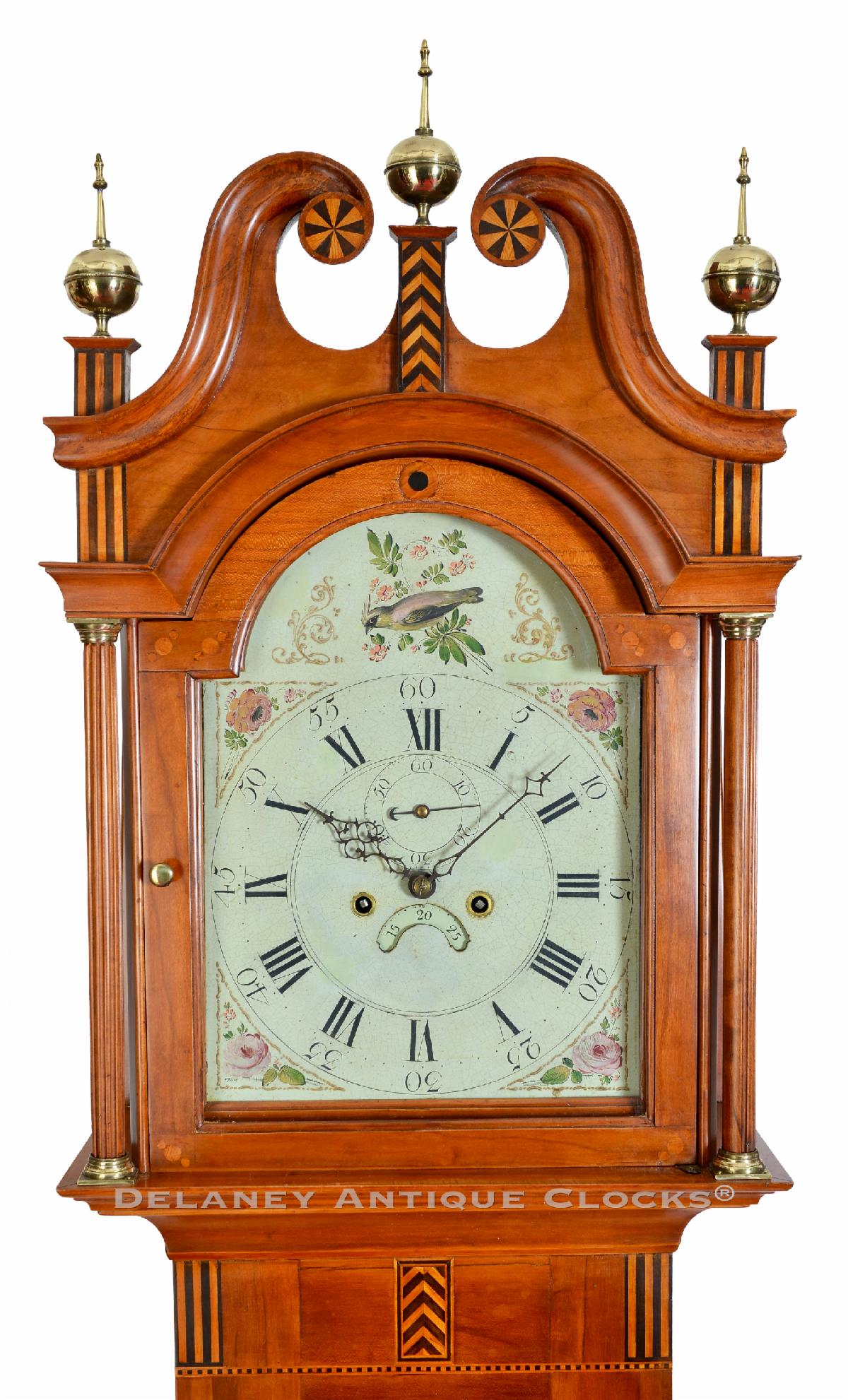
Above, the bonnet continues the case’s decorative confidence. The swan’s-neck pediment ends in inlaid rosettes, and three inlaid plinths are capped with brass finials. Turned and fluted columns rise to brass capitals and stand free, supporting the upper moldings. Oval glass sidelights remain in place, and the arched bonnet door, fitted with glass and decorated with matching inlay, opens to reveal the painted iron dial.
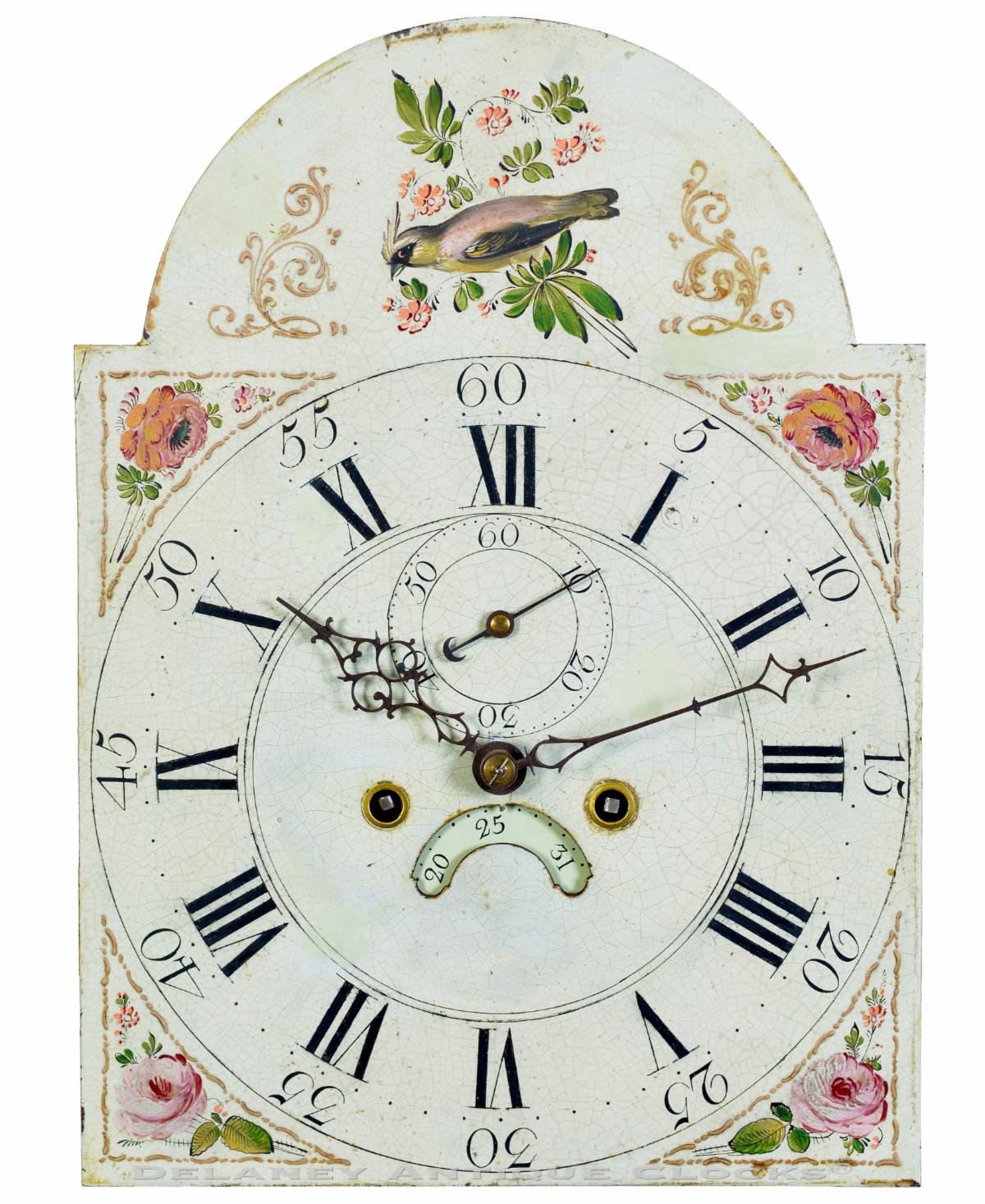
The dial is mounted on a false plate and laid out in two numeral systems: Roman numerals for the hours and Arabic numerals for the five-minute intervals. A subsidiary seconds dial and a month calendar are set within the chapter ring, and the spandrels are painted with floral decoration. In the arch is a moon-phase display, a costly complication that would have required additional labor and was typically supplied only by special order.
The brass movement is of good quality and uses a recoil escapement. It is an eight-day, weight-driven, two-train time-and-strike mechanism with a rack-and-snail striking system that sounds the hour on a cast-iron bell mounted above.
Height 7' 8" Width 20 1/2" Depth 11"
Inventory #225068
Price $11,500
|