Veto Session Wrap Up
The Illinois General Assembly concluded its Fall Session in the early morning hours of October 29th. The major issues addressed were approval of a reapportioned congressional map, modifications to Illinois’ Right of Conscience Act, establishing a tax credit for manufacturers of electric vehicles and their components and repeal of the parental notification for abortions being planned for minors. The General Assembly is not scheduled to return to Springfield until January of 2022. The legislative calendar for 2022 has been released with a scheduled adjournment of April 8th. This is seven weeks earlier than the General Assembly would normally adjourn (May 31st). The reasons for the early adjournment are the extensive renovations being started next spring for the Capitol and the need for campaigning as the Illinois primary elections have been moved from March to the end of June.
Right of Conscience Changes Signed into Law:
SB 1169 amends the Healthcare Right of Conscience Act providing that it is not a violation of the Act for any person or public official, or for any public or private association, agency, corporation, entity, institution, or employer to take any measures or impose any requirements intended to prevent contraction or transmission of COVID-19 or any pathogens that result in COVID-19 or any of its subsequent iterations. As amended, it will not be a violation of the Act to enforce such measures or requirements. Governor Pritzker signed SB 1169 as PA 102-667. While the effective date is not until June 1, 2022, the legislation indicates SB 1169 is a declaration of existing law and shall not be construed as a new enactment.
OSHA announces a new:
Here are four things the USDOL says employers of 100 or more need to know:
-
Employers with at least 100 employees will be required to adopt a mandatory vaccination policy unless they adopt a policy requiring unvaccinated workers to undergo weekly testing and wear a face covering at work.
-
Covered employers must provide paid time for workers to get the COVID-19 vaccine and ensure workers have paid sick leave to recover from any side effects that prevent them from working.
-
Employers must comply with most provisions by 30 days after the date of publication in the Federal Register, and comply with the testing requirement by 60 days after the date of publication in the Federal Register. Learn more about compliance dates here.
- Businesses that don’t comply may face significant OSHA fines.
Fifth Circuit Decision
The day after the ETS was issued by USDOL, the Fifth Circuit issued an order staying OSHA’s mandate pending further action of that court. The Court ruling was based upon the “petitions give cause to believe there are grave statutory and constitutional issues with the Mandate.”
What Does the Stay Mean for employers?
While the ETS is stayed, employers do not have to comply with its terms. However, that stay could be lifted by the Fifth Circuit or the Circuit that gets the consolidated cases for review on the merits. Once the stay is lifted, employers will have to comply with the terms of the ETS, but compliance deadlines should be tolled during the stay. Historically, though, stays of previous OSHA emergency temporary standards have remained in place pending resolution on the merits.
To avoid possible noncompliance and significant OSHA fines, affected employers should consider starting to create policies and procedures for compliance with the ETS to be prepared should the stay be lifted pending a resolution on the merits or should the court decide to uphold the ETS.
IDES Emergency Rule on Benefit Overpayments:
The Illinois Department of Employment Security’s proposed and emergency rule to implement the changes made by Public Act 102-26 to Section 900 of the Unemployment Insurance Act was published in today’s Illinois Register. Section 900 was amended to provide that when the stated requirements have been met, an individual who has received an overpayment of unemployment insurance benefits during a statutorily prescribed period of time may obtain a waiver of recovery of the overpaid benefits. The effective date of the rule is October 25, 2021. register_volume45_issue_45.pdf (ilsos.gov) (see pages 13994-14002).
General Assembly Pushes Back Speed Bumps:
During the Illinois fall session Fall Session, one important piece of business was the extension of the effective date for $500 million in increases of employer UI taxes and a cut of $500 million in UI benefits from December 31, 2021, to July 3, 2022. Fondly referred to as “speed bumps”, the provisions are meant to encourage business and labor interests to meet and negotiate changes to the Illinois unemployment insurance system. The change puts the negotiations into 2022 when the Illinois Chamber will be advocating for elimination of the nearly $5 billion deficit in the UI Trust Fund and to bring solutions to the rampant benefit fraud that has occurred since April of 2020. HB 594 (the Unemployment Insurance Act changes start on page 99) is expected to be signed into law by Gov. Pritzker.
General Contractor Liability Shift Stopped
ELC lobbying efforts coordinated with construction contracting organizations was able to get HB 3293 held in the Illinois House as the General Assembly adjourned its fall session. As amended, HB 3293 essentially shifted the liability for unpaid wages of employees of a subcontractor to the general contractor even if the general contractor had fully paid the subcontractor.
Critical to our success were the connections made by the Illinois Black Contractors Association and the Chicago Black Contractors, Owners and Executives members contacting their minority legislators urging them to oppose the measure. Also, helpful to our cause was Rep. Keith Wheeler (R-North Aurora). Rep. Wheeler suggested a more viable option to the House sponsor Rep. Jennifer Gong-Gershowitz (D-Glenview) that would also result in her intention to protect unpaid workers without the shifting liability of liability. We will be working on the viable alternative with the House sponsor and Rep. Wheeler before the General Assembly returns to Springfield in January.
The vote in the Senate was 40-17. Democrat Senator Napoleon Harris III did not support the measure and 17 of 18 republicans voted “no”. Sen. John Curran (R-Lemont) was not voting on the legislation.
Illinois Congressional Maps
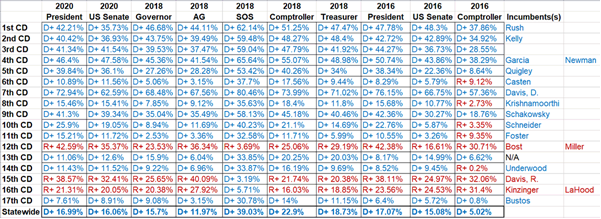
Illinois and national Democrats are taking full advantage of their super majority control of the Illinois General Assembly and democrat Governor Pritzker in maximizing their ability to extend their 13-5 democrat to republican Illinois majority in its congressional delegation. HB 1291 creates the Illinois Congressional Redistricting Act of 2021 establishing 14 democrat districts and 3 very heavy republican districts. Illinois lost a seat due to reapportionment after the 2020 census. Below is an analysis of the new districts based on recent past elections.
Unless there is a successful court challenge, Cong. Darrin LaHood (R) and Cong. Adam Kinzinger (R) are in the same district. Cong. Kinzinger has already announced that he will not seek reelection to the U.S. House. Early speculation is that he may run for the U.S. Senate taking on Sen. Duckworth in 2022 or Governor.