Issue 675 - July 10, 2026

IN THIS ISSUE


  • Bill to Help Child Sexual Assault Victims Seek Civil Damages Killed by Sweeping Last-Minute Amendment
  • Debate Over Legislative Hall Expansion Reignites After Governor Vetoes Funding
  • Marathon Last Night of the Legislative Session Reveals Need for Proposal
  • A Tale of Two First Responder Bills

NEWS - VIDEO

Bill to Help Child Sexual Assault Victims Seek Civil Damages Killed by Sweeping

Last-Minute Amendment


A bill to allow the victims of child sexual abuse to sue their abusers, regardless of when the acts took place, failed to clear the legislature despite overwhelming bipartisan support.


House Bill 75 sought to remove the civil statute of limitations on such cases, allowing these claims to be filed in Superior Court at any time. It would also have waived the state’s sovereign immunity for civil actions based on childhood sexual abuse. The measure applied retroactively, covering cases preceding the bill’s enactment.


Sponsored by State House Republican Leader Tim Dukes (R-Laurel), the measure had cleared the House of Representatives on the last night of the 2025 legislative session, 40-0. It was released from the Senate Judiciary Committee in late March of this year.


“I've asked for action on the bill since we got back in January,” Rep. Dukes said early last Wednesday morning. “This was not a political bill. It wasn't Democrat or Republican, but it really was recognizing the problems we've had in the past and trying to correct them by stating that we want to support victims of sexual abuse.” 


State Sen. Nicole Poore (D-New Castle), a Senate prime sponsor of the bill, said childhood sexual abuse is unlike most crimes. “We know from decades of research, from psychologists, law enforcement, prosecutors, advocates, and most importantly, from the survivors themselves, that many victims cannot tell their story as children. They're manipulated, they're threatened, and they are groomed by adults they were taught to trust.


“Many spend years believing what happened to them was somehow their fault,” she continued. “Some don't disclose until they are in their 40s, 50s, or even later, not because the abuse matters any less, but because trauma does not follow a legal timeline.”


After its committee release, the bill remained in Senate limbo for more than three months without being brought to the floor for consideration.


The evening before the final day of the session, State Senate President Pro Tem Dave Sokola (D-Newark, Pike Creek), a co-sponsor of the bill, filed a sweeping amendment entirely rewriting it.


Sen. Sokola said the changes were needed to clarify and streamline the legal process and that his changes would ultimately benefit victims.


However, supporters of the bill, like State Sen. Bryan Richardson (R-Seaford), characterized the amendment as gutting the measure in the service of special interests.


Sen. Poore said the amendment “changes the mission” of the legislation. “This is not a technical amendment. It is an insurance industry amendment designed to cut their losses at the expense of victims. It is a complete rewrite of the bill that unanimously passed the House and was unanimously released by both the House and Senate Judiciary Committees. Instead of restoring access to justice, this amendment restores barriers. It imposes arbitrary damage caps that apply only to survivors of childhood sexual abuse. … It creates separate damage caps for perpetrators and institutions, forcing courts to sort defendants into artificial categories and inviting years of unnecessary litigation.”


However, the objections in the Senate did not sway the majority. The transformative amendment was added, with Sen. Poore and all five Senate Republicans present for the vote opposing it. The bill was sent back to the House for another vote in the early morning hours of July 1st.


Discussing his bill in the House Chamber soon afterward, Rep. Dukes implied that the amendment's timing was calculated and that its addition to the measure was devastating. “On the 29th of June at 5 52 p.m., an absolutely disastrous amendment was added to the bill," he said. "The amendment creates numerous new legal definitions and hurdles with regard to liability. The amendment was never vetted, never went through a committee process. In fact, the frustration with it is that it actually creates more ambiguity in the law.”


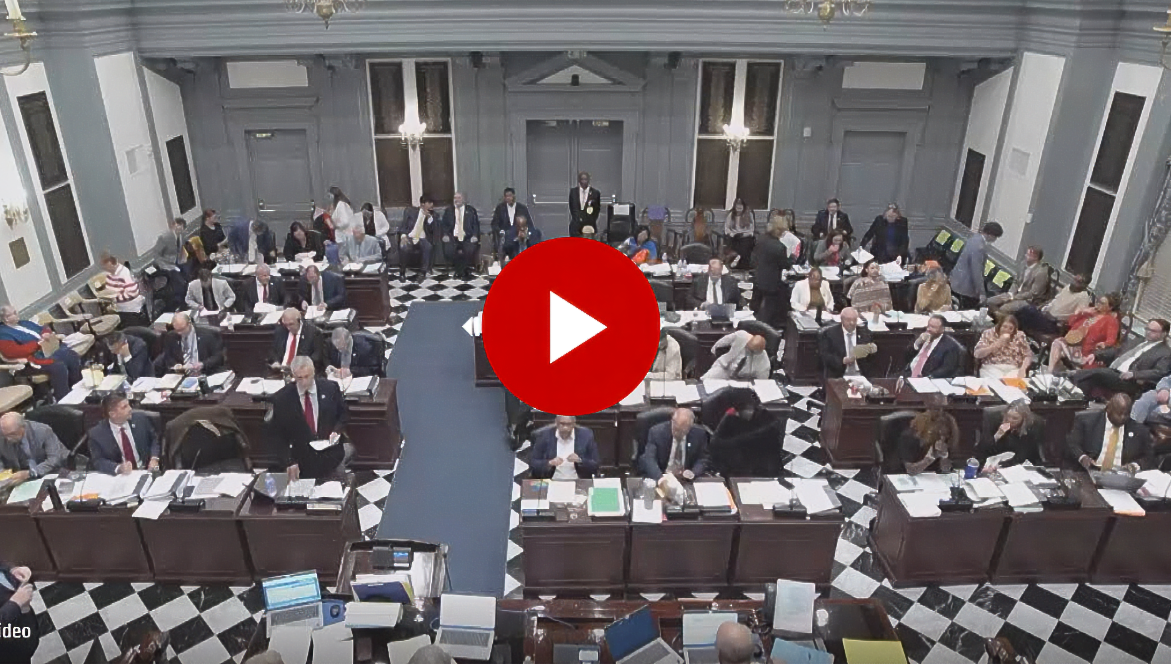
Rather than run a flawed bill, Rep. Dukes struck the legislation, promising to reintroduce it next January at the start of the new 154th General Assembly, prompting a standing ovation from every member of the chamber. (TO SEE REP. DUKES'S FLOOR COMMENTS, CLICK HERE OR ON THE GRAPHIC.)


Sen. Sokola has announced he is not seeking reelection and will not be a member of the state legislature in 2027.

NEWS

Debate Over Legislative Hall Expansion Reignites After Governor Vetoes

$35 Million in Project Funding


On Tuesday, Governor Matt Meyer exercised his line-item veto authority to remove a $35 million appropriation for the proposed Legislative Hall expansion project from the FY 2027 Capital Budget (Bond Bill). The action sparked renewed debate over the need for the proposed expansion and renovation.


“Whether it is building and improving our schools, investing in our communities, or finding additional ways to support working families, there are far more important priorities than renovating and expanding Legislative Hall.” Gov. Meyer noted in his veto statement.

He added that the vetoed appropriation was the first installment of a multi-year expenditure totaling an estimated $116 million.


Some lawmakers had also previously expressed reservations about the Legislative Hall proposal. As reported by the State News late last month, Joint Capital Improvement Committee member State Rep. Mike Smith (R-Pike Creek) opposed earmarking funds for the work at a time when many Delawareans were seeking financial relief. “I understand that the people that come into the building ... but (these people) are Legislative Hall insiders, for the most part, that we see all the time. It’s very rare that we get the general public showing up on a frequent basis.”


Earlier this year, State Rep. Bryan Shupe (R-Milford South, Ellendale, Lincoln) also criticized the initiative. “In 2025, this plan did not move forward because of public disapproval,” he said. “A year later, we’re appropriating money for it, still without public support. Our spending growth has been outpacing our revenue growth for most of this decade. We need to rein in spending, and this is a good start.”


Supporters of the project have noted that the expansion and renovations were intended to create larger public meeting spaces, improve accessibility, and fix glaring security issues.

A statement issued early this evening by Joint Capital Improvement Committee Co-Chairs, State Rep. Debra Heffernan (D-Bellefonte, Edgemoor) and State Sen. Jack Walsh (D-Stanton), said the governor’s decision was disappointing and perplexing.


“These are not frivolous or cosmetic upgrades – this is a carefully planned and well-thought-out project that would address problems that legislators, members of the public, the press, and staff have experienced for several years,” they said. “Years of bipartisan planning have gone into the expansion, with a special focus on public safety recommendations made by Capitol Police.”


They added that public complaints about the State Capitol are commonplace. “They've seen committee rooms filled beyond capacity, with people standing in hallways.

because there's nowhere left to sit, and those who have physical disabilities know how challenging it can be to simply navigate the building, which hasn’t had the updates necessary to keep pace with how our legislature, and the public it serves, has changed over the years.”


Originally constructed during the Great Depression, Legislative Hall has undergone an expansion roughly every three decades. The last major capital project involving the building was completed in the early 1990s. Since then, the state’s population has grown by approximately 50%.


State House Republican Leader Tim Dukes (R-Laurel) said he is surprised by the governor’s exercise of his line-item veto power. “There should have been better communication between the legislature and the chief executive on this issue,” he said. “In open public meetings early this year, it was made clear that this project would move forward before it became even more expensive. If the governor had objections, he should have begun a dialogue then.”


Even with the vetoed $35 million expenditure removed from the Bond Bill, the remaining $1.221 billion in the FY 2027 capital budget (House Bill 500) is still the fourth-largest in state history, falling just below the FY 2022, 23 & 24 budgets and a significant increase over the $977 million capital spending plan it replaced.


Critics of the veto note that the Legislative Hall project constituted less than 2.8% of the Bond Bill, which still includes ample funding for executive branch priorities, including the following:


  • $60 million for renovating the former Emily P. Bissell Hospital to serve as the new headquarters for the Division of Forensic Science.
  • More than $18 million for maintenance, capital improvements, and restoration at DHSS, DSHS, and DNREC facilities.
  • $110 million for the new container terminal project at the Port of Wilmington.
  • $34.5 million for Delaware State Housing Authority programs to create workforce housing, affordable housing, and conduct urban redevelopment.


The $35 million in vetoed funding will reportedly remain unappropriated authority under the Bond Bill. It could be reallocated to other state capital projects when lawmakers meet for the start of the 154th General Assembly in January.

NEWS

Marathon Last Night of the Legislative Session Reveals Need for Proposal


Earlier this year, State Rep. Lyndon Yearick (R-Camden, Woodside) introduced House Bill 428, a proposed constitutional amendment to establish a "Crossover Day" in Delaware.


Under the amendment, each chamber of the General Assembly would be prohibited from passing bills and sending them to the other chamber (crossing over) after June 20, 10 days before the end of the legislative session.


The state's annual funding measures -- the Operating Budget, Capital Budget, and Grants-in-Aid bill -- would be exempt, as they are typically not finalized until the closing days of the session.


Unfortunately, the proposal was bottled up in the House Administration Committee and not allowed to advance. However, Rep. Yearick has promised to refile it in the 154th General Assembly, citing the end of this year's session as evidence of its need.


Legislators conducted a marathon session on June 30, working past 5 AM on July 1 before adjourning. Combined, the House and Senate acted on approximately 100 bills and resolutions during those final hours.


"A Crossover Day may have helped curtail the kind of audacious activity we witnessed this year by limiting the number of bills available to be worked," Rep. Yearick said. "We have a two-year legislative session. There is no excuse for voting on dozens of bills in the last few hours, rushed through the process without proper consideration, debate, or public input. Legislators in both chambers were often making snap decisions on complicated bills within minutes that could carry significant consequences for years.


"Currently, 26 states, including Maryland, have Crossover Day deadlines," Rep. Yearick continued. "I think it is past time for Delaware to follow their example."

NEWS

A Tale of Two First Responder Bills


It was the best of times for supporters of a measure to increase penalties for people who wantonly damage emergency equipment, but the worst of times for the sponsors of a bill to create a safe zone around working first responders.


Senate Bill 232, sponsored by State Sen. Dave Wilson (R-Cedar Creek Hundred) and State Rep. Danny Short (R-Seaford), cleared the Senate in the early morning hours of July 1 and now awaits the governor’s signature.


The measure seeks to increase the seriousness of an act of "criminal mischief" to a class F felony when someone intentionally causes at least $5,000 in damage to an emergency vehicle and renders that vehicle unavailable for service.


The legislation was inspired by an incident in November 2023, when firefighters from six municipalities in Delaware and Maryland responded to a blaze at New Process Fiber Company in Greenwood. Two fire trucks from the Ellendale Fire Company and three vehicles from other companies were damaged by individuals throwing rocks near the fire scene.


Meanwhile, a measure sponsored by Sen. Eric Buckson (R–South Dover) and House Republican Leader Tim Dukes (R–Laurel) that sought to strengthen protections for Delaware’s first responders while they perform their duties was prevented from crossing the finish line.


Senate Substitute 1 for Senate Bill 284 would have established a 25-foot safe zone of operations, or "halo," around first responders performing their duties.


The bill would have made it a class A misdemeanor to cross a marked first responder barrier or, after receiving a warning, to enter the safety zone to interfere with a first responder or threaten them with harm.


The measure defined a first responder as a law-enforcement officer, volunteer or paid firefighter, emergency medical technician, paramedic, or fire police officer.


“Our first responders put themselves in harm’s way every day to protect our communities,” Sen. Buckson said. “The last thing they should have to worry about is someone interfering with their ability to do their job safely and effectively.”


Rep. Dukes said the bill was intended to reinforce respect for emergency personnel, prioritize public safety, and reduce the potential for conflict or misunderstandings.


The proposal is similar to the Halo Law, recently enacted in Florida.


The bill passed the Senate on June 18, 20-0. All five members of the House Administration Committee voted to release the bill a week before the session ended.


However, even though all three members of the House of Representatives' Democratic leadership, which controls the House Agenda, voted to release the bill from committee, it was not allowed to be considered by the chamber.


The bill is now essentially dead and will have to be refiled after the new 154th General Assembly convenes in January.