Photo by TARMO HANNULA
Earlier this week, Santa Cruz police enforced another sweep of tents and impromptu housing near highway 1 and River St.
|
|
A Victory for Chaos and Cruelty -- The Logic of Internment Advanced Against the Unhoused
By Food Not Bombs co-founder KEITH MCHENRY
We can only hope that the celluloid avatars at the Santa Cruz City Council are clueless, otherwise their “Camping Services and Standards Ordinance” is just naked sadism.
Imagine a fleet of city trucks and vans scouring the city every morning collecting the tents and other survival gear from hundreds of unhoused people, then returning that evening after 8:00 pm to deliver everyone’s equipment so they can get a night’s rest.
That is just one of the many dehumanizing insults of the “Camping Services and Standards Ordinance” passed on May 11, 2021, in Santa Cruz, California.
Another insult features the exciting prospect of a "safe sleeping site" for 150 people when it is likely that many additional people will be finding themselves homeless on the streets of Santa Cruz every month for the foreseeable future.
“As a grant writer, I know what it takes to be competitive as a community. Funders want to see communities that are in action. Funders want to see that we are capable of moving forward with solutions, and so this is a step in that direction,” Councilmember Shebreh Kalantari-Johnson said. “And so when the state sees that we have made progress, and we have stood up 150 safe sleeping sites in a matter of months, they’re going to want to fund us because they’re going to want to see our efforts progress and expand.”
Then consider what happens with all this promised funding announced by Governor Gavin Newsom, in his rule by headline desperation that seems to be exciting councilperson Kalantari-Johnson.
The Jeff Bezos “The Day 1 Families Fund” donated $2.5 million to Housing Matters in 2020 and a couple of months later, the 30-bed homeless shelter at Housing Matters on River Street was closed due to lack of funding. Social workers at the shelter struggled to find new locations for the dispossessed. Consider the success of Operation Roomkey. San Francisco is paying $16.1 million to shelter homeless people in 262 tents placed in empty lots around the city. They could have placed those people at the Fairmont for that price and that is really the solution here in Santa Cruz. Start by filling the Hampton Inn on Mission Street.
By dehumanizing those who cannot afford housing city officials have guaranteed that there will not be a single location for even one of their 150- person safe sleeping sites let alone the fifteen such cruel insults to human dignity that would be required to accommodate all those outside.
The May 7th Santa Cruz Sentinel article, “Eviction of Highway 1, 9 unhoused residents to start Monday” quotes city and county officials as saying that the city shelter programs don’t have a great deal of capacity”.
According to Jason Hoppin, Santa Cruz County communications manager, there are currently more than 800 people staying in various shelter types. That includes COVID-19 state-funded Project Roomkey, where motels are rented out to unhoused people who are at greater risk of the virus, as well as semi-congregate shelters at Veteran’s Halls, and the National Guard Armory shelter.
“We don’t have really a great deal of capacity in that system, and we still have hundreds and hundreds of people on waiting lists to get in to that system,” Hoppin said.
Those accepted into various shelter programs are prioritized based on medical need, Hoppin explained.
“There’s not enough shelter in the county, and the city is doing the very best we can with the resources we have available, within its purview — like the Benchlands, where we have 120 people camping,” City Communications Manager Elizabeth Smith said.”
I visited the Benchlands during the afternoon of the May 11 City Council meeting. I found a friend of mine standing under the pedestrian bridge looking exhausted still grasping her neatly packed garden wagon. “How are you doing?” I asked. “Not too good” she responded. She had lost much of her items during the Highway 1 sweep and was seeking someplace to set up her tent. I counted 184 tents already pitch on the Benchlands at 3pm that day. Those numbers are sure to grow well beyond the 122 spaces ordered by Magistrate Judge Susan Van Keulen.
A city that can embrace the idea of Seabright Strong is rushing ever closer to a time when the logic of internment becomes a reality.
|
|
What is Affordable Housing?
By CYNDI DAWSON
In these polarized times, building affordable housing seems to be one thing we all can agree on. You will hear city staff, elected officials and developers proudly proclaiming the developments springing up around Santa Cruz are helping affordability by producing lots of market-rate units and are providing enough affordable units to meet the need in Santa Cruz. But have you ever wondered what “affordable housing” actually means?
Due to its favorable climate, stunning landscape, and world-class university, Santa Cruz is a highly desirable location to live. Unfortunately, the current housing-affordability crisis determines who gets to access all that is great about Santa Cruz. The system to define and require affordable housing is opaque and complex. A suite of intertwined federal, state, county and city laws, ordinances, and processes makes it nearly impossible for an average citizen to know whether or not a new development is providing the affordable housing a community needs.
The first piece of the affordable-housing puzzle is the Average Median Income (AMI). This is determined on a county-wide basis by the Housing and Urban Development Department, which is a federal agency that uses census and other annually collected data to determine income brackets each year (although HUD has published 2020 numbers, the Santa Cruz County Housing Authority has not yet adopted updated income limits). The official 2020 AMI in Santa Cruz county for a family of four is $98,000 according to the most recent numbers from May of 2019 (Table 1). Income is further broken down into categories based on the percentage of AMI adjusted for household size.
The city of Santa Cruz uses those annually published numbers in defining not only different levels of housing-unit affordability, but also defining “affordable rent.” It currently defines affordable rent as the maximum monthly rent, including utilities and all fees for housing services, which does not exceed 35% of household income. There are three levels of housing unit affordability defined in the City’s municipal code: Extremely Low Income (households with incomes at 30% of the median income); Very Low Income (households at 50% of the median); and Low Income (households at 80% of the median income).
Santa Cruz used to focus its affordable housing efforts on the lowest income categories (Extremely Low, Low, and Very Low). Recently, they have expanded the definition of affordable housing to include the Moderate Income category, thereby allowing units with much higher pricing to count in meeting affordable-housing requirements. Affordable rent for the Moderate Income category was not defined in the city of Santa Cruz code until the Planning Commission defined it on October 15, 2020. This means that when someone describes a unit of housing as an “affordable rental,” that unit may now be in the Moderate Income category. A single person in Santa Cruz needs to make $82,300 a year or about $40 per hour, with “affordable rent” defined as about $2200 a month for a Moderate Income rental unit based on the current income limits..
A recent 2020 study by the California Housing Partnership says a renter in Santa Cruz needs to make $41.37/hr to afford the average monthly asking rent of $2,151. A teacher working at Santa Cruz City schools for 10 years can max out their salary at about $72k; if they use their own time and money to earn 75 units of professional education classes, they can make at most around $80k per year. A barista or bartender in Santa Cruz working downtown earns about $35 - 40k annually. On average, a year-round Seaside Company employee who works at the Boardwalk makes $50 - 60k. A Graduate Student Advisor at the University of California, Santa Cruz makes $45-50k annually. The majority in Santa Cruz are well below the Moderate Income affordable rent threshold (according to an average median income range between $68,600 and $82,300). The average, everyday worker in Santa Cruz, however, pays much more than 35% of their income if they are living in a rental priced at or above the Moderate Income level.
Way back in 1969, the state of California passed the State Housing Law requiring all cities and counties to plan for the housing needs of their residents regardless of income. This law is administered locally through the City of Santa Cruz General Plan Housing Element, which is linked directly to the Regional Housing Needs Assessment (RHNA). The Association of Monterey Bay Area Governments prepares the Regional Housing Need Assessment (RHNA) plan for Monterey and Santa Cruz Counties based on state projections of future population growth distributed to the different regions. The RHNA plan establishes the total number of housing units that each city and county must plan and zone for within an eight-year planning period for different income categories. Santa Cruz did not meet their RHNA goals in the Very Low and Low Income categories during the 2007-2014 period. Because the RHNA is based on a forecast of future conditions, there is debate about whether these numbers accurately reflect the housing needs in a community, but they certainly are an important benchmark that most believe should be achieved at a minimum. Santa Cruz has already met the RHNA requirements for all categories except Very Low Income for the 2015 - 2023 period (Table 2).
This leads us to the question at hand for all Santa Cruz residents: are all these buildings popping up around town producing the type of units we need to meet our community's housing needs? The answer really depends on the type of development. Generally, for-profit developments have a much lower rate of affordability than non-profit developments or developments where the land does not need to be purchased (as on city-owned parcels). In addition, a community's inclusionary requirement, meaning the amount of units in a new development required to be affordable, plays a big role.
Here in Santa Cruz, the local inclusionary requirement was raised in January of 2020 from 15% to 20%, requiring that proportion of affordable units in each new development with more than 5 units. However, this local ordinance to prioritize affordable housing production is now superseded by recent amendments to the State Density Bonus Law, which have taken effect as of January 2021. The original State Density Bonus Law, passed in 1979 to encourage the production of affordable housing, has met with limited success, as evidenced by the current housing crisis across California. The new amendments include the option for developers to build much denser and higher projects while escaping requirements for parking and outdoor space if the project provides a certain percentage of affordable units. The more lower income units a developer includes, the more concessions and waivers to local development requirements the project will receive. The density bonus was envisioned as a way to increase the production of affordable housing. However, the way the law is being interpreted results in the opposite outcome.
The Riverfront Project demonstrates clearly how the new density bonus law can increase the size of a project and lower the percentage of affordable units well below the local inclusionary requirement. The project is located along Front Street from the terminus of Cathcart Street to the Downtown Metro Center. The process to develop something like this starts with the developer designing a “base density” that is compliant with all the requirements in the City’s General Plan. In this case, the developer submitted an application for the “base density” of a fully-compliant, mixed-use development with 133 units. They then requested a density bonus which allowed for an increase in building height and the number of units to 175. The 20 affordable units remained the same, decreasing the percentage of affordable units to 11%.
The city inclusionary ordinance required 15% low income units at the time the application was submitted. In order to apply the density bonus, the developer was required to provide 11% of the base density with very low income units and was allowed to use whatever affordable income level they want for the remaining affordable units. Meeting this requirement enabled the developer to be granted a 35% increase in the number of project units and a waiver for height and setback limits, while not requiring any additional affordable units. There will be 15 very low income and 5 moderate income units in this 175 unit building. The bottom line is that the developer originally proposed building 20 “affordable” units (required by the local inclusionary ordinance) and is still building 20 “affordable” units, even though the Riverfront Project (thanks to the state density bonus law) jumped from 133 to 175 units. Yet the meaning of “affordability” has completely changed. To be clear, 89% of the units in this development will be market rate (i.e. $2500-4500/month), meaning a tenant would need to be making well above $82k annually to afford this rent.
The final piece of the affordable-housing puzzle in Santa Cruz is the vacancy rate. The vacancy rate refers to the number of units that are unoccupied but available for occupancy. Focusing on the rental vacancy rates for the area stretching from Santa Cruz to Watsonville, a study from 2019 reported that the rental vacancy rate decreased from 3.5% to 1.9% in 2010. However, when you look at indicators on the ground in the city of Santa Cruz, there is evidence that we may be building housing that is sitting empty because it is simply unaffordable. One such indicator is the luxury development at 555 Pacific Avenue. The developer recently asked the city to reopen negotiations of its developer's agreement citing “tenancy problems.” At 555 Pacific Avenue, one-bedroom units ranging in size from 420-650 ft2 go for $2600-$2800/month and they are currently offering one-month free rent for a thirteen-month lease. Another recent 79-unit development located at 1547 Pacific Ave. has studios and two-bedroom units ranging from $2,162-$4,733/month. The average worker at most of the major employers in the city of Santa Cruz does not make enough to pay these market-rate rents. The vast majority of building projects is serving wealthy out-of-towners and the burgeoning tech sector where the number of people employed is relatively low, but the wages are very high.
So, Santa Cruz, next time you hear “affordable housing,” or “51% affordable” and the like, here are some questions to keep in mind.
- What is the base density/number of units?
- What income level are the affordable units?
- What are the prices of the non-affordable units?
- Who in our community will be able to afford to live there?
State laws limit a municipality's ability to reject new housing, which sounds good on paper. But decades of limited-growth housing policies led by cities like Santa Cruz, have exacerbated the current housing crisis. Limitations placed on local government should not, however, limit the ability of the community to demand what type of housing will be built and how affordability will be classified. If it does, it tips the balance of influence in the developer’s favor. If we are going to push Santa Cruz to build truly affordable housing, then we first need to understand what affordability is and what it is not.
Cyndi Dawson is a Santa Cruz community member and this article is not affiliated with her civil service position as Planning Commissioner of the City of Santa Cruz. She is also an elected member of the Santa Cruz Democratic Central Committee, District 3.
Editor's note: to demand what type of housing should be built and how affordability should be classified, contact Santa Cruz Council.
|
|
Reel Work Labor Film Festival - Neoliberal Economics
By SARAH RINGLER
From May 12-18, you can watch the ironically named film, "Port Triumph." The film shows the effects of neolilberal economics on the shrimp industry in a coastal town in El Salvador where despite the valient efforts of the workers and the community, the industry closes down. Watch the trailer for Port Triumph. Watch the full film Port Triumph on Vimeo through May 18.
|
|
"Whiteness is a problem of being shaped to think that other peole are the problem."
Alexis Shotwell
|
|
Photo by TARMO HANNULA
A red-tailed hawk soars above the mouth of the San Lorenzo River mouth in Santa Cruz.
|
|
Santa Cruz County Covid-19 Report
By SARAH RINGLER
The Santa Cruz County Health Department regularly releases data on the current status of Covid-19 in the county. As of May 13, there were 16,264 cases that tested positive. That is a 2% increase from the previous week. Deaths increased by one to 206. There were few changes in all the categories.
Santa Cruz County moved into the Orange Tier on March 30. For information, go here.
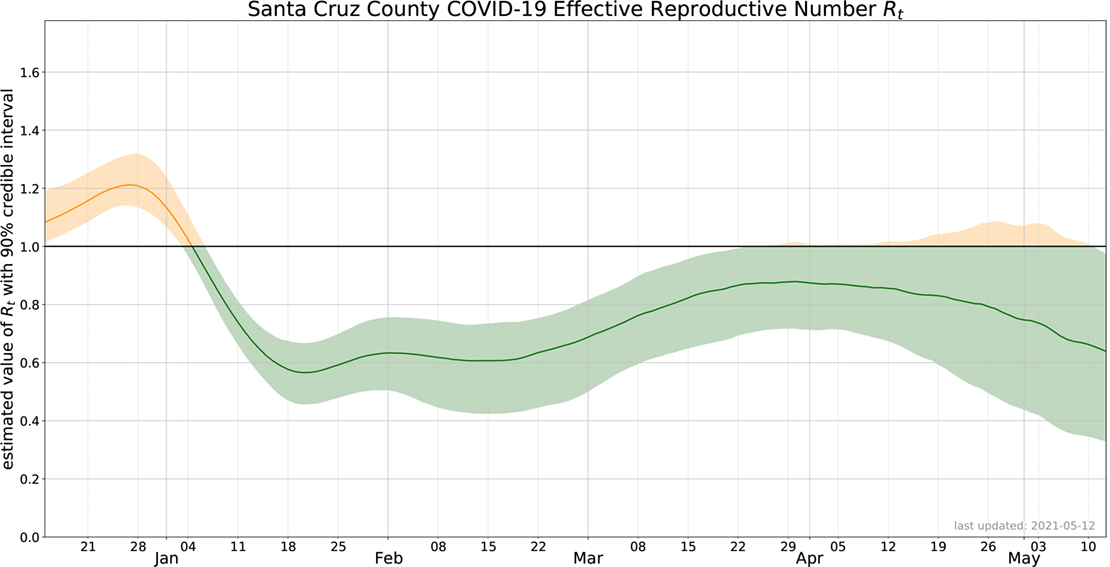
The county's Effective Reproductive Number is staying below one. See chart below. Numbers above one show the spread of the virus is increasing. Below one means the spread is decreasing.
To get tested without a doctor’s request, call 1-888-634-1123 or go online at https://lhi.care/covidtesting. Other testing sites that may have restricted access can be found here.
For vaccine information in Santa Cruz County, click here.
|
|
 |
% deaths by ethnicity/% of population:
White - 55%/58%
Latinx - 36%/34%
Black - 0/1%
Asian - 7%/4%
American Native - 0.5%/not available
% deaths by gender/% of population:
Female - 51%/50%
Male - 49%/50%
Other - 0
Under Investigation - 0
Deaths by age/202:
30-39 - 2%
40-49 - 3%
50-59 - 2%
60-69 - 13%
70-79 - 21%
80-89 - 31%
90+ - 27%
Tested positive by region/% of population:
Mid-county - 21%/12%
North county - 20%/60%
South county - 58%/29%
Under investigation - 0%
Weekly increases in positive tests:
June 12-19 - 7%
June 19-26 - 23%
June 26 to July 3 - 22%
July 3-9 - 23%
July 9-16 - 40%
July 16-23 - 20%
July 23-30 - 27%
|
|
|
|
July 30-Aug. 6 - 13%
Aug. 6-13- 12%
Aug.14-20 - 16%
Aug.20-28 - 10%
Aug. 28-Sept. 3 - 10%
Sept. 3-10 - 6%
Sept. 10-17- 8%
Sept. 17-24 - 7%
Sept. 25- Oct.1 - 5%
Oct. 1 - 9 - 4%
Oct. 9-15 - 4%
Oct. 15-22 - 5%
Oct. 23-29 - 4%
Oct. 30-Nov. 5 - 6%
Nov. 5-12 - 10%
Nov. 12-19 - 11%
Nov. 19-26 - holiday
Nov. 19-Dec. 3 - 29% 2 weeks of data for this week only
Dec. 3-10 - 16%
Dec. 10-17 - 17%
Dec. 17-24 - 14%
Dec. 24-31 - 19%
Jan. 1-7 - 13%
Jan. 7-14 - 14%
Jan. 15-21 - 11%
Jan. 21-28 - 5%
Jan. 28-Feb. 4 - 5%
Feb. 5-11 - 2%
Feb. 11-18 - 2%
Feb. 18-25 - 1%
Feb. 25-March 5 - 1%
March 5-11 - 1%
March 11-18 - 2%
March 18-25 - .5%
March 25 - Apr. 1 - .7%
Apr. 1-8 - 0.1%
Apr. 9-15 - 1%
Apr. 16-22 - 2%
Apr. 22-30 - 2%
Apr. 30 - May 6 - .3%
May 6-13 - 2%
|
|
|
|
Photo by TARMO HANNULA
Fashion Street - The Great Morgani
By SARAH RINGLER
The Great Morgani, Frank Lima, plays his version of “Pennies from Heaven” on Pacific Avenue in downtown Santa Cruz recently. The professional accordion player and performance artist has treated people on the streets of Santa Cruz and elsewhere for more than 25 years to his vast repertoire of more than 1,000 songs, from popular music to classical favorites. His unique array of more than 50 costumes, ranging from bizarre nutty animals to Santa, double his impact and draw to passersby. “During the pandemic I didn’t play my accordion for an entire year,” he said. “Then it struck me: ‘what am I doing?’ So I picked it up recently and began to play. I only lasted about 7 minutes before I got tired - an accordion is a heavy instrument; I was out of shape. But it feels good to be back out here.” Lima said he had just played the night before at a 20-somethings party. He performs at scores of events, from corporate galas to birthday parties across the map, including the Monterey Bay Area, Los Angeles, Chicago, New York, and Miami. For information, visit: Thegreatmorgani.com
|
|
Labor History Calendar for May 15-21:
May 15,1931: Soldiers fire on srikers, killling many in Adalen, Sweden
May 15, 1942: Death of IWW songwriter, T-Bone Slim.
May 16, 1821: Engineers start successful 5-month strike for 9-hour day in Newcastle-upon-Tyne.
May 16, 2018: North Carolina teachers strike for better schools.
May 17, 1838: First women's anti-slavery conference in Philadephia
May 17, 1954: Supreme Court outlaws segregation in public schools.
May 18, 1814: Birth of Michael Bakunin.
May 19, 1920: Miners win battle of Matewan (West Virginia) over Baldwin-Felts gun thugs.
May 19, 1925: Birth of Malcolm X.
May 19, 2017: 4,000 Haitian garment workers strike to double wages.
May 20, 1933: Rubber workers strike in Akron, Ohio.
May 20, 1999: 2,000 carpenters launch wild cat strike in San Francisco.
May 21, 1946: U.S. government seizes coal miners to break national strike.
|
|
Photo by TARMO HANNULA
Eggplant and Spicy Peanut Sauce
By SARAH RINGLER
This is a good side dish to serve with an egg noodle and vegetable dish. Peanut sauce loves noodles as anyone who has had Dan Dan Noodles at a Chinese restaurant knows.
Peanuts are not a nut; they are a bean probably first cultivated in central South America about 8,000 years ago. The cultivation of peanuts extended up into Aztec Mesoamerica. They were sold in the market of Tenochtitlan, now called Mexico City, under the name tlalcacahuatl. The Spanish name, cacahuate, or French, cacahuete, comes from the Nahuatl or Aztecan word.
½ cup natural peanut butter, room temperature
1/3 cup water
1 tablespoon soy sauce
1 tablespoon brown sugar
1 teaspoon grated lime zest
1 tablespoon lime juice
2 teaspoons hot sauce
1 minced garlic clove
1 large eggplant, about 1 ½ pounds
¼ cup sliced green onions
¼ cup chopped roasted peanuts
In a bowl, mix the peanut butter, water, soy sauce, sugar, lime zest, lime juice, hot sauce and garlic with a fork.
To prepare the eggplant, preheat oven to 400 degrees. Wash the eggplant and with a sharp knife, make 6 shallow slits, evenly spaced, along the length of the eggplant. Put the eggplant into a baking dish and roast in the oven for about 45 minutes. Turn the eggplant a few times to make sure it doesn’t burn. When it is soft to the touch, remove from the oven and let it cool. When just cool enough to handle, peel the skin off and cut into strips.
Place on a platter. Spoon the peanut sauce over the eggplant and garnish with the chopped roasted peanuts and the thinly sliced green onions. Serves four.
|
|
YOUR STORY OR ART HERE: Please submit a story that you think would be of interest to the people of Santa Cruz County. Try and keep the word count to around 400. Also, there should be suggested actions if possible. Submit to coluyaki@gmail.com
If you are enjoying the Serf City Times, forward it on to others. We need readers, artists, photographers and writers.
|
|
Welcome to Serf City Times. Over time, our county has grown more stratified and divided with many people feeling left out. Housing affordability, racism and low wages are the most obvious factors. However, many groups and individuals in Santa Cruz County work tirelessly to make our county a better place for everyone. These people work on the environment, housing, economic justice, health, criminal justice, disability rights, immigrant rights, racial justice, transportation, workers’ rights, education reform, gender issues, equity issues, electoral politics and more. Often, one group doesn’t know what another is doing. The Serf City Times is dedicated to serving as a clearinghouse for those issues by letting you know what is going on, what actions you can take and how you can support these groups.This is a self-funded enterprise and all work is volunteer.
Copyright © 2021 Sarah Ringler - All rights reserved
|
|
|
|
|
|
|