July 2017 | Volume 5, Issue 3
   Website      About      Faculty/Staff      News/Events      Projects/Programs
EVIDENCE IN ACTION
A quarterly research brief from the
Center on Trauma and Children

Gender Differences in Adolescents with Substance Misuse:
Trauma, Adverse Experiences and Mental Health 
Data from the Adolescent Health and Recovery Treatment & Training (AHARTT) Project at the UK Department of Psychiatry & Center on Trauma and Children was analyzed by the UK Center on Drug and Alcohol Research. This research was conducted as part of the statewide Adolescent Kentucky Treatment Outcome Study (AKTOS)1.
 
This Evidence in Action highlights findings from that outcome evaluation 2 revealing gender differences regarding trauma exposure and substance misuse.  
The Study 
The sample represents adolescents engaged in substance abuse treatment in Kentucky between 2014 and 2016, with measures taken at intake (N = 479) and at 12-months (N = 121). The adolescent sample was predominantly Caucasian, almost two-thirds male, and had an average age of 15.6 (range 12 - 19) at intake. Most youth had lived with family members, although one-third reported having been in an institutional setting (treatment or juvenile justice facility) for some period during the previous year. Nearly 80% reported a biological parent as the primary caregiver, with 25% reporting another family member as the primary caregiver and 3.3% reporting being in foster care at intake. Girls reported higher rates of living with family than boys. Referrals for substance abuse treatment were primarily through the court and child welfare systems, with some referrals provided by schools.
Trauma Exposure   
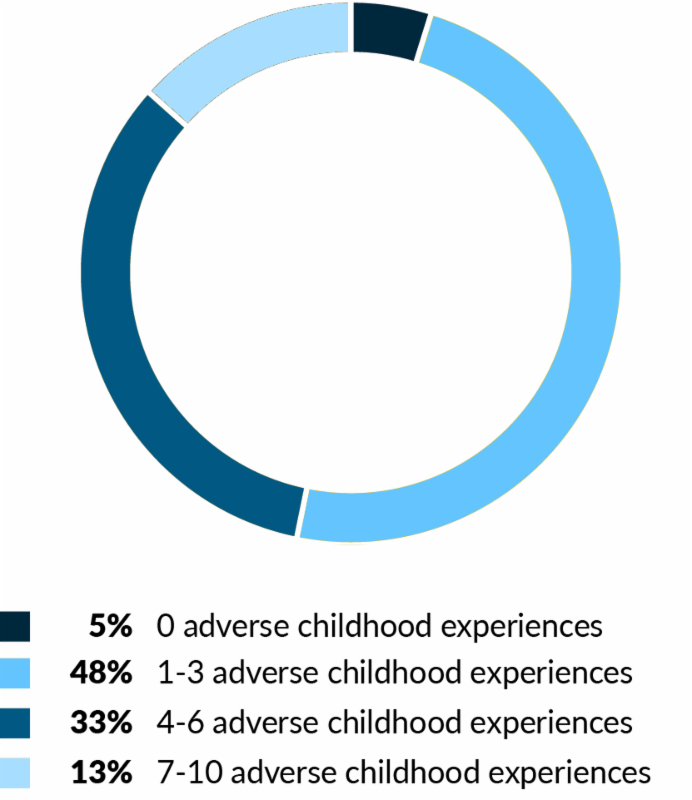
 Exposure to maltreatment, neglect and household dysfunction were common. On a scale from one to ten, the
average number of adverse childhood experiences (ACE) was 3.6.  Only 5% reported having had no exposure to interpersonal violence or household dysfunction. Forty-six percent of the sample reported four or more ACEs. Research from the original ACE study found that the dose response increases markedly when four ACEs are reported so this places these youth at increased risk of persistent physical, social, emotional and behavioral problems. An ACE score of 4 nearly doubles the risk of heart disease and cancer, and increases the likelihood of alcohol dependence by  approximately 700%. 
Girls reported significantly more trauma and adverse childhood experiences than boys

Girls reported an average of 4.3 adverse experiences  while
boys reported an average of 3.3.

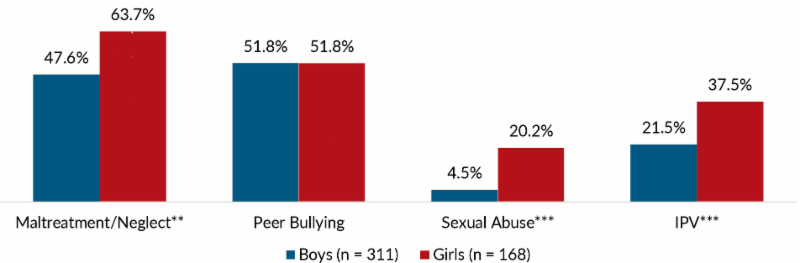
Girls reported significantly higher rates of child maltreatment or neglect, intimate partner violence and sexual abuse.

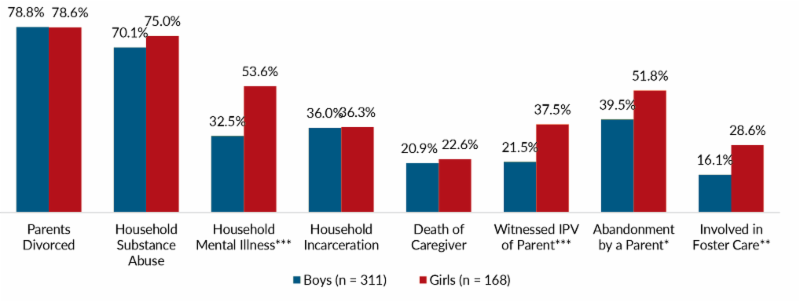
Significantly more girls than boys reported living in foster care  
LIFETIME CHILDHOOD ADVERSE EXPERIENCES AT INTAKE (n = 479)

*p < .05, **p < .01, ***p < .001
Girls reported significantly higher rates of mental health disorders and stress than boys at intake and follow up

Girls reported significantly higher rates of  internalizing problems (intake and follow up),  disordered eating (follow up), and  suicidal ideation/attempts
 
Girls reported significantly higher levels of stress and less ability to handle stress at both intake and follow up. 
 
Girls had higher scores of internal dysfunctional emotional regulation at both intake and follow up.
Girls reported fewer social and resiliency supports than boys 

School satisfaction
was lower for girls at intake, despite no differences in GPA, detentions, suspensions/expulsions, or level of educational achievement.
 
Girls reported lower levels of caregiver involvement and reported no significant change over the course of treatment; boys reported a significant increase in caregiver involvement.
 
Girls reported using alcohol and drugs at higher rates
than boys 

Girls reported using alcohol only (past 30 days and past 12 months), including drinking to intoxication and binge drinking significantly more than boys.

Girls reported using alcohol and drugs together at significantly higher rates than boys over the past 30 days.

Boys reported using marijuana only at higher rates than girls. 

Fewer girls than boys met criteria for no Substance Use Disorder (SUD) at intake.
Implications  
These findings highlight the complexity of the intersection of trauma and substance abuse.  The dose response between ACEs and increasing risk of drug and alcohol abuse has been noted in the literature: chronic adversity in childhood is linked to higher rates of substance abuse 3 and initiation of substance abuse in adolescence has been correlated to increasing ACE exposure 4.  These data are congruent with previously reported AHARTT findings that a higher number of ACEs was correlated with more polysubstance abuse. The larger AKTOS study also found a dose response between ACE exposure and severity of substance misuse 1.  This indicates there may be a particular risk of polysubstance abuse for adolescent girls with trauma and ACE histories, which may in turn increase risk for further victimization. Trauma can serve as a risk factor in developing substance use disorders, and the substance use can leave adolescents vulnerable to trauma5.  In addition, the substance misuse may compromise the efficacy of mental health treatment, consistent with the limited improvements and higher rates of internalizing, disordered eating, suicidality and stress reported at follow up by girls.  Lower levels of perceived caregiver involvement may be a result of or a contributor to the higher rates of persistent substance abuse and mental health problems reported by girls at follow-up.  This lack of caregiver connection and the lower sense of school connectedness also reported by girls decreases opportunities to promote resiliency while simultaneously increasing risk of substance misuse 6.
Translational Tips
To adequately address co-occurring trauma and substance use problems in adolescents, behavioral health agencies should consider the following:
  1. Comprehensive screening and assessment of exposure to trauma or adversity for all adolescents entering substance abuse treatment
  2. Integrated mental health and substance abuse treatment services for youth with co-occurring problems 
  3. Strategies to guard against gender bias in assessing the substance use of adolescents, particularly those with trauma or ACE exposure, i.e. social constructs that portray boys as heavier drinkers or more likely to engage in polysubstance use are erroneous
  4. Monitoring of mental health symptoms regularly over the course of all adolescent treatment, including substance abuse treatment, with particular attention to the internalizing strategies girls may use to manage stress; failure to attend to these needs may prolong mental health and substance use problems and increase risk of relapse
For more information about the Adolescent Kentucky Treatment Outcome Study and these reports, visit:  http://www.cdar.uky.edu/AKTOS/
References

1.  Cole, J., Logan, T., & Scrivner, A. (2017). Adolescent Substance Abuse Treatment in Kentucky. Lexington, KY: University of Kentucky, Center on Drug and Alcohol Research.


2.  Cole, J., Logan, T., Miller, J., & Scrivner, A. (2017). Adolescent Health and Recovery Treatment and Training (AHARTT) Outcome Evaluation. Lexington, KY: University of Kentucky, Center on Drug and Alcohol Research.


3.  McLaughlin, K.A., Green, J.G., Gruber, M.J., Sampson, N.A., Zaslavsky, A.M. & Kessler, R.C. (2012) Childhoos adversities and first onset psychiatric disorders in a national sample of U.S. adolescents.  Archives of General Psychiatry, 69(11), 1151-60.


4.  Dube, R.M., Felitti, V.J., Dong, M., Chapman, D.P., Giles, W.H> & Anda, R.F. (2003).  Childhood abuse, neglect and household dysfunction and the risk of illicit drug use: The Adverse Childhood Experience Study.  Pediatrics, 111(3), 564-72. 


5.  National Child Traumatic Stress Network (2008).  Making the connection: Trauma and Substance Abuse.  Available at: http://www.nctsn.org/sites/default/files/assets/pdfs/SAToolkit_1.pdf  

Funding for the AHARTT project was provided through a Kentucky Kids Recovery Grant administered by the Kentucky Substance Abuse Treatment Advisory Committee in January 2014. 
Data graphics created by Allison Mateyoke.
University of Kentucky Center on Trauma and Children
859-218-6901 | http://www.uky.edu/ctac


  Like us on Facebook   Follow us on Twitter   View our videos on YouTube   View our photos on flickr