 |
|
EVIDENCE IN ACTION
A quarterly research brief from the
Center on Trauma and Children
|
|
Special Edition
This
edition of
Evidence in Action
is an annual feature in which CTAC scientist-practitioners share clinical implications of a specific research study to illustrate how the findings can be used in trauma practice. For this issue, CTAC Faculty Associate Debra Katz, M.D. discusses a
synopsis of current research on
the reduction of Posttraumatic Stress Disorder (PTSD) symptoms with Propranolol therapy. As always, translational tips are offered to the reader to highlight potential clinical implications of the findings. For further information please see the source article:
Brunet, A., Saumier, D., Streiner, D.L., et al. (2018). Reduction of PTSD Symptoms with Pre-Reactivation Propranolol Therapy: A Randomized Clinical Trial.
American Journal of Psychiatry. Advance online publication
DOI: 10.1176/appi.ajp.2017.17050481.
|
|
|
Individuals with PTSD often wish to rid themselves of traumatic memories. Traumatic memories, commonly retrieved or reactivated in treatment, enter a malleable state. Once an individual stops thinking about a memory, the memory returns to a stable form, a process known as reconsolidation. It had been thought that traumatic memories lasted indefinitely and the most that could be hoped for was to inhibit their expression through extinction. Recent research has shown that even after a traumatic memory has consolidated, its retrieval-when influenced by certain medications- may result in permanent weakening or elimination. Therefore, medications
that interfere with the reconsolidation process could potentially weaken or eliminate retrieved
traumatic memories. Propranolol, a beta blocker, is one medication that has been studied in animals and humans. This randomized clinical trial in 60 adults with longstanding PTSD demonstrated that the administration of Propranolol before recall of a traumatic event significantly reduced PTSD symptoms over six weeks. The effect sizes obtained in this study compare favorably to those obtained with other major evidence-based treatments for PTSD such as Cognitive-Behavioral Therapy (CBT) and Selective Serotonin Reuptake Inhibitor (SSRI) medications. If these results can be replicated in further studies, administration of Propranolol prior to reactivation of traumatic memories may become a new therapy for some patients with PTSD.
Propranolol & PTSD
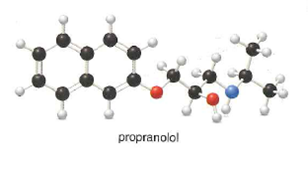
Propranolol, also known as Inderal, inhibits the actions of the neurotransmitter, norepinephrine. Norepinephrine has been shown to enhance memory consolidation.
Propranalol has a wide variety of medical uses including management of hypertension, irregular heart rhythms, tremors and migraine headaches. Psychiatrists have used it mainly in the treatment of performance anxiety but also in the treatment of specific phobias, such as fear of spiders, dental fear , and social phobia (Steenen et al. 2015). Because Propranolol inhibits norepinephrine, Propranolol has been studied as a potential treatment for PTSD (Brunet et al. 2008; Brunet at al. 2011). Therapies for PTSD necessarily involve recall, reexperiencing and reconsolidation of traumatic memories. Therapies that include a prolonged reexperiencing component often have a high drop-out rate, and the effects may decay over time (Mello et al. 2013; Bisson et al. 2013). There is therefore a need to find ways to impact the reconsolidation process so that traumatic memories are weakened or eliminated, and, hopefully, PTSD symptoms improve. Because Propranolol inhibits norepinephrine and, by extension, memory consolidation, it has recently been studied in PTSD. Several open label studies of Propranolol in PTSD demonstrated a reduction in PTSD symptoms which were maintained over time (Brunet et al. 2011; Brunet et al. 2014; Kindt & van Emmerik 2016).
This study is the first double-blind, randomized controlled clinical trial of Propranolol as an intervention for PTSD.
The Study
Design
(1)
Subjects were recruited through referral and local advertisement to participate at McGill University in in Montreal.
(2)
Adults with PTSD for at least 6 months who had a score of > 44 on the PTSD Checklist-Specific (PCL-S) were eligible. Exclusion criteria included medical issues that made administration of Propranolol unsafe or that made interpreting the results confusing including a history of psychotic disorder, bipolar disorder or traumatic brain injury; current substance dependence; acute suicidal ideation; strong dissociative symptoms or current engagement in an evidence-based therapy for PTSD.
(3)
Assessment measures included the PCL-S, the Clinician Administered PTSD Scale (CAPS) and the Mini International Neuropsychiatric Interview.
(4)
Subjects were given a combination of short acting and long acting Propranolol. Short acting Propranolol reaches a peak concentration after about one hour; long acting Propranolol achieves steady levels for 24 hours.
(5)
60 subjects were randomized into 2 groups: 30 subjects received active treatment with Propranolol and the other 30 subjects received placebo.
(6)
One hour after ingesting medication each group was asked to write and then read aloud a one-page trauma narrative "as if they were back in the event." The narrative was supposed to focus on the event's most disturbing moments and include 5 or more bodily sensations chosen from a checklist. On subsequent visits, each participant was asked if they wished to rectify or supplement the narrative, and they were asked read the narrative aloud again.
Results
(1)
Participants in the Propranolol and placebo groups did not differ on sociodemographic variables and had similar pretreatment CAPS and PCL-S scores.
(2)
At the posttreatment assessment, CAPS scores decreased in both groups but the decreases were significantly greater in the Propranolol group (p<0.034). The intention to treat and pre- to posttreatment CAPS improvements were 38% and 36% in the Propranolol group and 24% and 13% in the placebo group
.
(3)
PCL-S scores also decreased significantly in the Propranolol group (p<0.001). The intention to treat and pre- to posttreatment PCL-S improvements were 56% and 53% in the Propranolol group and 15% and 10% in the placebo group
(4)
The PCL-S time-by-group interaction decreased on average 2.43 points per week for a total significant difference of 14.58 points above placebo
.
(5)
There was a marked pre- to posttreatment effect size with 2.74 for Propranolol and 0.55 for placebo.
(6)
This was a relatively short study, but six month follow-up showed that participants in the Propranolol group continued to have lower scores than the placebo group, even without the use of Propranolol. This finding should be interpreted with caution since only about half of the participants in each group were available for this follow-up study.
Implications for Practice
Preventing the deleterious and often chronic effects of trauma is important to clinicians. This study demonstrates that PTSD subjects who recalled their traumatic event while taking Propranolol showed a decrease in symptoms, both by their own report and by that of their clinicians. This significant difference held in subjects who did not attend all the sessions or in whom protocol deviations existed. The effect sizes for Propranolol compare to the best evidence-based treatments for PTSD including CBT and SSRIs. This study needs to be replicated, but if the results hold, Propranolol used during memory reconsolidation may be useful for some patients with PTSD.
|
|
|
References
Bisson, J.I., Roberts, N.P., Andrew, M., et al. (2013). Psychological therapies for chronic post-traumatic stress disorder (PTSD) in adults. Cochrane Database of Systematic Reviews 2013, 12: CD003388.
Brunet, A., Orr, S.P., Tremblay, J., Robertson, K., Nader, K., & Pitman, R.K. (2008). Effect of post-retrieval Propranolol on psychophysiologic responding during subsequent script-driven traumatic imagery in Post-traumatic Stress Disorder.
Journal of Psychiatric Research
, 42 (6): 503-6.
Brunet, A., Poundja, J., Tremblay, J., et al. (2011). Trauma reactivation under the in
fl
uence of Propranolol decreases posttraumatic stress symptoms and disorder: 3 open-label trials. Journal of Clinical Psychopharmacology, 31: 547-550.
Brunet, A., Thomas, É., Saumier, D., et al. (2014). Trauma reactivation plus Propranolol is associated with durably low physiological responding during subsequent script-driven traumatic imagery. Canadian Journal of Psychiatry, 59: 228
-
232.
Kindt, M., & Emmerik, A. (2016). New avenues for treating emotional memory disorders: towards a reconsolidation intervention for Posttraumatic Stress Disorder. Therapeutic Advances in Psychopharmacology, 6: 283
-
295.
Mello, P.G., Silva, G.R., Donat, J.C., et al. (2013). An update on the ef
fi
cacy of cognitive-behavioral therapy, cognitive therapy, and exposure therapy for Posttraumatic Stress Disorder. International Journal of Psychiatry in Medicine, 46: 339-357.
Steenen, S. A., van Wijk, A. J., van der Heijden, G. J., van Westrhenen, R., de Lange, J., & de Jongh, A. (2015). Propranolol for the treatment of anxiety disorders: Systematic review and meta-analysis. Journal of Psychopharmacology, 30 (2): 128-139.
doi
:10.1177/0269881115612236.
Vaiva, G., Ducrocq, F., Jezekiel, K., Averland, B., Lestavel, P., Brunet, A., & Marmar, C.R. (2003). Immediate treatment with Propranolol decreases Post-traumatic Stress Disorder two months after trauma. Biological Psychiatry, 54: 947-949.
doi
:
10.1016/s0006-3223(03)00412-8
.
|
|
|
|
|
|
|
|