News & Updates from WAGLAC
April 19, 2022
|
|
The Summer WAGLAC meeting will be held in conjunction with the CWAG Annual Meeting in Sun Valley, Idaho June 13-16, 2022.
The WAGLAC roundtable will be held on June 15th.
The Fall WAGLAC meeting will be held October 17-18, 2022 at the Westin in San Diego, California.
Please mark your calendars. More details to follow.
|
|
New Mexico Adopts More Stringent Methane Regulations
New Mexico Environmental Improvement Board Press Release
April 14, 2022
“After two and half years of collaborative public and stakeholder engagement, the Environmental Improvement Board (EIB) adopted new air quality rules that will eliminate hundreds of millions of pounds of harmful emissions annually from oil and gas operations in New Mexico. The new rule will improve air quality for New Mexicans by establishing innovative and actionable regulations to curb the formation of ground-level ozone.
. . . .
The new rule will reduce harmful emissions of ozone precursor pollutants – volatile organic compounds and oxides of nitrogen – by approximately 260 million pounds annually, and will have the co-benefit of reducing methane emissions by over 851 million pounds annually. Starting this summer, compliance obligations for new and existing oil and gas operations in New Mexico counties with high ozone levels will begin to take effect. These counties are Chaves, Doña Ana, Eddy, Lea, Rio Arriba, Sandoval, San Juan, and Valencia counties.”
|
|
EPA Announces Plan to Protect Endangered Species and Support Sustainable Agriculture
U.S. Environmental Protection Agency, Region 7
11201 Renner Blvd., Lenexa, KS 66219
Iowa, Kansas, Missouri, Nebraska, and Nine Tribal Nations
LENEXA, KAN. (APRIL 12, 2022) –“ [T]he U.S. Environmental Protection Agency (EPA) released its first-ever comprehensive workplan to address the decades-old challenge of protecting endangered species from pesticides. The plan establishes four overall strategies and dozens of actions to adopt those protections while providing farmers, public health authorities, and others with access to pesticides.
‘Today’s workplan serves as the blueprint for how EPA will create an enduring path to meet its goals of protecting endangered species and providing all people with safe, affordable food and protection from pests,’ said EPA Administrator Michael S. Regan. ‘The workplan reflects EPA’s collaboration with other federal agencies and commitment to listening to stakeholders about how they can work with the Agency to solve this longstanding challenge.,
‘The workplace announced today will allow us to better protect wildlife, imperiled species, and ecosystems’ said White House Council on Environmental Quality Chair Brenda Mallory. ‘I look forward to continuing to work collaboratively across the federal government to better protect wildlife from extinction and minimize the impacts of pesticides.’”
|
|
10th Circuit upholds $23 million estimated cost for ranchers in jumping mouse habitat
AMANDA PAMPURO
COURTHOUSE NEWS SERVICE
April 15, 2022
“The 10th Circuit upheld the dismissal of a complaint filed by New Mexico ranchers claiming their economic burden was inadequately considered when the federal government designated critical habitat for the state’s endangered meadow jumping mouse.
“We conclude the Fish and Wildlife Service’s method for assessing the economic impacts of critical habitat designation complied with the Endangered Species Act,” wrote Chief U.S. Circuit Judge Timothy Tymkovich in a 40-page opinion.
‘The service adequately considered the effects of designation on the ranching association members’ water rights; and the service reasonably supported its decision not to exclude certain areas from the critical habitat designation,’ continued the George W. Bush appointee.”
|
|
Safari Club Int’l v. Haaland—Ninth Circuit upholds FWS ban on brown bear baiting in Kenai Refuge Area and closure of Skilak Wildlife Recreation Area to coyote, lynx and wolf hunts
"The Alaska Board of Game expanded permissible brown bear hunting in 2013, including approving the taking of brown bears through baiting at registered black bear stations in the Kenai Refuge. It also opened the Skilak Wildlife Recreation Area within that Refuge for seasonal coyote, lynx and wolve hunts. Disagreeing with these decisions, the United States Fish and Wildlife Service blocked the brown bear baiting in 2013 and 2014 and closed the Skilak WRA to the Board-authorized coyote, lynx and wolf hunts. The Service subsequently made its actions permanent through the “Kenai Rule.” 81 Fed. Reg. 27,045 (May 6, 2016), codified at 50 C.F.R. § 36.39(i)(5)(ii), (6). It did not prepare an environmental assessment or environmental impact statement under the National Environmental Policy Act, instead relying on a categorical exemption for actions that, absent extraordinary circumstances, “normally do not have a significant effect on the human environment.” See 40 C.F.R. § 1501.4(a)."
|
|
EPA approves the Southern Ute Indian Tribe’s Water Quality Standards
“DENVER (April 15, 2022) - The U.S. Environmental Protection Agency Region 8 (EPA) announced its approval of the Southern Ute Indian Tribe’s water quality standards under the federal Clean Water Act. This milestone approval culminates a 20-year effort by the Tribe’s Environmental Programs Division. With EPA’s action, the Southern Ute Indian Tribe becomes only the 47th federally recognized tribe, out of 574 nationally, to have tribal water quality standards approved by EPA under the Clean Water Act. The approval allows the Tribe to protect the water quality of the lakes and rivers they use for swimming, boating and fishing. The Southern Ute Indian Reservation is located in southwest Colorado and is comprised of lands within La Plata, Archuleta and Montezuma counties.”
|
|
Colorado Attorney General Phil Weiser asks Colorado Supreme Court to review a case that threatens to upend how water and access to Colorado rivers have been managed since Colorado joined the Union. The federal government has given title to its non-navigable riverbeds to streamside landowners through federal patents.
Over the last several decades, state and federal partners have worked together to increase fishing access, delineate private land boundaries, and increase public education about public access to the river. In this case, someone tried to fish on a segment of the Arkansas River that is on private property and not open to the public. After trespassing and being refused access by the property owners, he sued the landowners, claiming that a court should order that the riverbed belonged to the state and, as a member of the public, he had a right to use it.
|
|
Eighth Circuit Holds North Dakota Quiet Title Suit Time Barred
In 1871, the Dakota Territory enacted a law that accepted the Federal Government’s grant of right aways under Revised Statute 2477. The statute declared all section lines in the territory to be “public highways as far as practicable.” “When North Dakota was admitted as a state, in 1889, this provision became a state law and today is codified at § 24-07-03 of the North Dakota Century Code. The statute provides that ‘the congressional section lines are considered public roads open for public travel to the width of thirty-three feet [10.06 meters] on each side of the section lines.”
After the Forest Service issued Travel Plans and Public Notices restricting access to public lands within the Dakota Prairie Grasslands, North Dakota and several counties filed a quiet title against the Forest Service to establish title to right of ways along section lines within the Dakota Prairie Grasslands. The U.S. Eighth Circuit Court of Appeals affirmed the Federal District Court decision finding that “the Travel Plans and Public Notices issued by the Forest Service were sufficient to give plaintiffs notice, as defined by the Quiet Title Act- 28 U.S.C. Sec. 2409a - that the government had the power to restrict access to the 33 feet on either side of the section lines within the Grasslands, and, as a result, the plaintiffs knew of or should of known of the government's claims, and the plaintiffs' claims were time barred.”
|
|
The Idaho Attorney General’s Office seeks an attorney to join a team representing the Idaho Department of Environmental Quality (DEQ). The selected attorney will appear for DEQ in administrative and civil actions, draft rules, assist with permitting and contracting and provide general counsel applying state and federal statutes and regulations to protect Idaho’s outstanding environmental quality. Admission to the Idaho State Bar and at least 2 years of relevant legal and technical work experience or coursework is preferred. Strong academic qualifications are required. This description is only a summary. |
|
Join Kelley Drye attorneys for an upcoming seminar to discuss the latest developments around the use, impacts, regulation, and litigation surrounding the most impactful evolving contaminants in a generation: per- and polyfluoroalkyl substances (PFAS).
This seminar has been developed exclusively for our public clients and friends, by invitation only, both virtually and in Kelley Drye’s New York office.
This full-day program will present a series of panels featuring experts and practitioners from government, outside counsel, and a variety of technical fields that will discuss the most pertinent federal and state regulations, litigation issues, and liability developments surrounding these “forever” chemicals.
Kelley Drye is an accredited provider of NY, IL, CA, & TX CLE. This non-transitional continuing legal education program will offer NY Professional Practice credit, General IL credit, CA General credit, & TX General credit. We will apply for CLE credit in other jurisdictions, upon request, but cannot guarantee approval.
Tuesday, May 24, 2022 | 9:00 a.m. - 5:30 p.m.
Kelley Drye Offices | 3 World Trade Center | New York, NY 10007
Park Avenue North/South (Room #66119 on the 67th floor)
|
|
ENVIRONMENTAL JUSTICE & CLIMATE CHANGE WEBINAR SERIES
The United States Department Justice’s National Advocacy Center is offering a virtual conference on Environmental Justice & Climate Change. The conference will focus on important concepts and considerations when litigating and negotiating settlements in cases involving environmental justice and climate change. The programming described in the links below on May 3, 5, 10, and 17 is open to State, local, and Tribal government environmental practitioners.
|
|
All summaries are posted in CWAG's google docs account, accessible through the link below. Should you have any issues with the links, contact Patricia Salazar with any questions.
|
|
New Indian Law Case Summaries |
|
People in Interest of Jay J.L., 2022 COA 43, 2022 WL 112537 (Apr. 14, 2022): County department of human services failed to comply with the due-diligence requirement in the state ICWA-complementary statute by failing (1) to investigate why the mother believed that she might have Indian ancestry and (2) to establish whether family members whom it interviewed might have information beyond the issue of Indian heritage relevant to determining “reason to know” Indian child status.
|
|
Cully Corp. v. United States, ___ Fed. Cl. ___, 2022 WL 1115107 (Apr. 14, 2022): Alaska Native corporation is a “public bod[y]” under 41 C.F.R. § 102-75.990(c) to which a federal agency may donate government-owned real property, including improvements, when such property “has no commercial value or for which the estimated cost of continued care and handling exceeds the estimated proceeds from its sale.”
|
|
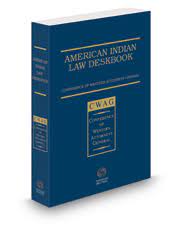
American Indian Law Deskbook |
|
Clay Smith, the American Indian Law Deskbook chief editor, summarizes Indian law decisions assigned headnotes by Westlaw to facilitate the Deskbook’s annual revision.
Editions of the Deskbook are published annually by Thomson Reuters, and the 2021 Edition was issued during the week of July 19, 2021. It is available on Westlaw in the Secondary Sources/Texts & Treatises category and in hard copy.
Please click below or reach out to Clay for questions regarding obtaining a copy of the American Indian Law Deskbook.
|
|
Western Attorneys General Litigation Action Committee
CWAG oversees and coordinates the Western Attorneys General Litigation Action Committee (WAGLAC), which consists of assistant attorneys general involved in litigation related to the environment, natural resources, public lands and Indian law. WAGLAC was formed over 40 years ago and meets three times per year to discuss the latest developments in these areas of the law. AGO staff gain important contacts throughout the country in these important areas of the law.
|
|
Contributions For WAGLAC Newsletter
We rely on our readers to send us links for the WAGLAC Newsletter. If you have or know of a recent (published in the last two weeks) case, statute or article relating to natural resources, environment, Indian law or federalism that you would like us to consider for inclusion in the Newsletter, please send it to Clive Strong. For a complete database of all previously published WAGLAC newsletters, please follow the link below.
|
|
Conference of Western Attorneys General | 1300 I Street, Sacramento, CA 95814 |
|
|
|
|
|
|