News & Updates from WAGLAC
April 26, 2022
|
|
The Summer WAGLAC meeting will be held in conjunction with the CWAG Annual Meeting in Sun Valley, Idaho June 13-16, 2022.
The WAGLAC roundtable will be held on June 15th.
The Fall WAGLAC meeting will be held October 17-18, 2022 at the Westin in San Diego, California.
Please mark your calendars. More details to follow.
|
|
CEQ RESTORES THREE PROVISIONS OF NEPA REGULATIONS
The Council on Environmental Quality (CEQ) issued a final regulation that restored the following three long-standing elements of its National Environmental Policy Act (NEPA) regulations that were removed by the Trump Administration in 2020.
-
Federal agencies will again be required to evaluate all “’direct,’ ‘indirect,’ and ‘cumulative’ impacts of a proposed action, including [] fully evaluating climate change impacts and assessing the consequences of releasing additional pollution in communities that are already overburdened by polluted air or dirty water.”
- Federal agencies are authorized “to work with communities to develop and analyze alternative approaches that could minimize environmental and public health costs.”
- CEQ’s NEPA regulations are “a floor, rather than a ceiling, for the environmental review standards that federal agencies should be meeting.”
CEQ said “the rulemaking is the first step in a two-phase approach that [it] is taking to reform and modernize the regulations that guide the implementation of the National Environmental Policy Act. Over the coming months, CEQ will be proposing a Phase 2 NEPA rulemaking that will provide further improvements to the efficiency and effectiveness of environmental review processes and reflect the Administration’s commitment to achieving environmental justice and confronting climate change.”
|
|
Chevron, other energy giants must face California climate change cases in state court
By Nate Raymond
Reuters
April 19, 2022
“A federal appeals court . . . sent lawsuits by six California cities and counties accusing ExxonMobil, Chevron Corp and other energy giants of fueling climate change back to state court after the U.S. Supreme Court required it to take another look.
The ruling by the San Francisco-based 9th U.S. Circuit Court of Appeals made it the third federal appeals court to remand a climate change lawsuit after the Supreme Court last year gave the companies an opening to try to fight them in federal court.
U.S. Circuit Judge Sandra Ikuta rejected the companies' arguments that the cases raised substantial federal issues that belonged in federal court, adding that the statute that governs removing cases from state to federal courts must be interpreted narrowly.
‘Our adherence to this doctrine does not change merely because plaintiffs raise novel and sweeping causes of action,’ she wrote for the three-judge panel.”
|
|
|
|
WHAT ARE THE DUTIES OF STATE ATTORNEY GENERALS
The linked article was written by six former Idaho Attorney Generals. In the article, they describe their collective view of the role of state attorney generals.
|
|
INDIAN AFFAIRS APPROVES HEARTH ACT REGULATIONS OF FIVE TRIBAL NATIONS IN CALIFORNIA
“Indian Affairs announced today that land leasing regulations submitted by five federally recognized Tribal Nations have been approved under the Helping Expedite and Advance Responsible Tribal Home Ownership (HEARTH) Act of 2012. The regulations were submitted by the Karuk Tribe, Morongo Band of Mission Indians, Northfork Rancheria of Mono Indians, Pala Band of Mission Indians, and Pechanga Band of Mission Indians in California.
The action restores the Tribes’ authority to govern and manage the leasing of their Indian trust and restricted fee lands for certain purposes authorized under the act without having such leases undergo additional review by the Secretary of the Interior.”
|
|
JUDGE FINDS PUBLIC TRUST DOCTRINE APPLIES TO WATERS OF OSWEGO LAKE
The Circuit Court for the County of Clackamas, Oregon issued an opinion on April 19 finding the public trust doctrine applies to the waters of Oswego Lake. Lake Oswego Corporation built a dam after Oregon statehood that enlarged Lake Oswego. Over time the lands surrounding the enlarged lake were purchased as private residents. Lake Oswego Corporation and residents asserted the lake was privately owned, and therefore, denied public access to the lake. The City of Lake Oswego passed an ordinance precluding public access. A kayaker and a swimmer sued the Corporation and the City asserting Oregon owned the bed of the lake, and under the public trust doctrine, the public has a right to access the waters of the lake.
In a fifteen-page ruling, Circuit Court Judge Ann Lininger found that the lake as it existed at statehood was navigable. Therefore, Judge Lininger held that Oregon owns the bed of the lake as it existed at the time of statehood under the equal footing doctrine subject to the public trust doctrine. While Judge Lininger held plaintiffs had not established state ownership of the lands inundated by the construction of the dam, nonetheless “Oswego Lake’s partial title-navigability, the public trust status of its waters, and the specific circumstance here create public right of access to the lake from the City’s public waterfront parks.”
Phase two of the trial will determine if the City’s resolution and related policies prohibiting public access to Oswego Lake from public parks unreasonably interfere with the people’s right of access.”
|
|
NEVADA DISTRICT COURT HOLDS STATE ENGINEER LACKS AUTHORITY TO CONJUNCTIVELY MANAGE SURFACE AND GROUNDWATER
On April 19, 2022, Clark County District Court Judge Bita Yeager vacated Nevada State Engineer’s (State Engineer) Order 1309 that merged seven independently designated hydrographic basins into the Lower White River Flow System (LWRFS) for purposes of conjunctive administration. Judge Yeager held that while “Nevada law provides certain tools for the management of water rights . . . nothing in Chapters 532, 533 or 534 gives the State Engineer express authority to conjunctively manage, in this proceeding, both the surface and groundwater flows he believes are occurring in the LWRFS superbasin.” Yeager said that “[b]y redefining and combining seven established basins for ‘joint administration,’ and ‘conjunctive management,’ the State Engineer essentially [stripped] senior right holders of their priority rights by deciding that all water rights within the LWRFS superbasin should be administered based upon their respective dates of priority in relation to other rights ‘within the regional groundwater unit.’” Yeager held “that the question of whether the State Engineer has authority to change the boundaries of basins that have been established for decades, or subject that newly created basin to conjunctive management, or not, is a legal question, not a factual one.” “The Court concludes that the State Engineer does not have authority to redefine Nevada basins to reorder the priority rights of water right holders through conjunctive management within those basins. Judge Yeager concluded that the hydrographic basins upon which Nevada groundwater rights have been based for at least 50 years are “immutable administrative units” even though they may not reflect the actual hydrologic connectivity between the water sources.
Judge Yeager also held the State Engineer violated the water rights holders due process rights by failing to disclose the criteria he would use to evaluate the hydrologic connectivity of the basins."
|
|
Join Kelley Drye attorneys for an upcoming seminar to discuss the latest developments around the use, impacts, regulation, and litigation surrounding the most impactful evolving contaminants in a generation: per- and polyfluoroalkyl substances (PFAS).
This seminar has been developed exclusively for our public clients and friends, by invitation only, both virtually and in Kelley Drye’s New York office.
This full-day program will present a series of panels featuring experts and practitioners from government, outside counsel, and a variety of technical fields that will discuss the most pertinent federal and state regulations, litigation issues, and liability developments surrounding these “forever” chemicals.
Kelley Drye is an accredited provider of NY, IL, CA, & TX CLE. This non-transitional continuing legal education program will offer NY Professional Practice credit, General IL credit, CA General credit, & TX General credit. We will apply for CLE credit in other jurisdictions, upon request, but cannot guarantee approval.
Tuesday, May 24, 2022 | 9:00 a.m. - 5:30 p.m.
Kelley Drye Offices | 3 World Trade Center | New York, NY 10007
Park Avenue North/South (Room #66119 on the 67th floor)
|
|
ENVIRONMENTAL JUSTICE & CLIMATE CHANGE WEBINAR SERIES
The United States Department Justice’s National Advocacy Center is offering a virtual conference on Environmental Justice & Climate Change. The conference will focus on important concepts and considerations when litigating and negotiating settlements in cases involving environmental justice and climate change. The programming described in the links below on May 3, 5, 10, and 17 is open to State, local, and Tribal government environmental practitioners.
|
|
All summaries are posted in CWAG's google docs account, accessible through the link below. Should you have any issues with the links, contact Patricia Salazar with any questions.
|
|
New Indian Law Case Summaries |
|
Tay v. Green, 2022 OK 37, ___ P.3d ___, 2022 WL 1150942 (Apr. 19, 2022): The Indian-lands disclaimer provision of the Oklahoma constitution does render invalid state initiative signatures collected, or elections held, within such lands.
Hooper v. City of Tulsa, ___ F. Supp. 3d ___, 2022 WL 1105674 (N.D. Okla. Apr. 13, 2022): City possessed authority under the 1898 Curtis Act to impose a criminal penalty against an Indian for speeding within the Creek (Muscogee) Reservation.
|
|
Southcentral Foundation v. Alaska Native Tribal Health Consortium, ___ F. Supp. 3d ___, 2022 WL 1194149 (D. Alaska Apr. 21, 2022): “Indian tribes,” as defined in the ISDEAA, were not parties required to be joined under Fed. R. Civ. P. 19(a) in a suit against a health consortium governed by a 15-member board of directors composed of representatives appointed by regional health entities (13 members), Indian tribes, subregional organizations other than RHEs operating health programs (2 members), given the nature of the relief requested by the plaintiff and the adequacy of representation provided by the defendant consortium.
|
|
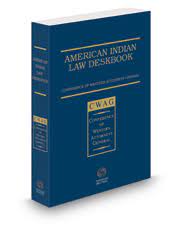
American Indian Law Deskbook |
|
Clay Smith, the American Indian Law Deskbook chief editor, summarizes Indian law decisions assigned headnotes by Westlaw to facilitate the Deskbook’s annual revision.
Editions of the Deskbook are published annually by Thomson Reuters, and the 2021 Edition was issued during the week of July 19, 2021. It is available on Westlaw in the Secondary Sources/Texts & Treatises category and in hard copy.
Please click below or reach out to Clay for questions regarding obtaining a copy of the American Indian Law Deskbook.
|
|
Western Attorneys General Litigation Action Committee
CWAG oversees and coordinates the Western Attorneys General Litigation Action Committee (WAGLAC), which consists of assistant attorneys general involved in litigation related to the environment, natural resources, public lands and Indian law. WAGLAC was formed over 40 years ago and meets three times per year to discuss the latest developments in these areas of the law. AGO staff gain important contacts throughout the country in these important areas of the law.
|
|
Contributions For WAGLAC Newsletter
We rely on our readers to send us links for the WAGLAC Newsletter. If you have or know of a recent (published in the last two weeks) case, statute or article relating to natural resources, environment, Indian law or federalism that you would like us to consider for inclusion in the Newsletter, please send it to Clive Strong. For a complete database of all previously published WAGLAC newsletters, please follow the link below.
|
|
Conference of Western Attorneys General | 1300 I Street, Sacramento, CA 95814 |
|
|
|
|
|
|