News & Updates from WAGLAC
August 23, 2022
|
|
The Fall WAGLAC meeting will be held October 17-18, 2022 at the Westin in San Diego, California. Please mark your calendars. More details to follow.
|
|
EPA Proposes Safer Communities by Chemical Accident Prevention Rule
“On August 18, 2022, EPA Administrator Michael S. Regan signed the Safer Communities by Chemical Accident Prevention (SCCAP) rule, which proposes revisions to the Risk Management Program (RMP) to further protect vulnerable communities from chemical accidents, especially those living near facilities with high accident rates. The proposed rule would strengthen the existing program and includes new safeguards that have not been addressed in prior RMP rules. Some of the proposed requirements include identifying safer technologies and chemical alternatives, more thorough incident investigations, and third-party auditing, all of which should benefit nearby communities. When finalized, the rule is expected to make communities safer by reducing the frequency of chemical releases and their adverse effects."
|
|
EPA ENVIRONMENTAL JUSTICE GUIDANCE
EPA recently issued an Interim Environmental Justice and Civil Rights in Permitting Frequently Asked Questions paper. “These Frequently Asked Questions (FAQs) provide information to federal, state, and local environmental permitting programs to help them meet their responsibilities to integrate environmental justice (EJ) and civil rights into relevant environmental permitting processes . . . This is a “living document” that EPA will update and refine as the practice of integrating EJ and civil rights into permitting advances.”
|
|
WSWC and COUNCIL OF STATE GOVERNMENTS SUBMIT COMMENTS ON ADMINISTRATION WATER QUALITY EPA/CWA §401 PROPOSED RULE
Western States Water Council Newsletter
August 12, 2022
“On August 8, 2022, the Council of State Governments-West (CSG-West) and the WSWC submitted comments in the form of a letter to Environmental Protection Agency (EPA) AdministratorRegan regarding EPA’s proposed rule to improve the Clean Water Act (CWA) Section 401 state certification process. The letter commended EPA for prioritizing the rulemaking and noted improvements that recognize the role of States regarding the content, processing, and conditioning of certifications. The letter expressed appreciation for the revisions to improve cooperative federalism but noted further room for improvement in coordination and consultation. “We strongly support early state engagement in federal permitting and licensing actions and the coordination of state and federal environmental requirements and review processes. Unfortunately, the Draft 2022 §401 Rule falls short in this regard by requiring that applicants request a pre-filing meeting 30-days before submitting a request for certification and include a draft of the federal license or permit. Although States appreciate the intent to improve early coordination through a 30-day prefiling meeting, requiring that such a meeting cannot occur until the federal agency has drafted the federal license or permit has the potential to reduce coordination between state and federal agencies. This approach puts States at the end of the federal permitting process rather than as a partner at the beginning and throughout the process. We strongly support meaningful, substantive, and early consultation with States as they work with EPA to achieve national water quality goals. We thank you for considering these comments and we look forward to working together to protect and restore water quality across our Western States.”
|
|
Supreme Court climate ruling ignites deregulatory challenges
By Ellie Borst
E&E NEWS
08/16/2022
"Less than two months after the Supreme Court issued its blockbuster ruling that reined in EPA’s authority to regulate power plant emissions, West Virginia v. EPA is already being used to shape legal battles over federal oversight on a range of issues from nuclear waste storage to LGBTQ+ rights.
. . . .
Despite Chief Justice John Roberts writing in the majority opinion that the doctrine should be reserved for ‘extraordinary cases’ only, ‘so many industry lawyers think it applies to their cases, Percival said in an email.
Even before it was decided, West Virginia was fueling a push by conservative groups to raise major questions and challenges against some of the Biden administration’s biggest climate actions.
. . . .
‘The Court has created a new hammer and now every lawyer thinks their case is a nail,’” said Robert Percival, director of the University of Maryland’s environmental law program."
|
|
CALIFORNIA ATTORNEY GENERAL LEADS COALITION OF 24 ATTORNEYS GENERAL TO PROTECT ICWA
“California Attorney General Rob Bonta today led a bipartisan coalition of 24 attorneys general in filing an amicus brief in Haaland v. Brackeen urging the U.S. Supreme Court to reject a challenge to longstanding protections guaranteed to Native American children, their families, and tribal communities under the Indian Child Welfare Act (ICWA). ICWA is a critical framework for managing state-tribal relations, protecting the rights of Native American children, and preventing the unwarranted displacement of Native American children from their families and tribal communities. In the friend-of-the-court brief in support of the federal and tribal parties defending ICWA, the coalition highlights the nation’s long history of inequitable removals of Native American children and reiterates the states’ fundamental interest in standing up for the well-being of children in state child-custody proceedings.”
|
|
FEDERAL JUDGE PERMANENTLY ENJOINS BIDEN ADMINISTRATION MORATORIUM ON NEW OIL AND GAS LEASES
Judge Terry Doughty of the Western District of Louisiana permanently blocked the Biden administration’s January 2021 moratorium on new oil and gas leasing on federal lands in Alabama, Alaska, Arkansas, Georgia, Louisiana, Mississippi, Missouri, Montana, Nebraska, Oklahoma, Texas, Utah and West Virginia. The Order does not apply in other states.
Judge Doughty held the moratorium violated the Mineral Leasing Act (MLA) and the Outer Continental Shelf Lands Act (OCSLA).
Judge Doughty wrote that “[b]oth statutes require Government Defendants’ agencies to sell oil and gas leases. The OCSLA has a Five-Year Plan in effect that requires eligible leases to be sold. Government Defendants’ agencies have no authority to make significant revisions in the OCSLA Five-Year Plan without going through the procedure mandated by Congress.”
Judge Doughty’s decision came one day after the United States Fifth Circuit Court of Appeals overturned his nationwide injunction against the moratorium.
|
|
State Attorneys General Seek to Halt Capacity Expansion of GTN Pipeline
California Attorney General Rob Bonta, Washington Attorney General Bob Ferguson, and Oregon Attorney General Ellen Rosenblum today filed a motion to intervene and request that the Federal Energy Regulatory Commission (FERC) deny the proposed capacity expansion of the Gas Transmission Northwest Express (GTN) pipeline. The Attorneys General also submitted comments criticizing FERC’s draft Environmental Impact Statement (EIS) for the capacity expansion.
|
|
CORPS WESTERN WATER COOPERATIVE COMMITTEE RECEIVES HOUSE SUPPORT
“On July 28, the Senate by a 93-1 vote returned to the House an amended version of H.R. 7776, the Water
Resources Development Act of 2022 (WRDA). It authorizes the U.S. Army Corps of Engineers (Corps) to carry out activities concerning water resources development projects, water supply, and wastewater infrastructure, flood control, navigation, or ecosystem restoration, such as shoreline restoration. In addition, it modifies the process used to deauthorize certain inactive water resource development projects. The bill also includes a number of policy and process changes and creates a number of advisory committees.
. . . .
Section 117 creates a Western Water Cooperative Committee to ensure that Corps flood control projects in Western States are operated consistent with congressional directives by identifying opportunities to avoid or minimize conflicts between the operation of Corps projects and State water rights and water laws. It may make recommendations for legislation or the promulgation of policy or regulations.”
|
|
A NEW ROUND OF COLORADO RIVER CUTS IS ANNOUNCED
Henry Fountain
NYTimes
August 16, 2022
“With water levels in the Colorado River near their lowest point ever, Arizona and Nevada on Tuesday faced new restrictions on the amount of water they can pump out of the river, the most important in the Southwest.
. . . .
The Colorado, which supplies water to 40 million people in the United States and Mexico and supports billions of dollars of agricultural production across the region, is in the throes of two decades of drought made worse by climate change. At the river’s two immense reservoirs, Lake Mead and Lake Powell, water levels are at just 28 percent of total capacity because of the river’s diminished flow and increased demand.
. . . .
Combined with the larger reductions imposed last year, the new cuts mean that Arizona will have access to 21 percent less water annually, compared to its historic allocation. Nevada’s total reductions are now about 8 percent of its allocation. Mexico’s cuts total 7 percent of its allotted supply.”
|
|
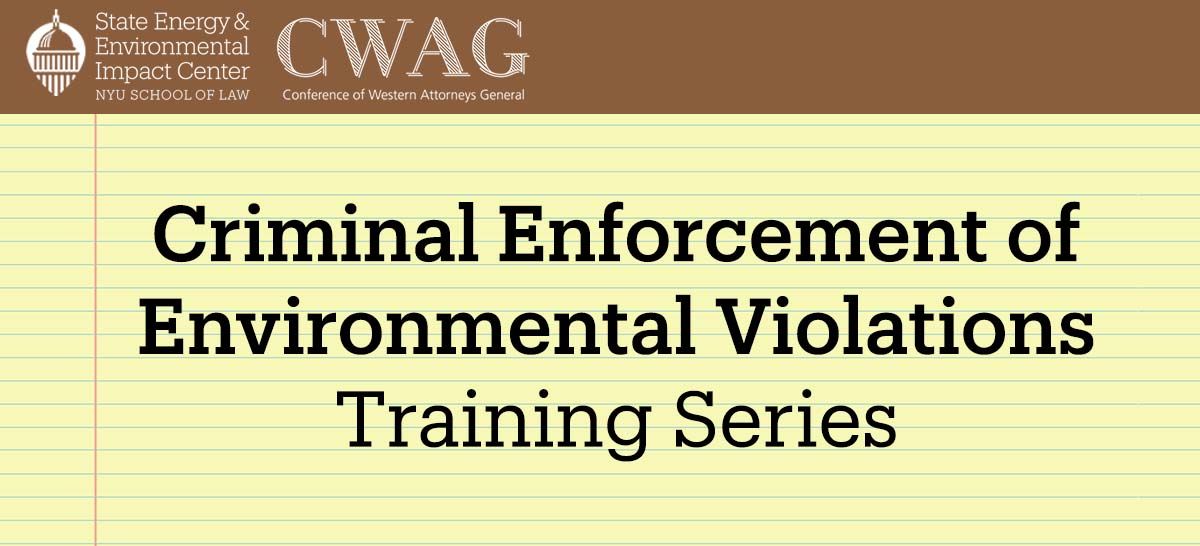
Session 3: Workplace Safety Prosecutions
Monday, September 12, 2022
Session 3 (1:00 p.m. - 2:30 p.m. ET)
Join the State Energy & Environmental Impact Center at NYU School of Law, the Conference of Western Attorneys General, and the Environment & Natural Resources Division of the Department of Justice to learn about workplace safety and abuse prosecutions. This is the fourth in a five-part training series specifically designed for state and local-level prosecutors tasked with enforcement of environmental laws. This is a training series for state and local prosecutors. When registering, please indicate your state or local jurisdiction.
Opening Remarks:
PETER F. NERONHA, Rhode Island Attorney General
• • • • •
DEBORAH HARRIS, Chief, Environmental Crimes Section USDOJ, Environment and Natural Resources Division
SAMANTHA MAGNANI, Deputy Assistant State’s Attorney, Connecticut Division of Criminal Justice, Hartford, Connecticut
NANCY A. WALKER, Chief Deputy Attorney General, Fair Labor Section Pennsylvania Office of the Attorney General
• • • • •
(Event Moderator)
TERRI GERSTEIN, Director, State and Local Enforcement Project Harvard Labor and Worklife Program Senior Fellow, Economic Policy institute
|
|
Session 4: Animal Welfare & Wildlife Trafficking Prosecutions
October 17, 2022 • 1:00 p.m. - 2:00 p.m. ET
|
|
Past Sessions
For recordings from our past sessions click the links below
|
|
All summaries are posted in CWAG's google docs account, accessible through the link below. Should you have any issues with the links, contact Patricia Salazar with any questions.
|
|
New Indian Law Case Summaries |
|
Lac Courte Oreilles Band of Lake Superior Chippewa Indians of Wisconsin v. Evers, ___ F.4th ___, 2022 WL 3355076 (7th Cir. Aug. 15, 2022): Where reservation parcels were allotted under a treaty provision to tribal members pursuant to presidential consent, not federal statute, and where the parcels were subsequently sold to non-Indians, they were not subject to state taxation upon reacquisition by tribal members.
Simmons v. State, ___ Wash. App. 2d ___, ___ P.3d ___, 2022 WL 3365394 (Div. 2 Aug. 16, 2022): Because aboriginal title had been extinguished to the area where clamming activity had occurred, a member of the Cowlitz Tribe was subject to state fishing regulation and associated criminal sanctions.
|
|
GTEC Industries, Inc. v. Guzman, ___ F. Supp. 3d ___, 2022 WL 3368599 (D.D.C. Aug. 16, 2022): Small Business Administration did not act arbitrarily or capriciously in declining to recognize an entity as a “Tribally-owned concern” for treatment as a disadvantaged business because of uncertainty over whether it was owned by a state-recognized Indian tribe.
|
|
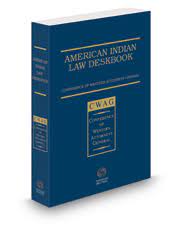
American Indian Law Deskbook |
|
Notice: 2022 Edition of the American Indian Law Deskbook now available on Westlaw and in hard-copy and electronic formats.
Editions of the Deskbook are published annually by Thomson Reuters, and the 2022 Edition was issued during the week of May 23, 2021. It is available on Westlaw in the Secondary Sources/Texts & Treatises category, in hard copy, and in electronic format.
Please click below or reach out to Clay Smith at clay.smith@cwagweb.org with questions regarding obtaining a copy of the American Indian Law Deskbook.
|
|
Western Attorneys General Litigation Action Committee
CWAG oversees and coordinates the Western Attorneys General Litigation Action Committee (WAGLAC), which consists of assistant attorneys general involved in litigation related to the environment, natural resources, public lands and Indian law. WAGLAC was formed over 40 years ago and meets three times per year to discuss the latest developments in these areas of the law. AGO staff gain important contacts throughout the country in these important areas of the law.
|
|
Contributions For WAGLAC Newsletter
We rely on our readers to send us links for the WAGLAC Newsletter. If you have or know of a recent (published in the last two weeks) case, statute or article relating to natural resources, environment, Indian law or federalism that you would like us to consider for inclusion in the Newsletter, please send it to Clive Strong. For a complete database of all previously published WAGLAC newsletters, please follow the link below.
|
|
Conference of Western Attorneys General | 1300 I Street, Sacramento, CA 95814 |
|
|
|
|
|
|