News & Updates from WAGLAC
August 9, 2022
|
|
The Fall WAGLAC meeting will be held October 17-18, 2022 at the Westin in San Diego, California. Please mark your calendars. More details to follow.
|
|
Court rules Navy failed to consider the damaging impacts of its Growler jet program
On August 2, 2022, Attorney General Bob Ferguson announced that the U.S. Federal District Court for the Western District of Washington ruled that the “U.S. Navy’s environmental review process for the Growler jet program expansion on Whidbey Island illegally failed to analyze the impacts of the noisy, often low-flying jets on classroom learning and local birds — a violation of the National Environmental Policy Act.”
“The Attorney General’s Office is challenging the Navy’s March 2019 decision to authorize a significant expansion of its Growler program, increasing flight operations on Whidbey Island to more than 110,000 per year.”
|
|
NINTH CIRCUIT HOLDS CALIFORNIA DID NOT WAIVE ITS SECTION 401 CERTIFICATION AUTHORITY
On August 4, 2022 the United States Ninth Circuit Court of Appeals issued a unanimous opinion, in California State Water Resources Control Board v. FERC, overturning the Federal Energy Regulatory Commission’s (FERC) finding that the California Water Resources Control Board (WRCB) waived its authority under section 401 of the Clean Water Act to issue water quality certifications for three hydropower projects. FERC held that the WRCB waived its certification authority by engaging in a coordinated effort with the project applicants to delay its certification decisions.
In Hoopa Valley Tribe v. FERC, the U.S. Court of Appeals for the District of Columbia held that section 401 does not allow states to avoid the one-year deadline for state certification of a project by engaging in a coordinated action with a project applicant to withdraw and resubmit a certification application before the deadline. FERC policy since the Hoopa decision distinguishes between “unilateral” withdrawals and resubmissions and “coordinated” withdrawals and resubmissions.
In all three challenged orders, FERC held that the project applicants and the WRCB had engaged in a coordinated withdrawal and resubmission of the applications, and therefore, the WRCB had waived its certification authority. The Ninth Circuit panel overturned FERC's Orders finding they were “not supported by substantial evidence in the record.” Rather, the panel found WRCB had simply acquiesced in the applicants’ own decisions to withdraw and resubmit their applications.
|
|
N.D. SUPREME COURT STRIKES KEY PORTIONS OF ‘PORE SPACE’ LAW
James MacPherson
Associated Press/Bismarck Tribune
August 4, 2002
“North Dakota’s Supreme Court on Thursday struck down key portions of a state law that a landowners group argued amounts to the unconstitutional taking of private property rights.
The so-called pore space law passed the 2019 Legislature after supporters sought clarification on the use of voids or cavities in underground rock formations. Pore spaces are used when the petroleum industry injects saltwater from oil and gas production underground for permanent storage or for enhanced oil recovery. The Northwest Landowners Association sued the state, arguing the law deprives them of their right to be compensated for the use of their pore space."
|
|
Federal Court Rejects Wyoming Montana Coal Mining Plan
The Cheyenne Post
Aug 4, 2022
U.S. Federal District Court Judge Brian Morris “struck down two U.S. Bureau of Land Management (BLM) resource management plans that failed to address the public health consequences of allowing massive amounts of coal, oil, and gas production from public lands and minerals in the Powder River Basin, including approximately 6 billion tons of low-grade, highly polluting coal over 20 years.” He “ruled that BLM failed to comply with a previous court order directing the agency to account for the environmental and human health impacts of burning publicly owned coal . . . . and that BLM failed to consider alternatives that would limit or end new coal leasing in the Powder River Basin . . . . in violation of the National Environmental Policy Act.”
|
|
Water wars in a drying California: New money vs. old power in San Joaquin Valley
By LISA M. KRIEGER
The Mercury News
August 7, 2022
“Water is the lifeblood in the parched San Joaquin Valley, sustaining endless acres of trees, seeds and pastures that feed a hungry nation.
But a controversial pipeline sits empty, as dry as dust, caught in an angry feud between two of California’s largest land barons, Silicon Valley developer and farmer John Vidovich and Pasadena-based longtime cotton king J.G. Boswell Company.
Vidovich needs the pipe to move water. The Boswell Company wants it blocked, saying it threatens the company’s own water supplies, which run through a canal over the pipeline’s underground route.
What started as a dispute about a tube of plastic under a muddy ditch is escalating into a bitter legal fight between the two multimillion-dollar businesses, pitting old power against new money and ambition.”
|
|
The Idaho Attorney General’s Office seeks an attorney to join a dynamic team advising the Idaho Department of Water Resources (IDWR) in Boise, Idaho. Attorneys representing IDWR provide advice on water rights administration and adjudications, appear before the Idaho Water Adjudication Court, argue cases before Idaho’s District Courts and the Idaho Supreme Court and assist IDWR with contracting, rulemaking and other matters.
Requirements: Admission to the Idaho State Bar and at least 2 years legal work experience is preferred. Strong writing and advocacy skills are required. Strong academic qualifications are required.
Applications: Forward cover letter, resume, unofficial law school transcript and writing sample to the following address: Idaho Attorney General’s Office, Attn: Victoria Wigle, P.O. Box 83720, Boise, ID 83720-0010.
|
|
|
|
Session 3: Workplace Safety Prosecutions
September 12, 2022 • 1:00 p.m. - 2:15 p.m. ET
Session 4: Animal Welfare & Wildlife Trafficking Prosecutions
October 17, 2022 • 1:00 p.m. - 2:00 p.m. ET
|
|
Violations of environmental standards may trigger both criminal and civil laws. What are considerations for state- and local-level prosecutors when facing a choice of enforcement route?
Join the State Energy & Environmental Impact Center at NYU School of Law, the Conference of Western Attorneys General, and the Environment & Natural Resources Division of the Department of Justice for a five-part training series specifically designed for state- and local-level prosecutors tasked with enforcement of environmental laws.
|
|
All summaries are posted in CWAG's google docs account, accessible through the link below. Should you have any issues with the links, contact Patricia Salazar with any questions.
|
|
New Indian Law Case Summaries |
|
In re G.A., ___ Cal. App. 5th ___, Cal. Rptr. 3d ___, 2022 WL 2817327 (3d Dist. Jul. 1, 2022): Juvenile court’s failure to make a finding concerning ICWA’s non-applicability was harmless where both parents denied any knowledge of Indian ancestry and no other information existed in the trial court record to suggest that such status existed.
Stimson Lumber Co. v. Coeur d’Alene Tribe, ___ F. Supp. 3d ___, 2022 WL 3027029 (D. Idaho Jul. 28, 2022): Lessee was granted a preliminary injunction against a tribe with respect to the latter’s demand that it vacate leased property.
United States v. Sanchez, ___ F.4th ___, 2022 WL 3051634 (8th Cir. Aug. 3, 2022): Although whether an offense occurred in Indian country is a question of law for the trial court to decide, reversible error did not occur where the parties submitted that question to the jury to decide and a reasonable factual basis existed for the jury’s determination that the offense did occur there.
In Matter of Dependency of A.W., ___ Wash. App. 2d ___, ___ P.3d ___, 2022 WL 2951529 (Div. 1 June 21, 2022): Superior court erred in holding that the standard for emergency removal under state law for non-“Indian child[ren]” was the same as for an emergency removal of “Indian child[ren]” under 25 U.S.C. § 1922 and the Washington Indian Child Welfare Act but did not err in holding that the “active efforts” requirement under the WICWA did not apply to such removals.
|
|
American Indian Law Deskbook |
|
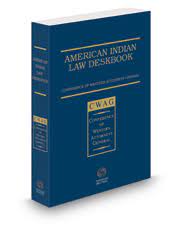
Notice: 2022 Edition of the American Indian Law Deskbook now available on Westlaw and in hard-copy and electronic formats.
Editions of the Deskbook are published annually by Thomson Reuters, and the 2022 Edition was issued during the week of May 23, 2021. It is available on Westlaw in the Secondary Sources/Texts & Treatises category, in hard copy, and in electronic format.
Please click below or reach out to Clay Smith at clay.smith@cwagweb.org with questions regarding obtaining a copy of the American Indian Law Deskbook.
|
|
Western Attorneys General Litigation Action Committee
CWAG oversees and coordinates the Western Attorneys General Litigation Action Committee (WAGLAC), which consists of assistant attorneys general involved in litigation related to the environment, natural resources, public lands and Indian law. WAGLAC was formed over 40 years ago and meets three times per year to discuss the latest developments in these areas of the law. AGO staff gain important contacts throughout the country in these important areas of the law.
|
|
Contributions For WAGLAC Newsletter
We rely on our readers to send us links for the WAGLAC Newsletter. If you have or know of a recent (published in the last two weeks) case, statute or article relating to natural resources, environment, Indian law or federalism that you would like us to consider for inclusion in the Newsletter, please send it to Clive Strong. For a complete database of all previously published WAGLAC newsletters, please follow the link below.
|
|
Conference of Western Attorneys General | 1300 I Street, Sacramento, CA 95814 |
|
|
|
|
|
|