News & Updates from WAGLAC
February 14, 2023
|
|
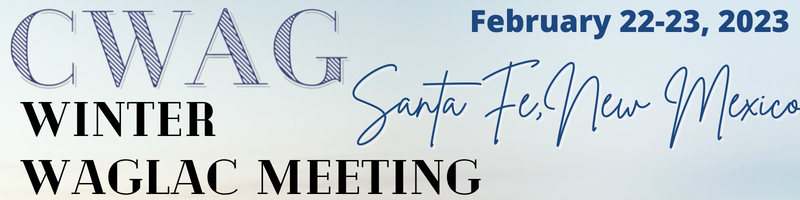
The 2023 Winter WAGLAC meeting will be held at the La Posada de Santa Fe in Santa Fe, New Mexico on February 22nd and 23rd. The legal seminar will cover Texas v. New Mexico, Gold King, and PFAS litigation.
We are excited to announce that registration is now open for this event!
*There will be a virtual option to participate. When sending your RSVP please specify if you will be attending virtually.
The Attorney General Alliance/CWAG is able to offer a travel scholarship to one staff member from each state for this event. The scholarship will cover all travel expenses for this staff member. We also welcome you to attend virtually!
The 2023 Summer WAGLAC meeting will be held in conjunction with the AGA/CWAG annual meeting on June 20th in Rancho Palos Verdes, California.
In addition to the roundtable discussion of natural resources, environmental, public lands, mining, energy, and Indian law matters there will be a half-day seminar during the Winter and Fall WAGLAC meetings.
|
|
TEXAS SEEKS PRELIMINARY INJUNCTION AGAINST WOTUS RULE
“Attorney General Paxton filed a motion for a preliminary injunction to halt the implementation and enforcement of an Environmental Protection Agency (“EPA”) and U.S. Army Corps of Engineers rule that would have severe adverse consequences for Texans and the state’s control over our own natural resources. The motion comes after Paxton filed the initial lawsuit challenging the Biden Administration rule in January.”
|
|
NEW MEXICO CHALLENGE TO SPENT STORAGE LICENSE DISMISSED
Last Friday the U.S. Tenth Circuit Court of Appeals dismissed New Mexico’s challenge to the U.S. Nuclear Regulatory Commission’s issuance of a license to Interim Storage Partners, a private entity, for the storage of spent nuclear fuel near the New Mexico border. The decision was in response to the Commission’s motion to dismiss New Mexico’s petition for lack of jurisdiction.
New Mexico asserted the Tenth Circuit had jurisdiction under the Hobbs Act, and the Atomic Energy Act. The Tenth Circuit determined that to invoke jurisdiction under these statutes New Mexico must be an “aggrieved party” in the licensing proceeding. The Tenth Circuit then held that New Mexico was not an aggrieved party because the state only commented on the draft environmental impact statement and did not seek to intervene in the licensing proceeding.
|
|
Interior Department Takes Action to Strengthen Endangered Species Act
Department of the Interior
February 8, 2023
“The Department of the Interior [] announced that the U.S. Fish and Wildlife Service is proposing a new rule to strengthen voluntary conservation opportunities under the Endangered Species Act (ESA). The proposed rule would revise permitting under Section 10 of the Act to promote species conservation through voluntary agreements and make the process clearer, easier and more efficient.
The announcement comes as the Endangered Species Act turns 50 years old in 2023. Throughout the year, the Department will celebrate the importance of the ESA in preventing the extinction of imperiled species, promoting the recovery of wildlife and conserving the habitats upon which they depend.”
|
|
AGs Lead Multistate Comment Letter Supporting the U.S. Bureau of Land Management’s Proposed Waste Prevention Rule
“California Attorney General Rob Bonta and New Mexico Attorney General Raul Torrez led a multistate coalition in submitting comments in support of the Bureau of Land Management’s (BLM) new proposed Waste Prevention Rule, which aims to reduce the waste of natural gas through improved regulatory requirements regarding methane venting, flaring, and leaks. The rule would require oil and natural gas producers to take cost-effective measures to cut the wasteful leakage of natural gas, which is primarily comprised of methane, a super pollutant up to 87 times more potent than carbon dioxide in its ability to trap heat over a 20-year timeframe, on federal and tribal lands managed by BLM.”
|
|
What does the nation’s commitment to tribal co-stewardship mean for public lands?
Anna V. Smith
High Country News
February 1, 2023
“Since the start of his administration, President Joe Biden has taken significant actions that have resonated in Indian Country: restoring Bears Ears National Monument; nominating the first Indigenous Cabinet member, Secretary of the Interior Deb Haaland (Laguna Pueblo); investing billions in tribal water-rights settlements and infrastructure. In 2021, his administration took a historic step when it committed to a policy of restoring tribal oversight of ancestral lands and of working with tribes in co-stewardship to manage public lands. Since then, a flurry of agency memos and reports have filled out more details of what these co-stewardship arrangements might look like. But what do all these statements amount to in practical terms?
Tribes across the country are seeking the return of lands that were illegally or forcibly taken by the United States. For some, co-management with federal agencies is a way to regain a measure of control of their ancestral lands and can be a first step toward the restitution and sovereignty sought by the Land Back movement. Given the declining budgets of federal agencies and tribes’ deep, place-based knowledge and growing governing capacity, co-stewardship can be a natural fit.
. . . .
Durable policy is a slow-moving ship, but the administration is making headway. In 2022, the U.S. Department of Agriculture signed 11 new co-stewardship agreements with tribal nations, and the department has said another 60 are in development.”
|
|
Comment Deadline for Comments on Trust Land Rules Approaches
CWAG continues to get inquiries regarding state plans to comment on the BIA’s proposed rules seeking to make it easier to place land into trust for tribes. Among many proposed changes, the rules would require decisions on tribal applications within 120 days of submission, add an expansive list of policy reasons that would support proposed acquisitions, establish several presumptions in favor of acquisitions, and abandon the current requirement that greater scrutiny be applied to the tribe’s justification of anticipated benefits as the distance from a tribe’s reservation increases. Comments must be submitted on or before March 1, 2023. The proposed rules, and comments submitted to date, can be viewed at the link on the button below.
|
|
DEPARTMENT OF INTERIOR INSPECTOR GENERAL TO CONDUCT REVIEW OF WESTERN WATER PROJECTS
The Interior Department Inspector General plans to audit the Klamath Project and the Central Valley Project this year. The audit of the Klamath Project will focus on the “millions paid to irrigators through the Klamath Project in an effort to reduce irrigation demands.” The audit of the California Project will focus on “potential lost revenue from uncollected fees for water delivered under the USBR service contracts.”
|
|
FEDERAL COURT FINDS ESA TRUMPS STATE WATER LAW
On February 6th, the U.S. District Court for the Northern District of California issued an order on several summary judgment motions that determined the Endangered Species Act (ESA) preempted state water law in the Bureau of Reclamation’s (Bureau) operation of the Klamath Project. The order is yet the latest decision regarding the long-standing conflict between the Yurok Tribe and Klamath Basin irrigators over the use of water for ESA-listed species versus irrigation.
In 2021, the Oregon Department of Water Resources (OWRD) issued an Order prohibiting the Bureau from releasing water stored under its state law storage rights from the Upper Klamath Lake “in excess of amounts that may be put to beneficial use” pursuant to state-based water rights. The court held the OWRD Order is preempted because it “conflicts with the ESA, at least because it poses an obstacle to the accomplishment and execution of Congress's purpose and objective in enacting the ESA: protecting and restoring endangered species. If the Bureau complies with the Order, it cannot release downstream flows, jeopardizing the coho salmon and Southern Resident Killer Whale and violating either section 7(a)(2) or section (9) of the ESA. If the Bureau carries out its obligations under the ESA, then it violates the Order.”
|
|
The Annual CWAG Indian Law webinar
on the West LegalEdcenter
Wednesday, February 22, 2023
11:00am - 12:30pm CST.
Annual CWAG Indian Law Webinar on West LegalEdcenter
Program Title: McGirt v. Castro-Huerta: Indian Law and Originalism
Program Description: The program will address the opinions in McGirt v. Oklahoma, 140 S. Ct. 2452 (2020) and Oklahoma v. Castro-Huerta, 142 S. Ct. 2486 (2022). The majority and dissenting positions in Castro-Huerta capture the difference that exists between those who advocate what they perceive as the clear-cut territorial sovereignty reflected in the Marshall Trilogy (i.e., the dissenters) and those (i.e., the majority) who see the Indian tribes as a unique, but non-constitutionally-grounded, set of sovereigns whose territorial authority has been reduced over time by Congress and federal common law to individuals with an ancestrally-based political connection (with certain congressional exceptions to the contrary as reflected in United States v. Lara, 541 U.S. 193 (2004) and Violence Against Women Act Reauthorization Act amendments). The former likely see much federal common law limiting inherent tribal authority as incompatible with the Trilogy; the latter see the Trilogy as a doctrinal starting but not ending point.
Mithun Mansinghani (Speaker)
Partner | Lehostsky Kellter | Former Solicitor General | State of Oklahoma
Jennifer Weddle (Speaker)
Partner |Greenberg Trauing, LLP
Delilah Tenorio (Moderator)
Senior Assistant Attorney General and Missing and Indigenous Persons Liaison | New Mexico Attorney General's Office
Date and Time for Live Broadcast:
February 22, 2023, 11:00 am CST to 12:30 pm CST.
The program will also be available for replay as part of the
West LegalEdcenter library.
|
|
All summaries are posted in CWAG's google docs account, accessible through the link below. Should you have any issues with the links, contact Patricia Salazar at psalazar@agalliance.org with any questions.
|
|
Littlefield v U.S. Dept. of the Interior, ___ F. Supp. 3d ___, 2023 WL 1878470 (D. Mass., Feb. 10, 2023): The Secretary of the Interior properly applied the Interior Solicitor’s Opinion M-37029 in deciding that the Mashpee Wampanoag Tribe was under federal jurisdiction in 1934 and thus qualified to have its fee lands taken into trust pursuant to 25 U.S.C.A. §§ 5108 & 5129.
U.S. v. Keys, ___ F. Supp. 3d ___, 2023 WL 1860989 (E.D. Okla. 2023): In child abuse case with Indian victim brought under 18 U.S.C.A. § 1152, the Government was not entitled to reconsideration of the court’s grant of a motion for a judgment of acquittal due to the Government’s failure to demonstrate, during its case in chief, that the defendant was a non-Indian; defendant’s admission of non-Indian status during cross-examination could not be considered part of Government’s case-in-chief.
Duwamish Tribe v. Haaland, ___ F. Supp. 3d ___, 2023 WL 1864243 (W.D. Wash., Feb. 9, 2023): In a challenge to the Department of Interior’s decision declining to recognize the Duwamish Tribe, the Department's decision was remanded withinstructions to include in the administrative record
documents relating to its contemporaneous decisions
(cont'd)
|
|
on 15 similar petitions for recognition.
Running Bird v. Mertens-Jones, ___F. Supp. 3d ___, 2023 WL 1785572 (D. S.D. Feb. 2, 2023): Court denied claims of imprisoned member of Native American Church for monetary damages under the Religious Land Use and Institutionalized Persons Act. (RLUIPA) and 42 U.S.C. § 1983, after being allowed to hold family pow rows in small visitor room, but not in larger gym or recreation yard; court allowed certain claims for injunctive relief under RLUIPA, equal protection clause, and free exercise clause, to proceed.
Hoopa Valley Tribe v. U.S. Bureau of Reclamation, ___ F. Supp. 3d ___, 2023 WL 1824236 (E.D. Calif., Feb. 8, 2023): Hoopa Valley Tribe, having previously exercised its statutory right to concur to fishery flow regime in the Trinity River that allowed fine-tuning of daily release schedules by management council of which Tribe was member, was not entitled to veto of changes in daily flows, and was not entitled to preliminary injunction when such changes were made over its objection.
Custard v. Farris, ___ F. Supp. 3d ___, 2023 WL 1530742 (W.D. Okla., Feb. 3, 2023): The fact that habeas petitioner convicted of major crime in state court
|
|
could not have understood the legal significance of his tribal status until the Supreme Court’s decision in McGirt v. Oklahoma, 140 S. Ct. 2452 (2020), did not avoid the one-year filing limitation in the Antiterrorism and Effective Death Penalty Act (AEDPA).
U.S. v. Harper, ___ F. Supp. 3d ___, 2023 WL 1765537 (N.D. Okla., Feb. 3, 2023): On motion for reconsideration, the court affirmed that the Tulsa Police Department acted in good faith in pursuing, obtaining, and executing an arrest warrant for Defendant when faced with conflicting evidence as to whether Defendant may be Indian for the purposes of federal criminal jurisdiction.
Bartell Ranch v. McCullough, ___ F. Supp. 3d ___, 2023 WL 1782343 (D. Nev., Feb. 6, 2023): The Bureau of Land Management, in issuing ROD approving proposed lithium mine on public lands, was not required to initiate National Historic Preservation Act consultations with Tribes that had previously indicated that they did not wish to be consulted on projects being considered in area of the proposed mine, and BLM’s National Environmental Policy Act analysis adequately addressed the project's impacts on cultural and historical resources.
|
|
American Indian Law Deskbook |
|
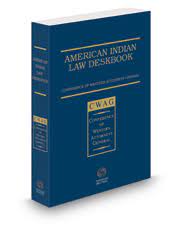
Notice: 2022 Edition of the American Indian Law Deskbook is now available on Westlaw and in hard-copy and electronic formats.
Editions of the Deskbook are published annually by Thomson Reuters, and the 2022 Edition was issued during the week of May 23, 2021. It is available on Westlaw in the Secondary Sources/Texts & Treatises category, in hard copy, and in electronic format.
Please click the link below to order or reach out to Steven Strack at sstrack@agalliance.org with questions regarding obtaining a copy of the American Indian Law Deskbook.
|
|
Western Attorneys General Litigation Action Committee |
|
CWAG oversees and coordinates the Western Attorneys General Litigation Action Committee (WAGLAC), which consists of assistant attorneys general involved in litigation related to the environment, natural resources, public lands, and Indian law. WAGLAC was formed over 40 years ago and meets three times per year to discuss the latest developments in these areas of the law. AGO staff gain essential contacts throughout the country in these important areas of the law.
|
|
Contributions For WAGLAC Newsletter |
|
We rely on our readers to send us links for the WAGLAC Newsletter. If you have or know of a recent (published in the last two weeks) case, statute, or article relating to natural resources, environment, Indian law, or federalism that you would like us to consider for inclusion in the Newsletter, please do not hesitate to send it to Clive Strong at clive.strong@cwagweb.org.
|
|
For a complete database of all previously published WAGLAC newsletters, please click the Archive Button. |
|
|
Conference of Western Attorneys General
5050 Laguna Blvd | Suite 112-323 | Elk Grove, California 95758
|
|
|
|
|
|
|