News & Updates from WAGLAC
January 17, 2023
|
|
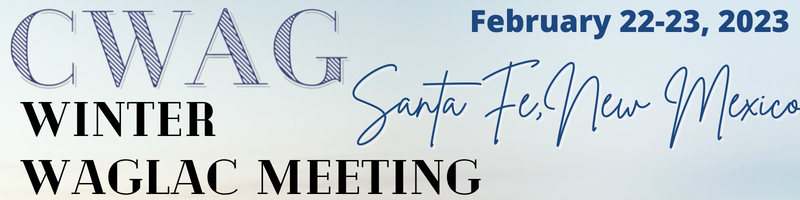
The 2023 Winter WAGLAC meeting will be held at the La Posada de Santa Fe in Santa Fe, New Mexico on February 22nd and 23rd. The legal seminar will cover Texas v. New Mexico, Gold King and PFAS litigation.
We are excited to announce that the registration is now open for this event!
The Attorney General Alliance/CWAG is able to offer a travel scholarship to one staff member from each state for this event. The scholarship will cover all travel expenses for this staff member.
The 2023 Summer WAGLAC meeting will be held in conjunction with the AGA/CWAG annual meeting on June 20th in Rancho Palos Verdes, California.
In addition to the roundtable discussion of natural resources, environmental, public lands, mining, energy, and Indian law matters there will be a half-day seminar during the Winter and Fall WAGLAC meetings.
|
|
FERC PROPOSED TRANSMISSION LINE SITING TO INCLUDE TRIBAL RESOURCES REPORT
January 17, 2023, issue of the Federal Register will contain a notice of proposed rulemaking by the Federal Energy Regulatory Commission (ferc) regarding siting of electric transmission lines. Where FERC has permitting jurisdiction for transmission lines, it proposes to require applicants to submit a Tribal Resources Resource Report "in furtherance of [FERC's] trust responsibility," and an Environmental Justice Resource Report. "Environmental justice communities" may include "indigenous peoples. 88 Fed. Reg. 2770.
|
|
New DoD specs for firefighting foam, now free of ‘forever chemicals’
By Meghann Myers
Military Times
January 13, 2023
“The Defense Department is officially requiring any new firefighting foam it buys to be made without per- and polyfluoroalkyl substances, also known as PFAS, toxic chemicals associated with a host of health issues and known to have contaminated the groundwater of dozens of military bases.
The Pentagon published a new military specification on Jan. 6 — part of the 2023 National Defense Authorization Act — which also required the department to stop buying PFAS-containing aqueous film-forming foam by October, with another year to eliminate its use entirely.”
|
|
Biden admin revisits sage grouse regs, teeing up fresh battles
By Scott Streater
Greenwire
01/11/2023
“The Bureau of Land Management is hoping the third time’s the charm on a federal blueprint designed to save the greater sage grouse and its dwindling sagebrush habitat.
The bird famous for its elaborate spring mating ritual is struggling across much of its range, despite decades of different efforts by federal and state regulators to help the species increasingly threatened by drought and wildfires (Greenwire, May 9, 2022).
BLM is working to complete a revised management plan for the nearly 70 million acres of habitat the agency oversees across the West, first adopted in 2015 under the Obama administration and amended in 2019 by the Interior Department under former President Donald Trump.
The bureau, which has reviewed more than 300 peer-reviewed studies that have been published since 2015, is considering major changes, including possibly redesignating some core sage grouse territory into ‘areas of critical environmental concern,’ which would add new restrictions on everything from energy development to recreational activities across potentially hundreds of thousands of acres.”
|
|
DOES THE BANKRUPTCY CODE ABROGATE TRIBAL IMMUNITY?
In Coughlin v. Lac du Flambeau Band of Lake Superior Chippewa Indians (In re Coughlin), 33 F.4th 600 (1st Cir. 2022), a divided panel held that the Bankruptcy Code § 106(a) abrogates tribal immunity from suit. The decision was in an appeal from In re Coughlin, 622 B.R. 491 (Bankr. D. Mass. 2020), which dismissed on sovereign immunity grounds a Chapter 13 debtor’s motion seeking a determination that four related tribal entities violated a Bankruptcy Code automatic stay by continuing to seek payment of payday loans. The bankruptcy court recognized that a circuit split existed over whether the otherwise broad abrogation of “governmental unit” immunity from suit in 11 U.S.C.A. § 106(a) and chose to follow Buchwald Capital Advisors, LLC. v. Sault Ste. Marie Tribe of Chippewa Indians (In re Greektown Holdings, LLC), 917 F.3d 451 (6th Cir. 2019), which concluded tribes did not constitute such a unit as defined in 11 U.S.C.A. § 101(27). That definition includes “United States; State; Commonwealth; District; Territory; municipality; foreign state; department, agency, or instrumentality of the United States (but not a United States trustee while serving as a trustee in a case under this title), a State, a Commonwealth, a District, a Territory, a municipality, or a foreign state; or other foreign or domestic government.” The majority likewise “focus[ed] on whether Congress intended to abrogate tribal sovereign immunity when it used the phrase ‘governmental unit.’” It found no disagreement between the parties “that a tribe is a government” and further “that tribes are domestic, rather than foreign, because they ‘belong[] or occur[] within the sphere of authority or control or the ... boundaries of’ the United States.” Given these predicates, “a tribe is a domestic government and therefore a government unit.” The majority later took issue with the dissent’s construction of “the phrase ‘domestic governments’ to mean only those governments that trace their origins to the Constitution[,]” reasoning that “[i]n injecting the constitutional character of an entity into ordinary statutory interpretation the dissent proposes a radical new rule of construction—one never previously adopted by any court, never briefed by the parties, and certainly never within Congress’ contemplation.”
The dissent also keyed off the “governmental unit” definition, stressing that “[a]s is evident from [§ 101(27)], Congress did not mention Indian tribes in this definition” despite the fact that “Congress ... did name many governmental types, including some that, like Indian tribes, enjoy an immunity from suit that Congress may abrogate only clearly and unequivocally.” It added that “[i]t is ... at least somewhat puzzling—if Congress did intend for § 101(27) to include Indian tribes—that the legislative history to the Code does not suggest that it is making any shift in their treatment. In fact, that legislative history makes no relevant mention of Indian tribes at all.”
|
|
|
|
LIST OF FEDERALLY-RECOGNIZED TRIBES
The BIA’s annual list of federally recognized tribes is published in today’s Federal Register, 88 Fed. Reg. 2112.
|
|
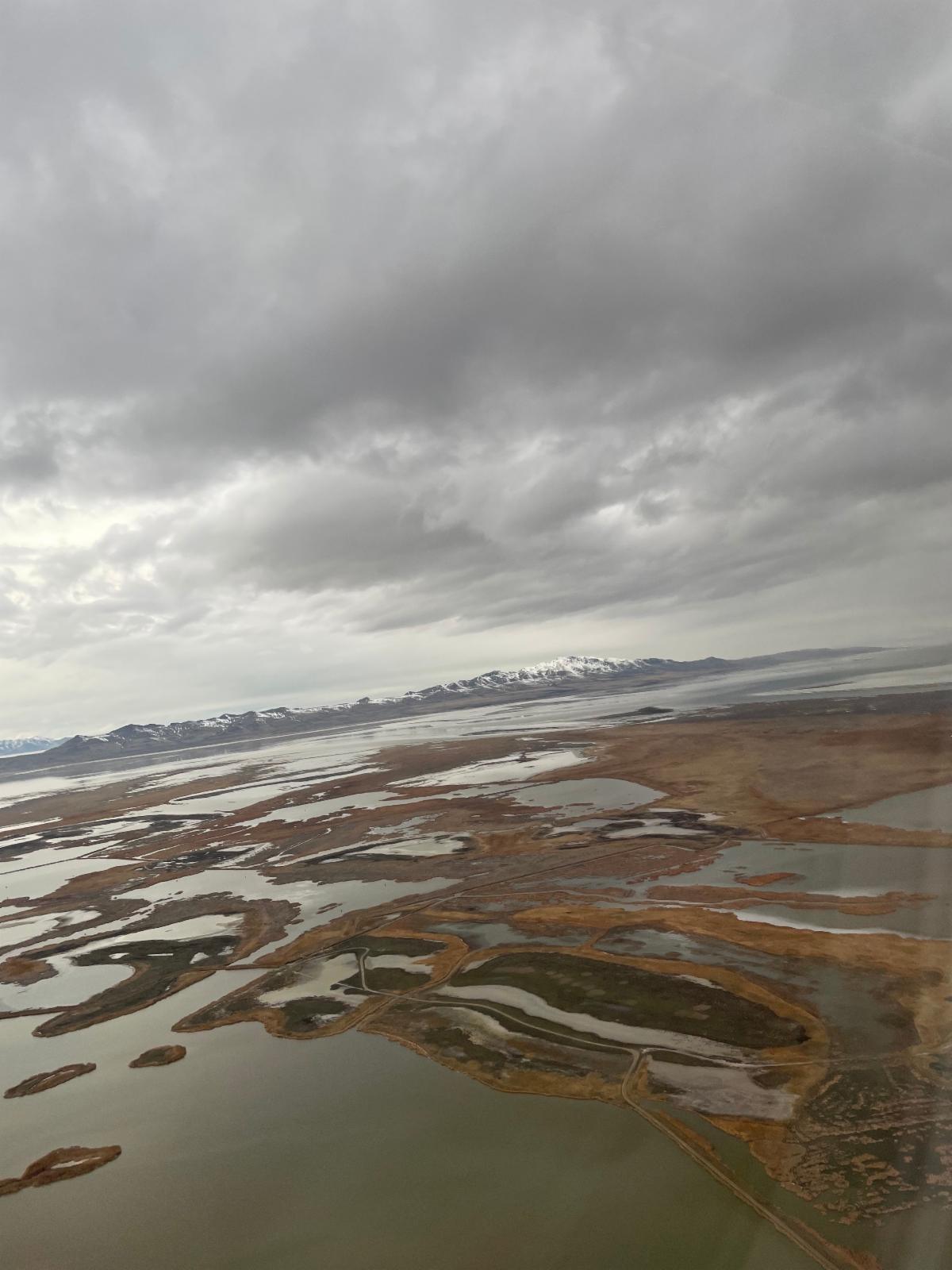
Great Salt Lake on track to disappear in five years, scientists warn
By Sarah Kaplan and Brady Dennis
WAPO
January 6, 2023
"Without dramatic cuts to water consumption, Utah’s Great Salt Lake is on track to disappear within five years, a dire new report warns, imperiling ecosystems and exposing millions of people to toxic dust from the drying lake bed.
The report, led by researchers at Brigham Young University and published this week, found that unsustainable water use has shrunk the lake to just 37 percent of its former volume. The West’s ongoing megadrought — a crisis made worse by climate change — has accelerated its decline to rates far faster than scientists had predicted.
But current conservation measures are critically insufficient to replace the roughly 40 billion gallons of water the lake has lost annually since 2020, the scientists said.
The report calls on Utah and nearby states to curb water consumption by a third to a half, allowing 2.5 million acre-feet of water to flow from streams and rivers directly into the lake for the next couple of years. Otherwise, it said, the Great Salt Lake is headed for irreversible collapse."
|
|
All summaries are posted in CWAG's google docs account, accessible through the link below. Should you have any issues with the links, contact Patricia Salazar at psalazar@agalliance.org with any questions.
|
|
In re Matter of L.R.J., 2023 MT 1, __ P.3d ___ (Jan. 3, 2023): Court-approved stipulation granting custody of two Indian children to their paternal grandparents, subject to modification only upon court, order constituted a foster care proceeding under ICWA, but return of the children to her custody was not automatic but instead subject to “the substantial and immediate danger or threat of such danger” exception in 25 U.S.C. § 1920.
Cayuga Nation v. Parker, ___ F. Supp. 3d ___, 2023 WL 130852 (N.D.N.Y. Jan. 9, 2023): Tribal immunity from suit barred counterclaims seeking monetary relief except for a claim that sounded in recoupment; state-law counterclaims for conversion and trespass to chattels were adequately pled for Fed. R. Civ. P. 12(b)(6) purposes to the extent that they sought otherwise permissible recoupment; and a tribal officer possessed immunity from suit for monetary relief where the allegations of a third-party complaint did not allow a plausible inference that he acted in his individual capacity with respect to the allegedly tortious conduct.
|
|
Treaty with the Chippewas subject to Indian Civil Rights Act constraints and, if having Special Law Enforcement Commissions, possess under a deputization agreement between the Band and the Bureau of Indian Affairs delegated federal authority to investigate violations of federal law within the reservation and to exercise all other powers identified in the Agreement subject to federal constitutional constraints.
Navajo Nation v. U.S. Department of Interior, ___ F. Supp. 3d ___, 2023 WL 142905 (D. Ariz. Jan. 10, 2023): Amended complaint filed by the Navajo Nation and a tribal enterprise stated claims for relief for violation of procedural due process based upon the failure of a Bureau of Indian Affairs regional director to give written notice of his action approving the Hopi Tribe’s application to take into trust land over which the Nation possessed a right-of-way easement.
Navajo Nation v. U.S. Department of Interior, ___ F.4th ___, 2023 WL 175402 (D.C. Cir. Jan. 13, 2023): 25 C.F.R. § 900.33, which forecloses review of a renewal ISDEAA contract for declination purposes “where no material and substantial change to the scope or funding of a program, functions, services, or activities has been proposed by the Indian tribe[,]” incorporates the tribe’s proposed annual funding agreement at least with respect to the first AFA in the renewal contract’s term.
|
|
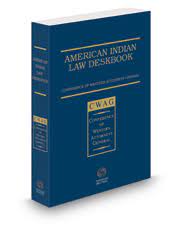
American Indian Law Deskbook |
|
Notice: 2022 Edition of the American Indian Law Deskbook is now available on Westlaw and in hard-copy and electronic formats.
Editions of the Deskbook are published annually by Thomson Reuters, and the 2022 Edition was issued during the week of May 23, 2021. It is available on Westlaw in the Secondary Sources/Texts & Treatises category, in hard copy, and in electronic format.
Please click the link below to order or reach out to Clay Smith at clay.smith@cwagweb.org with questions regarding obtaining a copy of the American Indian Law Deskbook.
|
|
Western Attorneys General Litigation Action Committee |
|
CWAG oversees and coordinates the Western Attorneys General Litigation Action Committee (WAGLAC), which consists of assistant attorneys general involved in litigation related to the environment, natural resources, public lands, and Indian law. WAGLAC was formed over 40 years ago and meets three times per year to discuss the latest developments in these areas of the law. AGO staff gain essential contacts throughout the country in these important areas of the law.
|
|
Contributions For WAGLAC Newsletter |
|
We rely on our readers to send us links for the WAGLAC Newsletter. If you have or know of a recent (published in the last two weeks) case, statute, or article relating to natural resources, environment, Indian law, or federalism that you would like us to consider for inclusion in the Newsletter, please do not hesitate to send it to Clive Strong at clive.strong@cwagweb.org.
|
|
For a complete database of all previously published WAGLAC newsletters, please click the Archive Button. |
|
|
Conference of Western Attorneys General
5050 Laguna Blvd | Suite 112-323 | Elk Grove, California 95758
|
|
|
|
|
|
|