News & Updates from WAGLAC
July 19, 2022
|
|
The Fall WAGLAC meeting will be held October 17-18, 2022 at the Westin in San Diego, California. Please mark your calendars. More details to follow.
|
|
Congress faces climate roadblock after Supreme Court ruling
By Lesley Clark, Niina H. Farah
E&E News
07/15/2022
“The Supreme Court’s landmark climate decision is expected to reverberate far beyond the walls of EPA — and possibly all the way up to Capitol Hill.
A number of legal observers say the justices’ 6-3 ruling last month in West Virginia v. EPA — which provides a first look at how the court’s new conservative supermajority will handle climate cases — clips agency authority and, perhaps more significantly, constrains how lawmakers can address planet-warming emissions.
“The most dangerous aspect of the court’s decision is the court’s seizure of power from Congress, not from the agency,’ Georgetown University law professor Lisa Heinzerling said at a recent Georgetown Climate Center event. “Under the opinion, Congress may no longer enlist an agency’s help in addressing major issues — as it has done throughout U.S. history — unless it speaks clearly enough for a hostile Supreme Court to hear it.”
|
|
Thirteen Attorneys General Submit Comments in Support of EPA’s Proposed Asbestos Regulation
The Attorneys General of Massachusetts, California, Connecticut, Hawaii, Illinois, Maine, Maryland, Minnesota, New Jersey, New York, Oregon, Rhode Island, and the District of Columbia, submitted comments supporting EPA’s “proposed rule setting certain restrictions on the manufacture (including import), processing, distribution in commerce, and commercial use and disposal of chrysotile asbestos to prevent unreasonable risk of injury to health in accordance with Toxic Substances Control Act (TSCA)1 section 6(a), 15 U.S.C. 2605(a).” California Attorney General Rob Bonta and Massachusetts Attorney General Maura Healey said asbestos is “a carcinogen that kills more than 12,000 people in the U.S. per year” and “is linked to diseases that are life-threatening, or cause substantial pain and suffering, including mesothelioma, fibrosis, lung cancer, gastrointestinal cancer, as well as other lung disorders and diseases. There is no safe level of exposure to this highly toxic material.”
|
|
STATES DIVIDED ON DOJ SEP GUIDELINES
On May 5, 2022, U.S. Attorney General Merrick Garland rescinded prior Attorney General William Barr’s 2017 Memorandum, which prohibited use of supplemental environmental projects that involved payments to non-governmental third parties. DOJ’s May 5 Memorandum outlined new guidelines and limitations on for supplemental environmental projects (SEPs) and directed publication of an Interim Final Rule for SEPS.
State comments on the proposed SEP rule are split. The Environmental Council of the States (ECOS) supports the use of SEPs in state and federal settlements. ECOS states that “SEPs advance the public interest by providing additional environmental and public health benefits for communities adversely impacted by environmental violations.” ECOS notes that 37 states have adopted SEPs Policies.
The State Attorneys General for Oklahoma, Arizona, Arkansas, Georgia, Indiana, Kentucky, Louisiana, Missouri, Montana, South Carolina, Texas, and Utah submitted comments in opposition to the SEP rule. They argue that the proposed rule change and related memorandum “will result in the Department of Justice (DOJ) improperly funneling public funds to third-party political allies without congressional authorization, in violation of the separation of powers inherent in the Constitution and in violation of the Miscellaneous Receipts Act.”
The U.S. Chamber of Commerce also submitted comments in opposition to the proposed rule. The Chamber stated that the abandonment of current policy prohibiting third-party SEPs “would allow the DOJ and other federal agencies to revive an unjust approach to settling disputes in which agencies usurp Congress’s spending power and effectively force defendants to fund Administration-favored advocacy groups that are not involved in the
Litigation.”
|
|
Federal report says dams may need to be removed to aid salmon
BY NICHOLAS K. GERANIOS
ASSOCIATED PRESS
JULY 12, 2022
The Biden administration released two reports last week “arguing that removing dams on the lower Snake River may be needed to restore salmon runs to historic levels and that replacing the energy created by the dams is possible but will cost $11 to $19 billion. The reports were released by the White House Council on Environmental Quality.”
The “draft report by scientists at the National Oceanic and Atmospheric Administration found changes are needed to restore salmon, ranging from removal of one to four dams on the lower Snake River to reintroduction of salmon to areas entirely blocked by dams. A second report studied how power supplies could be replaced if dams are breached.”
|
|
Ninth Circuit Upholds FWS’s EIS and Conservation Plan for Klamath National Wildlife Refuges
The Klamath Basin National Wildlife Refuge Complex covers approximately 200,000 acres above and below the California-Oregon border. The Complex includes six refuge areas, five of which were subject to an environmental impact statement and a comprehensive conservation plan issued by the Fish and Wildlife Service and adopted in a 2017 record of decision. Three federal statutes—the National Environmental Policy Act, the 1964 Kuchel Act (16 U.S.C. §§ 695k to 695r), and the National Wildlife Refuge System Administration Act of 1966, as amended (16 U.S.C. § 668dd to 668ee)—principally governed the EIS’s and CCP’s validity. The Kuchel Act provides in part that lands lying within the Tule Lake National Wildlife Refuge, the Lower Klamath National Wildlife Refuge, the Upper Klamath National Wildlife Refuge, and the Clear Lake Wildlife Refuge are “dedicated to wildlife conservation” and “shall be administered by the Secretary of the Interior for the major purpose of waterfowl management, but with full consideration to optimum agricultural use that is consistent therewith.” Id. § 695l. The Refuge Act directs the Interior Secretary, inter alia, “to ‘ensure that ... the purposes of each refuge are carried out” but authorizes her to “permit the use of any [refuge] ... for any purpose ... whenever [s]he determines that such uses are compatible with the major purposes for which such areas were established.” Id. § 668dd(a)(4)(D), (d)(1)(A). A magistrate judge rejected challenges to portions of the EIS and CCP concerning the Lower Klamath Refuge, the Tule Lake Refuge, and the Clear Lake Refuge brought by environmental groups and agricultural interests. in a report and recommendation that the district court adopted without modification. Audubon Soc’y of Portland v. Zinke, Nos. 1:17-cv-00069-CL et al., 2019 WL 8371180 (D. Or. Nov. 18, 2019), adopted, 2020 WL 1693677 (Apr. 6, 2021).
The Ninth Circuit affirmed in three separate opinions. Audubon Soc’y of Portland v. Haaland, No. 20-33508, 2022 WL 2794306 (9th Cir. Jul. 18, 2022) (Aububon I); Audubon Soc’y of Portland v. Haaland, Nos. 20-35509 & 20-35513, 2022 WL 2799170 (9th Cir. Jul. 18, 2022) (Aububon II); and Tulelake Irr. Dist. V. U.S. Fish & Wildlife Serv., No. 20-35515, 2022 WL 2800729 (9th Cir. Jul. 18, 2022). The Aububon decisions deferred to FWS’s balancing of competing environmental and agricultural concerns and addressed one substantive issue of statutory interpretation, while the Tulelake decision was devoted entirely to the proper construction of the Kuchel and Refuge Acts.
|
|
Texas Attorney General Ken Paxton led an 18-state coalition amicus brief in support of Utah’s challenge in the Denver-based U.S. Court of Appeals for the Tenth Circuit, opposing a court order requiring Utah Attorney General Sean Reyes to sit for an hours-long oral deposition about an employment dispute. The legal issue implicates significant separation-of-powers and federalism concerns.
|
|
|
|
Session 3: Workplace Safety Prosecutions
September 12, 2022 • 1:00 p.m. - 2:15 p.m. ET
Session 4: Animal Welfare & Wildlife Trafficking Prosecutions
October 17, 2022 • 1:00 p.m. - 2:00 p.m. ET
|
|
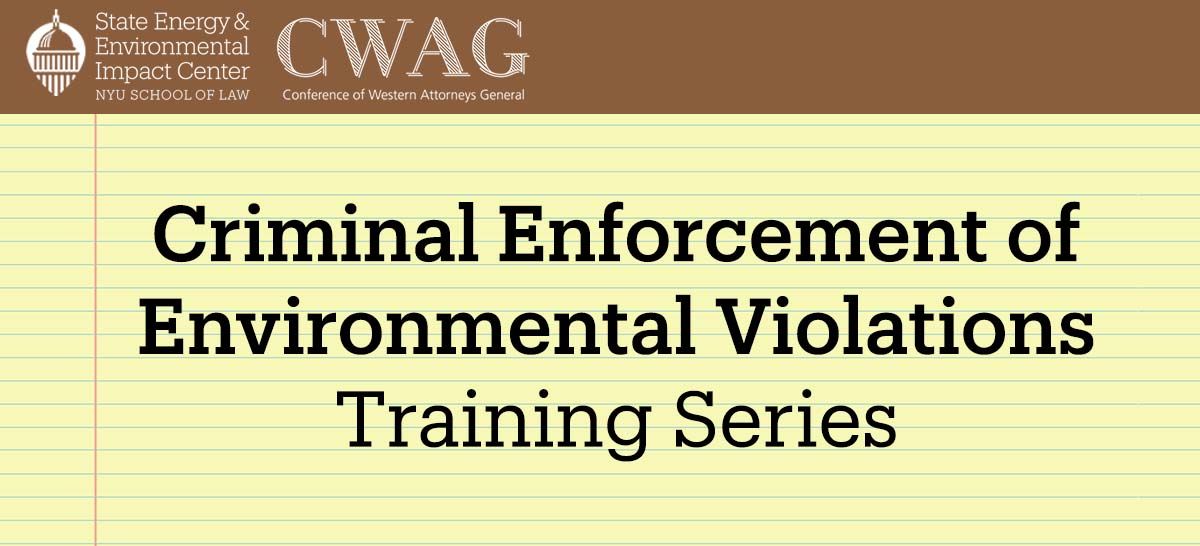
Violations of environmental standards may trigger both criminal and civil laws. What are considerations for state- and local-level prosecutors when facing a choice of enforcement route?
Join the State Energy & Environmental Impact Center at NYU School of Law, the Conference of Western Attorneys General, and the Environment & Natural Resources Division of the Department of Justice for a five-part training series specifically designed for state- and local-level prosecutors tasked with enforcement of environmental laws.
|
|
All summaries are posted in CWAG's google docs account, accessible through the link below. Should you have any issues with the links, contact Patricia Salazar with any questions.
|
|
New Indian Law Case Summaries |
|
Flandreau Santee Sioux Tribe v. United States, 565 F. Supp. 3d 1154 (D.S.D. 2021), motions for recons. & to amend denied, ___ F. Supp. 3d ___, 2022 WL 2666915 (Jul. 11, 2022): Tribe’s claims for unpaid sums due under ISDEAA contracts with the Indian Health Service were jurisdictionally barred in part for failure to comply with, inter alia, the sum-certain certification requirements in the Contract Disputes Act.
|
|
In re M.M., ___ Cal. App. 5th ___, ___ Cal. Rptr. 3d ___, 2022 WL 2679301 (2d Dist. Jul. 12, 2022): No prejudice existed in failing to inquire concerning “Indian child” status with the parents’ extended family where the mother and father denied Indian heritage and no party suggested any reason to believe that such status existed.
In re E.V., ___ Cal. App. 5th ___, ___ Cal. Rptr. 3d ___, 2022 WL 2352767 (Dist. 4 Jul. 1, 2022): Harmless error doctrine was inapplicable to violations of California’s statutory
“Indian child” inquiry requirements.
|
|
American Indian Law Deskbook |
|
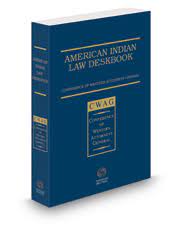
Notice: 2022 Edition of the American Indian Law Deskbook now available on Westlaw and in hard-copy and electronic formats.
Editions of the Deskbook are published annually by Thomson Reuters, and the 2022 Edition was issued during the week of May 23, 2021. It is available on Westlaw in the Secondary Sources/Texts & Treatises category, in hard copy, and in electronic format.
Please click below or reach out to Clay Smith at clay.smith@cwagweb.org with questions regarding obtaining a copy of the American Indian Law Deskbook.
|
|
Western Attorneys General Litigation Action Committee
CWAG oversees and coordinates the Western Attorneys General Litigation Action Committee (WAGLAC), which consists of assistant attorneys general involved in litigation related to the environment, natural resources, public lands and Indian law. WAGLAC was formed over 40 years ago and meets three times per year to discuss the latest developments in these areas of the law. AGO staff gain important contacts throughout the country in these important areas of the law.
|
|
Contributions For WAGLAC Newsletter
We rely on our readers to send us links for the WAGLAC Newsletter. If you have or know of a recent (published in the last two weeks) case, statute or article relating to natural resources, environment, Indian law or federalism that you would like us to consider for inclusion in the Newsletter, please send it to Clive Strong. For a complete database of all previously published WAGLAC newsletters, please follow the link below.
|
|
Conference of Western Attorneys General | 1300 I Street, Sacramento, CA 95814 |
|
|
|
|
|
|