News & Updates from WAGLAC
July 26, 2022
|
|
The Fall WAGLAC meeting will be held October 17-18, 2022 at the Westin in San Diego, California. Please mark your calendars. More details to follow.
|
|
EPA ISSUES FINAL RULE ON REPORTING FOR FIVE PFAS
The U.S. Environmental Protection Agency (EPA) issued “a final rule to update the Toxics Release Inventory (TRI) chemical list to identify five additional PFAS subject to reporting requirements.
The Fiscal Year 2020 National Defense Authorization Act (NDAA) provides the framework for the addition of PFAS to the TRI each year. As previously announced, for TRI Reporting Year 2022 (reporting forms due by July 1, 2023), reporting is required for four additional PFAS. Today’s final rule officially incorporates these requirements into the Code of Federal Regulations (CFR) for TRI. Additionally, this TRI update provides a conforming edit to the CFR to include a PFAS that met TRI listing requirements under the NDAA as of Reporting Year 2021.”
|
|
10th Circuit rebuffs Rocky Flats-skeptic groups' challenge to refuge trail system
Michael Karlik
The Gazette
July 23, 2022
“The federal appeals court based in Denver has agreed the government did not violate the law when it approved a set of trail modifications at the Rocky Flats National Wildlife Refuge in 2018 without a more rigorous environmental review.
In reaching its decision, a three-judge panel for the 10th U.S. Circuit Court of Appeals suggested a coalition of groups opposed in one form or another to Rocky Flats appeared more interested in challenging the broader, long-settled decision to open the former nuclear weapons site to the public, rather than the more recent realignment of trail segments.”
|
|
EPA PROPOSES TO DELEGATE AUTHORITY TO WASHINGTON STATE TO IMPLEMENT STANDARDS FOR HAZARDOUS AIR POLLUTANTS
On July 21, 2022, EPA published a proposed rule to delegate to Washington State delegation of Hazardous Waste Pollutants to implement and enforce the National Emission Standards for Hazardous Air Pollutants for radionuclide air emissions. Section 112(l) of the Clean Air Act (CAA) and the Code of Federal Regulations (CFR) at 40 CFR part 63, subpart E, authorize the EPA to delegate to State and local agencies authority to implement and enforce the National Emission Standards for Hazardous Air Pollutants (NESHAPs) if specified requirements are met. methods, under Executive Order 12898 (59 FR 7629, February 16, 1994). The proposed approval and delegation of the Radionuclides NESHAPs will not apply to sources or activities located in Indian country, as defined in 18 U.S.C. 1151.
|
|
EPA ISSUES FINAL RULE DELEGATING CAA AUTHORITY TO OKLAHOMA
EPA approved Oklahoma’s request for delegation of National Emission Standards for Hazardous Air Pollutants (NESHAP). The rule addresses the scope of delegation of authority to Oklahoma following the U.S. Supreme Court decision in McGirt v. Oklahoma.
|
|
FEDERAL DISTRICT VACATES ESA RULES
“On July 5, 2022, a federal court vacated three regulations implementing portions of the Endangered Species Act (“ESA”) related to interagency consultation, the prohibition of take of threatened species, and critical habitat designations. Now that the regulations have been vacated, two regulations promulgated in 2016 come back into effect. The 2016 regulations use different definitions of key terms and may limit federal agencies’ flexibility in administering the ESA. Another regulation, which applies the “take” prohibition to all threatened species will also come back into effect.”
|
|
WASHINGTON STATE SUPREME COURT REAFFIRMS DNR TRUST DUTY OVER STATE-GRANTED LANDS
In a significant decision, the Washington Supreme Court reaffirmed that the Washington State Department of Natural Resources (DNR) has a fiduciary duty to manage lands granted to the state as part of statehood. Petitioners sued DNR challenging its “management strategies on the grounds that they violate the mandate under Washington constitution article XVI, section 1 that ‘[a]ll the public lands granted to the state are held in trust for all the people.” Petitioners alleged that DNR prioritized maximizing timber revenue over management of granted lands for the broader public interest of conservation, climate change, wildfires, and land erosion. The trial court dismissed the petitioner’s lawsuit based on its conclusion that County of Skamania v. State, 102 Wn.2d 127, 685 P.2d 576 No. 99183-9 4 (1984), conclusively established that DNR was a trustee under the Enabling Act.
On appeal, the Supreme Court affirmed the dismissal of the case. The Court rejected the petitioner's argument that the Washington State Constitution Article XVI, section 1 created a trust for “all the people.” The Court stated that while Washington State’s enabling act did use explicit trust language, the provisions of the Enabling Act made clear “that the federal government intended to create a trust whereby the State accepted control of the granted lands with the express understanding that the lands were not its absolute property but, instead, were to be held and used exclusively for the enumerated purposes.” The Court interpreted Article XVI, section 1 as recognizing “the trust mandate that was created by the Enabling Act.” Accordingly, the Court held that the Enabling Act created a trust for the beneficiaries enumerated therein.”
The Court held that its duty in reviewing DNR’s management strategies was limited to discerning “whether DNR “has exercised its discretion in accordance with [the] law.’” The Court found that DNR’s decision to generate revenue from timber harvests did not undercut its obligations under the Enabling Act or article XVI, section 1.
|
|
CWAG, WGA and WSWC SUPPORT BIPARTISAN LEGISLATION CREATING A WESTERN WATER COMMITTEE
Senators Kevin Cramer and Jeff Merkley plan to introduce bipartisan legislation to establish a Corps of Engineers Western Water Cooperative Committee (Committee). The legislation is in response to the Corps prior effort to adopt a Water Supply Rule for the allocation of water from federal flood control reservoirs. The Rule would have undermined states primacy over the allocation and management of water within their borders. CWAG, Western Governors Association and Western States Water Council successfully advocated for the withdrawal of the Water Supply Rule. This legislation will create a forum going forward for US Army Corps of Engineers and Western States to coordinate the exercise of their respective authorities under Flood Control Act of 1944 and the Water Supply Act of 1958. State representatives of each governor and attorney general from prior appropriation states will sit on the committee. CWAG, Western Governors Association and Western States Water Council have sent letters in support of the legislation.
|
|
Colorado and other upstream states have a plan to help save the Colorado River. It doesn’t include any mandatory water cuts
By Michael Elizabeth Sakas
CPR News
July 19, 2022
“Colorado and the states that make up the upper half of the Colorado River basin have submitted a two-page proposal on how they will reduce their use of the river.
The five-point plan does not include any mandatory cuts to water usage in the upper basin.
The plan is in response to the U.S. Bureau of Reclamation’s recent demand that the seven states that share the river must act quickly to reduce their water consumption dramatically. The federal agency’s demand that states come up with a plan by August to reduce usage by 2 to 4 million acre-feet of water to save the country’s two largest reservoirs, Lake Powell and Lake Mead, which have both hit record-low levels amid decades of drought and climate change.”
|
|
|
|
Session 3: Workplace Safety Prosecutions
September 12, 2022 • 1:00 p.m. - 2:15 p.m. ET
Session 4: Animal Welfare & Wildlife Trafficking Prosecutions
October 17, 2022 • 1:00 p.m. - 2:00 p.m. ET
|
|
Violations of environmental standards may trigger both criminal and civil laws. What are considerations for state- and local-level prosecutors when facing a choice of enforcement route?
Join the State Energy & Environmental Impact Center at NYU School of Law, the Conference of Western Attorneys General, and the Environment & Natural Resources Division of the Department of Justice for a five-part training series specifically designed for state- and local-level prosecutors tasked with enforcement of environmental laws.
|
|
All summaries are posted in CWAG's google docs account, accessible through the link below. Should you have any issues with the links, contact Patricia Salazar with any questions.
|
|
New Indian Law Case Summaries |
|
In re Rylei S., ___ Cal. App. 5th ___, ___ Cal. Rptr. 3d ___, 2022 WL 2800958 (2d Dist. Jul. 18, 2022)L Order declaring a child to be dependent and removing her from parental custody was conditionally affirmed but remanded for compliance with the state statute’s requirement for further inquiry into “Indian child” status.
In re J.W., ___ Cal. App. 5th ___, ___ Cal. Rptr. 3d ___, 2022 WL 2816867 (2d Dist. Jul. 19, 2022): County department’s failure to inquire about “Indian child” status with a mother’s extended family constituted harmless error in view of the child’s placement with her maternal grandmother and the absence of any evidence of Indian heritage.
Tsi Akim of Taylorville Rancheria v. U.S. Dept. of Interior, ___ F. Supp. 3d ___, 2022 WL 2818035 (E.D. Cal. Jul. 19, 2022): Motion to dismiss for lack of subject matter jurisdiction on the grounds that the district court could not direct the Department of the Interior to place the plaintiff tribe on the list of federally recognized tribes and that one of the challenged decisions was not a final agency action was denied.
|
|
Southcentral Foundation v. Alaska Native Tribal Health Consortium, ___ F. Supp. 3d ___, 2022 WL 2834283 (D. Alaska Jul. 20, 2022): Regional health entity is entitled to all documents and information, regardless of privileged nature, from a health consortium necessary to exercise its governance and participation rights under Section 325 of the Department of the Interior and Related Agencies Appropriations Act of 1998 and is also entitled to share such documents and information with the entity’s board of directors, officers, and legal counsel to the extent necessary to exercise such rights subject to any agreement with the consortium to maintain the documents’ or information’s confidentiality.
In re Dependency of J.M.W., ___ Wash. 2d ___, ___ P.3d ___, 2022 WL 2840324 (Jul. 21, 2022): State department of children, youth and families erred in not providing “active efforts” as required by the Washington Indian Child Welfare Act prior to removal of an Indian child from his mother’s custody after an emergency shelter care hearing, and the superior court erred in failing to repeat during an interim shelter care hearing a specific finding that the child’s continued removal was necessary to prevent imminent physical damage or injury to the child.
|
|
United States v. Porche, ___ F. Supp. 3d ___, 2022 WL 2867424 (D. Mont. Jul. 21, 2022): Indian Civil Rights Act did not apply to an investigatory stop by a BIA police officer enforcing federal law.
State, Department of Health & Social Services, Office of Children’s Services v. Cissy A., ___ P.3d ___, 2022 WL 2899551 (Alaska Jul. 22, 2022) (per curiam): Superior court erred in construing existing precedent to require that Native village cultural expert testimony is required in every child custody proceeding subject to ICWA but did not err in declining to give weight to the testimony of qualified expert witnesses concerning Native village cultural practices given its vague and generalized nature.
Blount v. Blount, ___ P.3d ___, 2022 WL 2541831 (Nev. Jul. 7, 2022): Failure to challenge a tribal joint custody order within 20 days of its request for registration under the Uniform Child Custody Jurisdiction and Enforcement Act as adopted by Nevada barred a challenge based upon claims that the tribal court lacked jurisdiction and failed to give proper notice of its custody hearing.
|
|
American Indian Law Deskbook |
|
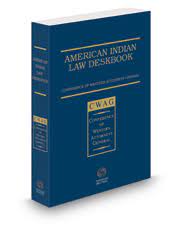
Notice: 2022 Edition of the American Indian Law Deskbook now available on Westlaw and in hard-copy and electronic formats.
Editions of the Deskbook are published annually by Thomson Reuters, and the 2022 Edition was issued during the week of May 23, 2021. It is available on Westlaw in the Secondary Sources/Texts & Treatises category, in hard copy, and in electronic format.
Please click below or reach out to Clay Smith at clay.smith@cwagweb.org with questions regarding obtaining a copy of the American Indian Law Deskbook.
|
|
Western Attorneys General Litigation Action Committee
CWAG oversees and coordinates the Western Attorneys General Litigation Action Committee (WAGLAC), which consists of assistant attorneys general involved in litigation related to the environment, natural resources, public lands and Indian law. WAGLAC was formed over 40 years ago and meets three times per year to discuss the latest developments in these areas of the law. AGO staff gain important contacts throughout the country in these important areas of the law.
|
|
Contributions For WAGLAC Newsletter
We rely on our readers to send us links for the WAGLAC Newsletter. If you have or know of a recent (published in the last two weeks) case, statute or article relating to natural resources, environment, Indian law or federalism that you would like us to consider for inclusion in the Newsletter, please send it to Clive Strong. For a complete database of all previously published WAGLAC newsletters, please follow the link below.
|
|
Conference of Western Attorneys General | 1300 I Street, Sacramento, CA 95814 |
|
|
|
|
|
|