News & Updates from WAGLAC
June 7, 2022
|
|
The Summer WAGLAC meeting will be held in conjunction with the AGA/CWAG Annual Meeting in Sun Valley, Idaho June 13-16, 2022.
The WAGLAC roundtable will be held on June 15th.
If you want to participate remotely in the roundtable discussion use the link below.
|
|
The Fall WAGLAC meeting will be held October 17-18, 2022 at the Westin in San Diego, California.
Please mark your calendars. More details to follow.
|
|
EPA PROPOSES RULE TO UPDATE CWA SECTION 401 RULE
“[T]he U.S. Environmental Protection Agency (EPA) announced a proposed rule to update the regulatory requirements for water quality certification under Clean Water Act (CWA) Section 401. This proposed rule would strengthen the authority of states, territories, and Tribes to protect their vital water resources while supporting an efficient, predictable, and common-sense certification process, restoring a long-held right, which was severely limited by the previous administration’s rule.
‘For 50 years, the Clean Water Act has protected water resources that are essential to thriving communities, vibrant ecosystems, and sustainable economic growth,’ said EPA Administrator Michael S. Regan. ‘EPA’s proposed rule builds on this foundation by empowering states, territories, and Tribes to use Congressionally granted authority to protect precious water resources while supporting much-needed infrastructure projects that create jobs and bolster our economy.’
This proposed rule is a key milestone in the regulatory process announced in May 2021 to revise the 2020 CWA Section 401 Certification Rule. The proposed rule would update the existing regulations to be more consistent with the statutory text of the 1972 CWA and clarify elements of Section 401 certification practice that have evolved over the 50 years since the 1971 regulation was promulgated. EPA conducted pre-proposal engagement to help inform the content of its proposal.”
|
|
Justices will analyze statute of limitations in Quiet Title Act
By Amy Howe
SCOTUSblog
on Jun 6, 2022
“The Supreme Court on Monday morning added one new case to its docket for the 2022-23 term, a technical dispute over the binding nature of the statute of limitations for a federal property law. The justices also invited the federal government to submit its views in a dispute over immunity for corporations that work on behalf of foreign governments.
The justices granted review in Wilkins v. United States, in which they will decide whether the 12-year statute of limitations to bring a lawsuit under the federal Quiet Title Act is jurisdictional – that is, it goes to the court’s power to hear the case and cannot be waived – or instead a “claims-processing rule,” a procedural rule that can be waived. The question arises in a case filed in 2018 by two Montana landowners, who argue that a roadway easement across their land held by the federal government does not give the public access to the road. A lower court ruled that the landowners filed their lawsuit too late and that the statute of limitations is jurisdictional.”
|
|
BEES ARE LEGALLY CLASSIFIED AS FISH IN CALIFORNIA
Noor Adatia
Sacramento Bee
June 3, 2022
“Bees are now legally considered fish in California under the state’s endangered species law, an appeals court in Sacramento ruled Tuesday. The 1970 act explicitly protected ‘fish,’ which were initially defined as invertebrates. And because the act has protected snails and other invertebrates that live on land since, Tuesday’s ruling said it interpreted the legislation to also include bees. ‘Accordingly, a terrestrial invertebrate, like each of the four bumble bee species, may be listed as an endangered or threatened species under the Act,’ the 3rd district California Court of Appeals Associate Justice Ronald Robie wrote.”
|
|
TRIBAL PLAYBOOK FOR FEDERAL FUNDING
“The White House released a Bipartisan Infrastructure Law Tribal Playbook to help Tribal governments unlock the benefits from the historic investments in our nation’s infrastructure, including the more than $13 billion set aside in the Bipartisan Infrastructure Law for Indian Country. The Tribal Playbook, found at build.gov, builds on the release of the Bipartisan Infrastructure Law Guidebook and provides Tribal communities with information on the more specific Tribal funding available under the law, in addition to the hundreds of billions available to Tribes on a competitive basis."
|
|
Attorney General Bonta Secures Decision Blocking Fracking Off California Coast
“California Attorney General Rob Bonta [] secured a decision by the Ninth Circuit Court of Appeals blocking the Department of Interior (Interior) from authorizing fracking on offshore platforms off the coast of California. In today’s decision, the Ninth Circuit found that the Interior's flawed final environmental analysis, which found that fracking poses “no significant impact,” violated the National Environmental Policy Act, Endangered Species Act, and Coastal Zone Management Act.”
|
|
JUDGE GREENLIGHTS MORE NEPA REVIEWS ON WESTERN OIL LEASES
Nina H. Farah
E&E News
06/03/2022
“The Biden administration has agreed to reconsider the cumulative climate effects of oil and gas leases on nearly 4 million acres in a settlement approved this week by a federal judge.
Judge Rudolph Contreras of the U.S. District Court for the District of Columbia this week approved voluntary settlements requiring the Bureau of Land Management to redo its analysis of the leases under the National Environmental Policy Act.
The agreements resolve legal challenges brought by WildEarth Guardians and other challengers beginning in 2016, and again in two other cases in 2020 and 2021. Altogether, the suits involve leases across five states: Wyoming, Utah, Colorado, New Mexico and Montana."
|
|
SPECIAL MASTER ISSUES PROPOSED DECREE FOR HOPI TRIBE
On May 25, 2022, Little Colorado General Adjudication Special Master Susan Ward Harris issued a Final Report and proposed decree for the Hopi Reservation in Arizona. The Final Report concludes litigation that began more than 30 years ago. The proposed decree adjudicates water right claims by the United States and the Hopi Tribe for use on lands within the Hopi Reservation. The proposed decree includes claims by allottees. This 408 page Final Report includes 341 findings of fact and 76 conclusions of law. The Final Report addresses claims by the Federal Government and the Tribe under both federal and state law, to surface and groundwater. The Special Master, based on the Arizona Supreme Court’s Gila V decision, used a “permanent home and abiding place” standard to quantify water use on the Reservation. The decreed recognized water rights for irrigation, domestic, commercial, municipal, industrial, mining, cultural, religious, and livestock uses, but denied water rights for a coal-slurry line.
The proposed decree also recommended granting water rights to the United States and the Tribe for the Keams Canyon Recreation Area, and for wetlands in Pasture Canyon and White Ruin Canyon.
The Special Master recommended that enforcement and administration of the decree be under the continuing jurisdiction of the Little Colorado General Stream Adjudication Court.
Objections to the Final Report must be filed in November and responses must be filed in January 2023.
|
|
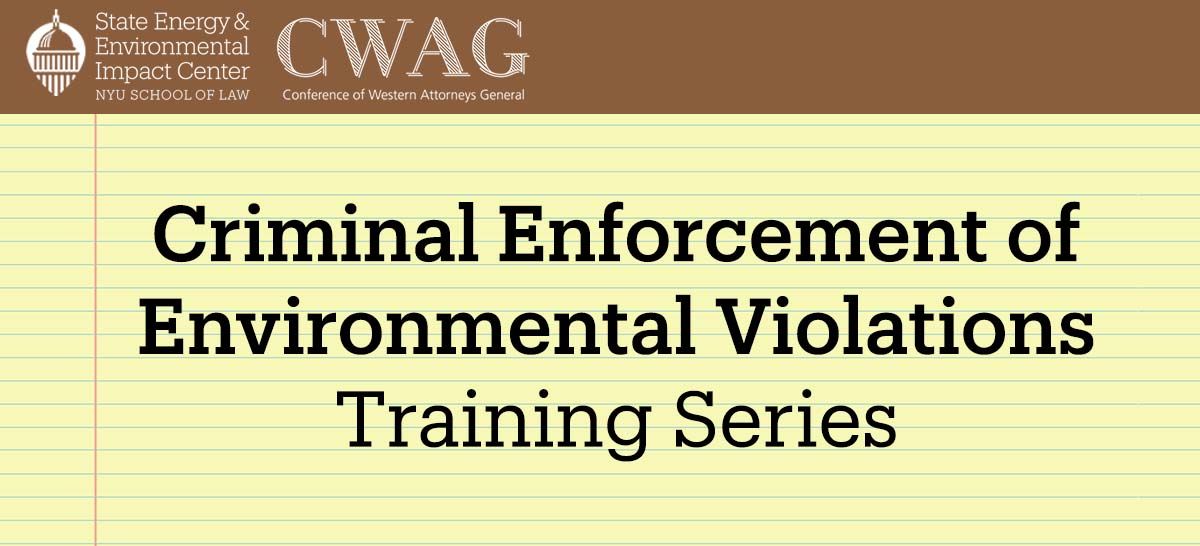
Violations of environmental standards may trigger both criminal and civil laws. What are considerations for state- and local-level prosecutors when facing a choice of enforcement route?
Join the State Energy & Environmental Impact Center at NYU School of Law, the Conference of Western Attorneys General, and the Environment & Natural Resources Division of the Department of Justice for a five-part training series specifically designed for state- and local-level prosecutors tasked with enforcement of environmental laws.
|
|
All summaries are posted in CWAG's google docs account, accessible through the link below. Should you have any issues with the links, contact Patricia Salazar with any questions.
|
|
New Indian Law Case Summaries |
|
People in Interest of M.M., 2022 COA 61, ___ P.3d ___ (June 2, 2022): Father’s assertion of a lineal tribal affiliation with a tribe in Delaware constituted “reason to know” that “Indian child” status existed and thereby triggered ICWA notice requirements.
|
|
Cayuga Nation v. Parker, ___ F. Supp. 3d ___, 2022 WL 1813882 (N.D.N.Y. June 2, 2022): RICO challenge brought by a tribe against a tribal member and others that alleged violation of federal cigarette and controlled substances statutes was stayed pending exhaustion of remedies in a pending tribal court suit over violation of a tribal business licensing ordinance.
|
|
American Indian Law Deskbook |
|
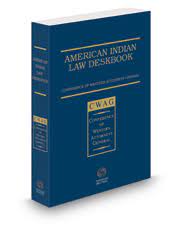
Notice: 2022 Edition of the American Indian Law Deskbook now available on Westlaw and in hard-copy and electronic formats.
Editions of the Deskbook are published annually by Thomson Reuters, and the 2022 Edition was issued during the week of May 23, 2021. It is available on Westlaw in the Secondary Sources/Texts & Treatises category, in hard copy, and in electronic format.
Please click below or reach out to Clay Smith at clay.smith@cwagweb.org with questions regarding obtaining a copy of the American Indian Law Deskbook.
|
|
Western Attorneys General Litigation Action Committee
CWAG oversees and coordinates the Western Attorneys General Litigation Action Committee (WAGLAC), which consists of assistant attorneys general involved in litigation related to the environment, natural resources, public lands and Indian law. WAGLAC was formed over 40 years ago and meets three times per year to discuss the latest developments in these areas of the law. AGO staff gain important contacts throughout the country in these important areas of the law.
|
|
Contributions For WAGLAC Newsletter
We rely on our readers to send us links for the WAGLAC Newsletter. If you have or know of a recent (published in the last two weeks) case, statute or article relating to natural resources, environment, Indian law or federalism that you would like us to consider for inclusion in the Newsletter, please send it to Clive Strong. For a complete database of all previously published WAGLAC newsletters, please follow the link below.
|
|
Conference of Western Attorneys General | 1300 I Street, Sacramento, CA 95814 |
|
|
|
|
|
|