News & Updates from WAGLAC
September 13, 2022
|
|
The Conference of Western Attorneys General cordially invites you to attend our upcoming Western Attorneys General Litigation Action Committee (WAGLAC) meeting. This year's Fall Meeting will be held on October 17-18, 2022 at the Westin San Diego.
The meeting will begin Monday, October 17, 2022, at 8:30 am and end on Tuesday, October 18, 2022, at 4:00 pm.
In addition to the roundtable discussion of natural resource, environmental, and Indian law cases, there will be a legal seminar.
All CWAG members are welcome to attend in person or via Zoom. CWAG will pay travel and hotel costs for one staff member from each CWAG state to attend. Please use the link below to register for the meeting.
Applications for CLE certification for the meeting will be requested from the Western States.
|
|
AG Bonta and DA Spitzer Announce Criminal Charges Against Amplify Energy for Huntington Beach Oil Spill
“California Attorney General Rob Bonta and Orange County District Attorney Todd Spitzer [] announced the filing of misdemeanor charges against Amplify Energy, Beta Operating Company, and San Pedro Bay Pipeline (collectively, “Amplify”) for discharging approximately 25,000 gallons of petroleum from an underwater pipeline off the coast of Huntington Beach in October 2021. The charges are the result of an investigation led by the California Department of Justice, the California Department of Fish and Wildlife, and the Orange County District Attorney's Office. As part of a plea agreement entered . . . in the Orange County Superior Court, Amplify will plead no contest to six misdemeanor charges, pay $4.9 million in fines and penalties to the state and the county in what is believed to be the largest state misdemeanor criminal fine in Orange County history, and be placed on probation for 12 months. Amplify separately will pay a $7.1 million federal fine and also will reimburse federal agencies for expenses incurred during the response to the spill.”
|
|
Metlakatia Tribe Secures Treaty Fishing Rights
The Ninth Circuit Court of Appeals held that Metlakatla tribal members don’t need state permits to fish in waters they have traditionally relied on — even outside their reservation’s boundaries. The panel held that the 1891 Act reserves for the Metlakatlan Indian Community an implied right to non-exclusive off-reservation fishing in the areas where they have fished since time immemorial and where they continued to fish in 1891 when their reservation was established.”
|
|
PUBLIC HAS RIGHT TO WALK ON BED OF NON-NAVIGABLE BED TO FISH, HUNT AND RECREATE IN NEW MEXICO
The New Mexico Supreme Court held, in Adobe Whitewater Club of New Mexico v. New Mexico State Game Commission, that the public has a right to walk or wade on privately owned submerged lands to fish and recreate in public waters. The decision invalidated New Mexico State Game Commission regulations that created a process for landowners to obtain a certificate to close public access to waters flowing over privately owned streambeds.
While the Court acknowledged landowners bordering non-navigable streams own the riverbed, their right of ownership is subject to a public right of way to use the publicly owned waters under Article XVI, Section 2 of the New Mexico Constitution. Article XVI, Section 2 provides that the natural waters of New Mexico “belong to the public and [are] subject to appropriation for beneficial use, in accordance with the laws of the state.” The Court said, “A corollary of the proposition that the public owns the water is the rule that there is a public easement over the water regardless of who owns the water beds beneath the water.” Justice Michael Vigil, writing for the Court, concluded that “under Article XVI, Section 2 ‘the public has the right to recreate and fish in public waters and that this right includes the privilege to do such acts as are reasonably necessary to effect the enjoyment of such right.”
|
|
Klamath Irrigation District Injunctions in Federal and State Court Overturned on Same Day
On September 8, 2022, the Oregon Court of Appeals directed that a lawsuit in which Klamath Basin irrigators won an injunction in the trial court be dismissed. The injunction ordered the water master and the Oregon Department of Water Resources to direct the U.S Department of Interior Bureau of Reclamation (Bureau) to cease releases of stored water for instream flows from the Link River Dam. The Court reasoned that dismissal of the case is required because the Bureau is a necessary party whose immunity from suit precluded its joinder and because the suit could not otherwise proceed in equity and good conscience. The Court observed that even if the Bureau could be forced to participate in the proceeding, “[a]n order to the Bureau to cease the release of water would be a pyrrhic victory for the plaintiff that would likely be overturned in federal court,” because the Bureau was under a federal court order to make the releases.
In a related lawsuit by the Klamath Irrigation District against the Bureau, the Ninth Circuit confirmed the Oregon Court of Appeals' observation. The panel dismissed under Fed. R. Civ. P. 19, the District’s suit under the Administrative Procedure Act challenging a Bureau operations plan that provided for instream flows to satisfy both ESA requirements and trust responsibilities to two tribes because the tribes were necessary parties whose immunity from suit precluded their joinder and because the suit could not otherwise proceed in equity and good conscience.
|
|
Session 4: Animal Welfare & Wildlife Trafficking Prosecutions
October 17, 2022 • 1:00 p.m. - 2:00 p.m. ET
|
|
Past Sessions
For recordings from our past sessions click the links below
|
|
Session 3: Workplace Safety Prosecutions
Monday, September 12, 2022
Session 3 (1:00 p.m. - 2:30 p.m. ET)
Recording in next week's edition.
|
|
Join Kelley Drye attorneys and guest speakers for an upcoming seminar to discuss the latest developments on the impacts, regulation, and litigation surrounding one of the most impactful emerging contaminants in a generation: per- and polyfluoroalkyl substances (PFAS).
This full-day program will present a series of panels featuring experts and practitioners from government, outside counsel, and various technical fields who will discuss the most pertinent federal and state regulations, litigation issues, and liability developments involving these “forever” chemicals.
Panel topics include; The State of PFAS Science, State, and Federal Regulatory Update, Litigation Addressing PFAS from Industrial Discharger Sites, Aqueous Film-Forming Foam Multidistrict Litigation, Damages, and Remediation.
There is no cost to register for this event.
Kelley Drye is an accredited NY, IL, CA, and TX CLE provider. This non-transitional continuing legal education program will offer NY Professional Practice credit, General IL credit, CA General credit, and TX General credit. We will apply for CLE credit in other jurisdictions, upon request, but we cannot guarantee approval.
DATE: Thursday, October 13, 2022 - 10:00 a.m. - 5:30 p.m. EST
LOCATION: Virtual
|
|
All summaries are posted in CWAG's google docs account, accessible through the link below. Should you have any issues with the links, contact Patricia Salazar with any questions.
|
|
Klamath Irrigation District v. U.S. Bureau of Reclamation, ___ F.4th ___, 2022 WL 4101175 (9th Cir. Sept. 8, 2022): Water users’ suit under the Administrative Procedure Act challenging a Bureau of Reclamation operations plan that provided for instream flows to satisfy both ESA requirements and trust responsibilities to two tribes was properly dismissed under Fed. R. Civ. P. 19 because the tribes were necessary parties whose immunity from suit precluded their joinder and because the suit could not otherwise proceed in equity and good conscience.
In re Kenneth D., ___ Cal. App. 5th ___, ___ Cal. Rptr. 3d ___, 2022 WL 4091838 (3d Dist. Aug. 31, 2022): Remand for a county department’s failure to conduct a proper inquiry into “Indian child” status is appropriate only when the record, including post-parental rights termination order evidence, shows a reason to believe that the child has such status.
State v. McCormack, 321 Or. App. 551, ___ P.3d ___ (Sept. 8, 2022): State failed to establish by clear and convincing evidence that prohibiting two Nez Perce tribal members’ gillnet fishing in the Columbia River mainstem at a usual and accustomed fishing place was necessary to conserve the affected salmon species’ continued existence.
|
|
Metlakatla Indian Community v. Dunleavy, ___ F.4th ___, 2022 WL 4101799 (9th Cir. Sept. 8, 2022): Tribal community possessed an implied non-exclusive right to fish for personal consumption and commercial purposes in two off-reservation areas under an 1891 statute establishing their reservation.
Bad River Band of Lake Superior Tribe of Chippewa Indians of Bad River Reservation v. Enbridge Energy Co., ___ F. Supp. 3d ___, 2022 WL 4094073 (W.D. Wis. Sept. 7, 2022): Tribe was granted summary judgment in the liability phase of a suit as to trespass and unjust enrichment claims related to an oil pipeline crossing tribal trust allotments, but the energy company was granted summary judgment as to state law nuisance, ejectment, and tribal regulatory authority claims. The energy company’s motion for summary judgment as to federal-common-law nuisance claims was denied because questions of material fact existed as to the imminence of the claimed environmental injury and the adequacy of proposed abatement measures. Injunctive relief requiring the company to remove the pipeline was withheld subject to the parties’ consultation over the court’s suggested remedy.
|
|
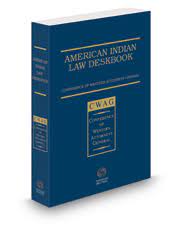
American Indian Law Deskbook |
|
Notice: 2022 Edition of the American Indian Law Deskbook now available on Westlaw and in hard-copy and electronic formats.
Editions of the Deskbook are published annually by Thomson Reuters, and the 2022 Edition was issued during the week of May 23, 2021. It is available on Westlaw in the Secondary Sources/Texts & Treatises category, in hard copy, and in electronic format.
Please click below or reach out to Clay Smith at clay.smith@cwagweb.org with questions regarding obtaining a copy of the American Indian Law Deskbook.
|
|
Western Attorneys General Litigation Action Committee
CWAG oversees and coordinates the Western Attorneys General Litigation Action Committee (WAGLAC), which consists of assistant attorneys general involved in litigation related to the environment, natural resources, public lands and Indian law. WAGLAC was formed over 40 years ago and meets three times per year to discuss the latest developments in these areas of the law. AGO staff gain important contacts throughout the country in these important areas of the law.
|
|
Contributions For WAGLAC Newsletter
We rely on our readers to send us links for the WAGLAC Newsletter. If you have or know of a recent (published in the last two weeks) case, statute or article relating to natural resources, environment, Indian law or federalism that you would like us to consider for inclusion in the Newsletter, please send it to Clive Strong. For a complete database of all previously published WAGLAC newsletters, please follow the link below.
|
|
Conference of Western Attorneys General | 1300 I Street, Sacramento, CA 95814 |
|
|
|
|
|
|