News & Updates from WAGLAC
September 27, 2022
|
|
The Conference of Western Attorneys General cordially invites you to attend our upcoming Western Attorneys General Litigation Action Committee (WAGLAC) meeting. This year's Fall Meeting will be held on October 17-18, 2022 at the Westin San Diego.
The meeting, limited to Attorneys General and Staff ONLY, will begin Monday, October 17, 2022, at 8:30 am and end on Tuesday, October 18, 2022, at 3:00 pm.
In addition to the roundtable discussion of natural resource, environmental, and Indian law matters, there will be a seminar on how the conservative majority on the Supreme Court is reshaping environmental and Indian law. See the agenda below for more details.
Although in-person attendance is now closed, CWAG members are welcome to attend virtually via Zoom. Zoom Link will be sent later, following online registration.
Please use the link below to register for the meeting.
Applications for CLE certification for the meeting will be requested from the Western States.
|
|
EPA Launches New National Office Dedicated to Advancing Environmental Justice and Civil Rights
September 24, 2022
“EPA announced that it is establishing a new national office charged with advancing environmental justice and civil rights. The creation of the new Office of Environmental Justice and External Civil Rights delivers on President Biden’s commitment to elevating these critical issues to the highest levels of the government and solidifies the agency’s commitment to providing justice and equity for all.
The new office will dedicate more than 200 EPA staff in EPA headquarters and across 10 regions to solving environmental challenges in communities that have been underserved for far too long. These staff will engage with communities with environmental justice concerns to understand their needs, as well as Tribal, state, and local partners; manage and disburse historic levels of grants and technical assistance; work with other EPA offices to incorporate environmental justice into the agency’s programs, policies, and processes, as allowed by law; and ensure EPA funding recipients comply with applicable civil rights laws. The office will be led by a U.S. Senate-confirmed Assistant Administrator, to be announced later.”
|
|
|
|
CWAG SUPPORTS GOOD SAMARITAN HARDROCK MINE CLEANUP BILL
The Conference of Western Attorneys General sent a letter to the U.S. Senate Environment and Public Works Committee in support of Senate Bill 3571 (the ‘bill”). The Bill, titled the Good Samaritan Remediation of Abandoned Hardrock Mines Act of 2022, was introduced by New Mexico Senator Martin Heinrich in February 2022. The letter states that the existing legal framework deters would-be “Good Samaritan” entities from conducting voluntary cleanups at abandoned mine sites. The Bill would remove legal barriers and incentivize Good Samaritan cleanups through a new permitting program administered by the U.S. Environmental Protection Agency and federal land management agencies.
|
|
California Dam
EDVARD PETTERSSON
Courthouse News
September 23, 2022
“The Ninth Circuit Court of Appeals agreed with two environmental organizations that a Central California dam can legally be managed to preserve an endangered trout species in addition to its primary purpose to conserve water for residents, farms, and industries in the surrounding area.
In a split decision Friday, the appellate panel overturned a judge's ruling last year that the government agencies in charge of the Twitchell Dam in the Santa Maria River watershed had no discretion to release water to flow into the ocean for the benefit of the Southern California steelhead trout.
The 1954 law that authorized the construction of the dam expressly authorized it to be operated for other purposes beyond its principal purpose to recharge the Santa Maria River Valley’s groundwater aquifer and to eliminate the threat of extensive flood damage, Circuit Judge Sidney Thomas, a Bill Clinton appointee, wrote for the majority.”
|
|
Landowners ask Supreme Court to curb pipeline eminent domain
By Niina H. Farah
E&E News Energywire
09/26/2022
“Cletus and Beverly Bohon, along with others living in the path of the Mountain Valley Pipeline, filed a petition [with the U.S. Supreme Court] on Sept. 15 asking the justices to weigh in on a narrow question with broad repercussions for the landowners’ bid to block the Federal Energy Regulatory Commission from delegating eminent domain power to companies that build natural gas infrastructure.
Mia Yugo, a private attorney representing the landowners, said in a statement that her clients would like to see the courts ultimately curtail FERC’s authority, as the justices have done in recent rulings against federal climate rules and vaccine mandates.
‘We cannot say, in the one instance, that the EPA has too much power and Congress needs to be more specific before the EPA can wield that power,’ she said, ‘but then, in the same breath, look at FERC and say, ‘Well, we really need pipelines, so we’ll just let FERC run wild with little to no guidance from Congress, as it has done for decades.'
. . . .
Rather than challenge the FERC certificate authorizing the construction of Mountain Valley, as other pipeline opponents have done, the Bohons sought to tackle the very source of the commission’s authority to allow companies to condemn land in the path of an approved project.
They have argued that a Natural Gas Act provision allowing FERC to delegate its eminent domain authority to certified project developers is unconstitutional.
But the claim has so far failed to gain traction, as lower benches have ruled that the landowners should have filed their lawsuit not in federal district court, but in the U.S. Court of Appeals for the District of Columbia Circuit, which has jurisdiction in FERC certificate challenges.”
|
|
Interior Department Announces Next Steps to Address Drought Crisis Gripping the Colorado River Basin
9/22/2022
“As the worsening drought crisis continues to impact communities across the West, senior leaders from the Department of the Interior are outlining new and urgent actions to improve and protect the long-term sustainability of the Colorado River System.
. . . .
The actions being discussed this week build on those announced in August 2022 as part of the Bureau of Reclamation’s release of the Colorado River Basin August 2022 24-Month Study, which sets the annual operations for Lake Powell and Lake Mead in 2023. Those previously announced actions specified that Lake Powell will operate in the Lower Elevation Balancing Tier in the water year 2023 and Lake Mead will operate in its first-ever Level 2a Shortage Condition in the calendar year 2023 requiring reduced allocations and water savings contributions for the Lower Basin States and Mexico.”
|
|
NEW MEXICO SUPREME COURT RECOGNIZES PARTIAL FORFEITURE OF WATER RIGHT
On September 26, 2022, the New Mexico Supreme Court issued an opinion, in State ex rel. State Engineer v. Romero, concluding that groundwater rights are subject to partial forfeiture. The petitioner Romero argued that his use of three acre-feet per year of a claimed water right of 394.85 acre-feet per year to water livestock was sufficient to preclude a partial forfeiture of the claimed right. The Supreme Court stated that “[s]ynchronizing the legislative relationship and legal history of groundwater and surface water forfeiture statutes with a plain reading of our Constitution supports only one conclusion: New Mexico’s groundwater forfeiture statute allows for partial forfeiture. The decision is grounded on Article XVI, Section 3 of the New Mexico Constitution which provides that “[b]eneficial use shall be, the measure and the limit of the right to the use of water.” “Because beneficial use is a grounding principle in our water law policy,” the Court stated that it had “rejected other theories of water ownership that are incompatible with the beneficial use provision of Article XVI, including theories that ignore the possibility that users can forfeit their rights.” The Court concluded that “forfeiture is an essential enforcement mechanism for Article XVI’s beneficial use provision.”
|
|
Session 4: Animal Welfare & Wildlife Trafficking Prosecutions
October 17, 2022 • 1:00 p.m. - 2:00 p.m. ET
|
|
Past Sessions
For recordings from our past sessions click the links below
|
|
Session 3: Workplace Safety Prosecutions
Monday, September 12, 2022
Session 3 (1:00 p.m. - 2:30 p.m. ET)
The recording will be uploaded when available.
|
|
Join Kelley Drye attorneys and guest speakers for an upcoming seminar to discuss the latest developments on the impacts, regulation, and litigation surrounding one of the most impactful emerging contaminants in a generation: per- and polyfluoroalkyl substances (PFAS).
This full-day program will present a series of panels featuring experts and practitioners from government, outside counsel, and various technical fields who will discuss the most pertinent federal and state regulations, litigation issues, and liability developments involving these “forever” chemicals.
Panel topics include; The State of PFAS Science, State, and Federal Regulatory Update, Litigation Addressing PFAS from Industrial Discharger Sites, Aqueous Film-Forming Foam Multidistrict Litigation, Damages, and Remediation.
There is no cost to register for this event.
Kelley Drye is an accredited NY, IL, CA, and TX CLE provider. This non-transitional continuing legal education program will offer NY Professional Practice credit, General IL credit, CA General credit, and TX General credit. We will apply for CLE credit in other jurisdictions, upon request, but we cannot guarantee approval.
DATE: Thursday, October 13, 2022 - 10:00 a.m. - 5:30 p.m. EST
LOCATION: Virtual
|
|
All summaries are posted in CWAG's google docs account, accessible through the link below. Should you have any issues with the links, contact Patricia Salazar with any questions.
|
|
Chegup v. Ute Indian Tribe of Uintah and Ouray Reservation, ___ F. Supp. 3d ___, 2022 WL 4359260 (D. Utah Sept. 16, 2022): On remand from the Tenth Circuit, the district court dismissed without prejudice for failure to exhaust tribal remedies an action brought by tribal members challenging a five-year reservation banishment order under the habeas corpus provision of the Indian Civil Rights Act.
Kumar v. Schildt, ___ F. Supp. 3d ___, 2022 WL 4299827 (D. Mont. Sept. 19, 2022): Non-Indian could not invoke 28 U.S.C. § 1353, which provides in part that “district courts shall have original jurisdiction of any civil action involving the right of any person, in whole or in part of Indian blood or descent, to any allotment of land under any Act of Congress or treaty[,]” as a basis for subject-matter jurisdiction in a property sale dispute.
In re Baby Girl M., ___ Cal. App. 5th ___, ___ Cal. Rptr. 3d ___, 2022 WL 4364187 (2d Dist. Sept. 21, 2022): Father’s appeal from an order in a foster care proceeding that challenged county department’s failure to comply with California’s “Indian child” inquiry requirement was deemed moot where the department had admitted error and compliance activities were underway before the juvenile court.
|
|
Pacheco v. El Habti, ___ F.4th ___, 2022 WL 4242131 (10th Cir. Sept. 15, 2022): McGirt did not recognize a new rule of constitutional law and, therefore, was not retroactive for purposes of applying the one-year Antiterrorism and Effective Death Penalty Act’s limitations period.
L.B. v. United States, 2022 MT 166, 515 P.3d 818 (Aug. 16, 2022): Montana supreme court answered “no” to the Ninth Circuit’s certified question, as reformulated, whether “[u]nder Montana law, ... law-enforcement officers act outside the scope of their employment, as a matter of law, when they use their authority as on-duty officers to sexually assault a person they are investigating for a crime[.]”
State v. Ward, 2022 OK CR 16, ___ P.3d ___ (Aug. 18, 2022): Dismissal of a charge against a non-Indian for an assault and battery against an Indian deputy sheriff in Indian country was reversed in light of Oklahoma v. Castro-Huerta.
|
|
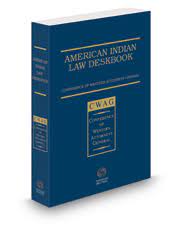
American Indian Law Deskbook |
|
Notice: 2022 Edition of the American Indian Law Deskbook now available on Westlaw and in hard-copy and electronic formats.
Editions of the Deskbook are published annually by Thomson Reuters, and the 2022 Edition was issued during the week of May 23, 2021. It is available on Westlaw in the Secondary Sources/Texts & Treatises category, in hard copy, and in electronic format.
Please click below or reach out to Clay Smith at clay.smith@cwagweb.org with questions regarding obtaining a copy of the American Indian Law Deskbook.
|
|
Western Attorneys General Litigation Action Committee
CWAG oversees and coordinates the Western Attorneys General Litigation Action Committee (WAGLAC), which consists of assistant attorneys general involved in litigation related to the environment, natural resources, public lands and Indian law. WAGLAC was formed over 40 years ago and meets three times per year to discuss the latest developments in these areas of the law. AGO staff gain important contacts throughout the country in these important areas of the law.
|
|
Contributions For WAGLAC Newsletter
We rely on our readers to send us links for the WAGLAC Newsletter. If you have or know of a recent (published in the last two weeks) case, statute or article relating to natural resources, environment, Indian law or federalism that you would like us to consider for inclusion in the Newsletter, please send it to Clive Strong. For a complete database of all previously published WAGLAC newsletters, please follow the link below.
|
|
Conference of Western Attorneys General | 1300 I Street, Sacramento, CA 95814 |
|
|
|
|
|
|