WEL NEWSLETTER April 2023, Vol. 13, No. 1 | |
|
Dear Kenneth,
Happy Spring! We made it through another winter! Happy Easter and Passover and Ramadan and the happiest of celebrations to everyone, no matter what you are celebrating!
I had the privilege of attending a lovely evening at TMU this week in honor of an award set up in the name of our former Chief Justice, George R. Strathy. I encourage you to support to this important initiative since it embraces the spirit of creating a new generation of lawyers with an improved approach to the well-being of lawyers in the practice of law.
A reminder that this month is the month to vote for the LSO Benchers. Please vote responsibly. Click here to see a complete list of candidates running in the 2023 bencher election.
No news to share on my reading initiatives-I have had no extra time-but I finally received by Gabrielle Zevin Novel Tomorrow, And Tomorrow, And Tomorrow. I look forward to the read and reporting in due course.
Our firm was busy with Elder Law Day and other important CPD initiatives in the last few weeks. In the next short while we will be involved in some of the Osgoode programming and very much look forward to seeing you there.
Finally, to all my female friends and colleagues, thank you for celebrating International Women’s Day this past month. It is important to take a moment to recognize your achievements and to further the objectives and goals of women as thought leaders in the law. As a small boutique business owner having experienced big and mid-sized firms, and everything in between, I recognize the challenges faced by female lawyers in our profession. Take the time to understand the importance of your leadership in the legal profession and be proud.
As ever, Enjoy the read.
Kim
| |
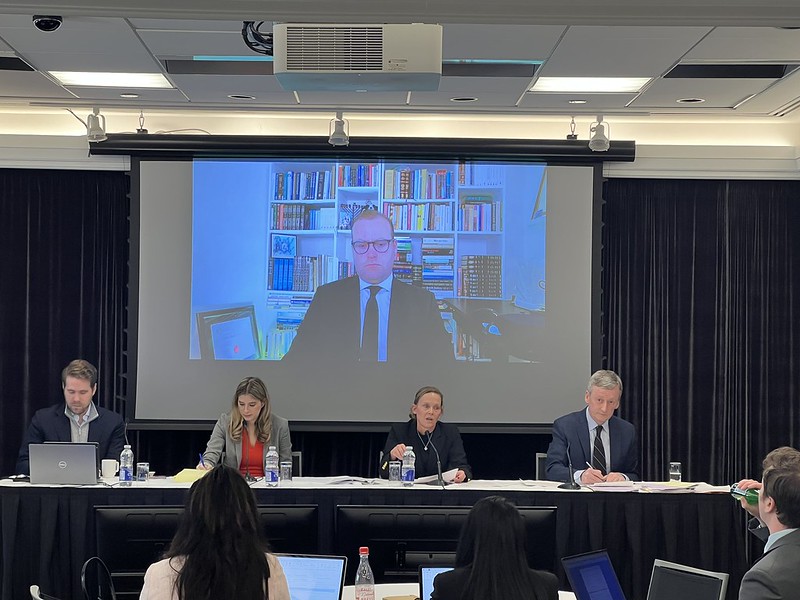
1. OBA ELDER LAW DAY, MARCH 28, 2023 | Matthew Rendely and Kim Gale co-chaired the OBA Elder Law Day program, on March 28, 2023, where Kimberly Whaley, the Honourable Justice Kelly and Avi Charney were on a panel discussion about capacity. | |
2. THE HONOURABLE JUSTICE STRATHY AWARD, MARCH 29, 2023 | On March 29, Kim and Bryan attended an event at Toronto Metropolitan University’s Lincoln Alexander School of Law to celebrate the launch of The Honourable George R. Strathy Award. This award is intended to honour law students who have contributed to the health, wellness and sense of belonging to the Lincoln Alexander School of Law. WEL Partners is pleased to have contributed to this fantastic initiative. If you would like to make a donation in support of this award, please us the link page is here and in the 'Designation' Drop Down Box, you can select the Honourable George R. Strathy Award. | |
3. BEWARE OF PHISHING EMAILS EMULATING WEL PARTNERS APPEARING AS FROM JOHN POYSER | It has come to our attention that there has been an attempted fraud circulating using phishing emails that emulate WEL Partners lawyer’s identity. Please note that all WEL email addresses end in @welpartners.com. Also note, WEL Partners does not ever solicit business via e-mail. If you receive one of these fraudulent e-mails, please kindly disregard. If you have any doubts, questions or concerns regarding WEL Partners e-mail communications, please contact our office at 416-925-7400. | |
4. OSGOODE PROFESSIONAL DEVELOPMENT INTENSIVE PROGRAM IN WILLS & ESTATES, APRIL 19, 2023 | |
On April 19, 2023, Bryan Gilmartin and Student-at-Law Brett Book will be lecturing at the Osgoode Professional Development Intensive Program in Wills & Estates on Powers of Attorney and Guardianship: Non-Contentious and Contentious Matters.
This one-day program, which is set up in an interactive format, features an expert faculty of practitioners who will walk participants through both contentious and non-contentious matters and facilitate a dynamic discussion on best practices and the range of scenarios they might face in this area.
WEL Partners is excited to once again provide expert knowledge in this program. This program is co-chaired by Ian Hull and Suzanna Popovic-Montag. To start the program, Bryan Gilmartin will be speaking to participants on Incapacity Planning and Powers of Attorney. Later in the evening, Brett Book will be stepping in for Kim, speaking on Contentious Guardianship Applications and Removals of Attorneys and Guardians.
More information on the program can be found here.
| |
5. WEL PARTNERS CONTRIBUTES UPDATES TO THE CIVIL PROCEDURE AND PRACTICE IN ONTARIO (“CPPO”) | |
The Civil Procedure and Practice in Ontario (the “CPPO”) is a free, online annotated volume of the Rules of Civil Procedure, the Courts of Justice Act, and the Limitations Act. It was designed to be “not only thorough and detailed enough for specialist litigators, but also accessible to law office staff, self-represented litigants, and the general public.”[1]
As you may have already discovered, the above-mentioned rules are complicated and verbose. For that reason, Professor Noel Semple at the University of Windsor, Faculty of Law, created the CPPO with the intention of providing a highly accessible and easy to understand text which explains the use and applicability of these rules.
The reason the CPPO is such a valuable and first-rate guide is largely because it is written by a team of over 135 leading litigators, judges, and experts in Ontario Civil Procedure. Each rule or bundle of sections from the above-note statutes and regulations have been given their own ‘Chapter’. The text includes case law which interprets the various rules and showcases their every day applicability. The text is also constantly being updated to reflect changes, making the CPPO a continuous work in progress.
WEL Partners is proud to have previously contributed to all versions of the CPPO in three chapters pertaining to the Rules of Civil Procedure:
1. Rule 9 – Parties and Joinder;
2. Rule 10 – Representation Orders; and
3. Rule 73 – Reciprocal Enforcement of United Kingdom Judgments.
Last month, WEL Partners contributed to the latest version of the CPPO.
The CPPO is published widely on CanLII.[2] The guide can be found here: https://www.canlii.org/en/commentary/81787/. We look forward to sharing news of the Spring 2023 version when it is available.
[1] Noel Semple, “Civil Procedure and Practice in Ontario: A New, Comprehensive and Free Guide” (September 10, 2021), Slaw, accessed online: https://www.slaw.ca/2021/09/10/civil-procedure-and-practice-in-ontario-a-new-comprehensive-and-free-guide/
[2] CanLII is funded by Canadian lawyers and is first to develop a thorough and free database of statutes, regulations, and decisions. Most recently, it has expanded into the realm of legal commentary.
| |
6. WEL PARTNERS AT THE INAUGURAL CBA ONLINE SYMPOSIUM | |
On April 25th, WEL Partners will be participating in the CBA Online Symposium: Elder Law in Canada – A National perspective on Criminal Law, Long-Term Care, and Human Rights, presented by the CBA Elder Law Section and sponsored by the Estate Planning Council of Canada. This symposium will feature a full-day and three expert panels.
WEL Partners Brett Book will be co-chairing the program and will be moderating the first panel which features WEL Partners Kimberly Whaley who will be speaking on Criminal and Civil Responses to Elder Abuse. Joining Kim will be Professor Nina Kohn: a David M. Levy Professor of Law at Syracuse University College of Law, and Stephanie Senecal: The Senior Support Unit Coordinator with the Canadian Anti-fraud Centre. This panel will discuss current criminal remedies against perpetrators of financial abuse and exploitation of vulnerable older adults in Canada. The panel will also discuss what Canada can learn from the United States’ criminal response and will end with a discussion surrounding the legal response to the latest scams and frauds targeting older adults.
The second panel will feature Laura Tamblyn-Watts, Sessional Lecturer and Assistant Professor at the University of Toronto’s Factor-Inwentash Faculty of Social Work and CEO of CanAge (Canada’s National Seniors’ Advocacy Organization), Alex Mihailidis, the Barbara G. Stymiest Research Chair in Rehab Technology at the University of Toronto and the Scientific Director of the AGE-WELL Network of Centres of Excellence (Canada’s Technology and Aging Network), and Kelly Thompson, retired Engagement Advisor with the Nova Scotia Health Authority and one of the 30 committee members of the Canadian Standards Association (CSA Group) Technical Subcommittee on Long-Term Care Homes. This panel will identify where legislative gaps and shortfalls have led to a failure to meet the needs of our again population, and whether a national standard is required.
Finally, the third panel will delve into the Human Rights of Older Adults and will feature Krista James Policy Director with Vancouver Coastal Health (formerly the National Director of the Canadian Centre for Elder Law), former Co-Director of the Public Legal Education Association of Saskatchewan and current University of Saskatchewan Associate Professor Doug Surtees, and University of Manitoba Professor of Native Studies Peter Kulchyski.
The Symposium will run from 11:00 AM to 4:35 PM ET. Registrants will receive on-demand recording(s) following the symposium. Canadian Bar Association members can register here. CPD Hours will be available.
| |
WEL CONGRATULATES THE HONOURABLE JUSTICE MOLDAVER | |
|
WEL congratulates the Honourable Justice Moldaver on receiving the University of Toronto Faculty of Law Distinguished Alumni Award. This is the Faculty’s highest honour, recognizing a graduate’s extraordinary public leadership and lifelong commitment to the community.
https://a-list.lawandstyle.ca/?p=16376
| |
WEL CONGRATULATES IAN HULL, 2023 LAW SOCIETY AWARDS | |
WEL EATS - POMEGRANATE RESTAURANT | |
|
By Nima Hojjati and Evan Pernica
In celebration of Nowruz and the coming of spring, our team experienced an immersion into classic Iranian cuisine by visiting Pomegranate Restaurant, a staple of the city since 2003.
Walking into Pomegranate, we were immediately met by the array of authentic Iranian decorations that cover the space from floor to ceiling. Bright tapestry and mosaics line the walls, Farsi script recite poems on the paneling, and glass chandeliers hearken back to antique lighting.
Moving to the tasting portion of the experience, our table was treated with the array of appetizers. While each carried an original and authentic flavour profile that perfectly matched the warm barbary bread, the common theme of sweet, sour, and savoury brought a harmonious feeling and consistency to the experience. Some dishes that we particularly loved were the mirza qasemi, a smoky eggplant, tomato, and garlic dip, and the zeitoun parvardeh, green olives marinated with walnut and pomegranate molasses.
|  | |
For main courses, the favourite of the table was the special galiyeh mahi, an aromatic fish, herb, and tamarind stew served with basmati rice (in honour of fish for Nowruz). Other notable dishes were the fesenjaan, a stew of walnut and pomegranate, and the baqali polo, a braised lamb shank served with basmati rice steamed with dill and fava beans. | |
|
For dessert we were treated to bastani akbar mashdi, saffron and rose water ice cream with clotted cream and pistachios, followed by pipping hot Persian tea and nokhodchi, chickpea shortbread cookies.
If you’re looking for a great experience with delicious Iranian dishes, head to Pomegranate at College and Bathurst.
|
|
(i) REBUTTABLE PRESUMPTION OF KNOWLEDGE AND APPROVAL & CAPACITY | |
|
By Albert H. Oosterhoff
1. Introduction
In a recent blog[1] I included a prolepsis about a possible future consideration of the rebuttable presumption of knowledge and approval and capacity. I had not planned to address the matter so soon but have concluded that it is better to do so now because more and more cases are being decided about the presumption. I wrote about it most recently in a blog posted in October 2022[2] on Re Grace Estate,[3] which also addresses the issue. The issue arises mostly because of a statement by Sopinka J in Vout v Hay:[4]
Upon proof that the will was duly executed with the requisite formalities, after having been read over to or by a testator who appeared to understand it, it will generally be presumed that the testator knew and approved of the contents and had the necessary capacity.
The question that has been explored in subsequent cases is the meaning of the italicised clause. Does it mean that the presumption can always arise only if it is proved that the testator has read over the will, or had it read over to him?
I shall address this question and related issues by reference to a slightly older case, Karpinski v Zookewich Estate.[5] In the process, I shall also refer to the excellent text by John E.S. Poyser, Capacity and Undue Influence.[6] He discusses the question in detail both in respect of testamentary capacity and knowledge and approval.[7]
2. Facts
The testator, Ernie Zookewich, was born in 1935. His father died when he was three years old and his mother, Annie, then married Stanley Karpinsky in 1938. Annie and Stanley had two children, Ed and Mary. Ernie never married and had no children. Ed and Mary are his only siblings. Ernie died in 2016.
Ernie quit school in grade 5 or 6 to work on the family farm. He never married, had few friends and no girlfriends. His parent paid for his living expenses and groceries. Ernie was a hard worker a self-taught mechanic. Ed left the family farm in 1957 and married Verl Karpinski. He adopted Verl’s daughter. They became involved with the family farm again in 1985 until they moved away in 1995. Mary left the family farm in 1963 and married Al Lozinski in 1964. They had four children.
Stanley and Annie died in 2007. They left three quarters of farmland to Ernie and one quarter to Ed. When Ernie died, he owned 11 quarters of farmland. He made his Will, prepared by his lawyer, in 2006 and in it named Mary and Al his executors and sole beneficiaries of his estate. He stated in the will:
As I have not left anything to my brother, I wish to confirm that the reason for doing so is because I feel my brother is well off and has no need for further funds or assets.
The drafting lawyer predeceased Ernie but his law firm provided the contents of the file as it related to the preparation of the Will.
Ed brought an application to require proof of the Will in solemn form. He alleged that Ernie lacked testamentary capacity and did not know and approve the contents of the Will, and that Mary and Al exerted undue influence over Ernie.
The chambers judge dismissed the application.[8] Ed appealed. He argued that the will had not been executed properly, that there were suspicious circumstances surrounding the making and execution of the will, and that it was unknown whether the testator knew and approved the contents of the will.
3. Analysis and Judgment
3.1 Issues
On the appeal the judgment was delivered by Herauf JA. The court considered the following issues:
(a) the standard of proof and test to have a will proved in solemn form;
(b) undue influence
(i) the presumption and legal burden; and
(ii) the test for undue influence;
(c) knowledge and approval of the contents of the Will:
(i) knowledge and approval as distinct from testamentary capacity; and
(ii) the doctrine of righteousness.
3.2 Standard of Proof and Test for Proving a Will in Solemn Form
Justice Herauf quoted the following passage from Bachman v Scheidt:[9]
[16] In order to have a trial to prove the will in solemn form, the applicant must, at the first hearing, establish a genuine issue to be tried. To do this, he or she must point to some evidence which, if accepted at trial, would tend to negative testamentary capacity or support a finding of undue influence. The applicant must do more than simply suggest an irregularity or point to evidence on peripheral points. Rather, probative evidence showing a genuine issue must be adduced. Once this hurdle is cleared, the propounder of the will may attempt to answer the challenge by showing unconditional and uncontroverted evidence that affirms that the maker of the will had the necessary testamentary capacity and/or was not unduly influenced. Although the Chambers judge may consider evidence from both parties, it is not his or her job to weigh conflicting evidence and make findings of credibility. If contradictory evidence is adduced, especially where findings of credibility will have to be made, the only option for the Chambers judge is to direct a trial.
This statement merely repeats the modern test for proving a will in solemn form and should not have to be stated.[10] But I have reproduced it in full because lawyers continue to bring such applications on the basis of flimsy evidence that often consist simply of the subjective opinions of the person attacking the will.
The chambers judge had applied the same test and concluded that Ed had not established a genuine issue to be tried. The Court of Appeal agreed with this assessment as regards the issues of undue influence (paras 31-32) and knowledge and approval (paras 35-36).
3.3 Undue Influence
The court applied the well-known statement of Sopinka J in Vout v Hay[11] in which he stated that the burden of proving undue influence (as well as fraud) lies on those attacking the will. Significantly, in Karpinski Justice Herauf therefore also emphasized that the rebuttable presumption of undue influence that can be raised in the context of inter vivos gifts does not apply in probate (para 29).[12]
As noted above, the court agreed with the chambers judge that no genuine issue arose to support the suggestion that Mary and Al exerted undue influence on Ernie. There was no evidence of manipulation, coercion, or abuse by them (para 31).
3.4 Knowledge and Approval
Justice Herauf again referred to Vout v Hay and Justice Sopinka’s statement in that case at para 26 about suspicious circumstances. The passage is:
[26] Suspicious circumstances in any of the three categories to which I refer above will affect the burden of proof with respect to knowledge and approval. The burden with respect to testamentary capacity will be affected as well if the circumstances reflect on the mental capacity of the testator to make a will. Although the propounder of the will has the legal burden with respect to due execution, knowledge and approval, and testamentary capacity, the propounder is aided by a rebuttable presumption. Upon proof that the will was duly executed with the requisite formalities, after having been read over to or by a testator who appeared to understand it, it will generally be presumed that the testator knew and approved of the contents and had the necessary testamentary capacity.
Justice Herauf notes that this passage confirms that knowledge and approval and testamentary capacity are separate concepts, for Sopinka J listed due execution, knowledge and approval, and testamentary capacity as three separate legal burdens. Very significantly, Justice Sopinka then went on to say:
[27] Where suspicious circumstances are present, then the presumption is spent and the propounder of the will reassumes the legal burden of proving knowledge and approval. In addition, if the suspicious circumstances relate to mental capacity, the propounder of the will reassumes the legal burden of establishing testamentary capacity.
Justice Herauf noted that the chambers judge considered all three issues and went on to state in any event ‘proof of capacity, combined with execution, is enough to discharge the propounder of the will’s burden since the testator’s knowledge and approval will be presumed.’ He then went on to note that this rebuttable presumption is based on the maxim omnia praesumuntur rite esse acta, which means that the law presumes that all required acts have been performed until the contrary is proved. He quoted the following passage from the judgment of Lindley LJ in Harris v Knight,[13] which explains the doctrine:
The maxim, "Omnia praesumuntur rite esse acta," is an expression, in a short form, of a reasonable probability, and of the propriety in point of law of acting on such probability. The maxim expresses an inference which may reasonably be drawn when an intention to do some formal act is established; when the evidence is consistent with that intention having been carried into effect in a proper way; but when the actual observance of all due formalities can only be inferred as a matter of probability. The maxim is not wanted where such observance is proved, nor has it any place where such observance is disproved. The maxim only comes into operation where there is no proof one way or the other; but where it is more probable that what was intended to be done was done as it ought to have been done to render it valid; rather than that it was done in some other manner which would defeat the intention proved to exist, and would render what is proved to have been done of no effect.
This maxim has been quoted and applied regularly by the courts.[14]
Ed argued that there was no proof that the Will was read over by or to Ernie and that he understood it, since the drafting lawyer had predeceased him and the file was silent on the point. He relied on the passage from paragraph 26 of Vout v Hay, quoted above and argued that such proof is necessary.
Justice Herauf disagreed and applied Yen Estate v Chan.[15] In it the British Columbia Court of Appeal held that when there are no suspicious circumstances surrounding the execution of the will and upon proof that the testator has signed the will, the court is entitled to rely on the presumptions of execution and knowledge and approval. Thus, in that case the court held that the presumptions applied even though there was no evidence that the testator had read the will or had it read over to him. Since Ernie had properly executed the Will and since the chambers judge rightly found there to be no suspicious circumstances, the chambers judge was entitled to conclude that Ernie had knowledge of and approved the contents of the will. The fact that Ernie left Ed nothing in the Will because he felt that he was well off was simply Ernie’s subjective belief that this was true and there was nothing suspicious about it.
3.5 The Doctrine of Righteousness
The Supreme Court of Canada spoke of this issue in Riach v Ferris,[16] in which it quoted a passage from the judgment of Lord Hatherly in Fulton v Andrew.[17] Lord Hatherly was discussing the second rule of Barry v Butlin[18] in which Baron Parke stated that when a person writes or prepares a will under which he takes a benefit, that is a suspicious circumstance and the court should not pronounce in favour of the will unless the suspicion is removed. In Fulton v Andrew Lord Hatherly stated that a person who was instrumental in preparing or obtaining a will must prove ‘the righteousness of the transaction’.
In Karpinski the Court of Appeal quoted from the first edition of Poyser’s text on this point. The author takes the view that the doctrine of the righteousness of the transaction is a separate doctrine from the doctrine of suspicious circumstances, although he admits that the doctrine of righteousness ‘appears to be falling out of favour’.[19] The Court of Appeal noted that there were no suspicious circumstances so that, if the doctrine still exists, it did not apply in this case.
It is interesting to note that in Fuller v Strum[20] Gibson LJ regarded the term to be an unfortunate one which suggests that a moral judgment of the court is required. His Lordship points out that this is not the case but that when a person is instrumental in making or obtaining a will under which he obtains a benefit, he must dispel the suspicion about whether the testator knew and approved the contents.
4. Conclusion
The burden of this blog was to address the meaning of the clause in paragraph 26 of Vout v Hay, ‘after having been read over to or by a testator who appeared to understand it’. I submit that we now have a significant body of case law which makes it clear that while proof of a reading over to or by a testator may provide the best evidence of knowledge and approval, it is not essential, even in cases of suspicious circumstances. Knowledge and approval can be proved in other ways. And importantly, if there are no suspicious circumstances and it appears that the testator has signed the will in accordance with the statutory requirements, even though that cannot be proved since the witnesses are not available, the court is entitled to rely on the presumptions of knowledge and approval and testamentary capacity, and it can do so even if there is no attestation clause in the will.[21]
Of course the presumptions can be rebutted by direct evident of suspicious circumstances
It is also important to consider the consequence of rules that require overly strict proof. In Re Laxer[22] Schroeder JA made the following trenchant comment:
The authorities supporting the application of the presumption favouring due execution of a testamentary instrument lay down a very sound and salutary principle, since a contrary rule would make the rights of devisees and legatees depend not only upon the honesty, but also upon the frail and slippery memory of witnesses. No man could be sure of dying testate, since the dishonesty or forgetfulness of a witness could frustrate all his precautions to comply with the requirements of the law.[23]
It is my hope that in light of the recent cases I have discussed in this blog applicants seeking proof of a will in solemn form will desist from insisting on proof that the testator read the will or had it read to her.
---
[1] ‘An Illusory Illusion’, a blog on Roe v Roe, 2022 ONSC 5821.
[2] https://welpartners.com/blog/2022/10/the-presumption-of-due-execution-re-grace-estate/.
[3] 2022 BCSC 1283.
[4] [1995] 2 SCR 876, para 26.
[5] 2018 SKCA 56. I am very much obliged to my colleague Nima Hojjati for finding the relevant cases.
[6] 2nd ed (Toronto: Thomson Reuters, 2019).
[7] Ibid., respectively at pp.12-33, and 234-254.
[8] Karpinski v Zookewich Estate, 2017 SKQB 278.
[9] 2016 SKCA 150 (emphasis added by the court in Karpinski). For a similar statement of the test see the recent English case, Boast v Ballardi, [2022] EWHC 1533 (Ch), para 29.
[10]The court cited two leading case as authority: Royal Trust Corp of Canada v Ritchie, 2007 SKCA, para 6; and Kapacila Estate v Otto, 2010 SKCA 85. See also Neuberger v York, 2016 ONCA 191, paras 81-98, per Gillese JA. And see also Johnson v Johnson, 2022 ONCA 682, 81 ETR 4th 7, paras 7-8, to the same effect
[11]Footnote 4, supra, para 21.
[12]On this point see also Seguin v Pearson, 2018 ONCA 355, para 12, to the same effect.
[13] (1890), 15 PD 170 at 170.
[14] See, e.g., R v. Rorquist, [1981] 1 WWR 279 (Sask CA), referred to by Herauf JA; Re Laxer, 1963 CarswellOnt 170, [1963] 1 OR 343 (CA), para 28; Yen Estate v Chan, 2013 BCCA 423, para 14; Re Grace Estate, 2022 BCSC 1283, para 20.
[15] Ibid.
[16] [1934] SCR 725 at 730-31.
[17] (1875), LR 7 HL 448 at 472-73.
[18] (1838), 2 Moo PC 480 at 482-83.
[19] See now the second edition of this text, footnote XX, supra, pp 272-312.
[20] [2001] EWCA Civ 1879, [2002] 1 WLR 1097 at 1107.
[21] Re Laxer, footnote 14, supra, p 356
[22]Ibid., p 357.
[23]See also Vout v Hay, footnote 4, supra, para 28, to the same effect.
| |
(ii) PROPRIETARY ESTOPPEL: ADOMAUSKAS V CHROLAVICIUS | |
|
By Albert Oosterhoff
Adomauskas v Chrolavicius[1]
Introduction
I have written about proprietary estoppel before, most recently in connection with the landmark case Guest v Guest,[2] a decision of the United Kingdom Supreme Court. In some respects, the reasons in the Adomauskas case are unexceptional. They provide a careful examination of the proprietary estoppel doctrine. But it is worth considering the case for two reasons: (1) proprietary estoppel cases are becoming more common; and (2) decisions at the highest levels have considered the doctrine recently and need to be kept in mind. The Adomauskas case did not refer to Guest v Guest for the simple reason that it was decided after Adomauskas. But Adomauskas does rely on the important Supreme Court of Canada case, Cowper-Smith v Morgan.[3]
2. Facts
John and Ona Adomauskas emigrated from Lithuania after World War II. They met and were married in Hamilton. They had two sons, Edward, born in 1953, and Peter, born in 1960. John worked for Stelco for many years but in the late 1960s he and Ona bought a hotel and tavern in Hamilton. Edward joined them in the business when he was in his early twenties. Thereafter the three of them ran the business together until it was sold in 1986 for $520,000. Edward received one-third of that amount. Peter had a difficult relationship with his parents, who regarded him a rebellious and unreliable. He moved to Calgary in 1983 to get away from his parents and found regular employment there. However, he maintained contact with them through phone calls and visits.
In 1989 John and Ona decided to purchase a house in Calgary for Peter. They spoke to Edward about it and John asked Edward to go to Calgary to find a house and pay the down payment his parents provided. Peter was married, had two young children, and had recently separated from his wife. With Edward’s help, a house was found and purchased. But title was taken in the joint names of John and Ona so that Peter’s wife could not lay claim to an interest in it. However, Edward understood that the parents intended ultimately to transfer title to Peter. He also understood that his father wanted to make amends to Peter for his difficult upbringing and to do something for him since Edward had benefited from the sale of the hotel. Moreover, Peter understood that the house was his. Since the purchase Peter has paid the insurance, taxes, and utilities for the house. He also invested his own time and money in the upkeep of and improvement to the property. His parents were aware of this.
John then died and Ona became to the sole legal owner of the house by right of survivorship. Thereafter, Peter’s relationship with his mother became increasingly strained. The evidence indicated that Ona suffered from severe depression and was treated in and out of hospital with medications and shock therapy. Her personality was difficult and she was manipulative and controlling of her sons. Peter asked her to transfer title to him in 2000, as he wanted to sell it and buy another house, but she refused. Nonetheless, Peter trusted that she would ultimately transfer the property to him.
Ona’s last will provided that Peter could remain in the Calgary house for five years after she died. Then it was to be sold and the proceeds divided equally among Peter and his two children. She appointed the defendants, her adult nephew and niece as her executors. Peter brought this action claiming entitlement to the property under the doctrine of proprietary estoppel. The defendants wanted to distribute Ona’s estate in accordance with her will.
3. Analysis and Judgment
By reference to Cowper-Smith,[4] Justice Dilts stated that she had to determine whether John and Ona represented to Peter that he would be given the Calgary property, and whether Peter reasonable relied on that representation to his detriment, so that it would be unfair to deny him ownership of the property.
3.1 The Representation
Justice Dilts noted that the representation may be express or implied and can be inferred from the promisor’s conduct. It does not have to be made in detail, but it must be sufficiently certain to give rise to reasonable reliance.
She found that the parents expressly or impliedly represented to Peter (and Edward) that the property would belong to Peter. They also told their sons why title would be taken in the parents’ names, but there was no evidence to indicate that the property would remain part of their estates. Thus, Justice Dilts concluded that the representations made by the parents were capable of giving rise to an equity in Peter’s favour.
3.2 Reliance
Justice Dilts noted that reliance and detriment are distinct elements of proprietary estoppel. Reliance involves a change in a party’s conduct because of the representation made. The reliance must be reasonable, but reasonableness is measured by the nature of the promise and the relationship between the parties. The representation must also be plausible; otherwise the reliance of the promise cannot be reasonable. Based on the evidence, she concluded that the reliance was reasonable. Moreover, the parents themselves expected Peter to rely on their representations and to maintain the property and improve it. And it was clear that Peter in fact relied on his parents’ representations.
3.3 Detriment
If the promisee relies to his detriment on the representation, that results in unfairness to which the doctrine of proprietary estoppel responds. When there has been continuous reliance of a long period of time, the court must measure the detriment at the point in time when the promisor resiles from the promise, or when, as here, the promisee learnt that the promisor has broken it. Based on the evidence, Peter clearly suffered a detriment. He paid for the upkeep and improvement of the property over two decades and did not consider any possible alternative than that the property was his. Moreover, Ona was aware of Peter’s continuing investment in the property. Consequently, all the elements of the doctrine of proprietary estoppel were established, and therefore Ona could not resile from the original representation.
3.4 Remedy
Justice Dilts noted that the doctrine does not axiomatically give title to the promisee. Rather, ‘the court must satisfy the equity that has arisen in a way that is proportionate to the overall detriment suffered and the benefits gained (para 54). In other words, the remedy is not based solely on the promisee’s expectation, for the equity must be proportionate to the detriment suffered.
The remedy must be the minimum necessary to avoid an unfair or unjust result according to Cowper-Smith.[5] But, having regard to the fact that Peter’s reliance on his parents’ promise continued over decades to the parents’ knowledge, and that it was consistent, the appropriate remedy to satisfy the equity was to order that title the property be transferred to Peter.
4. Conclusion
I do not quarrel with the decision as such. It is well-supported by the evidence and it is well argued. However, in light of the majority reasons in Guest v Guest,[6] courts in future cases should probably approach the resolution of such cases somewhat differently. Lord Briggs makes the following points:
(1) Detrimental reliance is a necessary condition for the equity to arise, but when the court holds the promisor to his promise, that does not seek to protect the promisee from the detriment or compensate him for it. Rather, the court’s aim is to prevent or remedy the unconscionability of the promisor’s conduct, ‘with the effect, but not the aim’ that it tends to satisfy the expectations of the promise (para 61).
(2) The court ‘should firmly reject the theory that the aim of the remedy for proprietary estoppel is detriment-based (para 71).
(3) The concept of proportionality has been adopted by the cases ‘as part of the assessment of whether a proposed remedy to deal with the proven unconscionability based on satisfying the claimant’s expectations works substantial justice between the parties’. However, while the concept is a good servant, it is a bad master and ‘is no more than a useful cross-check for potential injustice’. Thus, ‘the best summary of the proportionality test is that the remedy should not, without some good reason, be out of all proportion to the detriment’ (para 72). Moreover, the court should not consider the question of proportionality on the basis of pure financial considerations (para 73).
(4) The court should normally approach the issue in two stages. The first stage is to determine whether the promisor’s repudiation of the promise is unconscionable, having regard to the promisee’s detrimental reliance on it (para 74). In the second stage the court considers the remedy. Normally, that means that court will hold the promisor to his promise, but that may depend on the circumstances (paras 75-76).
(5) The concept of a ‘minimum equity’ derives from a dictum of Scarman LJ in Crabb v Arun District Council.[7] In that case the court sought to fulfill the plaintiff’s expectations in the fairest way, while ensuring that his expectations were not exceeded. In that context Scarman LJ said. ‘I would analyse the minimum equity to do justice to the plaintiff either to an easement or a licence upon terms to be agreed’.[8] This concept has often been misunderstood. However, Robert Walker LJ said of it in Jennings v Rice,[9] ‘Scarman LJ’s reference to the minimum does not require the court to be constitutionally parsimonious, but it does implicitly recognize that the court must also do justice to the defendant’. In Guest v Guest Lord Briggs noted that the dictum was not ‘minimum equity’, but ‘minimum equity to do justice’ (para 13).
---
[1] 2022 ABQB 567, 81 ETR 4th 104.
[2] [2022] UKSC 27. See ‘Proprietary Estoppel: Guest v Guest’ https://welpartners.com/blog/2022/12/proprietary-estoppel-guest-v-guest/.
[3] 2017 SCC 61, [2017] 2 SCR 754.
[4] Ibid., para 15.
[5] Ibid, para 47
[6] Footnote 2, supra.
[7] [1976] Ch 179 (CA).
[8] Ibid., pp 1998-99, emphasis supplied.
[9] [2002] EWCA Civ 159, para 44.
| |
(iii) FINANCIAL ADVICE FOR OLDER ADULTS – A CASE FOR CONCERN | |
|
By Oliver O'Brien
In Marrone (Re), a former mutual fund representative was fined and banned by Ontario’s Capital Markets Tribunal (the “Tribunal”) for failing to disclose conflicts of interest that arose when an elderly, financially unsophisticated and terminally ill client named him as the sole beneficiary of her estate, valued on her death at $2,000,000.00.
This case is important as it explores the nexus of professional responsibilities, conflicts of interest, and highlights some of the issues faced by financial advisors who provide services to older adults.
Facts
Aurelio Marrone (“Marrone”) was a registered mutual fund salesperson for 20 years.[1] One of his clients, “MU”, immigrated to Canada from Spain in the early 1970s. She had a grade school education and worked as a housekeeper.[2]
Marrone first met MU in 1986 and assisted her and her husband with their personal income tax preparation and continued to do so until both of their deaths. Marrone testified he had a close relationship with MU’s husband and both MU and her husband attended Marrone’s wedding in 2003.
Marrone submitted to the Tribunal that following the death of MU’s husband in 2004, he visited MU on a weekly basis and would assist with activities such as driving her to surgeries and arranging her travel. Marrone became MU’s financial advisor in April 2008 and by the time of Marrone’s termination in 2017, the aggregate value of MU’s accounts with him was $1.7m.[3]
In February 2017, MU was diagnosed with terminal pancreatic cancer. She was admitted to palliative care on May 1, 2017. In late March of 2017, MU asked Marrone to assist with her estate planning. Marrone provided names of three lawyers and MU picked one. Marrone arranged for the retainer and scheduled the meetings that enabled MU to prepare her will and powers of attorney for personal care and property.[4]
When first meeting MU, the drafting lawyer advised that they did not believe MU to be capable of giving instructions and that Marrone should obtain a capacity assessment. Marrone arranged for a doctor, albeit one who was not identified as a designated capacity assessor, to provide a certificate stating MU was capable of giving instructions, which he delivered to the drafting lawyer.[5]
MU’s will and power of attorney documents were executed on May 9, 2017 and MU passed away ten days later. The power of attorney documents appointed Marrone as her attorney and her will appointed Marrone as alternate executor and the sole beneficiary of her estate. Marrone failed to report these conflicts of interest to his employer[6].
An investigation was commenced by Marrone’s employer in September 2017 and Marrone was terminated from his position in December 2017.
Tribunal Decision
The Tribunal found Marrone guilty of misconduct in 2022[7], stating that he had acted unfairly, dishonestly and in bad faith towards his vulnerable client, MU. Specifically, Marrone had failed to follow the required procedures for dealing with conflicts or potential conflicts of interest which was in serious breach of the rules of the Mutual Fund Dealers Association of Canada (MFDA) and the policies and procedures of his employer. This included:
(1) Accepting his appointment as MU’s attorney for property;
(2) Failing to renounce his appointment as alternate executor of MU’s estate; and
(3) Not immediately reporting these conflicts of interest, as well as the conflict of MU naming Marrone as the sole beneficiary of her estate under her will when she was vulnerable.[8]
The Tribunal decision on sentencing and costs was released in February 2023. In their submissions, the Ontario Securities Commission sought the following orders for Marrone:
- to be permanently banned from market participation;
- pay an administrative penalty of $500,000;
- disgorge $1,800,00.00, being the value of MU’s estate; and
-
pay costs.[9]
The Tribunal found it in the public interest to order that Marrone be permanently banned from capital markets participation, to pay an administrative penalty of $500,000 and pay costs of $85,000 but they did not order that Marrone disgorge any amount he might receive from MU’s Estate.[10]
They found no provision in the Securities Act[11] or MDFA rules that prohibited him as a dealer from accepting under his client’s will. As the Tribunal could not find that Marrone had obtained the beneficial entitlement in breach of securities law, they could not order a disgorgement.[12]
Comment
Wealth Professional, who reported on the decision, highlighted the issues financial advisors face with older clients. John Moakler, a senior executive financial planner at Moakler Wealth Management in Ontario, told Wealth Professional that the case highlights the risks of working with advisors who do not have fiduciary obligations to their clients. As a CFP[13] and CLU[14], Moakler is never asked at his annual designation renewals whether he is an executor of any of his client’s estates.
Since 2021, the Financial Industry Regulatory Authority (FINRA) in the United States has required all members to affirmatively permit or prohibit stockbrokers from acting as a trustee or executor to a client, or to receive a bequest from their estate. Under FINRA Rule 3241, brokerage firms must assess the risks involved when a customer appoints a registered person to a position of trust or is named as a beneficiary.[15]
In Canada, and as seen in Marrone (Re), MDFA rule 3.4.1(a) prohibits a dealer from accepting authority over a client under a Power of Attorney or Executor appointment[16]. However, no provision of the Securities Act or the MDFA Rules prohibit a dealer from accepting under a client’s will[17].
On issues of capacity, Moakler believes that at an industry level, advisors and dealers should have safeguards to automatically trigger a branch-level review when the client is 70 years old or older. “It comes down to a compliance issue,” Moakler says. “When you have a client who’s 70 years of age or older, then the compliance officer at your branch must make a separate phone call with that client to make sure everything’s ok.”[18]
The fact pattern of Marrone (Re) is a typical example of undue influence and capacity issues at play. Canada’s population is ageing rapidly, with reports that the number of people over 85 has more than doubled since the 2001 census[19]. As a result, estate plans are more frequently compromised due to the higher risk of vulnerability and later life illnesses. As such, we are sadly seeing both an increase in scenarios such as this and an increase in challenges based on testamentary capacity or undue influence.
As a final note, it is worth mentioning that this case highlights the importance for all professionals, not just financial advisors, to be aware of not only their duties and responsibilities where it concerns conflicts of interest and compliance but also, to ensure the testamentary capacity of their clients.
---
[1] Marrone (Re), 2022 ONCMT 12 (CanLII)
[2] Ibid at para 11
[3] Ibid at para 14
[4] Ibid at para 16
[5] Marrone (Re), 2023 ONCMT 9 (CanLII) at para 25
[6] (supra note 1) at para 17
[7] Ibid at para 198
[8] (supra note 5) at para 1
[9] Ibid at para 3
[10] Ibid at para 4
[11] RSO 1990, c S.5
[12] (supra note 5) at para 70
[13] Certified Financial Planner
[14] Chartered Life Underwriter – individuals who specialise in life insurance and estate planning
[15] Wealth Professional, “Advisor inheritance case a cautionary tale for Canadian wealth industry” March 20, 2023
[16] MDFA Rule 2.3.1(a): “No Member or Approved Person shall have full or partial control or authority over the financial affairs of a client, including: (i) accepting or acting upon a power of attorney from a client; (ii) accepting an appointment to act as a trustee or executor of a client; or (iii) acting as a trustee or executor in respect of the estate of a client.”
[17] (supra note 5) at para 67
[18] (supra note 15)
[19] Michael Ranger and The Canadian Press, “Canada faces rapidly aging population, record retirements: 2021 census” April 27, 2022, CityNews, online: https://toronto.citynews.ca/2022/04/27/statistics-canada-2021-census-data/”
| |
(iv) DISREGARDING AN ORDER TO PASS ACCOUNTS AND THE PENALTY FOR CONTEMPT | |
|
By Brett Book
Introduction
In Estate of Nordby,[1] the penalty for a finding of contempt pursuant to Rule 60.11[2] was addressed in a passing of accounts case where patience with the responding party had clearly worn thin.
Pursuant to Rule 60.11, a contempt order to enforce an order requiring a person to do an act, other than the payment of money, or to abstain from doing an act, may be obtained only on a motion to a judge in the proceeding in which the order to be enforced was made. This notice must be served personally and not by an alternative to personal service and should include an affidavit in support.
Background
The Applicant, the Office of the Children’s Lawyer (the “OCL”), is litigation guardian for a minor child, the grandson of H.N., (the “Respondent”).
The Respondent’s daughter died in 2013. Her will appointed the Respondent as estate trustee and named her two children as beneficiaries.[3] The Respondent obtained a Certificate of Appointment of Estate Trustee with a Will on October 30, 2013. Despite multiple requests from the OCL, the Respondent failed to provide an accounting of estate assets.[4]
In April of 2017, the OCL obtained an order requiring the Respondent to file accounts of the estate and bring an application to pass accounts within 60 days of the order being served on him. However, by November, the Respondent had not complied. As a result, the OCL brought a motion for contempt.
The Respondent evaded service of the contempt motion and on August 11, 2022, the Honourable Justice W.D. Newton granted an order for substituted service of the contempt motion.[5] The Respondent was served and failed to appear, and thus, was found in contempt.[6] However, Newton J. ruled that the Respondent may purge his contempt by filing the application to pass accounts within 60 days of service of the order.
By December, the Respondent had not purged his contempt and the OCL moved for a penalty. The Respondent appeared this time and the penalty hearing was adjourned to allow him to seek and retain legal counsel. On January 26, counsel appeared on behalf of the Respondent and sought an extension of 60 days to allow their client to purge his contempt by perfecting and filing his application to pass accounts.[7] The OCL sought a penalty of 30 days imprisonment and costs of the motions.
The Law
The central issue in this case surrounded a failure to pass accounts and the subsequent contempt order that followed, which is dealt with in the Rules of Civil Procedure:
Rule 60.11(5) provides that where a finding of contempt is made, the court may order that the person in contempt:
a) be imprisoned for such period and on such terms as are just;
b) be imprisoned if the person fails to comply with a term of the order;
c) pay a fine;
d) do or refrain from doing an act;
e) pay such costs as are just; and
f) comply with any other order that the judge considers necessary,
and may grant leave to issue a writ of sequestration under rule 60.09 against the person’s property.
His Honour also looked at authoritative case law on the matter, including the decisions in Poulie v Johnston[8] where a sentence of four months imprisonment for contempt was imposed and Langston v Landen[9] where the Honourable Madam Justice Greer sentenced an estate trustee to 14 months imprisonment for contempt of various orders including failing to pass accounts.
In Poulie, the court applied legal principles for a finding of contempt, noting that one of the key principles to be applied in a sentence, even for civil contempt, is deterrence. In Poulie, LeMay J. cited McLachlin J. (as she then was) in United Nurses of Alberta v Alberta (Attorney General)[10] who noted that “[b]oth civil and criminal contempt of court rest on the power of the court to uphold its dignity and process … the rule of law is directly dependent on the ability of the courts to enforce their process and maintain their dignity and respect.”[11]
The decision in Langston held that:
[p]roper penalties make the public sit up and take notice. The word goes out into the community that the Court will not tolerate disobedience of its Orders. In this case, the “community” is specific as well as general in nature. The specific community is that of estate trustees and other trustees, as well as persons in positions as fiduciaries, persons acting under powers of attorney or other positions of trust.[12]
The Langston decision is illustrative of some of the most egregious conduct demonstrated by an executor. In that case, a rogue executor failed to probate a will and embarked on a campaign of fraud and deceit, depleting millions of dollars from an estate worth over $24 million. Over the course of seven years, the executor helped himself to estate assets, purchasing a mansion in Toronto’s Forest Hill neighborhood, leasing luxury cars for all of his family members, purchasing season’s tickets to the Toronto Maple Leafs and Raptors, and living an extravagant lifestyle at the expense of the estate. The fraud was discovered in 2004 when the Ontario Securities Commission investigated the executor for insider trading involving a company owned by the estate. At the time of discovery, there was less than $1 million left.
On October 14, 2010, Justice Greer found the executor in contempt of four Orders.[13] The executor’s conduct was described by Her Honour as “sociopathy … such that all his actions appeared to be a deliberate course of greed.” Her Honour then went on to state that, “This was no single incident and no slip from otherwise honest behavior.”[14]
The executor made an oral apology to the Court at the end of the sanctions hearing, however, Justice Greer stated that, “[i]n the face of all of this, I find no sincerity in Landen’s apology. I do not consider it to be a mitigating factor in this case.”[15] Justice Greer carefully noted that had the executor committed such fraud in any other position, someone would have reported the crime to the police. Taking all factors into account, Her Honour determined that the appropriate sentence was imprisonment for a period of 14 months. On the completion of this sentence, the executor was to return to the Superior Court of Justice to explain what he did with the balance of the estate assets.
On his return to court, Justice Greer determined that the executor did not purge his contempt. He filed no Affidavit, no letter of apology, and did not provide the court with a reasonable explanation. Justice Greer reluctantly concluded that it would not serve the public’s interests to sentence the executor to another 6 months in prison and withdrew the Order to have the executor Pass his Accounts in the Estate, describing that as “an impossible task for him.”[16] The matter concluded with the executor no longer bound to the Court and the Contempt Order and avoiding another prison sentence.[17]
Analysis
As the court noted in this decision, there has been a long-standing breach of a court order. The OCL has been requesting an accounting of estate assets for over five years. The Respondent had not taken adequate steps to discharge his duty. What’s more, only when the fire hit the pan did the Respondent finally act. As His Honour notes, “[i]ndeed, on the return of the motion before me on January 26, 2023, it was apparent that [the Respondent] had only retained counsel two days before the motion was heard.”[18]
His Honour clearly outlined that the Respondent “… is an estate trustee. He has been advised of his obligation to pass accounts and he has ignored that obligation. His actions show a complete disregard to his obligation as an estate trustee and a willful disregard for a court order.”[19]
Disposition
While the court was satisfied the Respondent’s conduct was not as egregious as that found in the line of authoritative cases, it still concluded that a fine was not appropriate in this case as “imprisonment is a punishment that will make [the Respondent] and the public “sit up and take notice””[20]
The penalty which His Honour deemed appropriate in this matter was imprisonment for a term of five days. His Honour signed a warrant of committal[21], however, granted the Respondent’s request to file passing of accounts within 60 days and obtain a date for the hearing of the passing of accounts.[22]
Costs were awarded to the OCL in the amount of $2500, all-inclusive, to be paid from the Respondent’s own personal funds and not from the estate.
Conclusion
This case illustrates a valuable lesson to those who are appointed to the position of estate trustee. An estate trustee is a fiduciary who has a duty to the estate and its beneficiaries. One of the obligations of an estate trustee is to pass accounts of the estate assets upon request. This is not a duty to be taken lightly or, as was the case here, to be disregarded entirely. There are serious consequences for a breach of a fiduciary duty. The same can be said for disregarding a court order. The court has the authority and discretion to impose a term of imprisonment in the face of contempt and as this decision illustrates, courts will impose a jail sentence in the face of egregious conduct.
---
[1] 2023 ONSC 821 [Nordby].
[2] Rules of Civil Procedure, RRO 1990, Reg 194, r. 60.11.
[3] Nordby, supra note 1 at para. 5.
[4] Ibid., para. 7.
[5] See Simon Sigler and Kimberley Chew Leung, Rules of Civil Procedure Chapters, Service, Rule 16 – Service of Documents in Civil Procedure and Practice in Ontario, Noel Semple (ed.), Canadian Legal Information Institute, 2021 CanLIIDocs 2022, where the authors write that pursuant to Rule 16.04, the court can order substituted service (which is service that is effected in a way other than through personal service or alternatives to personal service) or order that service be dispensed altogether. Courts will make this kind of order only when it is very difficult or even impractical to provide proper service.
[6] See Nordby, supra note 1 at para. 15 where His Honour held that “I was satisfied beyond a reasonable doubt that that the order alleged to have been breached clearly and unequivocally states what is required, that [the Respondent] had actual notice of the order, and that [the Respondent] intentionally failed to do what was ordered.
[7] Ibid., at para. 19.
[8] 2022 ONSC 5186 [Poulie].
[9] 2010 ONSC 6993 [Langston].
[10] 1992 CanLII 99 (SCC), [1992] 1 SCR 901.
[11] Poulie, supra note 9 at 45.
[12] Langston, supra note 8 at para. 43.
[13] The Orders included: a Mareva Injunction Order dated March 2, 2005; a Passing of Accounts Order April 7, 2006; a July 7, 2006 Order to provide the Court with an up-dated Affidavit respecting the up-dated values of the assets listed in the Mareva Injunction; and a February 27, 2009 Order to attend at an Examination in-aid-of-execution. There were also other Orders and Endorsements over the five years of litigation.
[14] Langston, supra note 8 at para. 29.
[15] Ibid., at para. 30.
[16] Langston et al. v. Landen, 2012 ONSC 7290, para. 36.
[17] At the time of the decision, Her Honour describes the executor as “living alone in a friend’s house and is said to be in receipt of social assistance. His life has become a narrow existence in comparison to the salad days of living in Forest Hill, attending the Leaf’s games, and driving luxury cars, all on other people’s money.”
[18] Nordby, supra note 1 at para. 29.
[19] Ibid., para. 30.
[20] Ibid., para. 33.
[21] See Rules of Civil Procedure, RRO 1990, Reg 194, r. 60.11(7) which states that “An order under subrule (5) for imprisonment may be enforced by the issue of a warrant of committal (Form 60L)”
[22] Ibid., para. 35.
| |
(v) INTERPRETING ONTARIO’S VALIDATING PROVISION IN GRATTAN ESTATE | |
|
By Brett Book[1]
Gratttan Estste[2]
Introduction
On February 16, 2021, Bill 245 the Accelerating Access to Justice Act, 2021 proposed welcome amendments to the Succession Law Reform Act.[3] On January 1, 2022, amendments to the SLRA came into force. Of note was the addition of section 21.1(1) to the SLRA, a validating provision for wills, similar to that which exists in many other Canadian jurisdictions.[4]
While there has been some jurisprudence from these jurisdictions to inform our courts on how to interpret these provisions, until recently, Ontario has not had a decision which interprets section 21.1(1).
On February 1, 2023, the Ontario Superior Court of Justice released the reasons for decision of the Honourable Mr. Justice J.M. Johnston in the unreported decision of Grattan Estate. This decision applies the aforementioned section 21.1(1) to validate a will despite its non-compliance with section 4 [2] of the SLRA.
To briefly recap, the relevant sections of the SLRA are outlined below:
Section 4 [2]
Valid execution of will
(2) Subject to subsection (3) and to sections 5 and 6, a will is not valid unless,
(a) at its end it is signed by the testator or by some other person in his or her presence and by his or her direction;
(b) the testator makes or acknowledges the signature in the presence of two or more attesting witnesses present at the same time; and
(c) two or more of the attesting witnesses subscribe the will in the presence of the testator. 2021, c. 4, Sched. 9, s. 1 (1).
Section 21.1(1)
Court-ordered validity
21.1 (1) If the Superior Court of Justice is satisfied that a document or writing that was not properly executed or made under this Act sets out the testamentary intentions of a deceased or an intention of a deceased to revoke, alter or revive a will of the deceased, the Court may, on application, order that the document or writing is as valid and fully effective as the will of the deceased, or as the revocation, alteration or revival of the will of the deceased, as if it had been properly executed or made. 2021, c. 4, Sched. 9, s. 5.
Grattan Estate – Background
In the case of Grattan Estate, the Applicant was seeking a declaration order that the Last Will and Testament of the Deceased is valid and fully effective as the Will of the Deceased, as if it had been properly executed. At issue was the fact that the Last Will and Testament of the Deceased was never signed, nor witnessed.
The Deceased passed away on February 15, 2022 at the age of 75. Her only surviving sibling was her brother, the Applicant. The Deceased had little remaining family; she had no surviving spouse or children and was predeceased by her parents and three other siblings, other than the Applicant.[5]
The Deceased’s third sibling, the father of the Respondent, passed away on November 12, 2013. The Respondent, admittedly, did not maintain a relationship with his aunt, the Deceased.
Before her passing, the Deceased retained Ms. Ainslie Coleman (the “Solicitor”) to prepare a Last Will and Testament for her. The Deceased had no previous Will or other testamentary document.[6]
The Deceased met with the Solicitor on January 10, 2022. At this meeting, the Deceased provided instructions to prepare a Will which included her wish to bequeath the entirety of the residue of her estate to her surviving brother, the Applicant. A memorandum was also prepared which confirms same. What’s more, the decision notes that “a notation in the family details portion of the estate planning information checklist in the solicitor’s file, indicates the Deceased and [the Respondent] were estranged.”[7]
As a result of the January 10 meeting, the Solicitor prepared a Last Will and Testament in accordance with the Deceased’s instructions (the “Will”). In this Will, the Deceased named her brother sole beneficiary and Estate Trustee.
The Will
The Will was delivered to the Deceased ten days after the initial meeting. The Deceased reviewed the draft and made minor corrections.[8] The Deceased returned the draft with changes to the Solicitor via email on January 31, 2022. The Solicitor’s office replied the next day and attempted to schedule a follow-up appointment with the Deceased. This did not transpire and unfortunately, the Deceased passed away fifteen days later, prior to the formal execution of the Will.
The Respondent’s Position
The Respondent, although having been properly served, did not file a response and did not contact the Applicant’s counsel or attend court. He initially indicated an agreement to defer any entitlement to any inheritance he might receive, however, he later resiled from that agreement, explaining that the “distance was making me guilty.”
The Law
The Will of the Deceased was not signed or witnessed as thus, did not meet the requirements for valid execution pursuant to section 4 [2] of the SLRA. The court in Grattan Estate, therefore, looked to the validating provision in section 21.1(1) of the SLRA.
As counsel could not provide the court with any jurisprudence interpreting section 21.1(1), the court looked to precedents in other provinces which feature similar legislation:
Decisions of the British Columbia Supreme Court
First, the court looked to the decision in Bishop Estate v Sheardown,[9] a case which is strikingly similar to the case at bar. In that case, the deceased had given instructions to a lawyer to prepare her Will. A draft was reviewed and minor changes were made. As a result of the COVID-19 Pandemic, her follow-up appointment was cancelled and she died shortly thereafter. It was noted that in Bishop Estate “the Court stated that the analysis of whether the curative provision applies centres on two issues: first: whether the document is authentic and second, does it represent the deceased’s deliberate, or fixed and final intentions regarding the disposal of her property upon death.”
In Bishop Estate, the British Columbia Supreme Court applied section 58 (1) of the Wills, Estates and Succession Act[10] to cure the noncompliance of the will at issue.
Next, the Court looked at the decision in the case of Gibb Estate (Re)[11] where the court applied section 58 (1) of WESA and found that a draft will reviewed over the phone with a lawyer which was never signed was valid. In Gibb Estate, the court found that the Will represented Mr. Gibb’s fixed and final testamentary intentions, notwithstanding the lack of signature.
Manitoba
Manitoba features a similar provision to Ontario’s section 21.1(1). For more on Manitoba’s legislation, Professor Albert Oosterhoff has previously written extensively on the subject here.[12]
In the Manitoba Court of Appeal decision in George v Daily,[13] the Court stated that “the crucial question to be answered is whether there was a deliberated or fixed and final expression of intention as to the disposal of his or her property on death; not every expression made by person whether made orally or in writing respecting the disposal of his/her property on death embodies his/her testamentary intention.”
Analysis
The court in Grattan Estate was satisfied that the Will of the Deceased is an authentic document, prepared by a lawyer with direct instructions of the Deceased with the purpose of preparing a formal will and that those instructions were clear, settled and unambiguous.[14]
The court concluded that the Will set out the fixed and final intentions of the Deceased. This was supported by the evidence of the Solicitor. The court also found that because a short time expired between the review of the document, the Deceased’s approval, and her death fifteen days later, a finding that these were in fact her final intentions was favourable. The court found that “there is no evidence to suggest that she changed her mind in the intervening time. Nor that she delayed in attending at the lawyer’s office to sign it because of change of mind.”[15]
Disposition
The court concluded on a balance of probabilities that the delay of fifteen days did not equal evidence of a change in the Deceased’s testamentary intentions, nor give rise to an inference that the Deceased changed her testamentary intentions.
Rather, the court held that it made sense that the Deceased intended for her brother, the Applicant, to be both Trustee and sole beneficiary, and noted the estrangement with the nephew, the Respondent.
As a result, the court held that the Will of the Deceased is valid and fully effective, despite the noncompliance with section 4 [2] of the SLRA.
Conclusion
The facts in Grattan Estate, although not complex, are important in illustrating some of the common issues that arise in circumstances where a testator intends to formally execute their Will but for whatever unforeseen reason (usually their death), they are unable to do so. These are typically the kinds of cases that section 21.1(1) was drafted to address. It is not surprising, therefore, that the same kinds of cases and interpretations are easily imported from other jurisdictions in Canada.
The decision in Grattan Estate, however, curiously only considered cases from British Columbia and Manitoba, rather than other jurisdictions such as Alberta.[16] In the 2021 decision in Re McCarthy Estate,[17] the Alberta Court of Appeal allowed an appeal in a case where the applicant sought to have an unwitnessed will validated as the Last Will and Testament of the Deceased. As previously written by Professor Oosterhoff, in McCarthy Estate “[t]he court expressed the opinion that the only reasonable inference was that the document set out the testamentary intentions of the deceased, and that the document on its face made it apparent that the deceased, by signing the document intended to give full effect to it as her will, all as required by s. 37.” For more on Alberta’s validating power, see Professor Oosterhoff’s blog on the subject.[18]
This decision is not currently known to be under appeal. It will be interesting to follow these s.21.1 decisions as they are revealed to learn what the Ontario approach will ultimately be.
---
[1] With special thanks to Professor Albert Oosterhoff for his valuable insight and thoughts on validating powers.
[2] Grattan v Grattan Estate, 1 February 2023, Ontario 22-054 (ONSC) [Grattan Estate].
[3] R.S.O. 1990, c. S.26 [SLRA]. For additional information on the Accelerating Access to Justice Act, 2021 see Professor Albert Oosterhoff’s article, “Welcome Amendments to Ontario’s Succession Law Reform Act” (2021) WEL Partners Blog, accessed online: https://welpartners.com/blog/2021/02/welcome-amendments-to-ontarios-succession-law-reform-act/
[4] For additional information on similar types of legislation across Canada, see Professor Albert Oosterhoff’s blog, “Validating Powers and Rectification Powers” (2022) WEL Partners Blog, accessed online: https://welpartners.com/blog/2022/03/validating-powers-and-rectification-powers/
[5] Grattan Estate, supra note 1 at paras. 2-3.
[6] Ibid., para.7.
[7] Ibid., para. 8.
[8] Ibid., at para. 11 where it is noted that “the corrections made by the Deceased dealt only with the spelling of names and location of her residence. No changes were made by the Deceased to the distribution provisions of her estate, none of the changes were substantive in nature.”
[9] 2021, BSCC 1571 [Bishop Estate].
[10] [SBC 2009] Ch. 13 [WESA]; which is legislation that is similar to the legislation under consideration in the case at bar.
[11] 2021, BCSC 2461.
[12] See Albert Oosterhoff, “The Usefulness of a Validating Power” June 2, 2020, WEL Partners Blog, accessed online: https://welpartners.com/blog/2020/06/the-usefulness-of-a-validating-power/
[13] 1997 CanLII 17 825.
[14] Grattan Estate, supra note 1 at para. 22.
[15] Ibid., at para. 24.
[16] It should be noted that Alberta’s Wills and Succession Act, SA 2010, c W012.2, s. 14 differs from most other Canadian dispensing powers in that it requires a will be signed by the testator.
[17] 2021 ABCA 403, 37 ETR 4th 1 [McCarthy Estate].
[18] Albert Oosterhoff, “Application of Alberta’s Validating Power: Re McCarthy Estate” June 14, 2022, WEL Partners Blog, online: https://welpartners.com/blog/2022/06/application-of-albertas-validating-power-re-mccarthy-estate
| |
|
Estate Planning and Litigation Forum
April 16-18, 2023
Blended Families
Speaker: Kimberly Whaley, Robert Halpern and Ambie Edgar Channa
Osgoode Power of Attorney and Guardianship: Non-Contentious and Contentious Matters
April 19, 2023
Contentious Guardianship Applications and Removals of Attorney and Guardians
Speaker: Kimberly Whaley, substituted by Brett Book
https://osgoodepd.ca/professional-development/short-courses-and-conferences/powers-of-attorney-and-guardianship/
CBA Elder Law Symposium
April 25, 2023
Civil & Criminal Remedies/Responses to Elder Abuse
Speaker: Kimberly Whaley
Moderator: Brett Book
Program info
Osgoode Intensive Program in Wills & Estates
Passing of Accounts and Fiduciary Accounts
April 26, 2023
Chair: Kimberly Whaley
Speakers: Albert Oosterhoff, Tracey Phinnemore
https://osgoodepd.ca/professional-development/short-courses-and-conferences/the-osgoode-intensive-program-in-wills-estates/
LSO Six-Minute Estates Lawyer
May 4, 2023
Proving Due Execution
Speaker: Kimberly Whaley
https://store.lso.ca/the-six-minute-estates-lawyer-2023
Elder Law Conference, Vancouver
November 9 -10, 2023
Co-chair: Kimberly Whaley, Hugh McLellan and Geoffrey White
https://www.bcli.org/sectors/ccel/
| |
Check out our recent Feature Series which are posted on our Blog:
| |
VII. IN CASE YOU MISSED IT - RECENT BLOG POSTS | |
Do you follow us on social media? Do you subscribe to our blog? We invite our subscribers to read our blog on-line or via a feed reader using our blog's RSS feed and to follow us on social media.
Newsletter Archive
WEL Blog
Online Connections
Sign Up for Our Newsletter
WEL Directory
| |
WEL NEWSLETTER April 2023, Vol. 13, No. 1 | | | | |