WEL NEWSLETTER August 2026, Vol. 16, No. 5 | | |
Hello,
August has been great so far. I have spent time at my favourite place in the north, with people I love, enjoying great food, great laughs, and all the great summer views that Northern Ontario has to offer.
I have been reflecting on my dog, Charlie, quite a bit this month. Charlie was born on August 5th, 2018, in Cayuga at DoodleLane. Sammi had just started at Western University (so, three degrees ago!) when we picked her up. She was hiding anxiously under a chair against a wall in the house where she was born. I was not looking to fill the void, and it was Sammi who pushed for the acquisition, along with a few people at the office, namely Alex Swabuk, who then moved back to BC and acquired one of his own. So, I was not convinced this was something I wanted, but from the moment she came home, she has been sheer joy. We took doggie training courses together in the evenings, and her days initially were spent with other dogs at the doggie daycare, “Deena Speaks Dog.” How could I not take her to daycare since it was at the foot of my street? When Deena moved from the convenience of the end of my street, I didn’t know what I was going to do, but Charlie quickly became the cherished office dog. I have to say that her office family is very well loved and vice versa. We all benefit from her presence at the office, and clients love her as well. She turned eight this summer, and we celebrated with a vanilla pup cone at the River Cone in Minden, as we usually do. She is so very loved. As the years pass by, I cannot imagine her not being in our lives, and so, though we celebrated this birthday, as we should, I also winced at her getting older. I know eight is not old, but one never knows in life how long you are going to get, and so I just wanted to share a few words about Charlie. Charlie is a great singer, but only sings to one song, “I Like Me Better,” by Lauv. Charlie does not bark except in two scenarios: 1. When my hairdresser passes her on the street (query serial killer vibes); and 2. If anyone is having fun on a dock or nearby water, she defaults to full-on lifeguard mode and does not like anyone being exposed to such “fun” dangers in life! Charlie does not like the car, and every little hair on her furry canine body shakes with anxiety on road trips, yet she loves the cottage and would not miss the trip. Charlie sits in on consultations and mediations and will often hop on the chair and sit at the boardroom table—comical, cute, and a real people pleaser. Charlie communicates with her eyes, staring me down until I figure out what she wants. She loves drinking water from the bathtub tap. Charlie relentlessly plays fetch, like forever, as in, she won’t quit. She loves her toys and brings them to bed. She makes me smile every day. I adore her!
| | |
Sadly, Joanna Weiss has left us, and though I am sure she will be back, we wish her well on her interim adventures. Joanna has been a senior litigation lawyer with our office for three years now, and I have enjoyed working with her every day. She will really be missed by everyone at WEL, but most especially by Charlie.
Now, I want to ask you an important question: What does “fold in the cheese” mean? Does this trigger an image or memory for any of you? Schitt’s Creek—David and Moira making a family recipe for enchiladas, which calls for the maker to fold in the cheese. David can’t figure out what this means, and what follows is pure comedy. I mention this because my daughter and I had this same event happen to us years earlier…. before Moira and David. Sam calls it a fight; perhaps it was, but occasionally, when I cannot sleep, I turn on Schitt’s Creek as I did recently, and this one came on. It made me cackle with laughter. You need to watch this episode if you have not seen it (season 2, ep. 2, “Family Dinner”)!
Ok, now lastly, this is a big ask—but I need to re-populate my estate planning lawyer referral database and administration lawyer database. WEL, of course, does not provide planning or administration services and refers out regularly. It is becoming more difficult, since feedback indicates that it is difficult to obtain such assistance in a timely way given the voluminous demands on estate planning professionals, and of course, there are sometimes conflicts, etc. So, I need to expand our database. I would appreciate receiving details from colleagues across Canada. If you can, please drop me an email with your details so I can add them to my referral database for these services. Please email me directly and I thank you in advance.
Enjoy the remainder of August!
As ever enjoy the read,
Until next time,
Kim
| | 1. A PARTING NOTE FROM JOANNA WEISS | | This month, I left WEL Partners, and private practice, in order to join the Office of the Public Guardian and Trustee’s litigation team as counsel. I am deeply appreciative of my time at WEL Partners; it was an honour to serve and advocate on behalf of the firm’s clients. While I leave with unforgettable memories, invaluable mentorship, and immense gratitude, I am looking forward to the next chapter in my career, and my future endeavours. | | 2. ESTATES & TRUSTS JOURNAL - CALL FOR SUBMISSIONS | | |
From the 45th Edition, the Estates, Trusts & Pensions Journal is now the Estates & Trusts Journal (ETJ). The ETJ is being co-edited by Ian Hull, LSM, Hull & Hull LLP, Suzana Popovic-Montag, Hull & Hull LLP, & Kimberly A. Whaley, WEL Partners. Submissions are open and encouraged. Interested authors should contact one or all of the editors directly to discuss their submission.
Contact: kim@welpartners.com, ihull@hullandhull.com, spopovic@hullandhull.com
| | 3. WEL PARTNERS WELCOMES TWO NEW MEMBERS TO OUR TEAM! | |
WEL is very excited to be welcoming two new members to our team this fall! Starting in September, David Postel and Alycia Park will be joining us.
David is joining as a Partner at WEL Partners. He brings his experience from generalist beginnings and associated deep legal knowledge of court Rules, and exceptional written advocacy to his practice. He routinely acts for clients on the Estates, Civil, and Commercial Court Lists throughout Ontario in trusts, estates, and related matters. Succession and family wealth disputes centered on control of family businesses at stake are central to David’s practice. David’s experience also extends to business and commercial litigation, including oppression applications, partnership disputes, and ancillary tort claims/applications concerning fraud, defamation, negligence and conspiracy. David received his Juris Doctor from the University of Michigan Law School in 2016 and before joining WEL practiced at a leading Chicago Law Firm, and a top Toronto litigation boutique with over 11 years in legal experience.
Alycia is joining us as an associate lawyer at WEL, with experience in estate litigation, guardianship, estate administration and estate planning. Prior to joining WEL Partners, she completed her articles at an estates and family law boutique in Toronto, where she also gained experience in family law matters. Alycia earned her Juris Doctor from Osgoode Hall Law School in 2025 and was called to the Ontario Bar in 2026.
Stay tuned for more next month.
| | 4. AI TRAINING AND SOLUTIONS AT CNSL.AI: AI-WHERE DO YOU START? | | |
Our friends at Hull & Hull LLP have powered a new and exciting company purpose-built to assist lawyers in navigating, implementing, and learning new AI systems that are becoming invaluable to the practice of law. We at WEL have benefitted from their knowledge and expertise, their team, especially their Chief Innovation Officer, Doug Higgins, having provided us with resources and solutions as we began branching out into our own AI systems. Their extensive knowledge and expertise in the practice of law and on the many ways in which AI can improve your productivity, organization, and work product, targets a growing need in our industry. If you are looking into implementing AI systems into your work or practice, we would highly recommend reaching out to CNSL.ai.
CNSL.ai — AI Training for Canadian Law Firms
| | 5. OOSTERHOFF ON WILLS 10TH EDITION | | |
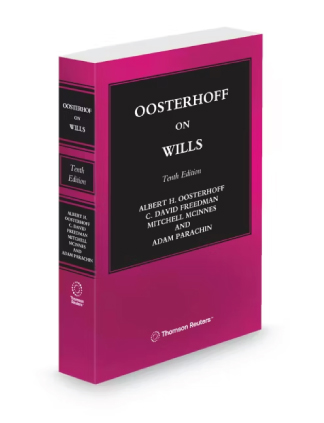
The amazing Albert H Oosterhoff has put out the 10th edition of Oosterhoff on Wills, with co-authors, C David Freedman, Mitchell McInnes, and Adam Parachin. Congratulations and thank you!
Buy your copy here
| | 6. STEP GLOBAL CONGRESS 2026: MIND, LAW AND MACHINE - NAVIGATING TRUSTS, ESTATES AND CAPACITY IN A DIGITAL AGE: NOVEMBER 24-25, BERMUDA | | |
JOIN US AT THE 2026 STEP GLOBAL CONGRESS: MIND, LAW AND MACHINE - NAVIGATING TRUSTS, ESTATES AND CAPACITY IN A DIGITAL AGE, 24-25 November 2026, Hamilton Princess Hotel & Beach Club, Bermuda
EARLY BIRD REGISTRATION HAS BEEN EXTENDED UNTIL SEPTEMBER 18, 2026 — DON’T WAIT!
https://www.stepevents.org/event/GlobalCongress/register
Why attend Global Congress?
Global Congress is a unique forum for STEP members and the wider profession to engage with both the technical realities of modern practice and the wider forces transforming our industry. It is your chance to connect with the world’s leading advisors and influential speakers from the forefront of our profession.
Across plenary sessions, panels and debates, the programme combines:
- In-depth technical discussion
- Real-world case studies and jurisdictional insights
- Thoughtful debate on emerging risks, responsibilities and opportunities
Be there to experience and participate in the current debates influencing the trusts and estates profession now, as well as the ones set to shape its future.
Full program information: https://congress.step.org/
Congress Chair: Kimberly A. Whaley, CS, TEP, LLM, QArb
| | WEL Partners takes great pleasure in congratulating our colleagues on their achievements, and to our delight there are many accomplishments of note this month. | | ELECTION FOR CANADIAN REPRESENTATIVE TO STEP WORLDWIDE COUNCIL | | WEL wishes to congratulate Leanne Kaufman on her re-election to STEP Worldwide Council! | | CONGRATULATIONS TO OUR NEW CHIEF JUSTICE OF THE FEDERAL COURT OF CANADA | | OBA AWARD OF EXCELLENCE IN CHILD AND YOUTH LAW | | (i) POTENTIALLY REPUGNANT CLAUSES IN WILL | | |
By Albert H. Oosterhoff
1. Introduction
Sometimes a will contains two clauses that could be considered to be repugnant to each other. If that is indeed the case, the court will typically hold that the second is repugnant to the first and cannot take effect. Older cases have often reached this conclusion. However, under the modern approach to will interpretation the court must consider the whole will and may find that the two clauses, properly interpreted, are not repugnant. The issue arose in the recent case, McCubbin v McCubbin.[1] The case also reminds us that direct evidence of the testator’s intention is not normally admissible.
2. Facts
Colin McCubbin (‘Colin’) married the applicant Louise McCubbin (‘Louise’) in 2009. They lived together at a house in Peterborough (the ‘Residence’) until Colin died in 2021. In 2015 Colin executed a handwritten holographic will. The respondents to the application were Colin’s two daughters from his first marriage, Julie and Nicola. Colin’s first wife died in 2001. The parties agreed that the will was valid, but they disagreed about the meaning of the following two clauses in the will:
MY WISHES IN THE EVENT OF MY DEATH: LOUISE MCCUBBIN (SPOUSE) SHALL ASSUME OWNERSHIP OF THE FAMILY HOME AND CONTENTS AT 19 MCNAB AVENUE.
IN THE EVENT OF LOUISE’S DEATH, JULIE MCCUBBIN (DAUGHTER) AND NICOLA MCGOEY (DAUGHTER) SHALL UPON THE SALE OF THE AFORESAID RESIDENCE, RECEIVE EQUAL SHARES IN ANY EQUITY REMAINING AFTER ALL OUTSTANDING DEBTS ARE PAID.
Louise argued that the first clause granted her full ownership of the Residence and that the second clause constituted a gift over that only applied if she died before Colin. The daughters argued that the first clause gave Louise a life interest in the Residue with a gift over in the amount equal to the net proceeds of sale of the residence when Louise died.
Colin made the will shortly before quadruple bypass surgery.
3. Analysis and Judgment
Justice Mathai began his analysis by reviewing the modern approach to interpreting wills. That approach requires the judge to occupy the position of the testator at the time he made his will and take into account the circumstances that existed at that time and which would undoubtedly have influenced him in disposing of his property. A common term for that process is that the judge should occupy the testator’s armchair. His Honour cited a number of authorities that have endorsed the process.[2]
Louise argued that the court can only consider extrinsic evidence if the will is ambiguous, but Justice Mathai rightly rejected the argument because it was based on earlier jurisprudence overruled by the cases mentioned.
The affidavits of Nicola and her husband Mr. Lang attested to different kinds of evidence. Justice Mathai rightly rejected evidence about Colin’s statements regarding his intentions about the residence because they constituted direct evidence of the testator’s intention. He also rejected evidence about the family members’ beliefs about what Colin intended to happen to the residence. His Honour cited further cases and other authorities in support of the point that direct evidence of the testator’s intention is generally inadmissible. He mentioned two exceptions to this rule. The first is equivocation when words in the will are equally applicable to two or more persons or things. The second is when the will contains a drafting error that should be rectified and the court can consider evidence from the drafting solicitor about the testator’s instructions. On the other hand indirect evidence of the circumstances at the time the will was made and contained in the affidavits of Nicola and Mr. Lang was admissible.
Justice Mathai then reviewed the jurisprudence on the rule of repugnancy and considered early cases, such as Re Walker,[3] which typically held that when a will left an absolute gift to one person but followed it by a gift over to a second person, the latter is repugnant to the first and is void. However, more modern jurisprudence applies the principle that the court should give effect to all parts of the will if that is possible. An example of the modern approach is Re Shamas.[4] In that case the testator gave ‘all I belong to my wife’ but went on to say that she should have it until the last of the children reached age 21. And he added that if his wife should marry again, she should have a share like each of the children, but ‘if not, she will keep the whole thing and see that every child gets his share when she dies’. McKay JA on behalf of the Court of Appeal held that this meant that the testator gave a life estate to his wife. He went on to point out that in the older cases the court applied common law rules of repugnancy that apply to property law and held that those rules do not apply when the court interprets a will. Justice Mathai also referred to other, similar, modern cases. But he went on to note that if two clauses in a will cannot be reconciled, the repugnancy rule has to be applied.[5]
Neither party argued that the clauses were inconsistent. Justice Mathai accepted the argument of Louise that the second clause in the will operates only if Lousie died before Colin. In reaching that conclusion, he focused on the phrase ‘assume ownership’ and held that the clear effect of that phrase was to give Louise ownership of the Residence. Thus, he rejected the argument of the respondents who argued that the first clause gave Louise only a life interest. He noted that while Colin prepared the will just before his bypass surgery, that did not mean that he did not consider the possibility that he might outlive Louise. Thus, he truly meant that Louise should, ‘assume ownership’ of the residence.
--
[1] 2026 ONSC 2079.
[2] Including Re Burke, [1960] OR 26 (CA), 1959 CarswellOnt 98 para 30; Dice v Dice Estate, 2012 ONCA 468, para 36; Trezzi v Trezzi, 2019 ONCS 978 para 14; Ross v Canada Trust Company 2021 ONCA 161 para 36; Jonas v Jonas 2022 ONCA 845 para 13.
[3] (1925), 56 OLR 517 (CA).
[4] [1967], 2 OR 275.
[5] Citing Re Paithouski (1978), 18 OR 2d 385 (CA).
| (ii) MEANING OF ‘IN THEIR ABSOLUTE DISCRETION’ | | |
By Albert H. Oosterhoff
1. Introduction
When a settlor or testator empowers trustees to do something with the trust property ‘in their absolute discretion’, ‘ in their uncontrolled discretion’, ‘in their absolute discretion,’ or by the use of similar language, what exactly does that mean? Does it give the trustees carte blanche to do as they please? Karrow v Boghosian[1] makes it clear that the trustees do not have carte blanche but are constrained by the terms of the trust and must maintain an even hand toward the beneficiaries, unless the trust ousts that fiduciary duty.
2. Facts
The testator, Elizabeth Karrow (‘Elizabeth’), died in 2016. She had made her Will in 2003. It appointed her sons Niel (‘Niel’) and Thomas Karrow (‘Tom’), and family friend and financial advisor Brian Cameron as Executors and Trustees. The Will provided that the residue of Elizabeth’s estate should be divided into four equal shares for the benefit of her grandchildren, the children of her four children. Each share was to be held in trust until the youngest grandchild in each set of grandchildren reached age 30. One of the four one-quarter shares, which is the subject matter of the proceedings in this case, was for the benefit of the children of Elizabeth’s son Niel, Jordan Boghosian (‘Jordan’) and Sarah Karrow (‘Sarah’). However, in respect of this share the Trustees were also empowered to make certain payments to Niel. Paragraph 3(s)(i)(b) of the Will provided in part:
TO KEEP INVESTED one (1) such equal share and to pay the whole or such part of the net income derived therefrom together with such part or parts of the capital thereof as my Trustees in their absolute discretion deem advisable to or for my son, NIEL ALEXANDER KARROW, and his children, or some one or more of them, to the exclusion of any one or more of them, in such proportions and in such manner as my Trustees in their absolute discretion deem advisable from time to time, provided however, that such payments shall be made to or for the children of my said son, NIEL ALEXANDER KARROW, only in situations where my Trustees in their absolute discretion consider such payment or payments to be advisable for the medical necessity or illness or disability of such child of NIEL and that payments shall be made to NIEL only in such situations as my Trustees in their absolute discretion consider such payments to be necessary to maintain NIEL’S standard of living . . .
The paragraph went on to direct that when Niel’s youngest child, i.e., Sarah, reached age 30, which will be in 2030, the Trustees should divide the amount remaining in the trust equally between Niel’s daughters, Jordan and Sarah.
The net amount of the share in question was $375,000. In June 2018 the two Trustees other than Niel authorized a payment of $50,000 to him and a further payment of $95,000 in October 2018. Niel had made requests to the other two Trustees for these payments because he was in financial difficulties after he and his former wife Jodie Boghosian (‘Jodie’) separated in 2011 and ultimately divorced. The two Trustees had sought the concurring advice of the estate lawyer before approving the requests. Niel asked for a further $80,000 in April 2019 so that he could purchase a home but after consulting the estate’s lawyer, the other two Trustees refused the request. In May 2019 Niel managed to purchase a new home.
The three executors (the ‘applicants’) brought an application to pass their estate accounts. The respondent, Jordan, opposed the application on the ground that the applicants failed to act with an even hand, exercised their discretion inappropriately, and depleted the capital of the estate for the benefit of her father Niel, and to the detriment of herself and her sister Sarah. Jordan also argued that the Trustees failed to abide by the terms of the Will because they authorized the payments to Niel without exercising due diligence. The respondents argued that the even hand principle had no application, since the Will had ousted it by giving them unfettered discretion.
3. Analysis and Judgment
3.1 Does the even hand principle apply in the case?
Justice Smith noted that the law permits a settlor or testator to give disproportionate interests to beneficiaries and thereby to avoid their duty to act impartially toward all the beneficiaries. But nonetheless, it is the duty of the trustees to carry out the terms of the trust and ensure that they do not give advantage or impose burdens on beneficiaries that the trust does not permit.[2]
The question was whether the language of Paragraph 3(s)(i)(b) permitted the Trustees to favour Niel over his children because of language such as ‘as my Trustees in their absolute discretion deem advisable’, and ‘some one or more of them, to the exclusion of any one or more of them’, as well as the provision that the Trustees could make payments to Niel’s children only when they ‘in their absolute discretion’ consider such payments ‘to be advisable for the medical necessity or illness or disability’ of a child, and that payments could only be made to Niel if the Trustees ‘in their absolute discretion consider’ the payments to be necessary to maintain Niel’s standard of living.
Justice Smith agreed with Jordan that this language did not relieve the Trustees of their duty to act impartially. To achieve that result, the testator should have said expressly that the Trustees did not have comply with the fiduciary duty to act impartially.[3]
Consequently, Justice Smith concluded that the language used in Paragraph 3(s)(i)(b) of the Will did not relieve the Trustees of the duty to adhere to the even hand principle. On the contrary, they could not ignore the interests of Jordan and Sarah but had to consider them.
3.2 Were the Trustees even-handed?
Justice Smith found that the Trustees did not act impartially.
First, Mr. Cameron swore that he had been legally advised that the Trustees did not have to act with an even hand, but the applicants asserted solicitor-client privilege over documents containing such advice.
Second, there was no evidence that the Trustees considered the interests of Jordan and Sarah. They only considered whether the payments made to Niel were necessary to maintain his standard of living.
Third, the size of the two payments to Niel, in the total amount of $145,000, confirmed that the Trustees did not maintain an even hand, since those payments amounted to almost 40% of the capital of the one-quarter share in question. In his Honour’s opinion the total amount ‘far exceeds what might have been reasonable to maintain Niel’s standard of living bearing in mind the interests of Niel’s children in the capital of the trust’. He held that this conclusion was supported by the structure of Elizabeth’s Will, the purpose of which was to give a substantial benefit to her grandchildren. In fact, by approving the payments to Niel, the Trustees allowed him ‘to encroach on the capital that was being held in trust for Jordan and Sarah for the purpose of fulfilling obligations he had toward them’, such as post-secondary education expenses and child support payments.
3.4 Did the Trustees act reasonably?
Since the Trustees ignored the interests of Jordan and Sarah, they breached the even hand rule, which amounted to a breach of their fiduciary duties, an absence of good faith, and an abuse of discretion. This meant that the Trustees failed to act reasonably when they approved the payments to Niel. This was evident from the meaning of the Will, which showed that the grandchildren were intended to be the primary beneficiaries of Elizabeth’s estate. In Justice Smith’s opinion, the Will could not be read to authorize a substantial gift to Niel of the capital of the relevant share (which was set aside for Jordan and Sarah).
Further, his Honour was not satisfied that the payments made to Niel were in fact necessary, or that the Trustees made inquiries about their necessity. Thus, he held that the evidence showed that the Trustees did not properly consider the question whether the payments were necessary to maintain Niel’s standard of living. This was true of the requests for both payments. Hence, the payments were unjustified.
3.5 Conclusion
Justic Smith noted that the burden of proof on an application to pass accounts is on the applicants. He considered the following circumstances, namely, the failure to act with an even hand, the failure to consider that the Will protected the interests of the two children, the approval of payments that represented a substantial portion of the capital of the trust, the failure to exercise due diligence, and the reliance on undisclosed legal advice, as well as the overpayment for legal fees, and the use of a portion of one of the payments for a purpose other than one for which it was requested. In consequence, his Honour held the requests for payment were unreasonable, and so were the payments themselves. Further, he held that the applicants failed to meet their burden to establish reasonableness and did not exercise the ordinary prudence of a person managing his own affairs.
3.6 Remedy
Justice Smith referred to section 49(3) of the Estates Act[4] and noted that it gives him power to order an executor, administrator, or trustee to pay such sum by way of damages or otherwise as he considers proper and just. He held that all three trustees were responsible for the payments made and ordered that they be jointly and severally liable to repay the amount of $145,000 to the trust with interest from the dates of the payments.
--
[1] 2026 ONSC 6680.
[2] Quoting an earlier edition of Waters’ Law of Trusts in Canada. The same quotation can be found in the 5th edition of that eminent text (Toronto: Thomson Reuters, 2021) p. 1090.
[3] Citing Clayton v Clayton, 2021 ONSC 5811, para 57, per Corthorn J., and Re Carley Estate (1994), 2 ETR 2d 242 (Ont SCJ), para 12, per Greer J., as authority, and distinguishing, inter alia, Edell v Sitzer (2001), 51 OR 3d 198, affirmed (2004), 9 ETR 3d 1 (Ont CA).
[4] RSO 1990, c E.21.
| | (iii) ESTATE OF WILLIAM ROBERT WATERS UPDATE | | (iv) WHEN THE BENEFICIARY IS A CHILD: PROTECTING MINORS IN ESTATE LITIGATION | | |
By Grant Swedak
August 12 is recognized as International Youth Day, a day dedicated to celebrating young people and the causes they champion. At first glance, this occasion may not seem like an obvious fit for an estates law blog; however, the role of minors, and the law's particular protections for their interests, arises in estate disputes more often than one might expect.
Introduction
Estate litigation naturally arises out of disputes regarding an individual’s succession planning and the instruments/vehicles used to facilitate the intergenerational transfer of their property. Accordingly, because the succession planning is often focused on passing property down to the next generation and along familial lines, it is often the case that, whether directly or indirectly, an interest in property is afforded to a minor beneficiary.
The difficulty that arises in circumstances where a minor beneficiary has an interest in property which is the subject of litigation is that the Rules of Civil Procedure[1] precludes minors from personally advancing their position. This is a result of Rule 1.03(1), wherein the term “Disability” is defined to include a person who is a minor.
While the preclusion of a minor being able to advance or represent their position personally seems contrary to the interests of justice, the effect of being classified as a party under disability engages the protective procedural framework of Rule 7.
This blog will focus on the two primary ways in which Rule 7 protects the interests of these minor beneficiaries; namely, through the appointment of a litigation guardian and through the approval of settlement.
Appointment of a Litigation Guardian
Rule 7.01(1) provides that, absent a court order or statutory exception, a proceeding shall be commenced, continued, or defended on behalf of a party under disability (i.e. any minor) through a litigation guardian.
In Ontario, a litigation guardian is a person who conducts civil litigation on behalf of a party under disability, exercising the procedural rights of that party, and taking all steps necessary to protect their interests. The powers and duties of a litigation guardian are set out pursuant to Rules 7.01(3)-(5).
Determining the appropriate litigation guardian for the party under disability is set out between Rule 7.01.1, Rule 7.02, Rule 7.03, and Rule 7.03.1. The process is essentially bifurcated according to whether the party under disability is the plaintiff/applicant or the defendant/respondent. Depending on which route is most applicable, each of the above-noted Rules set out their own requirements which must be satisfied in order to act as litigation guardian.
Rule 7.02(4) sets out the requirements which must be met in order to act as the litigation guardian for a plaintiff/applicant without a court order. Rule 7.03(3) sets out the requirements which must be met in order to act as the litigation guardian for a defendant/respondent without a court order. Whereas Rule 7.03.1(5) and Rule 7.03.1(9) set out the requirements for a motion seeking an order of appointment of a litigation guardian, with Rule 7.03.1(1) setting out who is entitled to make such a motion.
When Acting as a Litigation Guardian
Once appointed, the litigation guardian does not simply rubber-stamp counsel's strategy. The litigation guardian is required to act in the best interests of the party under disability and therefore must provide instructions to their counsel lawyer that accords with the party under disability’s best interests.
Where no proper person is willing or able to act, the Court may appoint the Office of the Children's Lawyer (“OCL”) to act as litigation guardian for the minor.[2]
The OCL's involvement is not the default litigation guardian; rather, they are entitled to be appointed precisely because the Rules will not permit a minor beneficiary's interest in the litigation to go unrepresented. Critically, if it later appears to the Court that an appointed litigation guardian is not in fact acting in the disabled’s best interests, the Court retains the authority to remove the litigation guardian and appoint another.[3]
Approval of Settlement on Behalf of a Party Under Disability
Even where a litigation guardian has been properly appointed and executed minutes of settlement outlining terms of resolution and settlement, Rule 7.08(1) holds that no settlement made by or against a person under disability is binding without the approval of a judge.
This requirement is not a procedural technicality; it is a codification of the Court's parens patriae jurisdiction, described by the Ontario Court of Appeal in Wu Estate v. Zurich Insurance Co. as existing to ensure the settlement is genuinely in the best interests of the party under disability, and that their legal rights are not compromised or surrendered without proper compensation.[4]
Rule 7.08(4) sets out the materials required to satisfy the Court on this point, which include an affidavit sworn by the litigation guardian addressing the material facts and their position on the proposed settlement; a separate affidavit sworn by the lawyer acting for the litigation guardian; where the minor is over sixteen, their written consent unless the judge orders otherwise; and a copy of the proposed minutes of settlement.
On a motion or application for approval of settlement, the Court is required to consider whether the proposed settlement is in the best interests of the person under disability.[5] Although approval does not depend on a comparison of what may have been awarded at trial, proper assessment of a proposed settlement should consider all material issues, including the party's benefit given the risks of litigation and the desire of the party to settle.[6]
Final Remarks
Where minors have an interest in estate litigation, the Rules carve out a protective procedural framework designed to ensure that a person who cannot fully protect their own legal interests is neither left unrepresented nor bound by a resolution without independent scrutiny.
Where a minor's interest is engaged, representation should be addressed at the outset, but the litigation should not be treated as capable of being finally resolved until the court has had the opportunity to independently assess whether the proposed outcome is in the minor's best interests.
In that sense, the procedural protections afforded to minor beneficiaries are not technical obstacles to settlement; they are an expression of the Court's broader protective role over those whose interests the law requires it to safeguard.
--
[1] R.R.O. 1990, Reg. 194: RULES OF CIVIL PROCEDURE, at Rule 1.03(1) (the “Rules”).
[2] Ibid., at Rule 7.03.1(10).
[3] Ibid., at Rule 7.06.
[4] Wu, Re, 2006 CanLII 16344 (ON CA), at para 10.
[5] Spicer v Wawanesa Mutual Insurance Company, 2023 ONSC 3221 (CanLII), at para 14.
[6] Ibid., at paras 14 and 16.
| | (v) DAS GUPTA v. DAS GUPTA, 2026 ONSC 3310 - WHEN FIDUCIARIES OBSTRUCT: MOOT GUARDIANSHIP COSTS, TRUSTEE REMOVAL, AND FULL-INDEMNITY COST CONSEQUENCES | |
By Jessica Homer
Background
Gerlinde died on or about February 16, 2023 (the “Deceased” or “Estate”). The Deceased was survived by her two children, Sonya and Amit.[1]
Amit was appointed the Deceased’s then Attorney for Property and subsequently as Estate Trustee pursuant to the Deceased’s Last Will and Testament (the “Will”).[2]
Sonya initially commenced a guardianship application where she sought a guardianship order for the Deceased. Following the Deceased’s passing, Sonya commenced a further application against Amit in his capacity as Estate Trustee (the “Consolidated Applications”).[3]
On or about November 5, 2026, due to Amit’s unreasonable conduct, failure to adhere to court orders and cause undue delay and costs in the proceedings, the Honourable Justice Gilmore ordered that Amit’s pleadings and Notice of Appearance be struck from the record prohibiting him from participating any further.[4]
Issues
The court was tasked with determining a host of issues in the Consolidated Applications. However, this blog will focus on three. Particularly, (1) who ought to pay costs in the guardianship application, (2) Amit’s removal as Estate Trustee, and (3) the determination of costs in the Consolidated Applications.
Application
#1: The Costs of the Guardianship Application
In arriving at a determination of who was responsible for costs, the court considered Lacaria v. Lacaria, 2026 ONSC 591, which dealt with a similar set of facts wherein an incapable mother died seven months following the commencement of a guardianship application.[5]
Where a guardianship application is rendered moot by the death of the alleged incapable, the court will consider the following in determining costs:
- Whether the incapable person benefitted from the proceeding;
- Whether the proceeding was conducted reasonably; and
- That the only actual costs incurred before the death of the incapable person should be awarded.”
Sonya argued that the Deceased did benefit from the application considering Amit’s refusal to produce information respecting his appointment as the Deceased’s then attorney and his refusal to have counsel appointed for the Deceased pursuant to section 3 of the Substitute Decisions Act.[6]
The Court agreed and found that Sonya had little choice but to commence the guardianship application, and that costs sought were reasonable in the circumstances.[7] Sonya sought $13,224.01 in costs from the Estate of the Deceased, representing 50% of her full indemnity costs.
#2: Removal of Amit as Estate Trustee
On or about January 9, 2025, an Estate Trustee During Litigation (“ETDL”) was appointed. However, because an ETDL does not have the authority to distribute an estate in order to wind up the estate administration, the ETDL exhausted its authority. As such, Sonya sought to have Amit passed over as Estate Trustee and have the ETDL formally appointed as in his place.[8]
When removing an estate trustee, the court will consider the factors as set out in Radford v. Radford Estate (2008), 2008 CanLII 45548 (ON SC):
- the court will not lightly interfere with the testator’s choice of estate trustee;
- clear evidence is required that removal of the trustee is necessary;
- the court’s main consideration is the welfare of the beneficiaries; and
-
the estate trustee’s acts, or omissions must be of such a nature as to endanger the administration of the trust.[9]
In considering the forgoing, the court drew significant attention to Amit’s past conduct:
-
As outlined in the Honourable Justice Gilmore’s Order dated November 5, 2025, Amit has acted in a conflict of interest as between himself and the beneficiaries;[10]
-
Amit’s failure to comply with various court orders;[11] and
-
Amit’s misappropriation of the Deceased’s funds and related breach of fiduciary duties.[12]
Accordingly, the Court found that it was necessary for the ETDL to be appointed in Amit’s place to ensure that the beneficiaries’ interests were protected.[13]
#3 Costs in the Consolidated Applications
Sonya sought her costs of $166,040.47, on a full indemnity basis payable from Amit’s share of the Deceased’s Estate. [14]
The Court considered various well-established cost principles in coming to a determination on costs, including but not limited to:
-
The Court’s discretion to award costs pursuant to section 131 of the Courts of Justice Act;
-
The “loser pays” principle, held applicable to estate litigation by the decision in Bilek v. Salter Estate, [2009] O.J. No. 2328, 2009 CanLII 28403 (S.C.J.);
-
The factors as outlined in Rule 57 of the Rules of Civil Procedure; and
-
The reservation of full indemnity costs to exceptional circumstances.[15]
Sonya requested full indemnity costs on the basis that; the proceedings were made more complex by Amit’s conduct and refusal to cooperate which caused undue delay; and the proceedings were important to Sonya in terms of having the Estate administered.[16]
Considering the above, the Court characterized Amit’s conduct as “egregious” and awarded Sonya’s full indemnity costs against Amit’s share of the Estate. Should that share not satisfy the $166,040.47 awarded, any remaining balance owing was ordered to be paid by Amit, personally.[17]
Takeaways
The Court reinforced core estate‑litigation principles: costs in guardianship matters turned moot by death focus on benefit, reasonableness, and pre‑death expense; removal of a trustee hinges on beneficiary welfare and conduct that endangers administration; and full indemnity costs are exceptional but warranted for egregious, obstructive behaviour. For fiduciaries, transparency and compliance are not optional—they are essential to avoid personal cost exposure and replacement.
---
[1] Das Gupta v. Das Gupta, 2026 ONSC 3310 (CanLII) at para 2 & 5.
[2] Ibid at para 2.
[3] Ibid at para 8.
[4] Ibid at para 4 & 9.
[5] Ibid at para 15.
[6] Ibid at para 17.
[7] Ibid at para 18.
[8] Ibid at para 74.
[9] Ibid at para 75.
[10] Ibid at para 76.
[11] Ibid at para 76.
[12] Ibid at para 78.
[13] Ibid at para 78.
[14] Ibid at para 86.
[15] Ibid at para 88.
[16] Ibid at para 86.
[17] Ibid at para 91.
| | (vi) COSTS FROM THE ESTATE DOES NOT MEAN FULL INDEMNITY: KUNKA ESTATE v. GIASSON, 2026 ONSC 4290 | | |
By Emily Caza
In Kunka Estate v. Giasson, 2026 ONSC 4290[1] (“Costs Decision”), the Ontario Superior Court of Justice considered the appropriate scale and quantum of costs following the dismissal of an estate trustee’s application concerning beneficiary designations on registered accounts. The decision provides a useful reminder that, even where public policy considerations justify payment of a party’s costs from an estate, full indemnity does not automatically follow.
Background
In the underlying decision, Kunka Estate v. Giasson, 2026 ONSC 1842 (“Merits Decision”), Justice Horvat dismissed the Estate Trustee’s application concerning whether beneficiary designations made on registered accounts, including an RRSP and RIF, were subject to a resulting trust and formed part of the Estate.[2]
Justice Horvat determined that the respondent, Ms. Giasson, was entitled to her costs payable from the Estate rather than personally by the Estate Trustee. When the parties could not agree on the amount, they made written submissions.[3]
Ms. Giasson sought $43,583.49 on a full indemnity basis, or alternatively $34,556.42 based on partial and substantial indemnity costs.[4] The Estate submitted that $10,000 was appropriate.[5]
When Should Costs Be Paid from the Estate?
Justice Horvat began by reiterating the distinct approach to costs in estate litigation.
Relying on McGrath v. Joy Estate, 2022 ONCA 119 (“McGrath”), and McDougald Estate v. Gooderham, 2005 CanLII 21091 (ONCA) (“McDougald”), the Court confirmed that the first step is to consider whether public policy would justify payment of reasonable costs from the estate.[6] Those considerations include circumstances where there are reasonable grounds to question the execution or validity of a will, or where the difficulties or ambiguities giving rise to the litigation were caused by the testator.[7]
Where those considerations are not engaged, the ordinary civil costs principles apply.[8]
In the underlying Merits Decision, Justice Horvat had already determined that the relevant public policy considerations were engaged.[9] Accordingly, there was no dispute that Ms. Giasson’s costs were payable from the Estate.[10] The issue was the appropriate scale and amount of those costs.
Estate-Funded Costs Are Not Necessarily Full Indemnity Costs
Ms. Giasson argued that full indemnity costs were appropriate because she had been compelled to participate in the application as a necessary party and should not personally bear the expense of doing so.[11]
Justice Horvat disagreed. There was no evidence of the reprehensible, scandalous, or outrageous conduct ordinarily required to justify full indemnity costs.[12]
Importantly, the Court emphasized that public policy considerations articulating in McGrath must be balanced against the Court’s obligation to guard against litigation unnecessarily depleting an estate.[13]
Accordingly, the fact that Ms. Giasson’s costs were payable from the Estate did not entitle her to recover them on a full indemnity basis.
The Offer to Settle
The Court also declined to award substantial indemnity costs following Ms. Giasson’s offer to settle.
Justice Horvat found that the offer involved an insignificant compromise and provided little incentive for the Estate to accept it, particularly given the unsettled law that had prompted the application.[14] There was therefore no basis to fault or punish the Estate for declining the offer.
Conclusion
The Court ultimately awarded Ms. Giasson $26,963.13 in costs on a partial indemnity basis, together with $2,081.76 in disbursements, payable from the Estate.[15]
The Costs Decision reinforces that the source and scale of a costs award are separate considerations in estate litigation. Even where the public policy considerations identified in McGrath justify payment of costs from an estate, only reasonable costs are recoverable, and full indemnity does not automatically follow. Reasonableness and proportionality remain central to balancing fair compensation for parties required to participate in estate litigation against the need to protect the estate from unnecessary depletion.
---
[1] 2026 ONSC 4290 [Kunka].
[2] Ibid at para 1.
[3] Ibid.
[4] Ibid at para 2.
[5] Ibid.
[6] Ibid at para 4.
[7] Ibid.
[8] Ibid at para 5.
[9] Ibid at para 8.
[10] Ibid.
[11] Ibid at para 9.
[12] Ibid at para 10.
[13] Ibid.
[14] Ibid at para 11.
[15] Ibid at paras 12-13.
| | (vii) ADULT CHILD UNDER DISABILITY SEEKS SUPPORT: WHY THE COURT SAID “NOT A DEPENDANT” | | |
By Mark Polese
The Ontario Superior Court of Justice was recently made to consider a claim for dependant’s support in the context of an adult child with a developmental disability in Jason Lappan v. Estate of Florence Bevins et al.[1]
Background
The matter concerned an application for dependant’s support brought by the son (the “Applicant”) of Florence Bevins (the “Deceased”) pursuant to s.58(1) of the Succession Law Reform Act (“SLRA”).[2] The Deceased passed in September of 2023, leaving a will dated November 14, 2022 (the “Will”). The principal asset of the Deceased’s estate (the “Estate”) was a residence located in Gananoque, Ontario, with an estimated value of $269,258.38, which the Will directed go to the Deceased’s granddaughter.
The Applicant received a 10% share of the residue of the Estate, which amounted to approximately $6,000, though he was also the designated beneficiary of the Deceased’s registered disability savings plan valued at approximately $29,000.
At the time of the application, the Applicant was 50 years old and has developmental disabilities that impacted his cognitive functioning and independence. Despite this, he lived apart from the Deceased and received income from various sources that are sufficient to pay his expenses, though his property is now managed by the Public Guardian and Trustee (the “PGT”). The PGT has been managing the Applicant’s property since August of 2024 and served as his litigation guardian through these proceedings. There is no clear evidence that the Deceased contributed her own funds toward the Applicant’s needs.
As of 2026, the Applicant had limited assets, and his financial position is modest. His expenses reflected his supported living environment in Kingston, Ontario, including housing, a personal allowance, and insurance. The PGT claimed that the Applicant’s current level of funding did not adequately support his lifestyle and that additional funds would improve his nutrition, clothing, personal care, and opportunities for social engagement. Additionally, it was submitted that the Applicant may have future health and mobility needs.
Analysis
Section 58(1) of the SLRA permits the court to order adequate provision for the proper support of a deceased’s dependants. The analysis proceeds in three stages: whether the applicant is a dependant, whether adequate provision has been made, and, if not, what provision should be ordered.[3]
The Court began its analysis by determining whether the Applicant constituted a “dependant” within the meaning of the SLRA. A dependant includes a child to whom the deceased was providing support, or was under a legal obligation to provide support, immediately before death. The Court noted that the evidence did not establish that the Deceased was providing financial support to the Applicant within the meaning of the SLRA as the Applicant’s living expenses were met from his own income. There was evidence that the Deceased assisted in administering the Applicant’s finances, though that role only involved the management and disbursement of the Applicant’s own funds.
The Court stated that in this case, the analysis then turns to whether the Deceased was under a legal obligation to support the Applicant by reason of his circumstances, noting that the jurisprudence in Ontario recognizes that an adult child with a disability may remain dependant notwithstanding the receipt of independent income. The relevant inquiry is whether, having regard to the child’s condition, means, and needs, the child has withdrawn from parental charge or remains in a relationship of dependency giving rise to a continuing support obligation.
The Court, citing Weber v. Weber,[4] noted that the question is not whether an adult child can meet basic subsistence needs, but whether their resources are sufficient to meet their reasonable needs having regard to their circumstances. Considering these principles, the Court found that while the Applicant is significantly vulnerable, there is not sufficient evidence to satisfy the Court that he remained dependant on the Deceased within the meaning of the SLRA. He had lived apart from the Deceased for many years, and his daily needs are met through a comprehensive combination of public benefits and institutional services.
Even accounting for his disability, the evidence does not establish that Jason remained in a relationship of dependency giving rise to a continuing obligation on Florence, as opposed to reliance on state and institutional structures independent of any parental role.[5] As such, it was held that the Applicant could not establish that he was a dependant.
However, given the closeness of the issue in the mind of the Court, Jenson J proceeded to consider the adequacy of provision in the alternative. If the Applicant were found to be a dependant, the Court would apply the framework for assessing the adequacy of the Deceased’s provision for him in the Will as set out in Tataryn v. Tataryn Estate. Here, wthe Supreme Court of Canada made it clear that adequacy must be assessed having regard to both legal and moral obligations balanced against the principle of testamentary autonomy.[6]
Additionally, in determining whether adequate provision was made for the Applicant, the Court would consider the factors set out in s.62(1) of the SLRA,[7] which guide the assessment of a dependant’s circumstances, the competing claims on the estate, and the means and intentions of the deceased.
Jenson J noted that the Applicant’s circumstances reflected a person with limited means, modest assets, and a degree of vulnerability. While the evidence suggested that additional financial support could enhance his quality of life, his current resources allowed him to live at a basic but adequate level. When weighing these considerations alongside the circumstances of the estate, the Court noted that the estate itself here was modest and largely illiquid, and that the court must further take into account the Deceased’s expressed testamentary intentions, which reflected an effort to balance her family’s competing interests within the constraints of her limited resources.
As such, the Court found that this was not a case in which the testamentary scheme left the Applicant unable to meet his reasonable needs, nor was it one in which the deceased failed to recognize a clear legal obligation. Therefore, it was held that adequate provision was made for the Applicant’s proper support by the Deceased.
Final Thoughts
Despite the Applicant’s modest resources and means, the Court was not willing to go so far as to consider him a dependant or make a finding that the relatively modest amounts left to him by the Deceased was inadequate. In my view, the key factor in this decision hinged on the fact that the Applicant had a robust support system through the PGT to manage his property despite his relatively modest income. If that had not been the case, it is possible that the legal obligation of the Deceased to provide the Applicant support could have been much more robust, since the Court here noted that, even with this strong support system through the PGT, this is still a case that is close to the line as to whether or not the Applicant was a dependant within the meaning of the SLRA. This case is an interesting result given all the ways it could have been concluded given the myriad of conflicting case law.
--
[1] Jason Lappan v. Estate of Florence Bevins et al, 2026 ONSC 3722
[2] Succession Law Reform Act, R.S.O. 1990, c. S.26 at s.58(1)
[3] Cohen v. Cohen, 2019 ONSC 4456 (CanLII), at para. 43
[4] Weber v. Weber, 2020 ONSC 4098, at para. 58
[5] Supra note 1 at para 27
[6] Tataryn v. Tataryn Estate, 1994 CanLII 51 (SCC), [1994] 2 S.C.R. 807 at para. 33:
[7] Supra note 2 at s. 62(1)
|
| (viii) LESSARD v. CULIC: COSTS AWARDED AGAINST ESTATE TRUSTEE FOR DELAY IN ADMINISTRATION | | |
By Oliver O'Brien
In Lessard v. Culic,[1] the Court imposed substantial indemnity costs on an Estate Trustee, personally, for delay in the administration of an Estate.
Background
The proceedings arose from the estate of Henry O’Hare, who died on November 23, 2023. At death, the Deceased owned two real properties and other assets that exceeded $1,000,000.[2]
In his Last Will and Testament, he named the Respondent, Mr. Culic, as his Estate Trustee. In the two years following the Deceased’s death, Mr. Culic had not applied for a certificate of appointment or provided information regarding assets, liabilities, or administration to the beneficiaries. This included the Applicant, Ms. Lessard, who was the Deceased’s stepdaughter, and a residual beneficiary of his Estate.[3]
Ms. Lessard successfully moved to appoint a neutral Estate Trustee During Litigation (ETDL) to preserve the Estate’s assets and deal with one of the real properties which had become vacant, given the inaction by Mr. Culic. Mr. Culic did not file materials, respond to, or attend the motion, despite being served with notice of same.[4]
Following success on the motion, the Applicant sought substantial indemnity costs of $20,708.74 payable personally by Mr. Culic, citing a pattern of non‑responsiveness that impeded administration and necessitated the motion. In response, Mr. Culic sent a letter reproducing informal bullet‑pointed comments, critiquing rates and hours in general terms and asserting that substantial indemnity costs were only awarded in exceptional situations. He also stated an Outlook “scheduling error” caused his non‑attendance at the ETDL motion and suggested he would have resigned had a “no‑damages and no‑costs” option been presented.[5]
Cost principles
The central issue in Lessard to be determined was the allocation of legal costs of Ms. Lessard’s Motion.
The discretion of a judge to determine by whom and to what extent costs shall be paid are set out in section 131 of the Courts of Justice Act.[6] In exercising this discretion, a court may consider, in addition to the results and any offers to settle, a series of factors set out in Rule 57.01 of the Rules of Civil Procedure.[7]
The general costs rules for civil litigation apply equally to estates litigation – the loser pays. This is subject to a court’s consideration of all relevant factors under Rule 57, and subject to limited exceptions, which includes: (1) the need to give effect to valid wills that reflect the intention of competent testators; and (2) the need to ensure that estates are properly administered.[8]
In Goodman Estate v. Geffen,[9] the Supreme Court of Canada noted that “the courts have long held that trustees are entitled to be indemnified for all costs, including legal costs, which they have reasonably incurred. Reasonable expenses include the costs of an action reasonably defended.”[10]
Rule 57.01(4) permits a judge to award elevated levels of costs, including substantial and full indemnity, “where the losing party has engaged in behaviour worthy of sanction.”[11] Elevated costs should only be awarded where “there has been reprehensible, scandalous or outrageous conduct on the part of one of the parties.”[12]
Analysis
The Court found that substantial indemnity costs were fair, reasonable, and proportionate, when considering the facts in Lessard.[13]
In this regard, the Court noted the Applicant’s entitlement to costs, a pattern of non‑responsiveness impeding administration by Mr. Culic as the Estate Trustee; his refusal—without reasons—to consent to an ETDL despite inaction for nearly two years; and that his conduct necessitated the motion and costs incurred.[14]
The Court rejected Mr. Culic’s submissions entirely, noting the absence of legal authority, analysis, specificity on appropriate rates or hours, and the failure to engage with the Applicant’s materials. The Court described his late and inadequate submissions, failure to attend without reasonable explanation, and failure to file materials, as reflecting a lack of respect for the process and the Court, warranting an elevated order.[15]
Concluding Comments
The Court ordered that Mr. Culic shall personally pay the Applicant’s costs in the amount of $20,708.74. The Court concluded that substantial indemnity was necessary to indemnify the successful Applicant, reflect the seriousness of the fiduciary’s conduct, and deter similar behaviour by estate trustees.[16]
Lessard highlights the Court’s readiness to sanction fiduciaries whose conduct delays and complicates estate administration, particularly where neutral interim management is resisted without reason.
---
[1] Lessard v. Culic, 2026 ONSC 1814 (“Lessard”).
[2] Lessard at para 2.
[3] Lessard at para 4.
[4] Ibid.
[5] Lessard at paras 9 and 10.
[6] Courts of Justice Act, RSO 1990, c C.43.
[7] Rules of Civil Procedure, RRO 1990, Reg 194.
[8] Sawdon Estate v. Sawdon, 2014 ONCA 101 at para 84.
[9] Goodman Estate v. Geffen, 1991 CanLII 69 (SCC).
[10] Goodman Estate v. Geffen, 1991 CanLII 69 (SCC) at para 75.
[11] Davies v. Clarington (Municipality) et al., 2009 ONCA 722 at para 28; Dewaele v. Roobroeck, 2021 ONSC 1604 (CanLII) at para 19.
[12] Young v. Young, 1993 CanLII 34 (SCC), [1993] 4 S.C.R. 3, at p. 134.
[13] Lessard at para 14.
[14] Lessard at paras 14 and 15.
[15] Lessard at paras 15 – 17.
[16] Lessard at para 19.
| | (ix) ELDER LAW AND THE CRIMINAL CODE BLOG SERIES I: WHY YOU SHOULD FOLLOW THIS SERIES | | |
By Jaclyn Holdsworth
Elder law involves the laws and rights of older adults in all practice areas, including criminal law. When a crime has been committed against an older person, civil and criminal remedies may both be available. For example, I have previously blogged about civil and criminal remedies that may be available where there’s a predatory marriage.[1] This blog series will seek to provide insight on how cases we see on a regular basis can overlap with provisions of the Criminal Code. The series may be a helpful primer for professionals who want to improve their ability to issue-spot and refer clients to appropriate resources, or for anyone living in Canada that may one day need to advocate for themselves or a loved one.
I want to preface from the beginning that there are a host of valid reasons a victim may not want the police to become involved in a matter. Not everything can, or should, be dealt with as a criminal matter. The purpose of this series is merely to provide a tool for spotting and talking about criminally concerning behaviour.
One tool for advocacy is knowing the correct people to speak with. In many police departments, you can ask to speak with someone who has been trained in senior abuse. Some jurisdictions also have specialised units, like the following:
- Calgary Elder Abuse Response Team (EART): 403-266-1234
- Durham Regional Police Senior Support (OASIS) Unit
- Hamilton Police Senior Support Officer: 905-546-4925
- Seniors Protection Partnership Intake Line: 780-477-2929
- Toronto Police Service Vulnerable Persons
- York Police Senior Safety Officers: 8 a.m. to 4 p.m. at seniorsafety@yrp.ca or 1-866 876 5423 ext. 6697
Another tool for advocacy is knowing what the police are looking for when they decide if charges can be laid. The police will only lay a criminal charge if they think an offence has been committed. Once the police lay a charge, government lawyers (Crown Attorneys) can only proceed with the charge if they think it is more likely than not that they will get a conviction.[2]
To help break down when bad behaviour is actually criminally unacceptable, the series will examine the Criminal Code,[3] and to a lesser extent the Canada Evidence Act[4] and Ontario’s Crown Prosecution Manual.[5] You can expect upcoming blogs to discuss, in an elder law context, the criminal burden of proof, what evidence is admissible, fraud, forgery, assault, harassment, neglect, and the many different criminal code provisions for theft. If there is an additional topic you want to see covered, I warmly welcome you to reach out to jaclyn@welpartners.com.
--
[1] Predatory Marriage Series Blog: Civil and Criminal Remedies | WEL Partners Blog
[2] D. 3: Charge Screening | Crown Prosecution Manual | ontario.ca
[3] Criminal Code, R.S.C., 1985, c. C-46
[4] Canada Evidence Act, R.S.C., 1985, c. C-5
[5] Crown Prosecution Manual | ontario.ca
| | A REVIEW OF I SLEEP IN MY KITCHEN BY MARIAM DAUD | | |
By Sam Henderson-Whaley
The covid lockdowns were, in almost every respect, downright awful. The only positive thing I can ever think to say about this period is that, locked away in our homes, with barriers to connection, and hobbies, and the outdoors, we got creative with how we spent our time. People picked up new hobbies, learned new skills, and spent time doing things they’d been putting off for years. When forced to completely drop out of our routines, we adapted. Prior to 2020, I could have been accused of being able to burn water. My undergraduate roommates can attest to my challenges: the time I managed to make world’s worst smoothie (I still don’t know how I made it both watery and grainy), the time I interpreted “two cloves of garlic” as two entire heads of garlic (our undergrad house, and perhaps the whole neighbourhood, was protected from the presence of vampires for a few days at least), and the time I tried to make carbonara pasta and every single ingredient separated so that the result was an oily looking soup heavy on the noodles. All that to say, I had my work cut out for me.
Just prior to the first lockdown, my roommate convinced me to download TikTok, and one of the first creators I followed on my account was @mxriyum, a cooking and baking content creator who opened her videos with the line, “hi, my name is Mariam, and I’m addicted to carbs.” So basically, she spoke to my soul. Where I had always struggled with cooking, I have historically been quite a competent baker. I love rules and precision, so learning the science of baking came rather easier to me than the instinct required for cooking. I can remember vividly that the first recipe of Mariam’s I ever tried was her garlic knots, which blew my mind, and that was quickly followed by her snickerdoodles, banana bread, and chocolate chip cookies. Every single recipe was fantastic, she never led me astray, and so, with a built-up trust in the advice she posted, I ventured into cooking some of her dinner recipes. Her videos are instructive, clear, relaxing, bordering on therapeutic, and provide ample inspiration for your stomach. To this day, I would credit Mariam’s channel with my current competence and interest in cooking. Which is why, when I learned that Mariam published her first cookbook in March, I immediately went out and got a copy.
In I Sleep in My Kitchen, Mariam shares dishes she grew up with in her Palestinian American home, and many playful and inventive recipes of her own. This cookbook contains one hundred dishes, encompassing breakfast, sides & salads, soups & stews, pasta & rice, breads, seafood, poultry, meat, and, most importantly, desserts. In this entire summer, I’ve barely made a dent, but I can assure you that every single recipe I’ve tried has been heavenly. The loaded chickpea salad with lemon-garlic shrimp, the teriyaki salmon with mango salsa and quinoa, the cast-iron chicken with tarragon, olives, and charred lemon, and the sumac and lemon roast chicken with tahini salad, have been my absolute favourite meals of the summer. The chickpea salad and mango salsa, in particular, have been staple sides for all of our meals throughout August! The food is amazing… but the dessert is beyond words. I have made many of Mariam’s chocolate chip cookie recipes over the years, and they’ve always been delicious, but the “generational” chocolate chip cookie recipe in her book has completely changed the game. These are the best homemade chocolate chip cookies I have ever had (a bold, but true claim), they’re fluffy, soft, and perfectly balanced. Her fudge brownies will send you into the most contented sugar overload of your life.
The recipe that stands out to me the most, however, is Mariam’s tahini and browned butter banana bread. This recipe is unique, showcasing Mariam’s flair and complex understanding of flavour profiles, and it makes banana bread with the most perfect soft texture. As Mariam outlines in the book, this recipe won’t scream “tahini,” but the tahini will add more of a slight sweetness and softer texture. The browned butter adds a nuttiness that compliments the bananas and chocolate, and absolutely no one could complain about the smell emanating from your kitchen while you brown the butter. While baking this recipe, strangely, my first thought was of how real estate agents will sometimes tell homeowners to bake something before people come to view their house to encourage a cozy and inviting atmosphere, and that this recipe should become the standard for what real estate agents should have sellers bake. If I walked into a home that smelled like this banana bread, I couldn’t be blamed for any resulting hasty decisions.
As with any good book, there’s a good story here too, and food is at its centre. These aren’t just meals, many of these dishes are closely intertwined with memories, culture, and family. From staple meals like the chicken shawarma her mother made and always had on hand for their household of twelve, and the national dish of Palestine, msakhan, that Mariam recalls her mother making all the time, especially for Ramadan, to the roasted yellow pepper pasta that was Mariam’s strike of lightening after a series of “recipe development fails,” something she developed when she decided to make something comforting just for her, this book feels personal in a way cookbooks rarely showcase this harmoniously. Food brings people together, it is, and always has been, a point of gathering, and that is exactly how reading I Sleep in My Kitchen feels. If you’re looking for inspiration in the kitchen, good comfort food, unique approaches to beloved dishes, or just a reliably fantastic source of recipes and culinary guidance, I cannot recommend Mariam Daud’s cookbook and all of her social media content enough!
| | |
Canadian Lawyer Webinar Series
September 22, 2026
Speaking: Kimberly Whaley, Bryan Gilmartin, Ian Hull & Suzana Popovic-Montag link
Medical Experts Presentation
September 23, 2026
Speaking: Bryan Gilmartin
Law Society of Ontario Probate Essentials 2026
September 25, 2026
Speaking: Bryan Gilmartin
https://store.lso.ca/practice-gems-probate-essentials-2026
Sudbury Colloquium Legal Education Conference
October 15-16, 2026
Estates Section Chair: Bryan Gilmartin
National Legacies & Estates Summit
October 15, 2026
Mississauga, ON
Speaking: Kimberly Whaley
Summit 2026 - National Estates & Legacies Summit
ACTEC Fall Meeting
October 15-18, 2026
Denver, Colorado
Attending: Kimberly Whaley
Law Society of Ontario Estates and Trusts Summit
October 20, 2026
Toronto, ON
Speaking: Bryan Gilmartin
https://store.lso.ca/29th-estates-and-trusts-summit-day-one
Osgoode Certificate in Estate Litigation
October 21 & 26, 2026
Speaking: Kimberly Whaley and Bryan Gilmartin
https://osgoodepd.ca/professional-development/certificates/estate-litigation/
Thunder Bay Law Association Continuing Education Program
October 29, 2026
Thunder Bay, ON
Speaking: Kimberly Whaley
STEP Canada, National Symposium on Powers of Attorney
November 13, 2026
Participating: Kimberly Whaley
Toronto Police Guest Speakers
November 16-28, 2026
Speaking: Kimberly Whaley and Bryan Gilmartin
STEP Global Congress
November 23-25, 2026
Bermuda
Conference Chair: Kimberly Whaley
Speaking: Bryan Gilmartin
https://congress.step.org/
Canadian Lawyer Webinar Series, Trusts
January 28, 2027
Speaking: Kimberly Whaley and Bryan Gilmartin, Ian Hull, Suzana Popovic-Montag
Cambridge Forum Bangkok
March 17-19, 2027
Bangkok, Thailand
Attending: Kimberly Whaley
Cambridge Forum B.C.
April 11-13, 2027
Victoria, B.C.
Attending: Kimberly Whaley
Osgoode Professional Development Passing of Accounts and Fiduciary Accounting
April 19, 2027
Chair: Kimberly Whaley
AIETL Annual Meeting Berlin
May 21-29, 2027
Berlin, Germany
Attending: Kimberly Whaley
| | VI. IN CASE YOU MISSED IT - RECENT BLOG POSTS | | WEL NEWSLETTER August 2026, Vol. 16, No. 5 | | | | |