WEL NEWSLETTER December 2024, Vol. 14, No. 9 | |
|
Dear Kenneth,
We wish you a lovely holiday season filled with family, love, and warm memories in the making. Recharge-Renew-Relax!
This month, I was pleased to be invited to participate in the Advocates’ Society Program, Mediation and Arbitration: Transforming Estates Law, chaired by Ian Hull and Justin de Vries.
I also was invited to attend STEP Worldwide Council in London and participated with council members and directors in an all-day council meeting discussing amongst other matters, the future growth, success, and improvement of STEP, identifying what is important to members and what are innovative ways to service members. It was great to catch up with worldwide colleagues and consider STEP initiatives across jurisdictions.
While in England, I caught up with some of my former workmates from Beale & Company where I started my law career. I also had a fun night out with several of my LLM Mates from Bristol University. It is so great to connect and learn about what everyone has been doing and and their future plans. I feel fortunate to have them in my life.
| |
|
Long ago and far away, I attended Exeter University, U.K. and shared a post-grad residence block with 5 others including, a doctorate student in statistics, from Lahore, Pakistan. Dr. Shahid Kamal later went on to become Professor Dr. Shahid Kamel, Vice Chancellor GCU Faisalabad and had over 30 years of experience in teaching, research and administration. He served as dean, director, principal, and professor at the University of Punjab, Lahore. He was an internationally acknowledged scholar in the field of statistics. He earned his PhD in Applied Biostatistics from the University of Exeter, Devon, United Kingdom (UK). He initiated many master's degree programs at the University of Punjab. He was the author of two fundamental books on statistical theory and contributed a great number of research articles in reputable national and international research journals. He also supervised many research scholars at MPhil and PhD levels.
Shahid was a son, a brother, a husband, a father and a loyal friend. This week, I learned that Shahid passed away in a car accident in March 2023. I had wondered why my last emails for nearly a year, and LinkedIn messages, went unanswered since Shahid, and I had regularly kept in touch at a distance over the years sharing news of our family, achievements, and career milestones.
| |
|
Notably, years ago, in 1989 when I showed up after travelling on a plane, train, and automobile in the south-west of England, in the little porter lounge at Exeter University in the city of Exeter with no sleep, knowing no one, no cell phones, and it was raining and I was crying…the voice of Shahid seemingly came out of nowhere (in the dark) , “My dear girl, why are you crying? Followed by, I think you are my flat mate from Canada by the sounds of your accent…come let me take your bags [3 BIG ONES!] and make you a cup of tea.” After that, Shahid and I became great friends. I treasured his kindness, and insight, and wisdom, he was an old soul. Shahid also far from home himself, was always helping people, he was generous, joyful, positive, kind, and good. He did visit me in Canada, and I always promised one day that I would get to visit him. Sadly, he was taken too early and that did not happen. Shahid’s LinkedIn is still active which is in part why I did not think he could possibly have died. As an aside, estate plans and digital assets are an important consideration which would address this LinkedIn issue!
I will miss Shahid terribly. Just knowing he was there, somewhere, gave me comfort. It is obviously difficult to deal with loss and though we were miles apart, this loss is no different. Shahid made a deep impression on me and in my life. Shahid was a man of values and ethics; he was morally rich and principled. I hope his family, friends and colleagues find solace in the memories and gifts he no doubt bestowed upon them.
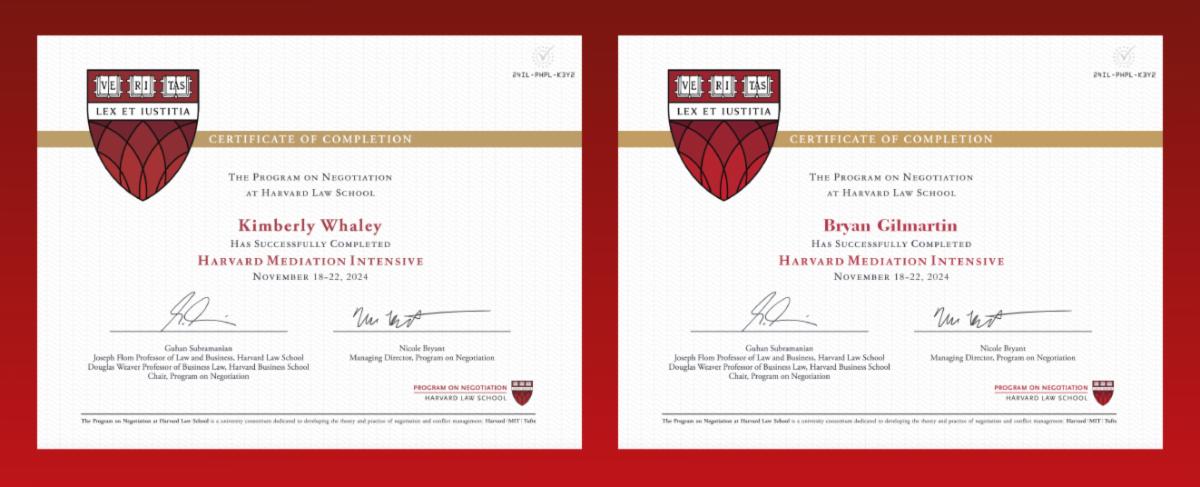
Bryan and I received our mediation certificates from Harvard this month. I look forward to continuing to mediate both alone and with Bryan for years to come. This course for me was a great refresher of the great responsibility placed upon a mediator.
| |
|
In the next few months, I will look forward to presenting in Newfoundland, and the Bahamas, at Osgoode, at LESA in Victoria, attending STEP Council in England, STEP Worldwide Congress in Rome, and TIAETL in Greece.
As we approach another year of practice, my heartfelt gratitude for your continued support of me, and our WEL team, and for our relationships, friendships, and professional and collegial networks. We are fortunate to have such fantastic colleagues.
As ever, enjoy the read,
Happy Holidays,
Kim
| |
1. HARVARD LAW SCHOOL PROGRAM ON NEGOTIATION: HARVARD MEDIATION INTENSIVE | |
Kimberly Whaley and Bryan Gilmartin are honoured to have received certificates from the Harvard Law School, Program on Negotiation having recently completed the "Harvard Mediation Intensive" course in Cambridge, Massachusetts. Kim and Bryan enjoyed their week working with the excellent faculty and staff and fellow ‘students’ who brought with them an amazing range of experience and perspective.
For more information on the program, see the following link: https://www.pon.harvard.edu/
| |
2. THE ADVOCATES SOCIETY - MEDIATION AND ARBITRATION: TRANSFORMING ESTATES LAW | |
On December 2, 2024, Kimberly Whaley had the opportunity to present at the Advocates Society, on an Arbitration Panel, entitled, “New Character Alert: The Rise of Arbitration.” The presentation focused on the use of Mediation and Arbitration in Estates law, the Legal Framework in Ontario, types of Estate Disputes Suitable for Arbitration, Procedure, Benefits and Challenges of Arbitration, as well as Addressing & Preventing Situations of Bias in Arbitration.
For more information on the program, click here.
Link to Kim’s paper: https://welpartners.com/resources/WEL-New-Character-Alert-The-Rise-of-Arbitration.pdf
| |
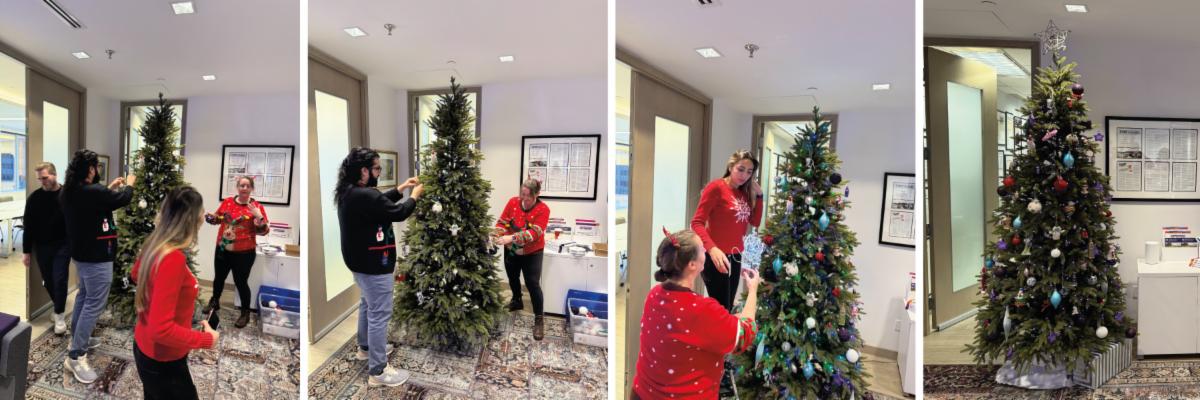
On December 6, 2024, our WEL team got together to put up the firm’s WEL-mas tree! The tree featured ornaments from everyone at the firm, including a few new ones this year, and of course, inclusive of purple lights! | |
4. JTEP WINTER SOCIAL AT WVRST | WEL was happy to host and participate in JTEP’s Winter Social at WRVST in downtown Toronto on December 16, 2024. The networking event brought together lawyers, students and other legal professionals who focus on Wills and Estate Litigation. | |
5. GREATER TORONTO ACCOUNTANT NETWORK PRESENTATION | On December 17, 2024, Bryan Gilmartin joined Rahul Sharma of Fasken at the Greater Toronto Accountant Network where they presented on "Estate, Trust, and Tax war stories: Critical Lessons Learned from Planning Gone Wrong". | |
6. SEASON'S GATHERINGS AT THE DISTILLERY DISTRICT | This past Friday the WEL Team gathered at the Distillery District Winter Village for some Holiday Cheer! From all of us to all of you, Happy Holidays! | |
II. IN MEMORIAM: DONALD CARR | |
|
On November 18, 2024, the legal world unfortunately lost the co-founder of the firm Goodman and Carr, Donald Carr. A highly regarded legal practitioner, with expansive experience dating back to 1951, Donald practiced in litigation, commercial leasing, public and private corporate law, as well having had a respectable career focusing on estates, trusts and charities law. He advised on estate and succession planning, estate and trust administration and general business matters for many years. In 2006, Donald was awarded the Order of Ontario which is reserved for Ontarians from all fields of endeavour, whose excellence has left a legacy in the province. Donald will be missed by many in the community, including his wife Judy Feld Carr, and children Aaron, Jonathan, Alan, Gary, Adam and Elizabeth, and many grandchildren and great-grandchildren. Donald was a gracious, yet, a fearsome colleague who was a gentlemen, and a very competent and accomplished lawyer and businessman.
https://thecjn.ca/news/donald-carr-obit/
| |
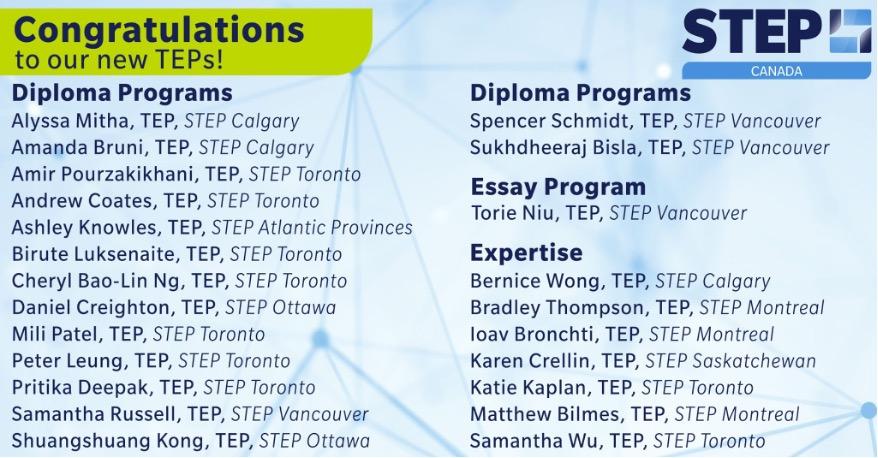
CONGRATULATIONS TO THE RECIPIENTS OF THE TRUST AND ESTATE PRACTITIONER (TEP) DESIGNATION | |
WEL Partners would like to congratulate the latest recipients of the prestigious Trust and Estate Practitioner (TEP) designation from STEP Canada. The TEP designation formally distinguishes these qualified practitioners from non-specialists and offers a competitive advantage in attracting clients. Congratulations again to all members found below: | |
2024 AWARD OF EXCELLENCE IN CRIMINAL JUSTICE | |
WEL Partners wishes to congratulate Maiha Martin, for receiving the 2024 Award of Excellence in Criminal Justice. The award recognizes outstanding contributions to the advancement of criminal law. Maiha’s demonstration of leadership in the criminal law bar through knowledge, experience, skill, commitment, passion, strength of character, and contribution to legal education and professional development, made her a top candidate for the award. | |
CCCA ONTARIO CHAPTER AWARD OF EXCELLENCE | |
|
WEL Partners wishes to congratulate Ashley Jane Butts of the BASF Canada, as the recipient of the 2024 CCCA Ontario Chapter Award of Excellence. The Award of Excellence is awarded to the person who has made significant contributions in enhancement of the practice of corporate counsel, assisted in the development of law applicable to corporate counsel, including teaching, writing and advocacy, leadership through participation in governmental/regulatory bodies and professional associations, including the CCCA, as well as mentoring and teaching through the sharing of knowledge and experience.
Ashley will be honoured at a dinner on Tuesday, February 11, 2025, at the OBA Conference Centre in Toronto. To attend this event, click the link:
https://www.cbapd.org/details_en.aspx?id=ON_ON25COR01T
| |
(i) CY-PRÈS AND IMPRACTICABILITY | |
|
By: Albert H. Oosterhoff
1. Introduction
The recent case, Boys and Girls Club of Greater Victoria Foundation v British Columbia (Attorney General)[1] is yet another case in which a charity made an application for cy-près to vary the terms of the trusts under which it operated, the reason adduced being impracticability. The alleged impracticability arose after the trusts were established and therefore this was a case of supervening, rather than initial impracticability.
2. Facts
The Boys and Girls Club of Greater Victoria Foundation (‘BGC’ or ‘Foundation’) held a 98-acre Property and two investment funds (the ‘Capital Funds’) upon specific purpose charitable trusts. The purposes of the Foundation were to promote and further the aims and interests of its sister charity, the Boy and Girls Club Services Society (the ‘Services Society’). The Services Society provided various services to youth and children on southern Vancouver Island on the Property. The Foundation organized fundraising programs, received donations, managed assets, and paid moneys to support the Services Society.
The Foundation argued that the interest in the programs operated by the Services Society had waned significantly, whereas the costs of running the programs and maintaining the property kept increasing. However, the Services Society runs other programs on southern Vancouver Island that are oversubscribed and have waiting lists. Therefore, the Foundation wanted to sell the Property and reallocate the proceeds, as well as the Capital Funds, to fund those programs.
The Attorney General opposed the application because: (a) the Foundation did not fully disclose its role as trustee in relation to the Property and the Capital Funds; (2) it proceeded in a hurried manner with limited disclosure; and (c) it failed to establish a level of impracticability that would allow the court to relieve the Foundation of its role as trustee for the specific charitable purposes for which it holds the Property and the Capital Funds.
3. Analysis and Judgment
Justice Marzari found that the Foundation raised funds during a special campaign, in part, to purchase the Property and to establish endowment funds to maintain and operate the Property, and that the funds were kept separate. She concluded from the evidence that the funds were raised to establish a specific purpose charitable trust in relation to the Property, with the Foundation as its trustee. Similarly, the Foundation also held the Capital Funds upon separate specific purpose trusts.
The Foundation did not provide detailed financial evidence, or supporting information such as construction budgets for a planned Dining Hall. Indeed, the Foundation failed to establish that the purposes of the Capital Funds cannot be achieved on the Property, because it wants to sell the Property and apply the Funds for other charitable needs financed by the Foundation.
The Foundation did give information about the loss of provincial funding. This meant that it had to use general charitable purpose funds to continue to offer services at the Property, while also charging fees for the programs offered. In addition, the Property has lost its tax exemption from municipal taxes. Further the cost of utilities and liability insurance continues to increase. However, Justice Marzari found that the Foundation failed to provide documentation or financial statements to support the alleged increases in costs. It also failed to provide the projected budget for the coming year to support the alleged income, costs, and shortfall, although the Foundation projects a shortfall of some $200,000 in funding. Presumably, that shortfall would have to be covered with general purpose charitable funds.
In 2023 the Foundation entered into a purchase and sale agreement to sell the Property, but it is subject to the condition that the court grants the application.
Justice Marzari then turned to the law of cy-près. She noted that the court may, in the exercise of its inherent jurisdiction, intervene when the purposes of a charitable trust have become impracticable and alter the terms of the trust. However, the court may not intervene if the purposes are not impracticable. Thus, the trustee must prove the alleged impracticability. The law is clear that if the original objects can still be carried out, even though in a more limited way than originally, the court cannot grant the cy-près application.[2] In contrast, the Foundation argued in favour of a concept of impracticability that is much broader than that recognized by existing law.
Justice Marzari held that the Foundation failed to establish that it was impracticable to continue to hold and maintain the Property for its specific charitable purposes. The financial evidence failed to show that the Foundation lacked sufficient funds to maintain and operate the Property. Also, other evidence showed that some 400 children and youths benefited from the programs on the Property in 2023. Moreover, the Foundation failed to establish that its financial existence is put in jeopardy if it is required to continue to act as trustee under the trusts in relation to the Property. In any event, she held that converting the value of the Property and the Capital Funds to unrelated charitable purposes, is not a purpose as close as possible (cy-près) to the original purpose of the trusts.
---
[1] 2024 BCSC 442.
[2] See, e.g., Sidney and North Saanich Memorial Park Society v British Columbia (Attorney General), 2016 BCSC 589, paras 47-49; In Re Dominion Students’ Hall Trust, [1947] Ch 183 at 186; Lee v Board of Education of North Vancouver School District No 44, 2011 BCSC 222; Re TLC The Land Conservancy of British Columbia Inc No S36826, 2014 BCSC 97 (reversed on unrelated grounds 2013 BCCA 473); and L’Evêque Catholique Romain de Bathurst v New Brunswick, 2010 NBQB 400. All these are cited in the case.
| (ii) CAN YOU RELY ON A PRESUMPTION OF UNDUE INFLUENCE WHEN ATTACKING A POWER OF ATTORNEY? | |
|
By Albert H. Oosterhoff
1. Introduction
It is now well-known that when a person attacks an inter vivos gift for undue influence, and if the alleged undue influencer occupies a position of influence or dominance over the donor, the attacker will be assisted by the presumption of undue influence. In contrast, if a person attacks a will for undue influence, the attacker cannot rely on the presumption of undue influence, even though the influencer occupies a presumption of undue influence.
Which of these approaches applies when someone attacks a power of attorney for property and alleges that the grantee has unduly influenced the grantor of the power?
The law has been uncertain on this point, but we now have two appellate decisions on point, one from the Ontario Court of Appeal, Vanier v Vanier,[1] and one from the Manitoba Court of Appeal, Drewniak v Smith.[2] I shall discuss these two cases and show that in my view the Manitoba decision is correct, while the Ontario decision is incorrect.
2. The Two Cases
2.1 Vanier v Vanier
2.1.1 Facts
Frank and Rita Vanier operated a successful business, 92780 Canada Ltd (‘92780’). Frank died in 2011 and left his entire estate to Rita. They had three children, a daughter, Patricia, and twin sons, Pierre and Raymond. After her husband died, Rita Vanier granted a continuing power of attorney to Patricia (the ‘2011 CPOAP’). It was alleged that Patricia used the CPOAP to misappropriate a large sum of money from her mother. That led to litigation that was eventually settled. Rita then granted a new CPOAP in 2013 to Pierre and Raymond with power to act jointly and severally. The two sons soon became suspicious about each other’s handling of Rita’s property. This caused Rita to grant another power of attorney in 2015 (the ‘2015 CPOAP’) in which she appointed Pierre as her sole attorney.
Raymond brought an application under the Substitute Decisions Act, 1992 (‘SDA’) for orders removing Pierre as attorney and declaring the 2015 CPOAP void. He also brought a motion for an order removing Pierre as attorney on an interim basis and an order requiring Pierre to pass his accounts. The motion judge granted the order to pass the accounts but otherwise dismissed the motion. Raymond appealed the dismissal on the ground that the motion judge applied the wrong test for undue influence and erred by failing to find suspicious circumstances surrounding Rita’s execution of the 2015 CPOAP.
Rita’s funds were tied up in 92780’s accounts at the Royal Bank of Canada (‘RBC’). They were frozen because of the litigation with Patricia. When that litigation was settled, RBC demanded that the three children, who were the three directors of 92780, sign documents authorizing a new account. Raymond refused, so that the moneys remained frozen. Patricia had been ordered to repay Rita some $300,000, but Raymond told her lawyer to hold those moneys and not to release them. Raymond’s actions meant that Rita had no access to money to pay her basic living expenses. That led her to sign the 2015 CPOAP. Subsequently, by shareholders’ vote, Raymond was removed as director of 92780. Raymond then arranged to have Rita undergo a capacity assessment. The assessor found that Rita was capable of executing and revoking a power of attorney for property. However, she also suggested that undue influence may have been a factor in Rita’s decision to grant the 2015 CPOAP to Pierre. Raymond continued to be suspicious of Pierre and maintained that Pierre’s relationship with Rita was marked by dominance and control for many years.
2.1.2 Decision at First Instance
At first instance, the motion judge, Penny J, held that the burden of proof to establish undue influence rests on the party alleging it, and thus he applied the test for ‘testamentary undue influence’. He held that the evidence did not support a finding of suspicious circumstances and ordered Raymond to pay Rita’s costs fixed at $55,000.
2.1.3 Appeal
Raymond raised four grounds of appeal, namely, that the motion judge:
(a) applied the wrong undue influence test;
(b) wrongly found that the evidence did not establish suspicious undue influence;
(c) failed to consider relevant evidence; and
(d) erred in determining the award of costs.
(a) On the first ground Raymond argued that the motion judge should have used the test for inter vivos equitable undue influence, either actual or presumed. In his view that would shift the onus to Pierre to prove that Rita signed the 2015 CPOAP willingly and without undue influence. He argued that while this test is traditionally applied to improperly taken inter vivos gifts, it also applies to inter vivos transfers of power over a grantor’s assets. Rita disagreed and argued that the testamentary undue influence test applied.
The court did not give effect to this ground of appeal because the application of the inter vivos equitable undue influence test was not argued on the motion. But in any event the equitable undue influence test has no application on the facts. Justice Epstein, who wrote the reasons for the court, applied Royal Bank of Scotland v Etridge.[3] It holds that the evidential shift in the burden of proof from the complainant to the other party happens only when the following two criteria are satisfied: (1) if the complainant (Raymond arguing on behalf of Rita) reposed trust and confidence in the other party (Pierre); and (2) if the transaction is not readily explicable by the parties’ relationship. The House of Lords held that for this second criterion to be satisfied, the evidence must show that the transaction is ’immoderate and irrational’.
It was clear that Rita reposed trust and confidence in Pierre, and he conceded that she did. But there was nothing immoderate or irrational about Rita granting the 2015 CPOAP to Pierre. Besides, the CPOAP conferred little, if any, benefit on Pierre. Further, even if the inter vivos equitable title were applicable, the facts did not support a finding of undue influence.
(b) On the second ground of appeal, the court noted that under section 2 of the SDA a person is presumed to be capable of granting a power of attorney for property. However, section 2(3) provides that a person cannot rely on this presumption if the person ‘has reasonable grounds to believe that the other person is incapable of entering into a contract or of giving or refusing consent’. In the latter case the burden of proving capacity shifts to the grantee of the power.
Justice Epstein did not regard this appeal as an appropriate one to consider the application of the doctrine of suspicious circumstances to powers of attorney as a whole. Besides, this ground of appeal amounted simply to a challenge to the motion judge’s findings of fact that there were no suspicious circumstances. Thus, she gave no effect to this ground of appeal.
Since Justice Epstein did not consider whether the application of the equitable doctrine of suspicious circumstances applies to powers of attorney, this means that lower court decisions in Ontario that have applied the wills doctrine of undue influence to powers of attorney continue to be effective.[4]
(c) On the third ground of appeal the court held that there was no merit to the argument that the motion judge failed to consider relevant evidence.
(d) On the costs issue, the court agreed with the motion judge that the litigation reflected a profound lack of judgment on Raymond’s part, and thus saw no basis to interfere with the costs award.
On the issue regarding the capacity assessor’s finding that undue influence may have been a factor in Rita’s decision to grant the 2015 CPOAP to Pierre, the motion judge had held that it was unreliable and inadmissible because it is outside the powers of a capacity assessor. So, Rita argued that the court should censor the practice of asking capacity assessors to provide opinion evidence on undue influence. While the court agreed that it was inappropriate for the assessor to provide such evidence and that it was unreliable and inadmissible, it left a more in-depth consideration of the issue to another day.
2.2 Drewniak v Smith
2.2.1 Facts
Margaret Smith (the ‘Donor’) has two daughters, Katherine (‘Katherine’) and Margaret (‘Margaret’). In 2003 the Donor granted an enduring power of attorney (the ‘2003 POA’) to Katherine. while naming Margaret as alternative attorney. The Donor began to have some cognitive impairment and memory issues in 2005 when she had a stroke but continued to be actively involved in the management of her financial affairs. Katherine was her investment advisor and accountant. The Donor became frustrated with Katherine’s excessive control over her personal and financial affairs. In 2016 Margaret helped the Donor to meet with her former and her new solicitor and the latter prepared a new power of attorney (the 2016 POA) in which she appointed Margaret as her attorney. When Katherine learnt of the new POA, she brought an application for, inter alia, a declaration that the 2016 POA was invalid.
2.2.2 Decision at First Instance
The application judge dismissed the application. She held that the Donor had capacity and that the equitable evidentiary presumption of undue influence cannot arise in the case of a power of attorney. Thus, she applied the wills doctrine of undue influence to powers of attorney.
2.2.3 Appeal
Katherine appealed on the following grounds:
(1) That the application judge erred in finding that the Donor had the required capacity to grant the 2016 POA, failed to give sufficient weight to the evidence of the Donor’s diminished capacity, and failed to recognize the evidence of suspicious circumstances surrounding the execution of the document.
(2) That the application judge erred in failing to find that the 2016 POA was procured by Margaret through undue influence.
This ground required a consideration of the question whether the application judge was correct in holding that an evidentiary presumption of undue influence cannot arise in respect of an enduring power.
(3) That the application judge made palpable and overriding errors in two findings of fact.
The court held that the third ground lacked merit and dismissed it summarily.
Justice Pfuetzner wrote the reasons for judgment, and Monnin and Cameron JJA concurred.
On the first issue she discussed the common law presumption of capacity and noted that it extends to the granting of a power of attorney. She also noted that section 10(3) of the Powers of Attorney Act[5] states that an enduring power of attorney is void if the donor is mentally incapable of understanding its nature and effect at the time of its execution, and that the application judge had found the Donor to be capable. It is interesting that she does not state that she dismisses the first ground of appeal, although in her conclusion in para 87 she dismisses the appeal in its entirety.
Justice Pfuetzner then launched into a lengthy and learned discussion of the history and jurisdiction of probate courts and noted that powers of attorney were not part of that history. The history and jurisdiction of the probate courts is a topic that the Honourable Maurice Cullity analyzed carefully and in detail in a number of his judgments,[6] and others, following his analysis, have also written about the topic. Justice Pfeutzner noted that the laws and procedure of the probate courts continue even after those courts were merged with the superior courts of justice. Consequently, when a court, sitting as a court of probate, considers the validity of a will, it applies the doctrine of undue influence as developed in the probate courts, without applying the presumption of undue influence. That presumption arose in equity, not in probate, and can be applied in a superior court of justice when considering the validity of other documents that did not traditionally fall within the purview of courts of probate.
Justice Pfuetzner continued with a learned disquisition of the burden of proof in wills proceedings, by reference, inter alia, to Vout v Hay.[7] She distinguished carefully between the ‘persuasive legal burden’ and the ‘evidential burden’. The former is the onus to prove facts on the civil standard of the balance of probabilities, which is governed by substantive law. The latter requires a party to point to a minimum threshold of evidence to satisfy the fact finder (judge or jury). She pointed out that while the two are usually, though nor always, aligned, they diverge on some issues in contested probate proceedings. In common form proceedings, while the propounder has the legal burden to prove due execution, knowledge and approval, and testamentary capacity, the propounder has the benefit of the rebuttable presumption of validity upon proof of due execution. If someone attacks the will. the attacker has the evidential burden to point to some facts that, if accepted, will establish those facts. The attacker can do so by pointing to suspicious circumstances in the making of the will, the capacity of the testator, or undue influence or fraud. If the attacker discharges the evidential burden, the propounder can no longer rely on the evidential presumption but must prove due execution, knowledge and approval, and capacity. However, if the attacker alleges fraud or undue influence, the attacker has the persuasive legal burden of proving the fraud or undue influence on a balance of probabilities. That onus does not shift to the propounder in probate proceedings. Justice Pfuetzner referred to this as probate undue influence, and it was this law that the application judge applied. The application judge did so because: (1) wills and powers of attorney are usually made with the aid of counsel and in the presence of witnesses; (2) powers of attorney impose fiduciary obligations that are similar to those imposed on an executor; (3) as in a will, a donor of a power can change it at will; and (4) as in a will, a donor does not bestow a benefit on the donee of the power.
However, Katherine argued that the approach to undue influence developed in courts of equity (‘equitable undue influence’) should be applied in the context of powers of attorney. Equitable undue influence applies to inter vivos gifts. It takes two forms, a substantive legal principle in which the undue influence is proved on the facts (‘actual undue influence’), and the presumption of undue influence, which is a rule of evidence (‘presumed undue influence’). With equitable undue influence, the attacker has the persuasive legal burden of proving undue influence on a balance of probabilities. But once certain facts are established, the attacker can rely on the presumption to satisfy the persuasive legal burden. Equity raises the presumption in some relationships, such as parent and child, guardian and ward, solicitor and client, trustee and beneficiary, doctor and patient, and others. In English law however, the presumption will not be raised in commercial transactions or transactions made with legal advice. Nor will it be raised for gifts, ‘unless the gift is so large or the transaction so improvident’ that it cannot reasonably be attributed to other innocent motives.[8] In Royal Bank of Scotland v Etridge,[9] Lord Nicholls outlined two prerequisites for the presumption to apply: (1) that ‘the complainant reposed trust and confidence in the other party, or the other party acquired ascendancy over the complainant; and (2) that ‘the transaction is not readily explicable by the relationship of the parties’. He described the second prerequisite as ‘a transaction which calls for explanation’, is ‘immoderate and irrational’, and is ‘explicable only on the basis that undue influence has been exercised to procure it’.[10]
However, as Justice Pfuetzner explained by reference to Goodman v Geffen,[11] in Canada the evidentiary presumption is triggered more readily, not only for gifts but also for contracts. For gifts, a dominant relationship is all that is required, and if that exists, the attacker does not have to establish undue disadvantage for the evidentiary presumption to arise. For contracts the attacker needs to show that there is a relationship with the potential for influence and that it had an unfair consequence.
Justice Pfuetzner acknowledged that a power of attorney can be granted as a result of undue influence over the donor. Then it does not matter whether the probate or equitable rule is applied, since the persuasive legal burden of proving undue influence rests on the attacker.
However, she went on to state that the problem with adopting the probate rule of undue influence to powers of attorney is that ‘doctrinally and historically, powers of attorney were not part of the jurisdiction of the probate courts’ (para 74). Powers of attorney have their origin in the law of agency and contract, areas over which equity has jurisdiction. Therefore, she concluded that powers of attorney are within the various transactions to which equitable (as opposed to probate) principles of undue influence apply (para 76).
That being so, the question becomes when the evidentiary presumption of equitable undue influence will arise when a donor grants an enduring power of attorney. Justice Pfuetzner took the view that there is a clear distinction between a gift and a power of attorney, since a power of attorney does not confer a benefit on the attorney. Indeed, a power of attorney does not confer either legal or beneficial ownership on the attorney. Consequently, she held that for the evidentiary presumption of undue influence to apply to the granting of an enduring power of attorney, there must be a relationship with the potential for domination. In addition, something more must be shown. Not a ‘manifest disadvantage’ as maintained in Geffen for gifts but rather evidence that the granting of the power is ‘immoderate and irrational’ as maintained in Etridge (para 50) for gifts.
Justice Pfuetzner held that the evidentiary presumption of undue influence did not arise on the facts in this case. Even assuming that the Donor and Margaret were in a relationship with the potential for dominance. the granting of the 2016 POA was not in any way ‘immoderate or irrational’. In any event, the resolution of the case did not depend on whether the presumption applied but on whether Katherine had met the persuasive legal burden to prove undue influence on a balance of probabilities. She agreed with the application judge that Katherine had not met that burden.
Justice Pfuetzner concluded with the following helpful comment:
[86] In my view, the granting of an enduring power of attorney to a family member with whom the donor has a positive relationship is not a transaction that should be regarded as prima facie evidence of the exercise of undue influence by the named attorney – even if there is the potential for dominance in the relationship. To do so would throw a wrench into virtually every basic estate plan. Such a transaction does not call for an explanation – it is readily explicable by the relationship of the parties.
Having regard to the different origins of probate law and the law over which equity has jurisdiction, in my opinion, for the reasons given by her, Justice Pfuetzner’s view that the equitable doctrine of undue influence applies to the granting of an enduring power of attorney (and to a continuing power of attorney for property) is accurate. And therefore, with great respect, I believe that Drewniak v Smith is correct and Vanier v Vanier is incorrect.
And, dear readers, I suggest, Tolle lege. That is, take up and read the very well written Drewniak case. You will learn much and be edified.
---
[1] 2017 ONCA 561.
[2] 2024 MBCA 86.
[3] [2001] UKHL 44, paras 21-22.
[4] See, e.g., the decision at first instance, Vanier v Vanier, 2016 ONSC 4620, para 15; Nguyen-Crawford v Nguyen, 2010 ONSC 6836, para 93; Hollinger v Marshall, 2024 ONSC 404, para 56.
[5] CCSM c P97.
[6] See, e.g., Re Ettore Estate, 2004 CarswellOnt 3618; Otis v Otis, 2004 CarswellOnt 1643
[7] 1995 CarswellOnt 528, [1995] 2 SCR 876.
[8] Hanbury and Maudsley Modern Equity, 13th ed (London: Stevens & Sons, 1989), p 4.
[9] Footnote 3, supra, paras 21-22.
[10] Ibid., paras 14, 22, 25.
[11] [1991] 2 SCR 353, 1991 CarswellAlta 91.
| |
(iii) AROMA FRANCHISE COMPANY, INC. V. AROMA ESPRESSO BAR CANADA INC., 2024 ONCA 839 | |
|
By Gabriella Banhara
Introduction
The interesting case of Aroma Franchise Company Inc. et al. v. Aroma Espresso Bar Canada Inc, et al.[1], 2023 ONSC 1827 addressed the standard used by courts to determine an arbitrator’s impartiality over a dispute, as well as their requirement to make disclosure.
In 2024, the Court of Appeal in Aroma Franchise Company, Inc. v. Aroma Espresso Bar Canada Inc.[2], 2024 ONCA 839 overturned the lower court decision on the basis that the lower court incorrectly applied the standard to determine an arbitrator’s requirements for disclosure, apprehension of bias, as well disqualification.
Facts
In 2020, a dispute arose amongst the applicants, Aroma Bar Canada Inc., (the “Applicants”) and the Respondents, Aroma Franchise Company Inc., (the “Respondents”) over a franchise Agreement.
While searching for an arbitrator, the parties sought and emphasized the need for a neutral arbitrator to settle their dispute. Fifteen months later, while the arbitration was well underway, the arbitrator emailed the parties his final decision, but inadvertently copied a lawyer from Sotos LLP (“Sotos”), the law firm of the Respondent’s counsel. The lawyer who had been inadvertently mentioned in the email chain had not taken part in the arbitration in any capacity.[3]
After being questioned by the Applicants, the arbitrator admitted he had been retained by the Respondents counsel in his capacity as an arbitrator in a separate and ongoing dispute, which I will refer to as the Sotos Dispute.
The Applicants found this to be a major issue and filed an application to set aside the decision on the basis that they were not provided a reasonable apprehension of bias.[4]
The Issue
The issue to be determined by the court was whether the final award should be set aside due to the lack of impartiality of the arbitrator.[5]
The Court’s Analysis:
According to the UNCITRAL Model Law on International Arbitration, otherwise known as Model law, an arbitral award may be set aside by the court according to Section 34 if:
The composition of the arbitral tribunal or the arbitral procedure was not in accordance with the agreement of the parties, unless such agreement was in conflict with a provision of this Law from which the parties cannot derogate, or, failing such agreement, was not in accordance with this Law (Model Law);[6]
The Applicant’s contended that according to the Model Law, if an arbitrator’s conduct led to a reasonable apprehension of bias, the arbitral award may be set aside.
The court analysed whether there was a reasonable apprehension of bias when the Arbitrator failed to disclose to the Applicants that he had been retained in the Sotos Dispute.
In its analysis, the court referenced Article 12 of the Model law which states:
When a person is approached in connection with his possible appointment as an arbitrator, he shall disclose any circumstances likely to give rise to justifiable doubts as to his impartiality or independence. An arbitrator, from the time of his appointment and throughout the arbitral proceedings, shall without delay disclose any such circumstances to the parties unless they have already been informed of them by him.[7]
The IBA Guidelines on Conflicts of Interest in International Arbitration (“IBA Guidelines”) provide that arbitrators should make available any conflicts that in the eyes of the parties may give rise to doubts on the arbitrator’s independence.[8]
The IBA guidelines created a system of practical application and scenarios to better understand what an arbitrator must disclose. The system is broken down into three different lists:[9]
1. Red is for no-go (subject to a potential waiver for items on the waivable red list),
2. Orange for potentially a problem; and
3. Green for go.
The orange list is a non-exhaustive list which states It is vital that an arbitrator evaluate on a case-by-case basis what must be disclosed by an arbitrator.
The Court noted that within the orange level, an arbitrator must, “disclose an appointment made by the same party or the same counsel appearing before an arbitrator, while the case is ongoing… depending on the circumstances…”[10]
Based on such reasoning, the applicants contended that the arbitrator had a duty to discuss the Sotos Dispute since the Sotos engagement was agreed upon while the Aroma matter was ongoing.
During cross-examination, the court reviewed the correspondence of the applicants, which emphasized the requirement of retaining an arbitrator that did not have a prior relationship with counsel to the parties.
The court also referenced the ADR Institute of Canada Code of Ethics which states at Section 6 that a “member shall disclose any interest or relationship likely to affect impartiality or which might create an appearance of partiality or bias”.[11]
Considering these factors, the court determined that there was a reasonable apprehension of bias by the Arbitrator for failing to disclose the Sotos Dispute.
The court concluded by stating that a reasonable, fair minded and informed person in the “applicant’s position would lose confidence in the fairness of the proceeding giving rise to a reasonable apprehension of bias.”[12]
For these reasons the court set aside the arbitration award.
The Appeal:
The Respondents, now referred to as the Appellants, appealed the lower court’s decision.
On Appeal, the court overturned the lower court’s decision on the basis that the judge erred in her application of the reasonable apprehension of bias test. The lower court judge misapplied this test subjectively for impartiality, rather than objectively. [13]
The court’s analysis included the following:
“Article 12(1) of the Model Law sets out an objective test” as it says, “likely to give rise to justifiable doubts as to [the proposed arbitrator’s] impartiality or independence” are to be assessed from the standpoint of a fair-minded and informed”[14]
Whereas the IBA guidelines, which is not a legal standard, uses a subjective test as follows:
“If facts or circumstances exist that may, in the eyes of the parties, give rise to doubts as to the arbitrator’s impartiality or independence, the arbitrator shall disclose such facts or circumstances to the parties.”[15]
This demonstrates the subjective test that is present within the IBA Guidelines.
The Appeal court stated that the Orange List within the IPA Guidelines does not outline what a fair minded and informed observer would consider adequate disclosure.[16]
Additionally, as mentioned by the lower court judge, situations not outlined in the ‘Orange’ list do not require disclosure. The court goes on to state that since the “single appointment of the Arbitrator by counsel for one party for a different, unrelated arbitration – is not included in the ‘Orange List’ disclosure was not required by the arbitrator”.[17]
Additionally, the lower court incorrectly applied the decision found in Halliburton Company v Chubb Bermuda Insurance Ltd., which stated that disclosure was “legally required where an arbitrator accepts appointments in multiple arbitrations concerning overlapping subject matter with a common party”. [18]
In the lower court decision, the judge explicitly stated that there were no overlapping issues or common parties. Additionally, there were no common parties between the Aroma arbitration and the Sotos Dispute. As the court stated, the Sotos Dispute did not involve a franchise nor the same incident as the Aroma arbitration.
The Court of Appeal went on to address the lower court’s confusion with the failure to disclose a reasonable apprehension of bias.
The court stated that there was not a reasonable apprehension of bias on behalf of the arbitrator, rather, the parties failed to inform the arbitrator of their expectation for disclosure. The court stated “this is simply not a situation of the Arbitrator ignoring obligations to disclose imposed by the objective test, by which he was bound, or even ignoring the parties’ desired level of disclosure” the parties merely never informed the arbitrator of their disclosure expectations.[19]
The court concluded that the reasonable apprehension of bias in Canadian law is determined on an objective standard. As stated before, the objective test is that the apprehension of bias must be a reasonable one, held by reasonable and right-minded persons.[20] In paragraphs 133-144 of this decision, the court discusses the details of this objective test.
Concluding Comments
The Court of Appeal found that the incorrect subjective test was applied by the lower court Judge. The Court of Appeal decision clarified that arbitrator disclosures and disqualification are evaluated on an objective standard.
---
[1] Aroma Franchise Company Inc. et al. v. Aroma Espresso Bar Canada Inc, et al. , 2023 ONSC 1827 [“Aroma 2023”]
[2] Aroma Franchise Company, Inc. v. Aroma Espresso Bar Canada Inc., 2024 ONCA 839 [“Aroma Appeal 2024”]
[3] Aroma 2023 at para 11.
[4] Ibid at para 17.
[5] Ibid at para 21.
[6] Ibid at para 22.
[7] Ibid at para 31.
[8] Ibid at para 35.
[9] Ibid at para 36.
[10] Ibid at para 37.
[11] Ibid at para 59.
[12] Ibid at para 64.
[13] Aroma Appeal at para 10.
[14] Ibid at para 2.
[15] Ibid at para 50.
[16] Ibid at para 53.
[17] Ibid at para 107.
[18] Ibid at para 81.
[19] Ibid at para 124.
[20] Ibid at para 139.
| |
(iv) CASE REVIEW: MARKLAND V. BENZ, 2024 BCSC 2167 | |
|
By Chhavi Monga
Overview
The decision in Markland v. Benz, 2024 examines the extent of a court-appointed committee’s authority under the Patients Property Act to sever a joint tenancy. The court emphasized the importance of respecting a donor’s documented intentions while clarifying the evidentiary requirements for altering inter vivos gifts.[1]
Case Background
Winnie Markland (the "Donor") owned a property in Burnaby, British Columbia, and had eight grandchildren in total. In 2008, she transferred 50% interest in the property to her granddaughter, Nadine Benz (the "Granddaughter") as a gift, creating a joint tenancy. The transfer was supported by a deed of gift in 2010 and independent legal advice, ensuring that the Granddaughter would inherit the property by right of survivorship upon the Donor’s death.[2]
Due to a stroke in 2019, the Donor was deemed incapable of managing her own affairs. Donovan Markland (the “Committee”) was adopted by the Donor in 2008, when he was 63 years old, and was subsequently appointed as her committee under the Patients Property Act. In 2021, the Committee severed the joint tenancy as per s. 15(1) and s.18 of the Patients Property Act, converting it into a tenancy in common, due to which, 50% of the property would now form part of the Donor’s estate rather than passing directly to the Granddaughter.[3]
Legal Issues
The primary issue involved whether the Committee’s decision to sever the joint tenancy fell within the powers granted under the Patients Property Act. The court considered:
- Whether the severance served the Donor's best interests;
- Whether the severance was consistent with the Donor’s previously expressed intentions; and,
- The evidentiary burden required to justify altering a donors inter vivos arrangements.
Court Findings
The British Columbia Supreme Court ruled in favor of the Granddaughter, declaring the severance invalid. The court’s key findings were as follows:
-
No Benefit to the Donor or Estate: The court concluded that the severance did not benefit the Donor or her estate, as required under the Patients Property Act.
“Section 18 of Patients Property Act constrains a committee’s powers as follows:
18(1) A committee must exercise the committee’s powers for the benefit of the patient and the patient’s family, having regard to the nature and value of the property of the patient and the circumstances and needs of the patient and the patient’s family.”[4]
Though the committee may not need to establish a transaction is necessary or the well being of the patient or their family, the committee is still held to a standard of a reasonable and prudent businessperson. Though the severance did not dimmish the value of the Donor’s estate, the court found no evidence to suggest that severing the joint tenancy was done for Ms. Markland’s financial benefit or that she received any financial advantage from the severance.[5]
-
Respect for Documented Intentions: The court found that the 2008 gift reflected the Donor’s clear intention for the Granddaughter to inherit the assets outright. This intention was then supported by a deed of gift and independent legal advice, with no evidence indicating a desire to alter the arrangement. As the deed of gift provided the following:
“I, WINNIE MARKLAND, hereby confirm that I gave my grand daughter, NADINE DAPHNE BENZ, a joint interest in the [the Property].
The joint interest has been registered in the Land Title Office. It is my intention that this gift will pass both a legal and beneficial joint interest such that, if NADINE DAPHNE BENZ is alive at the time of my death, she will become the sole legal and beneficial owner of the Property.”[6]
-
Lack of Sufficient Justification by the Committee: Although the Committee argued that the Donor wished to treat all her grandchildren equally, the court found this claim unsupported by evidence and insufficient to override the Donor’s documented wishes.
-
Invalid Severance: The court invalidated the severance, confirming the Granddaughter’s right to inherit the property by survivorship.[7]
Significance
The case sheds light on the limits of committee powers under the Patients Property Act, emphasizing that committees must act in the best interests of the donor and honor their documented intentions, especially in cases involving estate planning or inter vivos gifts. It also stresses the importance of presenting strong evidence to justify any changes to a donor's property arrangements, while underscoring the need for transparency and adherence to statutory obligations when acting on behalf of an incapable individual.
--
[1] Markland Estate v Benz, 2024 BCSC 2167.
[2] Ibid, at paras. 6 - 13.
[3]Ibid, at paras. 29 - 31.
[4] Ibid, at para 30.
[5] Ibid, at para 32.
[6] Ibid, at para 15.
[7] Ibid, at para 40.
| |
(v) SEEKING THE EQUITABLE REMEDY OF OCCUPATION RENT IN ESTATE LITIGATION | |
|
By Oliver O’Brien
It is not uncommon for family members to remain living in a property owned by a loved one who has passed away. The occupant is most often a child, spouse or parent of the deceased and they reside in the property in the absence of a formal agreement. The occupant may refuse to leave the property in the face of requests to vacate and assert a proprietary right after death. In these situations, it may fall on the Estate Trustee to seek their vacancy and financial compensation for their rent-free occupation of the property.
The Law
In Dagarsho Holdings Ltd. v. Bluestone,[1] (“Dagarsho”) Justice Karakatsanis (as Her Honour then was), summarised the relief of occupation rent as follows:
Occupation rent is an equitable remedy. The often-cited general principle of occupation rent is that “if a person is in occupation without a lease, although the relationship of landlord and tenant will not exist, the law will imply a contract for payment to the landlord or a reasonable amount for the use and occupation of his land.” The principle is based upon the presumption that the parties have agreed to reasonable compensation. That presumption can be rebutted by evidence that the parties intended that the occupation be without compensation.[2] [emphasis added]
In Bergman v. McMahon,[3] (“Bergman”), Justice Daley held that in to establish an entitlement to occupation rent, it must be demonstrated that:
(1) the party in possession of the premises has been enriched,
(2) there has been a corresponding deprivation suffered by those entitled to the property, and
(3) the absence of a juristic reason for the enrichment.[4]
In Calmusky v. Calmusky,[5] Justice Lococo added to the third juristic reason criteria by noting that the Supreme Court of Canada has provided guidance in Moore v. Sweet,[6] as follows:
First, the Court must look to the “established” categories of juristic reasons justifying the enrichment and corresponding deprivation, which are: the existence of a contract, a disposition of law, a donative intent, and other valid common law, equitable or statutory obligations. “If the court finds that any of these categories justify the disputed benefit, the analysis ends. However, if none of these established categories applies, then a prima facie case for unjust enrichment exists”.
Second, if none of the “established” categories apply, “the responding party can rebut this prima facie claim by establishing some residual reason to deny recovery”.[7]
The remedy of occupation rent is commonly used in estate litigation by Estate Trustees. For instance, in Filippelli Estate,[8] Justice Spies ordered vacant possession and occupation rent where a deceased’s son continued to reside in an estate property contrary to the terms of a Last Will and Testament. Although the son tried to argue that he was a tenant, Justice Spies rejected that position and held that there was no oral or written tenancy agreement in the face of the corroboration requirement under Section 13 of the of Ontario’s Evidence Act.[9]
In determining the quantum of occupation rent, Justice Karakatsanis in Dagarsho did not consider expert evidence but accepted the evidence of the rent that was charged on the identical unit next door.[10] In Bergman, Justice Daley noted that “as occupation rent is an equitable remedy, it is open to the court to require the payment of such rent in a sum based on the best available evidence”.[11] This evidence most typically used in these situations is evidence from real estate agents of predicted market rental value of the occupied property.
Case Example
In the recent case of Officer v. The Estate of Charles Herbert Officer,[12] occupation rent was successfully sought for occupancy of a property which belonged to the Deceased. The Deceased died on December 1, 2023, and was survived by a minor child, who was the sole beneficiary of his Estate. The Applicant was the mother of the Deceased, and the Respondent was the mother of the Deceased’s child.[13]
The Deceased and the Respondent owned a condo in Toronto (the “Condo”) in joint tenancy with rights of survivorship. At the time of the Deceased’s death, the Condo was occupied by the Applicant. The Applicant maintained that the Deceased expressed a wish for her to live in the Condo free of charge until her passing. The Applicant brought an application for, amongst other things, dependant’s relief under the Succession Law Reform Act (“SLRA”)[14], and orders restraining the Respondent from evicting her from the Condo or otherwise selling the property.[15]
The Respondent brought a motion for the Applicant to deliver vacant possession of the Condo and to pay occupation rent for her period of occupancy. In response, the Applicant argued that, as a dependant of the Deceased, it was not fair and just to order her to provide vacant possession or pay occupation rent. The court disagreed, noting that the dependant relief provisions of the SLRA have no application given the Condo passed by rights of survivorship to the Respondent and therefore does not form part of the Deceased’s Estate.[16]
Following the Deceased’s passing, the Respondent did not ask for the Applicant to pay rent but did notify her that she could no longer pay for her support after July 1, 2024. Accordingly, the court found that between December 1, 2023 (the date of death) and July 1, 2024, “the respondent intended that the applicant’s occupation be without compensation. [but] thereafter, the respondent did not continue to share that intention”.[17]
Therefore, the court ordered the Applicant to provide vacant possession of the Condo and pay occupation rent. In determining quantum of occupation rent, the court relied on evidence from the Respondent, who provided an opinion from a real estate agent of the Condo’s market rental value.[18]
Concluding Comments
As noted, it is not uncommon in estate litigation for disputes to arise when someone occupies a property after the death of the property owner. Therefore, the equitable remedy of occupation rent is a useful tool for Estate Trustees or other property owners to seek redress for lost rental income.
---
[1] Dagarsho Holdings Ltd. v. Bluestone,[1] 2004 CanLII 11271 (ON SC) affirmed in 2005 CanLII 39321 (ON CA).
[2] Ibid. at para 26.
[3] Bergman v. McMahon, 2010 ONSC 993
[4] Ibid. at para 38; see Dyal v. Dyal, 2023 ONSC 4322 at para 66.
[5] Calmusky v. Calmusky, 2020 ONSC 1506.
[6] Moore v. Sweet, 2018 SCC 52.
[7] Ibid. at para 72.
[8] Filippelli Estate.
[9] Evidence Act R.S.O. 1990 c. E.23.
[10] Dagarsho Holdings Ltd. v. Bluestone, 2004 CanLII 11271 (ON SC) affirmed in 2005 CanLII 39321 (ON CA), at para 28; Korsch v. Hildebrandt, 2023 ONSC 2513 at para 24.
[11] Bergman v. McMahon, 2010 ONSC 993 at para 49; Dyal v. Dyal, 2023 ONSC 4322 at para 68.
[12] Officer v. The Estate of Charles Herbert Officer, 2024 ONSC 6029 (CanLII).
[13] Ibid. at para 1.
[14] Succession Law Reform Act, R.S.O. 1990 c. S.26.
[15] Officer v. The Estate of Charles Herbert Officer at para 4-11
[16] Ibid. at paras 22-23.
[17] Ibid. at para 30.
[18] Ibid. at para 31.
| |
(vi) CASE REVIEW: PUBLIC GUARDIAN AND TRUSTEE V. SNELGROVE ET AL., 2024 ONSC 6892 | |
|
By Joanna Weiss
In the recently released Public Guardian and Trustee v. Snelgrove et al., 2024 ONSC 6892 the Honourable Madam Justice Doyle of the Ontario Superior Court of Justice (the “Court”), ordered a fiduciary to repay the Public Guardian and Trustee (“PGT”) $247,284.22 on behalf of a vulnerable woman.
Background
Loreen Snelgrove (“Loreen”) is a 76-year-old widowed woman who lives in long-term care.[1] Her son Jason Snelgrove (“Jason”) had been her attorney for property pursuant to a Power of Attorney for Property.[2]
In or around January 2023, the PGT Guardianship Investigation Unit (“GIU”) was contacted by Loreen’s bank who reported that she was being financially abused by Jason. The GIU investigated and had reasonable grounds to believe that Loreen was incapable of managing her property and that she was at risk of harm.[3]
The PGT brought an Application pursuant to sections 22, 27 and 42 of the Substitute Decisions Act, 1992, SO 1992, c 30. On August 12, 2024, the Court declared Loreen to be incapable of managing her property and appointed the PGT as her guardian of property. The matter was adjourned to allow Jason to provide an accounting.[4]
When the matter returned before the Court on November 28, 2024, Jason had filed an
unsworn statement indicating that he was not aware that he had to maintain a record of his spending and receipts. The court allowed him to affirm his statement so that it became evidence at the hearing. Jason was not able to provide a full accounting of the monies spent from his mother’s account. No other evidence was filed.[5]
Jason could not explain or account for the vast majority of withdrawals made.[6] The PGT took the position that between January 1, 2019, and March 12, 2024 Jason had misappropriated $256,073.50 of Loreen’s funds. Accordingly, they sought an order that he reimburse this amount to the PGT on Loreen’s behalf. [7]
Issues
Justice Doyle considered the following issues:
i. When was Loreen mentally incapable of managing her property, and did Jason owe her a fiduciary duty?
ii. Did Jason breach a fiduciary obligation to Loreen, and how much was owed to her?
i. Loreen had been capable as of January 1, 2019, and Jason owed her a fiduciary duty
Notably, the Court was not prepared to determine that Loreen was incapable of managing her property as of January 1, 2019. There was no capacity assessment as of that date.[8] As Justice Doyle articulated,
the court will not speculate as whether she was legally unable to manage her financial affairs. The court cannot just make such a finding on the basis that she had dementia which is a broad diagnosis and has many levels and degrees of symptoms.[9]
In determining that Jason owed Loreen a fiduciary duty, Justice Doyle considered and applied Wedemire v. Wedemire, 2017 ONSC 6891:
[51] . . . In Frame v. Smith, Wilson J. articulated three general characteristics of relationships in which fiduciary obligations are imposed:
a. The fiduciary has scope for the exercise of some discretion or power.
b. The fiduciary can unilaterally exercise that power or discretion so as to affect the beneficiary’s legal or practical interests.
c. The beneficiary is peculiarly vulnerable to or at the mercy of the fiduciary holding the discretion or power.
[52] In Elder, McLachlin C.J. narrowed these characteristics to articulate a test which may be summarized as follows. First, the evidence must show that the alleged fiduciary gave an undertaking of responsibility, express or implied, to act in accordance with the duty of loyalty imposed on him or her. As Newbould J. put it in Buccilli, at para. 181:
The undertaking may be found in the relationship between the parties, in an imposition of responsibility by statute, or under an express agreement to act as trustee of the beneficiary’s interests.
[53] Second, the duty must be owed to a defined person or class of persons who must be vulnerable to the fiduciary in the sense that the fiduciary has a discretionary power over them. Parent-child is one of those historically recognized relationships.
[54] Finally, the alleged fiduciary’s relationship must affect the legal or substantial practical interests of the beneficiary. As Newbould J. noted at para. 183, a property interest is the most obvious example.[10]
Justice Doyle determined that a fiduciary relationship existed between Jason and Loreen dating back to May 2017 when he took over as her attorney for property; he owed her a fiduciary duty.[11]
ii. Jason breached his fiduciary obligation to Loreen, and $247,284.22 was owed to her
In his fiduciary capacity, Jason had to exercise his duties diligently, with honesty and integrity, and in good faith. He failed to do so.[12]
Jason was obliged to exercise reasonable care as would a reasonably prudent person managing her own affairs and not to act contrary to the donor’s interests. The SDA stipulates that the fiduciary must set aside his own interests and act only in the donor’s interests.[13]
He did not, and accordingly was found to have breached his fiduciary obligations.[14]
Based on the evidence before it, the Court permitted certain payments to be deducted from the original amount claimed by the PGT in its Application.[15] The remainder of the expenses however remained uncorroborated, unconfirmed and undocumented.[16]
As Loreen’s attorney for property, Jason had been duty-bound to keep records of his spending and to ensure that Loreen’s property was being used for her benefit.[17] Justice Doyle found that Jason had failed to account for $247,284. 22 of Loreen’s funds. He had failed to maintain receipts or proper records, thereby resulting in his inability to account for these expenditures or demonstrate that these expenses benefited her.[18]
Accordingly, Jason was ordered to repay these funds to the PGT on Loreen’s behalf, and costs in the amount of $5,000 were ordered in favour of the PGT.[19]
--
[1] Public Guardian and Trustee v. Snelgrove et al., 2024 ONSC 6892, at para. 2.
[2] Ibid., at para. 3.
[3] Ibid., at para. 8.
[4] Ibid., at para. 5.
[5] Ibid., at para. 6.
[6] Ibid., at paras. 27-28.
[7] Ibid., at para. 1.
[8] Ibid., at paras. 40-41.
[9] Ibid, at para. 46.
[10] Ibid., at para. 48; See also Wedemire v. Wedemire, 2017 ONSC 6891, at paras. 51-54.
[11] Ibid, at paras. 39, 47, 49-52.
[12] Ibid, at para. 53.
[13] Ibid, at paras. 54-56. See also the Substitute Decisions Act, 1992, SO 1992, c 30, ss. 32(1), 32(6) and 38(1).
[14] Ibid., at para. 58.
[15] Ibid., at paras. 29-32, 79-86.
[16] Ibid., at para. 87.
[17] Ibid., at para. 88.
[18] Ibid., at para. 94.
[19] Ibid., at paras. 96-97.
| |
(vii) AMENDMENTS TO RULE 53.03 OF THE RULES OF CIVIL PROCEDURE: NEW CERTIFICATION REQUIREMENTS FOR FACTUMS AND EXPERT REPORTS | |
|
By Chhavi Monga
Since the release of ChatGPT into the legal language, eleven Canadian courts, five law societies, two professional liability insurers, one provincial government and the Canadian Judicial Council have issued guidance documents regarding the use of Generative AI. All with one thing in common, emphasizing the need to use Gen AI in the legal space with caution and for lawyers to be responsible for the truth and accuracy of their work, yet none have entirely banned it’s use yet.[1]
As for Ontario, on April 25th, 2024, the Law Society of Ontario’s Futures Committee presented a White Paper for information to Convocation entitled, “Licensee’s use of generative artificial intelligence”, which included a checklist, best practise tips, and discussion about the professional obligations regarding use of Gen AI in law.[2]
Since then, many developments have been made in both Gen AI and the guidelines in law on how it must be used. On December 1, 2024, Rule 53.03 (2.1) of the Regulation was amended by adding new procedural requirements for facta and expert’s reports under the Rules of Civil Procedure. The rules now require any party who submits a factum, or any form of expert report at a trial, on appeal, or in a judicial review application to the court, to file it with a signed certificate of authenticity. The signature could be of the party’s lawyer, or on the lawyer’s behalf by someone the lawyer has specifically authorized, certifying that the person signing the statement is satisfied as to the authenticity of every authority cited in the factum.[3]
Rule 53.03 was also amended to now include the following subrule (2.1.1) which states that an authority that is published on a government website or otherwise by a government printer, on a court’s website, or by a commercial publisher of court decisions, or on CanLII is presumed to be authentic unless proven otherwise.
As it relates to expert reports, the requirement to file a certificate of authenticity does not apply to the following:
i. a document or record consisting of evidence or potential evidence in the action that the expert analysed or interpreted in the report, if the document or record was provided to the expert by or on behalf of the party intending to call the expert as a witness,
ii. an authority or other document or record cited by the expert in the report only because it was referenced in a report prepared by another expert witness in the action and the expert is commenting on the reference, and
iii. an authority or other document or record referred to in the report the authenticity of which the expert doubts.[4]
All party-engaged experts must now add the same certification to the Form 53[5], Acknowledgment of Expert’s Duty, which they must fill out and sign.[6]
As courts across Canada become more familiar with Gen AI technology and the opportunities and challenges, they will continue to update guidelines and provide principled frameworks for understanding the potential risks associated with Gen AI in the legal space, and the extent to which it can be used beneficially and appropriately to support and enhance the experience of both the client and the legal practitioner.
---
[1] Law Society of Alberta, “Gen AI Rules of Engagement for Canadian Lawyers”, online: LSA
[2] Roy Bornmann, “Report to Convocation – Futures Committee” Law Society of Ontario, online: LSO
[3] Rules of Civil Procedure, RRO 1990, Reg 194, s. 4.06.1(2.2), Rule 53.03(2.1)6.1, Rule 53.03(2.1.1)
[4] Ibid, Rule 53.03(2.1.1)
[5] Courts of Justice Act, Form 53 - Acknowledgement of Expert’s Duty, online : Ontario court forms https://ontariocourtforms.on.ca/static/media/uploads/courtforms/civil/53/rcp-53-e.pdf
[6] Ibid
| |
|
Osgoode Hall Law School Guest Lecture
Elder Law
January 28, 2025
Speakers: Kimberly Whaley, Jordin Atin and Alex Procope
Elder Law Newfoundland
February 10, 2025
Elder Law
Speaking: Kimberly Whaley
Osgoode Professional Development – Elder Law Certificate
Predatory Marriages
February 12, 2025
Speakers: Albert Oosterhoff & Kimberly Whaley
https://osgoodepd.ca/professional-development/certificates/the-osgoode-certificate-in-elder-law/
STEP Global Congress, Rome
February 25 - 26, 2025
Attending: Kimberly Whaley
https://congress.step.org/
STEP Bahamas
March 12 - 15, 2025
Capacity Issues
Speaking: Kimberly Waley
https://stepbahamasconference.com/
Osgoode Law School Guest Lecture
Predatory Marriage and Capacity to Marry
March 22, 2025
Speaking: Kimberly Whaley
LESA
April 12, 2025
Jointly Held Assets
Speakers: Kimberly Whaley, Nancy Lynn Golding KC, Helen R. Ward KC, Jennifer R. Lamb, Les Scholly
https://www.lesaonline.org/program/lesas-refresher-2025-wills-and-estates-victoria/
Osgoode Passing of Accounts & Fiduciary Accounting
April 15, 2025
Chair: Kimberly Whaley
Speakers: Albert Oosterhoff & Tracey Phinnemore
Cambridge Forum on Estate Planning & Litigation
April 27-29, 2025
Attending: Kimberly Whaley
https://www.cambridgeforums.com/forums/eplf/
Osgoode Powers of Attorney and Guardianship
April 29, 2025
Speaking: Kimberly Whaley
TIAETL – Greece
May 18 - 22, 2025
Kimberly Whaley
| |
VII. IN CASE YOU MISSED IT - RECENT BLOG POSTS | |
WEL NEWSLETTER December 2024, Vol. 14, No. 9 | | | | |