WEL NEWSLETTER December 2025, Vol. 15, No. 9 | | |
Hello,
With the publishing of our December 2025 Newsletter, we come toward the end of another very busy and full year at WEL Partners. At the beginning of this month, I attended STEP Council meetings and the Branch Chair Assembly in London at Artillery House on Artillery Row. Notably, there are now approximately 23k STEP members worldwide, spanning membership in 100 countries which is an impressive collection of STEP members. The growth of STEP continues in large part to be attributable to its unique and robust opportunities for learning and collaborating in a multi-disciplinary forum. Part of my role as one of four STEP Council members from Canada (Leanne Kaufman, Pamela Cross and Nancy Golding) is to advocate on behalf of Canadian members and ensure that Canadian contributions and initiatives are advanced. The policy platform initiatives continue to grow within Europe and elsewhere to shape legislation globally. Canada is the 2nd largest membership, the 1st being U.K., and Ireland. Engagement with members is key to STEP’s future success-if you have not joined, consider joining; if you are a member, consider becoming involved in the many committees, thought leadership fora, and initiatives locally and globally, especially all you Next-Gen members! https://www.step.org/ Finally, the London meetings were informative and the venue in this great city indescribably beautiful with the seasonal lights and celebratory mood -it was intoxicating!
| |
I don’t think I mentioned but I was recently elected as the STEP GLOBAL CONFERENCE CHAIR, the conference set to be held in Dubai, November 16-17, 2026. I have never been to Dubai but am so looking forward to being there and celebrating my next birthday! That date is swiftly approaching-save the date-mark your calendars and join us! Watch this space for upcoming conference information.
RBC kindly invited me to join them for their regional conference, held in person, in Toronto and we had a chat about joint ownership. Also, this month, we partnered as a firm with the Estate Planning Council of Canada to develop a Fiduciary Accounting Course-watch this space for details to come.
So, it feels like yesterday, literally, that I was informing you of November’s experience and now we are almost at the end of 2025. It’s unbelievable that we are also nearly upon 2026. In reflecting on the past year in the overview two themes emerge of note: The first, is that we estate litigators are very busy and evidently in high demand right now given global demographics. Reflective of our aging population, and societal challenges we are seeing a great deal of legal issues surrounding our older adult population with disputes concerning guardianship, substitute decision making, related familial disharmony, will and trust disputes with the interplay of financial exploitation, capacity, undue influence and predatory relationships. It has been for that reason that our newer lawyers who have joined us have had some immediate immersive experience. We are fortunate to have some engaging, hard working and young legal talent.
The second, is that I had the wonderful opportunity this past year to spend time with friends and family that I have not seen in a while. My great-great- Aunt Mildred turned 100 and we had the opportunity to spend time with friends and family from early days. It was so interesting to see what life and careers unfolded amongst that group. I especially was amused by a gentleman that approached my mom, saying, “oh the one that got away, my first love…” hmmm-just saying never heard of him. The secrets always get revealed in life!
This past year, I also hosted in Toronto so many of my English friends that I went to law school with and that I worked with in London. These are friendships forged in years where I was away from my family for over 10 years and they became my family. Their children and Sammi have become by extension an addition to our families. Good friendships are important to me in my life, and I can say that I am so grateful to still have these wonderful humans in my life!
In closing 2025, I hope that you have an opportunity to relax and unwind during the upcoming holiday season given I know you have been equally as busy this fall. I want to take this opportunity before the end of the year to again, thank you for your loyal support, for being great friends, and colleagues and for involving our team in your client retainers, and education initiatives. We look forward to a rich and full 2026 working with you in productive, meaningful ways in servicing our respective clients together.
Happy Holidays
As Ever,
Enjoy the read,
Kim
| | 1. ESTATE PLANNING COUNCIL OF CANADA: FIDUCIARY ACCOUNTING PROGRAM | | |
WEL Partners is pleased to have partnered with the Estate Planning Council of Canada to develop a new online learning course on the duty of an Estate Trustee to account.
The program will feature nine video modules covering key topics including the duty to account, the fiduciary accounting process, practical guidance and common pitfalls, and an overview of the relevant legislation and leading case law. Designed for estate, trust, and capacity practitioners, the course will offer practical, accessible training grounded in real-world experience.
With participating experts such as Albert Oosterhoff and the Office of the Children’s Lawyer, this course provides a valuable learning opportunity in an increasingly important area of wills, estates, and trust law. The course will be available on demand to practitioners across Canada through the Estate Planning Council of Canada’s website starting early next year.
| | 2. ESTATES, TRUSTS & PENSIONS JOURNAL BEING RENAMED ESTATES & TRUSTS JOURNAL - CALL FOR SUBMISSIONS & UPCOMING CONFERENCE | | |
Effective April 2026, the Estates, Trusts & Pensions Journal will officially be renamed the Estates & Trusts Journal (ETJ) starting with its 45th Edition. This new chapter for the publication features a new editorial board led by Ian Hull, LSM (Hull & Hull LLP), Suzana Popovic-Montag (Hull & Hull LLP), and WEL Partners’ Kimberly A. Whaley. In preparation for this edition, the editors have issued an immediate call for submissions and encourage interested authors to contact them directly at their respective firms to discuss potential articles, case comments, or legal analyses.
Join us in Vancouver, February 19-20, 2026, for the Estates, Trusts & Pensions Journal Conference at the Peter A. Allard School of Law, University of British Columbia. The conference shall be held in-person and virtually.
The conference is generously sponsored by STEP Canada, Horne Coupar LLP, Hull & Hull LLP, Whaley Estate Litigation Partners, the Peter A. Allard School of Law, and the Centre for Business Law at the Peter A. Allard School of Law. Horne Coupar LLP’s sponsorship is in memory of the late Donovan Waters, who contributed so much to trust law.
The conference will feature cutting-edge presentations about trustee discretion, secret trusts, purpose trusts, trusts theory, spousal trusts, family provision litigation, trusts for Indigenous Peoples, foundations, and the incorporation of AI and other tech innovations in trusts and donatio mortis causae.
Full information and registration can be found at: https://etpj.allard.ubc.ca/
| | 3. LAW SOCIETY OF ONTARIO’S ANNOTATED POWERS OF ATTORNEY FOR PROPERTY AND FOR PERSONAL CARE 2026 PROGRAM | |
Join Nima Hojjati of WEL Partners on January 21, 2026, at the Law Society of Ontario’s Annotated Powers of Attorney for Property and for Personal Care 2026 program. Nima will share insights on drafting POAs through a litigation lens, identifying issues with agency and how to avoid disputes. This program provides 2h 30m Substantive hours and 30m Professionalism hours.
For more information on this program, please visit the following link: https://store.lso.ca/the-annotated-powers-of-attorney-for-property-and-for-personal-care-2026
| | |
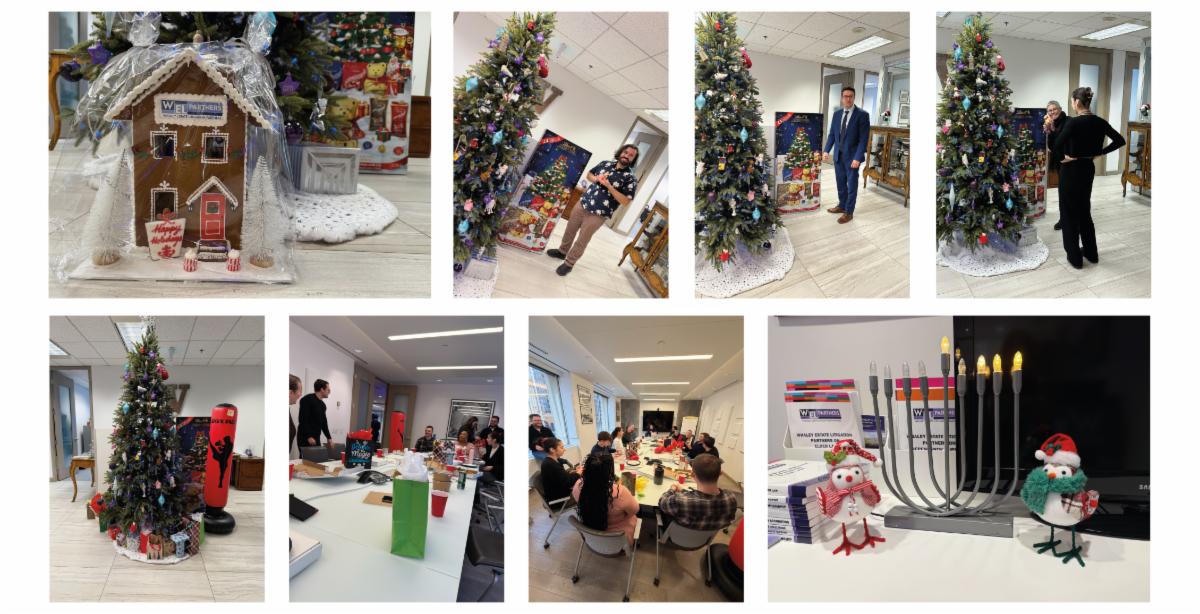
WEL has been counting down the days until our offices are closed for the holidays. During this busiest of seasons we take time to reflect on our blessings and find joy in our relationships with colleagues, clients, friends and family.
WEL started December with a new take on an old tradition with our GIANT Lindt Advent calendar. Our team has delighted in taking turns each day revealing new surprises behind each door.
We have also celebrated the season by exchanging Secret Santa gifts for our festive holiday lunch. We feasted on individual wood fired pizza’s hand delivered by our friends at Capocaccia Trattoria, while we sipped on festive cranberry mocktail creations from none other than Sam Whaley. A wonderful afternoon was had, guessing who gifted whom and recapping stories of the year ending.
WEL also wishes to honour and celebrate the Chanukah season with our Jewish friends and colleagues. Chag Sameach!
Next week we have one more celebration at the Distillery Winter Village and lunch at Cluny-so fun!
| | 5. STEP ANNUAL REVIEW 2025 | |
With another year ending, STEP Global has put together their Annual Review for 2025, which covers Strategic Initiatives & Research, Advocacy and Public Policy, Membership & Education and Financial & Governance Updates. WEL Partners wishes to congratulate STEP for another tremendous year and look forward to 2026!
To review STEP’s year in 2025, please click the below link:
https://annualreview.step.org/2025/
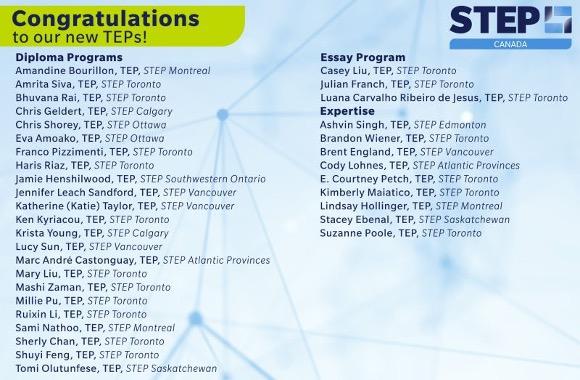
| | II. WEL SHOUT OUTS & CONGRATULATIONS | | NEW STEP TRUST AND ESTATE PRACTITIONER (TEP) DESIGNATIONS | | WEL Partners wishes to congratulate the recent recipients of STEP’s prestigious Trust and Estate Practitioner (TEP) designation. The TEP designation formally distinguishes these qualified practitioners from non-specialists and offers a competitive advantage in attracting clients. The below members were granted the designation in October, November, and December 2025. Congratulations to all recipients! | | OBA AWARD OF EXCELLENCE IN CIVIL LITIGATION | | WEL Partners wishes to congratulate Frank Walwyn on receiving the OBA Award for Excellence in Civil Litigation. The Award, created by the Executive of the Civil Litigation Section, recognizes contributions and achievements of members of the Ontario Bar Association with outstanding advocacy skills, professionalism, integrity and civility, teaching of civil litigation and practice, the enhancement of the practice of civil litigation, and leadership in the Civil Litigation Bar. Frank’s award will be presented at the Civil Dinner on Tuesday, January 20, 2026, at the Royal York Hotel in Toronto. Congratulations again, Frank on your well-deserved honour and recognition! | | (i) DEFINITION OF ‘CHILD’ FOR INTESTACY PURPOSES | | |
By Albert H. Oosterhoff
1. Introduction
The recent case, Estate of Sydney Monteith v Monteith et al,[1] considers the question whether a child fostered by the parents of an intestate can be considered the sister of the intestate and therefore entitled to share in his estate.
2. Facts
George and Doris Monteith, who died in 2016 and 1988 respectively, fostered 136 children over many years. Three of them include Sydney, Timothy, and Ena, and George and Doris adopted them. Sydney died intestate on 16 March 2022. He had no spouse and left no children surviving him. Ena predeceased Sydney and was survived by two children, Julie and Amy. George and Doris also fostered another child, Sandra. They never adopted Sandra, but she maintained a close relationship with George. He walked her down the aisle at her wedding and regularly referred to her as his ‘daughter’. George also named her as his Attorney for Property, jointly with Sydney, and as co-executor, jointly with Sydney and Timothy, and in doing so referred to them collectively as his ‘children’. Sandra claimed that since George treated her as his daughter, she qualified as the sister of Sydney and was therefore entitled to share in his intestate estate.
The Applicant, the Estate Trustee (Administrator) of Sydney’s Estate brought an Application for the court’s advice and was supported by the Respondents, Timothy, Julie, and Amy. They submitted that, as a foster child, Sandra does not fall within the definition of ‘child’ and thus was not Sydney’s sister. Sandra was the other Respondent.
3. Analysis and Judgment
3.1 Whether Sandra Is Sydney’s Sister
Justice Heeney began his analysis by noting that section 47(4) of the Succession Law Reform Act[2] governs the distribution of Sydney’s Estate. It provides that when a person dies intestate and there is no surviving spouse, issue, or parent, the intestate’s property shall be distributed among the surviving brothers and sisters, and that if any brother or sister predeceases the intestate leaving children, the share of the deceased brother or sister shall be distributed among his or her children equally.
His Honour, went on the consider the definition of ‘child’ in the Children’s Law Reform Act.[3] Sections 3 and 4 provide:
3 This Part governs the determination of parentage for all purposes of the law of Ontario.
4 (1) A person is the child of his or her parents.
(2) A parent of a child is,
(a) a person who is a parent of the child under sections 6 to 13, except in the case of an adopted child;
(b) in the case of an adopted child, a parent of the child as provided for under section 217 or 218 of the Child, Youth and Family Services Act, 2017.[4]
(3) The relationship of parent and child set out in subsections (1) and (2) shall be followed in determining the kindred relationships that flow from it.
(4) For greater certainty, this section applies for all purposes of the law of Ontario.
In light of section 4(3) and (4), the definition of ‘child’ also governs the SLRA provisions. It follows that Sandra is not a ‘child’ of George and is therefore also not a sister of Sydney.
Moreover, section 217 of CYFSA provides that an adopted child becomes the child of the adoptive parent and the adoptive parent becomes the parent of the adopted child. Further, the relationship to one another of all persons, including the adopted child, the adoptive parent, and the kindred of the adoptive parent shall for all purposes be determined accordingly.
Thus Sydney, Timothy, and Ena are children of George for all purposes of the law, including the SLRA, and they are siblings of each other, also for all purposes of the law. But since Sandra is not a child of George, she is also not a sister of Sydney, Timothy, and Ena, and therefore she is not entitled to share in Sydney’s intestate estate under section 47(4) of the SLRA.
The reason why George may not have adopted Sandra is irrelevant. At law the only relevant fact is that he did not do so.
Justice Heeney noted that it is true that in certain circumstances statutes expand the definition of ‘child’. For example, section 1(1) of the Family Law Act[5] defines ‘child’ to include a person to whom a parent has demonstrated a settled intention to treat the person as his or her child. It does so for the purpose of making the parent liable to pay child support. But the section expressly excludes foster children.
Section 57(1) of the SLRA also contains an expanded definition of ‘child’ to include, inter alia, ‘a person whom the deceased has demonstrated a settled intention to treat as a child of his or her family’. But it applies only to Part V of the Act, which deals with the support of dependants.
The fact that George named Sandra co-executor in his will and referred to her as one of his ‘children’ also has no legal relevance. The reality is that by statute Sandra does not qualify as George’s ‘child’, and the court cannot ignore its clear language. Thus, she is also not a sister to Sydney and is therefore not entitled to share in his intestate Estate.
3.2 Costs
Justice Heeney addressed the cost claims in the additional reasons mentioned above. The Applicant claims costs on a full indemnity basis payable out of the Estate. Timothy claims costs on a substantial indemnity basis payable by Sandra.
His Honour noted that the default rule regarding costs in estate matters is that the ‘loser pays’, unless public policy considerations apply to displace the default regime. As regards the Applicant’s claim, public policy considerations apply because of his concern to ensure that the estate was properly administered, and in the circumstances considerations of fairness to Sandra pointed to the same conclusion. Therefore, the Applicant’s costs should be paid by the Estate on a full indemnity basis.
With respect to Timothy’s claim, his Honour noted that Timothy’s participation in the litigation was not necessary for the proper administration of the Estate. He participated to protect his own entitlement to his share of the Estate. Thus, he and Sandra were opponents, and there being no policy considerations, the default rule is that costs follow the event. The real issue is whether Timothy should be awarded costs against Sandra on a substantial or partial indemnity basis. In his Honour’s opinion Timothy is entitled to costs payable by Sandra on a partial indemnity basis, with the balance of his full indemnity costs to be paid by the Estate.
--
[1] 2024 ONSC 7246, additional reasons on costs 2024 ONSC 800.
[2] RSO 1990, c S.26 (‘SLRA’).
[3] RSO 1990, c C.12 (‘CLRA’).
[4] SO 2017, c 14, Sched 1 (‘CYFSA’).
[5] RSO 1990, c F.3.
| (ii) ANOTHER UNCLEAR PER STIRPES PROVISION | | |
By Albert H. Oosterhoff
1. Introduction
Pierce v Oswald[1] is a recent case about a will that contained a direction to distribute the residue inter alia to persons per stirpes. But the meaning of that direction was unclear and required interpretation.
In Lau v Mak Estate[2] Justice Cullity had to interpret a will that left a share of the residue to one daughter, C, for life, with remainder equally between a son and another daughter, J and S, ‘as his or her own property absolutely, in equal share per stirpes’. All three children survived the testator, but S predeceased the life tenant, C, survived by two adult children. Justice Cullity held that this was an incorrect use of the phrase per stirpes, and that it lacked any meaning. The phrase only makes sense if more than one family or stirps is represented in the description of the beneficiaries. As Justice Cullity noted, a gift to the children of someone, ‘in equal shares per stirpes’, is a contradiction in terms if the word ‘children’ is to be given its natural meaning. His Honour was very critical of the misuse of the term and took the view that if the term is misused in this way the court should disregard it. Thus, in Lau he held that the remainder vested in J and S on the death of the testator and therefore the phrase per stirpes should be disregarded.
However, the Ontario Court of Appeal took a different approach in Dice v Dice Estate.[3] The testator gave a life interest to his wife and directed that his trustees should divide the net residue equally between his son and daughter, E and M, per stirpes. E predeceased his mother, survived by three children. The judge of first instance found that the testator’s intention was to treat his children and therefore their families equally. He used the phrase per stirpes because he must have been concerned that one of the children might predecease his wife. Therefore, he held that E’s children were entitled to his share of the estate. The Court of Appeal agreed. and the court followed that interpretation in Jonas v Jonas.[4]
The court in Pierce followed this second approach.
2. Facts
The Testator, Frieda Holtzgethan, died in Toronto in 2016. She had been a secondary school teacher and had been retired for 25 years. She had made her Will in 1997. Her husband had died before then. Frieda appointed her only child, Magrid, her executor and sole residuary beneficiary. Magrid predeceased her mother and so did the alternative executor.
The Will went on to provide in clause 3(d) that if Magrid should predecease her mother, Frieda directed her trustee to divide the residue of her estate ‘into equal shares per stirpes’ and to give or transfer one such share to each of her five named sisters, Paula, Justine, Angela, Maria, and Hilda, ‘for their own respective uses absolutely, and in the event that all of the aforesaid persons shall have predeceased me, I direct my Trustee to divide the residue of my estate among my surviving issue’. All five of the sisters lived in Austria. The four older ones predeceased Frieda. The spouses of the five sisters also predeceased Frieda. However, the sisters were survived by their children.
(a) Paula was survived by Adelheid,
(b) Justine was survived by Franz and Ewald,
(c) Angela was survived by Eberhard,
(d) Maria was survived by Eduard and Edeltraut,
(e) Hilda survived Frieda but has since died, survived by her four children.
The Applicant, Mary Pierce and her mother Carol Pierce, were family friends of Frieda and Magrid, Carol having worked with Frieda during their teaching careers, and Carol having acted as Magrid’s executor. Mary made an application to be appointed Frieda’s Estate Trustee with a Will in 2020, having complied with all the requirements of the Rules of Civil Procedure,[5] including service upon the family members, all of whom consented to the appointment.
Mary then brought this application for the opinion, advice and direction of the court about the interpretation of Frieda’s Will. She suggested that there are three possible interpretations of clause 3(d):
(a) each of the five sisters takes an equal one-fifth (20%) share, and since all are now deceased, their 20% shares pass to their child or children;
(b) the residue passes to the sole surviving sibling, Hilda, and the share of the predeceased siblings lapses, but is saved by section 31 of the Succession Law Reform Act,[6] and passes to their children.
(c) The entire residue passes to Hilda as the sole surviving sibling.
3. Analysis and Judgment
Justice Sanfilippo began his analysis be noting that the court must determine the testator’s actual or subjective intention about the disposition of her property, and for that purpose the court must place itself in the testator’s armchair.[7] Significantly his Honour stated, ‘This analysis is required when, like here, the direction sought by the Estate Trustee is unopposed. The judge is obligated to be satisfied that the declaration sought sets out the testamentary intentions of the testator’.[8]
His Honour concluded that Frieda’s actual or subjective intentions about the disposition of her property were clear from a plain reading of the Will and that evidence of surrounding circumstances at the time the Will was made were also found in the Will.
His Honour determined that Frieda intended to benefit each of her five siblings equally, including the stirps or family branches of any predeceased sisters. He reached this conclusion by giving effect to the phrase per stirpes and the absence of a contrary intention in the Will, and by a consideration of the other provisions of the Will
As already mentioned, Justice Sanfilippo followed the view expounded by the Court of Appeal in Dice that the term per stirpes implies that if a beneficiary predeceases the testator, her share should pass to her descendants.
The problem that arose in this case was that clause 3(d) is ambiguous in that it instructed the Trustee to divide the residue to each sister ‘in equal shares per stirpes’ but then went on to give the sisters an equal share ‘for their own respective uses absolutely’. His Honour noted that this latter provision could be interpreted as directing a per capita distribution to the sisters only. However, by relying on Dice, he concluded that it is necessary to consider the whole will and all its provisions, and that therefore it would be wrong to disregard the term per stirpes since it suggests that the testator did not intend a per capita distribution but that the share of any sister who predeceased the testator should pass to her descendants. His Honour held therefore that the per stirpes term overrides the statement ‘for their own respective uses absolutely’. His Honour found further that the minor beneficiary clauses in the Will also supported this conclusion.
Justice Sanfilippo then considered the effect of the anti-lapse provision in section 31 of the SLRA. It directs that a bequest made to a sibling of the testator who dies before her, takes effect as if it had been made directly to the descendants of the predeceased sibling. Thus, his Honour held that section 31 would have the same effect as the conclusion he had reached on the interpretation of the Will.
Therefore, Justice Sanfilippo ordered that the share of each predeceased sister, as well as the share of Hilda, who died after the testator should be divided among their children.
Not surprisingly, his Honour ordered that the Applicant’s costs, which he determined to be fair and reasonable, be paid from the estate assets, since the application was necessary because of the ambiguity in the Will.
--
[1] 2025 ONSC 5344.
[2] (2004), 10 ETR 3d 152 (Ont SCJ).
[3] 2012 ONCA 468.
[4] 2022 ONCA 845.
[5] RRO 1990, Reg 194, Rules 9.01(2)(b), 17.02(c)(iii), 17.05(1) 75.06(1), (2)
[6] RSO 1990, c S.26 (‘SLRA’).
[7] Citing, inter alia, Ross v Canada Trust Company, 2021 ONCA 161, at para 36; Trezzi v Trezzi, 2019 ONCA 978, para 13.
[8] Citing Hejno v Hejno, 2025 ONCA 249, paras 2 and 9.
| | (iii) NEED AN ORDER GIVING DIRECTIONS? | | |
By Emily Caza
Contested passings of accounts remain procedurally challenging terrain. Although Rules 74.15–74.18 of the Rules of Civil Procedure outline how to commence a passing, they do not offer a complete roadmap for what happens after objections are filed. Counsel and fiduciaries are often left navigating disclosure disputes, evidentiary issues, scheduling challenges, and questions about the appropriate hearing format – without meaningful guidance in the Rules themselves.
Our new paper explores how Orders Giving Directions fill this void.
Why Directions Are So Important
An Order Giving Directions customizes the process to the issues at stake, ensuring that the passing proceeds in a fair, efficient, and cost-effective way. Whether the objections relate to compensation, investment decisions, record-keeping, or allegations of breach of trust, directions create clarity. They help avoid unnecessary interlocutory motions and prevent the risk – illustrated in case law – of a court proceeding to adjudication on an incomplete or untested record.
Where the Court Gets Its Authority
We break down the three pillars of jurisdiction that empower courts to craft directions:
-
The Estates Act, including s. 49(4);
- Rule 75.06’s broad power to seek directions; and
- The Toronto Estates List Practice Direction, which remains the most practical procedural guide for passings.
What Directions Can Achieve
A well-structured Directions Order can address:
- the issues to be tried;
- the parties and their roles;
- disclosure timelines;
- expert and lay evidence;
- mediation requirements;
- discovery steps; and
- how evidence will be presented at the hearing.
The paper highlights several key decisions such as Zucker Estate, 2012 ONSC 2262, Horbaczyk v. Horbaczyk, 2017 ONSC 6666, and Re: The Estate of Andrew Hargrave Stuart, 2018 ONSC 6333, illustrating how courts use directions to impose structure, narrow issues, and, in some cases, convert a passing into a fully-pleaded action before the accounting proceeds.
The Bottom Line
For practitioners and fiduciaries alike, understanding how to craft, negotiate, and seek directions is essential. Our full paper provides a practical, case-driven overview of the “why, what, and how” of these critical tools.
Read the full paper: Motions And Orders for Directions in Passing of Accounts Applications: The Why, What & How, December 10, 2025, Emily Caza & Kimberly Whaley
| | (iv) REMOVING AN ESTATE TRUSTEE IN ONTARIO: WHAT EVERY BENEFICIARY NEEDS TO KNOW | | |
By Grant Swedak
While the removal of Estate Trustees pursuant to section 37 of the Trustee Act,[1] has been available for quite some time now, within the past few years (particularly 2022 onward) there seems to have been a discernible rise in scrutiny of Estate Trustees and an increase in applications to the Ontario Superior Court.
I will endeavor to lay out some of the foundational authorities one ought to consider when contemplating a removal proceeding.
Legislation
As mentioned above, pursuant to section 37 of the Trustee Act, the court may remove an Estate Trustee and appoint another person in their place where it is no longer possible for them to abide by their duties in an impartial and objective manner. Section 37 holds,
Removal of personal representatives
37 (1) The Superior Court of Justice may remove a personal representative upon any ground upon which the court may remove any other trustee and may appoint some other proper person or persons to act in the place of the executor or administrator so removed.
Caselaw
There are a number of caselaw authorities, tests and factors which may be considered for the removal of an Estate Trustee; however, many of these decisions are often qualified by the presiding justice as being non-exhaustive.
In the appellate decision of Gonder v Gonder Estate,[2] Epstein & Rouleau JJ.A, speaking for the Ontario Court of Appeal, held that three objectives that ought to be addressed when considering the removal of an Estate Trustee are as follows:
(1) ensuring the orderly administration of the estate in the interests of the beneficiaries;
(2) recognizing the plight of the respondents; and
(3) providing for the timely resolution of the disputes concerning the estate.[3]
In a more recent application of section 37(1) of the Trustee Act, Justice Gomery in the decision of Kasanda v Sartarelli,[4] articulates a similar test although it is derived from a different line of jurisprudence. Citing from the highly regarded decision of Radford v Radford,[5] where Justice Quinn canvassed the principles on an application to remove an Estate Trustee, to be later summarized in Johnston v Lanka,[6] the Court asserts the following in respect to Estate Trustee removal:
(1) the court will not lightly interfere with the testator's choice of estate trustee;
(2) clear evidence is required that removal of the trustee is necessary;
(3) the court's main consideration is the welfare of the beneficiaries; and
(4) the estate trustee's acts, or omissions must be of such a nature as to endanger the administration of the trust.[7]
From Justice San Filippo in the decision of La Calamita v La Calamita,[8] which stands out as one of the most exhaustive list of factors to date, he goes on to hold the following when considering Estate Trustee removal:
(a) The court will remove the estate trustee only if doing so is clearly necessary to ensure the proper administration of the trust.
(b) The court should not lightly interfere with a testator's choice of the person to act as his or her estate trustee. The wishes of the testator will generally be honoured "even if the person chosen is of bad character".
(c) A court should remove an estate trustee only on the "clearest of evidence" and should be reluctant to pass over a named estate trustee unless "there is no other course to follow".
(d) Even if an estate trustee has not executed their functions perfectly or ideally, "that is not the test". The test is whether the estate is likely to be administered properly in accordance with the fiduciary duty of the trustee and for the benefit of the beneficiaries.
(e) Friction alone between co-executors is not itself reason for removal. For friction to be the basis for removal, it must rise to a level that prevents the proper administration of the estate.
(f) Passing over an executor is an "unusual and extreme course". It has been described as an "extreme remedy" and one of "last resort".
(g) Past misconduct may justify removal if that misconduct is likely to continue in the future. Removal is not intended to punish, but to protect the Estate assets and the interests of the beneficiaries.
(h) The Court's main guide should be the welfare of the beneficiaries.[9]
[footnotes omitted]
Taken together, these authorities underscore the careful balancing act Courts undertake when considering the removal of an estate trustee. While section 37 of the Trustee Act grants broad discretion, the caselaw illustrates that removal is not merely a response to minor errors or interpersonal friction. Instead, the Courts consistently emphasize that any intervention must be justified by clear evidence that the trustee’s conduct endangers the proper administration of the estate and the interests of the beneficiaries. The jurisprudence also reflects a judicial respect for the testator’s intent: even where a trustee’s performance is imperfect, the threshold for removal remains high.
Final Remarks
For practitioners and beneficiaries alike, the key takeaway is the importance of early engagement, transparent communication, and meticulous record‑keeping. Trustees who act diligently and in good faith are unlikely to face removal, even if disagreements arise. Conversely, prospective applicants should recognize that the court will demand compelling evidence of mismanagement or risk to the estate before considering removal.
Ultimately, the law encourages resolution that preserves the integrity of the estate while safeguarding the interests of the beneficiaries. Removal should be thought of as a last resort, not the default solution.
For further readings on Estate Trustee removal, check out some of our other blogs:
Removal and Passing Over of Executors and Administrators | WEL Partners Blog
Removal Or Passing Over of Executor? | WEL Partners Blog
Renunciation & Intermeddling – Which Trustee Actions Cross the Line? | WEL Partners Blog
--
[1] Trustee Act, RSO 1990, c T.23, at section 37
[2] Gonder v. Gonder Estate, 2010 ONCA 172 (CanLII). (“Gonder Estate”)
[3] Ibid., at para 23.
[4] Kasanda v. Sartarelli, 2023 ONSC 4400 (CanLII). (“Kasanda”)
[5] Radford v. Wilkins, 2008 CanLII 45548 (ON SC)
[6] Johnston v. Lanka, 2010 ONSC 4124 (CanLII).
[7] Kasanda., at para 6.
[8] La Calamita v. La Calamita, 2024 ONSC 4219 (CanLII). (“La Calamita”)
[9] La Calamita, at para 95.
| | (v) IS INCAPACITY REQUIRED FOR TRUSTEE DE SON TORT?: A DISCUSSION OF MCGRATH v. EFFINGER ET AL. 2025 ONSC 6439 | | |
By Mark Polese
In Canadian Law, a “trustee de son tort” or “trustee by his own wrong” is an individual who assumes the role of a trustee without formal appointment. Doing so requires the individual to incur fiduciary duties and liabilities as a result of their actions. A finding of a trustee de son tort does not necessarily require there to be a formal finding of incapacity. However, it can be extremely difficult to establish one without it. The Ontario Superior Court recently had to grapple with the requirements for a trustee de son tort in the recent decision of McGrath v. Effinger et al.[1]
Background
In 2009, at the age of 65, Catherine Rozon (“Ms. Rozon”) voluntarily moved to the Canadian Divine Mercy Centre (“the Centre”), a private Christian centre situated in Lanark, Ontario. The Centre is a non-profit corporation built by Willy and Theresa Effinger (“the Respondents”). The Centre provided visitors with religious education and contemplation, though required full-time residents, like the Respondents and Ms. Rozon, to take a vow of poverty and commit to a life devoted to prayer and reflection.
Prior to moving to the Centre, Ms. Rozon had survived breast cancer and decided to move in to live a more contemplative life. Ms. Rozon ultimately moved into her own cabin on the property, paying the costs of renovating and maintaining it. Additionally, Ms. Rozon paid the Centre a monthly fee of $600-$1000.
In 2016, Ms. Rozon’s breast cancer returned. She opted to remain at the Centre during her treatment and as a result, called on the Respondents and other residents of the Centre to assist her with travel to medical appointments, home support, and the purchase of groceries, medications, and other necessities. In September of 2021, Ms. Rozon’s daughter, Pauline McGrath (“the Applicant”) concerned for her mother’s health retrieved her from the Centre.
3 years later, on July 2, 2024, the Applicant brought an application for a passing of accounts from the Respondents in relation to Ms. Rozon’s banking transactions between 2011 and 2021, alleging a misappropriation of an estimated $260,000. As part of this application, the Applicant sought a declaration that the Respondents owed a fiduciary duty to Ms. Rozon and acted as her trustees de son tort. The Applicant held a continuing power of attorney in relation to Ms. Rozon, who was now 82 years old at the time of the application.
The Respondents challenged the application, claiming that the Applicant did not have standing to bring the application, and further denied that they were ever in a trust relationship with Ms. Rozon to warrant a passing of accounts. Furthermore, they argued that the Applicant was barred from launching the application under the Limitations Act[2] as the limitations period to bring the claim had expired. Notably, no finding of incapacity had been made with regards to Ms. Rozon.
Issues
- Did the Applicant, who was a non-lawyer non-litigant, have standing based on the continuing power of attorney to bring the application?
-
Was the application statute barred under the Limitations Act, 2002?
-
Were the Respondents attorneys or guardians of property for Ms. Rozon to warrant a passing of accounts under s.42(1) of the Substitute Decisions Act (“SDA”)[3]
- Were the Respondents ever trustees de son tort or constructive trustees to warrant an order for the passing of accounts?
Issue 1: Standing
On December 4th, 2023, Ms. Rozon granted the Applicant a Continuing Power of Attorney for Property (CPOAP). The Court here accepted that CPOAP as valid and directly referenced the SDA, noting the difference between a Power of Attorney and a CPOAP. In examining the CPOAP document, the Court held that it began its effect on the day it was signed, and did not require a finding of incapacity, though it did reference that it will continue to remain in effect, even if Ms. Rozon is found incapable.
As the CPOAP was found to be valid, the Court referenced Part I of it where it stated:
Subject to any conditions and restrictions contained herein, I authorize my attorney to do on my behalf, anything that I can lawfully do by an attorney, and specifically, anything in respect of property that I could do if capable of managing property, except make, modify or revoke a will. My attorney shall have the authority to act as my litigation guardian, if one is required to commence, continue, defend or represent me in any court proceeding. [Emphasis added][4]
Therefore, the court found that the Applicant did have sufficient standing to bring the application.
Issue 2: Limitation
The Applicant alleged that the misappropriation or “wrong” occurred between 2011 and September of 2021. The Respondents argued that since the application wasn’t brought until 2024, the two-year limitation period set out int in the Limitations Act statutorily bars the Applicant from bringing the application. Additionally, there was adduced evidence showing that the Applicant had reviewed her mother’s bank account statements in November of 2021 and February of 2022, so the wrong would have been discovered at the latest in February of 2022, meaning an application filed on July 2, 2024 would still be in violation of the limitation period.
The Applicant argued that the limitation period does not apply to an order for the passing of accounts, relying on the Ontario Court of Appeal decision in Armitage v. The Salvation Army.[5]
The Court ultimately held that the application was statute-barred. In doing so, the Court distinguished Armitage v. The Salvation Army on the basis that the relief sought by the Applicant went beyond the scope of a mere passing of accounts. The Applicant sought declarations of trustee status, unjust enrichment findings, and restitution. That combination transformed the proceeding into a “claim” under the Limitations Act and therefore it was subject to the 2-year period from discoverability. [6]
Issue 3: Were the Respondents attorneys or guardians of property?
The Applicant argued that the Respondents owed a duty to pass accounts in their capacity as landlords, caregivers, and spiritual directors over Ms. Rozon. If they were found to be attorneys or guardians of property, they would be required to pass accounts pursuant to s. 42(1) of the SDA:
Passing of accounts
(1) The court may, on application, order that all or a specified part of the accounts of an attorney or guardian of property be passed. 1992, c. 30, s. 42 (1).
Attorney's accounts
(2) An attorney, the grantor or any of the persons listed in subsection (4) may apply to pass the attorney's accounts. 1992, c. 30, s. 42 (2).
Guardian's accounts
(3) A guardian of property, the incapable person or any of the persons listed in subsection (4) may apply to pass the accounts of the guardian of property. 1992, c. 30, s. 42 (3).
Others entitled to apply
(4) The following persons may also apply:
1. The grantor's or incapable person's guardian of the person or attorney for personal care.
2. A dependant of the grantor or incapable person.
3. The Public Guardian and Trustee.
4. The Children's Lawyer. 5. A judgment creditor of the grantor or incapable person. 6. Any other person, with leave of the court[7]
The Court rejected the Applicant’s argument, finding no basis to compel a passing of accounts under s.42(1). There had been no tenancy agreement establishing landlord accounting obligations, and any assistance rendered fit a non-fiduciary, community-based friendship pattern with transactions done at the grantor’s direction.
Notably, a key point of fact leading to the Court’s decision here was the absence of a finding of incapacity. They maintained that all assistance provided by the Respondent’s was done at Ms. Rozon’s specific direction. Had there been a finding of incapacity during the time that Ms. Rozon stayed at the Centre, then the holding may have been different.[8]
Issue 4: Trustees de son tort
The Applicant argued that even if the Respondents were not named as attorneys for the purposes of s.42(1) of the SDA, there was evidence that they had sufficient care and control over Ms. Rozon’s finances and personal needs such that they can be found to be trustees de son tort. The Applicant claimed that this evidence included the fact that the Respondents took money out of Ms. Rozon’s bank account, that they spent her money on food and cash donations to the Centre, and that, between 2016 and 2021, they were responsible for Ms. Rozon’s personal and financial needs. The root of the Applicant’s argument is that the Respondents, through this conduct, implicitly took on the role of a trustee in relation to Ms. Rozon, whether expressly or otherwise, and therefore should be open to liability.
The Court held that a finding for trust or fiduciary relationship does not require proof of incapacity or a formal trust relationship.[9] A finding of a trustee de son tort is a fact specific determination dependent on multiple factors, including the level of intrusion into the person’s affairs.[10] To establish liability under this doctrine, the Court held that it was the Applicant’s burden to prove that the evidence established that the Respondents took it upon themselves to act as a trustee, or to possess and administer trust property.[11]
The Court ultimately found that the Respondents were not in a trust relationship.[12] While they cared for her and engaged in various financial tasks when Ms. Rozon was ill, they did so as a friend and, again, at her direction. Importantly, there was no evidence that Ms. Rozon lacked cognitive capacity at the time of the alleged misappropriation. Additionally, while not an express issue in the holding, the Court mentioned that there is no evidence that the Respondents even engaged in any dishonest or fraudulent conduct in their assistance to Ms. Rozon, indicating that even if they were found to be trustees, the application likely would have failed on its merits. [13]
Takeaway
The Court here is clear that for a finding of Trustee de son tort, a finding of incapacity is not required. However, given this holding, it begs the question as to how narrow of a circumstance could result in that finding. Throughout the decision, the court’s holding seemed to hinge on the fact that Ms. Rozon was capable and was able to direct the Respondents. This appears to be the key consideration of the Court. Certainly, if she was found incapable, the decision could have very well gone the other way. At the end of the day, this decision emphasizes that, while a finding of incapacity may not be strictly required, a potential applicant should seriously consider their case when making a claim for trustee de son tort without one, as it appears that that would be an uphill battle.
--
[1] McGrath v. Effinger et al, 2025 ONSC 6439
[2] Limitations Act, 2002, S.O. 2002, c. 24, Sched. B
[3] Substitute Decisions Act, 1992, S.O. 1992, c. 30
[4] Supra note 1 at para 66
[5] Armitage v. The Salvation Army 2016 ONCA 971, 406 D.L.R. (4th) 563
[6] Supra note 1 at para 76
[7] Supra note 3 s.42(1)
[8] Supra note 1 at para 97
[9]Maki v. Cammaert et al., 2024 ONSC 6711 at paras 34 and 46
[10] Chambers v. Chambers, 2013 ONCA 511, 367 D.L.R. (4th) 151, at paras. 75-77
[11] Humphreys-Saude v. Pavao, 2022 ONSC 4982, at paras. 61-63.
[12] Supra note 1 at para 102
[13] Ibid
|
| (vi) THE DOCTRINE OF INCORPORATION BY REFERENCE IN TESTAMENTARY MATTERS | | |
By Oliver O’Brien
The doctrine of incorporation by reference permits a document entirely separate and apart from a Last Will and Testament to be considered part of that document for the purpose of probate. This doctrine is commonly used to incorporate memoranda which typically detail bequests of certain belongings by the testator.
The doctrine is only applicable where there is a valid and duly executed Will into which the document may be incorporated into. Accordingly, it must satisfy the common law requirements, and those prescribed in statute by Ontario’s Succession Law Reform Act (“SLRA”).[1]
Through Ontario caselaw, the courts have elucidated the threshold requirements for a document to be incorporated into a Will by reference which are as follows:
(1) The document must be in existence at the time the Will is made
A document that postdates the execution of the Will in question cannot be incorporated under this doctrine, given it would then in effect enable the testator to create an unattested future codicil.[2] Accordingly, even if the document to be incorporated is sufficiently referred to and identified, but was made after the Will, then it cannot be incorporated.
In the early 1900s English case of Re Goods of Smart,[3] the court considered a Will and incorporation of a separate document. Specifically, the testator’s Will provided that:
I give to my said cousin, Margaret Rose Smart, all my furniture, books, plate, linen, wearing apparel, and personal effects of a like nature during her life for her own absolute use and benefit, and from and after her decease I direct my trustees to give to such of my friends as I may designate in a book or memorandum that will be found with this will the different articles specified for such friends in such book or memorandum, and as regards any of such articles not specifically disposed of by me, I declare that the said Margaret Rose Smart shall have full power to absolutely dispose thereof. [emphasis added]
As the Will contemplated incorporating a document to be made sometime in the future, there could be no incorporation. The Honourable Justice Gorrell Barnes noted that: “it is clear that, in order that the informal document should be incorporated in the validly executed document, the latter must refer to the former as a written instrument then existing – that is, at the time of execution – in such terms that it may be ascertained”.[4]
(2) The document to be incorporated must be described in the Will as being in existence at the time of making the will
Likewise, it is clear that a document referred to in the Will of the testator must be in existence at that time and not in reference to a future document to be created. Importantly, if the Will refers to an existing document that is subject to change, the document cannot be incorporated.[5]
(3) The document to be incorporated must be sufficiently described in the Will
On a practical level, this requirement ensures that it is apparent that the document submitted for admission to probate is the same as the document referred to in the Will. The onus of proving that these three requirements are met is on the propounder of the document for incorporation, on the civil standard of the balance of probabilities.[6]
Application in Re Lacroix Estate
One of the more recent examples of the doctrine of incorporation by reference being considered by the Ontario Superior Court of Justice was in Re Lacroix Estate.[7]
Background
In May 2020, Rebecca Stephanie Lacroix (“Ms. Lacroix”) contacted a drafting lawyer, and instructed her to prepare a Will. At this time, Ms. Lacroix was in hospital with a terminal illness.[8]
The drafting lawyer subsequently prepared a draft Will pursuant to Ms. Lacroix’s instructions. Unfortunately, the drafting lawyer and her assistant were denied access to the hospital where Ms. Lacroix resided to execute the Will, given the COVID-19 restrictions in place at the time. Instead, the drafting lawyer delivered the Will to the hospital, and instructed Ms. Lacroix to create a holographic Will which incorporated the draft Will by reference. Ms. Lacroix subsequently prepared a handwritten note which stated the following:
“I, Rebecca Stephanie Lacroix, declare that this holographic Will shall constitute my last will and testament and I hereby incorporate into this Will the attached draft Will, that I have initialed on each page for identification purposes”.[9]
Attached to that handwritten note was the draft Will, which was initialed on each page by Ms. Lacroix.
Application of Doctrine
Ms. Lacroix died less than two weeks after preparing the holographic document. The estate trustee named in the draft Will applied for a Certificate of Appointment of Estate Trustee.[10]
The court considered the statutory formalities for a valid Will and in particular, sections 6 and 7 of the SLRA which provide that:
Holograph wills
6 A testator may make a valid will wholly by his or her own handwriting and signature, without formality, and without the presence, attestation or signature of a witness.
Position of signature
7 (1) In so far as the position of the signature is concerned, a will, whether holograph or not, is valid if the signature of the testator made either by him or her or the person signing for him or her is placed at, after, following, under or beside or opposite to the end of the will so that it is apparent on the face of the will that the testator intended to give effect by the signature to the writing signed as his or her will.[11]
The Court found that the handwritten document satisfied section 6 of the SLRA given it was made wholly in Ms. Lacroix’s handwriting. Moreover, it complied with section 7 of the SLRA as the signature immediately followed the handwriting. The handwritten document also indicated clear testamentary intent.[12]
The court then considered the doctrine of incorporation by reference. On the one hand, the court noted that the document in question complied with the statutory formalities.
Unfortunately for the testator, the court could not incorporate the draft Will by reference as the holographic document did not stand alone as a testamentary document. In this regard, the note prepared by Ms. Lacroix did not independently make any disposition of property.[13]
For these reasons, the handwritten note and the attached draft Will could be admitted to probate, and the issuance of a Certificate of Appointment of Estate Trustee was denied.[14]
Concluding Comments
The probate doctrine of incorporation by reference is readily used in matters of probate. As noted in Lacroix Estate, the testamentary document in question must comply with the statutory formality requirements. In Black Estate v. Black,[15] the Honourable Justice Morisette noted that:
the conditions for the application of the doctrine of "incorporation by reference" are very strict. As stated by Feeney:
Where those conditions exist, the doctrine has freely been used in connection with formal wills to breathe life into informal testamentary papers, regardless of the fact that the doctrine permits a court to admit to probate a paper that "flies in the face" of the wills legislation.[16] [emphasis added]
--
[1] Succession Law Reform Act, RSO 1990, c S.26 (“SLRA”).
[2] Re Currie; Labatt v. M.N.R. (1978), 91 D.L.R. (3d) 559 (Ont. H.C.).
[3] Re Goods of Smart, [1902] P. 238 (Eng HC – Prob Div), cb p.163.
[4] Ibid.
[5] Re Jones, [1942] Ch. 328; Oosterhoff on Wills (8th ed, Thompson Reuters) at page 137.
[6] Thomas Estate v. Gay (1996)199614 E.T.R. (2d) 229 (Ont. Gen. Div.), at p. 6.
[7] Re Lacroix Estate, 2021 ONSC 2919 (“Lacroix Estate”).
[8] Ibid. at paras 1 – 4.
[9] Ibid. at paras 1 – 7.
[10] Ibid. at para 7.
[11] SLRA at section 6 and 7(1).
[12] Lacroix Estate at para 24.
[13] Lacroix Estate at paras 25 – 27; Bennett v. Toronto General Trusts Corp., 1958 CanLII 49 (SCC), [1958] S.C.R. 392, at p. 396.
[14] Lacroix Estate at para 28.
[15] Black Estate v. Black, 2006 CarswellOnt 9030.
[16] Ibid. at para 20, citing MacKenzie J., Feeney's Canadian Law of Wills, 4th Edition(Toronto: Butterworths Canada Ltd., 2000), at 4.52.
|
| (vii) SUPERIOR COURT DECLINES TO RELEASE JOINT SALE PROCEEDS PENDING FURTHER COURT DIRECTION: VACCARO v. VACCARO, 2025 ONSC 6521 | | |
By Gabriella Banhara
Vaccaro v. Vaccaro[1], 2025 ONSC 6521, involved a dispute among siblings over whether the transfer of property was a valid gift and whether the sale proceeds from the property were subject to a resulting trust. The court determined that the funds should not be distributed among the siblings, as the issues needed to be resolved in the estate proceeding with all necessary parties present.
Facts
Giuseppina (the “Deceased”) was married to Angelo, who had predeceased her in 2017. On May 16, 2021, the Deceased passed away, and was survived by her three children, Ross (the “Applicant”), Lillo, and Josie (collectively the “siblings”). The Deceased’s son, Joe, passed away in 2015, but he was survived by his own children.[2]
The Deceased and Angelo owned two properties in Richmond Hill. A residence located at 88 Pathlane Road (the “Pathlane Property”) and an investment property located at 583 16th Avenue (the “Investment Property”).[3]
In 2017, following Angelo’s passing, his assets passed to the Deceased, as both spouses had mirror wills. The mirror Wills left the residue to their four children in equal shares, with Joe’s share left to a discretionary trust for all ten of their grandchildren.[4]
By 2021, the Deceased had become “mentally incapable,”[5] and Josie, acting pursuant to a power of attorney for property executed by the Deceased on March 31, 2021, transferred title of the Pathlane Property from the Deceased alone into joint tenancy with her three surviving children.[6] The siblings alleged that the purpose of this transfer was to save on probate fees.[7]
In February of 2023, the siblings sold the Pathlane Property resulting in net proceeds of approximately $2.67 million, which were held in trust by the siblings’ counsel, Mr. Fienberg, who was also the Deceased’s drafting solicitor, following the registration of a survivorship application.[8] On closing, Lillo and Josie directed that the sale proceeds were not to be released, asserting that the distribution must first account for loans of $100,000 given to the Applicant and Joe during the Deceased’s lifetime.
On April 3, 2023, the Applicant demanded his one-third share of the sale proceeds but was told by Mr. Fienberg that unanimous consent from the surviving children was required.[9]
In July of 2023, the Applicant commenced an application seeking equal distribution of the sale proceeds to the Deceased’s three children, the registered survivors of the Pathlane Property. The matter was delayed for several reasons including the later participation of certain grandchildren and Joe’s estate (through his widow as estate trustee). The court noted that the Deceased’s estate was never added as party.[10]
The evidentiary record consisted primarily of the Applicant’s affidavit and evidence from Mr. Feinberg limited to conveyancing matters. Josie appeared only in her personal capacity, and not in her capacity as the sole estate trustee of the Deceased’s estate.[11]
The Applicant contended that Josie had authority pursuant to the Deceased’s power of attorney for property to effect the gift, such that each sibling owned one-third outright. Joe’s estate took a similar position to the Applicant regarding the sale proceeds.[12]
Josie argued that the transfer of the Pathlane Property in 2021 was done for probate planning, and was not a gift, therefore the proceeds were held in trust for the Deceased’s estate. [13]
Issues
The court was tasked with determining two primary issues which was whether the transfer of the Pathlane Property in 2021 to joint tenancy constituted a gift and whether the Applicant’s share of the proceeds should’ve been paid out immediately.[14]
The court noted that these issues were challenging due to the lack of a complete evidentiary record and the absence of the Deceased’s estate as a party to the proceedings.[15]
Analysis
Justice Lemay highlighted the complexity of the legal issues involved, noting that a full interpretation of the Deceased’s power of attorney for property and the Deceased’s Last Will and Testament was necessary.[16]The court identified several reasons to defer a determination on the validity of the transfer of the Pathlane Property or the existence of a resulting trust, in the “absence of a complete record”[17]:
Legal Complexity:
As briefly noted above, the issues required a comprehensive analysis of the Deceased’s Last Will and Testament, as well as the fiduciary obligations surrounding a power of attorney and their obligations relating to the “disposition of property”.[18] These factors necessitated a complete record before the court.
Potential Challenges:
The Deceased’s grandchildren intended to challenge the distribution of the proceeds of the Pathlane Property, as they intended to argue that the transfer of the Pathlane Property likely altered the Deceased’s testamentary intentions.[19]
Significant Stakes:
The high value of the property meant that each grandchild's potential interest was substantial, amounting to a share of $60,000, each.[20]
Procedural Fairness:
The court was concerned about the fairness of using any ruling in this case to preclude future litigation on related properties. Accordingly, the “gift” issue must be resolved in the estate proceeding, by motion for directions if necessary.[21]
For these reasons, the court refused to order the payout of the proceeds of sale of the Pathlane Property and directed that the issues be resolved in the estate litigation. The court encouraged the parties to attend mediation to avoid prolonged litigation that may lead to regret by the parties later on.[22]
Concluding Remarks
This decision is yet another caution against using joint tenancy “to avoid probate” where the donor lacks capacity and the transaction may alter the Deceased’s testamentary intentions. Individuals should ensure the donor’s intention is contemporaneously documented.
--
[1] Vaccaro v. Vaccaro, 2025 ONSC 6521
[2] Ibid at para 5.
[3] Ibid at para 6.
[4] Ibid at para 8.
[5] Ibid at para 1
[6] Ibid at para 5.
[7] Ibid at para 18.
[8] Ibid at para 15
[9] Ibid at para 16
[10] Ibid at para 28
[11] Ibid at para 34
[12] Ibid at para 35.
[13] Ibid at para 22
[15] Ibid at para 38
[16] Ibid at para 43.
[17] Ibid at para 51.
[18] Ibid at para 50
[19] Ibid at para 52.
[20] Ibid at para 53
[21] Ibid at para 54.
[22] Ibid at para 68.
| | |
A REVIEW OF 'EVERYTHING IS TUBERCULOSIS', BY JOHN GREEN
By Samantha Henderson-Whaley
Between the ages of 11 and 13, I read every single John Green book that had been published. John Green wrote several young adult fiction novels featuring complex characters, and themes of mental health, romance, friendship, illness, and confronting mortality. You might know him as the author of The Fault In Our Stars, one of my favourites growing up, which was adapted into film in 2014. I knew John first and foremost as a novelist, but I came to associate him more with the YouTube channel Crash Course. The channel was started by the brothers John and Hank Green, who each made educational videos tackling their respective areas of interest. Hank’s videos helped me prep for many a chemistry or biology test while John’s videos taught me world history. Given all the things I have learned from the Green brothers in life so far, it is a comfort to me that I continue to learn from them over a decade later.
Earlier this year I listened to the audiobook of John Green’s memoir, The Anthropocene Reviewed. A unique memoir where instead of following a linear timeline of life events, John told his story through a series of seemingly unrelated and miscellaneous topics. This memoir spanned subjects like velociraptors, Halley’s Comet, Piggly Wiggly, Kentucky Bluegrass, and Monopoly. Fittingly, each chapter of Green’s memoir was educational and personal in equal measure. Each topic which, at the outset, seemed completely unrelated to John Green’s personal life, was a piece of his story, his thoughts, experiences, and the strong opinions he has formed. It was a fantastic read, and I highly recommend it. After finishing the audiobook, which ultimately reminded me how much I enjoy John Green’s storytelling, I learned that he had a newly released book out about, of all things, tuberculosis.
I would not say I am the most likely audience for this sort of book. I don’t regularly read about bacterial infections or global health crises, partly because I find a lot of science non-fiction to be written in a way that fails to hold my attention, but mostly because this is a topic that could genuinely take over my brain… and it has. I cannot stop thinking about tuberculosis. I have reverted to my childhood ways of approaching the people in my life with “did you know…” statements. I cannot help but want to spread all this critical information that John Green has so eloquently conveyed in his book. Everything IS tuberculosis, and the more educated we all become on this topic, the better equipped we are to tackle this global issue together.
This book is educational, but it doesn’t read like a textbook or a lecture. It’s a story, one of the history of humans and tuberculosis, how the two have forever been intertwined. It is also the story of our present day, how tuberculosis has impacted and continues to impact our society and how we, globally and socially, have shaped tuberculosis. Tuberculosis has held the title of deadliest infectious disease for much of known human history, except for the years 2020-2022, during which Covid-19 was responsible for more deaths (Green 4). In 2023, tuberculosis regained its title, killing over a million people in that year alone (Green 4). John Green’s analysis has answers for why we hear so little about the world’s deadliest disease, why a disease we have several effective treatments for continues to be the cause of staggering death rates, and why, without action, attention, and care, tuberculosis could make a large resurgence in the near future.
After reading Everything Is Tuberculosis, I cannot help but think of our society, our beauty standards, our misconceptions and stigma surrounding health and illness, our history, and our habits, in the context of tuberculosis. John Green has me seeing tuberculosis everywhere now and has got me questioning how many more aspects of daily life could, in some small way, be traced back to a point of intersection with tuberculosis. In the book, Green notes that tuberculosis is responsible, at least in part, for everything from the assassination of Archduke Franz Ferdinand, and the recognition of New Mexico as an official State, to the design and mass production of the Stetson hat and the Adirondak chair.
Everything Is Tuberculosis, is an essential piece of activism, an example of someone using their platform to meaningfully discuss an issue they feel passionate about and amplify other key voices and perspectives. Throughout this book, Green tells the stories of many tuberculosis patients and survivors, most prominent among those stories is Henry’s. Henry’s story is powerful, insightful, and wholistic, following his journey with his health, his education, and his family, friends, and loved ones, sometimes told through John Green’s narrative voice, and other times told through excerpts of Henry’s poetry.
Everything Is Tuberculosis has permanently altered my worldview, and I am so happy I stepped out of my reading comfort zone to read it. This book has joined my list of essential reading, and I hope that any of you who do read it will enjoy it as I have. If you do read it, please message me on my Instagram (@iamsamreads) and let me know what your thoughts are, I would love to discuss it!
| | |
STEP Cayman Islands
The Sham Showdown: Is Dishonesty the Wrong Test?
January 21 to 23, 2026
Speaking: Kimberly A. Whaley, Shân Warnock-Smith, Toby Graham, and Moderated by Andrew Miller
https://stepcayman.com/events/step-cayman-islands-conference-2026
Law Society of Ontario: The Annotated Powers of Attorney for Property and for Personal Care 2026
January 21, 2026
Speaking: Nima Hojjati
https://store.lso.ca/the-annotated-powers-of-attorney-for-property-and-for-personal-care-2026
Cambridge Forum: Asia-Pacific Wealth Advisors
February 8 to 10, 2026
Attending: Kimberly Whaley
https://cambridgeforums.com/forums/fawa
Estates, Trusts & Pensions Journal Conference
February 19 to 20, 2026
Speaking: Kimberly Whaley, Ian Hull & Suzana Popovic-Montag
Peter A. Allard School of Law, University of British Columbia
https://etpj.allard.ubc.ca/
Capacity Australia 9th International Conference: Marrakesh, Morocco
Predatory Marriage solutions from a Lawyer's Perspective and Ageism.
April 6, 2026
Speaking: Kimberly Whaley & Bryan Gilmartin
https://capacityaustralia.org.au/product/capacity-australia-9th-international-conference/
6 Minute Estates Lawyer
Financial Interest and Standing in Estate Litigation
April 15, 2026
https://store.lso.ca/the-six-minute-estates-lawyer-2026
Osgoode Hall Law School: Managing Consent & Capacity
April 20, 2026
Chair: Kimberly Whaley
Details: TBD
2026 Cambridge Forum on Estate Planning & Litigation
April 26 – 28, 2025
Cambridge, ON
https://www.cambridgeforums.com/forums/eplf/
Institute of Law Clerks of Ontario (ILCO) Annual Conference
May 13, 2025
Speaking: Kimberly Whaley
TBD
| | VII. IN CASE YOU MISSED IT - RECENT BLOG POSTS | | WEL NEWSLETTER December 2025, Vol. 15, No. 9 | | | | |