WEL NEWSLETTER July 2026, Vol. 16, No. 4 | | |
Hello,
Its July! Wow-the weather is finally here but now my next quibble is that time is moving too quickly. I am working remotely from the cottage for a bit so at least I have the water views and breaks on the paddle board!
We had our annual WEL firm pool party-and of course picked the day with torrential down pour! We had a wood fired pizza truck with an expert pizza crafter in the driveway that made us a delicious lunch - and a gelato cart for dessert. If you ever need an event food truck, I highly recommend PIZZA 22 (POP UP & CATERING). Thankfully, the rain held off through lunch. The Team admittedly were real troupers and held on under the awnings and umbrellas. It was a fun day chatting with each other, swimming, and watching the world cup outside!
| | |
Since last month the practice and business of law have been a little less hectic. Just a little though! Lots of work! Lots of referrals, thanks to our supporting colleagues. Our team is hard at work as ever for our clients and involved in some initiatives to assist the profession and the community. We are also doing some website updates-so stay tuned!
Conor Cushley completed his internship at WEL and has learned that he was offered employment in London following his last internship at home. Congrats to Conor, it has been a pleasure having him around the office. We all wish him every success. Thank you to Hull & Hull for inviting him to attend a full day judicial mediation.
I have some holiday booked this month at the cottage with some of my U.K. friends coming to spend some time. I am looking forward to sunny days and warm nights with good food, laughter, and fun!
Until next month,
As ever enjoy the read!
Kim
| | |
By Albert H. Oosterhoff
We are now in the middle of the hot, humid days of summer that we often refer to as the ‘dog days of summer’. They begin in early July and last until late August or early September. They can of course start earlier as we discovered during the heat wave in June. But why do we call them the ‘dog days? Because they are named after the star Sirius in the constellation Orion, and the first visible sighting of Sirius in the northern hemisphere happens early in July. Orion was known as the hunter in Greek and Roman mythology and Sirius was called the hound of Orion. The Roman name for Sirius is canicula, which means small dog (it is the diminutive of canis, the Latin word for dog). And therefore, the Romans referred to these days as dies caniculares, that is, the dog days, a literal translation of the Latin term. We’ve adopted the Latin adjective canicular (which means of or pertaining to the dog star) in English as well, and therefore we can also refer to the dog days as the canicular days.
Thought you’d like to know, all you who take shelter from the humidity in your air-conditioned homes, cars, and offices, and at the lake.
| | 1. BRYAN GILMARTIN, REGISTERED TRUST AND ESTATE PRACTITIONER (TEP) AND STEP MEMBER! | | |
The WEL Team is very pleased to congratulate our very own Bryan Gilmartin on this achievement! The TEP designation is an internationally recognized hallmark of professional expertise in this practice area. Congratulations Bryan! Amazing achievement!
#stepnetwork #stepcanada | Whaley Estate Litigation (WEL) Partners
| | 2. ESTATES & TRUSTS JOURNAL - CALL FOR SUBMISSIONS | | |
From the 45th Edition, the Estates, Trusts & Pensions Journal is now the Estates & Trusts Journal (ETJ). The ETJ is being co-edited by Ian Hull, LSM, Hull & Hull LLP, Suzana Popovic-Montag, Hull & Hull LLP, & Kimberly A. Whaley, WEL Partners. Submissions are open and encouraged. Interested authors should contact one or all of the editors directly to discuss their submission.
Contact: kim@welpartners.com, ihull@hullandhull.com, spopovic@hullandhull.com
| | 3. KIMBERLY WHALEY’S PUBLICATION UPDATES | |
Kimberly’s Digital Assets Paper & Checklist has been updated. Thank you to Grant Swedak and Jessica Homer for the updates. Check out the updates via the link provided below:
Keeping Pace with Digital Assets: Preparing for the Future (paper)
Digital Assets Checklist
| | 4. CHAMBERS & PARTNERS HIGH NET WORTH CANADA, PRIVATE WEALTH DISPUTES RANKINGS | |
We are honoured to be Top Ranked Band 1 by Chambers & Partners in the High Net Worth Canada, Private Wealth Disputes guide for the 11th year.
https://chambers.com/lawyer/kimberly-whaley-high-net-worth-21:1551781
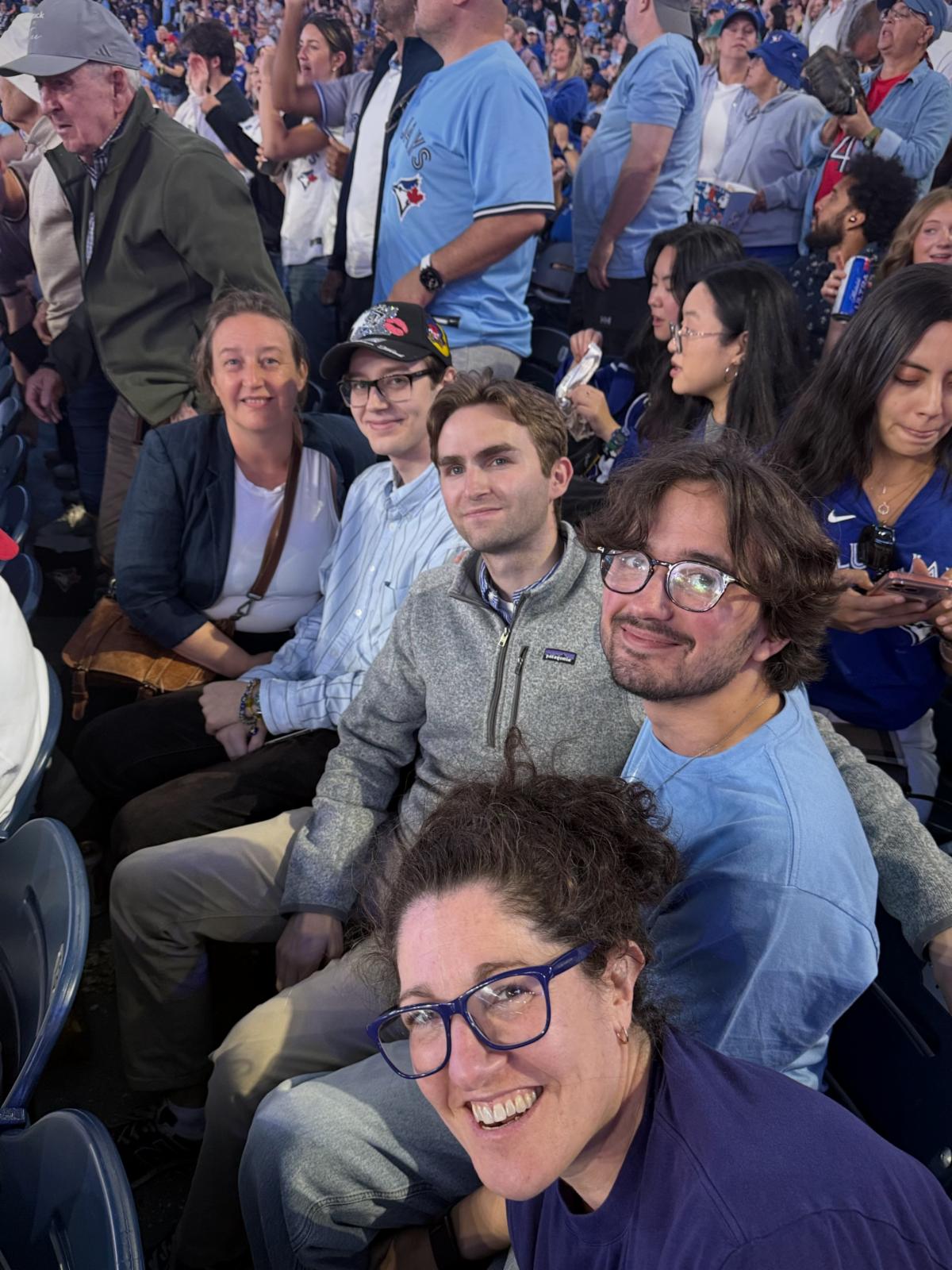
| | 5. WEL SUPPORTS THE TORONTO BLUE JAYS! | | On Friday July 17th and Wednesday July 22nd, members of the WEL Team went out to support our Toronto Blue Jays at their games against the Chicago White Sox and the Tampa Bay Rays! | | 6. CONOR CUSHLEY: ON MY TIME WORKING WITH WEL | | |
By Conor Cushley
Two weeks with Whaley.
Landing in Toronto from London at the start of July, everything was new to me. This was a new country, a new city, new people, an unfamiliar area of the law, and, indeed, a new legal system all together. It’s safe to say that as I walked towards the WEL Partners’ office on Tuesday morning, these considerations were becoming increasingly apparent to me. However, after a quick tour (and a lot of introductions), I realised that my worries were unfounded. WEL presented such a great balance between friendliness and professionalism that I felt both immediately welcomed and excited to learn more about estate litigation.
From the outset, I was given so many opportunities to get involved with both the work and the social side of WEL. From having the opportunity to sit in on client consults and judicial mediations to attending evening concerts with the team, it has been such a fun and engaging two weeks that I believe has equipped me with a strong foundational understanding of estates and trusts, as well as the nature of litigation more broadly. Whilst I would love to go into every detail of the past two weeks, however since I am limited by word count, I will instead highlight a few of my favourite moments from my internship with WEL.
One of the first things I learned from WEL was the importance of mediation. Whilst I had a very basic understanding of the concept and how it helped clients avoid a long, expensive, and emotionally draining trial experience, Kim’s “summer chat” on the topic really helped me better understand its process, nature, and goals. Kim placed a strong emphasis on communication with clients and keeping them informed of how the mediation works as well as what to expect on the day. This, in turn, allows clients to approach mediation with a more open mind, as well as with confidence regarding the nature of the proceedings. Kim also discussed the importance of preparing a brief and how the formatting, clarity, and persuasiveness of your brief can be critical in providing the client with a more favourable outcome. What was particularly exciting about Kim’s talk was my opportunity to take what I had learned and later observe it in practice at a judicial mediation.
Towards the end of my time with WEL, I was given the opportunity to shadow Ian Hull (co-founder and partner of Hull & Hull LLP) at an in-person judicial mediation. The Honourable Justice Dietrich acted as mediator for the day and was exceptional at maintaining a balanced, honest, and empathetic approach with our client. This alongside Ian’s clear preparation and communication with the client allowed for the day to end with a settlement that resolved the issues at hand without the need for trial. The day was such an eye-opening experience into how mediations work in practice and really brought the concepts Kim discussed in her talk to the forefront.
However, what truly stood out to me the most at WEL wasn’t the undeniably high-quality legal work and professional environment, but rather the people. Every single member of the team has been so unbelievably welcoming and are constantly allowing me to sit in/get involved. This is not just limited to the workplace, and indeed a few of my fondest memories of the two weeks are from spending time with the WEL team outside the office.
Within one week of landing in Toronto, I had already been brought along to two concerts. The first of which, with Sam, Ollie and Joanna, was to see Alex Warren at the RBC Amphitheatre. The music, atmosphere, and performance were all amazing and I was particularly grateful for Ollie, who, as my fellow Englishman in the office, shares my love for a good pint. The second concert was at the same venue with Christin, Sam and Emily to see Lord Huron. It was another amazing set with a great balance between Lord Huron’s soulful music as well as more lively tracks. Additionally, Christin subbed in very well as my fellow beer lover for the evening!
All in all, I cannot thank Kim, Bryan, and the entire team at WEL Partners enough for what has truly been an amazing few weeks, packed with legal experience and plenty of fun. I hope to take what I’ve learned back with me to the U.K. and indeed towards my future career in London. It’s been an absolute pleasure getting to know everyone, thank you.
| | WEL Partners takes great pleasure in congratulating our colleagues on their achievements, and to our delight there are many accomplishments of note this month. | | NEW CHIEF JUSTICE OF THE ONTARIO SUPERIOR COURT OF JUSTICE | | STEP WORLDWIDE EXCELLENCE AWARD WINNERS | | |
WEL Partners congratulates 2026 STEP excellence award winners! You can find the full list of this year’s award recipients via the link below:
Excellence Awards 2026 | STEP
| | STEP PRIVATE CLIENT AWARDS FINALISTS 2026 | | ONTARIO BAR ASSOCIATION AWARD OF EXCELLENCE IN ALTERNATIVE DISPUTE RESOLUTION | | |
WEL Partners wishes to congratulate Kathryn Podrebarac, recipient of the 2026 OBA Award of Excellence in Alternative Dispute Resolution! This award recognizes members of the OBA who demonstrate outstanding contributions to the field, including but not limited to participating in legal education, writing, and teaching, mentoring others, participation in law reform, and providing leadership. Congratulations Kathryn!
Alternative Dispute Resolution | Ontario Bar Association
| | ONTARIO BAR ASSOCIATION AWARD OF EXCELLENCE IN INSURANCE LAW | | |
WEL Partners wishes to congratulate David Zuber, recipient of the 2026 OBA Award of Excellence in Insurance Law! This award recognizes outstanding members of the OBA for their exceptional achievements and contributions in the areas of advocacy, teaching, writing, legislative reform, and enhancing the profession and community well-being.
Insurance Law | Ontario Bar Association
| | (i) SCOPE OF TRUSTEE’S ABSOLUTE DISCRETION | | |
By Albert H. Oosterhoff
1. Introduction
What is the scope of a trustee’s absolute discretion? Can the trustee, who is also a beneficiary, transfer estate assets to himself as he sees fit? That was the question raised in Reid v Cote et al.[1]
2. Facts[2]
The case concerned the estate plans of Ailean Read (‘Ailean’) and her blended family. Ailean was a successful businesswoman and accumulated a large estate through her property management companies. She died 23 January 2022 and was survived by the Applicant, Jacqueline Reid (‘Jacqueline’), Ailean’s only child, by Jacqueline’s three children, by her common law partner, the Respondent, D’Arcy Cote (‘D’Arcy’), and by the other Respondents, Patrick and Samantha Cote (‘Patrick’ and ‘Samantha’), who are D’Arcy’s children from his first marriage. D’Arcy and Ailean have lived together since 1988.
In 1983, before she met D’Arcy, Ailean incorporated 5611 Ontario Inc (‘5611’) and issued 10 common shares in the company to Jaqueline. In 1987 those shares were placed in the Read Family Trust (‘RFT’). Ailean owned and operated Read Property Management Limited (‘RPML’), which provided property management services to condominium corporations.
After Ailean and D’Arcy moved in together in 1988, the two of them worked together on several projects initiated by Ailean through RPML. In 1994 D’Arcy and Ailean incorporated Darail Holdings Limited (‘Darail’). The two of them, together with Sarah Jennings and Ian Johns, worked on the renovation and restoration of property on Sussex Drive in Ottawa, owned by the National Capital Commission (‘NCC’), and acquired a 50-year lease on the buildings. The parties incorporated 489 Sussex Properties (‘489 Sussex’) in 1993. 5611 owned 50% of the shares in 489 Sussex and Jennings and Johns owned the other 50%. One day after the incorporation of Darail the shares of 489 Sussex were reorganized. Thereafter, Saraham Holdings and Darail each owned 50 Common ‘A’ shares of 489 Sussex.
The directors of Darail were D’Arcy and Ailean. Since Ailean’s death, D’Arcy has been its sole director. However, Ailean was the sole shareholder until 2010. In 2010 D’Arcy was issued $5 in preferred shares but Ailean had full control of the corporation until her death. Darail’s preferred shares were subject to redemption. The common shares were the most valuable.
RFT expired in 2008 and its assets (the 10 common shares in 5611) were distributed to Jacqueline as the trust’s sole beneficiary. Jacqueline then exchanged her common shares into 10 preferred shares, and the 10 common shares were settled into a new trust, the Read Family Trust No 2 (‘RFT2’). The beneficiaries of RFT2 were Ailean, D’Arcy, Jacqueline, and Jacqueline’s children. Most of the income of RFT2 went to Ailean and after her death to D’Arcy. However, the common shares were to pass to Jacqueline after both Ailean and D’Arcy died. Ailean was the original Trustee of RFT2, but D’Arcy became its Trustee when Ailean died.
The Cote-Reid Family Trust (‘CRFT’) was created in 2010 for the benefit of Ailean, D’Arcy, and their families. Its beneficiaries were D’Arcy, Ailean, Jacqueline, Patrick, and Samantha. D’Arcy is now its trustee. Also, in 2010 the shares of 489 Sussex were reorganized so that CRFT held the 50 common shares in 489 Sussex. The other 50 common shares were held by the Johns-Jennings Family Trust. Since then, Darail no longer held the 50 common shares. Instead, it held 600,000 Class ‘B’ Special Shares, and Saraham Holdings held the same number of those shares.
In 2018, Ailean made an important change in the distribution of her wealth. It removed CRFT’s access to the income stream from 489 Sussex. At same time Ailean transferred the 50 Class ‘A’ common shares in 489 Sussex from CRFT to Darail. In consequence, RFT2, which held 10 Class ‘A’ common shares in Darail, became the recipient of the income stream.
Ailean left a Primary Will and a Secondary Will, and D’Arcy is the executor of her estate. The Wills created a Spousal Trust in favour of D’Arcy. The Trust contained the preferred shares Ailean held in Darail. It gave a life interest to D’Arcy with remainder as to 50% to be distributed to Jacqueline and as to the other 50% to be distributed to Patrick and Samantha equally.
D’Arcy claimed that he acquiesced in Alean’s arrangement under which 5611 owned 50% of the shares in 489 Sussex because he believed that Ailean held those shares on behalf of himself and Ailean. He also asserted that the moneys 489 Sussex paid to the NCC was paid with funds that Ailean, D’Arcy, Mr Johns, and Ms Jennings pooled together. However, as the court noted in para 19, D’Arcy ‘did not initiate any proceedings challenging Aileen’s actions on the basis of unjust enrichment and proposing the need to impose a constructive trust over any of her property’.
D’Arcy also claimed that he was entirely unaware of the 2018 change by Alean in the distribution of her wealth. However, he did sign the corporate resolution that approved the transfer of the 50 common shares in 489 Sussex from CRFT to Darail.
D’Arcy was firmly of opinion that Ailean’s testamentary intentions were that the wealth generated by 489 Sussex, which belonged to her and D’Arcy, was to be split 50-25-25 between Jacqueline, Patrick, and Samantha. Based on his opinion, he determined to redress what he perceived to be the unfairness of Ailean’s redistribution of her wealth in 2018.
Accordingly, on 1 January 2024, D’Arcy transferred five of the ten common shares in Darail to himself in his capacity as trustee and beneficiary of RFT2. He testified that, as trustee, he was entitled to distribute five of the Class ‘A’ common shares that RFT2 holds in Darail to himself, and that he did this so that Patrick and Samantha would receive half of the income stream generated from his involvement with Ailean in 489 Sussex.
Jacqueline brought this Application contesting D’Arcy’s action. In her opinion, D’Arcy violated his role as Trustee of RFT2, defied his fiduciary obligations and a court order to provide an accounting of his management of Ailean’s estate and the other trusts. As a result, she argued that D’Arcy must be removed as trustee of all three trusts and as executor of Ailean’s Wills.
The case raised the following issues:
- As trustee of RFT2, did D’Arcy have authority to transfer five Common Class ‘A’ shares in Darail to himself in his capacity as a beneficiary of the trust?
- Should the Common Shares in Darail be returned to RFT2?
- Should the court remove D’Arcy as the executor and trustee of the Trusts?
3. Analysis and Judgment
3.1 Exercise by D’Arcy of his discretionary powers
Justice Jensen began her analysis by noting that section 2.1 of RFT2 gave the Trustee complete and unfettered discretion to distribute income and capital as he sees fit, and that section 4.2 gives the Trustee ‘the power and authority in her [his] absolute and uncontrolled discretion at any time and from time to time to administer the Trust Fund (including any share thereof) in whatever manner she [he] may determine’. Thus, the Trustee was empowered to use the Trust Fund as though he were its sole owner and could transfer any of its assets without obtaining the consent of anyone. However, her Honour went on to state that the case law makes it clear that D’Arcy cannot do whatever he wants with the Trust property. The cases hold that absolute discretion in the exercise of trust powers by a trustee is not without constraints. On this point her Honour referred to and followed Fox v Fox Estate.[3] That case held that if a trustee acts in bad faith by, for example, being guided by extraneous considerations or fails to take into account considerations that he should have taken into account, the matter falls within the scope of judicial supervision and the court will intervene and reverse the decision. Her Honour also referred to Banton v Banton,[4] in which the court made the same point.
Justice Jensen noted that the intention of the RFT2 was clear, namely, that at Distribution Date the Trust Fund shall be paid to Jacqueline if living and otherwise to her issue. Ailean thus intended that when all the preferred shares of Darail are redeemed, Jaqueline, the beneficiary of the Trust, would become the sole owner of Darail. The purpose of RFT2 was confirmed in evidence by its drafter, who also stated that Darcy’s plan to redistribute the shares of Darail to himself was inconsistent with Ailean’s intentions.
Justice Jensen noted that, as Trustee of RFT2, D’Arcy had a fiduciary obligation to respect the intention or purpose of the Trust, and not to rely on extraneous considerations, such as the overall fairness of Ailean’s estate plans, for those considerations were inconsistent with the purpose of the trust. RFT2 was set up to benefit herself, D’Arcy, Jacqueline, and Jacqueline’s children, and no one else. And Jacqueline was to receive the 10 Class ‘A’ Common Shares when D’Arcy and Ailean died.
Her Honour noted that it was clear that Ailean knew what she was doing when she transferred the 50 Class ‘A’ Common Shares in 489 Sussex to Darail in 2018, and she did it with the advice of her accountants and lawyers. She noted that if D’Arcy felt that he had a claim over some of the assets in RFT2, he could have initiated legal action to have the Trusts set aside or to assert a constructive trust. He failed to do so.
Justice Jensen therefore found that D’Arcy did not follow the intent of RFT2 when he distributed the shares to himself because his reason for doing that was to benefit his own children, who were not beneficiaries of the trust. Thus, he had regard to extraneous considerations and did not exercise his discretion in accordance with the intent of the Trust.
3.2 Should the Common Shares in Darail be Returned to RFT2?
By reference to MacDonald et al v BMO Trust Company et al,[5] Her Honour noted that equity provides a wide range of remedies for breach of trust or fiduciary duty. These include an account of profits, equitable compensation, equitable lien, equitable tracing, and constructive trust. But when the fiduciary wrongfully acquires benefits, the conventional remedy is an account of profits or disgorgement. She held that disgorgement is appropriate in this case, so that D’Arcy must return the five Common Shares and any profit he has made on them. If that is not possible, he must pay equitable compensation for the value of the shares and any profit he has made.
3.3 Should the Court remove D’Arcy as executor of the Estate and Trustee of the Trusts?
Justice Jensen noted that the court has an inherent power to remove an executor and a trustee and, by reference to well-known cases, she reviewed the equally well-known principles the court needs to take into account for this purpose. Her Honour listed the following acts of misconduct and breaches:
- breach of fiduciary duties in transferring five common shares;
- failure to communicate with the beneficiaries about the transfer;
- failure to obtain an advance tax ruling and to report the transfer to Darail on Darail’s tax return;
- breach of Shareholder’s Agreement and failure to inform Jaqueline about the transfer;
- apparent misappropriation of a dividend issued to Darail by 489 Sussex;
- failure to provide an accounting;
- draining Darail’s Operating Account;
- RBC froze Darail’s investment account, apparently because of D’Arcy’s mismanagement;
- failure to call a shareholder’s meeting of Darail since Ailean’s death;
- failure to comply with court orders;
- defaulting on pre-authorized payment for insurance premiums.
Her Honour agreed that any of these breaches would be sufficient to remove D’Arcy as executor of Ailean’s estate and as trustee of the Trusts. But she went on to find that as a whole these breaches demonstrated a shocking lack of fidelity to D’Arcy’s fiduciary obligations. Therefore, she concluded that D’Arcy could not be trusted to administer the estate or the Trusts and must be removed.
3.4 Replacement executor and trustee
While Jaqueline might be considered to be a suitable replacement as executor of Ailean’s estate and as Trustee of the Trust, in light of the animosity between her and the other beneficiaries, Justice Jensen, rightly I think, asked for further submissions from the parties on this point.
3.5 Costs
Justice Jensen awarded costs to Jacqueline that was calculated in part on a partial indemnity and in part on a substantial indemnity basis. She went on to hold that because D’Arcy acted unreasonably in his administration of the Trusts and the Estate, he must pay the costs personally.
---
[1] 2025 ONSC 6542.
[2] I apologize in advance for the length and complexity of the facts, but it is necessary for a clear understanding the court’s decision.
[3] 1996 CarswellOnt 317, 28 OR 3d 496 (CA).
[4] 1998 CarswellOnt 3453, para 172 (OCJ (General Division)).
[5] 2020 ONSC 93 para 48.
| (ii) EQUALIZATION AND UNJUST ENRICHMENT CLAIM? | | |
By Albert H. Oosterhoff
1. Introduction
Schmutz v Schmutz[1] explores the question whether a surviving spouse, who successfully claimed an equalization payment of the parties’ net family properties, can also make a claim the value of an unjust enrichment claim on the basis of a joint family venture. The court held that she could not do so on the facts in this case. The decision is unexceptional, but it is worthwhile to consider the reasons in this blog, since the issue does not arise often.
2. Facts
The applicant, Susan Schmutz (‘Susan’) and Christian Schmutz (‘Christian’) began co-habitation in 1997 and were married in 1980. They had no children. They first separated in 2017 and after an unsuccessful attempt at reconciliation they separated on a final basis in 2020. A proceeding for divorce and resolution of their property issues was commenced in September 2018. Susan and Christian were joint tenants of the matrimonial home, and Christian also held title to another property (‘Black Walnut’). Christian died in 2023. The respondent was his estate trustee.
The parties agreed to the net family properties (‘NFP’) calculation in 2025. Pursuant to that calculation Christian’s estate paid Susan an equalization payment of $34,116.92. The matrimonial home was valued at $720,000. Susan claimed exclusive possession of it and that was granted. Black Walnut was valued as of the date of final separation at $870,000, with an assumed capital gains obligation of $178,034. It was eventually sold for $1,250,000. Susan sought a 50% share of the net increase in the value of the Black Walnut property, namely $97,106. The purchase of Black Walnut was financed with a bank loan jointly undertaken by the spouses. Susan’s father lent Christian $227,345.75 in 1996 to construct a building on the property at interest, but no interest was actually paid. The principal was paid back in 2017.
Christian earned a modest income, while Susan was the breadwinner. Her employment income and later her retirement income were paid into the spouses’ joint bank account. The majority of the household expenses as well as utilities at Black Walnut were paid from that account.
Susan argued that Black Walnut was part of a joint family venture because she contributed a substantial amount of money over the years to that property. Thus she claimed that Christian was enriched by it, that she was correspondingly deprived, and that there was no juristic reason for the enrichment. Further, she argued that since a monetary valuation of Black Walnut is possible, a finding of a constructive trust is unnecessary. The respondent argued that this was not a case to which a remedy of joint family venture flowing from unjust enrichment applies.
3. Analysis and Judgment
Justice Spurgeon noted that outside of marriage unjust enrichment on the basis of a joint family venture can certainly be raised. It is not impossible to raise it when the parties are married, but such a claim is unlikely to succeed. His Honour referred to a passage in McNamee v McNamee[2] in which the Ontario Court of Appeal said:
66 It must be stated that, in the vast majority of cases, any unjust enrichment that arises as the result of a marriage will be fully addressed through the operation of the equalization provisions under the Family Law Act;[3] the spouse who legally owns an asset will ordinarily share half its value with the other spouse as a result of the equalization provisions under the Act. However, a fair and contextual reading of the equalization and net family property provisions of the Family Law Act ensures that married spouses are not deprived of equitable remedies they would otherwise have available to them because, as noted above, ownership issues — equitable or otherwise — are to be determined before the net equalization payment exercise is undertaken.
Counsel for the respondent referred to Mullin v Sherlock[4] as such an exceptional case. In it the Ontario Court of Appeal held that the statutory equalization scheme would work an injustice, since the parties had cohabited for a long time and were married for only a short time. The family wealth was generated mostly during the period of co-habitation. Hence, in those circumstances the court should consider unjust enrichment and the remedy of a joint family venture.
Justice Spurgeon held that this was not such an exceptional case and thus there was no room for a separate unjust enrichment analysis. However, if he was wrong on that issue, he went on to consider whether Susan had proved unjust enrichment. He reproduced the well-known components of unjust enrichment: 1. the claimant must prove unjust enrichment; 2. the claimant must show a corresponding deprivation; and 3. The court must determine that there is no juristic reason for the enrichment. The third step consists of a two-part test: (a) whether there is a categorical juristic reason to allow the respondent to retain the benefit to the detriment of the applicant (gift, contract, disposition of law, other valid common law, equitable, or statutory obligation); and (b) if there is no categorical juristic reason, the court may consider the reasonable expectations of the parties and public policy considerations to determine whether recovery should be denied.
His Honour held that in step (a) of the juristic reason analysis, there was a categorical juristic reason to deny recovery to Susan, namely, the statutory obligation of NFP equalization. Thus, he concluded that Susan’s claim failed.
--
[1] 2026 ONSC 2024.
[2] 2011 ONCA 533, para 66.
[3] RSO 1990, c F.3.
[4] 2025 ONCA 511, para 23.
| | (iii) SHAPIRO v. SHAPIRO, 2026 ONSC 3834: COSTS IN ESTATE LITIGATION FOLLOWING A MIXED OUTCOME | | |
By Emily Caza
In Shapiro v. Shapiro[1], the Ontario Superior Court of Justice considered the appropriate costs consequences following two related estate proceedings: a failed Will challenge and a partially successful dependant support claim. The decision provides a useful application of the modern approach to costs in estate litigation following the Court of Appeal's decision in McGrath v. Joy[2], reaffirming that public policy considerations do not automatically entitle unsuccessful litigants to have their costs paid from the estate.
Background
The litigation arose following the death of Carol-Sue Shapiro.
Her October 2018 Wills significantly altered her previous estate plan. The residue of her estate, valued at approximately $7 million, was left entirely to her son, Michael.[3] Her husband, Jack, received a substantially reduced benefit, while her daughter, Tracy, was effectively disinherited.[4] Jack and Tracy challenged the validity of the Wills, alleging that Michael and his wife had exercised undue influence by misleading the deceased regarding Jack's financial circumstances and Tracy's husband.
The Court dismissed the Will challenge, concluding that the objectors had failed to establish undue influence on a balance of probabilities.[5] Although the deceased may have held some mistaken beliefs, the evidence demonstrated that she was independent, strong-willed, and had long-standing concerns regarding the preservation of the family's assets. The Court found that the changes to her testamentary plan reflected her own evolving intentions rather than manipulation by Michael.
The second proceeding involved Jack's claim for dependant support under the Succession Law Reform Act. On that claim, Jack was partially successful. The Court concluded that the deceased had failed to make adequate provision for her spouse and ordered that title to the matrimonial condominium be transferred to him in addition to the $250,000 bequest provided under the Will.[6]
The Costs Issue
Following the merits decisions, the parties advanced competing positions on costs.
Michael sought approximately $298,000 in substantial indemnity costs for successfully defending the Will challenge, arguing that the allegations against him were unsupported and unnecessarily prolonged the litigation.[7]
Jack argued that the litigation had been caused by the deceased's own conduct – specifically, her departure from previous testamentary intentions and her failure to make adequate provision for him – and that, on public policy grounds, his costs should be paid from the estate on a full indemnity basis.[8] In the alternative, he submitted that there should be no costs order because the overall result was mixed.[9]
The Court's Analysis
Justice Breen began by reaffirming the analytical framework established by the Court of Appeal in McGrath.[10] The first question is whether public policy considerations are engaged. If they are, the Court retains discretion to depart from the ordinary rule that costs follow the event. If they are not, the Court applies the ordinary costs principles under section 131 of the Courts of Justice Act and Rule 57.01.
The Court concluded that public policy considerations applied to the dependant support claim because the deceased's estate plan failed to make adequate provision for her spouse, making litigation reasonably foreseeable.[11] However, those considerations did not extend to the Will challenge in the same way. The Will challenge was an adversarial dispute alleging undue influence and testamentary fraud, and Michael was entirely successful in defending the validity of the Wills.[12]
Importantly, the Court emphasized that even where public policy considerations are engaged, they do not automatically justify full indemnity costs from the estate.[13] Success, reasonableness, and proportionality remain central considerations.
The Court also rejected Michael's request for substantial indemnity costs, reiterating that such awards are reserved for exceptional cases involving reprehensible conduct or abuse of process.[14] Although the litigation was vigorously contested, neither party's conduct warranted elevated costs. Likewise, the parties' settlement offers did not affect the outcome because no party achieved a result more favourable than its offer.[15]
Costs Award
Applying ordinary partial indemnity principles, while accounting for the complexity of the proceedings and reasonable local rates, the Court awarded[16]:
- $200,000 to Michael for successfully defending the Will challenge;
- $125,000 to Jack for the dependant support proceeding.
Recognizing the public policy considerations underlying the dependant support claim, the Court directed that 40% of Jack's costs ($50,000) be paid from the estate.[17] The remaining $75,000 was recoverable personally against Michael and was set off against Michael's $200,000 costs award, resulting in a net payment of $125,000 from Jack to Michael.[18]
Takeaways
Shapiro reinforces that the modern approach to costs in estate litigation remains guided by McGrath. Courts must first determine whether public policy considerations are engaged before deciding whether to depart from the ordinary rule that costs follow the event. Even where public policy applies, it does not automatically entitle a party to recover its costs from the estate. Success, proportionality, and fairness remain central considerations, and courts retain broad discretion to fashion costs awards that reflect the unique outcome of each claim.
--
[1] 2026 ONSC 3834 [Shapiro].
[2] 2022 ONCA 119 [McGrath].
[3] Shapiro, supra note 1 at para 1.
[4] Ibid.
[5] Ibid at paras 4, 5.
[6] Ibid at paras 6, 7.
[7] Ibid at para 8.
[8] Ibid at para 10.
[9] Ibid at para 11.
[10] Ibid at para 15-17.
[11] Ibid at para 19.
[12] Ibid at para 20.
[13] Ibid at para 21.
[14] Ibid at paras 23, 24.
[15] Ibid at para 25.
[16] Ibid at paras 32, 36.
[17] Ibid at para 37.
[18] Ibid at para 39.
| | (iv) HENRIKSEN ESTATE (RE): CAN A WILL DRAFTED AFTER DEATH BE SAVED PURSUANT TO S. 58 OF THE WESA? | | |
By Jessica Homer
In what the Court considered a novel case, it had to determine whether it was possible to validate a draft will pursuant to section 58 of British Columbia’s Wills, Estates and Succession Act S.B.C. 2009, c. 13 (“WESA”).
Background
Krista Henrinksen died on July 4, 2025 (the “Deceased” or “Estate”) and was survived by her next-of-kin Awad Mohamed (“Awad”).[1]
The Court stated that while it was not necessary to “legally characterize” the Deceased and Awad’s relationship, it was nonetheless relevant to understanding the nature of the document sought to be validated pursuant to s.58 of the WESA.[2]
The Deceased and Awad married in or around 1992 and divorced in 2003. Awad alleged that following the divorce, and until the Deceased’s passing, the two reconciled an entered a marriage-like relationship without formally re-marrying.[3]
In or around January 2025, the Deceased and Awad met with a solicitor to discuss, amongst other things, their testamentary planning, which included the preparation of mirror wills.[4]
The drafting solicitor provided notes from her initial conversation with the Deceased and Awad, which demonstrated the following:
- The Deceased and Awad considered themselves spouses;
- Neither were subject to undue influence; and
-
The drafting solicitor’s instructions were to draft mirror wills.[5]
In or around February 2025, the drafting solicitor provided a draft copy of the mirror will to both the Deceased and Awad. Only one copy of the draft will was provided, which was drafted in Awad’s name. However, in the drafting solicitor’s email providing a copy of the will, she outlined:
Because they will be mirror documents (except as detailed below and in the documents), I will finalize the draft for one person before I create the final version of the spouse’s document.[6]
After a delay in the matter due to an unpaid invoice, on or about June 25, 2025, the drafting solicitor provided an updated draft of the will in Awad’s name (the “June Draft”) and requested a meeting with the Deceased and Awad to execute same.[7]
Unexpectedly, the Deceased died on July 4, 2025. After which, Awad requested that the drafting solicitor provide a mirrored copy of the June Draft prepared in the Deceased’s name, and appointing Awad as estate trustee and beneficiary of the residue of the Estate.[8] The June Draft was revised and provided as a draft to the funeral home (the “Post Death Draft”).[9]
Validity of the Post Death Draft
Statutory Interpretation:
The Honourable Justice Morley turned his mind to the statutory interpretation of s.58 of the WESA - particularly the meaning of record, document or writing in s.58(2) of the WESA, and whether a document created post death fits that interpretation.[10]
In doing so, his Honour poignantly highlighted that the foremost consideration in statutory interpretation is the statute’s text.[11] Justice Morley clearly sets out that, “statutes should not be interpreted literally, but they must be interpreted faithfully”.[12] In doing so, the context in which legislation was created (to form an understanding of what the legislature has written or said) along with the policy goals sought to be accomplished by that legislation, are necessary for a faithful interpretation.[13]
Section 58 of the WESA:
58 (1) In this section, "record" includes data that
(a)is recorded or stored electronically,
(b)can be read by a person, and
(c)is capable of reproduction in a visible form.
(2) On application, the court may make an order under subsection (3) if the court determines that a record, document or writing or marking on a will or document represents
(a)the testamentary intentions of a deceased person,
(b)the intention of a deceased person to revoke, alter or revive a will or testamentary disposition of the deceased person, or
(c)the intention of a deceased person to revoke, alter or revive a testamentary disposition contained in a document other than a will.
Application:
In considering the above outlined approach to statutory interpretation, Justice Morley points out that s.58(2) of the WESA does not limit the definition of record, document or writing, to that which is made during the testator’s lifetime.[14] Furthermore, “record” pursuant to s.58(1) is defined broadly.[15]
In considering the context and purpose surrounding the enactment of s.58 of the WESA, his Honour notes that the enactment of the provision came as “significant reform” to British Columbia’s pre-existing law as set out in the predecessor Wills Act, R.S.B.C. 1996, c. 489.[16] The enactment of s.58 is described as a curative provision, allowing more flexibility in recognizing testamentary intentions.[17]
In taking this approach, his Honour states that “what is of principle importance are testamentary intentions, not how they are recorded”.[18] However, what remains is that a “court must find a record, document, writing or marking that is to be given effect”.[19] Therefore, while intentions are important, “a will must be in writing or at least recorded – and s.58 does not permit a court to author a will but just to give effect to a record, document or writing”, even if the intentions of the deceased are well established.[20]
Accordingly, his Honour saw little difference in a will drafted after death by a court or by a solicitor, regardless of its basis in testamentary intentions.
Additionally, in Hadley Estate (Re), 2017 BCCA 311, the British Columbia Court of Appeal outlined a two-part test that must be satisfied to validate a document under s.58 of the WESA. The test required determining whether (1) the will was authentic and (2) whether the document represents the deceased’s testamentary intentions.[21]
His Honour found that “an authentic document must date to the life of the deceased”.[22] Whereas, on these facts, the Post Death Draft, was dated after the life of the deceased.
Further, it would be in defiance of long-standing common-law and statute to find that a will drafted post death and based on orally communicated intentions could be a valid will.[23]
Therefore, his Honour held that the Post Death Draft could not be seen as a record, document or writing pursuant to s. 58 of the WESA.
Rectification:
Despite his Honour’s determination on s.58 of the WESA, he found a remedy still existed, rectification.
Section 59 of the WESA sets out:
59 (1) On application for rectification of a will, the court, sitting as a court of construction or as a court of probate, may order that the will be rectified if the court determines that the will fails to carry out the will-maker's intentions because of
(a)an error arising from an accidental slip or omission,
(b)a misunderstanding of the will-maker's instructions, or
(c)a failure to carry out the will-maker's instructions.
His Honour found that the present case fell within the meaning of s.59(1)(C). As such, the June Draft, which was circulated to the Deceased before her death and reviewed[24] , could be rectified by naming the Deceased as the testator, and mirroring Awad’s will by naming the Awad as estate trustee and residual beneficiary.
Key Takeaways
A will drafted following the death of the alleged testator does not satisfy the definition of “record, document, or writing” pursuant to s.58 of the WESA. However, where applicable, rectification can be used to give effect to the testamentary intentions of the deceased.
--
[1] Henriksen Estate (Re), 2026 BCSC 1058 (CanLII) at para 7.
[2] Ibid at para 8.
[3] Ibid at para 9.
[4] Ibid at para 11.
[5] Ibid at para 12.
[6] Ibid at para 14.
[7] Ibid at para 16 & 17.
[8] Ibid at para19.
[9] Ibid at para 20.
[10] Ibid at para 23.
[11] Ibid at para 25 citing Quebec (Commission des droits de la personne et des droits de la jeunesse) v. Directrice de la protection de la jeunesse du CISSS A, 2024 SCC 43 at para 24.
[12] Ibid at para 29.
[13] Ibid at para 26 & 27.
[14] Ibid at para 30.
[15] Ibid at para 31.
[16] Ibid at para 32, citing Hadley Estate (Re), 2017 BCCA 311 at paras 1 and 33.
[17] Ibid at para 36.
[18] Ibid at para 39.
[19] Ibid at para 40.
[20] Ibid at para 42.
[21] Ibid at para 44.
[22] Ibid at para 45.
[23] Ibid at para 46.
[24] Ibid at para 49.
|
| (v) BENEATH THE SURFACE OF PREDATORY MARRIAGES: RECOGNIZING THE HALLMARKS | | |
By Grant Swedak
Every July, millions of viewers tune in to watch Shark Week and learn about one of nature's most formidable predators. Despite their fearsome reputation, sharks possess one redeeming quality: they often reveal themselves before they become a threat. The predators to be discussed below offer no such warning.[1]
Introduction
Estate litigators have been increasingly required to confront a different sort of predator. Rather than fins, teeth, or brute force, these predators disarm their victims with companionship, trust, and affection. The harm they cause occurs over the course of months or years, as opposed to moments. Their targets are some of society's most vulnerable individuals; the elderly, the isolated, the recently widowed, and those experiencing cognitive decline.
By wielding the institution of marriage as a tool for financial exploitation, these predators can fundamentally alter a victim's legal rights long before family members recognize what has occurred. The predators this article is concerned with are those who engage in what has become known as predatory marriage.
To be clear at the outset: not every late-in-life marriage is suspicious. Many are genuine, loving relationships, and courts are rightly cautious about second-guessing the emotional lives of older adults simply because their children disapprove. The above comparison is not meant to diminish the genuine tragedy and difficulty that predatory marriages cause; the aim here is simply to explain, in accessible terms, a pattern that estate litigators increasingly encounter.
What Is a Predatory Marriage?
The term “predatory marriage” does not refer to a cause of action, or a legal test, and there is no current statutory definition in Ontario; rather, the term is meant to broadly describe a type of issue and/or similar fact pattern, the frequency of which is increasingly before the courts.
Accordingly, although there is no universally accepted definition, the term generally describes the exploitation of an elderly or otherwise vulnerable individual, by a recent acquaintance or caregiver who has ingratiated themselves into a position of trust and companionship, not for the purpose of forming a genuine marital relationship, but to secure a financial benefit (typically through marriage).
Although every case turns on its own facts, predatory marriages commonly share several hallmarks. The predator is often substantially younger than the vulnerable individual, and the relationship is frequently characterized by a significant age disparity, the absence of children born of the relationship, and the progressive isolation of the vulnerable spouse from family and friends. The relationship itself may develop with unusual speed, culminating in marriage shortly after the parties meet, often accompanied by increasing pressure to marry at a time when the vulnerable individual's cognitive or physical health is in decline.
Marriage As a Vehicle for Exploitation
To understand why predatory marriage is such an effective form of exploitation, one must appreciate the legal consequences that arise from a formal marriage. The effects to be enumerated below often arise automatically and immediately, without either spouse taking any further legal steps.
Under Part V of the Succession Law Reform Act,[2] a surviving spouse is entitled to commence a dependant’s support claim, regardless of whether the deceased died testate or intestate. Further, should the vulnerable party die intestate, the surviving spouse is entitled to a preferential share of the estate, together with a portion of any remaining estate.[3]
Pursuant to the Family Law Act,[4] spouses are afforded specific rights with respect to the matrimonial home, including possessory rights that exist independently of legal or beneficial ownership, and that cannot be defeated by a Will, or by the home being held in the other spouse's name alone. Upon divorce/separation, a spouse may be entitled to equalization of net family property and/or spousal support.
Marriage also elevates a person's standing within the law's substitute decision-making hierarchies. Pursuant to section 20 of the Health Care Consent Act,[5] a spouse ranks near the top of the list of persons authorized to consent to treatment on behalf of an incapable person.[6] Similarly, under the Substitute Decisions Act, 1992,[7] a spouse is typically given priority standing to apply for statutory guardianship over an incapable person's property.
Lastly, marriage occupies a unique legal position insofar as it can immediately alter an individual's legal rights and entitlements without requiring independent legal advice, without generating any meaningful documentary record beyond the marriage license itself, and often without anyone present other than the two spouses. By contrast, the creation or amendment of a testamentary plan is typically a deliberate and well-documented process involving legal counsel who ordinarily turn their minds to the testator's capacity and intentions.
Challenging the Validity of a Marriage:
Capacity to Marry:
In Ontario, Courts must begin with the presumption that every adult is capable.[8] That presumption is not easily displaced, as a finding of incapacity is usually required to rebut it, and the presumption applies to all personal decisions. Accordingly, the presumption will stand unless there is clear, corroborating evidence to the contrary.[9]
Two statutory frameworks governing marriage itself reflect this baseline requirement: First, Ontario’s Marriage Act prohibits the issuance of a license to solemnize a marriage where the issuer knows, or has reasonable grounds to believe, that a party lacks the mental capacity to marry.[10] Second, the federal Civil Marriage Act requires the free and enlightened consent of both parties.[11]
To succeed in having a marriage declared void or a nullity on the basis of incapacity, a party must demonstrate that the individual in question was incapable of understanding the nature of the relationship, and the obligations or responsibilities it involved.[12] The onus rests with the party asserting incapacity, and the evidence must be of a sufficiently clear and definite character, a mere preponderance will not suffice.[13]
As with other capacity inquiries, the determination is decision, time, and situation specific. The relevant time in evaluating an individual's capacity to make a particular decision is the time at which the decision is made, and one is presumed capable unless and until the presumption is legally rebutted.[14]
In assessing the capacity to marry, Courts will consider several contextual factors:
(1) the couple's relationship prior to the marriage;
(2) the person's cognitive capacity leading up to and immediately after the marriage,
(3) the person's understanding of the marriage ceremony, vows, obligations it created; and
(4) the person's interactions with professionals contemporaneous to the marriage.[15]
Duress & Coercion:
Capacity is not the only avenue to challenge the validity of a marriage. A marriage may also be set aside where one of the parties was exercising sufficient duress or coercion which vitiated consent.[16]
To establish duress, it must be shown that the spouse's mind was so overborne by oppression that there was an absence of free choice; the ultimate question being, whether the consent given at the ceremony was real, informed, and voluntary.[17]
The Difficulties in Challenging Predatory Marriages & The Need for Further Reform
Setting aside a predatory marriage is challenging litigation because the law begins from a position that favours the validity of the marriage. By the time the issue reaches the courts, the vulnerable spouse is often incapacitated, leaving parties to reconstruct capacity retrospectively from medical records and witness testimony. Capacity, duress, and coercion each require distinct evidentiary foundations, and courts remain appropriately cautious before setting aside a legally valid marriage.
Ontario has begun to respond, but only incrementally. Effective January 1, 2022, the province abolished the long-standing rule that marriage automatically revoked a prior Will, eliminating one significant avenue for financial exploitation.
For practitioners and families, vigilance therefore remains essential. While no single circumstance is determinative, a rapidly developing relationship, increasing isolation, sudden marriage, unexplained estate planning changes, cognitive decline, or controlling behaviour should prompt timely legal advice before critical evidence is lost.
Conclusion
Unlike the sharks featured each July, financial predators seldom announce their presence. They often begin by cultivating trust, intimacy, and dependence, before exploiting the legal rights that marriage confers. By the time the warning signs become obvious, the consequences often extend well beyond broken family relationships, as they reshape inheritances, alter legal entitlements, and generate some of the most complex and evidentially fraught disputes encountered in estate litigation.
The value of Shark Week lies not in sensationalizing predators, but in understanding how they behave. The same is true of predatory marriage. Only by recognizing its hallmarks can the law meaningfully distinguish genuine relationships from financial exploitation disguised as marriage. That distinction is neither easy nor intuitive, particularly where exploitation unfolds gradually behind a façade of affection, trust, and companionship. Yet it is precisely that challenge that courts, practitioners, and policymakers must confront if the law is to provide meaningful protection to society's most vulnerable individuals.
--
[1] The comparison that contained herein is offered only as a way into a serious subject; it is not intended to make light of the very real tragedy and hardship that predatory marriages inflict on their victims and families.
[2] Succession Law Reform Act, R.S.O. 1990, c. S.26 (“SLRA”); to read more about intestacy and preferential shares, check out - Dying Without a Will: How Ontario’s Intestacy Rules and Preferential Shares Shape Estate Distribution | WEL Partners Blog.
[3] See Part II of the SLRA, at sections 45-46.
[4] Family Law Act, R.S.O. 1990, c. F.3 (“FLA”).
[5] Health Care Consent Act, 1996, S.O. 1996, c. 2, Sched. A (“HCCA”).
[6] Second only to a court-appointed guardian of the person or a named attorney for personal care.
[7] Substitute Decisions Act, 1992, S.O. 1992, c. 30, (“SDA”).
[8] Pursuant to section 2 of the SDA; and section 4(2) of the HCCA.
[9] Pursuant to section 2(1) of the SDA; Starson v. Swayze, 2003 SCC 32 (CanLII), [2003] 1 SCR 722, at para 77; and Lewis v. Lewis, 2019 ONCA 690 (CanLII), at para 3.
[10] Marriage Act, R.S.O. 1990, c. M.3, at section 7.
[11] Civil Marriage Act, S.C. 2005, c. 33, at section 2.1.
[12] Banton v. Banton, 1998 CanLII 14926 (ON SC), at para 142 (“Banton”); Tanti v. Tanti, 2021 ONCA 717 (CanLII), at para 11 (“Tanti”).
[13] Tanti, at para 10.
[14] Hunt v. Worrod, 2017 ONSC 7397 (CanLII), at para 13.
[15] Tanti, at para 58.
[16] Banton, at para 135; see also Feng v. Sung Estate, 2003 CanLII 2420 (ON SC), at para 65.
[17] Saeed v Nabi, 1999 CarswellOnt 1087, at para 10.
|
| (vi) PROPRIETARY ESTOPPEL IN ACTION: LESSONS FROM GEDDES v. SCHUERCH | |
By Mark Polese
Proprietary estoppel is an equitable doctrine whereby, “(i) an owner of land induces or encourages the claimant to believe that they have or will enjoy some right or benefit over the owner’s property, where (ii) to knowledge of the owner the claimant relies on this belief and acts to their detriment and (iii) the owner seeks to take unconscionable advantage of the claimant by denying them the benefit they expected to receive”.[1]
In Geddes v. Schuerch,[2] the Ontario Superior Court of Justice recently had to rule on a proprietary estoppel claim.
Background
Manuela Geddes (the “Applicant”) brought the action against her father, Werner Schuerch (the “Respondent”), for a judgment that she is the beneficial owner of a plot of land located in Ridgetown, Ontario (the “Property”). The Respondent is the registered owner of the Property. The Applicant has been residing in a house located on the Property since 2013, without paying rent, though she and her family have maintained and upgraded the house during their time residing in it as well as paying a portion of the property taxes. The Respondent lived in a modular home, also located on the Property, between 2014 and 2017 when he then relocated to Switzerland.
The Respondent purchased the Property in 1994 and has been the sole registered owner since. In 2014, the Respondent executed a Will (the “2014 Will”) which directed that the Property be transferred to the Applicant upon his passing. In 2016, the Respondent executed a Codicil to the 2014 Will that removed the provision related to leaving the Property to the Applicant, and, imparting on her a right of first refusal to buy the Property at fair market value.
When the Respondent moved to Switzerland in 2017, he granted a power of attorney for property to the Applicant for the purposes of more easily maintaining the Property in his absence.
In Fall of 2021, the Respondent wrote to his lawyer indicating that he wished to sell the Property to his son, Marcel, for a sum of $500,000. He also indicated that he would further like to give the Applicant a notice of eviction.
Marcel purchased the Property in January of 2022; however, the Applicant has continued to reside in the house on the Property since, and has additionally changed the locks to the modular home that the Respondent had previously resided in.
Analysis
Justice Horvat of the Ontario Superior Court of Justice identified the key issue in this matter to be whether the Applicant is entitled to the relief sought on the basis of proprietary estoppel.
In order to establish an entitlement to relief based on proprietary estoppel, a claimant must satisfy the following elements on a balance of probabilities:
- There existed a representation or assurance made to the claimant, based on which the claimant expects that they will enjoy some right or benefit over property;
- The claimant relies on that expectation by doing or refraining from doing something, and their reliance is reasonable in all circumstances; and
-
The claimant suffers a detriment because of their reasonable reliance, such that it would be unfair or unjust for the party responsible for the representation or assurance to go back on their word and insist on their strict legal rights.[3]
Regarding the first element, the court found that a representation or assurance may be express or implied, though it must be unambiguous, and must appear to have been intended to be taken seriously.[4]
The Applicant testified that it was her understanding that the Respondent intended to gift the Property to her based on an oral agreement made in 2013. In this oral agreement, the parties contracted that the Applicant would reside in the main house on the Property and would maintain the home in addition to splitting the tax burden with the Respondent. The Applicant claimed that an additional term of this oral agreement was that the Respondent would gift her the Property as part of her inheritance. The Respondent disputed this assertion, stating that the oral agreement only involved the Applicant residing on the Property rent free.
The court found that, while it was true that the Respondent initially left the Property to the Applicant in the 2014 Will, this in and of itself was not sufficient evidence to demonstrate an oral agreement. As such, the court held that there was no unambiguous representation made by the Respondent given the presence of conflicting evidence.
Additionally, with respect to the second element of proprietary estoppel, the court found that any reliance on the alleged representation would not have been reasonable because she was aware of the 2016 Codicil, and she knew that she was not being gifted the Property outright. Furthermore, the Applicant was unable to establish that she had suffered some detriment or loss as a result of relying on a belief that she would inherit the Property since although the Applicant invested in repairs and improvements to the Property, it was greatly offset by virtue of the fact that she had resided on the Property rent free for 13 years.
Accordingly, the court found that the Applicant’s proprietary estoppel claim must fail.
Final Thoughts
Although ultimately the proprietary estoppel claim was unsuccessful, the case serves as a prime demonstration as to how courts will deal with such a claim. For me, the key takeaway here is that the court placed primacy on the fact that the promise needed to be clear and unambiguous. Although the Applicant could have been under the impression that she would inherit the Property, such an impression is insufficient to establish a claim for proprietary estoppel where the promise is not sufficiently unambiguous. Those seeking to make a claim for proprietary estoppel should ensure that they have clear evidence of an unambiguous promise, as general understanding is insufficient on its own to achieve a successful claim.
--
[1] Craig Vander Zee and Saman M. Jaffery, “Estoppel Revisited: Do Promises Still Matter?”, at 12-3 citing J. McGhee, ed.,Snell’s Equity, 30th ed. (London: Sweet and Maxwell) at 637.
[2] Geddes v. Schuerch, 2026 ONSC 3520
[3] Cowper-Smith v. Morgan, 2017 SCC 61, [2017] 2 S.C.R. 754, at paras. 15, 19, 23, 43, 64
[4] Metske v. Metske, 2025 ONCA 418 at para 46
| | (vii) COSTS CONSEQUENCES OF ABANDONING AN APPLICATION IN ONTARIO | | |
By Oliver O'Brien
In Orde v. Foster (“Orde”),[1] the Honourable Justice Casullo awarded costs against Applicants who brought an Application against an Estate which was found meritless and was subsequently abandoned.
Background
Family
The litigation in Orde concerned the Estate of William Wayne Brown (the “Deceased”), who passed away in 2021.[2]
The Deceased was survived by various family members including his sons, Shannon Brown, Roger Orde, and Steve Orde. He was also survived by his niece, Christine Foster, and sister, Gail Brown, amongst others.[3]
The Estate Proceedings
The Deceased passed away with a Last Will and Testament dated January 24, 2020 (the “2020 Will”).[4]
In February 2022, the Deceased’s sons commenced an Application for Advice and Directions seeking a declaration that the 2020 Will was invalid on the grounds of undue influence and lack of testamentary capacity. What ensued was various interlocutory motions including the addition of parties and the limited appointment of Estate Trustees to liquidate the Deceased’s assets which totaled in or around $550,000 at the time of his passing.[5]
In April and May 2025, the Court heard a minimal evidentiary threshold motion brought by the Respondents, as well as the Applicants motion for further production of records pertaining to the Deceased.[6]
In August 2025, the Court granted the Respondents’ motion, finding that the Applicants had not met the minimum evidentiary threshold on the grounds that there was no evidence which, if accepted, would call into question the validity of the 2020 Will. The Court found that “Wayne did not lack the capacity to draft the 2020 Will and that the allegations of Christine’s undue influence over Wayne to her benefit were based solely on supposition and speculation”.[7]
In December 2025, the Applicants served their Notice of Abandonment. Accordingly, the Court was required to adjudicate the costs of the Application.[8]
Governing Costs Principles
Rule 38.08(3) of the Rules of Civil Procedure (the “Rules”),[9] provides that where an application has been abandoned, a respondent is entitled to their costs of the application, unless the court orders otherwise.[10]
Ultimately, the costs of a proceeding is an exercise of the Court’s discretion pursuant to section 131 of the Courts of Justice Act.[11] In exercising their discretion, they are to consider the relevant factors set out in rule 57.01(1) of the Rules, including the principle of indemnity, the amount of costs the unsuccessful party could reasonably expect to pay, the complexity of the proceeding, and the importance of the issues.[12]
As explained by the Ontario Court of Appeal in McGrath v. Joy,[13] the traditional approach of paying costs out of the estate was based on two policy considerations:
(a) the need to give effect to valid wills that reflect the intention of competent testators and
(b) the need to ensure that estates are properly administered.[14]
Where there are reasonable grounds to question the validity of a will, there is a public interest in determining those issues without burdening the parties with costs. Further, where litigation arises from the actions of the testator, it can be appropriate for the estate to bear the costs.[15]
In Orde, the Court noted that it must stand on guard to prevent litigation from depleting an estate, which is prejudicial to the ultimate beneficiaries. In essence, where public policy considerations are engaged, the losing party’s costs should be payable from the estate. If there are no public policy considerations, the challenger should bear their own legal costs.[16]
Analysis
The Parties’ cost positions
The Applicants submitted that their application was necessary because it arose from suspicious circumstances warranting the Court’s scrutiny. They further posited that they should be shielded from any cost penalties as they abandoned their claim at the earliest possible juncture.[17]
The Respondents, meanwhile, sought their substantial indemnity costs in the amount of $112,000 for the entirety of the litigation with all costs payable by the Applicants.[18]
The Judgment
The Court found that the Deceased’s actions did not cause the litigation to occur. Furthermore, the Will Challenge was not reasonable and there was nothing to ground the Applicants’ allegation of undue influence. The medical records of the Deceased which were introduced into evidence did not support any form of incapacity. In summary, Justice Cusullo found that “the Application was wholly unnecessary to ensure the proper administration of the Estate”.[19]
The Court noted three recent decisions, which were analogous where modest estates were wasted on unmeritorious litigation alleging incapacity and undue influence, and the losing applicant was ordered to pay costs.[20]
In summary, Justice Casullo had the following concluding remarks on the merits of the abandoned Application and the allocation of costs:
[54] The fact of the matter is that it is difficult to imagine a more ill-conceived will challenge. The Applicants’ unsubstantiated allegations have prolonged the administration of Wayne’s modest Estate. It would offend the principles of justice to allow their actions to deplete it any further.
[55] Not only are the Applicants disentitled to an award of costs, but they are also jointly and severally responsible for paying [the Respondent, Christine Foster’s] costs on a substantial indemnity basis in the amount of $80,000 plus disbursements. Christine bore the brunt of the litigation, absorbing all of the risk of preserving not only her interest in the Estate, but Gail’s and Kerrie’s as well.[21]
Concluding Comments
Orde serves as a reminder of the cost consequences that may flow from abandoning a meritless application against an Estate. In this regard, the Courts are equipped with Rule 38.08(3) and section 131 of the Courts of Justice Act to allocate costs in their own discretion.
--
[1] Orde v. Foster, 2026 ONSC 4090 (CanLII) (“Orde”).
[2] Orde at para 1.
[3] Orde at paras 12 – 21.
[4] Orde at paras 1 -3.
[5] Orde at para 3.
[6] Orde at para 4.
[7] Ibid.
[8] Orde at para 7.
[9] Rules of Civil Procedure, R.R.O. 1990, Reg. 194 (the “Rules”).
[10] Ibid. at Rule 38.08(3).
[11] Courts of Justice Act, R.S.O. 1990, c. C.43.
[12] Rule 57.01(1) of the Rules.
[13] McGrath v. Joy, 2022 ONCA 119, 471 D.L.R. (4th) 211, at paras. 91-95.
[14] Ibid.
[15] Orde at para 39.
[16] Orde at paras 40 and 41.
[17] Orde at paras 31 – 36.
[18] Orde at paras 29 – 31.
[19] Orde at para 42.
[20] Orde at para 44, citing Fanelli v. Fanelli-Bruno, 2023 ONSC 6501; Issa v. Aiello, 2025 ONSC 5173 and Cissek v. Laszlo, 2026 ONSC 1493.
[21] Orde at paras 54 and 55.
| | (viii) MEHTA v. MEHTA: THE CHALLENGES OF ENFORCING THE INCLUSION OF THIRD-PARTY AND PROFESSIONAL DOCUMENTS IN AN AFFIDAVIT | | |
By Conor Cushley
Summary
In Mehta v. Mehta, 2026 ONSC 37941, the Ontario Superior Court addressed how far a party must go in producing historic financial and professional records in a family dispute over beneficial ownership of a home. The decision is significant, as it clarifies the burden and limitations in seeking the further production of documents, especially where records are old or dispersed across third party professional files.
Background
This litigation centres around a dispute between a son (the Plaintiff) and his mother (the Defendant) over the legal and beneficial ownership of a property in Brampton, Ontario (the property) where the plaintiff resides with his fiancée and child. The Plaintiff’s father, Jagdishchandra Mehta (deceased), plays a central role in the matter regarding the property.
In 2003, the Plaintiff moved into the property with his (now) ex-wife and her mother Nuzhat Kamal. At purchase, the property title was placed into the names of Jagdishchandra (who held 66.66% share of the property), and Nuzhat Kamal (who owned a 33.33% share), as tenants in common. The Plaintiff claims that his father, Jagdishchandra, was holding his portion of the property in trust for the plaintiff. The Defendant denies this claim and takes the position that the Plaintiff and his ex-wife were granted a license to live at the property provided they paid the maintenance and carrying costs for the property, which she claims they failed to do.
In approximately 2007, Nuzhat moved out of the property, at which time her interest in the property was transferred to Jagdishchandra. In June of 2007, there was a transfer adding the Defendant as a joint tenant. As such, when Jagdishchandra passed away on June 3, 2019, his legal interest in the property passed to the Defendant due to her right of survivorship as a joint tenant. The Defendant asserts that from this point on the property had belonged to her exclusively.
The defendant filed a counterclaim for $100,000 against the Plaintiff to seek reimbursement for alleged unpaid loans, which Jagdishchandra had advanced to the plaintiff. The Plaintiff then sought production of new documents from the defendant to prove that it was Jagdishchchandra’s intention that the plaintiff become the owner of the property. The documents the plaintiff sought included:
a) Bank records for Jagdishchandra Mehta from 1997 to present
b) Tax records for Jagdishchandra Mehta from 1997 to present
c) the file of the financial planners
d) the file of estate planning lawyer
e) the file of the lawyer who handled the 2007 transaction that placed the Defendant on title to the property.
Analysis
This case adopts the same framework set out in Sarta v Mazo 20212, which applies four requirements for compelling further documents: i) the document exists, (ii) it is relevant, (iii) it is in the party’s possession, power, or control; and (iv) production is proportionate to the needs and stage of the proceeding. The courts applied this framework to each of the Plaintiffs requests individually.
a. Jagdishchandra’s bank records from 1997 to present
The court did consider these documents relevant, especially with regards to the Defendant’s $100,000 counter claim. The court also acknowledged that the Plaintiff had provided documentation proving that the defendant had access to both her own and Jagdishchandra’s bank records. However, the court did not require that the defendant include these documents in her affidavit for two key reasons: firstly, the Plaintiff failed to establish that 30 years’ worth of historic bank records actually existed, and, secondly, failed to prove that it was proportional at the affidavit of documents stage to include 30 years’ worth of bank records from multiple different accounts at multiple different banks.
b. Tax records for Jagdishchandra Mehta from 1997 to present
The court took a very similar approach regarding Jagdishchandra’s bank records. The court accepted that the documents were relevant and that they would be in the control of the defendant. The court additionally stated that this request was proportional to the affidavit of documents stage of proceedings, as the defendant would not be prejudiced by producing these documents, and there would not be any significant costs associated with their production. However, once again the defendant was not required to produce these documents, as the Plaintiff failed to prove their existence. This once again shows the inherently high bar and difficulty required to prove the existence of documents not originally included in an affidavit.
c. The file of the financial planners
The Plaintiff established that the file was in the power of the Defendant, since she could request a copy of the file from the planners. It was also established that the file was relevant to this stage of proceedings due to an email from the financial planner sent on March 12, 2021, which stated that the Defendant asked the financial planner to summarise meeting notes and financial/estate plans pertaining to the Plaintiff. With this, the plaintiff had established all four criteria, and the court ordered the production of the documents.
d. The files of the lawyers
The Plaintiff failed to establish that the complete files of either lawyer were in the control and power of the defendant. Under the principles recognised in cases such as Aggio v Rosenburg3, certain aspects of a lawyers file are the property of the lawyer. As such, there was no evidence to suggest that either lawyer would be compelled to hand over their entire file on request without the relevant court order under rule 30.10 of the rules of civil procedure. Therefore, the defendant was not required to produce either file in her affidavit of documents.
Key Takeaways
Mehta v Mehta does not reinvent the law on production of documents in an affidavit, but it is a clear reminder of the onus on the party moving. The high threshold for proving existence and relevance ensures that the documents requested need to be specific and relevant due to the obvious practical barriers to requesting 30 years of bank records or the entire lawyer’s file.
Ultimately, it is a reminder of the need to carefully tailor requests for information based on documents that can be proven to exist, are obtainable, and are clearly relevant to the stage of proceedings.
| | (ix) CHER’S CONTINUED BID FOR CONSERVATORSHIP OF SON IN CALIFORNIA DELAYED BY PROCEDURAL CHALLENGES | | |
By Joanna Weiss
As recently reported by Rolling Stone, legendary singer and actress Cher is again seeking a California conservatorship in respect of her adult son, Elijah Blue Allman (“Allman”). While Cher first sought a conservatorship in 2023, claiming that her son required urgent protection in the context of worsening substance abuse, mental health, and rapid dissipation of trust funds received, emergency relief was denied at that time. In September 2024, the parties reached a private settlement.
However, in April 2026, Cher revived her conservatorship petition, reportedly citing that Allman had breached his promise to hire a business manager, and his substance abuse and mental health struggles had relapsed. The appointment of a neutral conservator, namely, a licensed private fiduciary, as opposed to Cher herself was sought. In April, the Court declined to grant the requested relief, apparently noting that there was a lack of urgency because Allman was detained in New Hampshire following back-to-back arrests.
The matter was back before the Court in June 2026, yet was adjourned to September 1, 2026, in light of Allman, who appeared by video from a psychiatric hospital, not having legal representation and claiming that he wanted to represent himself. The presiding judge advised him that he was required to be represented, and that if he appeared again without a lawyer, one would be appointed for him. Additionally, she questioned whether she had the jurisdiction to hear the matter at all. Allman, who is facing a number of criminal charges in New Hampshire, is likely to spend at least the next year and a half detained in a psychiatric hospital, and/or in jail, and/or in a treatment facility in that state. This, in combination with Allman’s apparent assertions that California was not his legal home, and that he did not intend on returning there, stalled the proceedings. In advance of the hearing, Cher’s legal counsel is to file a legal brief on the jurisdiction issue.
| | REVIEW OF THE ENDING WRITES ITSELF BY EVELYN CLARKE | | |
By Sam Henderson-Whaley
My favourite author, V.E. Schwab, has gone and done it again… this time with an accomplice! The Ending Writes Itself was written by not one, but two brilliant writers, V.E. Schwab and Cat Clarke, who came together to craft this gripping and poignant Agatha Christie-esque mystery that had me from the very first page. I pre-ordered this book back in December and had originally planned to start reading it the moment it arrived on my doorstep on April 7th. The trouble with me is that no matter how much planning goes into my tbr (to-be read), I will *almost* always end up reading whatever I have available to me that best suits my mood, the place I’m in, the weather around me, and the time of year. Think of it like a 4D viewing experience, if you can actually feel the damp cold, the blistering winds, the suffocating humidity, or the dry unrelenting heat of mid-summer, the story springs from the page with added fervour.
So, when I missed the boat on our decidedly temperamental Spring weather in Southern Ontario, I thought I had missed my chance to simulate my ideal reading experience for The Ending Writes Itself. Sometimes, however, the stars align and the fates provide me with the conditions I seek exactly when I need them. Which is how I wound up reading the most chilling and ambient scenes in the novel, set during a booming lightning and thunderstorm… during an actual lightning and thunderstorm on the lake at my cottage. The lightning was so bright that every strike lit the cottage in stark white, brightening and dimming my view of the pages as I read each electric chapter racing towards the climactic ending, the accompanying rumbling thunder serving as my soundtrack. That said, this story required no cosmic timing or 4D embellishment, it’s packed with ambience, compelling, if not always likeable, characters, and a killer plot (pun intended).
In The Ending Writes Itself, six authors receive an exclusive invitation to a remote private island in Scotland owned by renowned author, Arthur Fletch. Fletch is prolific, a mystery author who has dominated the bestseller list for years, and who is long overdue in publishing the highly anticipated final instalment in his most successful series. Impressing Fletch, or his team of influential editors, agents, and publicists, might just be the thing that these six writers need to rise from their mid-list status. However, any lofty ambitions the writers may have had in mind are swiftly forgotten when they arrive on the island to find that Arthur Fletch is dead… and has been since before their invitations were ever sent. The writers haven’t been brought here to workshop or network, they’re here to compete for the chance to write the ending to Fletch’s unfinished final manuscript, and the opportunity to sign a book deal of their own. Everyone on the island has something to prove, and now, given the chance, who knows what they might be willing to do to win.
This story lives in the grey area between familiar and new, blatantly celebrating the use of genre tropes whilst weaving in subtle new perspectives and ideas. As with any good mystery, it kept me on my toes and perpetuated the vicious cycle of “just one more chapter.” The story is told through the lens of a full cast of characters, chapters taking turns on each perspective. It struck me how each character, no matter how likeable or loathsome, was so layered, that I was constantly second guessing the impressions I had formed about them. Their motivations, desires, fears, and affections were so deeply flawed and human. As I came to the last few lines of this novel (tearfully, I might add), I realised the story itself was as complex as the characters. This isn’t just a great murder mystery novel, it’s also a fantastic dissection of capitalism, hierarchies, the commodification and undervaluing of art, and the meaning of success. It also just so happens to give readers a glimpse into the challenges faced by those navigating and working within the publishing industry to produce the stories we love. The Ending Writes Itself is my favourite book of 2026 (so far), and maybe one of the best novels I’ve read in recent years. As always, I love to chat about books, so if you do end up reading The Ending Writes Itself, please let me know what you think!
Available at Indigo: https://www.indigo.ca/products/the-ending-writes-itself?variant=46226325569746
| | |
Canadian Lawyer Webinar Series
September 22, 2026
Speaking: Kimberly Whaley, Bryan Gilmartin, Ian Hull & Suzana Popovic-Montag
Medical Experts Presentation
September 23, 2026
Speaking: Kimberly Whaley
Law Society of Ontario Probate Essentials 2026
September 25, 2026
Speaking: Bryan Gilmartin
Sudbury Colloquium Legal Education Conference
October 15-16, 2026
Estates Section Chair: Bryan Gilmartin
National Legacies & Estates Summit
October 15, 2026
Mississauga, ON
Speaking: Kimberly Whaley
Summit 2026 - National Estates & Legacies Summit
ACTEC Fall Meeting
October 15-18, 2026
Denver, Colorado
Attending: Kimberly Whaley
Law Society of Ontario Estates and Trusts Summit
October 20, 2026
Toronto, ON
Speaking: Bryan Gilmartin
Thunder Bay Law Association Continuing Education Program
October 29, 2026
Thunder Bay, ON
Speaking: Kimberly Whaley
STEP Canada, National Symposium on Powers of Attorney
November 13, 2026
Speaking: Kimberly Whaley
Toronto Police Guest Speakers
November 16-28, 2026
Speaking: Kimberly Whaley and Bryan Gilmartin
STEP Global Congress
November 23-25, 2026
Bermuda
Conference Chair: Kimberly Whaley
Speaking: Bryan Gilmartin
Canadian Lawyer Webinar Series
January 28, 2027
Speaking: Kimberly Whaley and Bryan Gilmartin
Cambridge Forum Bangkok
March 17-19, 2027
Bangkok, Thailand
Attending: Kimberly Whaley
Cambridge Forum B.C.
April 11-13, 2027
Victoria, B.C.
Attending: Kimberly Whaley
AIETL Annual Meeting Berlin
May 21-29, 2027
Berlin, Germany
Attending: Kimberly Whaley
| | VII. IN CASE YOU MISSED IT - RECENT BLOG POSTS | | WEL NEWSLETTER July 2026, Vol. 16, No. 4 | | | | |