WEL NEWSLETTER June 2023, Vol. 13, No. 3 | |
|
Dear Kenneth,
Happy June! This month, we celebrate PRIDE for an all-inclusive community, city, province, country and world! Happy Pride!
I promised to report on the AIETL conference in Vienna in June, So here we go…..the Academy was joined by 248 fellow academicians from across the globe. What a wonderful city to attend our professional sessions which were held in the magnificent National Library at Palais Wertheim. Substantively, the program delivered! On a fun note, it was nice to meet up with friends and colleagues from Canada as well as meet new members and worldwide connections. I took an indulgent side trip to the United Nations Worldwide Headquarters which was a highlight of my time in Vienna.
Thanks to the confidence of my fellow estate litigation colleagues, I have enjoyed a heavier than usual mediation schedule of late. I am firmly of the view that mediation really is the better way to resolve estate disputes especially when considering the fees incurred by clients, the delay in awaiting court resolution, and the stress and emotional drain on families. Some matters of course, require adjudication, but in the majority, mediation for estate related matters, is better for all sorts of reasons. Working hard to establish creative solutions requires a dedicated mediator as well as both counsel and client commitment to the process and outcome.
Finally, WEL are pleased to be attending and sponsoring the 25th STEP National Conference, and, welcoming friends from across the globe to our city, our conference, and to our Exhibit. Happy 25th STEP!
As ever, please enjoy the read!
Kim
| |
1. CANADIAN LAWYER WEBINAR, JUNE 12, 2023, A DEEP DIVE INTO FIDUCIARIES’ ADMINISTERING MODERN ASSETS | |
On June 12, Kim Whaley and Ian Hull moderated a webinar for the Canadian Lawyer Magazine. This exclusive and free virtual session featured an expert panel on the topic of fiduciary obligations in the administration of digital assets. Kim and Ian were joined by Jeff Kehoe, Director of Enforcement at the Ontario Securities Commission: https://www.osc.ca/en and Leigh Sagar, Barrister: https://iclg.com/firms/new-square-chambers/leigh-sagar and author of The Digital Estate: https://legal.thomsonreuters.com.au/the-digital-estate-2nd-edition/productdetail/129214. I highly recommend this book for Estate lawyers.
Another good read is, CRYPTO DECRYPTED, by Jake Ryan & James Diorio: https://www.amazon.ca/Crypto-Decrypted-Understanding-Breakthroughs-Foundations/dp/1394178522.
Guests attended this highly anticipated event which focused on recent developments, current trends, and complex issues in the context of complex digital assets including cryptocurrencies.
The growth in modern-day assets such as social media accounts, online marketplace accounts, and blockchain-based cryptocurrencies, individual’s now hold unique digital footprints. At the heart of the conversation were administration concerns, including the risks and liabilities surrounding the duties of fiduciaries tasked with administering estates. As this is a complex and constantly evolving landscape, the panelists carefully addressed what fiduciaries and their advisors need to know to do their job properly. To help facilitate this understanding, Jeff and Leigh were able to succinctly explain some of the risks associated loss, investigation, following the money and the general landscape in fraud and bankruptcy relating to these modern-day assets. A discussion regarding conflicts of law, regulation and court decisions demonstrated that future certainty will be a long journey!
View a recording of the webinar on the WEL Partners YouTube channel
| |
2. RIDE TO CONQUER CANCER, JUNE 10-11, 2023 | |
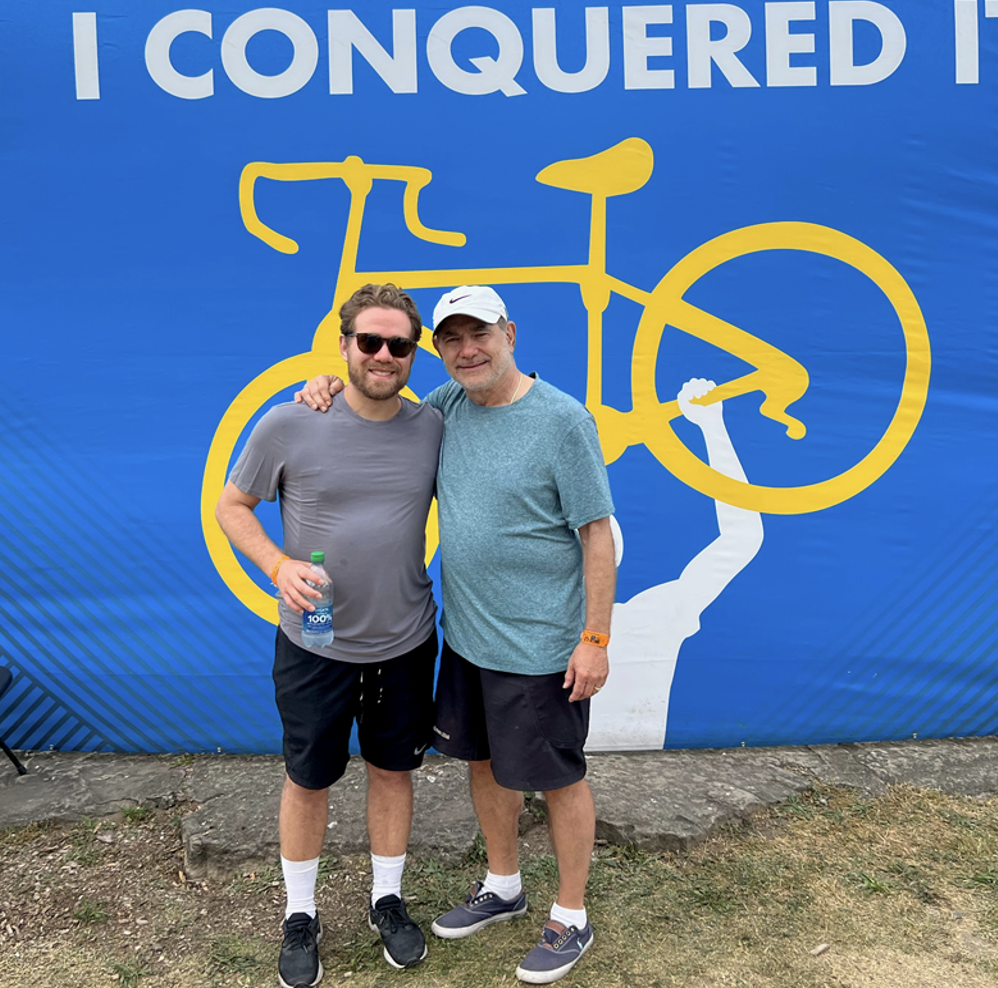
On June 10-11, 2023, Matthew Rendely and his father, Dr. Russell Rendely, participated in the Ride to Conquer Cancer. The Ride was 226 kilometres beginning in Toronto at the CNE and ending in Niagara Falls. Matthew and Russell rode in honour of their brother/son-in-law, Stephen Sheps, who is a cancer survivor.
Together, Matthew and Russell’s team raised over $26,000 for cancer research and the event at large raised over $17 Million. These monies will help support the Princess Margaret Cancer Centre, which is one of the top five (5) cancer research centres in the world!
If you would like to contribute to this great cause you can do so at the following link:
https://supportthepmcf.ca/Ride23/8c3e1eb720664c169ea6326fe71de069
| |
3. THE COLLOQUIUM LEGAL EDUCATION CONFERENCE, SUDBURY | Bryan Gilmartin will be chairing and speaking at the Estates Session of the Colloquium Legal Education Conference in Sudbury Ontario on October 19, 2023. | |
4. DECISIONAL CAPACITY, PEI, OCTOBER 24, 2023 | On October 24, 2023, Kimberly Whaley and Bryan Gilmartin will be speaking in Prince Edward Island on decisional capacity and some of the common issues that arise with respect to estates and powers of attorney. | |
5. ESTATES TRUSTS AND PENSIONS JOURNAL, 2023 | John Poyser published a co-authored paper: “Dispositive Delusions Affecting Wills: Part One – The Legal Perspective and Challenges Posed by Definitions”, appearing in the next release of the Estates, Trusts & Pensions Journal, 2023 (co-authored with Dr. Kenneth Shulman, Dr. Nathan Herrmann, Roger Lee). | |
6. LESA WEBINAR, APRIL 25, 2023 | John Poyser moderated the webinar: “The Impact of Alcohol on Capacity” (Dr. Arlin Pachet and Ryan Gorlick), program for the for the Legal Education Society of Alberta (LESA) on April 25, 2023. | |
7. LESA WEBINAR, JUNE 1, 2023 | John Poyser moderated the “The Affect of Delusions on Capacity” (Dr. Nathan Hermann and Roger Lee), program for the for the Legal Education Society of Alberta (LESA), webinar on June 1, 2023. | |
CANADIAN LAYWER 2023-24 TOP 10 WILLS, TRUSTS & ESTATES LAW BOUTIQUES | |
|
WEL congratulates the new STEP Canada TEP’s:
- Anne-Marie Dupras
- Dana George
- Shaun Doody
- Charlotte McCurdy
- Olivia Ruoyi Yu
- Christopher Smith
- Maria Clavel
| |
(i) GIFT TO CHARITY THAT NO LONGER EXISTS | |
|
By Albert H. Oosterhoff
1. Introduction
Testators often make gifts in their wills to charities. But if a named charity never existed or has ceased to exist before the testator’s death, or if the testator’s purpose cannot otherwise be carried out, the question arises what should be done with the subject matter of the gift. There are two possible situations. The first is the case of an initial failure. The second is the case of a supervening failure.
In the case of an initial failure, the court has to determine whether: (a) the purpose specified by the testator is impossible or impracticable to carry out; and (b) whether the testator had a general charitable intention. Most cases involve an initial failure.
In the case of a supervening failure the property has already vested in the charity and cannot (save for a couple of minor exceptions) revert to the testator’s estate, but the purpose can later become impossible or impracticable. In this case it is not necessary to show that the testator had a general charitable intent.
‘Impossibility’ means that the purpose cannot be carried out at all. ‘Impracticability’ means that there is no longer a real need for the purpose the testator intended.
In the case of an initial failure, if the testator has named a specific institution that still exists but it is impossible or impracticable to give effect to the intended purpose, the gift will typically fail, and the property will result to the estate. However, if the court finds that the testator had a general charitable intention, even though she named a specific charity, the property can be applied cy-près to purposes similar to the named charity. If the testator gives her entire estate or all the residue to named charities one of which has never existed, the court can also find a general charitable intent by the concept of ‘charity by association’ or ‘kindred objects’. And then it can direct that the share of the non-existent charity be applied cy-pres.[1]
The question whether a gift of residue given to a charity that had ceased to exist before the testator’s death, a case of initial failure, arose in Dors v The Public Guardian and Trustee.[2]
2. Facts
The testator, Anna Salnikova, died in 2018. She had no spouse or children and her only sibling died in World War II. Her only living relatives were a first and second cousin. The testator appointed her friend, Elizabeth Dors and another person her executors. The testator’s Will, made in 2006, left legacies to the two cousins, and directed that the residue be distributed and paid to 20 named charities in varying percentages. The charity to which the testator gave the largest part of the residue (20 percent) was the Pan American Mission in Canada (‘the Mission’). She provided the Calgary address of the Mission, as well as the address of its head office in California in her Will. The Mission helped fund orphanages in South America. The testator and Ms. Dors were part of a group of women who raised funds for various charities, including the Mission. Ms. Dors was also the testator’s attorney for property and sent a cheque for $200 to the Mission’s Calgary office on the testator’s instructions. However, the cheque was returned with a note stating the charity was no longer in existence. Further research indicated that the Canadian charity had been voluntarily wound up in 2012, and that the US charity had been dissolved involuntarily in 2013.
The will did not contain a provision directing the executors how to distribute the residue if one of the charities was no longer in existence. The executors brought an application for directions about the disposition of the money left to the Mission. They took the position that the gift had lapsed, and that the money should be distributed pro rata to the other 19 charities. However, The Public Guardian and Trustee (the ‘PGT’) took the view that it should be paid to a charity with objects similar to the Mission under the cy-prés doctrine.
3. Analysis and Judgment
Justice Gilmore applied the principles described in Re Jacobsen[3] to determine charitable intent:
- The bequest is a bequest without limitation to an institution which was admittedly a charitable institution.
- The bequest is a residuary bequest.
- Provision has already been made for the next of kin in para. 6(c) of the will of the testatrix.
- All of the beneficiaries mentioned in para. 6(d) of the will are admittedly charitable institutions (as compared to para. 6(b) of the will where only some of the legatees are charitable institutions).
In Jacobsen the court determined that the money left to one of the charities should be applied cy-prés.
Her Honour also referred to and applied another similar case, La Fabrique de la Paroisse Sainte-Sophie,[4] which also applied a gift cy-près. In that case,[5] the court quoted the following applicable principles in determining whether to apply cy-près from Conforti v Conforti:[6]
The cy-près doctrine may be used by the court to direct a gift in a Will to an institution or organization other than the one named in the Will if:
a) the gift in the Will is impractical or impossible;
b) the testator manifested a general charitable intention in making the gift in the Will; and
c) the gift to the alternative institution or organization would be a gift resembling the initial purpose of the gift in the Will.
Her Honour, relying on the above authorities held that the gift to the Mission should be applied cy-prés because the testator evinced a general charitable intention since she gave 95 percent of her Estate to charities, and it was clear that the Mission and its objects were particularly important to her. Distributing the 20 percent to the other charities would defeat her intention to benefit orphans in South America. Consequently, her Honour rejected the position of the executors. But she noted that the result would have been different if the Will contemplated a gift over to the other charities.
In the order, her Honour directed that the 20 percent should be paid to a charity with objects similar to those of the Mission. She directed that the PGT should provide the executors with a list of nominee charities and the executors were then entitled to choose one of the nominees on their own or in consultation with the PGT.
As is apparent from the reasons, it is possible for a testator to insert a provision in a will that avoids the necessity and cost of having to make an application to the court for a cy-près order. Lawyers who draft wills for clients who make testamentary gifts to charities should suggest such a provision. Precedents provide several examples. Others are mentioned in a paper prepared by Dana De Sante, then of the Office of the Public Guardian and Trustee, for the Six-Minute Estates Lawyer presented by the Law Society of Upper Canada on 27 April 2011.[7]
The provision could direct the executors to distribute the money left to a charity that no longer exists or never existed equally to the other charities. But a more appropriate provision would be to direct the executors in their absolute discretion to select an appropriate charity with similar objects to those of the charity that no longer exists. The provision can and should also address the possibility of a charity having changed its name or having been amalgamated with another charity.
---
[1] For a detailed discussion of the cy-près doctrine, see Oosterhoff on Trusts, 9th ed by Albert H Oosterhoff, Robert Chambers, and Mitchell McInnes (Toronto: Thomson Reuters, 2019) §7.7, and for Initial Impossibility or Impracticability, and Supervening Impossibility or Impracticability see §§7.7.2 and 7.7.3.
[2] 2023 ONSC 1503. See also the fine blog by my colleague, Evan Pernica, on this case at https://welpartners.com/blog/2023/05/what-happens-when-a-gift-in-a-will-is-made-to-a-charity-that-no-longer-exists/.
[3] (1977), 80 DLR 3d 122 (BCSC) at 127.
[4] 2020 ONSC 3534. See my blog, ‘Application of Cy-Près Doctrine to Charitable Gift’, https://welpartners.com/blog/2020/10/application-of-cy-pres-doctrine-to-charitable-gift/, posted 6 October 2020.
[5] At paras 21-22.
[6] (1990), 39 ETR 32 (Ont Gen Div), para 14.
[7] I am indebted to my colleague, Heather Hogan, for drawing my attention to this paper.
| |
(ii) REMEDIES FOR MISAPPROPRIATION BY ATTORNEY | |
|
By Albert H. Oosterhoff
1. Introduction
Sadly, it happens frequently enough that an attorney of property misappropriates money or other property from the grantor. Since the attorney is a fiduciary, this amounts to a breach of fiduciary duty and he will be held liable. But others may have received some of the property as well and the question may arise on what basis they can be held liable. These issues arose in the recent case, Doherty v Doherty.[1]
2. Facts
Mrs. Molly Doherty died a widow in 2019, aged 84. She was survived by her two children, Kathleen and Terrence. Kathleen had been estranged from her family for a number of years. Mrs. Doherty lived in the family residence until 2018. Terence and his wife, Sylvia lived in the residence from time to time or in their trailer but during the winter they lived on their sailboat in Florida. In 2017 Mrs. Doherty executed a power of attorney for property in which she appointed Terrence as her attorney. In the spring of 2018 Mrs. Doherty was not doing well and the residence had fallen into a state of disrepair. In the same year, with the assistance of a lawyer, Mrs Doherty executed both a new power of attorney appointing Terrence as her attorney and a will in which she left the residue of her estate to Terence and to Sylvia if he should predecease her. Terence and Sylvia undertook repairs to the residence, the costs of which were paid by Mrs Doherty out of her CIBC bank account to which Terrence had access as attorney.
Mrs. Doherty entered into an agreement of purchase and sale of the residence and as demanded by the listing agent Terrence also signed it as attorney. The transaction closed in October 2018 and the 2018 power of attorney was registered on title. The net proceeds were paid into Mrs Doherty’s CIBC account. Meanwhile she moved into an assisted-living facility. Terrence and Sylvia then left for Florida. While there they learnt that Kathleen and her daughter were visiting Mrs. Doherty. Kathleen made inquiries about the sale of the residence and about her mother’s property and personal care. In 2020 she contacted the OPP alleging that Terrence had stolen some $400,000 from his mother while acting as her attorney. The OPP investigated the matter but laid no criminal charges, having concluded that the matter was a civil matter between family members.
Kathleen arranged for a capacity assessment of her mother by Ms Kay concerning Mrs. Doherty’s capacity to grant or revoke powers of attorney and whether she had testamentary capacity. Ms Kay concluded that Mrs Doherty did have the requisite capacity for both purposes. Soon thereafter Mrs Doherty executed new powers of attorney for property and for personal care, naming Kathleen as her attorney. She also made a new will in which she appointed Kathleen as executor and left her estate equally to Kathleen and her daughter Meaghan.
Between 1 June 2018 and 14 August 2019 more than $370,000 had been withdrawn from Mrs. Doherty’s CIBC account (the ‘Transferred Amount’). Terrence did not dispute that within 20 days of the deposit of the proceeds of sale he arranged for a total of $230,000 to be transferred to Sylvia and their son Liam. At her death Mrs. Doherty’s estate was worth only $46,682.78.
Terrence, supported by Liam alleged Mrs. Doherty intended to make a gift of the transferred amount to him and Liam. He alleged that $23,000 of the Transferred Amount was a gift by Mrs. Doherty to Liam to pay off a loan on a truck, and another amount was allegedly either a gift or a loan to Liam to allow him to purchase a house. Terence paid most of the balance into Sylvia’s bank accounts.
Kathleen then brought this application for an accounting from Terrence for the moneys that were missing from Mrs. Doherty’s bank account. She also alleged that Terrence committed fraud in dissipating his mother’s assets and breached his fiduciary duties to her. Further, she submitted that Sylvia and Liam were aware of and participated in a conspiracy to defraud Mrs Doherty and should be held jointly and severally liable with Terrence. The court earlier granted her a tracing order. The main focus of this blog is on the appropriate remedies.
3. Analysis and Judgment
Justice Dietrich applied the well-known tripartite test for an inter vivos gift: (a) an intention by the donor to make a gift; (b) acceptance of the gift by the donee; and (c) a sufficient act of delivery of the property by the donor to the donee.[2]
It is not necessary to recount the application of the test to the facts. Let it suffice to note that after a very careful and detailed examination of the facts Justice Dietrich concluded that the evidence presented by Terrence and Liam was contradictory and that they failed to prove that Mrs Doherty intended to make the alleged gifts to Liam or to Terrence. Thus, the $23,000 and the $55,000 alleged to have been gifts to Liam had to be returned to Mrs Doherty’s estate. Similarly, the balance of the Transferred Amount of $246,745.02, most of which had been transferred into Sylvia’s bank accounts, had to be returned to Mrs. Doherty’s estate.
Her Honour noted that a distinction can be drawn between the case of a person who has been appointed attorney but for the nonce acts as agent when conducting business on the donor’s behalf, and then acts as attorney once the grantor ceases to have capacity. However, she also noted that the distinction is less significant when abuse of a power of attorney is alleged, since the named attorney will have a fiduciary duty to the grantor regardless. In any event, if the attorney exceeds his authority, he will be liable for any breach of fiduciary duty. Whether as agent or attorney, Terrence was not allowed to withdraw funds from Mrs. Doherty’s account for his personal use or the use of his spouse and son. Since Terrence did not meet the burden of proving that the transfers were inter vivos gifts, her Honour found that Terrence breached his fiduciary duty and was liable for the damages that flowed from the breach.
A stranger to the fiduciary relationship may also be liable jointly and severally with the fiduciary in one of two ways: (a) when the stranger knowingly assisted the fiduciary in the breach of duty, which is known as ‘accessory liability’; and (b) when the stranger received trust property with actual or constructive knowledge of the breach, which is known as ‘knowing receipt’. Justice Dietrich, citing Citadel General Assurance Co v Lloyds Bank Canada,[3] concluded that Sylvia was liable for knowing receipt and that, though her tracing efforts, Kathleen could demonstrate that Sylvia received the bulk of the Transferred Amount. Her Honour found that Liam was also liable for knowing receipt. She also found that Sylvia could also be held liable for knowing assistance in Terrence’s breach of duty and, citing Air Canada v ML Travel Ltd,[4] that made her personally liable jointly and severally with him for damages arising from the breach.
4. Costs
Kathleen asked for full indemnity costs on the application, as well as an adjustment to full indemnity costs on an earlier motion in which Gilmore J denied her request for full indemnity costs. Justice Dietrich refused to increase the costs on the earlier motion but held that costs on a full indemnity basis on the application were appropriate. In her opinion Terrence’s conduct rose to the level of reprehensible, scandalous, and especially egregious. All three of Terrence, Sylvia, and Liam were jointly and severally liable for the costs but her Honour provided that Liam’s share should not exceed one-third of the total.
---
[1] 2023 ONSC 1536.
[2] Teixeira v Markgraf Estate, 2017 ONCA 819.
[3][1997] 3 SCR 805.
[4] [1993] 3 SCR 787.
| |
(iii) ATTENDING THE CBA HEALTH LAW SUMMIT | |
|
By Brett Book[1]
On Wednesday, May 24, I arrived in Ottawa, Ontario to attend the Health Law Summit hosted by the Canadian Bar Association’s Health Law Section. I was invited to this Summit to receive the Law Student Essay Contest Award for a paper I wrote and submitted last year entitled Nothing About Us Without Us.[2]
The Summit took place at the historic Fairmont Chateau Laurier in the Adam Ballroom and was co-chaired by Valerie Wise (Wise Health Law, Oakville, Ontario) and Catherine Gaulton (Healthcare Insurance Reciprocal of Canada, Toronto, Ontario).
The Summit featured a total of six expert panels on topics that ranged from concerns surrounding a health care professional’s fitness to practice to practical implications for the expansion of virtual health care.
Keynote Address
On day two, Retired Chief Justice George R. Strathy provided an important key note address on a difficult topic: the mental health crisis in the legal profession. Retired Justice Strathy reminded attendees that mental illness in the legal profession is higher than that in most other professions and that lawyers are less likely to seek help. Why? Because it’s become part of our culture. Lawyers are working harder than ever and the development of technology has made it easier for a lawyer to work a seven-day week. Retired Justice Strathy offered four recommendations to help address the ongoing crisis:
- Talk about it – have open and candid discussions with friends, family, and colleagues;
- Reduce some of the stressors that cause anxiety and depression – make a work/life balance a real priority;
- Strengthen mentoring and support systems – all lawyers should have a senior and confidential mentor; and
- Provide every member of every firm with access to mental health supports – these do exist, but people are not utilizing them.
Canada’s Expanding Medical Assistance in Dying Framework
One of the expert panels featured a discussion on Canada’s expanding MAID framework. The panel was led by Professor Trudo Lemmens (Scholl Chair in Health Law and Policy, University of Toronto), and, Dr. Karandeep Sonu Gaind (Sunnybrook Hospital, Temerty Faculty of Medicine, University of Toronto).
Professor Lemmens, discussed how the recently removed reasonably foreseeable natural death (“RFND”) eligibility criteria was actually a helpful safeguard. He commented that Canada’s MAID framework is unique due to its over-emphasis on access. Professor Lemmens confirmed that Canada is now the absolute world leader in the provision of Medical Assistance in Dying, commenting that in 2021, 10,064 Canadians utilized the framework to end their lives with medical assistance - a significant increase from the 1,016 MAID deaths in 2016.
Echoing the comments of his colleague before him, Dr. Gaind focused on a major shift in how we discuss Canada’s framework. As the framework expanded, the terminology has changed from ‘safeguards’ to ‘barriers.’ Dr. Gaind, pointed out that across the globe, the most common reason for a MAID application is depression. To this, he shared that we know people suffering from depression think differently and operate under a known cognitive triad centering around feelings of despair and hopelessness for the future. Dr. Gaind shared this comment, “we lose our resilience and we break,” and this has biological, functional, and medical correlatives. Perhaps most importantly, Dr. Gaind held that there are no standards for predicting the irremediability of mental illness. He concluded by raising many concerns around what he believes has become suicide facilitation in a process that has been taken over by ideology.
Law Student Essay Award
The CBA and its sponsor, Carbert Waite LLP (Calgary, Alberta) provided me with the award for the top law school essay on a health law topic. My paper discussed the influence of the United Nations Convention on the Rights of Persons with Disabilities before briefly addressing the expansion of Canada’s MAID framework.
In delivering my thank you speech, I discussed the influence of my father Phil, on my writing and advocacy for vulnerable persons and marginalized groups. Unfortunately, Phil passed away on April 30 after a brief but courageous battle with non-Hodgkins Lymphoma.
Fighting back the tears, I shared how proud my father was and how he inspired me by always standing up in the face of injustice. I was definitely humbled and touched after receiving a standing ovation from the attendees which included not only lawyers practicing in Health Law but even several law students from my alma mater Thomson Rivers University Law School in Kamloops, B.C. I pictured dad in the audience, clapping louder than anyone else and telling everyone around him, “that’s my son.”
---
[1] The author would like to dedicate this article to his father, Philip Donovan Book (July 27, 1953 - April 30, 2023).
[2] Brett Ryan Book, “Nothing About Us Without Us” August 24, 2022, Canadian Bar Association, accessed online: https://www.cba.org/Sections/Health-Law/Resources/Resources/2022/HealthEssayWinner2022.
| |
(iv) A BAD NOTE FROM THE BANK: THE FINANCIAL ABUSE OF A VULNERABLE ADULT | |
|
By Brett Book
It’s now June which means that it is Senior’s Month in Ontario. To compliment this month, on June 15th, a global conversation surrounding the prevention of elder abuse took place on the annual World Elder Abuse Awareness Day.
Looking closely at the situation in Canada, we know that financial abuse is one of the most pervasive forms of elder abuse.[1] In trying to help raise awareness of different scenarios where financial exploitation of older adults can occur, I’d like to share a recent case out of British Columbia.
On Friday June 9, a recently expelled bank manager and mutual fund dealing representative learned her fate on criminal charges which stem from acts of fraud she committed against her 79-year-old mother-in-law (the “Client”) and her employer (the “Bank”).
Justice Phillips of the British Columbia Provincial Court handed Ms. Thomas (the “Former Bank Manager”), a 24-month conditional sentence. The Former Bank Manager, who was previously banned by the Mutual Fund Dealers Association (“MFDA”), misappropriated approximately $157,000 from the Client and the Bank.
The Former Bank Manager told the court that the misappropriation bankrolled her drug addiction, which was brought on by her husband’s infidelity. In his oral ruling, Justice Phillips commented to the defendant, “you were at a time in life when things were going poorly, but it’s still no excuse.”[2]
On April 25, 2023, the MFDA released its decision on the misappropriation.
The disciplinary panel found that from December 7, 2012 to October 25, 2019, the Former Bank Manager was registered in British Columbia as a dealing representative with CIBC Securities Inc. In her position with CIBC, the Former Bank Manager helped the Client open a Tax-Free Savings Account (“TFSA”) and purchase $56,316 worth of mutual funds.
On November 22, 2021, the MFDA commenced disciplinary proceedings against the Former Bank Manager, alleging that between February and August 2019, the Former Bank Manager misappropriated client funds in contravention of the Rules.
Some of the fraudulent acts alleged to have occurred included:
- Processing 12 redemptions out of the TFSA account totalling $59,000 and depositing the proceeds into a fake account;
- Changing the account statement deliver method so it would be delivered online and changing the address associated with the account;
- Misappropriating $34,000 from an account the Client shared with her spouse; and,
- Obtaining unauthorized loans and a Line of Credit in the Client’s name and receiving $59,000 from the Bank.
Analysis
The disciplinary panel held that “misappropriation is among the most serious types of misconduct encountered by securities regulators as it usually involves a serious breach of trust, causes real harm to the client’s affected, and undermines the reputation and integrity of the securities industry.”[3]
The Former Bank Manager held a position of trust, the Client was a vulnerable older adult, one whom she exploited and stole money for her own personal use. What’s more, the Former Bank Manager, with close to decade of experience, was well aware of regulatory obligations. At the time, the MFDA felt she had not demonstrated that she recognized the seriousness of her misconduct and expressed no remorse for her actions and refused to participate in the hearing process or otherwise accept responsibility for her actions.
The MFDA imposed the following penalties:
a. Permanent prohibition of authority to conduct securities related business;
b. $300,000 fine; and
c. $10,000 in costs.[4]
Concluding Remarks
This case demonstrates the means that fraudsters will go to in order to exploit their victims. Here, there was an older adult of vulnerable age, a professional in a position of trust, and easy access to the funds and investments of the victim. The fraudster was calculated in taking steps to prevent her victim from receiving notifications on the nefarious activity taking place in her accounts.
The lesson here is that even those in positions of authority and trust can take advantage of vulnerable clients. In fact, as seen by this case, individuals holding these positions seem to have more access and less barriers to their conduct. It is important to report suspicions of elder financial abuse if and when you see the signs.
---
[1] See Vancity, “Suffering in Silence: The financial abuse of seniors in British Columbia” (2017) accessed online at https://www.vancity.com/SharedContent/documents/pdfs/News/Vancity-Report-Seniors-Financial-Abuse-2017.pdf. The report, which surveyed seniors in the Vancouver and lower mainland regions, found that 41 per cent of elderly adults have experienced some form of financial abuse and 35 per cent choose not to report it to anyone.[1]
[2] Graeme Wood, “Merritt bank manager who stole $157k from mother-in-law avoids prison” June 10, 2023, Castanet News, accessed online: http://www.castanet.net/news/Kamloops/431167/ Merritt-bank-manager-who-stole-157K-from-mother-in-law-avoids-prison [Wood].
[3] Hope Moira Donna Thomas (Re) MFDA File No. 202173, Hearing Panel of the Pacific Regional Council, Decision dated April 25, 2023.
[4] Hope Moira Donna Thomas (Re), MFDA File No. 202173, Hearing Panel of the Pacific Regional Council, Decision dated April 25, 2023 at para. 51.
| |
(v) ESTATES, COPYRIGHT AND THE LORD OF THE RINGS | |
|
By Oliver O'Brien
Estates and copyright
When an individual dies, the assets they held in life devolve to their estate trustee who has an obligation to identify and collect in these assets and administer them. Typical assets that an estate trustee could be expected to take inventory of include real property, bank accounts and cash. A more unique type of asset that an estate trustee may need to deal with is intellectual property such as copyright.
The estate trustee has an ongoing duty to the beneficiaries of the estate to preserve the estates assets and in the case of copyright, this can involve pursuing litigation to protect the copyright against infringement.
In Canada, ‘Copyright’ is defined as the exclusive legal right to print, publish, perform, record, produce, reproduce or license literary, artistic or musical material.[1] The right is given to an owner, who is most often the artist or creator of the work. The owner has the right to assign or license the copyright. Assignment is akin to selling the property interest whereas licensing permits another to use the copyright under certain conditions, with the owner retaining ownership.
Associated with this copyright are ‘moral rights’, which work to preserve the integrity and intent behind the work by the creator and allow them to limit some uses of their work.[2] Moral rights, while separate from economic rights, exist for the same period as copyright, and the estate can enforce them.
Once assigned, copyright exists throughout the lifetime of the creator and the right is protected for 70 years after their death.[3] Copyright is international in nature and has been since the Berne Convention for the Protection of Literary and Artistic Works in 1886,[4] which 181 countries are signatory to. As such, most of the world abide by either a 50- or 70-year protection period for copyright. Following the 70-year mark, the artistic work becomes public domain, meaning it becomes freely available and legal permission is not required to be used.
Tolkien Estate and other estates & copyright litigation
In June 2023, legal proceedings were brought in California by the Estate of J.R.R. Tolkien, the author of The Lord of the Rings and The Hobbit (the “Tolkien Estate”) and the Tolkien Trust against Mr. Dementrious Polychon for violation of their copyright.[5]
The suit was brought due to Mr. Polychron’s “willful and blatant violation” of the Tolkien Estate’s copyright interests in The Lord of the Rings. The basis of the claim is that Mr. Polychron has written, published and sold a book titled ‘Fellowship of the King’, a purported sequel to Tolkien’s saga and which appears to be an amalgamation of Tolkien’s books ‘Fellowship of the Ring’ and ‘Return of the King’. This comes weeks after Mr. Polychron filed his own $250 million suit against the Tolkien Estate, Amazon and Jeff Bezos for their 2022 television series Rings of Power, which he claims stole aspects from his manuscript.
Estate trustees have a fiduciary obligation to protect the copyright they hold against infringement. In 1999, the estate of Martin Luther King Jr. sued CBS for their use of his 1963 ‘I Have a Dream’ speech. The basis of the claim was the refusal of CBS to pay the estate for their use of the speech in a documentary. Mr. King’s estate claimed that the speech constituted copyrighted works and was not in the public domain. The US Court of Appeals for the Eleventh Circuit found that the speech was a ‘performance’ rather than a ‘general publication’ of Mr. King’s written text, thus granting Mr. King’s estate copyright over the speech and entitlement to a license fee for its use.[6]
And in 2013, the estate of the singer Marvin Gaye sued Pharrell Williams and Robin Thicke for copyright infringement because of their song ‘Blurred Lines’, claiming similarity to Gaye’s 1973 hit ‘Got to Give it Up’. In 2016, the US Court of Appeals for the Ninth Circuit ordered Mr. Williams and Mr. Thicke to pay $5 million in damages and entitled the estate of Marvin Gaye to 50% of the royalties from ‘Blurred Lines’ in perpetuity.[7]
Regarding the Tolkien Estate, the proceedings brought against Mr. Polychron highlight how the copyright for works by an individual who passed away almost 50 years ago can still be vigorously defended in court by their estate. Moreover, the licensing of Tolkien’s work has spawned a Hollywood franchise which has brought hundreds of millions of dollars into his estate. This has far exceeded the returns that J.R.R. Tolkien received on his works during his lifetime, demonstrating the economic potential in copyright after death.
Estate planning for copyright interests
Copyright represents a unique asset and it is important for those creators with valued works to consider how their interest is dealt with on death. Legal issues can arise over entitlement to royalties of the copyright, the status of the asset (such as licensing), their valuation, as well associated moral rights of the creator.
Prepare a Will: The best planning practice for creators with copyright is to draft a Last Will and Testament which outlines how the copyright should be dealt with on death and who will benefit. A Will can ensure that the estate is entitled to the copyright for the full 70-year period. Section 14(1) of the Copyright Act states that where an author of a work is the first owner of the copyright, no assignment of the copyright is valid for more than 25 years after their death, except in a Will.
Furthermore, a Will can ensure that the testamentary intentions of the creator are definitively spoken to, reducing the likelihood of litigation occurring on their passing. When the singer Prince died in 2016, he did not leave a Will to divide his $156 million estate. Unsurprisingly, litigation ensued between his six-half siblings who became intestate beneficiaries to his estate, and only in 2022 did the family reach a settlement. The settlement split Prince’s lucrative music rights amongst his half-siblings.[8]
Appoint an appropriate estate trustee: The creator will need an estate trustee who understands their work and the moral rights connected with them, as well as the fiduciary nature and obligations of the role. In the instance of J.R.R. Tolkien, for many years the estate trustee of his estate was his son Christopher Tolkien. Christopher was intimately familiar with his father’s work, having laboured to publish his manuscripts and unpublished books throughout his life. He was also involved in numerous litigation battles, including an $80 million suit against Warner Brothers in 2012 for their use of copyrighted works in gambling machines, which the Tolkien Estate claimed fell outside of the original licensing agreement made in 1969 and harmed Tolkien’s legacy.[9]
It may also be prudent to prepare a separate Will that deals exclusively with the copyright, and appoint an alternate estate trustee just for those assets. This Secondary Will could deal with intellectual property which is not subject to probate, in turn ensuring the privacy of those rights.
Document and value the copyright: It is advisable for a creator to engage professionals to accurately value the copyright interest and the ability of their future estate to deal with them. The creator should consider how many copyrights they hold, licensing agreements or assignments they have made to third parties and the rights that will require ongoing management. This is especially important where the value of the copyright is likely to comprise a large part of the estate.
Conclusion
The economic and moral rights associated with copyrighted works can be of enormous importance not just to the creator during their lifetime but to their beneficiaries after death. As such, it is important for those with copyrighted works to think carefully about how they wish to deal with these rights on their passing and to appoint suitable fiduciaries to then deal with these assets and protect them.
---
[1] Copyright Act, (R.S.C., 1985, c. C-42) section 3(1) - the Copyright Act is a piece of federal legislation that governs all copyrights in Canada.
[2] Ibid section 14.1
[3] In 2023, Canada signed the Canada-United States-Mexico Agreement (CUSMA) which increased the post-death copyright period from 50 to 70 years.
[4] For a copy of the Berne Convention (1886), see: https://treaties.un.org/doc/Publication/UNTS/Volume%20828/volume-828-I-11850-English.pdf
[5] The Tolkien Trust v. Polychron, C.D. Cal., No. 2:23-cv-04300, 6/1/23
[6] Estate of Martin Luther King, Jr., Inc. v. CBS, Inc, 194 F.3d 1211 (11th Cir. 1999)
[7] Williams v. Gaye, No. 15-56880 (9th Cir. 2018)
[8] The Guardian, ‘Prince family and advisers settle distribution of singer’s $156m estate’ (2 August, 2022) <https://www.theguardian.com/music/2022/aug/02/prince-singer-heir-distribution-estate>
[9] Fourth Age Limited et al. v. Warner Bros. Digital Distribution Inc et al. (CV 12-9912 ABC)
| |
(vi) THE COSTS OF SUCCESS – “WINNING” ISN’T ALWAYS FREE | |
|
By Evan Pernica
Litigation, by nature, gives rise to an adversarial arena where parties often believe that there will be a clear-cut winner and loser at the end of the day. In the spirit of this competitive approach, some parties who believe that their positions are bound for success may misjudge their financial risks by trusting they will be reimbursed and indemnified for their legal costs if they press forward and “win the day” at trial.
Unfortunately, this bullish view is often misguided when seen through the lens of estate litigation since the potential blended approach to cost awards can result in parties and potential beneficiaries having to pay for significant amounts of their own legal costs, even when their challenger’s arguments are dismissed.[1]
A recent example of the potential costs associated with successful advocacy in estate litigation can be seen in the Ontario Superior Court decision of Nanchin v. Peller, 2022 ONSC 2846, where the Honourable Justice Conlan, J. required the respondents to bear nearly $20,000 of their own legal costs despite dismissing the moving party’s motion for dependant support (Nanchin v. Peller, 2022 ONSC 1760) (“the Motion”).
By way of brief summary, the moving party, the girlfriend of the deceased at the time of his death, sought a declaration that she was a dependant who the deceased failed to make adequate provision for out of his estate, and she also sought orders for interim support and her legal fees be paid out of the Estate. Unable to adduce sufficient supporting evidence, the moving party’s motion was dismissed.
On its face, the court’s decision to dismiss the moving party’s Motion appears to clearly suggest that the Respondents were successful or “victorious” while the moving party was unsuccessful or “lost”. In fact, in determining costs, Justice Conlan, J. specifically and plainly set out that the moving party’s arguments were rejected while the respondents’ arguments were accepted, and it is simply incorrect to claim that there was equal success on the Motion.[2]
Despite the respondents’ success on the Motion, in determining costs awards Justice Conlan placed considerable weight on balancing the proportionality of the respondents’ actual costs for the Motion while satisfying the overall objective of indemnifying successful litigants, stating as follows:
Thus, the only legitimate questions are whether the quantum of costs sought by the interim Estate Trustees is fair, just, reasonable, and proportionate, and whether the award requested would meet the objectives of costs orders – to at least partially indemnify successful litigants, and to encourage settlement, and to discourage bad or inappropriate conduct.[3]
On this basis, Justice Conlan, ordered the moving party to pay for only $35,000.00 of the respondents’ $54,166.31 legal fees primarily because:
“$54,166.31 is a lot of money to pay for costs of a motion which was argued in one-half day and which could not have resulted in a final order being made.”[4]
Considering the significant costs attributable to the respondents despite their apparent success at the Motion, diligent lawyers must be careful to provide perspective and objective recommendations to their clients on costs outcomes. While the desire to “win” and to obtain a form of perceived validation from the courts may motivate some clients to relentlessly pursue adjudication, the costs of such efforts, even when successful, can result in diminishing returns and significant losses to clients who must thus be properly informed and educated by their lawyers.
---
[1] Neuberger v. York, 2016 ONCA 303.
[2] Nanchin v. Peller, 2022 ONSC 2846 at para 14, 18.
[3] Ibid at para 19.
[4] Ibid at paras 21, 23.
| |
|
IV. FEATURE A COLLEAGUE -
MARK HANDELMAN
| |
|
By Mark Handelman
My cousin called me last week. He was troubled. He was just at a farewell party for a good friend. She was approved for Medical Assistance in Dying, scheduled for a few days after the party. Close family were in her hospital room, other family and friends were gathered in her family home, site of many happy memories. People were happy and joking, having a good time.
“She looked good, she was joking, having a great time, why would she want to die now,” he asked me.
The woman was 81, diagnosed with stage 4 cancer and without any prospect of recovery, he told me. “But,” he said, “She was the life of her own party, so why now?”
My cousin did not know how much pain medication it took for his friend to mount that show of well-being and did not know how much time she would have if her cancer ran its normal course to her death. I reminded him that, to be approved for MAiD, she had to have two physicians agree she was capable to make that decision and that her condition was intolerable to her.
“But why now,” he asked again, “she was the same fireball she’s always been.”
Without knowing my cousin’s friend, I could only speculate. I listed the reasons that immediately came to mind:
- She knew what her future held and did not wish to endure it.
- She knew what her future held and did not wish her family to endure it.
- She wants to be remembered as she was during her goodbye party and not as the pain-wracked shell unable to care for herself that she knew was her only future.
- She was a proud person and her sense of personal dignity precluded living to the point that someone else had to attend to her every bodily function and need.
- She wanted to die enveloped with the memories of her friends and family putting their best happy faces on.
-
It was an act of defiance: “Cancer will not decide when I die.”
- She was so fine a human being that she could not countenance the thought of using the scarce medical resources required to continue her life beyond when she would be aware of anything but pain, discomfort and the loss of personal dignity and autonomy.
There are other valid reasons to hurry death. Whatever the reasons, it is an intensely personal decision by a person who knows, starkly, what their future holds. It is a final act, sometimes defiant, by a person defining their own personal dignity and autonomy. And, perhaps also, the decision is to celebrate life rather than mourn death.
ELIGIBILITY FOR MAiD
The Canada.ca website outlines the parameters of eligibility and contains much other useful, relevant information.
https://www.canada.ca/en/health-canada/topics/end-life-care.html
Briefly, to be eligible for Medical Assistance in Dying, the person must:
- be eligible for health services funded by the federal government, or a province or territory (or during the applicable minimum period of residence or waiting period for eligibility)
- generally, visitors to Canada are not eligible for medical assistance in dying
- be at least 18 years old and mentally competent. This means being capable of making health care decisions for yourself.
-
have a grievous and irremediable medical condition
- make a voluntary request for MAiD that is not the result of outside pressure or influence
-
give informed consent to receive MAiD
---
Mark is a consultant to our firm. He is a Senior Lawyer Member of Ontario’s Consent and Capacity Board and holds a Master of Health Sciences degree in bioethics from The University of Toronto Joint Centre for Bioethics. He knows a lot about end of life decision-making for both capable and incapable persons, about mental health law and about mental capacity to make decisions. Mark is also part of our firm mediation team. His relevant experience includes over 800 mediations at which he presided as a part time Member of The Ontario Human rights Tribunal from 2008 to 2018.
| |
|
B'nai Brith Inaugural Advocacy Symposium
Canadian Action Now (CAN)
July 5, 2023
Racism and Ageing
Speaker: Kimberly Whaley on Ageism, Civil & Criminal Remedies in Elder Law
https://www.bnaibrith.ca/can/
Canadian Lawyer Webinar
October 10, 2023
- The Role of the Medical Expert in Estates Practice
- Societal context and demographics – a brief overview
- Clarity on capacity
- The role of the medical expert witness or assessor
Speakers: Kimberly Whaley and Ian Hull
LSO Estates and Trust Summit
October 10, 2023
Intersection of Criminal Law and Estates Law
Speaker: Kimberly Whaley
Colloquium Legal Education Conference
October 19, 2023
Chair & Speaker: Bryan Gilmartin
Decisional Capacity, PEI
October 24, 2023
Speakers: Kimberly Whaley and Bryan Gilmartin
Elder Law Conference, Vancouver
November 9 -10, 2023
Co-chair: Kimberly Whaley, Hugh McLellan and Geoffrey White
https://www.bcli.org/sectors/ccel/
| |
Check out our recent Feature Series which are posted on our Blog:
| |
VII. IN CASE YOU MISSED IT - RECENT BLOG POSTS | |
Do you follow us on social media? Do you subscribe to our blog? We invite our subscribers to read our blog on-line or via a feed reader using our blog's RSS feed and to follow us on social media.
Newsletter Archive
WEL Blog
Online Connections
Sign Up for Our Newsletter
WEL Directory
| |
WEL NEWSLETTER June 2023, Vol. 13, No. 3 | | | | |