WEL NEWSLETTER March 2026, Vol. 15, No. 12 | | |
Hello,
HAPPY ST. PATRICK’S DAY! May the Luck of the Irish be with you. Enjoy the celebrations of the day! This day always signifies spring is imminent to me-so it feels good and soul warming.
Last, I wrote, I was reflecting on my South Asian Adventure. The remainder of my trip involved visiting various other locations in Thailand, followed by Malaysia, Cambodia, and Taiwan. My travels were anything but relaxing given the moving between cities and countries every 3-4 days or so. Importantly, I saw some great sites, experienced different cultures, learned a great deal of history, experienced new rituals and foods. It was an eye opening and valuable experience. Cambodia I am not done…and must go back…plans in the works for next year to be shared when formulated!
| | |
Now, I am back at it with teaching and speaking and working hard for our clients. Bryan guest lectured at Nimali Gamage’s Elder Law course at Osgoode, and I, at Jordan Atin’s Will’s course at Osgoode. It’s always refreshing to meet and discuss legal and societal issues with inspiring students. I chaired the Osgoode, Consent & Capacity Professional Development program last week, which is always a good one to learn about new developments and approaches to these complex matters concerning capacity and incapacity.
Our law clerk, Jordan moved to embark upon a journey of e-discovery. All of us at WEL are sad to see him go-he was a bright light everyday at our offices. We wish him well, but we miss him already! Difficult shoes to fill for sure.
I am off to STEP Council meetings in London next week and will report back on notable exciting developments. STEP Worldwide has a new CEO, and this will be our first council meeting with Emma Lovell. It will be great to reconnect with Council on upcoming strategies for STEP.
Wishing you an amazing St. Patrick’s Day with all the green you can muster up. Finally, because Easter follows so soon, I wish you all a Happy Easter also since our next issue will be towards the end of April. Shamrocks and Bunnies afoot! Enjoy!
As Ever, Enjoy the Read!
Kim
| | I. SAINT PATRICK AND THE LAWS OF INHERITANCE IN HIS DAY | | |
By Oliver O'Brien
Today is St. Patrick’s Day, a holiday dedicated to the life of the patron saint of Ireland as well as the celebration of Irish culture.
Life of Saint Patrick
St. Patrick lived a tumultuous life in 4th and 5th century Britain and Ireland. What may come as a surprise to some is that St. Patrick was not born and raised in Ireland. Rather, he was a Romano-Briton of wealthy background and referred to himself in his writings by the Latin Patricus.[1] In his lifetime alone, he saw the withdrawal of the Romans from Britain and the gradual introduction and settlement of the Anglo-Saxons from what we now call Germany.
At sixteen years old, Patrick was kidnapped by pirates and taken to Ireland where he was forced to work as a shepherd. After six years of captivity, he managed to escape and return to Britain, where he went on to Belgium to study as a priest.
Several years later he would return to Ireland, for what he saw as a singular mission to convert the Pagan peoples to Christianity. Historically, much of St. Patrick’s life’s work concerns his missionary work and the conversion of the locals, which included Irish Kings, nobles and even slavers.
In the years following his death, many legends grew surrounding St. Patrick. These include his use of a shamrock in a parable and his supposed banishment of all snakes from Ireland.
What were the Laws of Inheritance?
What may come as a surprise to some readers is that despite living over 1500 years ago, the laws of inheritance which would have been familiar to St. Patrick are recognisable to those seen in Canada and most of the world today.
Britain and Ireland in the 5th century were a complex network of cultures and legal traditions. Chief among these were the remnants of Roman law, traditional Celtic law and the emerging Anglo-Saxon law brought from northern Europe. Ireland, meanwhile, was never a province of the Roman Empire and as a result never inherited its civil laws. Instead, Ireland had its own Celtic laws and customs.
Roman Inheritance Law
We understand that the Romans recognised wide testamentary freedom, permitting the use of a written Will, or testamentum, to name an heir and dispose of one’s property. This Will could name a guardian, or tutor, for underage children and leave legacies to third parties. There was even a system for trusts, or fidei-commissa, which existed alongside Wills. The Romans also permitted Codicils, which were often in the form of letters with amendments to a Will.
If a Roman citizen failed to make a Will, or one compliant with their stringent and formulaic rules, then there were intestacy rules that governed. Intestacy was dictated by the Roman Twelve Tables, a codified system of laws established in the early Republic. Roman law generally had no concept of primogeniture, the idea that the oldest male inherited first, such that male and female children were generally treated equally.
Over time, the Romans developed further rules governing Estates, including forced heirship and certain statutory entitlements. For instances, in 178 AD the Senate decreed Senatus Consultum Orfitianum, which gave children a priority claim over an Estate over other relatives. Several years later the Senate decreed Senatus Consultum Tertullianum, which placed certain mothers in the line of succession to the Estates of their intestate children.
Celtic and Anglo-Saxon Inheritance Law
By contrast to Roman law, historians understand that the Celtic and Anglo-Saxon rules of inheritance in the 5th century were far less codified. With comparatively low levels of literacy, they were based on tribal custom, and oral tradition. Accordingly, written Wills were uncommon and laws varied significantly.
What we do know is that Celts and Anglo-Saxons of the time exercised partible inheritance, known by some as Gravelkind. Under this system, the death of a landholder dictated that the property be divided equally among his sons. While sons received equal shares of the land, the father often prescribed the division by stating which parcel of land was to go to which son.
Although life was very different for St. Patrick over a millennia and a half ago, it is interesting that throughout time, rules of inheritance were always deemed important enough to require some form of structure and governance, to varying degrees.
[1] Our knowledge and understanding of St. Patrick mainly derives from two sources: the autobiographical writing of his life, Confessio, and the Letter to the soldiers of Coroticus.
| | 1. THE ESTATES, TRUSTS AND PENSIONS JOURNAL CONFERENCE, VANCOUVER B.C | |
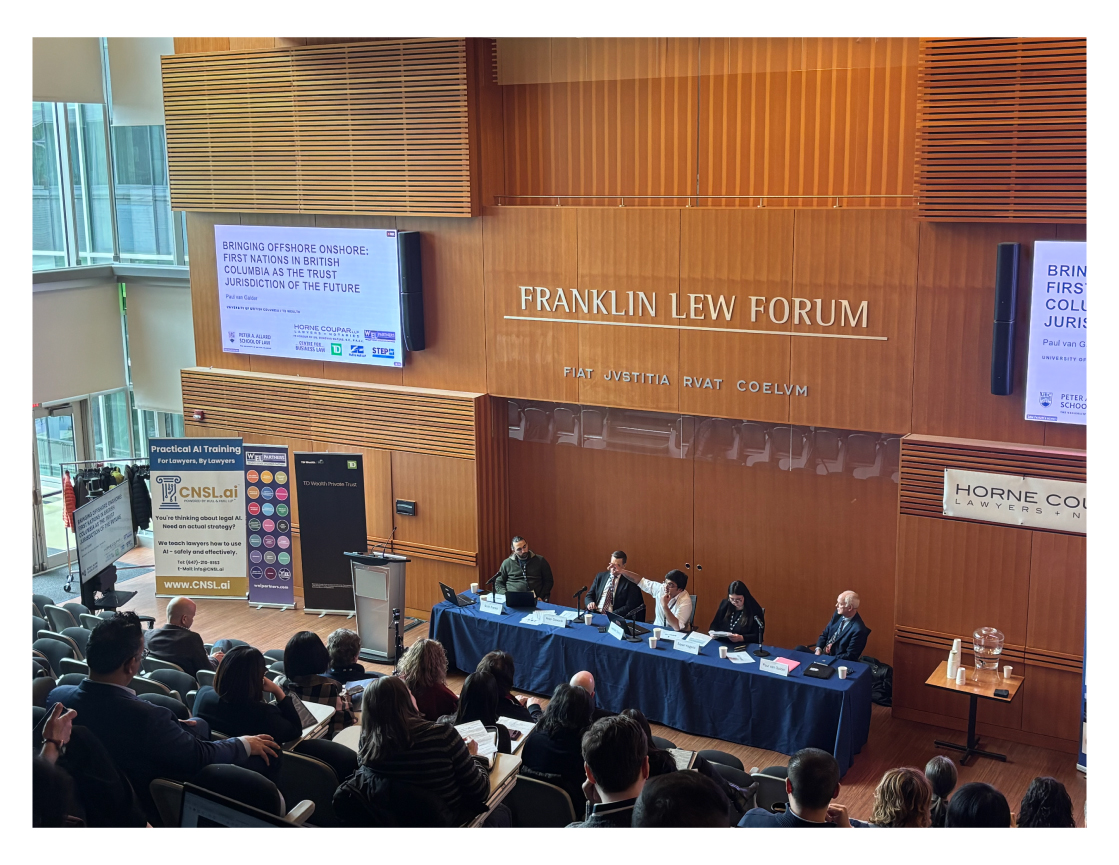
Bryan Gilmartin had the opportunity to attend at, The Estates, Trusts and Pensions Journal Conference hosted by the Peter Allard School of Law at the University of British Columbia on February 19th and 20th. The conference featured Canadian and international speakers presenting on topics such as trustee discretion, secret trusts, purpose trusts, trusts theory, spousal trusts, family provision litigation, trusts for Indigenous Peoples, foundations, and the incorporation of AI and other tech innovations in trusts and donatio mortis causae. WEL PARTNERS were pleased to support the sponsorship of the significant conference.
https://etpj.allard.ubc.ca/
| | 2. LEV CONTINUING EDUCATION PROGRAM ON PARKINSON’S, LAW, AND LEADERSHIP: NAVIGATING CAPACITY, CREDIBILITY, AND CARE | |
On February 24th, Bryan Gilmartin spoke on decisional capacity at a program on Parkinson’s, Law, and Leadership: Navigating Capacity, Credibility, and Care, provided by LEV Continuing Education. This program features leaders in law, medicine, workplace inclusion, and governance with the aim of exploring and examining topics such as professional judgement, how to access capacity and credibility fairly, navigating inclusion when ability changes over time, and how best to balance ethics, privacy, and leadership when health becomes a part of professional life.
https://levcontinuingeducation.com/programs/parkinsons-law-and-leadership-navigating-capacity-credibility-and-care/
| | 3. TORONTO LAWYERS ASSOCIATION AWARDS GALA | | On February 26th WEL Partners attended the Toronto Lawyers Association Awards Gala in honor of the esteemed and renowned, Tom Curry, Lawyer, Lenczner Slaght. It was a fantastic evening, and we once again congratulate Tom on an award well deserved! | | 4. ELDER LAW COURSE AT OSGOODE HALL LAW SCHOOL | | On March 5th Bryan Gilmartin had fun giving a lecture on predatory marriages for Nimali Gamage’s Elder Law course at Osgoode Hall Law School. Bryan enjoyed the students and the discussion. | | 5. OSGOODE HALL PROGRAM MANAGING CONSENT AND CAPACITY ISSUES IN WILLS AND ESTATES PRACTICE | | |
Kimberly Whaley chaired the Osgoode, Professional Development program on Managing Consent and Capacity Issues in Wills and Estates on March 11th. This program featured experienced lawyers and medical experts who provided knowledge and key practice points that legal professionals need when advising clients in circumstances where there may be consent and capacity issues. experienced lawyers and medical experts.
https://osgoodepd.ca/professional-development/short-courses-and-conferences/managing-consent-and-capacity-issues-in-wills-and-estates-practice-2026/
| | 6. STEP WORLDWIDE COUNCIL, LONDON U.K. | | Kimberly Whaley is keen to attend the STEP Worldwide Council meetings in London, UK on March 25-26th as one of the 3 Canadian elected representatives on Council. | | KIMBERLY WHALEY INVITED TO BECOME AN INTERNATIONAL FELLOW OF THE AMERICAN COLLEGE OF TRUST AND ESTATE COUNSEL | | |
Congratulations to Kimberly Whaley on having been invited to be an International Fellow of the American College of Trust and Estate Counsel (ACTEC)! ACTEC is an organization made up of top lawyers in trust and estate law who have been elected by their peers in recognition of outstanding contributions to their practice area in the United States and around the world. ACTEC aims to bring these outstanding professionals together to foster mutual education and a network of trust, confidence, and collegiality, with the goal of achieving progress and improvement in trust and estate law.
https://www.actec.org/about/
| | BRYAN GILMARTIN CO-MANAGING PARTNER | | In case you missed it, Bryan Gilmartin is now Co-Managing Partner at WEL PARTNERS, congratulations Bryan and thanks for all your hard work! | | ONTARIO BAR ASSOCIATION BOARD ELECTIONS | | |
WEL Partners would like to congratulate the winners of the Ontario Bar Association 2026 Board elections. Congratulations to Mohsen Seddigh, (2nd Vice-President), Melanie Webb (Treasurer), Antoine L. Collins (Secretary), Paul Lomic (Chair of Professional Development), and Katie DiTomaso (Chair of Selections)!
Full details
| | STEP CANADA TRUST AND ESTATE PRACTITIONER (TEP) DESIGNATION JANUARY AND FEBRUARY 2026 | | 2025 DAVID WALTER MUNDELL MEDAL | | (i) UNPAID DEMAND LOANS, UNJUST ENRICHMENT OF RESULTING TRUST? | | |
By Albert H. Oosterhoff
1. Introduction
Webb v Webb[1] concerns demand loans allegedly made by a mother to her son. The mother made a formal demand for repayment, but the son refused to repay the money, so she brought this action against the son. The case raises issues about whether the moneys can be recovered under a resulting trust or under a claim based on unjust enrichment. The case also raises a limitation issue.
2. Facts
The mother, Sheila Webb, alleges that she made payments in the total amount of $299,715.88 to third parties for the benefit of her son Malcolm in 2007 and 2008. During this time Malcolm was going through a marital separation, and he did not have the income to meet his expenses and debts. After her husband died, Sheila sold their home and used the sale proceeds to support Malcolm. She also moved in with Malcolm during this time and took care of Malcolm’s young daughter during the times that he had custody. The payments stopped when Sheila ran out of money.
Sheila alleges that the payments are demand loans that were intended to be repaid in the future and that both she and Malcolm understood this. She testified that Malcolm subsequently repaid a small amount of $3,436.65, leaving a total amount of $296,279.23 owing to her.
In March 2022, Sheila made a formal demand for repayment and when Malcolm failed to comply, she brought this action to recover the moneys. Malcolm denied an agreement or understanding that the moneys were loans. He argued that the moneys were gifts and contributions by Sheila toward her living costs while she was living with hum over a 13-year period on properties owned by him. Malcolm also brought a counterclaim against Sheila, in which he added his brother Michael to the action. He alleged that Michael caused the action by unduly influencing his mother to recover the moneys. Malcolm counterclaims against Sheila and Michael for reimbursement of living expenses he paid on behalf of Sheila during the time she lived with him, and which he values in the amount of $312,000. He also seeks $500,000 in damages for ‘general suffering and mental distress’ caused by Shela and Michael.
3. Bases of Claim
Sheila sought recovery on the basis of a resulting trust. However, Justice Healey noted that, as the Supreme Court of Canada made clear in Pecore v Pecore,[2] a Resulting trust is typically awarded to return property to the person to whom it belongs. In contrast, in this case, apart from one lump sum payment toward Malcolm’s mortgage, the payments Sheila made were not made to recover a tangible asset. The Supreme Court made the same point in Kerr v Baranow.[3]
Regarding the unjust enrichment, Justice Healey noted that a claim for unjust enrichment can arise in a variety of situations. The basis of such a claim is to restore a benefit that justice does not permit a person to retain without a juristic reason.[4] Sheila did not plead unjust enrichment. However, Justice Healey found that no unfairness would result to Malcolm if the court considered the doctrine of unjust enrichment: (1) it did not take the defendant by surprise and was obviously anticipated by Malcolm; (2) it does not raise new issues in the case; (3) although the onus is different, the same evidence must be used for claims in resulting trust and unjust enrichment; and (4) the remedy sought be Sheila is the same, namely judgment against Malcolm for the total amount she advanced to him, plus prejudgment interest. Although her Honour was of opinion that a resulting trust does not arise on the facts, she stated that she would examine the evidence by looking at it from both an unjust enrichment analysis and, in case she is in error on the resulting trust issue, from a resulting trust analysis.
Her Honour noted the test for unjust enrichment will be met if the plaintiff establishes on a balance of probabilities that the defendant has received a benefit, the plaintiff has suffered a corresponding deprivation, and there is no juristic reason for the defendant to retain the benefit.
With respect to resulting trusts, her Honour noted that to determine whether an advance of money or property by a parent to an adult child is a loan or a gift, the intention of the parent is the determining factor. The presumption is that the money or property is held on a resulting trust. Thus, the onus is on Malcolm to rebut the presumption on a balance of probabilities. And to prove that the advances were gifts, he must prove: (1) the clear and unmistakeable intention of Sheila to make a gift to him; (2) acceptance of the gift: and (3) delivery of the gift.
4. The Evidence
The evidence was voluminous. Some was not in dispute, but much of the evidence was. Ultimately, Justice Healey found most of the evidence adduced by Sheila to be credible and reliable but found that much of Malcolm’s evidence was not credible.
5. Analysis and Judgment
5.1 Issue 1: Whether Sheila made payments for the Benefit of Malcolm
On this issue her Honour found that Sheila’s memory of the transactions is authentic. This was based in part on the fact that she tracked her bank accounts very carefully during her lifetime and kept a ledger. In addition, the amounts in question were significant, so that she would undoubtedly remember them. Also, the amounts were paid to Malcolm during a difficult financial time in Malcolm’s life when he needed financial assistance, so it is understandable that Sheila remembers the significant payments she made.
With respect to the 11 payments in dispute, her Honour had no difficulty in accepting the evidence presented by Sheila to the effect that she made them. Indeed, she found as a fact that Sheila supplied the total amount claimed to third parties, and that they were made by cheque or point of purchase debit, or by cheques she gave to Malcolm directly.
5.2 Issue 2: Whether the Limitations Act bars a claim for unjust enrichment
Justice Healey accepted Sheila’s evidence that the payments were a loan that had to be repaid on demand, and that Malcolm understood that. She rejected Malcolm’s assertion that there was no such understanding. Apart from one loan, the moneys were all loans payable on demand. Since they were demand loans, the two-year limitation period begins to run from the time the demand was made in 2022.[5] Accordingly the claim for restitution on the basis of unjust enrichment is not statute barred.
5.3 Issue 3: Has the test for unjust enrichment been met?
Justice Healey noted that the first two elements of the cause of action in unjust enrichment were clearly met. Malcolm received the economic benefit of the amount claimed and Sheila experienced a direct loss of the same amount.
Sheila must then establish that there is no justification for the fact that Malcolm is enriched at her expense. The first stage of that process is that she must demonstrate that Malcolm’s retention of the benefit cannot be justified on the basis of the established categories of juristic reasons, namely, contract, disposition of law, a donative intent, and other valid common law, equitable, or statutory obligations.[6] While Malcolm claimed that the advances were gifts, Sheila’s evidence was unequivocal that she never told Malcolm that they were gifts, and Malcolm has not provided contrary evidence. Thus, Malcolm knew that the moneys had to be repaid. In any event, Malcolm’s receipt of all the proceeds of sale of Sheila’s house is totally disproportionate to Sheila’s treatment of her other two children. Besides, she had no other source of income. Moreover, Sheila knew that Malcolm would be able to repay the loans eventually when his career as a GTA was firmly established. Also relevant to the conclusion that the payments were loans is their timing, namely, when Malcolm had a lot of debt and a low income. Thus, Sheila met the onus of showing that the advances were not a gift. Moreover, the evidence disclosed that there is no equitable basis for Malcom to retain Sheila’s money. Malcolm’s counterclaim for ‘rent and upkeep’ from Sheila was also baseless, since the implication of a contract for payment of rent to the owner of property by someone who occupies it is rebutted by the evidence.
Consequently, Justice Healey held that nothing in the evidence provides a basis to deny recovery of the moneys, and further that there are no moral or policy-based arguments that support retention by Malcolm, especially considering that he has had the benefit of the moneys for 18 years, interest free.
Thus, her Honour concluded that Sheila has established that there is no juristic reason for Malcolm’s enrichment and her corresponding deprivation, and that there is no reason to disallow her recovery of the moneys.
5.4 Issue 4: Whether the presumption of resulting trust has been rebutted?
Justice Healey held that on the evidence Malcolm has not proved that the payments were a gift and therefore equity demands that he restore the moneys to its owner, that is, Sheila.
5.5 Issue 5: Whether Malcolm is entitled to damages for rent and Sheila’s maintenance
This issue was already determined and held against Malcolm in the discussion of Issue 3.
5.6 Issue 6: Whether Malcolm is entitled to damages for suffering and mental distress?
Justice Healey noted that a party cannot recover damages against another party for pursuing a legitimate case of action, as Sheila did. She held therefore that the counterclaim does not raise a legitimate cause of action against Sheila or Michael, and further that the evidence is incapable of proving a claim for damages for psychological distress or economic loss. Thus, she dismissed the counterclaim.
Accordingly, the court ordered that Sheila is entitled to repayment of the total sum of $297,715.88 ($2,000 of the original sum having been repaid), and that Sheila shall have judgment against Malcolm for that amount, plus prejudgment interest and post-judgment interest.
[1] 2025 ONSC 7030.
[2] 2007 SCC 17.
[3] 2011 SCC 10, at para 25.
[4] Ibid., para 31.
[5] Citing T.O Estate v D.O., 2024 ONCA 603, paras 28, 39.
[6] Moore v Sweet, 2018 SCC 52, para 57.
| (ii) TESTATOR’S ARMCHAIR YET AGAIN | | |
By Albert H. Oosterhoff
1. Introduction
I have written at great length (some might say ad nauseam) on the topic of the modern approach to the interpretation of wills.[1] It demands that a judge, as it were, place herself in the testator’s armchair when she begins to interpret a will in order that she can, as the concept requires, interpret the will in the context of the surrounding circumstances of the testator when he made the will. The armchair rule is so simple, and yet so profound that one would assume all courts would adhere to it. Alas that is not the case. I feel like a voice crying in the wilderness,[2] one that is unheard, although I repeatedly describe the armchair rule again and again. Nonetheless, in light of recent cases which ignore the rule, I shall attempt to restate the concept again. ‘Once more unto the breach, dear friends, once more’.[3] In the course of my blog, I shall expostulate with the approach of some judges who have failed to apply the armchair rule. It gives me no pleasure to do so but think it necessary. However, I do so with respect.
2. The Law
2.1 The Objective Approach
In the 19th century awell into the 20th, courts took an objective approach to interpreting wills. In this approach, a court would initially construe a will without regard to any evidence other than the will itself. Once the court concluded this exercise, it would inquire whether there were subjects and objects in the world that match the description in the will. If there were, the interpretation ended. The court was precluded from considering evidence of surrounding circumstances which might indicate that the testator actually intended something else. Those who favoured this approach argued that a court cannot go outside the clear meaning of the language of the will, for that would lead the court beyond the construction of the written will and could result in the court writing a different will for the testator. Thus, in Higgins v Dawson,[4] the Earl of Halsbury LC said:
My Lords, I have often said that to treat language with that violence and to say that you have arrived at the conclusion from external circumstances that the testator would have made a different disposition from what he has done if he had had the whole subject-matter in his mind, and, therefore, to construe his language differently, is not to construe or to interpret the language which the testator himself has used, but to make a will for him which you think he ought to have made if he had had the whole circumstances present to his mind.
The objective approach to construing a will is now often referred to as the strict construction, objective, nineteenth century approach. As one can imagine, this approach would often lead to defeating the testator’s intention. We mention a number of examples in Oosterhoff on Wills.
National Society for the Prevention of Cruelty to Children v Scotland National Society for the Prevention of Cruelty to Children[5] is one such example of the objective approach, but there are many others. The testator left a substantial gift to the NSPCC. There was an organisation by that name, but it was based in England, and its work was restricted to that part of the United Kingdom called England. However, the testator was domiciled and resident in Scotland; all his interests were Scottish; his money was invested there; and he left all his other property to Scottish charities. There was an organisation called the Scotland National Society for the Prevention of Cruelty to Children, and in the circumstances that was undoubtedly the society the testator wanted to benefit. However, the House of Lords held that the language of the will was unambiguous and that therefore the English society should receive the gift. The holding is surely risible but there are many cases that took the same approach.
Under the objective, strict construction, nineteenth century approach, a court could only consider evidence of surrounding circumstances at the time the will was made if there was an ambiguity in the language of the will, in the sense that the language did not match external subjects or objects. Thus, only in the case of an ambiguity was the judge allowed the luxury of sitting in the testator’s armchair, and to use the evidence of the surrounding circumstances to resolve the ambiguity.
Lord Denning MR described the problems with the objective approach very well in dissent in Re Rowland:[6]
It seems to me that the fallacy in that argument is that it starts from the wrong place. It proceeds on the assumption that, in construing a will, ‘It is not what the testator meant, but what is the meaning of his words’. That may have been the nineteenth-century view; but I believe it to be wrong and to have been the cause of many mistakes. I have myself known a judge to say: ‘I believe this to be contrary to the true intention of the testator but nevertheless it is the result of the words he has used’. When a judge goes so far as to say that the chances are that he has misconstrued the will.
Lord Denning also recounted the remark of an unnamed Chancery judge that a group of dissatisfied testators are waiting on the other side of the river Styx to receive the judicial personages who misconstrued their wills, presumably to take out their ire on them.[7] Perhaps in our modern secular society, judges who misconstrue wills simply dismiss the remark as mythology, which of course it is, and perhaps there are no consequences for misinterpretations in a modern world, except at the hand of a Court of Appeal.
Except when a statute permits it, direct evidence of the testator’s intention was normally excluded, and that is still the case. Direct evidence of intention can only be considered in two instances: (a) when a testator made a gift to persons known to her to have been deceased when she made her will; and (b) in the case of an equivocation. An equivocation arises when the court finds that there are not one but two or more subjects or objects to which the description in the will applies equally.
Finally, if the ambiguity cannot be resolved, even with the aid of evidence of surrounding circumstances, the gift in question fails for uncertainty. And that is still the case today.
2.2 Subjective Approach
Canadian case law is replete with examples of a strict construction approach, even into the twenty-first century! But already early in the twentieth century other voices were heard that favoured a more liberal, subjective approach to construing wills.[8] In particular, I mention the leading House of Lords case, Perrin v Morgan.[9] In it, Lord Romer said:
I take it to be a cardinal rule of construction that a will should be so construed as to give effect to the intention of the testator, such intention being gathered from the language of the will read in light of the circumstances in which the will was made. In order to understand the language employed the Court is entitled, to use a familiar expression, to sit in the testator’s armchair.[10]
Viscount Simon LC and Lord Atkin also emphasised that the fundamental rule in construing a will is to ascertain the intention of the testator.[11]
This liberal approach allows, indeed, requires a court to admit evidence of surrounding circumstances immediately when it begins to interpret a will. The court does not wait to sit in the testator’s armchair until after it discovers that the will has no sensible meaning without the extrinsic evidence. This is surely a sensible approach. After all, a will is an expression of the testator’s intentions and should therefore be interpreted in a way that reflects those intentions. It is worth noting that Alberta has incorporated the subjective approach in its wills legislation. Section 26 of the Wills and Succession Act[12] provides in part:
A will must be interpreted in a manner that gives effect to the intent of the testator, and in determining the testator’s intent the Court may admit the following evidence:
…
(b) evidence as to the meaning of the provisions of the will in the context of the testator’s circumstances at the time of the making of the will …
And thus, in Hanson v Mercredi[13] Wakeling JA said:
To be faithful to the testator's will, a court must identify the meaning the testator wished to convey by her choice of words. This can only be done, in many cases, if the court has access to relevant evidence which records information, in existence at the time the testator signed her will, about the testator's family and the nature of various family relationships, close friends, interests and many other facts which might influence the testator when engaged in the will-making process. A court, aware of important information about the testator, must carefully read the entire will, giving the words she selected or approved their ordinary meaning.
The subjective approach gained traction in the late 1970s with the Saskatchewan case, Haidl v Sacher.[14] The Saskatchewan Court of Appeal reviewed the objective and subjective approaches to interpreting wills and discussed a number of cases on point. It held that the subjective approach should be followed in interpreting wills.
The switch to the subjective approach was aided further by the fact that in 2014 the Supreme Court of Canada endorsed a new approach to the interpretation of contracts and other commercial documents. In Creston Moly Corp v Sattva Capital Corp,[15] the court said:
Contractual interpretation involves issues of mixed fact and law and it is an exercise in which the principles of contractual interpretation are applied to the words of the written contract, considered in light of the factual matrix.
In other words, thereafter, a contract and other commercial documents have to be construed in light of extrinsic evidence from the time parties entered into the contract or other document.
It did not take long for the courts to acknowledge that the new subjective approach to interpreting contracts applies also to the interpretation of wills. Thus in Zindler v Salvation Army[16] Beard JA noted that the most recent Canadian cases hold that courts should take evidence of surrounding circumstances into account when interpreting a will and that they should do so even if the language of the will is not ambiguous or unclear. And Justice Beard also said:[17]
Given that both contracts and wills are now to be interpreted in the context of their factual matrix, I am of the opinion that the analysis of the application of the Housen[18] principles to the interpretation of contracts, as set out in King[19] and Sattva,[20] applies equally to the interpretation of a will. To the extent that the interpretation of a will is to be done in the context of the surrounding circumstances, that involves a question of mixed fact and law, as explained in Housen, unless there is an extricable point of law, which is then subject to a correctness standard.[21] Thus, the applicable standard of review regarding the interpretation of a will is now that of palpable and overriding error.
Similarly, in RP Johnson Family Trust (Trustees of) v Johnson[22] Steeves J stated:
The weight of the authorities demonstrates that the modern judicial approach to interpreting a will is to admit all the evidence regarding the surrounding circumstances at the start of the hearing and to construe the will in light of those circumstances.
In passing, I note that the trust in that case was an inter vivos trust, but Justice Steeves noted that the subjective approach to interpreting a will applies also to the interpretation of an inter vivos trust.[23] To the same effect, see Millar v Millar,[24] in which HHJ Paul Matthews concluded, ‘there can be no doubt that the principles of interpretation for commercial documents … also apply to trusts and wills’,[25] and “There can be no reason to suppose that the construction of a family trust deed … should be construed along different lines’.[26]
I have already mentioned a number of Canadian cases that have endorsed the use of the subjective approach to interpreting will, including earlier cases like Marks v Marks, Re Burke, and Re Waters, which I have mentioned above,[27] as well as Perrin v Morgan,[28] and also more recent cases, such as Haidl v Sacher,[29] Hicklin Estate v Hicklin,[30] and Zindler v Salvation Army.[31] There are, however, also quite a number of others both at the Superior Court and Appellate levels. Leading cases are Re Strafford Estate,[32] Ross v Canada Trust Company,[33] and Hipkins v McDonald.[34] These cases show beyond peradventure that the courts must always consider extrinsic evidence when they interpret a will or an inter vivos trust. They have no choice in the matter.
This is clear from Re Strafford Estate,[35] in which the Alberta Court of Appeal stated:
10 This court made it clear in Hicklin Estate v. Hicklin[36] that a will must be interpreted to give effect to the subjective intention of the testator. No other principle is more important than this one.[37] In addition, extrinsic evidence is admissible to accurately ascertain the testator's intention and "[i] ts admissibility is not dependent on a finding that a word is capable of more than one meaning or that an ambiguity exists".[38]
It is clear also from Trezzi v Trezzi.[39] The application judge had made certain findings in interpreting a testator’s will about his subjective intention. On appeal, M Jamal JA agreed with this approach and stated:
15 These findings of the application judge interpreting Peter's will to determine his subjective intention in light of all the surrounding circumstances are findings of fact and of mixed fact and law that are entitled to appellate deference. Just as the interpretation of a contract in light of its surrounding circumstances is now subject to review (absent an extricable error of law) only for palpable and overriding error, in my view, the same is true for the interpretation of a will in light of its surrounding circumstances.[40]
And it is clear from Ross v Canada Trust Company[41]in which David Brown JA made the following trenchant statements and observations:
36 When interpreting a will, a court's task can be stated simply: it is to determine the testator's actual or subjective intention as to how she intended to dispose of her property.[42]
37 The basic approach to the construction of a will was described by this court in Re Burke:[43]
Each Judge must endeavour to place himself in the position of the testator at the time when the last will and testament was made. He should concentrate his thoughts on the circumstances which then existed and which might reasonably be expected to influence the testator in the disposition of his property. He must give due weight to those circumstances in so far as they bear on the intention of the testator. He should then study the whole contents of the will and, after full consideration of all the provisions and language used therein, try to find what intention was in the mind of the testator. When an opinion has been formed as to that intention, the Court should strive to give effect to it and should do so unless there is some rule or principle of law that prohibits it from doing so.
38 While a key element of Burke's approach to will interpretation is, of course, studying the document's contents — not only the provisions in dispute but the entire will — its approach also includes the use of what is known as the "armchair rule". Ian Hull and Suzana Popovic-Montag, Feeney's Canadian Law of Wills, 4th ed,[44] describes the "armchair rule" as follows:
In the first instance, the court may not be convinced that the testator's intention can be discerned from the will itself. In such a situation, since the testator must be taken to have used the language of the will in view of the surrounding circumstances known to him or her when he or she made his or her will, evidence of such circumstances is necessarily admissible, at least insofar as it corresponds to the facts and circumstances referred to in the will. It seems obvious that a court might conclude that admissible evidence of surrounding circumstances is not helpful in determining meaning.
. . .
The court puts itself in the position of the testator at the point when he or she made his or her will, and, from that vantage point, reads the will, and construes it, in the light of the surrounding facts and circumstances. This approach is commonly referred to as the "armchair rule".
39 Sitting in the place of the testator, the court assumes the same knowledge the testator had at the time of making the will, in regard to the nature and extent of her assets, the makeup of her family, and her relationship to its members.[45]
40 In the past, courts usually have resorted to the "armchair rule" where the testator's intention cannot be ascertained from the plain meaning of the will's language.[46]
41 More recently, courts are treating the "armchair rule" as an over-arching framework within which a judge applies the various tools for will construction at his or her disposal. As put by the Court of Appeal of Manitoba in Zindler:[47]
Feeney's [Canadian Law of Wills][48] concludes that "the most recent trend in Canadian cases seems to indicate that evidence of surrounding circumstances should be taken into account in all cases before a court reaches any final determination of the meaning of words". This is true even if the words, themselves, do not appear to be ambiguous or unclear . . .
With ‘so great a cloud of witnesses’[49] before us in the form of Appellate and Superior Court judgments, it seems to me inexplicable that courts ignore or misunderstand the armchair rule, and in some cases continue to apply the objective approach to interpreting a will.
The objective approach has been discredited in the cases mentioned, And so I come to bury that approach, not to praise it.[50]
3. Misinterpretations of Wills
I now turn to a couple of recent cases in which the courts failed to understand the armchair rule with the result, in my opinion, and I say this with respect, that they misinterpreted the wills they were considering.
The first case is Gilchrist v Gilchrist.[51] Although I already blogged this case,[52] I wish to discuss it briefly again. The testator made specific bequests in her will to two of her siblings but deliberately did not mention another sibling because he had indecently assaulted her over a period of several years when she was a minor. He was found guilty of the offence. The testator left the residue of her estate to her parents. However they predeceased her. That meant that unless the court considered the extrinsic evidence of the circumstances when the testator made her will, the gift of the residue lapsed, and the residue would pass on intestacy to all the parent’s children, including the one deliberately omitted from her will. Sadly, the chambers judge felt unable to apply the armchair rule because the language of the will was unambiguous. And thus, he applied the objective approach to interpreting the will even though that approach had been effectively excoriated in many leading cases. In the blog I explained why I thought the decision was wrong.
The second case is Re RM Plasterer Education Trust.[53] It concerned an interpretation of an inter vivos family trust that was settled to subsidise the cost of the education of descendants of the settlor. As I have noted above, the interpretation of wills principles, including the subjective approach, applies also to inter vivos trusts.[54] Indeed, the chambers judge also noted this[55] by reference to The Bank of Nova Scotia Trust Company (Trustee) v Quinn.[56] It became evident that a provision of the trust deed was ambiguous. The factual details are not relevant to the argument in this blog but the manner in which the court should interpret the deed is.
The chambers judge relied on the analysis of Blok J in Killam v Killam,[57] who identified two approaches to interpreting a will, which he identified as the ‘four corners’ approach and the ‘armchair’ approach. He defined the ‘four corners’ approach as one in which the court restricts itself to the language of the will itself to determine the meaning of the language in dispute, and that the court can only consider evidence of surrounding circumstances if the ‘four corners’ approach does not allow the court to ascertain the testator’s intention. However, the chambers judge also concluded that Blok J identified two different approaches to the armchair principle, namely the ‘armchair approach’, and the ‘expansive armchair approach’.
The first allows the court to consider extrinsic evidence only when the court cannot discern the testator’s intention from the will itself. The second requires the court to take the surrounding circumstances into account from the outset. The chambers judge decided to apply the ‘four corners’ approach first, and then, if necessary, the ‘armchair approach’. He declined to apply the ‘expansive armchair approach’. To be fair, the British Columbia Court of Appeal also endorsed the ‘four corners approach’ as a starting point in interpreting a will before a court should turn to the armchair approach if that is necessary.[58] However, based on the overwhelming adoption of the subjective approach to interpreting a will, I suggest that this approach is now dated.
Based on my discussion of the subjective approach to the interpretation of a will above, it will be clear that the so-called ‘four corners approach’ is none other than the objective approach which, as I have been at pains to point out, has been superseded by the subjective approach. Further, it will also be clear from my earlier argument that what the chambers judge calls the ‘armchair approach’ is simply an aspect of the objective approach and should not be used. Only what the chambers judge calls the ‘expansive armchair approach’, in which the court takes surrounding circumstances into account already when it begins its interpretation, is valid today.
As it happens, it made no difference in the result. The chambers judge found that the ‘four corners approach’ did not resolve the ambiguity in the trust deed. Consequently, he turned to the ‘armchair approach’ to resolve the ambiguity. So now harm was done. But what if the court had concluded that the ‘four corners approach’ resolved the ambiguity? And what if this would have had the effect of failing to respect the testator’s subjective intentions, which is what happened in Gilchrist? In my opinion, this demonstrates the fallacy of a continuing reliance on some form of the objective approach. It is my fervent hope that courts will cease rely on it.
[1] See Oosterhoff on Wills, 9th ed by Albert H Oosterhoff, C David Freeedman, Mitchell McInnes, and Adam Parachin (Toronto: Thomson Reuters,, 2021), §13.6 (10th edition forthcoming in 2026).
[2] Pace scriptural cognoscenti, I acknowledge that I have applied this image from Isaiah 40:3 (KJV) in a somewhat heterodox way, but it seems appropriate in this context.
[3] William Shakespeare, Henry V, Act 3, Scene 1.
[4] [1902] AC 1 (HL) at p 6.
[5] [1915] AC 207 (HL).
[6] [1963] 1 Ch 1 at 9-10 (CA).
[7] Loc cit. Lord Atkin recounted the same remark in Perrin v Morgan, [1943] AC 399 (HL) at 415.
[8] See, e.g., Marks v Marks (1908), 40 SCR 210 at 212-213, per Idington J; re Burke [1960] OR 26 CA), per Laidlaw JA; Re Waters (1978), 89 DLR 3d 742(Ont HC). See also Hanson v Mercredi, 2014 ABCA 216, para 56, per Wakeling JA, who emphasized that interpreting a will is a subjective, not an objective undertaking, as well as Hicklin Estate v Hicklin, 2019 ABCA 136, para 56, in which the court makes the same point.
[9] Footnote 7, supra.
[10] Ibid, p. 420, emphasis supplied.
[11] Ibid., pp 406 and 414-415, respectively.
[12] SA 2010, c W-12.2. Section 26(c) also permits reference to the testator’s intent regarding matters referred to in the will.
[13] Footnote 8, supra, para 9.
[14] 1979 CarswellSask 131, 106 DLR 3d 360 (CA).
[15] 2014 SCC 53, para 50.
[16] 2015 MBCA 33, para 14.
[17] Ibid, para 10.
[18] Housen v Nikolaison, 2002 SCC 33, para 37.
[19] King v Operating Engineers Training Institute of Manitoba Inc., 2011 MBCA 80, paras 19-29.
[20] Creston Moly Corp v Sattva Capital Corp, footnote 15, supra, paras 42-45.
[21] See King v Operating Engineers Training Institute of Manitoba Inc., footnote 19, supra, para 21.
[22] 2014 BCSC 1889, para 15.
[23] Ibid., para 16.
[24] [2018] EWHC 1926 (Ch).
[25] Ibid., para 17.
[26] Ibid., para 23. And see Oosterhoff on Trusts, 10th ed by Albert H Oosterhoff, Robert Chambers, and Mitchell McInnes (Toronto: Thomson Reuters, 2024), §14:13, Notes and Questions.
[27] In footnote 8, supra.
[28] Footnote 7, supra.
[29] Footnote 14, supra.
[30] Footnote 8, supra.
[31] Footnote 16, supra.
[32] 2023 ABCA 99.
[33] 2021 ONCA 161, paras 30-34.
[34] 2025 SKCA 34, paras 43-45
[35] Footnote 32, supra.
[36] Footnote 8, supra.
[37] Ibid., para 48.
[38] Ibid. para 75.
[39] 2019 ONCA 978.
[40] His Honour referred to the following cases as authority for this statement: Hicklin Estate v Hicklin, footnote 8, supra. paras. 10, 94-95; Zindler v Salvation Army, footnote 16, supra, para 10; and Creston Moly Corp v Sattva Capital Corp, footnote 15, para. 50.
[41] Footnote 33, supra.
[42] Trezzi v Trezzi, footnote 39, supra, para 13.
[43] Footnote 8, supra, p 30.
[44] (Toronto: LexisNexis, 2020) at §§10.45 and 10.46.
[45] His Honour referred to several cases on point, including Perrin v. Morgan. footnote 7, supra, pp. 420-21.
[46] Dice v. Dice Estate 2012 ONCA 468, 111 OR (3d) 407, para 37.
[47] Zindler v Salvation Army, footnote 16, supra, para 14.
[48] Footnote 44, supra, para 10.54
[49]The reference is to Hebrews 12:1 and, yes, I have adapted it also to my purposes.
[50] Yes, I know that this is an unorthodox application of the opening lines of Marc Antony’s oration at Caesar’s funeral, William Shakespeare, Julius Caesar, Act 3, Scene 2.
[51] 2023 SKKB 187.
[52] See https://welpartners.com/blog/2024/03/armchair-principle-not-used-to-save-undisposed-of-gift.
[53] 2025 BCSC 1204.
[54] See footnotes 23-26, supra.
[55] 2025 BCSC 1204, para 28.
[56] 2019 BCSC 439, para 29.
[57] 2017 BCSC 175.
[58] See Re Smith Estate, 2010 BCCA 106, paras 18, 28; Killam v Killam, 2018 BCCA 512, paras 13, 52.
| | (iii) WHEN “SHARED FAMILY LIVING” BECOMES RENTAL INCOME: ODSP, OWNERSHIP, AND INFORMAL HOUSING ARRANGEMENTS | | |
By Emily Caza
Family members frequently live together and share housing costs, particularly where one relative is financially vulnerable or living with disability. These arrangements are often informal and based on trust rather than documented agreements.
A recent decision of the Social Benefits Tribunal (the “Tribunal”) highlights how these arrangements can have unintended consequences for social assistance eligibility when the legal ownership of a home does not reflect the family’s internal understanding.
In 2506-03964 (Re)[1], the Tribunal confirmed that where a disability benefit recipient is the sole registered owner of a home, payments made by a relative toward the mortgage may be treated as rental income, even if the parties view the arrangement as merely sharing expenses.
Background
The appellant applied to the Ontario Disability Support Program (“ODSP”) in January 2025.[2]
Following the application, the Director granted the appellant ODSP income support retroactive to March 2023. However, the Director determined that monthly payments made by the appellant’s sister toward the mortgage on the family home constituted rental income and deducted that income from his ODSP entitlement.[3]
Initially, the Director deducted $881.20 per month. After internal review, the deduction increased to $1,381.20 per month.[4]
The appellant appealed that decision to the Social Benefits Tribunal.
At the time of the Director’s decisions, the appellant lived in the home with his wife, his eight-year-old daughter, and his sister.[5] Importantly, the property was registered solely in the appellant’s name.
The appellant testified that although he held legal title, the house was effectively his sister’s.[6] According to his evidence[7]:
- his sister contributed $50,000 toward the down payment when the property was purchased in 2021;
- the house was placed in his name because his sister had poor credit;
- she paid the entire monthly mortgage payment of $2,302.41, along with the annual property taxes; and
- he paid utilities, insurance, and water costs.
The Appellant argued that the arrangement was simply a shared family living arrangement. In his view, the sister’s mortgage payments should not be treated as rental income because he derived no personal financial benefit from them.[8]
Issue
The Tribunal was required to determine whether the Director correctly treated the sister’s mortgage payments as rental income under the ODSP regulatory scheme and deducted them from the appellant’s monthly income support.
Analysis
1. The Broad Definition of Income Under ODSP
The Tribunal began by noting that the ODSP regime defines income very broadly.[9]
Under the governing regulation, income includes “the total amount of all payments of any nature or kind.”[10]
Unless a payment falls within a specific exemption, it is included in the calculation of income support.[11]
The regulation also contains specific provisions addressing rental income, which provide that 60% of the gross rent received must be included as income, while 40% is exempt.[12]
The Director applied this rule to the sister’s monthly mortgage payment.
2. Ownership of the Property
The central fact was that the appellant was the sole registered owner of the property. There was no evidence that the sister had any legal or beneficial interest in the home.[13]
In particular[14]:
- there was no trust agreement indicating the appellant held the property for his sister;
- the sister was not a co-signer on the mortgage; and
- she did not testify at the hearing.
Without supporting evidence of a beneficial ownership arrangement, the Tribunal concluded that the sister’s mortgage payments were effectively payments made in exchange for lodging.[15]
3. The Mortgage Payments Benefited the Appellant
The Tribunal rejected the appellant’s argument that he received no benefit from the arrangement.
Although the sister was paying the mortgage, those payments reduced the outstanding debt on a property registered in the appellant’s name, thereby increasing his equity.[16]
In the Tribunal’s view, that increase in equity constituted a direct financial benefit to the appellant.[17]
4. Inconsistent Evidence Undermined the Appellant’s Position
The Tribunal also noted inconsistencies in the appellant’s documentary evidence.
At one point, the appellant submitted a letter indicating that he was renting from his sister for $1,200 per month.[18] Later correspondence attempted to correct this and describe the arrangement as shared shelter costs.
When asked about the discrepancy, the appellant explained that the earlier letter was incorrect.[19]
The Tribunal was not persuaded by this explanation and found the evidence insufficient to establish that the Director’s decision was wrong.
Conclusion
The Tribunal dismissed the appeal and confirmed that the Director correctly deducted $1,381.20 per month as rental income.
Because the revised calculation had increased the deduction, it also resulted in an overpayment of approximately $2,532.26. However, the Tribunal declined to address the overpayment because it had not been formally raised in the appeal.[20]
Final Thoughts
While this case arises in the ODSP context, the underlying issue will be familiar to estates and elder law practitioners: informal family arrangements that are never legally documented.
Property is often placed in one person’s name for reasons of credit, convenience, or trust, even where another relative contributes funds toward the purchase or ongoing expenses. When disputes arise, decision-makers will generally begin with legal title and require clear evidence to establish a different beneficial ownership arrangement.
The decision is also a useful reminder for practitioners advising vulnerable clients who rely on ODSP or similar benefits. Housing arrangements and financial contributions within a family can have unintended effects on benefit entitlement, making careful documentation and planning essential. Without that documentation, what a family considers helping with the mortgage may legally be treated as rent.
[1] 2025 ONSBT 4266 [2506].
[2] Ibid at para 3.
[3] Ibid.
[4] Ibid.
[5] Ibid at para 4.
[6] Ibid at paras 6-7.
[7] Ibid at paras 5—6.
[8] Ibid at para 7.
[9] Ibid at para 18.
[10] Ibid.
[11] Ibid.
[12] Ibid at para 19.
[13] Ibid at para 20.
[14] Ibid.
[15] Ibid at para 23.
[16] Ibid at para 22.
[17] Ibid.
[18] Ibid at para 21.
[19] Ibid.
[20] Ibid at para 25.
| | (iv) FROM JOINT TENANCY TO TENANCY IN COMMON - SEVERANCE IN PROPERTY LAW: UNILATERAL ACTS, MUTUAL AGREEMENTS, AND COURSE OF DEALINGS | | |
By Grant Swedak
Joint ownership of property can have dramatic consequences at death—but the distinction between joint tenancy and tenancy in common is often misunderstood. When does conduct between co-owners actually sever a joint tenancy and extinguish the powerful right of survivorship? The answer lies in a nuanced body of law where intention, mutuality, and course of dealings can determine whether an interest passes outside the estate or becomes part of it.
Introduction
In the domain of property law, and by extension in the practice of estate litigation, the term “severance” does not refer to compensation and benefits provided to an employee upon the termination of their employment. Rather, the doctrine of severance refers to the alteration of one’s interest from joint tenancy to tenants in common. For those who may not be aware, while a broad oversimplification, when property is held jointly, it may be held either in joint tenancy or tenancy in common. Although similar in name, the distinction between the two is quite significant.
Where property is held in joint tenancy, the joint tenants provide one-another with a right of survivorship. While the right of survivorship is a complex concept worthy of blog itself, for our purposes the following definition will suffice: The right of survivorship holds that upon the death of a joint tenant, the deceased’s interest is extinguished and the surviving joint tenant’s interest is correspondingly enlarged by the operation of the right of survivorship.[1] The notable and technical distinction here is that a proper conceptualization of the right of survivorship should hold that nothing “passes” from the deceased to the surviving joint tenant.
Tenants in common, on the other hand, does not carry with it the right of survivorship; consequently, parties in a tenancy in common are able to devise or bequest their interest in the jointly held property through testamentary disposition.
While the doctrine of severance appears simple in concept, in application the conduct and analysis of what may or may not qualify as severance is often misunderstood and misapplied. It will be the aim of this blog to clarify, hopefully, the modes of severance.
The Law
The leading case respecting severance is Hansen Estate,[2] which identifies three modes of severance, commonly referred to as the “three rules”,
Rule 1: unilaterally acting on one's own share, such as selling or encumbering it;
Rule 2: a mutual agreement between the co-owners to sever the joint tenancy; and,
Rule 3: any course of dealing sufficient to intimate that the interests of all were mutually treated as constituting a tenancy in common.[3]
Rule 1 - Severance by Unilateral Acts
Rule 1 is relatively straightforward. A person can unilaterally sever a joint tenancy upon the transfer or conveyance of their interest. This may be done by the joint tenant conveying their interest to either a third party, or to them themselves. As per sections 41 and 42 of the Conveyancing and Law of Property Act,[4]
Conveyance of property to self
41 A person may convey property to or vest property in the person in like manner as the person could have conveyed the property to or vested the property in another person. R.S.O. 1990, c. C.34, s. 41.
Two or more persons may convey to any one or more of themselves
42 Two or more persons, whether or not they are trustees or personal representatives, may convey and shall be deemed always to have been capable of conveying property vested in them to any one or more of themselves in like manner as they could have conveyed the property to a third party, but, if the persons in whose favour the conveyance is made are, by reason of any fiduciary relationship or otherwise, precluded from validly carrying out the transaction, the conveyance is liable to be set aside.
Notably, however, severance by unilateral act must be an inter vivos transaction, as it has been held that it must be done before the person dies and cannot be done in a will or testamentary disposition.[5] The fact that severance by unilateral act cannot be accomplished by testamentary disposition is logically consistent for two reasons:
(1) Conceptually, right of survivorship takes precedence over any disposition made by a joint tenant's will because their interest in the property is extinguished immediately upon their death, prior to the settling or disposition of the Estate; and
(2) As a general principle of severance, a declared intention not communicated to a co-owner is insufficient to establish a mutual intention to sever a joint tenancy.[6]
Notwithstanding the general principle that a declared intention not communicated to a co-owner is insufficient to sever joint tenancy, severance by unilateral act is permitted because it goes beyond a declared intention, requiring the actual transfer or conveyance of the property.
Rule 2 - Severance by Mutual Agreement
Severance under Rule 2 operates in Equity so as to prevent a party from asserting a right of survivorship where doing so would not do justice between the parties.
The Ontario caselaw is relatively sparse in regard to severance by mutual agreement. As an inverse inference from Hansen Estate, this may be because severance according to this mode requires evidence of an explicit agreement and where there is evidence of an explicit agreement parties are perhaps less likely to litigate.[7]
Rule 3 - Severance by Course of Dealings
The majority of the severance caselaw is focused on severance by course of dealings as this Rule is to govern where there is no evidence of an explicit agreement between the co-owners to sever the joint tenancy.[8] A Court’s assessment under the course of dealing test is inherently fact-specific.[9] The principle to be assessed is whether the co-owners have shown, through their conduct, a common intention to no longer treat their respective shares in the property as an indivisible, unified whole.[10] In regard to severance by course of dealing, Winkler C.J. would go on in Hansen v Hansen Estate, to cite and paraphrase Professor Ziff’s explanation of the course of dealings:
35 …What is determinative under this rule is the expression of intention by the co-owners as evidenced by their conduct: see Robichaud, at p. 45.
36 Rule 3 governs cases where there is no explicit agreement between the co-owners to sever a joint tenancy. In contrast, rule 2 is engaged where a mutual agreement to sever is claimed to exist. This distinction between rule 2 and rule 3 is significant. What follows from this distinction is that the proof of intention contemplated by rule 3 does not require proof of an explicit intention, communicated by each owner to the other(s), to sever the joint tenancy. If such proof were required, then rule 3 would be rendered redundant because a communicated common intention would be tantamount to an agreement. Instead, the mutuality for the purposes of rule 3 is to be inferred from the course of dealing between the parties and does not require evidence of an agreement.
[…]
38 The phrase in rule 3 — "the interests of all were mutually treated" — requires that the co-owners knew of the other's position and that they all treated their respective interests in the property as no longer being held jointly. Such knowledge can be inferred from communications or conduct. The requirement that the co-owners knew that their interests in the property were being mutually treated as held in common was emphasized in Williams v. Hensman, at p. 867:
[I]t will not suffice to rely on an intention, with respect to the particular share, declared only behind the backs of the other persons interested.[11]
Guidance for the interpretation of Hansen was notably provided by the Honourable Justice Wilson J. (as she was then), in Wong v. Wong,[12] where Wilson J. begins by relying on paragraph 7 of Hansen, reiterating that a Court is required to discern whether the parties intended to mutually treat their interests in the property as constituting a tenancy-in-common and directs that the Court must look to each co-owner's entire course of conduct, based on the totality of the evidence.[13] Wilson J. then provides a following summary of the jurisprudence on severance and course of dealings holding, that there is no formula or class of cases to guide the application of test; rather, a course of dealings is a fact-specific inquiry, and the burden of proof is upon the party seeking to establish the severance:
[72] There is no formula or class of cases to guide the application of this test. A course of dealing is a fact-specific inquiry, and the burden of proof is upon the party seeking to establish a severance, in this case the Plaintiffs.[14]
Severance by course of dealings is sometimes misunderstood as permitting severance on the basis of a unilateral intention manifested through conduct. Properly understood, however, the doctrine continues to emphasize mutuality. While proof of an explicit agreement is not required, the requisite mutual intention must still be inferred from the parties’ communications and conduct over time. The inquiry therefore focuses on whether the co-owners, with knowledge of one another’s position, mutually treated their respective interests as no longer forming an indivisible joint tenancy. Accordingly, courts must examine the totality of the parties’ dealings to determine whether their conduct demonstrates a shared understanding that the joint tenancy had effectively come to an end.
Final Remarks
Ultimately, the doctrine of severance illustrates how the legal characterization of jointly held property can dramatically alter the distribution of assets on death. While the mechanics of severance are conceptually straightforward, the jurisprudence demonstrates that the inquiry is often highly contextual, particularly where severance is alleged to arise from the parties’ course of dealings. Courts will not lightly infer that the powerful right of survivorship has been displaced; rather, the evidence must demonstrate that the parties’ conduct reflects a mutual departure from the unity that defines joint tenancy.
[1] Jackson v. Rosenberg, 2023 ONSC 4403, at para 66 (“Jackson v Rosenberg”).
[2] Hansen Estate v. Hansen, 2012 ONCA 112, (“Hansen Estate”); recently applied in Chieffallo v. Blair, 2025 ONSC 3411, at para 64, affirms that Hansen Estate remains the dominant paradigm for assessing severance.
[3] Ibid., at para 34; citing Burgess, at pp. 152-53 All E.R.; Robichaud v. Watson (1983), 1983 CanLII 1701 (ON SC), 42 O.R. (2d) 38, [1983] O.J. No. 3046 (H.C.J.), at p. 44 O.R.; Bruce Ziff, Principles of Property Law, 5th ed. (Toronto: Carswell, 2010), at pp. 342 and 345.
[4] Conveyancing and Law of Property Act, R.S.O. 1990, c. C.34.
[5] Jackson v Rosenberg, at para 82; citing Thompson v Elliot Estate, 2020 ONSC 1004, at paras 48-50.
[6] Hansen Estate, at para 63.
[7] Ibid., at para 36.
[8] Ibid.
[9] Ibid., at para 39.
[10] Ibid.
[11] Ibid., at paras 35-36 and 38.
[12] Wong v Wong, 2019 ONSC 3937, at para 7 (“Wong v Wong”).
[13] Hansen Estate, at para 7.
[14] Wong v. Wong, at paras 70 and 72; citing National Trust Co. v. McKee, 1975 442 (ON CA), 7 O.R. (2d) 614, at p. 618 and Jansen v. Niels Estate, 2017 ONCA 312, at para 34.
| | (v) UNWRITTEN PROMISES, UNPROVEN TRUSTS: LESSONS FROM TODD V. TODD (2026 ONSC 968) | | |
By Mark Polese
A resulting trust arises whenever legal or equitable title to property is in one party's name, but that party, because they are a fiduciary or gave no value for the property, is under an obligation to return it to the original title owner, or to the person who did give value for it.[1] A resulting trust is presumed when a piece of property is purchased with the money of one person, but title is in the name of another, despite there being no written evidence of the trust.[2] Often, resulting trusts are found to exist when there are “unwritten” or “assumed” agreements that a parent’s property is meant to revert back into an estate, despite being held in name by a child. However, legally these can be difficult to identify, especially in situations where almost all evidence is predicated on unwritten agreements and understandings. The Ontario Superior Court of Justice recently had to grapple with such a predicament in Todd v. Todd et al.[3]
Background
This case concerned a dispute among a large family of siblings. The father, Alex Todd (“Alex”) passed away in 1995, and the mother, Hyacinth Todd (“Hyacinth”) passed away in 2009. Together, they had seven children. The eldest sibling, Cedric Todd (“Cedric”) brought an initial application for partition and sale of a residential property in Etobicoke that had been the longtime familial home of the Todd family (the “Property”). Five of Cedric’s siblings (the “Todd Siblings”) opposed Cedric’s application and brought a counter application for, among other things, a declaration of resulting trust in the Property. The seventh sibling passed away in 2018, unmarried and with no heirs.
In 1976, the Property was purchased by the Todd family for $68,000. A $16,000 downpayment was made and two mortgages were taken out: the first for $41,593 and the second for $9,698. Cedric and one of his brothers, Brian Todd (“Brian”) were listed as tenants in common. On September 14, 2023, Cedric’s counsel wrote to Brian advising that Cedric wished to sell the Property.
Notably, other than the agreement of purchase and sale, title and deed, and mortgage papers, there are no other written documents pertaining to the Property. As such, the evidence of the two parties differed wildly from one another, as the basis for the dispute was founded on assertions of unwritten agreements and understandings as to the beneficial ownership of the property.
Cedric’s evidence relied on the fact that he and his father, Alex, purchased the Property together. He deposed that the two of them had an unwritten agreement that they alone would contribute to the purchase, with each of them having a 50% interest in the Property. He deposed that he had provided half of the purchase payment for the Property, and that he and Alex never had any agreement that the Property would be held in trust for his siblings. He further deposed that the only reason that his brother Brian’s name was on the Property was for the purpose of getting the mortgage approved.
The Todd Siblings’ evidence substantially differed from Cedric’s deposition. They claimed that they collectively paid the entire downpayment for the Property as well as the entirety of the first mortgage with only Cedric paying the somewhat nominal second mortgage. They asserted that the only reason that Cedric’s name was on the Property was because of the family’s culture coming from Pakistan, where the eldest unmarried sons would hold property for the benefit of the family. The thrust of their evidence revolved around each sibling separately giving money to their mother, who would then provide it to Alex for the purpose of paying the mortgage. Again, no documentation was provided to support this claim, as they argued that it was based on an unwritten understanding of the ownership of the Property.
Issues
Justice Mathen of the Ontario Superior Court of Justice identified the following issues arising out of the circumstances:
- Is the Todd Siblings’ counter application statute barred?
- Does the evidence support the claim for resulting and/or constructive trust, or for an unwritten agreement that the Property would be collectively owned?
- Is Cedric entitled to an order for partition and sale, and if so, how much of the proceeds is Cedric entitled to, and should the proceeds of any sale be held in trust?
Analysis
Issue 1: Is the Counterclaim Statute Barred?
As a preliminary issue, Justice Mathen first had to consider whether there was a limitations issue respecting the Todd Siblings’ claims. Under the Real Property and Limitations Act[4] (“RLPA”), no person shall “bring an action to recover any land…but within ten years next after the time at which the right…to bring such action, first accrued”. Effectively, the analysis depended on whether or not the Todd Siblings knew that Cedric thought that he had a greater interest in the Property than the rest of them at any point prior to the last 10 years.
On review of the evidence, Justice Mathen did find that it was more likely than not that the Todd Siblings did in fact know about Cedric’s intentions as early as 2003. This finding was largely based on a handwritten note penned by Hyacinth in 2003 that stated that “This house which has been our Family Home, and everything in it, belongs to my children, to be shared among them.” This note was produced by the Todd Siblings themselves in an attempt to bolster their case. Evidence on cross-examination was brought out that it was likely that this note was written as a response to comments made by Cedric that he owned the house. Additionally, although it was unclear as to when the Todd Siblings became aware of the note, it was likely that they had at least known about it following their mother’s death in 2009.
As such, on a balance of probabilities, Justice Mathen found that the Todd Siblings had been aware of Cedric’s intentions by 2009 at the latest, which would fall outside of the limitation period provided for in the RPLA. Accordingly, their claim is statute-barred and is extinguished. For completeness, however, Justice Mathen went on to rule on the merits of the counter application in any event.
Issue 2: Does the Evidence Support the Claim for Resulting Trust, Constructive Trust, and/or an Unwritten Agreement for Collective Ownership?
At the outset, Justice Mathen identified the governing law surrounding resulting and constructive trusts. Specifically in the context of a resulting trust, a trust is presumed when the property is purchased with the money of one person, but title is in the name of another. Referencing Nishi v. Rascal Trucking Ltd.,[5] the court found that a resulting trust is formed when:
- The trustee has title to the property;
- The claimant supplied part of all of the purchase price when the property was being bought and transferred into the alleged trustee’s name; and
- The claimant acted throughout as a purchaser.
While the court did find that the Todd Siblings had satisfied the first branch of this test, it was ultimately held that sufficient evidence was not adduced to satisfy the second and third branch. Although it is clear that Cedric has title to the Property, it is unclear to what extent the Todd siblings provided any of the purchase price. The Todd Siblings deposed that they had pooled their resources to give to Alex for the purchase price, but no corroborative evidence was provided to support this claim. Justice Mathen also found that parts of the Todd Siblings’ testimony was inconsistent with itself and unpersuasive.
With respect to a constructive trust Justice Mathen, referencing Djekic v. Zai,[6] found the following requirements:
- A party benefited from an enrichment;
- The enrichment was to the detriment of the party seeking a constructive trust; and
- There is no juristic reason for the enrichment.
The court found that no constructive trust could be made out on unjust enrichment as none of the siblings suffered a deprivation. There was clear paper evidence of cheques made by Alex and Cedric paying the mortgage for the Property, but no corroborative evidence supporting the Todd Siblings’ claims that they paid any of it. As such, no enrichment could be to their detriment, as they did not provide for the purchase price.
As for the existence of an unwritten agreement for collective ownership based on cultural and familial norms, the Court found that s.2 of the Statute of Frauds barred such a finding, as it dictates that interests in land can only be assigned, granted or surrendered “by deed or note in writing” and must be “signed by the party so assigning…or the party’s agent”.[7]
As such, even if the Todd Siblings’ claim wasn’t statute-barred, the court found that it would still fail on all accounts, and no trust can be established.
Issue 3: Is Cedric entitled to an order for partition and sale, and if so, how much of the proceeds is Cedric entitled to, and should the proceeds of any sale be held in trust?
The court ultimately held that, as a tenant in common of the Property, Cedric has a prima facie right to seek its sale.[8] In order to bar Cedric from selling the Property, the court would need to find that his conduct is “malicious, vexatious, or oppressive.”[9] Although two of the Todd Siblings currently resided in the home, the court found that Cedric’s desire to sell was not for vexatious or oppressive reasons, as he had legitimate reasons to wanting to sell the Property (he was 78 years old and needed the proceeds for his retirement).
The court went on to find that Cedric and Brian would each be entitled to 50% of the proceeds as tenants in common. Given that the counter claim was dismissed, there was no reason to order the proceeds of the sale to be held in any sort of trust.
Final Thoughts
Todd v. Todd et al is a prime example of the difficulties involved in cases where resulting trusts and unwritten agreements are claimed. Those problems are inherent in the name of the claim itself – the very nature of the circumstances being “unwritten” can make them incredibly difficult to claim in court. It should also be noted here that the Todd Siblings were not represented by counsel at the hearing of this matter, which made an already difficult claim even more trying to make out. This case serves as a stark reminder of the importance of keeping clear and detailed records whenever any transfer of funds is made, even if it is within family. There is no telling what may happen down the road in terms of family relationships, and unfortunately it is all too common for trusted families to turn on one another when money is involved. As such, we should all strive to take steps to protect ourselves, and hopefully, on this St. Patrick’s day, some luck can rub off on us such that we’ll never need to actually use that protection.
[1] Kim v. Kim, 2014 ONSC 4773, at para. 8, citing D.W.M. Waters, Law of Trusts in Canada, 2nd ed. (Toronto: Carswell, 1984)
[2] Ibid at para 9, citing Anger and Honsberger, Real Property, 2nd ed. (Aurora: Canada Law Book, 1985) vol. 1, at pp. 646-47
[3] Todd v. Todd et al., 2026 ONSC 968
[4] Real Property Limitations Act, R.S.O. 1990, c. L.15 9 at s.4
[5] Nishi v. Rascal Trucking Ltd., 2013 SCC 33, [2013] 2 S.C.R.
[6] Djekic v. Zai, 2015 ONCA 25, 54 R.F.L. (7th) 1,
[7] Statute of Frauds, R.S.O. 1990, c. S.19, s. 2,
[8] Partition Act, R.S.O. 1990, c. P.4, s. 2.
[9] Latcham v. Latcham (2002), 2002 CanLII 44960 (ON CA), 27 R.F.L. (5th) 358 (Ont. C.A.), at para. 2.
| | (vi) ZHANG ET AL. V. ZHANG: WRITS OF POSSESSION AND ‘ESTATE PROPERTY’ | | |
By Jessica Homer
Pei Zhang and Linda Zhang (the “Applicants”) are the children and named estate trustees of the Estate of Yong Xiang Song, who passed away on October 21, 2024 (the “Deceased” or “Estate”). The within application was commenced for, inter alia, an order for leave to issue a writ of possession on the grounds that the subject property (the “Property”) was owned soley by the Deceased and forms part of her Estate.[1]
Ya Ping Zhang (the “Respondent”), who was the Deceased’s husband but was separated from the Deceased for many years, continued to live at the Property. The Respondent argues the Property is a matrimonial home that he financially contributed to and thus has a beneficial interest and right to continue living there.[2]
The Property
On or about May 30, 2012, the Property was purchased by the Deceased with her sole name added to title. It is argued by the Applicants that the Deceased contributed the entire downpayment and paid off the mortgage to the Property.[3] The Applicants, the Respondent and the Deceased resided at the Property until 2013, when Pei moved out for university and until 2016 when the Deceased moved out to begin a new job in Alberta.[4]
By 2019, the mortgage was paid off, and in 2022, Linda moved out of the Property to attend university.[5] The Respondent continued to reside at the Property.
Following the Deceased’s death, the Applicants requested the Respondent to vacate the Property on the basis that the Deceased was the sole legal and beneficial owner and thus the Property formed part of her Estate.[6] The Respondent refused.
The Evidence
The Applicant’s argued that the property was soley owned by the Deceased, the evidence they relied on included:
-
The Deceased contributed the entire downpayment of approximately $93,000[7]
-
The Parcel Register lists the Deceased as the sole owner.[8]
-
The Respondent executed two title transfer documents relating to the property (1) “Spousal Consent to Electronic Registration and Charge” and (2) an “Acknowledgement and Direction” – the Applicants rely on these documents as evidence that the Deceased was not holding the property in trust for anyone else.[9]
-
The Deceased paid for the mortgage and utilities of the Property.[10]
-
Text messages from the Deceased to the Respondent which the Applicants say support the proposition that the Deceased purchased the Property alone.[11]
-
In December 2022, despite the Respondent being the only one to reside in the Property since September that year, began to partially pay for utilities such as gas, hydro, water, telephone/internet bills and car insurance.[12]
-
While the Deceased was hospitalized with cancer treatment, she told the Applicants that she wanted to transfer title of the Property directly to them - but was unable to leave the hospital due to treatment. The Respondent was allegedly supportive of the Deceased’s intentions to transfer title at this time.[13]
The Respondent’s evidence of contribution included the following:
-
The Respondent contributed a $67,000 downpayment to the purchase price of the Property but the bank did not allow him to be added to title because he did not have a job.[14] The Respondent was unable to provide a bank statement corroborating that $67,000 was transferred to the Deceased for the purpose of a downpayment - but did provide a handwritten note dated April 11, 2012 allegedly written by the Deceased and signed by the Deceased and Respondent which read:[15]
Ya ping Zhang paid down payment $70,000 when he purchased the Property located at 7459 Monastery Drive […], when the selling price is higher than the price now, Ya Ping Zhang get $70,000, Yong Xiang Song get the rest, if the selling price is low than the price now, Ya ping Zhang share the half loss.
If buying the house in GTA, Ya Ping Zhang pay for the house, Ya ping Zhang keep the house, if bankrupted, there is nothing to do with Yong Xiang Song.
Yong Xiang Song
Ya Ping Zhang
2012.4.11
The handwritten note was produced after the Respondent’s cross-examination which he translated to English – though noting it was a ‘rough’ translation at best.[16]
-
The Respondent argues that he contributed to household expenses of the Property by providing bank statements, credit card bills and e-transfers.[17]
-
The Respondent did not consider himself and the Deceased as legally separated after the Deceased moved to Alberta. After her move, the Respondent paid for the water, gas and hydro bills for the Property otherwise they would have been shut off.[18]
The Writ of Possession
Section 60.10 of the Rules of Civil Procedure provides:
60.10 (1) A writ of possession (Form 60C) may be issued only with leave of the court, obtained on motion without notice or at the time an order entitling a party to possession is made.
(2) The court may grant leave to issue a writ of possession only where it is satisfied that all persons in actual possession of any part of the land have received sufficient notice of the proceeding in which the order was obtained to have enabled them to apply to the court for relief.
The Court stated that “only a party who has a right to exclusive possession to the property at issue is entitled to be granted leave to issue a writ of possession”.[19]
On the facts, it was yet to be determined whether the Applicants have the right to exclusive possession of the Property. Therefore, the Court held that it had no authority to grant leave to issue a writ of possession. [20]
The Court found that since the Deceased and the Respondent were still legally married at the time of her death and considering the Respondent’s matrimonial home claims, that an application under the Family Law Act (the “FLA”) ought to be made to determine who has possessory rights to the Property.[21] As such, an application for exclusive possession by either the estate trustees or surviving spouse should have been filed with the court seeking such relief.[22]
Additionally, while section 26(2) of the FLA provides that an untitled spouse who is in possession of the matrimonial home may continue to occupy it rent free for 60 days after the death of the other spouse – the court in Luyks v Luyks, 1998 CanLII 14824 (ON SC), 158 D.L.R. (4th) 188 (Ont.Ct.(Gen.Div.)), at paras. 22-23 held:[23]
22 There is nothing in the Family Law Act that says that the spouse’s right to continue in the matrimonial home terminates upon death.
23 Section 26(2) of the Family Law Act refers to the obligation to pay rent, nothing more.
Presumably, while the rent-free period had expired in this case, the Respondent may have a right to continue to occupy the Property.
Occupation Rent
The Court held that until the ownership and possession issues are determined that it was unable to decide whether the Respondent ought to pay occupation rent, as the possession determination would affect whether such rent should be paid and at what quantum.[24]
Decision and Takeaways
This case serves as a reminder that exclusive possession is the foremost issue to be decided when seeking an order for leave to issue a writ of possession over a property. Further, where a matrimonial home is concerned, various provisions under the FLA must be considered.
[1] Zhang et al. v. Zhang, 2026 ONSC 1353 (CanLII) at para 1.
[2] ibid at para 2.
[3] ibid at para 4.
[4] ibid at paras 6-7.
[5] ibid at paras 8-9.
[6] ibid at para 13.
[7] ibid at para 19.
[8] ibid.
[9] ibid at para 19.
[10] ibid at para 20.
[11] ibid at para 23.
[12] Ibid at para 24.
[13] ibid at para 25.
[14] ibid at para 26.
[15] ibid at para 27.
[16] ibid at para 28.
[17] ibid at para 29.
[18] ibid at para 34.
[19] ibid at para 42.
[20] ibid at para 43.
[21] ibid at para 44.
[22]ibid at para 45.
[23] ibid at para 52.
[24] ibid at para 56.
| | (vii) COSTS AWARDED AGAINST THE SUCCESSFUL PARTY: HERNANDEZ v. HERNANDEZ, 2026 ONSC 1136 | | |
By Gabriella Banhara
Introduction
In Hernandez v. Hernandez, 2026 ONSC 1136 (“Hernandez”), the Superior Court of Justice dismissed the estate trustee’s application under Rule 75.06 of the Rules of Civil Procedure. However, it ordered the Respondent to personally pay $27,000.00 in full-indemnity costs because her actions unnecessarily escalated a minor dispute and increased litigation expenses.
Background
Anna (the “Deceased”) passed away on March 1, 2020, leaving six children (the “beneficiaries”). Three of her children were initially appointed as the co‑estate trustees of the Deceased’s Estate (the “Estate”), including her daughter, Cheri (the “Respondent”). On February 15, 2022, the court removed the siblings as estate trustees on consent, and appointed lawyer Sebastien S. (the “Applicant”) as Estate Trustee, with compensation capped at $4,000.[1]
Following the Applicant's appointment as estate trustee, he began administering the Estate. However, the Respondent was dissatisfied with the Applicant’s decisions and requested an accounting of the Estate's accounts in March of 2023.[2]
In September of 2023, an interim distribution of the Estate took place. On July 31, 2025, all parties met to discuss the final distribution. All the beneficiaries had signed the release, except for the Respondent, as she had taken issue with minor disbursements. Such issues included a $198 software charge and a $16 paralegal fee, which split amongst each beneficiary totalled to $35.67. The Respondent also raised concerns about a $561.53 commission on a share transaction facilitated by the Applicant as Estate trustee, claiming she could have completed the task without the fee. During the meeting the Respondent became aggressive with the Applicant, and a confrontation at the meeting led to the police being called.[3]
The residue available for distribution was $27, 211.33, equalling to $4,535.22 per beneficiary. On August 25, 2025, the Applicant commenced an application to distribute the beneficiaries remaining share of the Estate and to deposit the Respondent’s share into court, as she refused to sign the Release. Application and responding records, as well as factums, were exchanged by the parties, followed by cross-examination, bringing the total costs for each party to approximately $27,000.[4]
Issue
The court addressed two main issues:
- Whether the Applicant could obtain the requested relief under Rule 75.06 rather than by a passing of accounts; and
- How to allocate costs given the disproportionate litigation over minor disbursements.
Analysis
The Court accepted that, technically, the application for substantive relief should not have proceeded under Rule 75.06 and should have been brought as a passing of accounts, relying on the procedural nature of Rule 75.06. However, the court found the Respondent’s timing in raising this jurisdictional objection, which was on the evening of the return date, far too late. Full disclosure had been provided, and the substantive issues were already resolved. [5]
On the merits of administration complaints, the court found the Applicant’s disbursements fell within the scope of the order appointing him as estate trustee. The court rejected the Respondent’s argument that the Law Society restricted such disbursements as the amounts in dispute were minimal relative to the Estate. The court emphasized proportionality and criticized both the escalation of the litigation (including going through with cross‑examinations) and the insistence on litigating over what amounted to one‑sixth of $214.[6]
Turning to costs, the court applied the traditional estates costs principles, which are that trustees are entitled to indemnification for reasonably incurred costs unless acting unreasonably or in self‑interest. The court also asserted that civil costs rules govern absent public‑policy reasons to charge costs to the estate.[7]
The judge concluded the Applicant acted in good faith but chose the wrong procedural route. Nonetheless, the court determined that the Respondent’s unreasonable conduct was the real driver of the costs. Exercising the broad discretion under section 131 of the Courts of Justice Act and Rule 57.01(2), the court awarded costs against the technically “successful” party in the circumstances.[8]
The court dismissed the application for want of proper procedure under Rule 75.06 but ordered the Respondent to pay $27,000.00 in full‑indemnity costs to the estate trustee personally, given her disproportionate and unreasonable litigation conduct over trivial disbursements.[9]
Concluding Remarks
Hernandez highlights that costs may be awarded against a technically successful party when their conduct has unnecessarily prolonged proceedings.
[1] Hernandez v. Hernandez, 2026 ONSC 1136
[2] Ibid at para 21
[3] Ibid at para 23
[4] Ibid at para 25
[5] Ibid at para 36
[6] Ibid at para 60
[7] Ibid at para 51
[8] Ibid at para 47
[9] Ibid at para 62
| | (viii) DIXON v. MAYNARD: COURT VOIDS CONTINGENCY FEE ARRANGEMENT AND ANALYSES CLIENT’S LACK OF CAPACITY TO INSTRUCT COUNSEL | | |
By Oliver O’Brien
In the decision of Dixon v. Maynard (“Dixon”),[1] the Honourable Justice Bryne considered the validity of a Contingency Fee Arrangement (CFA) and the decisional capacity of a client to instruct their counsel.
Background
Dixon concerned a client (the “Client”) and a property they jointly owned with their daughter (the “Property”). Unfortunately, a bitter dispute arose between them which resulted in litigation concerning ownership and the division of the proceeds of sale from the Property.[2]
On or about December 4, 2020, the Client entered a CFA with a solicitor (the “Solicitor”) for collection of her share of the Property following its sale. The CFA contemplated that the Client would pay the Solicitor 20% of anything he was able to recover, plus disbursements, resulting from the litigation. The Solicitor subsequently filed a Statement of Defence and Counterclaim.[3]
On March 20, 2021, the Court heard an interpleader motion and ordered that the Client’s share of the Property be paid into Court. On July 10, 2024, the Public Guardian Trustee (PGT) became Guardian of the Property for the Client. In January 2025, the litigation settled and the PGT received the sum of $484,000.00 on behalf of the Client.[4]
Legal Issues
In Dixon, the Solicitor sought payment of their fees pursuant to the CFA. As the Court considered the validity of the CFA, it also analysed the Client’s capacity to instruct counsel during the course of their retainer.
(i) The Contingency Fee Arrangement
The Court considered whether the CFA complied with the governing Solicitor’s Act.[5] Pursuant to the Act, a CFA must include the following to be effective in Ontario:
(a) A statement that the client and solicitor discussed other options other than a contingency fee arrangement, as per s. 2(3)(i);
(b) A statement that hourly rates vary, and she could speak to others to compare rates, as per s. 2(3)(ii);
(c) A simple calculation of how a contingency fee was calculated, as per s. 2(6);
(d) A statement advising the client that he or she can ask the Superior Court of Justice to review the solicitor’s bill, as per s. 2(8).
The Court noted that the CFA between the Solicitor and the Client did not include several of these factors. Given these deficiencies, Justice Bryne noted they were required to declare the CFA void.[6]
(ii) Capacity to Instruct Counsel
The secondary issue thus became whether the Solicitor was entitled to payment of their legal costs, notwithstanding the void CFA. In this regard, the Court noted there was much evidence that the Client’s capacity was at issue well before they entered their retainer with the Solicitor.[7]
In Costantino v Costantino,[8] the Ontario Superior Court noted that to have capacity to instruct counsel, a person must:
- understand what they have asked the lawyer to do for them and why;
- be able to understand/process the information, advice, and options the lawyer presents; and
- appreciate the advantages/drawbacks/consequences associated with the options
In the subsequent decision of Bajwa v. Singh,[9] the Ontario Superior Court provided further clarity on the factors that should be considered in assessing the requisite decisional capacity to instruct counsel, including:
- The ability to understand and appreciate the nature of the proceeding and the ultimate issues in the proceeding, the financial risks and benefits of the lawsuit to the client, and the social risks and benefits of the proceeding;
- The ability to assess the comparative risk of available alternatives, and reasonable range of possible outcomes; and
- The ability to make a reasoned choice regarding the proceeding, the rationality and stability of the choices made.
Justice Bryne noted that the Solicitor’s dockets indicated that they should have been concerned about the Client’s capacity to instruct counsel when the CFA was entered into.[10]
Early in the retainer, the Client was served with a Statement of Claim alleging that the Client suffered from delusions and suffered from psychotic episodes. Moreover, than in 2019 she was involuntarily detained for assessment at a psychiatric facility. In the Client’s Statement of Defence, they disputed that they suffered from mental health issues.[11]
In the following months, the Solicitor sought the production of the Client’s medical records. In March 2021, the Solicitor wrote to the Regional Senior Justice concerning the Client’s need for a litigation guardian “because of her past mental health history, her lack of understanding of her financial affairs and the risk of financial abuse by others”.[12]
On March 12, 2021, the Solicitor arranged for the Client to undergo a capacity assessment to manage their property. The designated capacity assessor under the Substitute Decisions Act,[13] Ms. Shah, opined that the Client was not capable of managing her property. The Client’s medical records were examined which noted a diagnosis of early to moderate dementia which impacted her memory and added confusion. This assessment was not shared with any other party until May 2023.[14]
Despite the capacity assessment, the Solicitor continued to receive instructions from the Client, including to contest the interpleader motion in March 2021. As noted by Justice Bryne:
The difficulty arises on March 16, 2021, when [the Solicitor] learned that [the Client] had no capacity to manage her own affairs. While the assessment did not address capacity to instruct counsel, it has been recognized that the capacity to instruct counsel involves a higher level of understanding than when deciding personal financial matters.[15]
The Client was swearing affidavits to issues in the litigation concerning the Property within the same month she was found to lack capacity. Following the March capacity assessment, the Solicitor docketed a further 96 hours. It was only in May 2023 that the Court referred this matter to the PGT, upon which they were eventually appointed as the Client’s Guardian.[16]
In light of the evidence before the Court, Justice Bryne permitted the Solicitor to claim 15% of their outstanding dockets for a sum of $4,200.00.[17]
The Court heavily discounted the Solicitor’s time following the capacity assessment on the basis that the instructions they were receiving, and acting upon, may not have been in the Client’s best interests. It is ambiguous whether the Client understood the extent that her instructions were diminishing the value of the Property, and in particular given the high 20% margin that the Solicitor would claim pursuant to the CFA.[18]
Concluding Comments
As the adage goes, capacity is time, task and situation specific. Whereas there is no formal hierarch of capacity, the Court in Dixon highlighted that the capacity to instruct counsel requires a higher level of sophistication and understanding than the management of one’s property. One of the key responsibilities of any lawyer is to assess and be cognisant of their client’s capacity and understanding of the legal matter at issue.
The Law Society of Ontario has useful resources on this topic and an instructive guide to navigating client capacity concerns. Moreover, WEL Partners has a red flag checklist for decisional incapacity in the context of a legal retainer.
[1] Dixon v. Maynard, 2026 ONSC 879 (“Dixon”).
[2] Dixon at paras 3 – 6.
[3] Dixon at para 7.
[4] Dixon at paras 10 and 11.
[5] At the time the CFA was entered in December 2020, they were governed by Contingency Fee Agreements, O Reg 195/04 of the Solicitors Act, RSO 1990, c S.15.
[6] Dixon at paras 13 – 16.
[7] Dixon at para 18.
[8] Costantino v. Costantino, 2016 ONSC 7279 (CanLII) at para 47.
[9] Bajwa v. Singh, 2022 ONSC 3720 (CanLII) at para 14.
[10] Dixon at para 19.
[11] Dixon at para 19.
[12] Dixon at paras 20 – 22.
[13] Substitute Decisions Act, 1992, S.O. 1992, c. 30.
[14] Dixon at para 23.
[15] Dixon at para 21; citing Calvert (Litigation Guardian of) v. Calvert, (1997) 32 O.R. (3d) 281 (S.C.), at 294, affirmed (1998) 37 O.R. (3d) 221(C.A.); Carmichael v. GlaxoSmithKline Inc., 2020 ONCA 447, at para. 87.
[16] Dixon at para 24.
[17] Dixon at para
[18] Dixon at para
| | V. BOOK REVIEW - SAM'S BOOK CORNER | | CARELESS PEOPLE: A CAUTIONARY TALE OF POWER, GREED, AND LOST IDEALISM, BY SARAH WYNN-WILLIAMS | | |
By Samantha Henderson-Whaley
Careless People is a memoir written by Sarah Wynn-Williams about her career and personal life, and about how these two once separate entities became increasingly one and the same throughout her time as the Director of Public Policy at Facebook. Sarah Wynn-Williams is a lawyer and public policy expert from New Zealand who began her career in commercial law and went on to work as a policy advisor for the New Zealand government for 9 years. It was while working out of the New Zealand embassy in Washington D.C. that Wynn-Williams recognized the good that Facebook could do for connection and community internationally and the need for a public policy plan for the company. She petitioned for a role at Facebook that didn’t exist, and, in fact, no one at the company seemed to think necessary, eventually becoming instrumental in creating a department and forming a team dedicated to public policy at Facebook.
This is a deeply personal memoir detailing Wynn-Williams’ experience as a public policy expert, a woman, a mother, and a person who tried to make positive change from within a profoundly flawed industry. Wynn-Williams details her account of a disturbing workplace culture at Facebook where abuses of power, harassment, and a callous disregard for anything other than profit and legacy, were normalized and, in some cases, encouraged. Throughout her memoir Wynn-Williams paints a concerning picture of our socio-political landscape that has been heavily influenced and, in many ways, warped by social media, specifically by the policies she says that Facebook adopted and enforced internationally.
If you are thinking to yourself, what could an American social media company possibly have to do with international politics and the election of world leaders, I would urge you to hear what Sarah Wynn-Williams has to say on this topic. Throughout this book, Wynn-Williams does not simply explore the acts of corruption and insidious carelessness of the past but also engages critically with how these past decisions have shaped our present, and how the decisions we are making today, with notable mention of generative AI, may shape the future of social media and international politics. Wynn-Williams suggests that Facebook has played both passive and active roles in governmental leadership disputes, international privacy laws, international business tax evasion schemes, pioneering exploitative social media marketing protocol, and the election of President Donald Trump both in 2016 and in 2025.
Careless People has been a hot topic since before its publication and has continued to be incredibly divisive. Facebook tried and failed to prevent the publication of this memoir, and on the very date of the book’s publication on March 11th 2025, Facebook filed an arbitration demand claiming that statements in the book violated a voluntary non-disparagement agreement that Wynn-Williams signed the day she left Facebook. More recent reports from September 2025 claim that Wynn-Williams may be facing bankruptcy due to her long and expensive battle with her former employers, wherein she is allegedly fined $50,000 USD for every time she breaches an order that prevents her from publicly disparaging Meta.
It has been reported that Sarah Wynn-Williams has been legally prevented from further promoting this memoir and has alleged that Facebook is now blocking her from speaking to Congress about her experiences with the company. Her publisher, Pan Macmillan is not subject to the same legal obligations and has continued to promote the book internationally. Pan Macmillan has made their stance clear by continuing to endorse and celebrate Wynn-Williams’ bravery. When joining Wynn-Williams on stage as she was presented with a Speakie Award, Mike Harpley, Non-Fiction Publisher at Pan, had this to say: “We believe in books that hold power to account, that demand transparency, and that ensure no corporation – no matter its resources – can silence free speech.” I would highly recommend this memoir and may go so far as to label it essential reading. Everyone stands to benefit from reading what Sarah Wynn-Williams has to say and supporting her rights and freedoms as she navigates making formal claims as a whistleblower.
For more information, linked below are some of the articles and media that have helped inform this book review:
https://www.panmacmillan.com/news/sarah-wynn-williams-wins-whistleblowing-prize
https://www.thebookseller.com/news/pan-macmillan-commends-sarah-wynn-williams-brave-testimony-on-meta-to-us-senate
https://www.cnn.com/2025/03/20/tech/meta-whistleblower-sarah-wynn-williams-response-congress
https://www.theguardian.com/technology/2025/sep/21/meta-expose-author-sarah-wynn-williams-faces-bankruptcy-after-ban-on-criticising-company
https://www.instagram.com/reel/DRj1WEwDCZz/
Available at:
https://www.indigo.ca/en-ca/careless-people-a-cautionary-tale-of-power-greed-and-lost-idealism/9781250391230.html
| | |
Ontario Police College Elder Abuse Course
March 26, 2026
Windsor, ON
Speaking: Bryan Gilmartin, Joanna Weiss, and Oliver O’Brien
Capacity Australia 9th International Conference: Marrakesh, Morocco
Predatory Marriage solutions from a Lawyer's Perspective and Ageism
April 6, 2026
Speaking/Presenting: Kimberly Whaley & Bryan Gilmartin
https://capacityaustralia.org.au/product/capacity-australia-9th-international-conference/
Law Society of Ontario: Six-Minute Estates Lawyer
Financial Interest and Standing in Estate Litigation
April 15, 2026
Speaking: Kimberly Whaley
https://store.lso.ca/the-six-minute-estates-lawyer-2026
Osgoode Hall Law School: Passing of Accounts
April 20, 2026, from 2:00pm to 5:00pm
Chair: Kimberly Whaley
https://osgoodepd.ca/professional-development/short-courses-and-conferences/passing-of-accounts-and-fiduciary-accounting-2026/
2026 Cambridge Forum on Estate Planning & Litigation
April 26 – 28, 2025
Cambridge, ON
https://www.cambridgeforums.com/forums/eplf/
Osgoode Professional Development on Incapacity Planning and Powers of Attorney
April 30, 2026
Speaking: Bryan Gilmartin
https://osgoodepd.ca/professional-development/short-courses-and-conferences/powers-of-attorney-and-guardianship-non-contentious-and-contentious-matters-2026/
Fireside Chat with RBC
May 7, 2026
Institute of Law Clerks of Ontario (ILCO) Annual Conference
May 11-13, 2025
Speaking: Kimberly Whaley
https://www.ilco.on.ca/
Thunder Bay Law Association Continuing Education Program
October 29, 2026
Thunder Bay, ON
Speaking: Kimberly Whaley
Details: TBA
STEP Global Conference
November 17 to 18, 2026
Conference Chair: Kimberly Whaley
| | VII. IN CASE YOU MISSED IT - RECENT BLOG POSTS | | |
Removal of Attorney and Replacement with Guardian
Elizabeth Casey Cooke Family Trust v. Dioguardi: Negligence Actions, Probate and Abuse of Process
Power of Attorney Part 1: The Basics
“Understand” versus “Appreciate” in Capacity Law: Harvey v. The Public Guardian and Trustee et al.
Clark v. Matossian Estate: Distributions and Designations on Intestacy
Recent Amendment to the Succession Law Reform Act Regarding Beneficiary Designations
The Costs of Estate Litigation: McCorkell v Roos and Substantial Indemnity Cost Awards
Gordon v. Hamilton Health Sciences Centre: Estate Trustee Barred from Bringing Elder Discrimination Claim by Human Rights Tribunal
Buchanan v. Hemingway: Court Enforces Oral Agreement for Transfer of Land Through Use of Equity
Trust Issues: When Asset Protection is Deemed to be a Sham Trust in Resendes v. Maciel
Estate Trustee Sentenced to Six Days Imprisonment for Failing to Comply with Order to Pass Accounts
Proving A Copy of a Last Will and Testament When the Original Cannot Be Found
R v. Ehrhardt: Criminal Accountability for Abuse of a Power of Attorney
“Don’t Go Breaking My Heart” … Or My Bank: Predatory Romance Scams
Trust, Title, and Turmoil: Lessons from Ramcharran V. Ramcharran
Court Avoids a “Phantom Trial” in Determining Costs for a Contested Guardianship Application in Lacaria v. Lacaria
Dependant Support Claims: Limitations, Quantum, and Moral Obligations
Lapse, Contrary Intention, and the Armchair Principle
Validity of Trust Amendment
Sebnac Estate: Dependant Support Claims at the Intersection of Divorce, Death, and Insolvency
The Challenges of Wills and Multiple Jurisdictions in Re Pregent Estate
The Limits of Interim Relief: The Alberta Court of Appeal on Mandatory Injunctions and Trustee Removal, Scammell v Scammell
Finality Prevails Despite Rule 7.08 Non-Compliance: Ratnasingam v. Balasubramaniam
Court Rules Exploitation of Vulnerable Man in Laflamme St-Jean v. Laflamme
| | WEL NEWSLETTER March 2026, Vol. 15, No. 12 | | | | |