WEL NEWSLETTER September 2025, Vol. 15, No. 6 | | |
Hello,
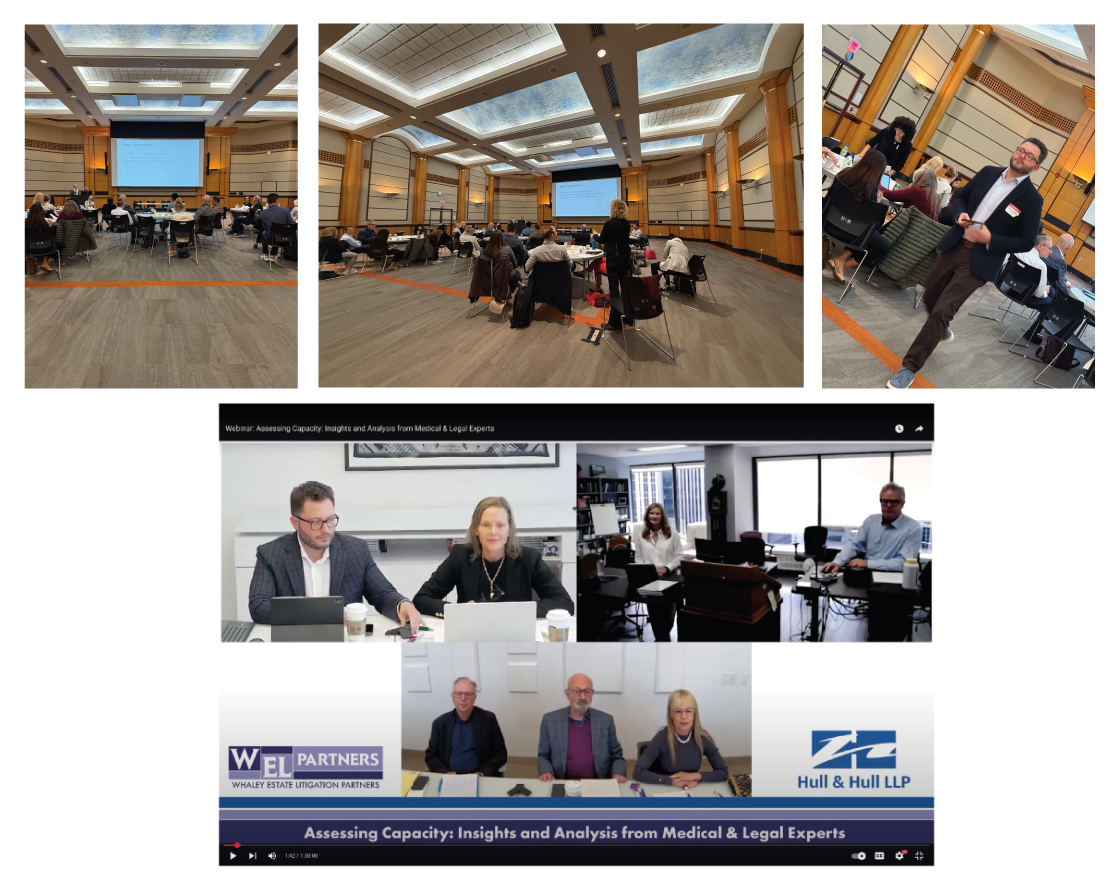
September is here like a jolt of espresso! WEL were into the thick of it instantly, with the Medical Expert’s Course at Sunnybrook Health Sciences through the University of Toronto and taught by international medical experts and a few of us lawyers - Ian Hull, Suzana Popovic-Montag, Bryan Gilmartin, and me. We also had some lawyers attend to expertly assist the doctors in smaller group sessions, Andrea McEwen, John Poyser, Holly Cunliffe, Stephen Halas, Anne Posno, as well as some expert insight from the Honorable Justices Himel and Myers. It was a busy few days of learning and entertaining our international guests. Capacity is so complex, assumptions have no place in its determination when it comes to ageist approaches. It was an impactful learning opportunity for the docs, and I was honoured to have been part of the initiative together with my friends at Hull & Hull. We also presented a Canadian Lawyer Webinar on Capacity. In case you missed it, it’s well worth a watch! View webinar: Assessing Capacity: Insights and Analysis from Medical & Legal Experts. View: Presentation - Paper
| | Bryan and I arrived in London on September 17, for the STEP Global Private Client Awards at the Park Lane Hotel Gala held on September 18th. WEL PARTNERS was nominated as a finalist for the second time, this time in the category of Litigation Boutique of the Year. We were thrilled to attend this event with our STEP colleagues from around the world to recognize excellence within our STEP community. Congratulations to all the finalists and the ultimate award recipients on a job well done. It was Bryan’s first time in London which presented the opportunity to pack in a full 5 days of sights and entertainment. | | |
We said goodbye to Jaclyn Holdsworth, our summer student, who went back to Osgoode for her last academic year. Jaclyn will be back to article with WEL in July. This month you will see her podcast/blog series on Predatory Marriages. It is very good with an excellent interview with Daphne Franks. View/listen to Episodes Jaclyn worked hard on this initiative past summer. Wishing you all good things in your studies this year Jaclyn and looking forward to receiving you back!
My article, The Complexities of Joint Ownership in Canada, was published this month in the Estates Trusts & Pensions Journal, Volume 44, No.2, September 2025 and Bryan’s article: Recognition of Foreign Guardianship Orders in Ontario: Addressing the Legislative Gap will be published shortly. Writing is a labour of love and an instrument of passion and a tool for change. It always presents a learning and teaching opportunity. If you happen to read the articles, let us know what you think!
I am so very honoured to be appointed co-editor of the soon to be newly re-named "Estates & Trusts Journal” (formerly ETPJ (Estates Trusts & Pensions Journal)), alongside Suzana Popovic-Montag, and Ian Hull. To all lawyers, and new lawyers…..write, write well, and write often…take the time to learn and educate, let us know what your ideas are, and if you have any academic publishing initiatives for us to consider please get in touch with one or all of us!
We have alas arrived upon fall. Enjoy the colours, see you next month and in the meantime, enjoy Thanksgiving with your friends & family!
Enjoy the Read,
Kim
| | 1. RECOGNITION IN THE 2025 TORONTO'S TOP LAWYERS LIST | | |
Kimberly Whaley is honoured to have been named to the Post City Magazine’s Top Lawyers List, Toronto, 2025, as nominated by Kimbely’s peers. We thank all those who voted for Kimberly and the firm for this award! Congratulations, Kim!
https://postcity.com/torontos-top-lawyers/?keyword=WEL+Partners
| | 2. STEP WORLDWIDE COUNCIL | WEL Partners is pleased to announce that Kimberly Whaley will continue serving on STEP’s Worldwide Council. Kimberly was first elected to the Worldwide Council in 2022. This new three-year term will extend her service to 2028, during which she will continue to represent Canadian STEP members. | | 3. ONTARIO POLICE COLLEGE ELDER ABUSE COURSE | On September 12, 2025, Joanna Weiss and Oliver O’Brien had the privilege of leading a session (virtually) at the OPP Central Region Headquarters located in Orillia, Ontario for the Ontario Police College’s Elder Abuse Course. The session focused on the financial abuse of older persons, the misuse and abuse of Power of Attorney documents, predatory marriages, and the available civil and criminal remedies when an older person has fallen victim to financial abuse. WEL Partners thanks the Ontario Police College for the opportunity to engage with the police on such important issues. | | 4. CANADIAN LAWYER WEBINAR – ASSESSING CAPACITY - PERSPECTIVES AND ANALYSIS FROM MEDICAL AND LEGAL EXPERTS | |
On September 10, 2025, Kimberly Whaley and Bryan Gilmnartin of WEL Partners, together with Ian Hull and Suzana Popovic-Montag of Hull and Hull LLP, led a panel of globally recognized medical doctors, international experts, academics, and senior capacity lawyers for an in-depth discussion on capacity assessments. In the live webinar, the panel provided practical tools and expert guidance to confidently navigate both contemporary and retrospective assessments.
For more information, or to view the archived content, please see the link below:
https://welpartners.com/blog/2025/09/webinar-assessing-capacity-insights-and-analysis-from-medical-legal-experts-archive/
| | 5. REGISTRATION OPEN: STEP TORONTO'S 2025-26 BRANCH BUNDLE | |
STEP has announced that the registration for the STEP Toronto’s 2025-2026 Branch Bundle, is now open. By accessing the bundle, it provides you with an opportunity to learn, connect, and grow. This year’s bundle includes four seminars packed with expert insights, collaborative discussions, and networking.
For more information on accessing the bundle, please see the following link:
https://web.cvent.com/event/95df71d0-ee9a-4d00-b85e-89892d5ba4cf/websitePage:72e3a99c-16ea-4577-a625-dbc5dbfaf0b6
| | 6. NEW WEL ASSOCIATE: GRANT SWEDAK | |
WEL Partners welcomes Grant Swedak. Grant received his Juris Doctor from the Bora Laskin Faculty of Law at Lakehead University. Prior to which he completed his Practice Placement at Hull and Hull LLP, served as a Teaching Assistant for Property Law, and was a Research Assistant for his wills and estates professor. In his free time, Grant enjoys reading philosophy, biographies from the Heroic Age of Arctic/Antarctic exploration and learning about the Conquistador’s voyages into the new world. Grant is also an avid sailor, weightlifter, hiker, and practices Brazilian Jiu-Jitsu.
https://welpartners.com/people/swedak
| | |
Kimberly Whaley will be presenting at the STEP Cayman Islands Conference on January 23 to 24, 2026, on the topic of Sham Trusts. Kimberly is grateful to be invited and will be presenting alongside notable and esteemed estate practitioners, Shân Warnock-Smith KC and Toby Graham.
Shân Warnock-Smith KC is widely regarded as one of the leading names at the Chancery Bar. She is a referral barrister and Cayman attorney specializing in private trusts and succession. She has been admitted to practice in England, Wales, the Cayman Islands, the British Virgin Islands, Barbados, and Trinidad and Tobago. She is often consulted by government regarding legislative changes, has litigated numerous leading cases, and authored the Practice Direction for applications regarding Lloyds Names.
Toby Graham leads Farrer & Co’s Trust and Estate group, with over 30 years of experience handling trust and estate disputes. He was the editor of Trusts & Trustees from 2008-2024, member of the advisor board for International Tax Planning, winner of the STEP outstanding achievement award, and author of the STEP Trust dispute course.
The event will be moderated by Andrew Miller. Andrew specializes in all aspects of Cayman Islands and British Virgin Islands international wealth structuring for individuals and financial institutions. He has received a STEP Founder’s Award and named in 2023 Private Client Global Elite. He has been a past chairman of STEP Cayman and is the editor of the STEP Directory Cayman Section.
For more details on STEP Cayman 2026, please see the following link:
https://stepcayman.com/events/step-cayman-islands-conference-2026
| | 8. ELDER ABUSE PREVENTION OF ONTARIO’S PODCAST | |
On September 12, 2025, Emily Caza and Joanna Weiss joined the Elder Abuse Prevention of Ontario’s podcast to speak about what seniors need to know when it comes to wills and estate planning. Their engaging session highlighted the key differences between Wills and Powers of Attorney, explained what “capacity” to make a Will really means, and provided an overview of Ontario’s estate laws. The discussion was designed to empower older adults to plan their estates in line with their true wishes and values, helping them find peace of mind during their lifetime, and ensuring clarity and security for their families after they pass.
Be sure to check out LinkedIn and the WEL Partners website for updates about when this podcast episode will be available.
| | 9. THE COURTS DIGITAL TRANSFORMATION: TORONTO COURTS TRANSITIONING E-FILING SYSTEM IN OCTOBER 2025 | | |
Phase 1 of the Courts Digital Transformation is fast approaching. Effective October 14, 2025, all electronic filings of court documents in the Toronto region for the Superior Court of Justice must be submitted via the new Ontario Courts Public Portal (OCPP). This portal will offer expanded access to court services, including:
- Electronic document filing;
- Searching court records;
- Viewing hearing details;
- Making payments online; and
- Retrieving submitted materials.
Importantly, in support of this transition, the current JSO portal will stop accepting filings for Toronto courts at 5:00 p.m. on October 3, 2025.
Following which, between October 4 and October 13, online filing will not be available for Toronto matters. In this period, the Courts Digital Transformation team recommends either:
(a) submitting any required documents through JSO before the cutoff or waiting until the OCPP launch; or
(b) if you are unable to do so, documents may still be filed in person at the courthouse or submitted by email.
The Courts Digital Transformation Team has provided draft guidance for reference as Toronto transitions to the OCPP, which can be accessed below:
- Ontario Courts Public Portal User Guide
- E-Filing Quick Guide
- Navigate the Public Portal Quick Guide
- Notifications Preferences Quick Guide
| | 10. WEL PARTNERS’ JOANNA WEISS PARTICIPATES IN THE TERRY FOX RUN | |
On September 14, 2025, WEL Partners’ Joanna Weiss participated in the Terry Fox Run, which raises funds for the Terry Fox Foundation for cancer research. The weather cooperated, the turnout was great, and Joanna was thrilled to be able to fundraise for such a worthwhile and meaningful cause.
For more information, or to donate to the Terry Fox Foundation, please see the link below:
https://run.terryfox.ca/92763
| | 11. LSO PRACTICE GEMS: PROBATE ESSENTIALS, SEPTEMBER 26, 2025 | |
Kimberly presented together with Kathleen Robichaud on SEARCHING FOR WILLS AT THE PROBATE LEVEL, WITNESSES, AND PROVING SIGNATURES. This program was chaired by Ambie Edgar-Chana, and Craig Ross. Emily Caza, lawyer at WEL, prepared a very helpful checklist on the topic which can be accessed on our website:
https://welpartners.com/resources/WEL-Probabte-Essentials-Checklist.pdf
| | II. WEL SHOUT OUTS & CONGRATULATIONS | | STEP PRIVATE CLIENT AWARDS CEREMONY | | |
WEL Partners wishes to congratulate all the nominees and winners in every category in the STEP Private Client Awards. WEL Partners was honoured to be nominated in the Boutique Firm of the Year (legal) category alongside Bethel Chambers, Circe Law, RMO, and Shreya Rao & Associates. Congratulations to Yue-En Chong (Yue-En Chong TEP) and his team in Singapore at Bethel Chambers on their well-deserved recognition!
For a full list of 2025 winners, please see the following link: https://pca.step.org/winners-2025
| | STEP CANADA: LAROUX PEOPLES | | WEL Partners wishes to congratulate Laroux Peoples on her successful Expertise Application with STEP! Laroux Peoples is an expert in estate planning, powers of attorney, and estate administration. She brings a wealth of experience to every client they help, whether it's a family navigating the loss of a loved one or a business owner building a comprehensive plan for the future. Congratulations, Laroux! | | III. MATURE MATTERS BLOG SERIES | | |
By Emily Caza
As Ontario’s population ages, protecting the health, dignity, and rights of older adults, especially those living in long-term care and retirement homes, has become a matter of urgent public concern.
This blog series will explore existing and emerging legislation and jurisprudence aimed at protecting those amongst society’s most vulnerable, older adults in residential care. I will analyze our current legal safeguards, proposed reforms, and the evolving landscape of elder care law in Ontario. Join me as I learn how our laws strengthen and support accessible, equitable, and high-quality home and community care services in Ontario.
PART 3: COVID-19 IN ONTARIO’S LONG-TERM CARE: WHAT BROKE, WHAT CHANGED, AND WHAT STILL HASN’T
In Parts 1 and 2, we looked at the rights-forward agenda emerging in elder law: dementia-specific care and caregiver access, stronger inspection tools, and culturally safe services; and, separately, how the Residential Tenancies Act[1] governs fees and protections for seniors in care homes. This instalment steps back to the crucible for many of today’s reforms: COVID-19’s devastation in long-term care homes (“LTCs”). The goal isn’t to re-litigate the pandemic, but to translate what courts, commissions, and legislators have said into concrete reforms for the benefit of seniors and their families.
What COVID-19 Exposed
The pandemic didn’t create Ontario’s LTC problems, it magnified long-standing weaknesses: chronic understaffing, multi-bed ward layouts that frustrate isolation, uneven infection prevention and control (“IPAC”), and fragmented oversight. Ontario’s Auditor General later found that these pre-existing issues left homes “ill-equipped” to prevent or contain COVID-19.[2]
By spring 2020, hospitals were overstretched, forcing Ontario’s government to request federal help. Starting April 22, as part of Operation Laser, Canadian Armed Forces (“CAF”) medical teams were deployed to five of Ontario’s worst-hit nursing homes.[3]
What CAF personnel documented neglected and malnourished residents, rotten food, and insect infestations.[4] Residents were found in soiled bedding after going unbathed for weeks.[5] Staff were observed making “degrading or inappropriate comments” toward residents.[6] Patients were crying out for help with no response for hours.[7] PPE shortages, staffing gaps, and systemic failures were exposed.
The toll was staggering. By January 14, 2021, 3,211 LTC residents had died, representing 60.7% of all COVID-19 deaths in Ontario at that point.[8] By June 14, 2022, Public Health Ontario recorded 4,587 LTC resident deaths.[9]
Government Action During the Storm
These conditions were so jarring that they spurred immediate public outrage. Premier Ford called them “gut-wrenching” and “shocking.”[10]
Ontario moved from initial emergency orders to progressively tighter controls and external support:
-
Single-site work: an emergency order limiting LTC workers to one home took effect April 22, 2020, to curb cross-facility spread.[11]
-
Hospital partnerships/IPAC surge: hospitals were directed to partner with struggling homes and deploy IPAC expertise.[12]
-
Pandemic pay: a temporary $4/hour wage top-up for eligible frontline workers (including LTC) began April 24, 2020, with subsequent targeted enhancements for PSWs.[13]
These steps mattered yet key measures (universal masking, cohorting, single-site staffing) were weeks late, given what was already known about asymptomatic transmission and the high risk in congregate settings.
How Courts Framed Accountability
Regardless of the emergency stopgaps, the sheer scale of LTC resident deaths combined with the harrowing conditions documented demanded accountability. The systemic weaknesses – staffing gaps, delayed directives, inadequate oversight – did not just expose residents to unacceptable risks; they also raised pressing legal questions about government responsibility and operator liability. In this climate, litigation became a natural extension of the search for justice, pushing courts to weigh whether Ontario and LTC operators should be held legally accountable for decisions and omissions that had life-and-death consequences.
Two litigation streams continue to shape policy expectations:
-
Public law accountability for the Province: In Robertson v. Ontario[14], 2022 ONSC 5127, the court certified a negligence class action against the Minister of Long-Term Care, holding it is arguable that Ontario’s LTC statute creates a private-law duty to take action when residents’ care and safety may be compromised. The Court struck fiduciary-duty and Charter claims but allowed negligence to proceed to the merits on a full record. This signaled that timely, clear ministerial action during crises is not merely political, it can be justiciable.
-
Private-operator accountability: In Pugliese v. Chartwell[15], 2024 ONSC 1135, the Court certified a negligence claim against a large corporate chain where pleadings allege gross negligence – necessary to clear the Supporting Ontario’s Recovery Act[16] (“SORA”) shield for defendants acting in good faith. SORA raises the pleading bar but did not foreclose claims alleging marked departures from reasonable standards.
The certification of negligence claims against both the province and private operators reflects the judicial systems acknowledgment that the harms in LTCs were not inevitable. Families who lost loved ones, residents who endured inhumane conditions, and frontline workers who risked everything are entitled to answers, and potentially redress. Robertson and Pugliese show that courts are prepared to scrutinize government delay and operator conduct through the lens of legal duty, not just political responsibility.
Reform: Gains and Gaps
After the pandemic, Ontario introduced the Fixing Long-Term Care Act[17], accompanied by program changes that together amounted to the most significant overhaul of the sector in years. The Act set a phased path toward four hours of direct care per resident per day by 2025[18], supported by nearly $5 billion in funding to recruit and retain thousands of personal support workers and nurse.[19] It also reinstated proactive, unannounced inspections with new authority for inspectors to issue administrative penalties and install supervisors in failing homes.[20] Homes are now required to maintain dedicated IPAC programs.[21]
Yet many of the system’s weaknesses persist. Staffing remains precarious: despite wage enhancements, vacancies and reliance on agency workers continue to undermine continuity of care.[22] The ownership model has also come under scrutiny. Studies during the pandemic showed that for-profit homes experienced worse outcomes than non-profit or municipal facilities, yet the province has continued to award new licenses and redevelopment contracts to large corporate chains.[23] Finally, while institutional LTC has expanded, alternatives such as aging-in-place supports and community-based housing have not grown at the same pace.[24] Without stronger investment upstream, nursing homes remain the default rather than the last resort.
Regardless, residents & families now have clearer legal entitlements including care-hour norms, inspection transparency, and caregiver policies. Document your concerns. Use inspection tools. Know your options when standards fail.
Final Thoughts
Rights on paper mean little without real enforcement and accessible remedies. The challenge now is ensuring that the lessons of COVID-19 translate into lasting protections. Seniors and their caregivers must remain vigilant, advocates must continue pressing for systemic reform, and governments and operators must be held to the duties their laws and licenses already impose. Only then can never again move beyond aspiration and become a lived reality for Ontario’s most vulnerable.
---
[1] Residential Tenancies Act, 2006, S.O. 2006, c. 17.
[2] Office of the Auditor General, “Covid-19 Preparedness and Management: Special Report on Pandemic Readiness and Response in Long-Term Care” (April 2021), online at page 6: .
[3] Canadian Armed Forces “Joint Task Force Central Observations in Long Term Care Facilities in Ontario” online (14 May 2020) .
[4] Ibid at pages 7, 10.
[5] Ibid at page 7.
[6] Ibid at page 5.
[7] Ibid at page 7.
[8] Science Table: Covid-19 Advisory for Ontario, “COVID-19 and Ontario’s Long-Term Care Homes” (20 January 2021) online: < https://covid19-sciencetable.ca/sciencebrief/covid-19-and-ontarios-long-term-care-homes-2/>.
[9] Public Health Ontario, “COVID-19 in Ontario: January 15, 2020 to June 14, 2022” (2022), online: .
[10] The Guardian, “Canada: neglected residents and rotten food found at care homes hit by Covid-19” (26 May 2020), online: .
[11] O. Reg. 146/20: Limiting Work to a Single Long-Term Care Home.
[12] M. Sawhney, M. J. Lamb, & A. La Delfa “Mobilizing an interprofessional IPAC-SWAT team to long-term care during COVID-19”.
[13] Ontario Newsroom, “Pandemic Pay Provides Support for Frontline Workers Fighting COVID-19” (25 April 2020) online: .
[14] Robertson v. Ontario, 2022 ONSC 5127 [Robertson].
[15] Pugliese v. Chartwell, 2024 ONSC 1135 [Pugliese].
[16] Supporting Ontario's Recovery Act, 2020, S.O. 2020, c. 26, Sched. 1 at s. 2.
[17] Fixing Long-Term Care Act, 2021, S.O. 2021, c. 39, Sched. 1 [Fixing Long-Term Care Act].
[18] Ibid at s. 8(2).
[19] Ontario, “Published plans and annual reports 2022–2023: Ministry of Long-Term Care” (updated 15 February 2023), online: < https://www.ontario.ca/page/published-plans-and-annual-reports-2022-2023-ministry-long-term-care?>.
[20] Fixing Long-Term Care Act, supra note 17 at ss. 144-153.
[21] Ibid at s. 23.
[22] Office of the Auditor General of Ontario, “Long-Term Care Homes: Delivery of Resident-Centred Care” (2023).
[23] See, e.g., S. Braedley, “Commentary: Critical to Care – The Problem of Profit in Ontario's Long-Term Care Home Sector” (20 August 2024) 20:1 Healthcare Policy 41, online: ; Ontario Health Coalition, “The Private Deals Remaking Long-Term Care” (13 March 2023), online: .
[24] Government of Canada, “Aging in Place Challenge Program” (Modified 21 may 2025), online: .
| | (i) PRESUMPTION OF DESTRUCTION OF MISSING WILL | | |
By Albert H. Oosterhoff
1. Introduction
It is not uncommon that people are unable to find the will of a relative who has died even though it is known that she did make one. When that happens the presumption of destruction is raised. It is a rebuttable presumption and the onus rests on the person relying on the will to prove that the testator did not destroy the will but that it is more likely that it was lost, stolen, or inadvertently destroyed. The issue arose in Re Finsant Estate.[1] The reasons of JG Morley J are sound and examine the principles in detail.
2. Facts
The deceased, Rosemary Finsant, died in hospital from pneumonia in October 2021. She lived alone in her home on Quadra Island for many years, having divorced her husband in the 1980s. She had no children or surviving siblings. Her closest living relatives are her niece, Rhonda Schicchi, and her children; a nephew, Fred Biggs, who has no children; and the children of a predeceased nephew, namely, the Applicant, Megan Beggs, and her siblings, Minique and Sebastian Beggs. Ms. Finsant’s contact with her extended family was limited. While Ms. Finsant had physical limitations, the evidence showed that she did not suffer any significant cognitive decline up to her death.
The hospital informed Ms Schicchi of her aunt’s illness and death. Ms Schicchi and her husband searched the house soon after. They found a filing cabinet upstairs that contained a number of significant documents but no will. There was also a table upstairs on which there were other documents but also no will. In November 2022 Ms Schicchi made a search for a registered will, which disclosed that Ms. Finsant had registered a will executed in December 2001. It also disclosed that a notary public, Ms. Lakberg, had drafted the will. Ms Schicchi then returned to the house with her husband, her son and his girlfriend, and Minique Beggs and her partner. They conducted another thorough search, during which they found other papers, some hidden in books which they searched as well. But no one found a will.
Ms. Lakberg gave Ms Schicchi an unsigned copy of the 2001 will and informed her that she gave the original to Ms. Finsant after it was executed. The copy disclosed that it named the Applicant the sole beneficiary of the residue of the estate. Ms. Finsant had also named the Applicant the beneficiary of her Registered Retirement Income Fund.
Megan Beggs (‘Ms Beggs’) brought this Application for an order pronouncing in favour of the will. Ms Schicchi is the Respondent and brought an order confirming that Ms. Finsant died intestate. Ms Schicchi is the administrator of the estate.
3. Analysis and Judgment
Justice Morley noted that everyone agreed that Ms. Finsant had the requisite testamentary capacity and that the statutory formalities for the execution of the will were probably observed. Everyone also agreed that since Ms. Finsant was the last one in possession of the will and that it could not be found after she died, the presumption of destruction arises. Justice Morley noted further this is a rebuttable presumption that applies unless there is good reason to find that the will was more likely lost, stolen, or inadvertently destroyed. The onus rested on the Applicant, who relied on a non-original copy of the will, to prove on a balance of probabilities that Ms. Finsant did not intentionally destroy the will but that it was inadvertently lost or displaced.[2] Older cases suggest that the burden is a heavy one, requiring clear and convincing evidence but Justice Morley pointed out that the modern Canadian rule recognizes only one standard of proof in civil cases, namely, proof on the balance of probabilities.[3]
Justice Morley added that the presumption takes into account the commonsense assumption that people expect a person who has executed a will to keep it in a place where it can be found after she dies. And thus, unless there is contrary reason, that is the more inherent probability.
Justice Morley quoted[4] the following factors that a court will consider in determining whether the presumption of destruction has been rebutted:
- whether the terms of the will itself were reasonable;
- whether the testator continued to have good relationships with the beneficiaries in the copy of the will up to the date of death;
- where personal effects of the deceased were destroyed prior to the search for the will being carried out;
- the nature and character of the deceased in taking care of personal effects;
- whether there were any dispositions of property that support or contradict the terms of the copy sought to be probated;
- statements made by the testator which confirm or contradict the terms of distribution set out in the will;
- whether the testator was of the character to store valuable papers, and whether the testator had a safe place to store the papers;
- whether there is evidence that the testator understood the consequences of not having a will, and the effects of intestacy;
- whether the testator made statements to the effect that he had a will;
Justice Morley considered each of these factors in turn, found that there was very little evidence one way or the other, and therefore concluded that Ms Beggs has not rebutted the presumption of destruction. Consequently, Ms. Finsant’s estate would be distributed on the basis that she died intestate.
---
[1] 2024 BCSC 217.
[2] Thierman Estate v Thurman, 2013 BCSC 503, para 43.
[3] Citing FH v McDougall, 2008 SCC 56, para 40, and Canada (Attorney General) v Fairmont Hotels Inc, 2016 SCC 56, para 36.
[4] From Haider v Kalugin, 2008 BCSC 930, para 13.
| (ii) WHAT CONSTITUTES A TRUST FILE? | | |
By Albert H. Oosterhoff
1. Introduction
The recent case, Re Yurkiw Estate,[1] addresses important questions about the information a trustee must maintain and disclose to the beneficiaries of the trust.
2. Facts
The deceased had two children, Benjamin and Bethany. Heritage Trust Company Inc is the Trustee of the estate. Benjamin brought an application requiring the Trustee to produce copies of the trust file to him. On 21 November 2024 Justice JG Morley made an order (the ‘November Order’) which states in part that:
The entire file of the Executor, Heritage Trust Company Inc be disclosed to Benjamin Yurkiw and Ms Bethany Clark [the other beneficiary] if she requests it, with the exception of any documents over which solicitor client privilege can be claimed as against the beneficiaries.
Subsequently, Benjamin made another application for an order that the Trustee comply with the November Order by producing copies of the entire file to him as it relates to the estate, including the file of the trustee’s lawyers. He also seeks another order that the Trustee identify the basis of any redactions made in its disclosure.
The meaning of the phrase ‘entire file’ in the November order had become an issue, and it is clarified by Justice Morley in response to the second application.
3. Analysis and Judgment
Justice Morley began his analysis by noting that any trustee, but especially a institutional trustee, has a duty to maintain a file of trust documents. This can be a challenge when many communications are sent electronically but the trustee should have procedures in place for electronic record retention and management. The trustee has the duty to maintain such a file for the beneficiaries who are the owners of it, subject to certain exceptions. Courts will not be sympathetic to an institutional trustee that fails to retain electronic documents properly and is consequently unable to determine what constitutes the trust file.
Justice Morley cited the well-known case, Re Londonderry’s Settlement.[2] In that case the Court of Appeal for England and Wales held that trustees are not required to disclose, inter alia, their reasons for the exercise of their discretion to distribute trust assets among the beneficiaries, but subject to exceptions they are entitled to see the trustee’s file. However, Lord Justice Salmon went on to state that beneficiaries have a proprietary interest in all trust documents and are therefore entitled to see them, including recorded communication between the trustees.
In passing, I note that in Schmidt v Rosewood Trust Ltd[3] the Privy Council disagreed with Lord Justice Salmon’s opinion that the beneficiaries have a proprietary interest in the trust file. The Board held that the right to seek the court’s assistance in gaining access to trust documents does not depend on the beneficiaries having a beneficial (proprietary) interest. Rather, it depends on the court’s discretion, which may be exercised in favor even of the holder of a mere power.
Although the Court of Appeal did not define the phrase ‘trust document’ in Londonderry, it is generally understood that the term means a document held by the trustee that contains information about the trust and that is not subject to a rule that permits the trustee to withhold it.
Consequently, Justice Morley concluded that all physical and electronic records held by the trustee, which contains information about the trust are trust documents, unless:
(a) they are ‘transitory’ records with respect to which the trustee tells the beneficiaries that it will not retain them; or
(b) they fall within exceptions to the rule that beneficiaries are entitled to see trust documents, such as documents subject to solicitor-client privilege and other exceptions established by the case law.
If there are further exceptions, the trustee must disclose them to the beneficiaries, and they must be in the interest of the beneficiaries.
Justice Morley then considered the issue of privacy protection. It was raised by Bethany, who informed the court that there is conflict between her and Benjamin, and it may happen that certain information should not be shared by both of them, such as full bank account numbers.
Justice Morley agreed that maintaining privacy between beneficiaries is important. Therefore, he held that so long as the Trustee acts in an even-handed way with both beneficiaries in maintaining privacy interests, and so long as the personal and private information is not necessary to an accounting for the management of the trust, the Trustee may redact information that is personal or confidential.
Justice Morley went on to hold that since the Trustee failed to comply with the November order, it should bear the costs of this application, without the right to be indemnified by the trust.
Accordingly, Justice Morley granted the orders requested. With respect to redactions of personal information, he directed that they should be symmetrical as between the two beneficiaries, that there should be a reasonable privacy interest in the personal information, and that the redacted personal information must not be necessary for the beneficiary to get an accounting.
---
[1] 2025 BCSC 1026.
[2] [1964] 3 ALL ER 855.
[3] [2003] UKPC 26, [2003] AC 709, para [51].
| | (iii) ESTATE-BASED EXCEPTIONS TO THE BASIC LIMITATION PERIODS | | |
By Grant Swedak
Introduction
Limitation periods are a fundamental component of the legal system. They promote the timely commencement of litigation and protect defendants from claims based on events that occurred in the distant past. They also serve an important evidentiary function by ensuring that allegations are supported by reliable proof. With the passage of time, documents may be lost or destroyed, physical evidence may deteriorate, and witnesses may forget or pass away.
In the estate’s context, limitation periods are less than straightforward. This is generally, attributable to two phenomena. First, from a historical perspective equitable claims were not governed by limitation statutes. Secondly, in the contemporary legislative landscape, estate-related limitation periods are scattered throughout multiple statutes. Further, as we will be explained below, there are many estate-based limitation periods which do not follow the basic period established by the Limitations Act, 2002.[1] This article aims to provide some clarity with respect to estate-based exceptions to the basic limitation periods.
Limitation Periods – The Basics
Pursuant to section 4 of the Limitations Act, 2002, Ontario has a standing basic 2-year limitation period subject to the doctrine of discoverability:
4. Unless this Act provides otherwise, a proceeding shall not be commenced in respect of a claim after the second anniversary of the day on which the claim was discovered. 2002, c. 24, Sched. B, s. 4. [emphasis added][2]
Discoverability, as articulated by section 5 of the Limitations Act, 2002, codifies a common law principle that,
5 (1) A claim is discovered on the earlier of,
(a) the day on which the person with the claim first knew,
(i) that the injury, loss or damage had occurred,
(ii) that the injury, loss or damage was caused by or contributed to by an act or omission,
(iii) that the act or omission was that of the person against whom the claim is made, and
(iv) that, having regard to the nature of the injury, loss or damage, a proceeding would be an appropriate means to seek to remedy it; and
(b) the day on which a reasonable person with the abilities and in the circumstances of the person with the claim first ought to have known of the matters referred to in clause (a).[3]
Exclusions and Exceptions
With respect to estate practitioners, while section 4 of the Limitations Act, 2022[4] establishes the basic 2-year limitation period for all claims, there are codified exceptions listed in section 2 and set out by Schedule 19.
Section 2 of the Act states:
Application
2. (1) This Act applies to claims pursued in court proceedings other than,
a) proceedings to which the Real Property Limitations Act applies;
b) proceedings in the nature of an appeal, if the time for commencing them is governed by an Act or rule of the court;
c) proceedings under the Judicial Review Procedure Act;
d) proceedings to which the Provincial Offences Act applies;
e) proceedings based on the existing aboriginal and treaty rights of the aboriginal peoples of Canada which are recognized and affirmed in section 35 of the Constitution Act, 1982; and
f) proceedings based on equitable claims by aboriginal peoples against the Crown. 2002, c. 24, Sched. B, s. 2 (1).
Section 2 – the Real Property Limitations Act
Insofar as estate-based limitation periods are concerned, the Real Property Limitations Act[5] stands out given it governs all limitation periods affecting land. The connection being land frequently forms a significant portion of a deceased’s estate. Further, the limitation period applicable to a claim for recovery of a legacy (including a share of residue) or a devise is also contained in the RPLA, not the Limitations Act, 2002.[6]
The RPLA provides for a 10-year limitation period which starts at the time the claimant has a vested interest in possession of the legacy (or devise) and not with discovery.[7]
Notwithstanding the above, the recent case of Ingram v Kulynych Estate,[8] considered whether the 10-year limitation period in the RPLA, or the 2-year period pursuant to section 38(3) of the Trustee Act[9] applied to equitable trust claims against an estate. The respondent, claiming to have been in a common law relationship with the deceased, sought a constructive trust via unjust enrichment four years after death. The lower court had applied the 10-year RPLA limitation, citing McConnell v Huxtable.[10]
Ultimately, the Court of Appeal overturned the trial level decision, holding that the specific 2-year limitation period under section 38(3) of the Trustee Act governs such claims against estates. The Appellate court distinguished McConnell, which applied the RPLA limitation period of 10-years to a claim for constructive trust, by noting that McConnell involved an inter vivos trust whereas the case at bar did not.[11] The court underscored that the RPLA does not govern equitable claims against estates, and in cases of apparent conflict, the specific statutory limitation for estate matters in the Trustee Act overrides the more general RPLA period.
The RPLA also deviates from the standard limitation period prescribed by the Limitations Act, 2002, for the recovery of interest on a legacy, as per section 17.[12] Confirmed by the Ontario Court of Appeal in Chadwick v Buchanan[13] a legatee has 6 years from the date that the interest became due to commence a claim for recovery.[14]
The 10-year limitation period under the RPLA does not apply to an intestate share of an estate.[15] The 2-year limitation period from the date of discovery under the Limitations Act, 2002, would apply in that circumstance.
Exceptions Listed by Schedule 19
As mentioned above, exceptions to the basic 2-year limitation period prescribed by the Limitations Act, 2002, are set out in section 2 and Schedule 19. To facilitate greater visibility of the estate-related limitation periods contained in Schedule 19, we extracted the relevant provisions below:
Estates Act, ss. 44(2), 45(2) and 47[16]
SS. 44 & 45 – Where an estate trustee has notice that claim or demand has been made against the estate, the estate trustee may serve a Notice of Contestation of the Claim. The claimant has 30 days to apply to a judge of the Superior Court of Justice for an order allowing their claim.
S 47 – Provides that the limitation period prescribed by s 38(3) of the Trustee Act will not apply where notice of a claim is provided to the estate trustee at any time prior to the date upon which the claim would be barred by the Trustee Act.
Estates Administration Act, s 17(5)[17]
S 17(5) – Allows the court to make an order for the distribution of an estate, within 3 years from the date of death, upon application by the personal representative or any beneficially entitled party.
Family Law Act, s 7(3)[18]
S 7(3) – Requires that applications for equalization of NFP be brought before the court within 6 months after the first spouse’s death.
Succession Law Reform Act, s 61[19]
S 61 – Dictates that applications for dependant support claims must be made within 6 months of the certificate of appointment of Estate Trustee having been granted.
Trustee Act, s 38(3)[20]
S 38(3) – Holds that personal claims by or against estate trustees, or estate administrators must be brought within 2 years from the date of death.
Equitable Claims
Historically, equitable claims, those claims in law that originated from the courts of Equity, which are governed by principles of fairness and generally seek discretionary remedies other than damages, have had a significant overlap with estate proceedings. In terms of equitable claims and their limitation periods, prior to the Limitations Act, 2002, many equitable claims were not subject to a statutory limitation period, but instead they were regulated to the equitable doctrines of laches and acquiescence.
Now, based on the cases below, it appears that most equitable claims are covered under the new Limitations Act, 2002. We will review some of the most relevant estate-related equitable claims.
Constructive Trust (and Other Non-Express Trust) Claims
As touched on above, McConnell stands for the proposition that constructive trust claims against inter vivos transfers of land are governed by the RPLA. Conversely, as per Kulynych Estate, where section 38(3) of the Trustee Act is implicated, said legislation governing claims against estates overrides the general 10-year limitation period in section 4 of the RPLA.
Equitable Fraud - Breach of Fiduciary Duty and Misrepresentation
Equitable Fraud, which is sort-of catchall term for certain kinds of unconscionable or misleading conduct (i.e. undue influence/ misrepresentation as a fiduciary), is subject to the standard 2-year limitation period. However, according with the principles of discoverability, if the fraud concealed the cause of action, the running of the limitation period may be postponed until the plaintiff discovers the wrongdoing.[21]
In specific regard to breach of fiduciary duty, following the enactment of the Limitations Act, 2002, a 2-year limitation period applies, running from the date the claim is discovered.[22]
Rectification
Rectification is generally subject to section 4 of the Limitations Act, 2002, as this section, notwithstanding the above, is generally applied to will challenges and equitable claims. The Ontario Court of Appeal in, Alguire v. The Manufacturers Life Insurance Company (Manulife Financial) held that the limitation period for rectification begins to run when the applicant knows or ought to know that injury, loss, or damage has occurred, which may not be until the other party resiles from the common understanding reflected in the will or instrument.[23]
Quantum Meruit
In Ontario, the leading authority for quantum meruit period limitation periods come from the Court of Appeal decision of, The Catalyst Capital Group Inc. v. Dundee Kilmer Developments Limited Partnership, which clarifies that the limitation period applicable to quantum meruit is the general 2-year limitation period under the Limitations Act, 2002.[24]
Concluding Comments
The foregoing illustrates how limitation periods, especially in the estate’s context, are far from uniform. Various statutes carve out exceptions to the basic regime established by the Limitations Act, 2002. While this article highlights some of the key provisions most relevant to practitioners, it only scratches the surface of a complex area of law. Further commentary and case law will continue to shape how these limitation periods are interpreted and applied, and much more remains to be said.
---
[1] Limitations Act, 2002 c.24, Sch. B at section 4. (the "Limitations Act, 2002" or the “Act”)
[2] Ibid.
[3] Limitations Act, 2002 c.24, Sch. B at section 5.
[4] Limitations Act, 2002 c.24, Sch. B at section 4.
[5] Real Property Limitations Act, R.S.O. 1990, c. L.15. ("RPLA")
[6] RPLA, at section 4.
[7] See Anne Werker, “Limitation Periods in Ontario and Claims by Beneficiaries” (2008) 34:1 Advocates’ Quarterly, at p.4 ("Werker").
[8] Ingram v. Kulynych Estate, 2024 ONCA 678 (CanLII). (“Kulynych Estate”)
[9] Trustee Act, RSO 1990, c T.23 at section 38(3). (“Trustee Act”)
[10] McConnell v. Huxtable, 2014 ONCA 86 (CanLII). (“McConnell”)
[11] Kulynych Estate, at paras 15 and 65.
[12] RPLA, at section 17.
[13] Chadwick v Buchanan, 1938 CarswellOnt 191; [1938] 3 D.L.R 753; also see Falconbridge on Mortgages, 5th Ed. § 30:5.
[14] RPLA, supra note 5 at section17.
[15] Werker, supra note 7 at p.13.
[16] Estates Act, R.S.O. 1990, c. E.21 at ss 44(2), 45(2), and 47. (“Estates Act”)
[17] Estates Administration Act, R.S.O. 1990, c. E.22 at section 17(5). (“Estates Administration Act”)
[18] Family Law Act, R.S.O. 1990, c. F.3 at section 7(3). (“Family Law Act”)
[19] Succession Law Reform Act, R.S.O. 1990, c. S.26 at section 61. (“SLRA”)
[20] Trustee Act, RSO 1990, c T.23at section 38(3). (“Trustee Act”)
[21] Goodfellow v. Tordjman, 2016 ONSC 3888, 2016 CarswellOnt 9869 at paras 31-33; Massie & Renwick, Limited v. Underwriters' Survey Bureau Ltd. et al., 1940 CanLII 1 (SCC), [1940] SCR 218 at para 83.
[22] Total Meter Services Inc. v. GVM Integration, 2025 ONCA 321, 2025 CarswellOnt 6300 at para 35.
[23] Alguire v. The Manufacturers Life Insurance Company (Manulife Financial), 2018 ONCA 202 (CanLII) at paras 30-34.
[24] The Catalyst Capital Group Inc. v. Dundee Kilmer Developments Limited Partnership, 2020 ONCA 272 (CanLII) see paras 73 & 81.
| | (iv) A PRIMER ON MUTUAL WILLS | | |
By Oliver O’Brien
‘Mutual Wills’ refer to Last Will and Testaments executed by two individuals, typically spouses, predicated on the contractual agreement and understanding that both parties will not change, or revoke their Wills, often to ensure specific beneficiaries receive their estate. The following is a high-level summary of the Mutual Wills doctrine and how it operates in practice.
Key Requirements
The origins of the doctrine trace back to the English case of, Dufour v. Pereira (1769), which established that, where Mutual Wills were found to exist, equity will enforce this agreement by imposing a trust upon the survivor’s estate.[1]
In Edell v. Sitzer,[2] Justice Cullity of the Ontario Superior Court provided a thorough overview of the Mutual Wills doctrine:
The doctrine of mutual wills has traditionally been applied in cases where individuals have made separate wills pursuant to an agreement with respect to their terms. Most commonly, they have agreed that each will obtain a benefit under the other’s will and that other specified individuals will receive property of each of them on the death of the survivor. In some cases of this sort, the benefit obtained by the survivor under the other’s will has been a life interest; in other cases, it takes the form of an outright gift. Where the requirements for the application of the doctrine are satisfied, the survivor will not be permitted to defeat the agreement by revoking his or her will after the death of the other. This result is achieved by the imposition of a constructive trust on the survivor’s estate for the benefit of those who intended to benefit under the agreement.[3] [emphasis added]
Accordingly, for the Mutual Wills doctrine to apply, three factors are required:
-
There must be an agreement between the individuals who made the wills, which amounts to a contract at law;
-
The agreement must be proven by clear and satisfactory evidence; andIt must include an agreement not to revoke their wills.[4]
-
The requirements for determining the existence of such an agreement are governed by the general enforceability of a contract.[5].
The Ontario Court of Appeal (“ONCA”) has highlighted that the onus of proving Mutual Will rests with the party alleging their existence. In this regard, while the legal onus is proof on the balance of probabilities, the quality of the evidence “must be clear and cogent”.[6]
Due to the far-reaching consequences of finding a Mutual Will agreement exists, the court will not generally make a finding of intention lightly. To ascertain the intention of the parties, the court will examine the four corners of the will as well as extrinsic evidence.[7]
It is worth remembering that section 13 of Ontario’s Evidence Act,[8] provides that a verdict cannot be obtained on the evidence of a potential beneficiary of the verdict unless that evidence is corroborated by other material evidence:
13 In an action by or against the heirs, next of kin, executors, administrators or assigns of a deceased person, an opposite or interested party shall not obtain a verdict, judgment or decision on his or her own evidence in respect of any matter occurring before the death of the deceased person, unless such evidence is corroborated by some other material evidence.
In the event it becomes necessary to enforce a Mutual Wills agreement, the law of equity will impose a constructive trust. The purpose of equity intervening with a constructive trust is, “to enforce the survivor’s promise to the deceased to confer a benefit on the beneficiaries of the mutual will”.[9]
Applications in Case Law
Neilson v. Trottier
In Neilson v. Trottier,[10] a husband and wife in their second marriage, executed Mutual Wills and entered into an agreement not to revoke or amend them. The agreement included all current and future property and revoked any prior cohabitation agreements. They acknowledged that breaching their agreement would result in a constructive trust favoring their children.[11]
After the husband's death, the widow donated $200,000 to a college in his honour. The court examined whether this gift breached the couple’s Mutual Wills agreement. The Application judge, referencing Edell v. Sitzer, found that the gift was intended to honor the deceased husband, not to defeat the Mutual Wills agreement. Therefore, the widow did not breach the agreement, and no constructive trust was necessary.[12]
Jackson v. Rosenberg
In Jackson v. Rosenberg (“Jackson”),[13] the court dismissed a claim of a Mutual Wills agreement for lack of corroborating evidence. Jackson concerned Mr. Taube, and Mr. Jackson, who were partners since in or around 1963. In 2005, both executed mirror wills, naming each other as the sole beneficiary of their respective estates. Mr. Taube also listed his great niece, Ms. Rosenberg as his alternate beneficiary given he had no other family to support.[14]
It was Ms. Rosenberg’s position that Mr. Taube and Mr. Jackson executed a binding Mutual Wills agreement, relying on the mirrored terms in their respective wills. The application judge found no direct written or oral confirmation of such an agreement, noting Mr. Jackson’s express denial of one, and relied on evidence that Mr. Taube had altered his will after 2005 (executing a codicil in 2009). In this regard, the Application Judge relied on the decision in Gefen,[15] where the ONCA noted that:
A mutual will agreement is more than a mirror will -- it is an agreement that the wills are not changed and is a constraint on testamentary freedom. The testamentary intentions of the will-makers expressed in their mirror wills is not enough to establish that they had agreed that the survivor would not be able to vary such dispositions in the future.[16] [emphasis added]
Concluding Comments
In summary, the Mutual Wills doctrine ensures that a contractual agreement between parties to not revoke their wills is upheld by imposing a constructive trust on the survivor's estate, thereby protecting the intended beneficiaries' interests. This doctrine requires a clear and satisfactory agreement, proven by cogent evidence, to prevent the survivor from altering the testamentary dispositions after the other party's death.
--
[1] Fox, Re, 1951 CarswellOnt 53 at para 8.
[2] Edell v. Sitzer, 2001 CanLII 27989 (ON SC) (“Edell”).
[3] Ibid. at para 58.
[4] Edell at para 58.
[5] Trotman v. Thompson, 2006 CarswellOnt 1056 at para 46.
[6] Gefen Estate v. Gefen, 2022 ONCA 174 at para 37 (“Gefen”).
[7] Gefen at para 31.
[8] Evidence Act, R.S.O. 1990, c. E.23 at section 13.
[9] Edell at para 62.
[10] Neilson v. Trottier, 2019 ONSC 1657.
[11] Ibid. at paras 5 - 16.
[12] Ibid. at paras 51 - 53.
[13] Jackson v. Rosenberg, 2023 ONSC 4403 (CanLII) (“Jackson”); dismissed on appeal in Jackson v. Rosenberg, 2024 ONCA 875 (CanLII).
[14] Ibid. at para 13.
[15] Gefen v. Gaertner, 2019 ONSC 6015, at para. 80 aff’d Gefen Estate v. Gefen, 2022 ONCA 174.
[16] Jackson at paras 108 - 112.
| | (v) COURT AWARDS SUBSTANTIAL INDEMNITY COSTS FOR REPREHENSIBLE LITIGATION BEHAVIOR | | |
By Gabriella Banhara
In Issa v. Aiello[1], 2025 ONSC 5173, the court ordered substantial indemnity costs against the Applicant for an Application brought against the Respondent challenging the validity of their mother, Luisa’s Last Will and Testament (the “Will Challenge”). The court’s findings, underscore the inclination to award substantial indemnity costs in applications involving baseless claims.
Background
On January 20, 2012, the Deceased executed a Last Will and Testament (the “2012 will”) that provided her estate to her six children, including the Applicant and the Respondent. The six beneficiaries did not receive equal shares of the Estate.[2]
On July 8, 2016, the Deceased executed a Last Will and Testament (the “2016 Will”) which provided the Respondent with a 90% share of her estate and the Applicant with the remaining 10% share. The Applicant commenced the Will Challenge alleging, amongst other things, that the 2016 Will should be set aside on the basis that the Deceased was unduly influenced by the Respondent, and lacked the capacity to execute the 2016 Will.[3]
In the Will Challenge, the Applicant failed to submit any medical evidence providing a diagnosis of Dementia or any type of medical condition that would have affected the Deceased’s capacity to execute the 2016 Will. The Applicant also made a “scandalous assertion, without any supporting evidence, that the [Respondent] financially exploited the [Deceased]” and unduly influenced the Deceased to provide a larger share of her estate to the Respondent.[4]
Due to the absence of evidence supporting the Applicant's claims, the court dismissed the Will Challenge and awarded costs to the Respondent. The Respondent sought costs on a substantial indemnity basis in the amount of $70,000.[5]
The court concluded that the Respondent was entitled to her costs on a substantial indemnity basis, in the amount of $55,000. This decision was based on two reasons.[6]
First, the court found that the Applicant engaged in “reprehensible litigation behaviour” by rejecting several offers to settle made by the Respondent during the Will Challenge.[7] The Respondent initially offered to settle if the Applicant paid $10,000 in costs and both parties withdrew from litigation. The following year, the Respondent made a similar offer, proposing that if the Applicant paid $20,000 in costs, both parties would abandon the Will Challenge.[8]
Second, the court also found that the Applicant's conduct was reprehensible because she failed to provide any evidence supporting her claims of undue influence or financial exploitation.[9] The court referenced, Fanelli v. Fanelli-Bruno 2023 ONSC 6501, and stated the following:
“Alleging fraud and undue influence with no relevant evidence constitutes reprehensible litigation behaviour” [10]
As a result, the court found it reasonable to award costs to the Respondent. Additionally, the court determined that the time spent by the Respondent’s counsel was reasonable “having regard to the serious and scandalous allegations made by [the Applicant]”.[11]
Concluding Remarks
This decision serves as a cautionary tale for litigants commencing a will challenge without supporting evidence. The decision emphasizes that the burden of proof lies with the challenger, who must present compelling evidence to substantiate claims of undue influence, lack of testamentary capacity, or other grounds for invalidating a will. Absent such evidence, courts are unlikely to entertain these challenges, thereby protecting the integrity of the testator's intentions.
--
[1] Issa v. Aiello, 2025 ONSC 5173 (“Issa’’)
[2] Issa v. Aiello, 2025 ONSC 4055 at para 8 (“ONSC 4055”)
[3] ONSC 4055 at para 8
[4] Issa at para 7
[5] Ibid at para 3
[6] Ibid at para 9
[7] Ibid at para 6
[8] Ibid at para 4
[9] Ibid at para 5
[10] Ibid at para 6
[11] Ibid at para 7
|
| V. “THAT’S SO HIGHSCHOOL” | | MY EXPERIENCE AS A CO-OP STUDENT AT WEL PARTNERS | | |
By Davis Falkiner
My name is Davis, and I am a grade 11 student at North Toronto Collegiate Institute. I have been working at WEL Partners for almost 2 weeks now. I have had the pleasure of working in a fun work environment with inviting colleagues who teach me what they do on a day-to-day basis. Every day, I have a new task, ranging from helping unpack new office equipment to writing a blog about estate challenges. Everyone who has helped me finish these tasks has been kind and has helped point me in the right direction when I don’t fully grasp a topic. I have worked in a variety of different work environments; however, nothing like what I have done before has been to the same working standards as WEL Partners. You gain experience in what it is like to work in an office, you are introduced to what lawyers must do every day, and you learn how to be confident and take initiative in a workplace setting.
If you are also interested in pursuing law after university, just like me, this is a great opportunity for anyone who thinks they want to do law or is still on the fence about it. You are given a chance to do some real work, such as researching for a paper or checking if client files have been properly submitted. However, if you want something a little more hands-on, you can sit in on meetings, go down to court, or answer calls with potential clients looking for answers to their problems.
WEL Partners has been a great place for me to get a chance to experience real-world working conditions while still having a chance to do my homework and have time to relax at the end of the day. After these two weeks, I have been surprised by how a work environment can feel enjoyable, while at the same time encouraging me to get my work done. I am looking forward to the next few months of co op here and hope they go as smoothly as the last few weeks have. Please follow my journey with me, I will provide updates in the newsletters through to the conclusion of my placement.
|
| |
STEP Toronto - After the Diagnosis: Estate & Incapacity Planning for the Client with Neurodegenerative Disease
October 9, 2025
Speaking: Kimberly Whaley
Case Comment to be presented by Emily Caza
Canadian Law Webinar: A.I. Tools for Estates and Trust Lawyers: What You Need to Know
October 16, 2025
Speaking: Kimberly Whaley, Ian Hull, Suzana Popovic-Montag, Bryan Gilmartin, and Doug Higgins
Information and Registration
Colloquium Legal Education Conference: Sudbury 2025
October 16 to 17, 2025
Speaking: Bryan Gilmartin & Kimberly Whaley
https://www.colloquiumsudbury.com/
LSO Estate Summit (Day One)
POA Litigation Issues
October 22 to 23, 2025
Speaking: Bryan Gilmartin, Andrea Hill (TMA Law), and Alexander Procope (Perez Procope Leinveer LLP)
https://store.lso.ca/28th-estates-and-trusts-summit-day-one?utm_campaign=Fall25-WE1022&utm_medium=webbanner&utm_source=lsostore
The Jewish Foundation’s Professional Advisory Committee
November 6, 2025
Speaking: Kimberly Whaley
https://www.jewishfoundationtoronto.com/professional-advisors/2025-pac-seminar
Thunder Bay Law Association
October 29 to 30, 2025
Chair: Suzana Popovic- Montag - Hull & Hull LLP
Panelists: Jordan Atin, Kim Whaley, Ian Hull LSM - Hull & Hull LLP
https://tbla.ca/tbla-fall-conference/
Osgoode Certificate in Estate Litigation
Module 2: Capacity Proceedings
Module 3: Locating Missing Beneficiaries, Costs in Estate Litigation
November 11 & 12, 2025
Speaking: Kimberly Whaley (Capacity Proceedings/ Missing Beneficiaries) and Bryan Gilmartin (Costs in Estate Litigation)
https://osgoodepd.ca/professional-development/certificates/estate-litigation/
Financial Planning Canada
Care, Capacity, and Complexity: Planning for Vulnerable Clients
November 17, 2025
Speaking: Kimberly Whaley, Karine Diedrich (CHPCA), Carol Lynde (Bridgehouse), and moderated by Tamara Center
https://www.fpcanada.ca/CE-courses
STEP Cayman Islands
The Sham Showdown: Is Dishonesty the Wrong Test?
January 21 to 23, 2026
Speaking: Kimberly Whaley
https://stepcayman.com/events/step-cayman-islands-conference-2026
Cambridge Forum: Asia-Pacific Wealth Advisors
February 8 to 10, 2026
Attending: Kimberly Whaley
https://cambridgeforums.com/forums/fawa
Osgoode Hall Law School: Managing Consent & Capacity
March 11, 2026
Chair: Kimberly Whaley
Details: TBD
Capacity Australia 9th International Conference: Marrakesh, Morocco
Predatory Marriage solutions from a Lawyer's Perspective and Ageism.
April 6, 2026
Speaking: Kimberly Whaley & Bryan Gilmartin
https://capacityaustralia.org.au/product/capacity-australia-9th-international-conference/
| | VII. IN CASE YOU MISSED IT - RECENT BLOG POSTS | | WEL NEWSLETTER September 2025, Vol. 15, No. 6 | | | | |