Hello,
Every month I encourage our WEL team to contribute items of news about themselves. Most of the time I receive nothing. When I send along a recognition of an event that one of our members was involved in, and deserving of accolade, I often say, make sure you write a little something up for me for the newsletter. Despite my persistent requests (ok, downright nagging!) I still get nothing. I think maybe many of us do not have the courage to talk about our own notable achievements. I have come to realize that unless I flag these moments of acknowledgment, no one else will. So why do I bother?
Well, the answer is in part, because our profession can be cutthroat and it is important to me to encourage and praise those who do good things. We work in a practice area of familial strife and our non-institutional clients are often stressed, emotional, have years of pent up frustration, anger, or hurt brought to the forefront my death, loss, or abuse.
Our team members fight hard every day for these clients. We don’t do what we do for gratitude, at least I don’t, and am willing to bet most do not. Yet it feels nice to give credit where credit is due and to show appreciation for the good things our colleagues do even if in some small way. To share the news of such endeavours keeps our clients in touch with what we are all up to. Throughout the pandemic this was evermore important. I will persist in doing my best for them, and for you to continue to bring to the forefront some of these newsworthy items.
Thank you to our readers for your continued support and trust that you place in our team.
Enjoy the Read,
Kim
|
|
1. CANADIAN LAWYER MAGAZINE, NOVEMBER 12, 2021 |
Daniel Paperny was quoted by the Canadian Lawyer Magazine, discussing holographic wills, the BC Supreme Court's ruling in Henderson v Myler and what estate planners and will-makers should take-away from the Court's decision, which upheld the animal-loving testator's gift of nearly $1.5 million to the SPCA.
|
|
Kimberly Whaley was interviewed by Sigfrid Forberg on November 2, 2021, for the publication Moneywise, on Financial Exploitation. |
|
3. POST CITY'S TORONTO’S TOP LAWYERS, 2021 |
Kimberly Whaley was nominated by her peers and was included in Post City’s Toronto’s Top Lawyers 2021 in the Wills category.
|
|
4. OBA TRUST AND ESTATES LAW SECTION |
This fall, our articling student, Natalie Kodsi, was featured in OBA’s Trusts and Estates Law Section with her article titled “Re: Lacroix Estate: Holograph Wills and the Doctrine of Incorporation by Reference During the Time of COVID-19”.
|
|
5. ONTARIO POLICE SEMINAR, NOVEMBER 17, 2021 |
Rebecca Betel and Paul Murphy presented virtually at the Ontario Police College, Elder Abuse Investigations Seminar on: “Elder Abuse, Civil and Criminal Remedies” on November 17, 2021, along with speakers, Raeann Rideout, Laura Proctor and Laura Tamblyn-Watts.
|
|
6. CANADIAN LAWYER CO-BRANDED WEBINAR: KEEPING PACE WITH DIGITAL ASSETS, NOVEMBER 24, 2021 |
Kimberly Whaley and Ian Hull presented on: “Keeping Pace with Digital Assets - Preparing for the Future” at the Canadian Lawyers Webinar on November 24, 2021.
|
|
7. STEP INSIDE, NOVEMBER 2021 |
John Poyser’s article: "Executorships: Before Accepting One, Read This!” published in the STEP Inside, November 2021, Volume 20, No. 3., was written jointly with Mark Biderman, Janet Michelin, and Corina Weigl.
|
|
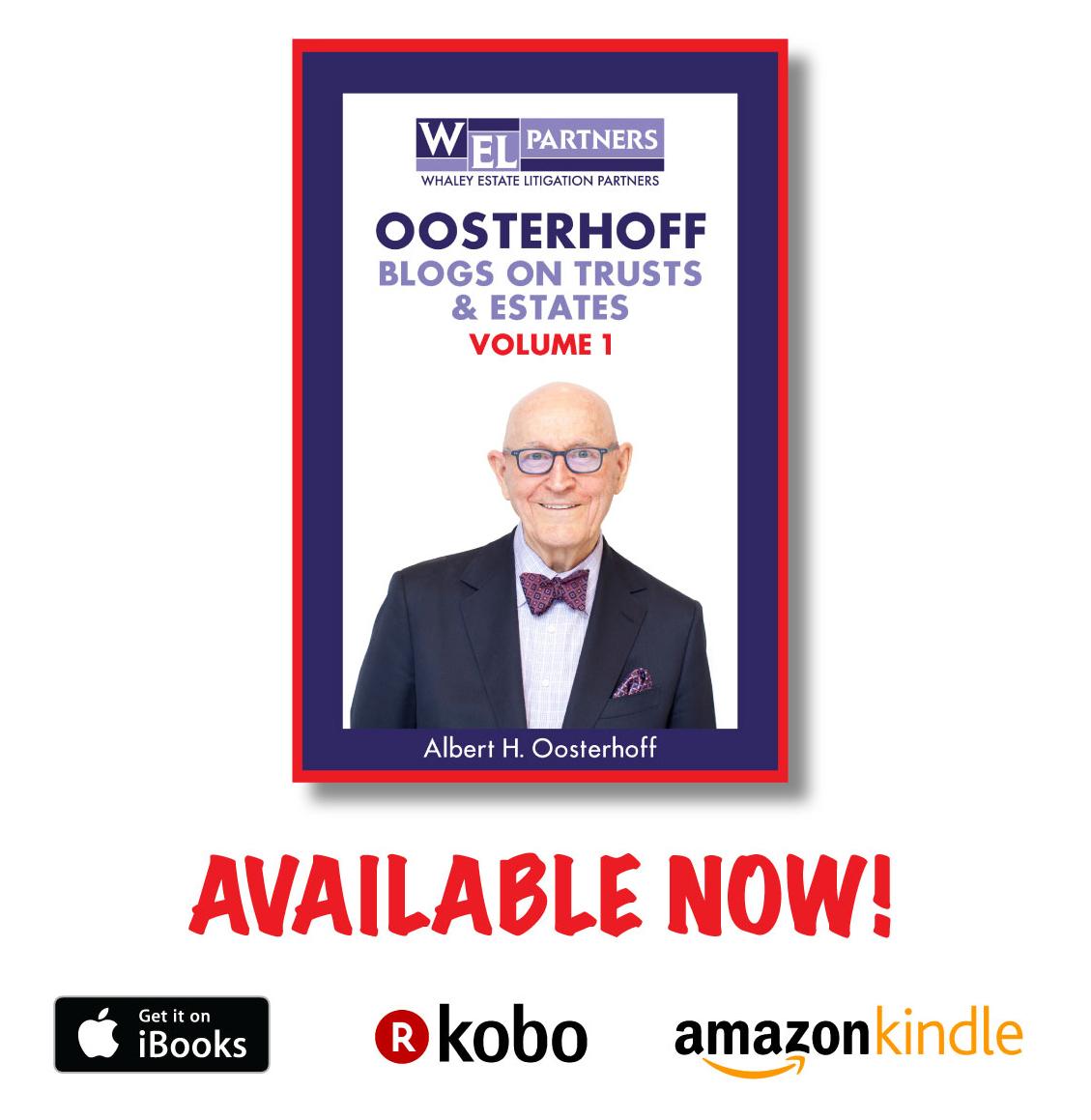
8. OOSTERHOFF BLOGS ON ESTATES & TRUSTS - VOLUME 1 |
Oosterhoff Blogs on Estates & Trusts – Volume 1 is a compilation of 62 blogs on a wide range of estate, trust and related subjects written by Albert H. Oosterhoff between 2016 and 2021.
The blogs do not simply review new cases and statutes, but usually provide extensive historical background. Case and statute critiques are provided when they run counter to established principles, or do not go far enough in reforming the law. The blogs are often of considerable length and often deal with topics that are somewhat obscure and are not otherwise easily accessible.
|
|
POST CITY - TORONTO TOP LAWYERS, 2021 |
|
WEL congratulates Laroux Peoples who was nominated by her peers and was included in Post City’s Toronto Top Lawyers 2021 in the Wills category.
WEL congratulates all of our fellow lawyers also nominated in the Toronto Top Lawyers, Wills category.
|
|
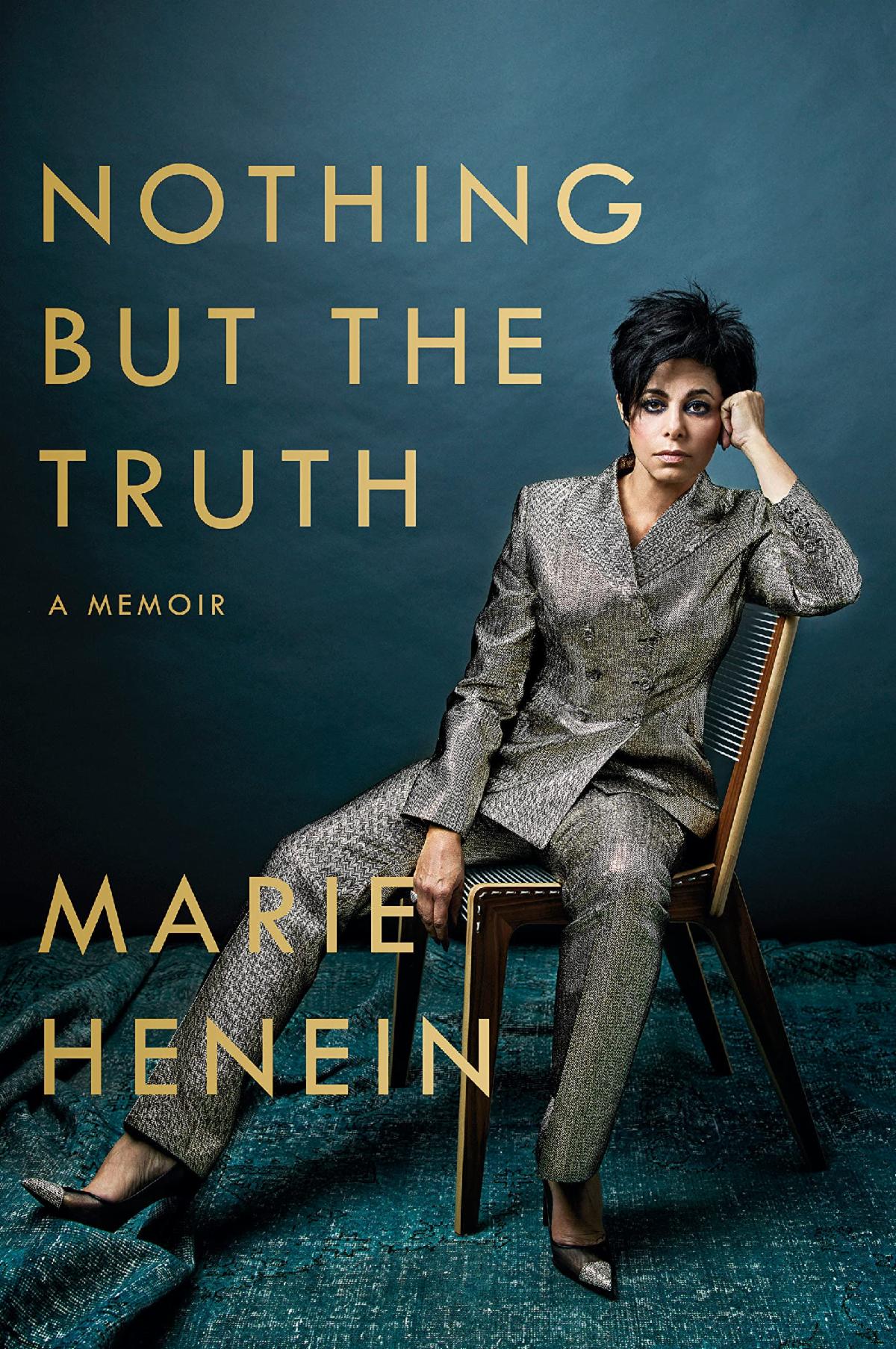
NOTHING BUT THE TRUTH, A MEMOIR, BY MARIE HENEIN |
|
By Kim Whaley
When I first noticed this book release on LinkedIn, I was immediately intrigued, although, at the time, I had 3 books on my TBR which I had intended to take on holiday. Sorry to say the word holiday since many of you have yet to have the post-pandemic holiday, but I did it, and I loved it!
In fact, I was so excited about my holiday that I completely forgot my anticipated reading material. By the second day in, I was stressed about the book situation - so my daughter suggested I should load one on my iPad and showed me how. Who knew it was so easy! I guess I should have known just having completed our first WEL e-blog book but I digress.
My next dilemma became-what to load-I like biographies/autobiographies and, well, not much else unless a book written by anyone who is extremely funny…. I will not mention Russell Brand’s “My Booky Wooky”…..
Staying on point, Sammi said, why not read the book that you just sent me a link to written by that kick *%# lawyer you like (at this moment I should say, I have never actually met Marie Henein). Sam described my interest in Marie Henein’s book as similar to when a celebrity spots one of their own personal idols on a red carpet and has a fangirl moment (like Mark Ruffalo spotting Paul Rudd at the 2014 Comic Con). Ok, so it’s not exactly like that but I accepted her desire to poke fun at me. In any event, we downloaded it, she from England and me from the beach! Sam and I have this thing about reading. I read every day for my job and so when I am on holiday, I would rather look at pictures in magazines and read as little as possible. She on the other hand has already read over 100 books since January. I accept that I cannot compete. I downloaded the book and could not put it down. I read it in a day. I loved it. I made a pact with the kid that if she would read this next, I would read one of her fiction favourites and then we could have a debrief - our own little book club. I did it because I really want to talk about the book with her, a compromise for me since I am emphatically not a fiction fan! Sam was born negotiating, so I took a page out of her play book! Fyi - no review forthcoming of that other book - the book of the pact.
Ok, now for the book, I bookmarked favourite pages. I will snapshot some of my favourites. I liked the memoir because it was genuine, intensely personal, insightful, and funny. I could relate so thoroughly to the story she decided to tell, even though my own story is obviously different. I felt that so many experiences, observations, and insights I could identify with - so much so that I caught myself laughing out loud several times.
I was amazed with the Marie’s recall of so much detail from early childhood years and it forced me to think through mine. I feel like so many memories of mine are not informed by actual memories but perhaps by pictures. Anyway, her rendition of experiences got me thinking about parents, becoming a parent, family, role models within families and how for better or worse, that sets the stage for the journey one travels in life. Our resilience, endurance, tolerance, strength, drive, behaviour, and goals-everything informed by our experiences.
I found the stories of Marie’s Teta (grandmother) especially engaging. Marie’s description of placing her Teta in a home and the devastation on her family members as a result. This is something I have personally experienced and so many of my clients describe this to me regularly. It was an outpouring of observation and acceptance which was real, painful, and compassionate.
Marie shared with the reader, a refreshing straight up introspective look at her life and her career with humility and candour, exposing herself. Marie’s book is incredibly insightful, touching on family, loss, life, suffering, tragedy, politics, the law, the criminal justice system, being a female lawyer, a female leader, on bias, racism, prejudices, influencers, why she became a criminal defence lawyer and how she persevered and learned her way to the top of her game -her chosen career and no less importantly, just how passionate she is about what she does and why she does it! I laughed over Martha Stewart, TikTok, meditation, yoga and cottages! I cannot now remember if she mentions golf. I imagine however what her take on golf would be! I even laughed about the way she described not being able to turn off being a lawyer as a parent – something Sammi has incessantly accused me of from a precocious young age.
All I have left to say is read this book! I had so much fun. Thank You Marie Henein.
As a final point, I signed up for the OBA Book Club this past week to participate in a chat about this wonderful reflection but as a sick post-holiday twist of fate (recall?..... the Kim Effect ?) I got food poisoning post last run on the beach from a fish taco and landed myself in bed all week sick as sick can be!
|
|
By Albert H. Oosterhoff
1. Disclaimer
There have been a significant number of developments in the law of disclaimer during the last couple of decades, so it seemed to me good to review this law.[1]
No one can be compelled to accept a gift[2] and therefore a beneficiary under a will and the next of kin on an intestacy may disclaim the gift or share on the intestacy. Not many people look a gift horse in the mouth, of course, but a person may want to reject a gift in certain circumstances. Thus, for example, if the gift is subject to onerous conditions the beneficiary may well want to decline it.
A disclaimer has the effect of avoiding the gift and thus the law treats the gift as though it never existed. It is void ab initio and there is no transfer of a property interest to the beneficiary.[3] The beneficiary may disclaim orally, by conduct, or in writing, so long as she has not unequivocally accepted it.[4] This means that once a beneficiary has accepted a gift, she can no longer disclaim it. It is her property. Therefore, it may be important for the beneficiary to disclaim reasonably promptly to avoid any implication that she has accepted the gift.[5]
If a disclaimer is effective, the failure of the gift dates back to the date of the testator’s or intestate’s death.[6] This means that if the gift is testamentary and specific, it falls into residue, unless there is a contrary intention in the will.[7] If the gift is residuary, it will go out on intestacy.[8] If the disclaimer is of a share of an intestate estate, it has the effect of augmenting the shares of the other next of kin.[9] The disclaimed interest does not pass to the Crown as bona vacantia.[10]
If a will gives more than one gift to the beneficiary, he may disclaim one and accept the other, so long as they are not inextricably bound together.[11]
2. Renunciation
Although a beneficiary can no longer disclaim a gift once he has accepted it, he can renounce it if he decides later that he no longer wants the property. If he does renounce, the property will go to the next beneficiary who is entitled to it, of if there is none, it will go back to the estate. But there is an important difference between disclaimer and a renunciation. As explained above, a disclaimer avoids the gift, so that it never takes effect. In contrast, a renunciation amounts to a disposition of property by the beneficiary. This may have tax consequences. For example, if the taxpayer disclaims a gift of property and the property then passes to his spouse or minor child, income earned from the property will be attributed to the taxpayer.[12]
However, in many cases it does not matter whether the beneficiary disclaims of renounces. But you should nonetheless use the correct terminology. Unfortunately, many cases fail to do so and speak promiscuously of disclaimer, or of disclaimer or renunciation, when the beneficiary in fact renounced.[13]
3. Acceleration
The main issue that arises in disclaimer (and renunciation) cases is whether the interests of the persons next in line will accelerate when a beneficiary disclaims (or renounces). The cases make clear that there is a presumption in favour of acceleration.[14] But a presumption can be rebutted and the presumption in favour of acceleration will be rebutted if the testator evinces a contrary intention. Testators never seem to preclude acceleration expressly, so the court must find their intention from the language of the will and the surrounding circumstances. Unfortunately, the cases are not easy to reconcile.
Older cases rarely concluded that the testator intended an acceleration. Re Jacques[15] is an example. The testator directed that part of the residue of the estate be held in trust and that the income on it be paid to her daughter for life. On the death of the survivor of the testator and her daughter the capital was to be paid to the testator’s son if living at that time, with gifts over if he was not. The daughter disclaimed her life interest, apparently so that her brother’s interest would accelerate, and he had promised to give the capital to his sister. The court held that the disclaimer was effective, but that the son’s interest did not accelerate. According to the court, acceleration would defeat the testator’s intention of giving her son the capital only if living at a specified date. In consequence, the income went out on a partial intestacy until the daughter’s death.[16]
Modern cases are much more likely to conclude that the testator must have intended an acceleration. Brannon v. British Columbia (Public Trustee)[17] is a leading case on point. The testator made her will in 1975. In it, she directed her executors to pay her husband $400 per month until the earlier of his death or remarriage. On the death of the survivor and her husband the executors had to divide the estate into as many equal shares as there were children of the testator then living, with gifts over to the issue of any child who died before that date. The children would be paid their shares when they reached age 30. The testator and her husband had three sons. She died in 1987. In 1988, when the youngest son turned 30, the husband disclaimed any interest in his wife’s estate with the intent that the gift of residue would vest absolutely and immediately in the three sons. The four of them brought an application for an order so declaring. The chambers judge granted the application, but the Public Trustee appealed on the ground that the sons’ interests could not be accelerated, since they were subject to being divested if they did not survive the father. The Court of Appeal dismissed the appeal.
In his very thorough judgment, Cumming J.A., relied heavily on the Australian case, Re Syme.[18] In that case, Lush J. reviewed most of the leading cases and confirmed the modern approach that ‘on the premature determination of the particular interest the subsequent interests are accelerated, unless there is an intention to the contrary’.[19] He also concluded that ‘acceleration is not excluded by words defining the time of distribution by reference to the natural ending of the particular estate, for instance, a direction for distribution upon the death of the life tenant or by a direction that distribution is to be made among persons then living’.[20]
Justice Cumming then applied the modern approach to interpreting wills by having regard to the surrounding circumstances when the will was made. He considered the following facts: (a) that when the testator made the will no remoter issue had been born, so she was likely concerned primarily with her sons and not with remoter issue; (b) the estate was small, so it was unlikely that she had dynastic concerns; (c) most of the remoter issue were born during her lifetime, but she did not change her will to prevent acceleration; (d) she gave her husband the unilateral ability to end his interest by remarrying and thus he had the right to determine who became entitled to the residue; and (e) the trustees could encroach on the capital only for the benefit of the sons, not remoter issue.
He concluded that these circumstances, taken together, suggest that the testator would have wanted the three sons to take now. Moreover, he found nothing in the will to indicate a contrary intention. Instead, the scheme of the will provided for the order of the gifts and did not determine the time of distribution. Thus, it indicated an intention that the distribution was to take place on the determination of the husband’s interest, however caused. Very significantly, Justice Cumming stated:[21]
To limit acceleration only to cases where the testator specifically contemplated that a beneficiary would refuse a gift or to exclude acceleration in any case where there is the contingency of survivorship would be contrary to the weight of authority and to the very concept of acceleration.
A large number of cases has followed the Brannon case.[22]
One of the factors considered by Justice Cumming in Brannon was the size of the estate. The implication is that if the estate is large, it may well be that the testator had dynastic concerns, which is shorthand for saying that he wished to make provision not just for the current generation, but also for future members of the family. This was the conclusion in de la Giroday v. de la Giroday.[23] An older widow held a life interest in a large inter vivos trust that had been in existence for some years. The trust provided that on her death the corpus was to be distributed equally among the settlor’s children. She wanted to terminate the trust but had not yet disclaimed her interest. The court found that the trust showed a contrary intention that prevented acceleration in that the trust did not provide for encroachment on the capital for the life tenant or the other beneficiaries. In the court’s opinion, this demonstrated an intention to preserve the corpus.
It has been held that a disclaimer, if not made for value, can be retracted so long as no one has altered his position on the basis of the disclaimer.[24] Re Woodward Estate[25] is a case in which the court held that the beneficiary could not retract his disclaimer, because the executors of the estate had relied on it.
In Sembaliuk v. Sembaliuk[26] the court held that a disclaimer cannot be held invalid on public policy grounds. A husband and wife had separated, the wife had custody of the children, and the husband agreed to pay maintenance for the wife and the children. He was in arrears. Then his father died and left him a large sum of money. The husband disclaimed so that the wife would not get any of the money. The disclaimed money would remain with the father’s estate and would then pass to the husband’s brother-in-law as residuary beneficiary under the father’s will. The husband believed that the brother-in-law would look after his children. The court held that since a disclaimer is not a conveyance, it could not be set aside as a fraudulent conveyance. Moreover, the fact that the husband had an obligation to support his dependants, did not impose a legal or equitable obligation on him to accept the bequest.
A disclaimer of an anticipated benefit under a person’s will before the person’s death is a nullity. You can only disclaim a property interest and an anticipated benefit is a mere spes successionis.
Of course, a disclaimer is invalid if the beneficiary lacks the required mental capacity, although no case seems to have decided what the measure of capacity is in such a case.[27] Semble, a disclaimer will also fail if it was made under duress or undue influence.
4. Disclaimer and Variation of Trusts
Disclaimer is a right beneficiaries have to vary an estate plan in a way that may differ from the plan envisaged by the settlor or testator. This right has existed for centuries and has never been doubted. Much more recently (in the 1950s) common law jurisdictions adopted variation of trusts legislation. That raised the question whether the legislation had superseded the common law right of disclaimer.
The question was raised initially in the Saskatchewan case, Re Kist Estate.[28] The court held that the legislation did indeed supersede the common law rule of disclaimer. The will gave a life estate to the testator’s wife for life, with remainder equally to the testator’s issue. He was survived by his wife and three children. One of the children was married and had two minor children The wife wanted to disclaim her life interest so that the gift to her children would accelerate. But the court held that she could not do so, since the variation of trust legislation requires that there can be no variation unless there is a benefit to beneficiaries who are minors or who have a contingent interest. The court distinguished Brannon v. British Columbia (Public Trustee), because the court in that case had failed to consider the effect of the British Columbia variation of trusts legislation.[29]
However, in McGavin v. National Trust Co.[30] the British Columbia Court of Appeal emphatically rejected the idea that disclaimer and acceleration are superseded by variation of trusts legislation. It held, rightly, that only if a statute is negative in its operation, that is, if it abolishes a common law rule, does it take precedence over the common law, and the variation of trusts legislation is not negative in its operation. In Skerrett v. Bigelow Estate[31] the Nova Scotia Supreme Court also declined to follow Kist and held that the legislation does not override the common law principle of disclaimer. The New Brunswick Court of Queen’s Bench reached the same conclusion in Turnbull v. Hagman.[32]
The same would apply to the rule in Saunders v. Vautier.[33] It is also a common law rule of long standing. Was it displaced by variation of trusts legislation? Clearly, it was not. In fact, in Sandwell & Co. v. Royal Trust Corp. of Canada[34] the court noted that the variation of trust legislation did not supersede the rule but extended it.[35]
Moreover, Waters’ Law of Trusts in Canada[36] agrees that the variation of trusts legislation has no relevance to the common law principles of disclaimer and acceleration. This means therefore that both disclaimer and termination of a trust under Saunders v. Vautier, assuming they are possible, are alternatives to varying a trust.
---
[1] For a more detailed discussion of the topic, see Oosterhoff on Wills, 9th ed. by Albert H. Oosterhoff, C. David Freedman, Mitchell McInnes, and Adam Parachin (Toronto: Thomson Reuters, 2021), §14.11.
[2] Bence v. Gilpin (1868), L.R. 3 Ex. 76 at 82, where Kelly C.B. said, ‘No man is bound to take an estate against his will’.
[3] Biderman v. The Queen, 2000 DTC 6149 (F.C.A.).
[4] Re Graydon, 1942 CarswellOnt 175, para. 7 (H.C.); Montreal Trust Co. v. Matthews, 1979 CarswellBC 87, 99 D.L.R. (3d) 64 (S.C.), para. 25.
[5] Failure to do so may have tax consequences. See Income Tax Act, R.S.C. 1985, c. 1 (5th Supp.), subs. 248(8) and (9).
[6] Re McFaden, [1937] O.W.N. 404 at 406 (H.C.).
[7] See Succession Law Reform Act, R.S.O. 1990, c. S.26, s. 23(b) and similar legislation in other common law jurisdictions.
[8] Re Stuart Estate, 1964 CarswellBC 60 (S.C.); Re Metcalfe (1972), 29 D.L.R. (3d) 60 (Ont. H.C.).
[9] Re Scott; Widows and Friends of the Clergy Corp., [1975] 2 All E.R. 1033.
[10] Re Doornbos; Public Trustee v. Kelley (1988), 31 E.T.R. 213 (N.W.T.S.C.).
[11] Re Hotchkys, (1886), 32 Ch. D. 408 (C.A.).
[12] Income Tax Act, R.S.C. 1985, c. 1 (5th Supp.), ss. 74.1-74.5. And see Maria Elena Hoffstein, ‘Restructuring the Will and the Testamentary Trust: Methods, Underlying Legal Principles, and Tax Considerations’ (2012), 60:3 Can. Tax J. 719 at 732-33.
[13] See, e.g., Re Coulson (1977), 16 O.R. (2d) 497, 1 E.T.R. 1 (C.A.); Rubner v. Bistricer, 2018 ONSC 1934, 39 E.T.R. (4th) 17.
[14] See, e.g., Brannon v. British Columbia (Public Trustee), 1991 CarswellBC 103, 41 E.T.R. 210 (C.A.), para. 30; Skerrett v. Bigelow Estate, 2001 NSSC 116, para. 14.
[15] 1985 CarswellOnt 694 (H.C.), varied 1986 CarswellOnt 662 (C.A.).
[16] For a similar case see Re Graydon, 1942 CarswellOnt 175 (H.C.).
[17] 1991 CarswellBC 103, 41 E.T.R. 210 (C.A.).
[18] [1980] V.R. 109 (S.C.).
[19] Quoted in Brannon, supra, para. 16.
[20] Loc. cit., internal citations omitted.
[22] See, e.g., McGavin v. National Trust Co., 1998 CarswellBC 794 (C.A.); Skerrett v. Bigelow Estate, 2001 NSSC 116; Re Morrow Estate, 2002 BCSC 796; Clarke v. Di Bella, 2010 BCSC 505; and Turnbull v. Hagman, 2011 NBQB 23.
[23] 1998 CarswellBC 1615 (S.C.).
[24] Re Cranstoun’s Will Trusts, [1949] Ch. 523.
[25] 2001 BCSC 635, 38 E.T.R. (2d) 139.
[26] (1984), 15 D.L.R. (4th) 303 (Alta. C.A.), leave to appeal refused (1985), 35 Alta. L.R. (2d) xl (S.C.C.).
[27] See Kusch Estate v. Muller Estate, 2016 SKQB 69, 17 E.T.R. (4th) 94.
[28] 1993 CarswellSask 354 (Surr. Ct.).
[29] In Genova v. Giroday, 2000 CarswellOnt 3267 (S.C.J.), the court followed Kist.
[30] 1998 CarswellBC 794 (C.A.).
[33] (1841) Cr. & Ph. 240, 41 E.R. 482.
[34] 1985 CarswellBC 683 (C.A.), para. 23. This point was quoted in and relied on in McGavin.
[35] Note, however, that the Alberta and Manitoba variation of trusts legislation does require court approval for the acceleration of an interest when a beneficiary renounces or disclaims her interest: Trustee Act, R.S.A. 2000, c. T-8, s. 42(3)(b)(iii); C.C.S.M., c. T160, s; 59(3)(b)(iii).
[36] 5th ed. by Donovan W.M. Waters, Mark Gillen, and Lionel Smith (Toronto: Thomson Reuters, 2021), pp. 1331-33.
|
|
(ii) THE PRESUMPTION OF CAPACITY IN PALICHUK v PALICHUK
|
|
Introduction
The presumption of capacity and the autonomy of competent adults should not be overturned without strong evidence to the contrary. The recent Ontario case of Palichuk v Palichuk[1] demonstrates this important notion while simultaneously tackling the question of whether the determination of capacity is an issue that must be decided by trial.
In Palichuk, the court was asked to determine the capacity of an older adult in four separate areas, each requiring their own legal criteria. However, the court had to first evaluate the evidence of three competing narratives from a bitter yet not uncommon family dispute.
Facts
The Parties are Nina Palichuk, and her two adult daughters, Susan and Linda Palichuk.
Nina is a 90-year-old widow who lived on a two-acre property in Acton for approximately 50 years with her late husband, Steve Palichuk. In 2019, Nina moved into Amica, an assisted living retirement home.[2] Linda is married with one grown child, and Susan is single with three grown children. Susan is retired and moved into the Acton home to live with Nina in 2016.[3]
On July 4, 2016, Nina signed Power of Attorney documents, naming Linda and Susan as attorneys for Property and Personal Care. Also, in 2016, Nina added Linda as a joint account holder on her BMO investment account.
On September 11, 2020, Nina had a change of heart and disinherited Linda from her Will, removed her as an Attorney for Property and Personal Care (appointing Susan as sole attorney), and signed a transfer and declaration of trust, transferring her Acton home to Susan. Title was transferred to Susan the same day. Susan signed and agreed to hold the title as bare trustee for Nina.[4]
Linda and her counsel argue that these changes to legal instruments and the transfer are all invalid because of undue influence and that a trial is required to assess whether Nina was subject to undue influence.[5]
Linda brought an application naming her mother, Nina, and sister, Susan, seeking orders which would declare Nina incapable, appointing Linda as guardian for property and personal care and assess the validity of the legal instruments and transfer.
Nina’s application sought an order removing Linda as a joint account holder on the BMO account. The court dismissed Linda’s application and allowed Nina’s, removing Linda from the BMO account.
The Narratives of Linda and Susan and Nina
Linda’s evidence is that by 2017, Susan had no longer kept up with the general maintenance of the home and, by 2018, was preventing visitations between Linda and Nina. What’s more, Linda accuses Susan of being a hoarder and, of misappropriating Nina’s funds.[6]
On cross examination, Linda testified that she believed Susan was plotting to move Nina out of her retirement home and back home in Acton to save money. This was based on a conversation where Susan complained to Linda about the high cost of Nina’s living arrangements.[7]
Susan denied all of Linda’s allegations and while she did not go into extensive detail in her defence, she testified that Linda spent money on a landscaping company, contrary to Nina’s wishes.[8]
Nina’s feelings and, subsequently, her capacity, were summarized in three short affidavits. On May 6, 2021, Nina stated that she doesn’t need a guardian but if she did, Susan would solely make decisions for property and personal care.
Regarding her choice to make Linda joint attorney and account holder Nina stated that she “felt bullied by Linda, was afraid of Linda, and agreed only because she felt she had no choice,” and that she no longer wants Linda on her account, but that Linda won’t remove herself.[9]
Nina’s position is that she is mad at Linda and can manage her own money without anyone’s supervision. She supported this with cogent answers during examination.[10]
The Question of Capacity
At the request of Nina’s counsel, Ms. Sweatman, two capacity assessments were conducted by Geriatric Psychologist Dr. Shulman who reported that Nina had mild cognitive impairment affecting her ability to recall fine details but having little impact on her ability to understand.[11] In the words of Nina, “You got to remember, I’m 90 years old, and I can be a little forgetful. And I know I am a bit forgetful. But I try and answer it correctly.”
Nina’s Justification for Disinheriting Linda
Nina disinherited Linda based on the belief that Linda misappropriated funds from the BMO account when Linda accessed the BMO account to pay for landscaping services and on the fact that Nina felt Linda was keeping her BMO statements from her. In fact, Linda switched the account to online statements. Linda said she discussed this with Nina. In the decision, Chown J. posed an interesting paradox; either it is not true that Linda discussed this with Nina, justifying Nina’s belief of being denied her statements or it is true, in which case, Linda must have thought Nina was capable enough to learn a relatively new skill.[12]
Nina also disinherited Linda because she felt Susan was more deserving because of her situation. The court agreed that Nina had a ‘rational’ belief to the relative wealth of her daughters and the condition of the Acton home, despite the fact that Justice Chown felt “some positions Nina took regarding Linda appeared unfair.”[13]
Police Occurrence Evidence
Nina’s capacity was strongly supported by evidence in police occurrence reports. Nina had previously made allegations that Linda had misappropriated funds, however, after a police investigation, no charges were laid.
In her interviews with police, Nina described relationships with her daughters and the unauthorized landscaping charges stating that, “Linda did it anyway to sell the house.”[14]
The police occurrence reports were helpful, holding that “Nina was articulate, alert and consistent when talking to the writer.”[15]
Capacity Assessment by Dr. Shulman
Dr. Shulman prepared two reports. Linda’s counsel disputed the 2nd report as improper reply evidence, however, the court held that “Linda made a strategic decision not to obtain an expert report to respond to Dr. Shulman for purposes of this hearing but rather to object to the admissibility of his second report.”[16] Dr. Shulman was cross-examined on both reports and the court ruled this meant Linda could not claim she was prejudiced. Dr. Shulman interviewed Nina on three occasions. The court found his conclusions to be ‘persuasive’
Analysis
Justice Chown held that as a threshold issue, there was no point in having a trial over the validity of impugned instruments when they take effect on future contingency. Nina, being free to change her Will and powers of attorney at any time, could simply prepare new instruments before a trial, making litigation moot.[17] Chown J. held that the court should not expend its resources in a wasteful exercise, bearing in mind that the issue Linda sought to have adjudicated was hypothetical and premature. Justice Chown cited the decision of Re Skinner[18] for the proposition that the function of the court is not to answer hypothetical questions, but only questions of law as they arise as a result of facts which actually exist.[19]
Is it Fair to Decide Capacity without a Trial?
Justice Chown looked at the decision in Przysuski v City Optical Holdings Inc.[20] where Justice Firestone outlined the general principles to consider in determining whether an application should be converted into an action:
-
Where the legislature has stipulated that a proceeding may be brought by application, in which case a, prima facie right to proceed is made out; and,
- When a Judge cannot make a proper determination of the issues on the application record.
The Przysuski decision also looked at Collins v Canada (Attorney General)[21] which set out the following relevant factors:
- Whether material facts are in dispute;
- The presence of complex issues requiring expert evidence and/or a weighing of evidence;
- Whether there is a need for pleadings and discoveries; and,
- The importance and impact of the application and relief sought.
The Assessments of Capacity
Chown J. had to assess Nina’s capacity in four areas. From the outset, his honor acknowledged that the onus for the determination of capacity is not the same for all four assessments but because that was not a material issue in the case, it would not be addressed.
The decision held that, “Nina readily meets the requisite capacity in all applicable spheres” before embarking on a detailed analysis of capacity under the Substitute Decisions Act[22] (“SDA”) and the four areas in question in the case.
For Linda to be appointed Nina’s guardian of property, Nina would have to be declared “incapable of managing property” Chown J. provided that the test for incapacity is defined under section 6 of the SDA:
A person is incapable of managing property if the person is not able to understand information that is relevant to making a decision in the management of his or her property or is not able to appreciate the reasonably foreseeable consequences of a decision or lack of decision.
Justice Chown was careful to point out that the law values autonomy and presumes capacity unless the contrary is proven: Starson v Swayze.[23] The decision of Koch (Re)[24] was revisited for the proposition that “capacity exists if the person is able carry out her decisions with the help of others.”
Based on the reports of Dr. Shulman, Nina required some assistance in transporting to and from the bank and her financial advisor and help with showering to avoid falling.[25] Linda made observations when Nina lived with her for three weeks in June of 2020, however, aside from documenting that Nina forgot to take her medication, there were no examples of significant memory issues, confusion, or lack of comprehension of financial or other issues.[26]
Capacity to Give a Continuing Power of Attorney
The test for whether someone is capable of granting or revoking a Continuing Power of Attorney is defined in section 8 of the SDA:
Capacity to give continuing power of attorney
8 (1) A person is capable of giving a continuing power of attorney if he or she,
(a) knows what kind of property he or she has and its approximate value;
(b) is aware of obligations owed to his or her dependants;
(c) knows that the attorney will be able to do on the person’s behalf anything in respect of property that the person could do if capable, except make a Will, subject to the conditions and restrictions set out in the power of attorney;
(d) knows that the attorney must account for his or her dealings with the person’s property;
(e) knows that he or she may, if capable, revoke the continuing power of attorney;
(f) appreciates that unless the attorney manages the property prudently its value may decline; and
(g) appreciates the possibility that the attorney could misuse the authority given to him or her.
Capacity to revoke
(2) A person is capable of revoking a continuing power of attorney if he or she is capable of giving one.
The court also cited the decision of Covello v Sturino[27] for holding that the capacity to grant a power of attorney “requires a lesser level of capacity than that required to manage property”
Capacity to Give a Power of Attorney for Personal Care
In order for Linda to be appointed Nina’s guardian for personal care, she needed to demonstrate that Nina was “incapable of managing her personal care.” The test for the capacity to give and revoke a continuing power of attorney for personal care is found in section 47 of the SDA:
Capacity to give power of attorney for personal care
47 (1) A person is capable of giving a power of attorney for personal care if the person,
(a) has the ability to understand whether the proposed attorney has a genuine concern for the person’s welfare; and
(b) appreciates that the person may need to have the proposed attorney make decisions for the person. … Capacity to revoke
(3) A person is capable of revoking a power of attorney for personal care if he or she is capable of giving one.
Testamentary Capacity
Chown J., embarked on a detailed review of testamentary capacity supported by John E.S. Poyser’s text Capacity and Undue Influence[28] which examines Schwartz v Schwartz[29] where Laskin J.A. recited the time-honored test from Banks v Goodfellow[30] followed by his own restatement of the test “in more contemporary terms.”
The court acknowledged that Nina “need only know in a general way the nature and extent of her property.”[31] Nina possesses an awareness of property, assets, and resources, plus, she appreciates the social awkwardness of her decision.[32] What’s more, Nina told Dr. Shulman that her Will was not set in stone and would be willing to divide her assets evenly if Linda treated her better.[33]
Capacity to Give an Inter Vivos Gift
Justice Chown again examined Poyser’s text which looked at Ball v Mannin (1829)[34] a case that is widely accepted as the leading case in England and Canada on the test for capacity applicable to inter vivos gifts. Ball holds that the donor must be “capable of understanding what he did by executing the deed in question, when its general purport was fully explained to him.”[35]
Justice Chown ruled that the transfer of the Acton property might be properly treated as testamentary. Susan, as bare trustee will derive no benefit from the transaction until Nina dies. Under this analysis, Justice Chown held that the capacity to give an inter vivos gift was not necessary (understanding how the transfer affects the donor’s future security and comfort). If, however, this transfer was considered an inter vivos gift, Chown J., held it was no hurdle; Nina provided a reasonable-enough lay explanation of the effect of the declaration of trust to satisfy her capacity.
Conclusion
Despite declaring Nina to have overall capacity, Justice Roger Chown provided a thoughtful analysis in Palichuk v Palichuk which supported autonomy and the presumption of capacity while succinctly clarifying four of the criteria for capacity under the Substitute Decisions Act. The decision reminds us that advanced age often is accompanied by mild cognitive decline that should not be taken as evidence of a lack of capacity and that competent adults have the freedom to make testamentary decisions according to their wishes.
---
[1] 2021 ONSC 7393. [Palichuk]
[2] Palichuk at para. 11.
[6] Ibid at paras. 17-19.
[7] Ibid at paras. 24-25.
[9] Ibid at paras. 44-45.
[18] [1970] 3 O.R. 35 (H.C.J.).
[20] 2013 ONSC 5709 at paras. 5-10.
[21] (2005), 2005 CanLII 28533 (ON SC), 76 O.R. (3d) 228 (S.C.) at para. 5.
[22] 1992, S.O. 1992, c. 30.
[23] 2003 SCC 32, [2003] 1 S.C.R. 722 at paras. 7, 77, 85, and 91.
[24] (1997), 33 O.R. (3d) 485 (S.C.) at p. 521.
[25] Palichuk, supra, at 134-136.
[27] [2007] O.J. No. 2306, at para. 20.
[28] (Toronto: Carswell, 2014) at pp. 43 to 72.
[29] [1970] 2 O.R. 61 (C.A.), aff’d [1972] S.C.R. 150.
[30] (1870), 5 Q.B. 549, at p. 565.
[31] Palichuk, supra, at para. 149 which cites Orfus Estate v. Samuel and Bessie Orfus Family Foundation, 2013 ONCA 225 at para. 60; Re Schwartz, at para. 78; Quaggiotto v. Quaggiotto, 2019 ONCA 107 at para. 7.
[35] This test was expanded in Re Beaney (Deceased), [1978] 2 All E.R. 595, at p. 601, followed in Canada by MacGrotty v. Anderson, [1995] B.C.J. No. 1857 (B.C.S.C.); Lynch Estate v. Lynch Estate (1993), 9 Alta. L.R. (3d) 291 (Q.B.), at para. 108; McLeod Estate v. Cole, 2021 MBQB 24; Egli v. Egli, 2005 BCCA 627.
|
|
(iii) WHAT TO KEEP IN YOUR SAFE |
|
By Laroux Peoples
Safety deposit boxes have been in use for decades; maybe your parent or grandparent owns one. However, contrary to popular belief, safety deposit boxes are not the most secure way to ensure that your valuables are protected. The reason for this is because the contents of safety deposit boxes are rarely insured with the bank, as well, they may be difficult to access upon the death of a loved one.
Therefore, the best place to keep important assets is in a fire-proof safe that is bolted to the floor in the comfort of your own home. Usually, the contents of your home fall under the jurisdiction of your homeowner’s insurance policy which adds that extra peace of mind to know that your valuables are insured if anything was to happen. A fire-proof safe is also the superior option because it allows for easy access of your items if you ever need them. To put this into perspective, an Estate Trustee will require numerous documents to access your safety deposit box at the bank whereas all you have to do is give them the code and location of your safe in your home.
The items that you may want to keep in your safe will vary between individuals. Here is a list of the top 8 that you should consider keeping in your safe:
1. Legal documentation such as wills, power of attorneys, signed marriage contracts or cohabitation contracts, are important to keep in a safe as they can be easy accessed by Estate Trustees as the need arises.
2. Identification such as passports, original birth certificates and social insurance numbers are good things to keep safe as you do not want them to get lost or stolen.
3. Insurance policies and up to date print outs of banking information including branch location and account numbers should be stored in a safe ensure that they are readily accessible and that they do not get misplaced. It is best to keep your financial documents together to avoid confusion. If you don’t want to put printouts of your banking info in your safe see 7.
4. Title deeds to assets such as your house or car are important documentation that allows you to prove ownership and may be required more frequently that others thus its important to keep in a place where you know their whereabouts to save time searching through miscellaneous papers.
5. Valuables such as jewelry, cash, and small collectible items that you would not want damaged in case of a fire or stolen in the event of a robbery should always be securely kept away.
6. Photographs in either their original forms or digital hard drives containing family photos are sentimental items that may hold no monetary value but certainly hold an emotional one and should not be taken for granted and would do well to be included in the safe.
7. Digital assets information about how to get into the phone and computers and then any other login information will go a long way to ensuring the Estate Trustee can access items when need be. You could provide the access to account information this way instead of the printouts mentioned in 3 but keep your Estate Trustee up to date as that login info changes.
8. Your point people – Contact information of your accountant, financial advisor, account manager where you bank, property manager if you have income properties and if you are a business owner an additional list of the key people who should be on standby to assist if something happens to you.
Keep your assets organized safe and secure to avoid loss and unnecessary hardship. Remember to keep the location of the combination in a reliable place as well and to share that information with the Estate Trustees in advance.
|
|
Elder Abuse Prevention Ontario (EAPO) Webinar
Powers of Attorney, Fiduciary Duty
December 2, 2021
Speaker: Kimberly Whaley
Toronto Police Seminar
December 3, 2021
Elder Abuse Investigation Course
Speakers: Daniel Paperny and Natalie Kodsi
Osgoode Certificate in Elder Law
Predatory Marriages
April 7, 2022
Speakers: Kimberly Whaley and Albert Oosterhoff
Estate Planning and Litigation Forum
April 10 – 12, 2022
Osgoode Professional Development
April 12, 2022
Passing of Accounts
Chair: Kimberly Whaley
Canadian Centre for Elder Law (CCEL)
Elder Law Course
April 21, 2022
Chair: Kimberly Whaley
LESA 53rd Annual Refresher: Managing Wills & Estates Matters
April 30 – May 2, 2022
Decisional Capacity: A Wills & Estates Context
Speakers: Kimberly Whaley, Albert Oosterhoff and John Poyser
STEP Global Congress, London UK
July 7-8, 2022
Predatory Marriages
Speaker: Kimberly Whaley
|
|
Check out our recent Feature Series which are posted on our Blog:
|
|
VII. IN CASE YOU MISSED IT - RECENT BLOG POSTS |
|
Do you follow us on social media? Do you subscribe to our blog? We invite our subscribers to read our blog on-line or via a feed reader using our blog's RSS feed and to follow us on social media.
Newsletter Archive
WEL Blog
Online Connections
Sign Up for Our Newsletter
WEL Directory
|
|
|
|
|
|
|