Hello,
I feel it is important to lend support and supportive words to colleagues, friends, family and even strangers and acquaintances, especially during tougher times in life. Death, loss, and grieving is a tremendous burden that humans must endure. Our life training, skills, and experience do not really prepare us for these moments. Even when we know death is coming, the knowledge does not ease its consequences. The emotions that hit us are sometimes desperate, raw and consuming. Time seems to stand still in these moments we feel the despair and sadness and it often feels impossible to move through the aftermath. Still the expectation on all of us is that we stay strong, persevere, and get through the sadness somehow. Death certainly causes us to reflect on our own mortality and how we really do not have a long time - it’s not forever unless forever simply means as long as one is still here.
These past months in my practice which of course is about death in almost every way, as well as outside of my practice, I have witnessed suffering because of devastating loss. I often feel that the words I have to offer are meaningless because my words will not stop the pain and suffering…my words will not “fix it”. Maybe it is more of a curse for me and others like me because as professionals in law we are wired to do just that-fix it!
On the other hand, taking the time to reach out is important-it is what makes us human, compassionate, and caring members of this life we share.
This month, I want to pay my respects to my friends who are suffering from the loss of a loved one and importantly to a member of our legal community, The Honorable Justice Glenn Hainey. Justice Hainey touched many of our lives in a memorable and meaningful manner. He will be missed by all those he touched because he was an individual who cared, he was a good person and he was, even in the toughest of situations respectful, kind and delivered smiles-always a witty, funny downright hilarious little anecdote or story. He made people laugh and feel light, yet he was engaging, resolute and commanding in his presence. To all those suffering loss, I am sending you healing wishes and hope reflective memories will ease your burden.
This October message is not meant to be sad or spiritual, rather a reminder to be human and to support those around you and celebrate life.
On that note, we at WEL wish all of you a Happy Halloween this October 2021.
Enjoy the Read,
Kim
|
|
1. WEL IS SO PLEASED TO WELCOME A NEW MEMBER OF OUR TEAM, REBECCA BETEL, ASSOCIATE LAWYER |
For more information about Rebecca, please click here:
|
|
2. CBA ELDER LAW ONLINE SYMPOSIUM, SEPTEMBER 24, 2021 |
Last month, Kimberly Whaley participated in the CBA Elder Law Symposium, with colleagues Margaret O’Sullivan, Larry Enfield, Andrew Boyer and John Poyser, and we would like to share with you the very helpful checklist that Larry Enfield prepared regarding the use of a power of attorney in real estate transactions.
Many of the issues that we see in terms of elder abuse and misappropriation involve transfer of real estate under a power of attorney. This resource created by Larry for the CBA is a very good practice tool.
|
|
3. ONTARIO CANADIAN ELDER LAW CONFERENCE CHAIR |
WEL Partners is pleased to announce Kim Whaley as the new Planning Chair of the Canadian Elder Law Conference. Kim joins colleagues Geoffrey White, Hugh McLellan and Krista James. |
|
4. INCOME ENDURANCE: NAVIGATING FINANCIAL STABILITY IN RETIREMENT, GLOBE & MAIL WEBCAST, SEPTEMBER 29, 2021 |
Kimberly Whaley was part of a panel of speakers, which was hosted by Pablo Fuchs, Editor, Globe Advisor of the Globe & Mail. The panel of speakers included, Natasha Knox, Principal, Alaphia Financial Wellness, Som Seif, CEO, Purpose Investments, Bill VanGorder, Chief Operating Officer and Chief Policy Officer, C.A.R.P., on: “Income Endurance: Navigating Financial stability in retirement”.
|
|
5. GLOBE & MAIL ARTICLE, OCTOBER 7, 2021 |
Kimberly Whaley was quoted in the Globe & Mail article: “Why your digital footprint needs to be part of your will”, which was published by Joel Schlesinger.
|
|
6. GLOBE & MAIL ARTICLE, OCTOBER 8, 2021 |
Kimberly Whaley was quoted in the Globe & Mail article: “A Pressing question for Older Canadians: How do you ensure your savings last a lifetime?” on October 8, 2021, presented by the Globe & Mail Events Team.
|
|
7. STEP, THOUGHT LEADERSHIP MENTAL CAPACITY WEBINAR, OCTOBER 19, 2021 |
Kimberly Whaley was part of a panel of speakers on the STEP Thought Leadership Webinar on “Mental Capacity: the abuse of trust in practice”, which was chaired by Claire Van Overdijk. The panelists consisted of Margaret Walsh of Sheil Solicitors, Ireland, and Sherlynn Chan of Deacons, Hong Kong.
|
|
8. THE LAWYER’S DAILY ARTICLE, OCTOBER 21, 2021 |
Kimberly was interviewed by Amanda Jerome, in her article “Ontario Court of Appeal upholds validity of marriage ruling”. The link to the article can be accessed at:
|
|
9. STEP CONNECTION, OCTOBER, 2021 |
Paul Murphy’s article: “Cochrane v. Cochrane: A Fiduciary’s Blurred Lines” was published in the STEP Connection, Toronto Branch Newsletter, October 2021- Vol.9 No.2.
|
|
10. LAW COMMISSION OF ONTARIO (LCO) RELEASES "LAST STAGES OF LIFE: FINAL REPORT" |
The Law Commission of Ontario (LCO) released a major new report, "Last Stages of Life: Final Report". This report considers legal and policy issues that arise in the “last stage of life”, including palliative care, end-of-life care, and medical assistance in dying.
Mark Handelman, Firm Counsel, WEL Partners contributed as an Advisory Group Member.
|
|
11. BUGSY AND KEN CHARITY GOLF TOURNAMENT FOR LAWYERS FEED THE HUNGRY |
On September 29, 2021 WEL Partners were proud to participate in the Bugsy & Ken Charity Golf Tournament at Wyndance Golf Club in Uxbridge, Ontario. The event honours the memories of lawyers, David “Bugsy” Newman and Ken Danson, with the proceeds going to Lawyers Feed the Hungry Program. Daniel Paperny, Bryan Gilmartin, and Paul Murphy represented or team, and enjoyed a wonderful day playing this beautiful golf course. WEL Partners encourages all lawyers looking to make a difference in their communities, to contribute or volunteer their time for a very worthy cause with the Lawyers Feed the Hungry Program.
|
|
12. GTAAN/GTAFN, OCTOBER 22, 2021, TRUSTS AND ESTATES WEBINAR |
This full day webinar was hosted by GTA Accountants Network, and included speakers from WEL Partners: Kimberly Whaley, Daniel Paperny, Matthew Rendely, Bryan Gilmartin, Rebecca Betel, Natalie Kodsi, Paul Murphy, Albert Oosterhof, Mark Handelman, John Poyser. Speakers also included, Laroux Peoples, Wills & Estates Lawyer, Mark McCabe of the Toronto Police and Dr. Ken Shulman of Sunnybrook.
GTAAN Info:
Session presentations:
|
|
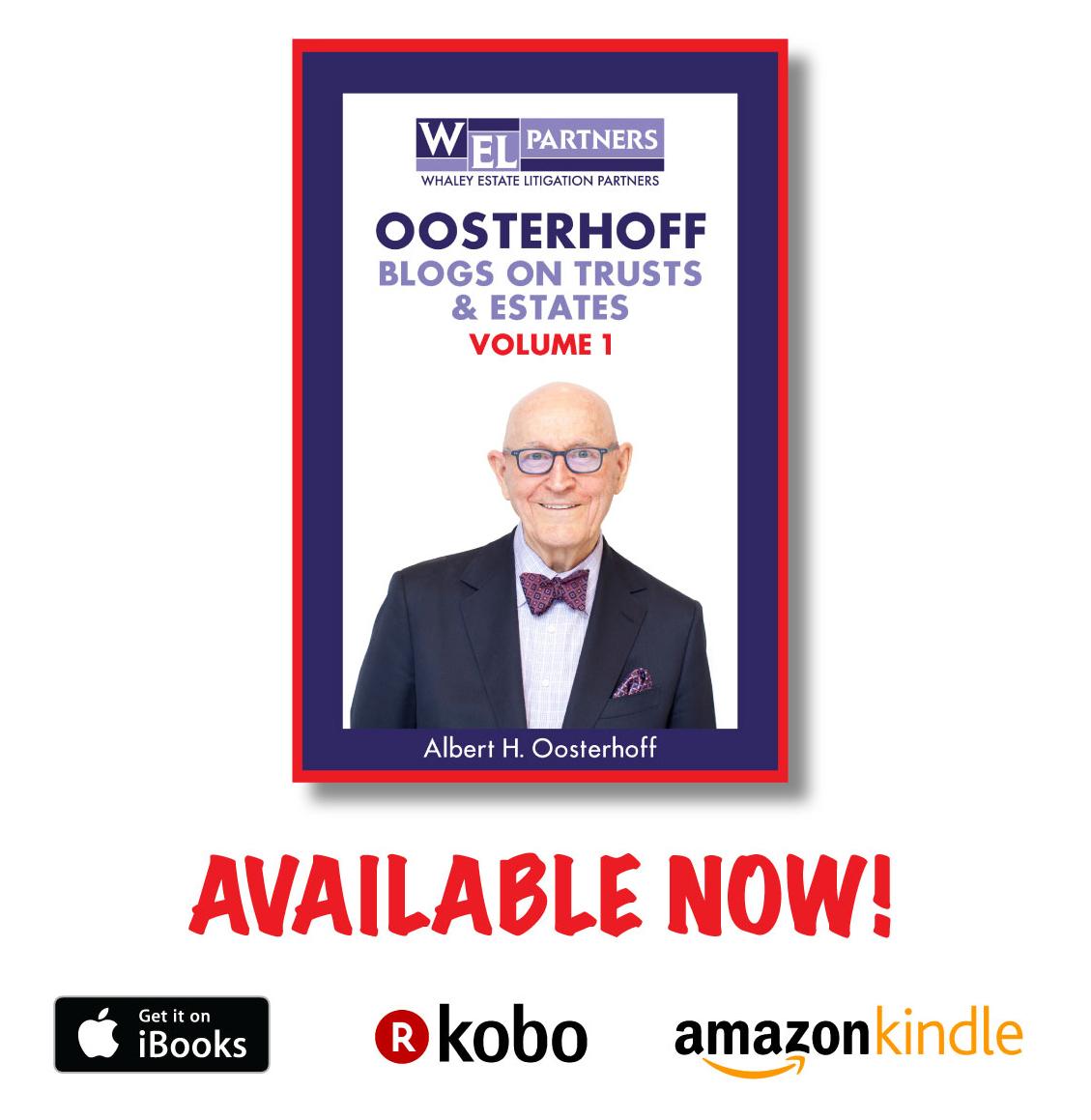
13. OOSTERHOFF BLOGS ON ESTATES & TRUSTS - VOLUME 1 |
Oosterhoff Blogs on Estates & Trusts – Volume 1 is a compilation of 62 blogs on a wide range of estate, trust and related subjects written by Albert H. Oosterhoff between 2016 and 2021.
The blogs do not simply review new cases and statutes, but usually provide extensive historical background. Case and statute critiques are provided when they run counter to established principles, or do not go far enough in reforming the law. The blogs are often of considerable length and often deal with topics that are somewhat obscure and are not otherwise easily accessible.
|
|
WEL CONGRATULATES THE HONOURABLE JUSTICE MARY JO M. NOLAN |
|
WEL Partners congratulates The Honourable Mary Jo M. Nolan as the recipient of the 2021 OBA Award of Excellence in Alternative Dispute Resolution. |
|
WEL CONGRATULATES NIKA LAW, STEP PRIVATE CLIENT AWARD, 2021 |
|
WEL Partners congratulates Nika Law LLP on winning 2 awards at the 16th Annual International Society of Trust and Estate Practitioners (STEP) – Private Client Awards: Boutique Firm of the Year and Vulnerable Client Advisory Practice of the Year.
|
|
WEL CONGRATULATES PAMELA CROSS, STEP WORLDWIDE COUNCIL, 2021 |
|
WEL Partners congratulates Pamela Cross, Borden Ladner Gervais LLP (Ottawa), on her election to the STEP Worldwide Council. |
|
III. JUSTICE SECTOR INFORMATION |
|
The Ministry of the Attorney General advises that a regulation has been filed amending the Rules of Civil Procedure (RCP) with respect to court rules and forms for estates proceedings in the Superior Court of Justice, as described below:
The regulation:
- streamlines the Rule 74 probate process;
-
aligns the Rule 74 application forms with Succession Law Reform Act amendments to sections 15(a), 16, 17 and 43.1 that were made through the Accelerating Access to Justice Act, 2021, Schedule 9; and
- makes administrative amendments to 15 estate court forms.
These estate court rule and form amendments will come into force on January 1, 2022.
The RCP amendments are expected to reduce costs and simplify the Rule 74 process to apply for probate by:
- introducing one set of requirements for applications with a will and applications without a will (one new rule 74.04 replaces current rules 74.04 and 74.05);
- reducing the number of forms by 35 forms (content of 43 forms consolidated into 8 new forms);
- creating new forms with a simpler format, larger font and fillable text boxes;
- improving the guiding language in the forms; and
- numbering the forms alpha-numerically (e.g. Form 74A instead of Form 74.4), allowing for easier identification of the forms.
The streamlined process also allows for more expeditious processing of applications by court staff.
Court of Appeal for Ontario - Tentative Model for Return to In-Person Proceedings
The OBA has received the following update from the Ontario Court of Appeal on a tentative plan for return to in-person proceedings. The Court advises that if it proceeds with the plan, it will issue a public announcement at a later date and release an amended practice direction, counsel slip, and health and safety protocol for in-person proceedings.
|
|
(i) CANADIAN WILL VALIDATING PROVISIONS AND THEIR APPLICATION |
|
By Albert H. Oosterhoff
I began this blog as a comment on the recent British Columbia case, Bishop Estate v Sheardown.[1] However, that case does not stand on its own and so I had to discuss some decisions that preceded it, as well as the divergent language of validating provisions in wills statutes across the country and cases applying them. In consequence, this blog is more about the validating provisions and how they are interpreted than about the Bishop case. The blog does not, however, give an exhaustive discussion of the case law.
Many Canadian jurisdictions now have validating provisions in their wills legislation. Before these were enacted, many wills foundered on the shoals of the formal requirements of the legislation because they did not comply strictly with those requirements. Since this clearly defeated the intentions of the testators, the validating provisions were welcomed by the practicing bar. They have saved many a will over the years. But the language of the several statutes varies. Some validating provisions require partial or substantial compliance with the formalities; others do not require any compliance. The Schedule to this blog contains a summary of the Canadian validating provisions.
Manitoba enacted the first validating provision. The initial version of the provision required partial compliance with the formalities, but it was replaced in 1995 and the current provision does not require substantial compliance with the formalities. Section 23 of the Wills Act[2] provides in part:
… if the court is satisfied that a document or any writing on a document embodies
(a) the testamentary intentions of a deceased; …
the court may, notwithstanding that the document or writing was not executed in compliance with any or all of the formal requirements imposed by this Act, order that the document or writing … be fully effective … as the will of the deceased …
Many of the other Canadian validating provisions are based on the Manitoba provision, but not all. Thus, for example, section 70 of the Prince Edward Island Probate Act[3] requires that the document be signed by the deceased. Other validating provisions do not use the language ‘not executed in compliance with any or all of the formal requirements’. Thus, for example, Ontario’s provision, section 21.1 of the Succession Law Reform Act,[4] scheduled to come into force at the beginning of 2022, speaks of a document ‘that was not properly executed or made under this Act’. The Alberta legislation also appears to be more restrictive. Section 37 of the Wills and Succession Act[5] provides that the court may order that a writing is valid as a will, even though it does not comply with certain formal requirements, if ‘satisfied on clear and convincing evidence’ that the writing sets out the deceased’s testamentary intentions and was intended as his or her will. However, section 37 does not waive the requirement that a will must be signed by the testator. Thus, this validating provision is also a partial compliance one.
The British Columbia provision is perhaps one of the broadest. Section 58 of the Wills, Succession and Administration Act[6] provides in part:
58 (1) In this section, “record” includes data that
(a) is recorded or stored electronically,
(b) can be read by a person, and
(c) is capable of reproduction in a visible form.
(2) On application, the court may make an order under subsection (3) if the court determines that a record, document or writing or marking on a will or document represents
(a) the testamentary intentions of a deceased person,
…
(3) Even though the making … of a will does not comply with this Act, the court may, as the circumstances require, order that a record or document or writing … be fully effective as though it had been made
(a) as the will or part of the will of the deceased person,
… or
(c) as the testamentary intention of the deceased person.
…
The differences are apt to lead to different results. Woods v. Cannon[7] is an example. The testator met with a lawyer to take instructions for her will and an appointment was scheduled to execute it. However, she died suddenly without executing the will. Her sisters brought an application for a declaration that her handwritten instructions, or the instructions prepared by the solicitor constituted her testamentary intentions and should be validated as her will. However, the court refused to validate them, even though the instructions prepared by the solicitor accurately reflected the testator’s instructions, since the Alberta validating power does not permit validation if the document lacks the testator’s signature.
George v. Daily[8] is a somewhat similar case. The testator had discussed his desire to make certain changes in his will with his accountant. The accountant wrote a letter to the testator’s lawyer setting out the changes and the lawyer confirmed the desired changes with the testator. However, there was no evidence that a revised will was drafted and the testator died two months later. The trial judge found that the accountant’s letter was a valid will under the Manitoba validating provision, but the Manitoba Court of Appeal reversed on the ground that accountant’s letter did not reflect the deceased’s testamentary intentions.[9] In contrast, in Re Estate of Jean Agnes MacDonald Marsden[10] the New Brunswick courts validated a will for which the testator (who was in hospital with a terminal illness) had given instructions to a solicitor but which she was unable to execute before she died.
Since the British Columbia validating provision is one of the least restrictive, it stands to reason that courts in that jurisdiction more readily validate wills even if they do not comply with any of the statutory formalities.
An early BC case is Re Young Estate.[11] The testator left a will made in 2009 in which she named Canada Trust as her executor. She died in 2014 in her home. A representative from Canada Trust attended the home and found two documents on the dining room table. The first was a signed document dated in 2013. The second was unsigned and was dated four months later. The first document listed several people as beneficiaries and listed items of personal property to be given to them. On the date she made the first document the deceased invited a friend out to lunch, handed her an unsigned copy of the document and asked her to ensure that the beneficiaries named in it received the items named. The second document merely confirmed her instructions to her friend and contained a few other wishes.
The executor brought an application for a determination whether the two documents could be validated. The court held that whether the court should validate a non-compliant document depends very much on the facts of each case. Two criteria must be satisfied: (1) whether the document is authentic; and (2) whether it represents the deceased’s testamentary intentions in the sense that it records a deliberate or fixed and final expression of intention about the disposition of the deceased’s property at death. Factors that may be relevant in a particular case include: ‘the deceased’s signature, the deceased’s handwriting, witness signatures, revocation of previous wills, funeral arrangements, specific bequests and the title of the document’.[12] Significantly, the court added the following caveat:
37 While imperfect or even non-compliance with formal testamentary requirements may be overcome by application of a sufficiently broad curative provision, the further a document departs from the formal requirements the harder it may be for the court to find it embodies the deceased’s testamentary intention
The court concluded that the first document recorded the testator deliberate expressions of her wishes. It was particularly significant that the document was signed by her since that signalled her knowledge and approval of the contents. Moreover, the document was consistent with her will. Thus, the court validated the first document. But it refused to validate the second, since it contained no more than an expression of the deceased’s non-binding wishes, was not signed, and differed from her will.
The next case is Re Hadley Estate.[13] it was the first occasion for the Court of Appeal to consider the BC validating provision. The testator had a formal will made in 2008, but after she died at age 93 in 2015, a friend found the deceased’s personal journal in a valise that the deceased had entrusted to the friend and asked her to keep safe. The journal contained an entry, which the deceased wrote in 2014 and which she entitled, ‘This my last Will’. The document purported to leave her estate to three individuals whom she had befriended during one of her activities as a community activist. She signed the document. She also wrote that she wrote the ‘will’ hastily because of health scare and hoped to see a named lawyer in person to ‘write this will’. She was survived by a number of nieces and friends. Canada Trust, the executor under the 2008 will had written her not long before the 2014 ‘will’ asking her if the 2008 will was still current and enclosing a copy. She made a number of notations on the copy, including her wish to make a new will as soon as possible. She did speak with a representative of Canada Trust and indicated her intention to change her will. However, she was unable to make an immediate appointment to do so and died in hospital.
The Chambers Judge dismissed Canada Trust’s application for an order validating the 2014 ‘will’. She found the document to be authentic because it was in the testator’s handwriting but concluded that it did not represent the testator’s deliberate and final expression of her testamentary intentions since, among other things, she had written that she wanted to make a new will, gave no explanation why the document differed from her existing will, and failed to mention the document to her friends. The Court of Appeal held that the Chambers Judge did not err in holding that the 2014 did not represent the testator’s testamentary intentions. The court gave the following outline of the principles to be applied on a validation application: Section 58 of WESA does not require a minimum level of compliance with the statutory formalities. It requires only that the court be satisfied that the document represents the testamentary intentions of the deceased[14] and the material time for determining testamentary intentions is the time the document was created.[15] Sitting as a court of probate, the court must determine ‘on a balance of probabilities, whether a non-compliant document embodies the deceased’s testamentary intentions’ at the material time’. For this purpose, extrinsic evidence of testamentary intent is admissible.[16]
Hadley was followed in 2019 by Re Hubschi Estate.[17] It was an unusual case. The deceased was born in 1961 and was given into the care of the Roman Catholic Children’s Aid Society in Vancouver. At age 3 he was placed in the home of the Stack family under a foster home agreement. The family comprised the parents and five children. The deceased was treated as one of the other children and he treated them as his siblings. Mrs. Stack died in 2011 and divided her estate equally between her children, which included the deceased. The deceased never married, had no children, and died in 2017 of complications from surgery. After he died, his brother made a search for will in his home. When he opened the deceased’s computer, the brother found a document entitled ‘Budget for 2017, which included the following statement: ‘Get a will made out at some point. A5 – way [sic] assets split for remaining brother and sisters. Greg, and at or [sic] Trevor as executor’. Greg was his brother and Trevor was his nephew. The evidence showed that he looked at the document on the day of his death. His birth mother had died, but he was survived by his mother’s sister and a niece, both of whom lived in Switzerland. He had never met them and had had no contact with them. The brother brought an application for an order declaring that the document was the last will of the deceased and that probate be granted to him.
The court held that the document could be validated under s. 58 of WESA. The court considered Re Hadley Estate[18] and its discussion of the relevant principles, as well as three other Supreme Court decision and cases from other jurisdictions. The court found that the document did not disinherit any usual beneficiaries, was rational on its face, and benefited exactly those one would expect. The court concluded that the document on the deceased’s computer had been made by him. It also found that it represented a deliberate or fixed and final expression of his intentions to distribute his property among his family members. Although the document said, ‘Get a will made at some point’, the court held that in view of the deceased’s history, his relationship with the Stack children and their relationship with him, his deteriorating health, the division of his estate among his brothers and sisters, and the fact that he reviewed the document on the day of his death, it contained the deceased’s testamentary intentions. Consequently, the court validated the document.
The result is defensible on the ground that it made sense to leave the estate to the only family the deceased knew, rather than to his birth family whom he did not know at all. But with respect, I find that the facts the court used to support validation to overcome the statement in the will about getting a will made at some point, inadequate as proof that the document represented his deliberate or fixed and final expression of his intentions. Moreover, the court failed to distinguish Re Hadley Estate, in which the document contained a similar statement.
This brings me finally to Bishop Estate v. Sheardown.[19] The testator, Ms Bishop, died 20 July 2020. She had made a will in 2014 in which she named her husband as her sole beneficiary and the Kelowna General Hospital Foundation as the substitute beneficiary. Her husband predeceased her. Thereafter she sold her property outside the city and moved into a mobile home in Kelowna. For the latter part of her life the deceased suffered from a rare autoimmune disease that required monthly intravenous treatments that were enervating and left her feeling tired. In 2016, her nephew, Mr. Sheardown, and his wife moved to Kelowna and became very close with her. In December 2019 the testator was admitted to hospital because of her health condition and moved into a care home in February 2020. In early February she met with a solicitor from the same firm that prepared the 2014 will. He reviewed that will with her and she instructed him to draft a new one naming Ms. Sheardown as executor, removing the gift to the Foundation, including a couple of modest gifts to charities and the Sheardown’s daughter, and giving the residue equally to the Sheardowns, with a gift over to their children. The solicitor prepared the will and sent it to the testator for review. On 3 March 2020 the testator delivered a handwritten note to the solicitor to make a couple of minor changes but that no charities were to receive any gifts. She did not sign the note. The solicitor prepared the final draft of the 2020 will and instructed his assistant to contact the testator. Ms. Bishop made an appointment to see the solicitor on 20 March 2020. However, she cancelled the appointment on 19 March and she failed to sign the will before she died. While the reasons for the cancellation were hearsay, there was clear evidence that because of COVID-19 Ms. Bishop’s care home prohibited residents from leaving the home except for medical appointments and did not permit visitors at the time. The executor under the 2014 will sought the court’s direction whether the unexecuted 2020 will could be validated under s. 58 of WESA.
The court considered a number of cases, including Re Young Estate and Re Hadley Estate and concluded on the basis of Hadley that it should be satisfied that the will is (a) authentic; and (b) represents Ms. Bishop’s deliberate or fixed and final intentions about the disposition of her property on her death. Justice Matthews had no difficulty in finding the will authentic on the facts. On the issue of fixed and final intentions, she held that this has two dimensions: (1) whether its departure from the formal testamentary requirements made it impossible to establish testamentary intention; and (2) whether the failure to execute the 2020 will from the time it was ready for execution until Ms. Bishop’s death nullified any testamentary intention Ms. Bishop may have had when she made her appointment to execute it.
Justice Matthews noted that in considering the departure from the formal testamentary requirements a court will normally consider the following among other factors: (1) whether the document has the hallmarks of being made to record the deceased’s fixed and final intentions and whether it was made in a context that supports that conclusion; (2) whether the document uses the language of a will; (3) whether the deceased hired a lawyer to draft it; (4) whether, if handwritten, it is in the deceased’s handwriting; (5) whether it was signed and witnessed; (6) whether it revokes previous wills; and (7) whether it prescribes funeral arrangements. The 2020 will departed from the formal testamentary requirements in that it was not signed or witnessed. But on the facts that could be explained. And so Justice Matthews found that that the 2020 will represented Ms. Bishop’s fixed and final intention on the date she made an appointment to execute it. Moreover, her failure to execute it during the following four months were readily explained by the fact that she was prevented from leaving her care home during the pandemic or to have the solicitor attend at the care home for her to execute the will. Although the province put in place remote execution procedures for wills on 19 May 2020, Ms. Bishop seems not to have been aware of them and therefore her failure to execute the will did not, in the circumstances, mean that she changed her testamentary intentions. Justice Matthews was alive to the fact that this was not a case of imperfect compliance with the formal requirements, but a case of non-compliance, but held that this is not a bar to validating a will under s. 58. In the circumstances she held that the non-compliance did not prevent the court from directing that the 2020 will be fully effective.
I cannot really find fault with the decision. Justice Matthews thoroughly addressed all relevant issues in Bishop and went to great lengths to demonstrate that the 2020 will did contain Ms. Bishop’s testamentary intentions. At paragraph 9, she even repeated and considered paragraph 37 of Re Young Estate,[20] in which Justice Dickson quoted the following statement from the judgment of Philp JA in George v Dailey:[21] ‘the further a document departs from the formal requirements the harder it may be for a court to find it embodies the deceased’s testamentary intentions’.
Nevertheless, cases like Bishop and Hubschi leave me dissatisfied, but my concern is primarily with the validating provision that permitted the courts to reach those decisions. After all, section 58 does not demand any compliance with the formal requirements for making a will. And that concerns me. All wills statutes contain formal requirements, but the validation provisions in some of them effectively dismiss them in order to reach a desirable result. Of course, the formal requirements continue to serve an important purpose in that they ensure that most wills can be probated quickly. But I prefer a validating provision that requires at least some minimal observance of the formal requirements, such as a signature. I appreciate that many will disagree with me, because they regard the broad approach used in the non-compliance provisions desirable. And that is understandable. But I am glad that the new Ontario provision appears to suggest that the deceased must have made some attempt to execute the document.
SCHEDULE
Summarizing the Canadian Validating Provisions
This Schedule addresses only compliance or non-compliance with the statutory formal requirements for wills. All the validating provisions insist that the document must contain, as one would expect, the testamentary intentions of the deceased.
1. Non-compliance
Jurisdictions in which the court may validate a will whether it does not comply or complies only partially with the statute’s formal provisions. Typical language in the validating provision is ‘notwithstanding that the writing was not executed in compliance with the formal requirements imposed by’ the Act. But the language of the statutes differs somewhat in this respect.
Indian Act Regulations, CRC 1978, c. 954, s. 15: ‘whether or not [the instrument] conforms with the requirements of the laws of general application in force in any province’.[22]
Wills, Estates and Succession Act, SBC 2009, c. 13, s. 58(3): ‘even though the making … of a will does not comply with this Act’.
Wills Act, CCSM, c. W150, s. 23: ‘notwithstanding that the document or writing was not executed in compliance with any or all of the formal requirements imposed by this Act’.
Wills Act, RSNB 1973, c. W-9, added by SNB 1997, c. 7, s. 1: ‘not executed in compliance with the formal requirements’.
Wills Act, RSNS 1989, c. 505, s. 8A, added by SNS 2006, c. 49, s. 2: ‘not executed in compliance with the formal requirements’.
Uniform Wills Act (2015), Uniform Law Conference of Canada, https://www.ulcc-chlc.ca/ULCC/media/EN-Uniform-Acts/Uniform-Wills-Act.pdf, s. 10: ‘despite that the document was not made in accordance with [the formal requirements of the Act] or is in electronic form’. Section 11 makes a similar provision for alterations. Section 12 makes provision for electronic wills.
2. Partial or Substantial Compliance
Wills and Succession Act, SA 2010, c. W-12.2, s. 37: ‘despite the fact that the writing was not made in compliance with [specified formal requirements]’, but it does require the testator’s signature. Section 37 makes the same provision for alterations.
Succession Law Reform Act, RSO 1990, c. S.26, s. 21.1(1), added by SO 2021, c. 4, Sched. 9, s. 5: ‘a document or writing that was not properly executed or made under this Act’ (emphasis supplied). Note that although the amending Act received Royal Assent on 19 April 2021, s. 21.1 will come into force on a day named by proclamation of the Lieutenant Governor that is not earlier than 1 January 2022 (see SO 2021, c. 4, Sched. 9, s. 9(4)).
Probate Act, RSPEI 1988, c, P-21, s. 70: ‘notwithstanding that the document or writing was not executed in compliance with all the formal requirements’ (emphasis supplied).
Civil Code of Quebec, LRQ, c. C-1991, art. 714: ‘does not fully meet the requirements’.
Wills Act, SS 1996, c. W-14.1, s. 37: ‘not executed in compliance with all the formal requirements’ (emphasis supplied).
---
[2] CCSM c. W150, emphasis supplied. All of the statutes apply not only to the making of a will or part of a will, but also to its revocation, alteration, or revival. For simplicity’s sake I have not reproduced those aspects of the statutes in this blog.
[4]RSO 1990, c. S.26, added by SO 2021, c. 4, Sched. 9, s. 5.
[6] SBC 2009 c. 13 (‘WESA’).
[8] (1997), 143 DLR 4th (Man CA).
[9] For a similar case, see Sawatzky v. Sawatzky Estate, 2009 MBQB 222.
[10] 2017 NBQB 199, affirmed sub nom. Marsden v. Talbot 2018 NBCA 82.
[11] 2015 BCSC 182, 5 ETR 4th 161.
[21] Footnote 8, supra, para. 81.
[22] See also Indian Act, RSC 1985, c. I-5, s. 45(2), which permits the Minister to accept as a will any written instrument signed by an Indian that disposes of his property on his death.
|
|
(ii) ENTITLEMENT TO CONSTRUCTIVE TRUST FOR TORTIOUS CONDUCT |
|
By Albert H. Oosterhoff
1. Introduction
When an employee engages in a kickback scheme, thereby defrauding the employer, and uses the moneys to pay off the mortgage on his house, can the employer obtain a constructive trust over the property, and can it succeed in a claim for punitive damages? That, in brief, is what Sunwing Airlines Inc. v. Mora[1] is about. The case does not provide many facts since it involved supplementary submissions by the Airline on these matters. However, two previous cases provide the background facts: Sunwing Airlines Inc. v. Mora et al.,[2] which was a motion for a Mareva injunction freezing Mora’s assets, and Sunwing Airlines Inc. v. Mora,[3] which was the trial of the action against Mora.
The Airline employed Mora as regional airport manager for Latin America. The Airline engaged another person as an independent contractor to supervise flights to Cuba. From the money she received, she paid certain amounts to Cuban workers who assisted the Airline on the ground in Cuba. When her contract came up for renewal in 2012, Mora persuaded her to ask for a significantly higher remuneration and to pay him a portion of the increase in cash. She made these payments to Mora over a period of five years but disclosed the kickback scheme to the Airline in April 2017. The Airline investigated the matter and, at a meeting with Mora, terminated his employment. During this meeting Mora admitted the kickback scheme. The total amount paid to him over the five years was $537,885.
The Airline brought an action against Mora in 2017 for damages for civil fraud, breach of contract, breach of fiduciary duty, breach of trust, conversion, or unjust enrichment in the amount paid to him over the five years, for punitive damages, and for related relief. Mora brought an action for wrongful dismissal. The Airline obtained an interim Mareva order in 2017 and the court continued the order in the Mareva Motion proceeding in 2019.
The trial took place in 2021. The court noted that this was strictly a credibility case. It found the evidence of the witnesses who testified for the Airline to be credible beyond a reasonable doubt and did not believe or accept any of Mora’s evidence. It found that the Airline had just cause to terminate Mora. Thus, it granted the Airline’s action and awarded it the amount claimed in damages. And it dismissed Mora’s wrongful dismissal action since he was terminated for cause.
2. Supplementary Submissions
The Airline then made the supplementary submissions regarding a constructive trust over Mora’s property, and regarding punitive damages. With respect, these reasons are disappointing in that the court does not explain why it held that a constructive trust was appropriate and why punitive damages were appropriate.[4] Instead, the court seems simply to have accepted the Airline’s submissions on both points.
2.1 Constructive Trust
On the constructive trust issue, the Airline argued: (a) that a monetary award would not properly address its legitimate needs; and (b) since Mora used the kickbacks to pay off the mortgage on his property, the court could impose a constructive trust on it since there was a direct link between the Airline’s money and the property. The Airline listed the four conditions for imposing a constructive trust based on wrongful conduct identified by the Supreme Court of Canada in Soulos v. Korkontzilas:[5]
(a) the defendant must have been under an equitable obligation, that is, an obligation of the type that courts of equity have enforced, in relation to the activities giving rise to the assets in his hands;
(b) the assets in the hands of the defendant must be shown to have resulted from deemed or actual agency activities of the defendant in breach of his equitable obligation to the plaintiff;
(c) the plaintiff must show a legitimate reason for seeking a proprietary remedy, either personal or related to the need to ensure that others like the defendant remain faithful to their duties; and
(d) there must be no factors which would render imposition of a constructive trust unjust in all the circumstances of the case; e.g., the interests of intervening creditors must be protected.
The Airline also submitted that Mora was enriched, it was deprived, there was no juristic reason for the enrichment, and the enrichment was traceable into the property.
Apart from a few parenthetical comments, the court did not engage with Mora’s submissions but stated that a constructive trust order was appropriate. However, it put the order on hold and stated that it would be granted in 30 days if Mora had not paid the damage award in full. This part of the judgment makes sense since the Airline had asked for a constructive trust order over the property co-extensive with the amount of the damages.
It is regrettable that the court did not address the question whether the court can award a constructive trust for a common law wrong. The first condition listed by the Supreme Court in Soulos was that the defendant must have been under an equitable obligation of the type that courts of equity have enforced. Was Mora under such an obligation? Was he a fiduciary? He was an employee, but the facts do not suggest that his position was sufficiently senior that he could be considered a fiduciary on the basis of the principles outlined in Canadian Aero Service Ltd. v. O’Malley.[6] It is undoubtedly true that Mora was unjustly enriched in the broad sense, although it was not a true unjust enrichment; rather he made a wrongful gain and the question was whether the court could strip him of that gain by way of a constructive trust. The law is still unclear on the question whether the court can grant a constructive trust for a common law wrong. I believe that it can. I refer to what Waters says on this point in the latest edition of his seminal text.[7] The text refers to the first condition in Soulos and its requirement that the defendant must been under an equitable obligation. Waters comments:
But in the twenty-first century the relevance of this is not clear. If the trust is the appropriate remedy, then it is so whether the wrong from which it arises is sourced in Equity or common law.[8]
The text refers to the judgment of Wilson J in LAC Minerals v International Corona Resources Ltd.,[9] who quoted from a lecture given by John McCamus, in which he said,
Would it not be anomalous to allow more sophisticated from of relief for breach of fiduciary duty than for those forms of wrongdoing recognized by the law of torts, some of which, at least, would commonly be more offensive from the point of view of either public policy or our moral sensibilities than some breaches of fiduciary duty?[10]
Waters also quotes[11] from the judgment of Binnie J in Cadbury Schweppes Inc. v FBI Foods Ltd.,[12] who said, ‘whether a breach of confidence in a particular case has a contractual, tortious, proprietary or trust flavour goes to the appropriateness of a particular equitable remedy but does not limit the court’s jurisdiction to grant it’.
Waters concludes,[13] ‘The clear implication is that even in a case in which the only wrong was a common law tort, or even a breach of contract, a constructive trust could be viewed as the appropriate remedy’, and refers to a number of cases in support of this statement.
Consequently, the constructive trust the court awarded in Sunwing can be viewed as the appropriate remedy for Mora’s tortious conduct. However, I should have liked to see a discussion of the law on this point.
2.2 Punitive Damages
Since this issue does not concern constructive trusts, I shall address it only briefly. On this issue too, the court seems to have adopted the Airline’s submissions and did not engage with Mora’s submissions. The Airline submitted that the court can award punitive damages in exceptional cases for misconduct that ‘offends the court’s sense of decency’ and ‘represents a marked departure from ordinary standards of decent behaviour’. It noted that it is well-established that punitive damages are appropriate in cases of employee fraud and referred to Elekta Ltd. v Rodkin,[14] in which the court concluded at para. 31 that the time had come ‘to raise the range of possible awards of punitive damages made in cases involving serious, protracted fraud by an employee who works in a position of trust handling the funds of his employer’. The court concluded that past decisions that awarded punitive damages in the range of $25,000 did not register in the consciences of the public. It ended up awarding punitive damages of $200,000.
Justice Ferguson concluded in para. 8 of Sunwing:
Punitive damages are absolutely appropriate. Mora is a thief. He stole $537,885.00. To not award punitive damages will send a message that if you steal from your employer you only have to pay it back. If this was in the criminal system, he would go to jail. Punitive damages are awarded in the amount of $200,000.00.
In the circumstances, this would seem to be an appropriate award.
--
[1] 2021 ONSC 6179 (‘supplementary submissions’).
[2] 2019 ONSC 3917 (‘Mareva proceeding’)
[3] 2021 ONSC 1376 (‘trial’)
[4] The reasons also do not give citations to most of the cases referred to.
[5] [1997] 2 SCR 217, 146 DLR 4th 214, para 45.
[7] Waters’ Law of Trusts in Canada, 5th ed. by Donovan W.M. Waters, Mark R. Gillen, and Lionel Smith (Toronto: Thomson Reuters, 2021).
[9] [1989] 2 SCR 574 at 632.
[10] J.D. McCamus, ‘The Role of Proprietary Relief and the Modern Law of Restitution’, in Cambridge Lectures 1987 (1989) at 141, 150
[11] Waters, supra, p. 557.
[13] Waters, supra, p. 557.
|
|
International Federation of Ageing – 15th Global Conference on Ageing November 9-12, 2021
Speakers: Daniel Paperny and Matthew Rendely
Ontario Police
Elder Abuse Investigations 2021
November 16, 2021
Speakers: Rebecca Betel and Paul Murphy
Canadian Lawyer Co-Branded Webinar
November 24, 2021
Speakers: Kimberly Whaley and Ian Hull
Toronto Police Seminar
December 3, 2021
Elder Abuse Investigation Course
Speakers: Daniel Paperny and Natalie Kodsi
EAPO Webinar
December 2, 2021
Speaker: Kimberly Whaley
Osgoode Certificate in Elder Law
April 7, 2022
Predatory Marriages
Speakers: Kimberly Whaley and Albert Oosterhoff
Estate Planning and Litigation Forum
April 10-12, 2022
Osgoode Professional Development
Passing of Accounts
April 12, 2022
Chair: Kimberly Whaley
Canadian Centre for Elder Law (CCEL)
Elder Law Course
April 21, 2022
Chair: Kimberly Whaley
LESA 53rd Annual Refresher: Managing Wills & Estates Matters
April 30-May 2, 2022
Decisional Capacity: A Wills & Estates Context
Speaker: Kimberly Whaley and John Poyser
|
|
Check out our recent Feature Series which are posted on our Blog:
|
|
VII. IN CASE YOU MISSED IT - RECENT BLOG POSTS |
|
Do you follow us on social media? Do you subscribe to our blog? We invite our subscribers to read our blog on-line or via a feed reader using our blog's RSS feed and to follow us on social media.
Newsletter Archive
WEL Blog
Online Connections
Sign Up for Our Newsletter
WEL Directory
|
|
|
|
|
|
|