WMU NEWSLETTER

04.10.2026

실천영성 "Spirituality in Praxis"

"Reading the Grain of the Word"

The Weak and the Strong in Faith

“Let not the one who eats despise the one who abstains, and let not the one who abstains pass judgment on the one who eats, for God has welcomed him.” (Romans 14:3)


In the church in Rome, there were conflicts surrounding issues of food and sacred days. Some believers avoided meat and wine and observed certain days as special, rooted in their Jewish traditions and matters of conscience. Others, however, regarded this as a sign of “weak faith.”


Yet Paul does not treat this simply as a matter of right and wrong. Instead, he first emphasizes that believers must neither despise nor judge one another. Each person stands before God, and it is only by God’s sustaining grace that anyone stands. Differences in faith are not a measure of superiority, but areas of personal responsibility before God.


Paul also stresses that the life of every believer ultimately belongs under the lordship of Christ. Whether we live or die, we belong to the Lord. Therefore, no one should be forced to act against their conscience. At the same time, believers bear the responsibility to avoid causing others to stumble or fall.


Paul himself is convinced that distinctions between clean and unclean foods have been abolished in Christ. However, this truth should not be imposed uniformly on everyone. If someone’s conscience is destroyed, it is no longer an application of truth but a loss of love. For the kingdom of God is not a matter of eating and drinking, but of righteousness, peace, and joy in the Holy Spirit.


Thus, Christian freedom is not a right to assert oneself, but a responsibility to be restrained by love. Actions that do not come from faith become sin, and willingly limiting one’s freedom for the sake of a brother or sister is, in fact, an expression of mature faith.

Paul gives a clear exhortation to the “strong”: rather than insisting on their own convictions, they are to bear with the weaknesses of the weak. The model for this is Christ Himself, who did not please Himself but endured reproach and suffering for our sake.


Ultimately, the church is not a community united by uniformity, but one united in love amid differences in faith. And at its center is always the way of Christ, who humbled Himself.


Rethinking Assessment Innovation and Accreditation in the Age of AI

Participation in WSCUC ARC 2026


Emphasizing “an implementation system that drives institutional quality and continuous improvement”


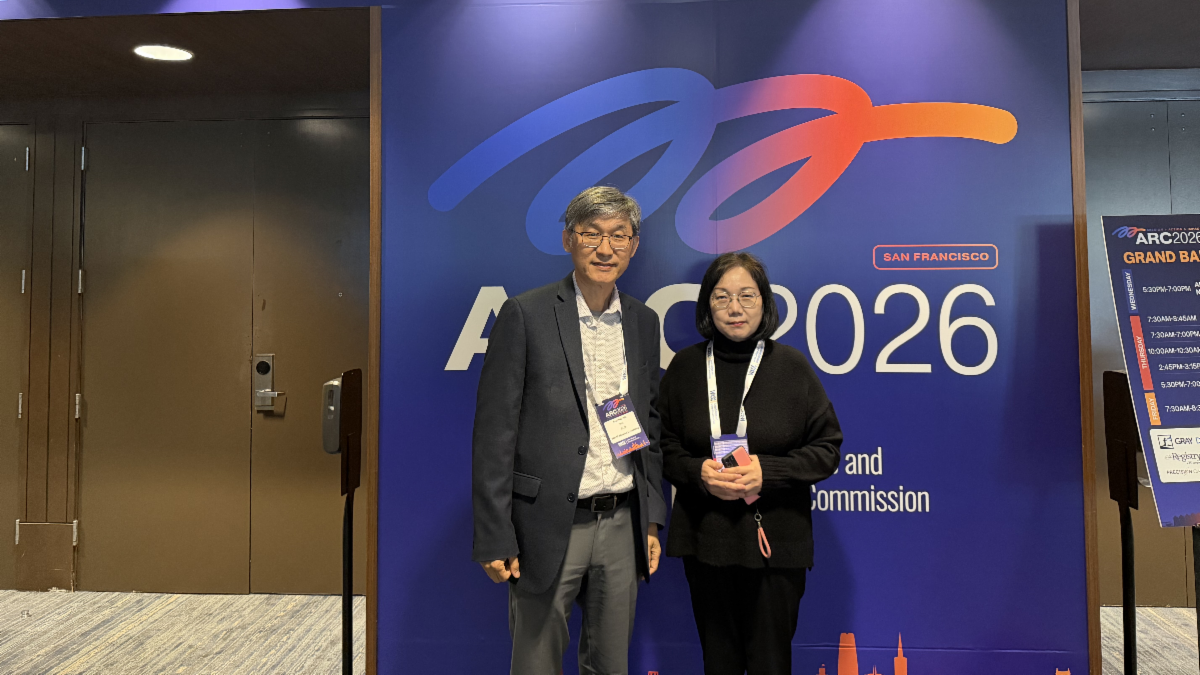
World Mission University (WMU) attended the WSCUC ARC 2026 (Accreditation Resource Conference), held from April 8 to 10, 2026, in San Francisco, to review student learning outcomes assessment and institutional direction in the age of AI. The conference was attended by Executive Vice President for Planning Seon Mook Shin and Vice President for Academic Affairs Yoon Jung Choi.


Under the theme “Mission > Action > Impact,” the conference focused on ways to translate institutional mission into actionable practices and measurable student outcomes. In particular, it emphasized understanding accreditation not merely as an administrative procedure, but as an operational system that drives institutional quality and continuous improvement.


One of the key discussions centered on redesigning assessment methods suitable for the AI era. Beyond simple detection of AI usage, there was strong emphasis on the need for assessment approaches that can verify students’ actual understanding and learning processes, such as oral examinations, process-based evaluation, and reflective assessment.


Data-informed decision-making and program review were also highlighted as central themes. It was repeatedly emphasized that learning outcomes assessment and institutional improvement should not be treated as separate tasks, but rather as processes closely integrated into overall university operations.


Through participation in ARC 2026, WMU reaffirmed the importance of developing learning outcomes assessment and program review not as formal reporting requirements, but as systems that genuinely enhance the quality of education. It also confirmed that in the age of AI, designing assessments that can demonstrate students’ authentic understanding and growth has become increasingly essential.


Based on the insights gained from this conference, WMU will continue to advance learning outcomes assessment, data utilization, and the design of educational systems suited for the AI era.


[Faculty Column] “Wounds and Trauma” – Professor Kyung Hwa Song

“Past wounds are not something to simply forget, but rather require a healing process for the records imprinted in our bodies and brains.”


This video explains that wounds and trauma are not merely matters of memory, but conditions that create physical changes in the brain and nervous system, continuously affecting present life and relationships. It also presents a path toward breaking the cycle of inherited pain by acknowledging and confronting it, and moving toward professional healing.


If you wish to release long-suppressed emotional burdens and take the first step toward true recovery, we encourage you to watch this video featuring Professor Song’s warm and insightful guidance.