|
President's Message
The Conquest of Canaan (Joshua 10–12)
“Now these are the kings of the land whom Joshua and the people of Israel defeated on the west side of the Jordan, from Baal-gad in the Valley of Lebanon to Mount Halak, which rises toward Seir. And Joshua gave their land to the tribes of Israel as a possession according to their divisions.” (Joshua 12:7)
The first nine chapters of the Book of Joshua describe in detail the conquest of a relatively small region of Canaan, stretching from the Jordan near Jericho to the hill country near Gibeon. All of these events took place in territory that was later allotted to the tribe of Benjamin. With the alliance of the five Amorite kings, the western and southern regions around Jerusalem now come into view. Joshua chapters 10–11 record Israel’s campaigns in the southern and northern parts of Canaan, while chapter 12 lists the kings whom Joshua defeated. In this sense, chapters 10–11 may be seen as the continuation of the conquest narratives following the victories at Jericho, Ai, and Bethel.
The Conquest of Southern Canaan: The Battle Fought for Gibeon (10:1–15)
After promising to fight for Israel, God Himself throws the enemy into confusion and even uses a natural phenomenon—hailstones—to assist His people. This demonstrates that God’s help is greater than the sword of man. One thing made clear in this passage is that Israel could not have won the victory by its own strength.
In the middle of the battle narrative appears a fragment of a poem taken from the Book of Jashar. Just as the stars fought against Israel’s enemies in the Song of Deborah (Judges 5:20), the God of heaven and earth (Joshua 2:11) commands the forces of heaven here as well. The Book of Jashar is also mentioned in 2 Samuel 1:18, though its contents are unknown. It is thought to have been a collection of heroic accounts, songs, or poems praising great figures.
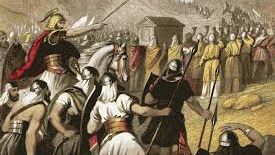
Israel’s sudden appearance caused the Amorite kings to panic and flee in confusion. The Lord hurled large stones and hail from the sky, and more of the fleeing enemy died from the hail than were killed by Israel’s swords. Israel pursued them along the road to Beth-horon, but time was running short to complete the victory. So Joshua prayed to the Lord that the sun and moon would stand still. God heard his prayer and caused the sun and moon to stand still until Israel had fully defeated its enemies.
Victory at the Battle of Merom and the Conquest of Northern Canaan (Joshua 11:1–15)
Like the kings of southern Canaan, the kings of northern Canaan also formed an anti-Israel alliance. Hazor, the leading city of this coalition, was located in the territory later allotted to the tribe of Naphtali. Because such a vast army was mobilized, this battle took on the character of a decisive confrontation. Like the Egyptians, the northern Canaanites fought with horse-drawn chariots. When Israel launched a sudden attack, the enemy was unable to deploy their forces effectively. Joshua hamstrung the horses, rendering them useless for battle. Israel had to remember that what protected them was not advanced military technology like that of their enemies, but the Lord Himself.
The Jordan River flows through two bodies of water before emptying into a third. The southernmost and largest is the Dead Sea. About 65 miles north of the Dead Sea lies the Sea of Galilee, and about 12 miles further north is Lake Huleh. This lake is generally identified with the “waters of Merom.” Lake Huleh is the smallest of the three bodies of water connected by the Jordan River, measuring only about four miles in length and half a mile in width.
All Canaan Falls into Israel’s Hands (11:16–23)
The whole land came into Israel’s possession. The hill country that Israel conquered included the southern hill country of Judah as well as the central and northern hill regions. Israel was not to make peaceful alliances with the Canaanites, who relied on human strength and methods. They even captured the hill country of the Anakim. The Anakim had once terrified the Israelite spies and caused the first attempt to enter Canaan to fail. With their destruction, the land of Canaan finally became Israel’s.
The list of kings recorded in chapter 12 includes place names not previously mentioned (Jerusalem in verse 10, for example, would not be conquered until the time of David). The list first moves southward through central Canaan and then, from verse 16 onward, proceeds northward. Some of these kingdoms are mentioned as Egyptian vassals in the letters of Amenhotep IV (reigned 1375–1358 BC). As the power of these city-kings was broken, so too was the power of the gods of Canaan.
Reflection
God had promised Abraham, Moses, and the people of Israel that He would give them the land of Canaan. Although the seven Canaanite nations were mentioned, specific cities, kingdoms, or kings had not been named. Now Scripture clearly records the names of the lands, cities, and kings that God gave into Israel’s hands. This shows that God faithfully fulfilled His promises and demonstrates how specific and concrete His promises truly are.
|