|
President's Message
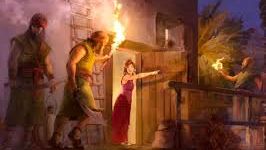
The Spies of Jericho
"And she said, ‘I know that the Lord has given you this land, and that the terror of you has fallen upon us, so that all the inhabitants of the land melt in fear before you. For we have heard how the Lord dried up the water of the Red Sea before you when you came out of Egypt, and what you did to the two kings of the Amorites who were beyond the Jordan, to Sihon and Og, whom you utterly destroyed.’” (Joshua 2:9-10)
Jericho, an ancient city, was a strategic stronghold guarding the entrance to the land across the Jordan, serving as a kind of gatekeeper. In this sense, the city represents all the lands (v. 3, 24). Rahab’s house, a brothel, was a place where strangers could enter without drawing attention, which is why her profession is not criticized in the text.
The Sending of the Spies to Jericho (1-2)
Jericho was a fortified city in the Jordan Valley, about five miles west of the Jordan River and fifteen miles northeast of Jerusalem. Its elevation is approximately 850 feet below sea level, with a subtropical climate typical of the Jordan Valley. Jericho had been inhabited for a very long time, with evidence of settlement dating before 5000 B.C. The city described in the text was likely the third settlement on the site, as the previous two cities had been destroyed. Jericho was heavily fortified, with walls twelve to fifteen feet thick.
Forty years earlier, Joshua had been one of the twelve spies sent by Moses to scout Canaan. That earlier mission was undertaken at the request of the Israelites, who doubted God’s promise to give them the land (Numbers 13:2). As a result, all the Israelites over twenty years old died in the wilderness except for Joshua and Caleb, who trusted God. In contrast, the spies sent at this later point were carrying out a faithful mission recognized by God. Joshua, now in the position of sending spies into Canaan, would have strengthened his resolve to faithfully conquer the land promised by God.
Rahab Rescues the Spies (3-7)
As soon as the Israelite spies infiltrated Jericho, their presence was quickly discovered and reported to the king, indicating the city’s strict security and vigilance. Rumors of Israel’s victory over the Amorite kings on the eastern side of the Jordan were already widespread, and the Canaanite cities were on high alert for the approaching Israelites.
Rahab, a prostitute, risked her life to hide the Israelite spies in her house. This act was a demonstration of faith, intended to protect God’s people and secure her own salvation when Jericho was conquered (Hebrews 11:31; James 2:25). Fundamentally, it was God—who had delivered Israel from Egypt (Exodus 14:14) and was now leading them into the Promised Land (Joshua 1:2-4)—who used Rahab to hide and protect the two spies from the evil hands of Jericho’s king.
Rahab’s Assurance and Confession of Faith (8-11)
Rahab’s confession, “The Lord has given this land of Canaan to Israel,” serves as a key that reveals the central theme the author emphasizes. The text does not focus on the objective details of the spies’ reconnaissance but instead highlights Rahab’s declaration of faith. By centering on Rahab’s spiritual confession, the narrative points to the true essence of the conquest of Canaan. God, in guiding the spies into Jericho, used Rahab’s lips to confirm that the core of Canaan’s conquest lies in His divine will. Through her testimony, the spies clearly understood that the success of their mission depended on God’s sovereign plan.
Scholars have proposed various and sometimes conflicting interpretations regarding Rahab’s actions. Nevertheless, God accomplished the great work of Israel’s salvation through her. In ways that seem unexpected and beyond ordinary understanding, God uses unlikely individuals to fulfill His redemptive purposes.
Reflection
What is noteworthy here is Rahab’s theology and faith. As a foreigner and merely a prostitute, she recognized Yahweh as the one true God of the universe and believed that He would drive out the Canaanites and give the land to Israel. Rahab’s theology and faith surpassed that of even the covenant people of Israel, becoming the source of salvation for her and her family. This teaches us that correct theology and faith are the pathway to salvation and symbolically demonstrates that God’s salvation extends to all who believe in Him, regardless of nation or lineage.
|