|
The Plagues of Flies, Livestock Pestilence, and Boils
“Then Pharaoh saw that the rain and the hail and the thunder had ceased, and he sinned again and hardened his heart, he and his servants alike.”
(Exodus 9:34)
God causes Pharaoh to realize that He has the power to preserve His own people who dwell in the midst of Egypt from the plagues that strike all the other regions of Egypt. This is the new element revealed in the plague of flies. In the text, pālāh is used in the perfect tense, showing God’s firm determination to make a clear distinction between the Egyptians and the Israelites. This divine separation became evidence to the Egyptians that the plagues that had come upon them were not natural phenomena but were sent by the LORD, the God whom the Israelites worshiped. For the Israelites, it became an important sign that revealed God’s omnipotence and the greatness and wonder of His love for them.
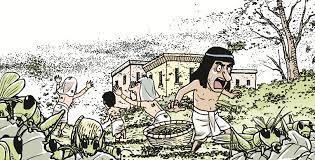
The Plague of Flies
It is uncertain what specific insect is referred to by the “flies” in this passage. In 7:20 the water was turned into blood, in 8:3 frogs came up, and in 8:17 the dust became gnats. In these first three plagues, the verbs describing the plagues are all in reflexive or simple active forms, expressing God’s involvement in a relatively indirect manner. By contrast, the verb corresponding to “I will send” in this passage (šālaḥ) is used in the causative participle active form. This emphasizes that the swarms of flies did not arise naturally but came about through God’s supernatural intervention. In addition, the first through third plagues were all plagues that originated from water and land. However, the fourth plague, the plague of swarms of flies, took place in the air. This shows that as the plagues progress, their scope expands. In other words, it reveals that God’s wrath toward Pharaoh and Egypt increases as Pharaoh’s heart grows more hardened and his disobedience continues.
The Plague of Livestock Pestilence
While the previous plagues caused inconvenience in daily life, with the plague that killed livestock, plagues that directly threatened life began. Once again, it is clearly shown that the Israelites suffered no harm. The plague struck horses, donkeys, and camels. At that time, horses were mainly used for military purposes, though they were also used to some extent for agriculture. Donkeys were widely used for carrying loads, transportation, and plowing fields. For this reason, they were considered among the most important animals in ancient Egyptian society, and thus donkeys were regarded as some of the most valuable property of each household. Camels were used for riding, carrying loads, and producing milk. Also called dromedaries, they were especially essential for long-distance transportation and were indispensable animals for those engaged in trade across the desert.
The severity of the plague of livestock pestilence was such that all the livestock of Egypt died. Whereas the previous plagues merely caused temporary suffering to people or animals, this fifth plague was directly connected to the lives of all the livestock. It was far more devastating than any of the plagues that had come before it.
The Plague of Boils
The boils refer to “swellings and blisters.” The Hebrew term for “swellings,” shĕḥīn, comes from a root meaning “to burn” and refers to burn marks, abscesses, or pustules. The term for “blisters,” ’ăbāp̄û’, is derived from Aramaic, meaning “to swell,” and refers to pustules causing inflammation on the skin. Thus, as indicated by the original Hebrew, the plague of boils describes a severe skin disease in which the ashes covering all of Egypt touched the Egyptians’ skin, causing the affected areas to swell red as if burned, form blisters, produce high fever, intense itching, and eventually rupture, oozing pus. This was a virulent, contagious skin disease, comparable to leprosy or other serious dermatological conditions accompanied by pain and fever. In the Bible, Job is an example of someone who suffered from a similar disease. In an era without developed medicine, such illnesses were regarded as terrifying and repulsive.
Reflection
As the confrontation with the magicians reached its final stage, the magicians could no longer match God’s power. However, this did not mark the end of God’s acts against Pharaoh. Regarding the phrase “the LORD hardened…,” some have misunderstood it to mean that God forcibly intervened in human hearts, denying human free will. Yet the good and sovereign God never overrides anyone’s heart to make it hard. On the contrary, He desires that those with hardened hearts turn from their sinful ways and repent to do what is right. Rather, God allows rebellious humans to misuse their free will, opposing Him and hardening their own hearts, as described in Romans 1:28.
|