WORC’s Compost Professional Training | | |
Registration is Now Open! Only 10 Spots Remaining!
Registration fee includes breakfast and lunch each day, transportation for the tours, and all required supplies. Additional information about this training will be made available at www.compostwashington.org.
| | |
The legislative session began on Monday, January 12th. Please note that we are in a short session year, so the session will close on March 12th. A handful of solid waste-related bills have already been introduced, though none are directly related to organics recycling or as impactful to our membership as the Organics Management Laws introduced over the last handful of years.
We discuss the status of these bills at our biweekly meetings. Any WORC member is invited to attend, and we welcome your participation. We meet every other Thursday at 9:00am. To receive a meeting invite, please email Mike Oechsner (mike@aminc.org) with the request.
We are currently monitoring the following bills. This list may be updated as other bills are introduced or dropped in the coming days.
-
HB 2018 - Establishing the Local Government Solid Waste Assistance Account. This would create a fund to support jurisdictions implementing new solid waste requirements. The account would be funded by a tax on customers of solid waste collection systems. The tax per user starts at 0.5% and reaches a max rate of 2.5%. Not yet introduced.
-
HB 2238 - Concerning statewide food security. This would direct WSDA to develop a statewide food security strategy, which will include a food waste prevention and food rescue component. Passed the House Committee on Agriculture and Natural Resources on January 21st.
Other solid waste bills we have noted, but are not directly related to organics:
-
SB 5502 / HB 1607 – Bottle and can recycling refund act – aka Bottle Bill.
-
HB 2233 / SB 5965 - Reducing environmental impacts associated with bags provided to customers at retail establishments.
-
HB 1420 / SB 6174 - Textile extended producer responsibility (EPR).
You may check the status of any bill including finding updated bill language and testimonies by using the Legislature’s online portal.
| | |
Washington Regional Organics Summits
Spring 2026 Schedule
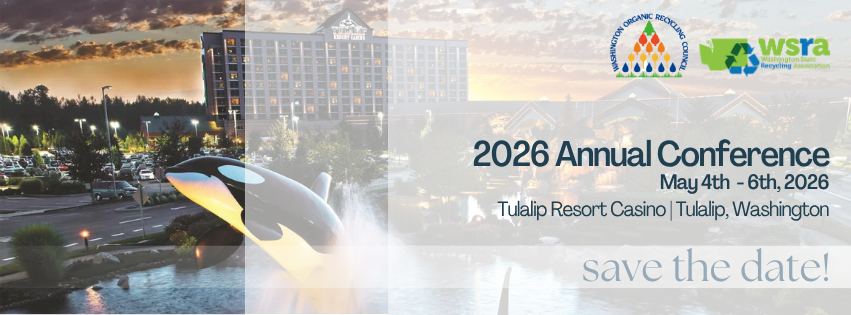
| | WSRA/WORC Joint Conference | | We are looking forward to another spectacular conference filled with education, networking, tours and more! | | | |
WSRA and WORC are a highly engaged community of curious, inspired professionals in the recycling, compost, and waste reduction industry. For over 40 years, this conference has been an amazing opportunity to learn from experts and change-makers from all sectors of the industry — collection, processing, manufacturing, vendors, consulting, education and outreach, government, and nonprofits. We welcome everyone to join us!
WSRA is the home for all industry members to experience education, networking, and collaboration about recycling and solid waste. The Washington Organic Recycling Council (WORC) is the source for advocacy, education, and networking related to organics.
| | |
| Early Registration
Ends April 10th | Regular Registration
April 11th - May 4th | | Member
Full Conference | $695 | $795 | | Non-Member
Full Conference | $795 | $895 | | One Day | $385 | $485 | | One Day with Gala Entry | $460 | $560 | | | |
Regarding Chapter 173-350 WAC
Organics Management Rulemaking
| | |
Ecology is undertaking a rulemaking to update its organic materials management regulations in Chapter 173-350 WAC Solid Waste Handling Standards to address contamination in incoming feedstocks and finished products at organic waste handling facilities. Additional amendments have been drafted to address organic materials management practices. Review the latest changes here.
Ecology is in the process of reviewing this feedback and using it to improve the rule language. An economic analysis will also be conducted to help Ecology understand the financial impacts of changes to the rule. Draft updated rule language is expected to be published for formal comments this summer.
|
| SCC COMPOST26 Conference Recap | | |
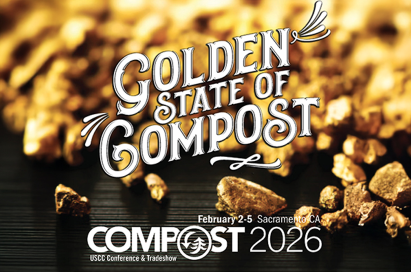
The world’s largest composting convention did not disappoint this year, as it brought thousands of vendors, composters, consultants, public sector employees, and researchers to the SAFE Credit Union Convention Center in Sacramento California. Presentations included fascinating research updates, financing strategies, policy developments, and novel approaches for blending, marketing, and selling composts. Being a California-based conference this year, there was plenty of SB1383 and SB54 conversation to be had as the state smooths out the wrinkles in the nation's more ambitious organics-diversion program on record.
WORC’s Vice President, Kelsey Bailey, spoke about King County’s procurement strategies and WORC sponsor organizations Engineered Compost Systems and Green Mountain Technology led half-day workshops on navigating air permitting and integrating food waste into composting operations.
Huge thanks to the US Composting Council and the Compost Research and Education Foundation for hosting another incredible composting conference! And save the date - we’ll be heading to Daytona, FL for COMPOST2027!
| | BioCycle: New Census Shows Community Composting Scaling Up and Delivering Results | | | | |
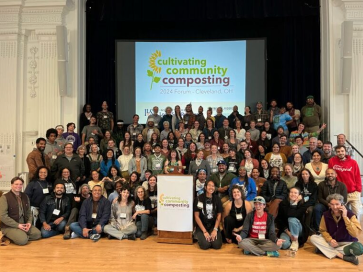
Community composting continues to become a more established and resilient part of the organics recycling ecosystem. The 2026 Community Composter Mini-Census – based on 2024 data – from the Institute for Local Self-Reliance (ILSR) offers a data-rich update on how the sector is evolving since the first national census in 2022. For composters, the findings provide both validation and insight into how peer operations are growing, diversifying revenue, and managing scale.
Some of these key findings highlight:
| |
-
Growth is no longer the exception - Community composting is expanding in both number and scale. While the sector once averaged just one new operation per year prior to 2010, the Census shows an average of 11 new operations per year between 2011 and 2025, confirming that community composting has entered a sustained expansion phase.
-
Food scraps are central to the model - Nearly all community composters surveyed – 98% – report handling food scraps. This highlights a key distinction: community composters are often filling gaps in local food waste diversion that larger systems are not designed to address.
-
Scaling brings capital needs into focus - As operations grow, so do investment needs. When asked about hypothetical funding priorities, respondents most frequently cited equipment and supplies, followed by vehicles, land or sites, staffing, and site improvements. These needs reflect the realities of scaling community-based infrastructure, where capital investments are often incremental but critical to maintaining service quality, managing contamination, and supporting staff.
-
Revenue mix is shifting, not weakening - While the share of respondents receiving collection service fees declined from 75% in 2022 to 61.2% in 2024, reliance on government contracts more than doubled, rising from 11.9% to 26.2% over the same period. Grant funding also increased significantly, with 41.8% of respondents receiving grants in 2024, up from 26.2% in 2022. The majority of respondents estimated that 85% or more of their revenue came from earned income in both 2023 and 2024, indicating that grants and contracts are supplementing, not replacing, core business activity.
-
Financial health is improving - Financial stability is trending in a positive direction. The share of respondents reporting positive revenue increased from 2023 to 2024, with 71% reporting positive revenue in 2024, a 14 percentage point increase year over year. This improvement suggests that many community composters are moving beyond startup volatility and toward more sustainable operating models.
-
Jobs and community impact remain core strengths - Community composting continues to generate local employment. Because composting remains local by design, these jobs, and the benefits of compost use stay within the communities being served.
|
| WSU Farmer Compost Training (via PCD) | | |
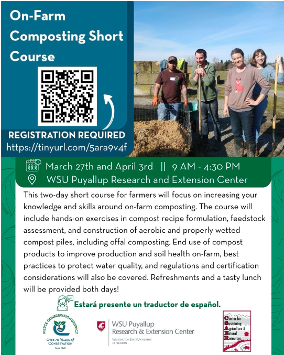
Are you a produce or livestock farmer interested in improving your working knowledge of on-farm composting strategies?
If so, the Pierce Conservation District’s spring training may be for you! See the flyer below for more information about the unique training opportunity for farmers.
| | | |
WORC Announces
2026 Board Members and Committees
| | |
Happy New Year from WORC! Please join us by signing up for one of our committees and welcoming our new Board Officers and Directors for 2026-2027. To learn more and/or join a committee, please reach out to the Committee Chair.
Committees and Chairs
Officers
President: Dave Keeney, King County
Vice President: Kelsey Bailey, King County
Treasurer: Cullen Naumoff, WA Department of Ecology
Secretary: Kate Kurtz, Seattle Public Utilities
Directors
- Alissa Campbell, Recology King County
- Nehemias Chalma, Natural Selection Farms
- Doug Collins, Washington State University
- Dan Corum, City of Tacoma
- Scott Deatherage, Barr-Tech Compost
- Jasmine Kamdar, Green Mountain Technologies
- Kevin Kelly, Divert
- Stephanie Kraus
- Reingard Reiger, Tilth Alliance
- Chris Thomas, Divert
- Wendy Weiker, Republic Services
Ad Hoc Director
Liv Johansson, Golden Roots Organics
| | | | |