|
February 2025 Markets Newsletter
| |
|
In this issue:
- "Practice Makes Published" by Chelsey Clammer
- Calls from Editors: Pitches, Freelance Gigs, Opportunities
- "On Submission with The Write Launch and bookscover2cover, LLC Founding Editor Sandra Fluck" interview by Renee Roberson
- February Deadlines: Poetry, Fiction, Nonfiction, Multigenre, Just for Fun
- Craft Corner: "You’re Dumped! How to Avoid Information Dumping in Your Writing" by Julie Shackman
- Recent posts on The Muffin
| |
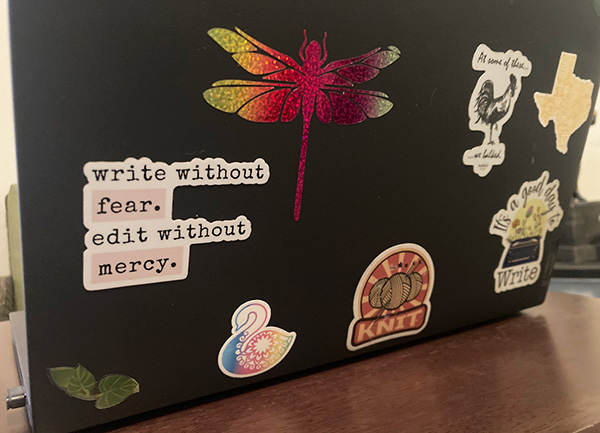
I went through a sticker phase a few summers ago. Stickers purchased from Etsy and slapped on every surface of writing-related object I had. I found them as inspiration and encouragement. “Someone out there needs your writing,” reads the cover of one journal; “Write like it matters, and it will,” reads another. | |
|
My absolute favorite is on my computer: “Write without fear. Edit without mercy.” I want to fist-bump this sticker. It’s like a motto I live by and an excellent reminder. Because there’s writing, and then there’s editing. Both are equally important to the writing process; one is not as favored.
There’s something about “killing your darlings” that doesn’t sit well with some. Or how about realizing the piece really starts on the last page? Or even admitting that you actually have two pieces in one and they need to be separated, or opposite town: there are two thoughts that need to be woven together better into one.
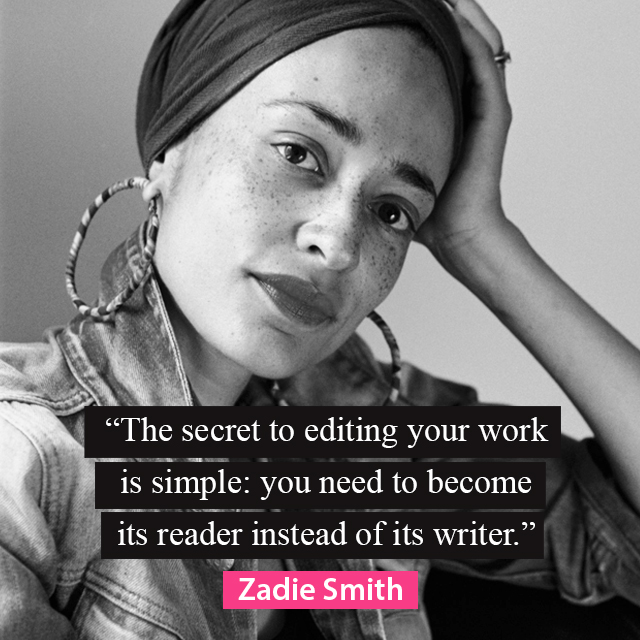
These are all tasks I think most writers dread or at least don’t quite know how to do on their own. One thing writers can do to address this is gain some narrative distance. You must separate writer-you from editor-you, to not only face your fears of getting the writing out of you but also face perhaps a bigger fear of changing what you think might be acceptable. But who wants “acceptable” writing? Not publishers, that’s for sure. There are numerous things you can do to create narrative distance from your work so you can edit it.
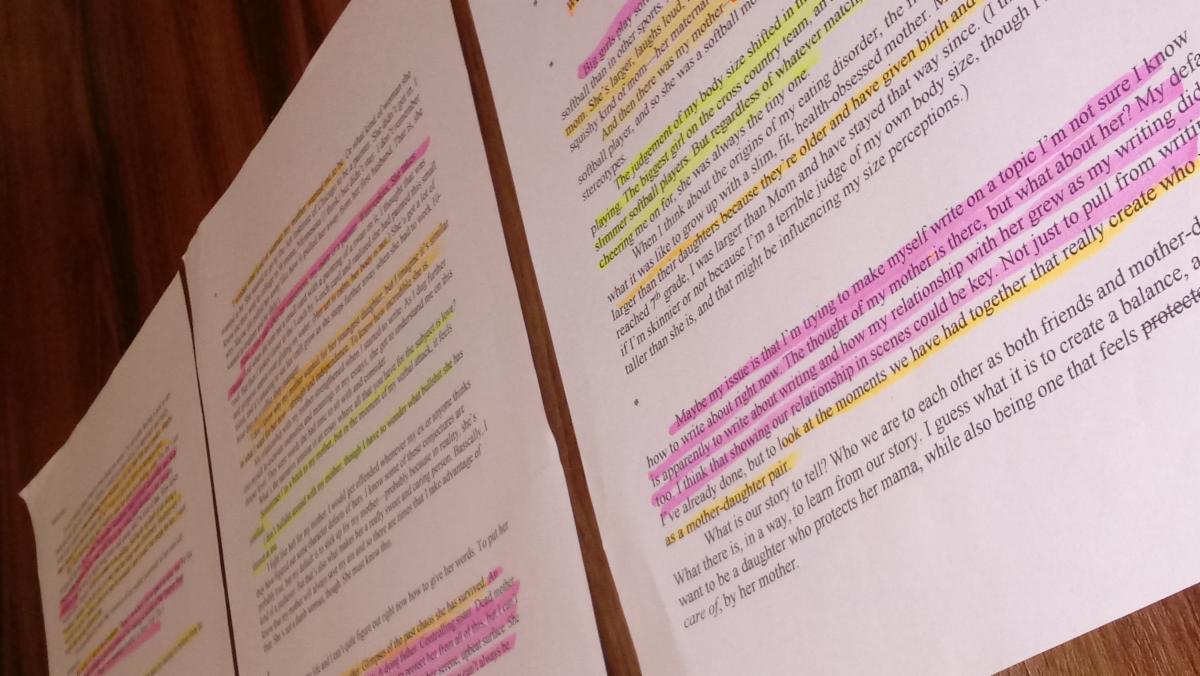
- Print out your drafts to edit them by hand
- Change the font of your drafts so they look different to you on the page
- Give yourself at least a month in between the time you wrote the piece and when you return to it for revisions
- Record yourself reading it out loud then listen to it to hear the words differently
|
|
Those are some of the best tips editors can give writers. But here’s the secret and the way to address your revising dread: the way to effectively implement those tips and tricks is to actually do them. Meaning: PRACTICE. Don’t just do one round of revisions and call it done. I tend to follow this editor workflow when I approach my first sketches of an essay:
- Print out piece and read it without paying attention to grammar. Just read it to see if I get bored anywhere (hello information dump!) and look for narrative holes.
- Take out/write more as needed.
- Repeat Step 1 and 2 as needed.
- Print out piece and cut it up section by section (sometimes paragraph by paragraph) and rearrange to ensure I have the best organization.
- Apply edits to the computer file, print it out, and begin line edits. Meaning, take a pen to it and read it carefully to make sure each sentence makes sense, then apply edits to the computer file.
- Repeat Step 5 ad nauseam until I’m sick of the piece.
- Take an hour to a week away from the piece.
- Record myself reading it out loud, and listen to the recording, making notes on the file as needed.
- If there are a lot of changes, repeat Step 8 as necessary until there isn’t a damn thing I would change about the piece.
- Send the piece to my beta readers and repeat Steps 1–10 as necessary.
Writing is hard, although anyone can do it. Writing well is even harder, and only those who stick with it succeed. Building from that, editing is the hardest because it means taking your most precious creation and mauling it until it looks nothing like the original in 10 steps or possibly more. But hey—that’s where the real writing happens. And for me, it’s the most fun part of the process. It’s where you get to take the results of facing your fears as you put pen to page and mercilessly creating them into art.
Once you’ve created your masterpiece, why not challenge yourself by submitting to your dream market? The act of submitting builds confidence in your work, and this month’s issue has plenty of new and exciting markets to try. You’ll also be treated to a markets interview by Renee Roberson, who chats with Sandra Fluck, founding editor of The Write Launch. This literary journal publishes monthly and seeks submissions in poetry, long short story, short story, creative nonfiction, essays, and uniquely—novel chapters! They are open for submissions the first two weeks of the month.
Circling back to my point above on avoiding reader boredom, in this issue’s Craft Corner, author Julie Shackman shares her best tips and tricks for avoiding info dumps in your writing. Instead of dropping reams of information, discover how to drip and thread, create pictures, use conversation, items, and even holidays to keep your readers entertained.
| |
|
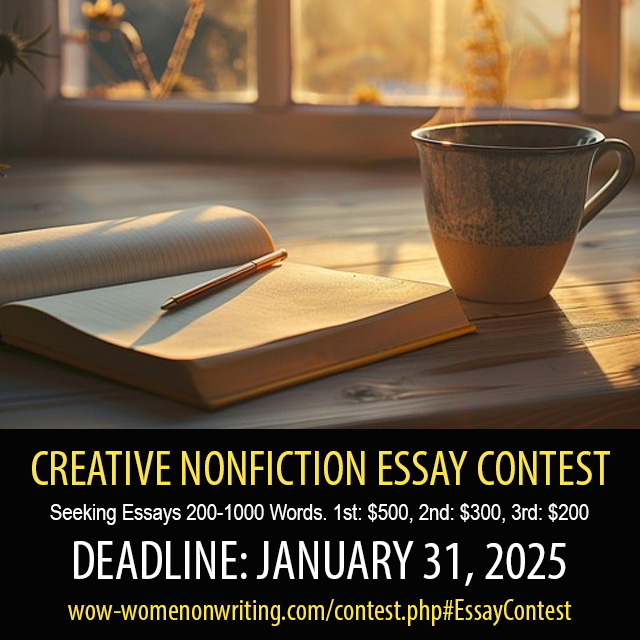
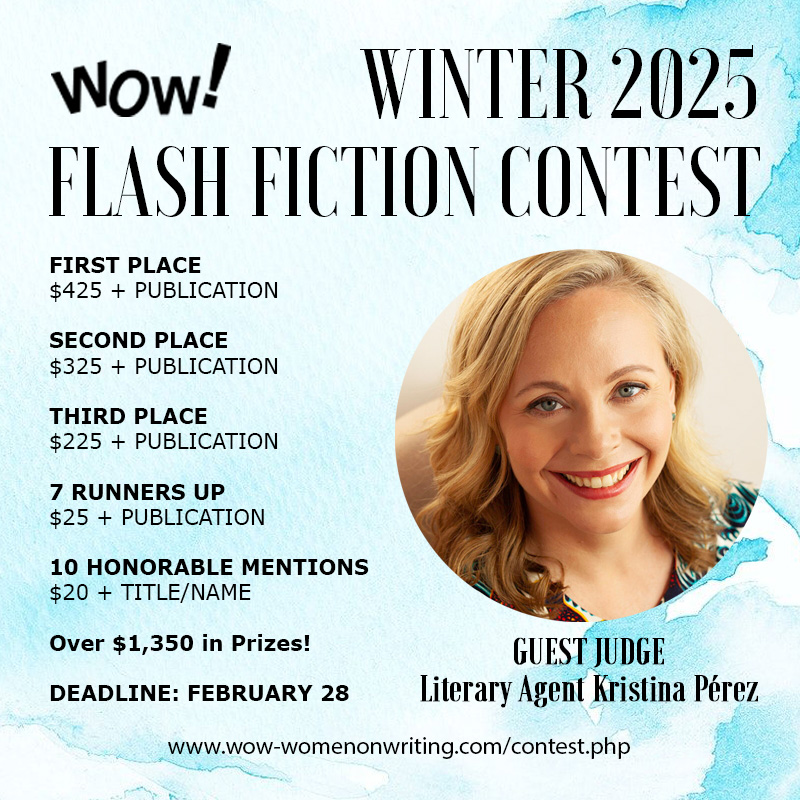
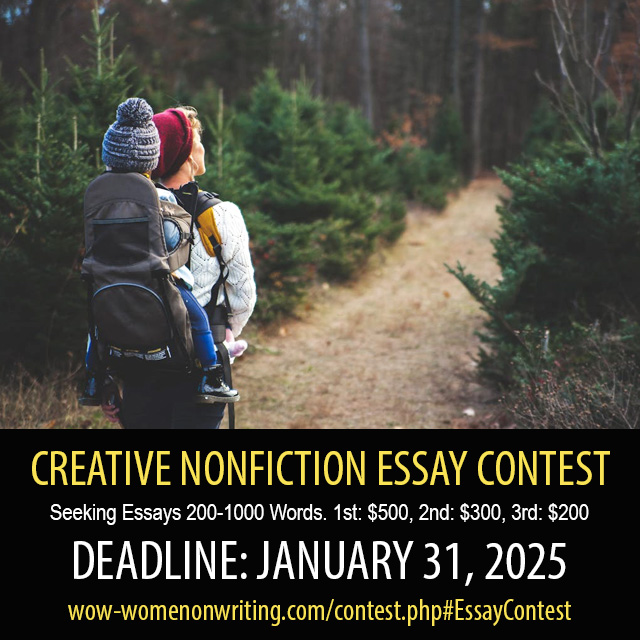
Our contest readers and judges love an entertaining read, too! If you’ve written an essay of 1,000 words or fewer, consider submitting it to WOW’s Q2 Creative Nonfiction Essay Contest by January 31st. Fiction writers will enjoy WOW’s Winter 2025 Flash Fiction Contest with guest judge literary agent Kristina Pérez, founder of Pérez Literary & Entertainment. Submit your flash fiction of 750 words or fewer by February 28th. WOW offers $1350 in cash prizes for fiction, $1,250 for nonfiction, and accepts previously published work.
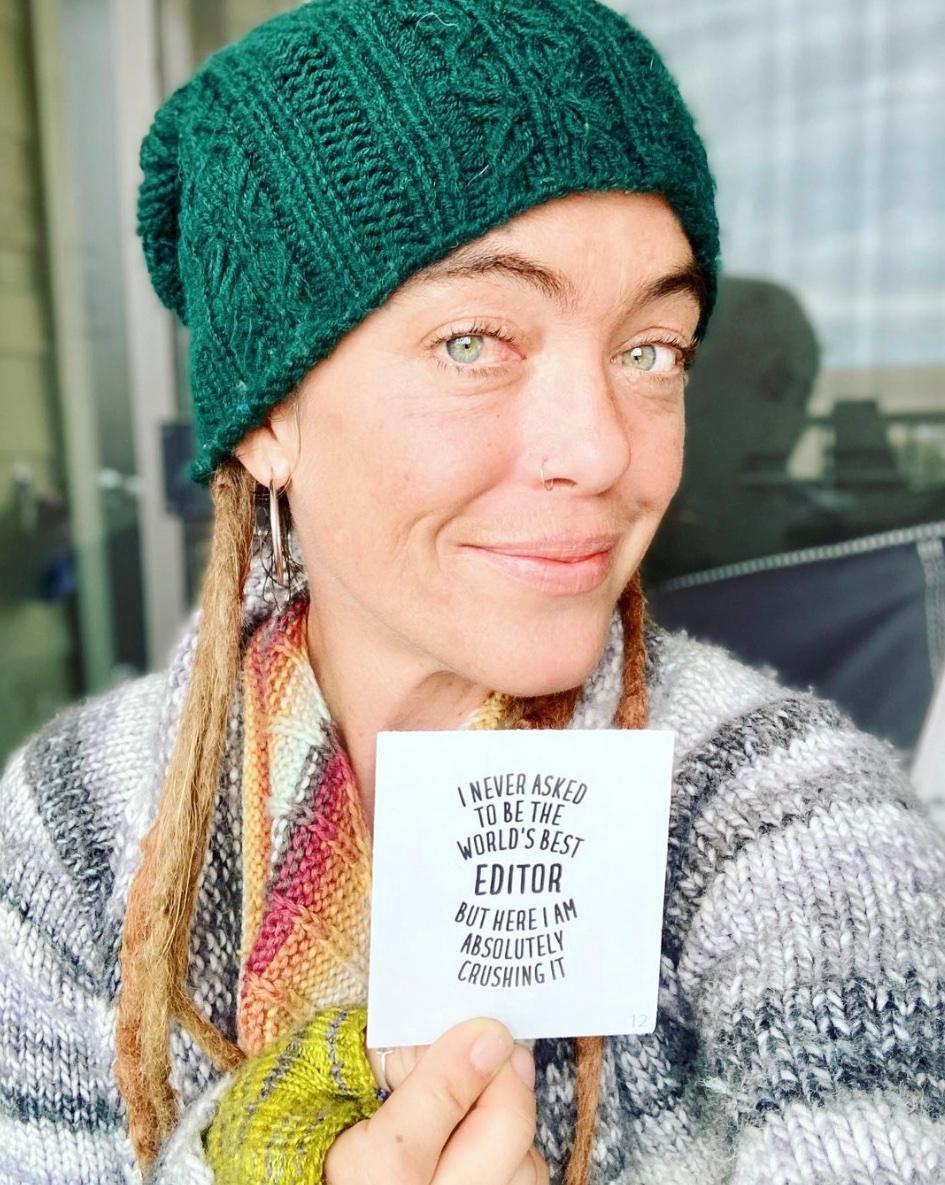
On a final note, and to do that thing that editor-me tends to encourage myself to do to create a complete-feeling piece of writing, I just want to tell you that my coffee mug (which I consider a writing tool) says, “I never asked to be the world’s best editor but here I am absolutely crushing it.” Go get that sticker for yourself because the more you practice editing, the truer it will be.
| |
|
Chelsey Clammer is the award-winning author of the essay collections, Human Heartbeat Detected (Red Hen Press, 2022; finalist for the Memoir Magazine Book Awards 2023), Circadian (Red Hen Press, 2017; winner, Red Hen Press Nonfiction Manuscript Award) and BodyHome (Hopewell Publications, 2015). Her work has appeared in Salon, The Rumpus, Brevity, and McSweeney’s, among many others. She’s a freelance editor and teaches online writing classes with WOW! Women on Writing. Chelsey's next class starts March 3: Writing is Revising: How to Become a Better Editor.
| |
WOW! Book Promotion Services | |
|
Do you need help promoting your book in 2025?
WOW! offers virtual marketing options for authors, such as blog tours, radio/podcast tours, opportunities for your book to be reviewed, and fun creative events. We accept all genres and promote books that are about to be published as well as books published years ago. Whether you are a self-published author, indie author, or traditionally published, we’d love to work with you on promoting your book!
Check out WOW's Book Promotion Packages.
| |
The Story of You: Memoir as a Path to Self-Discovery | |
|
There’s only one person who can tell the story of you.
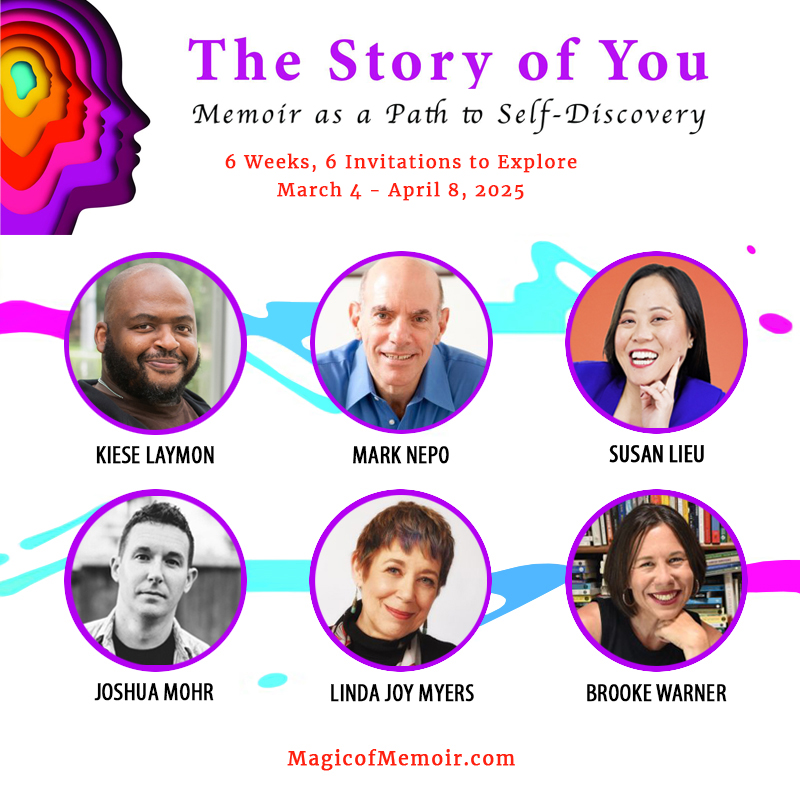
A new six-week course with Kiese Laymon, Mark Nepo, Susan Lieu,
Joshua Mohr, Brooke Warner & Linda Joy Myers!
The intention of these six weeks together is simple—to provide new insights and supportive structures for memoirists, no matter what stage of the writing you’re in. Join us for these six weeks to explore, unpack, and unspool the story of you.
-
Truth, with Kiese Laymon, author of Heavy
-
Self-expression, with Mark Nepo, author of The Book of Awakening
-
Staying the course when other people would rather you not write your memoir, with Susan Lieu, author of The Manicurist’s Daughter
-
Self-forgiveness, with Joshua Mohr, author of Model Citizen
-
Discovery, with Linda Joy Myers, co-host of Magic of Memoir
-
Authenticity and paying attention to the messages your memoir is sending you, with Brooke Warner, co-host of Magic of Memoir
The Story of You: Memoir as a Path to Self-Discovery
6 Tuesdays: March 4 - April 8
Live Zoom Classes: 4-5pm PT | 7-8pm ET
Check out the details:
MagicofMemoir.com
| |
Calls fo Pitches, Opportunities | |
|
Narratively – My Secret Obsession
narratively.com
The editors are looking for true stories about real people with secret obsessions or unconventional infatuations. Ever know someone who got so obsessed with a stranger’s cold case that they lost all their friends as a result? Have you had a neighbor who started rescuing stray cats at an unhealthy level, causing your whole block to turn against him and resulting in an ugly lawsuit? Was it you who rescued hundreds of cats and had your whole neighborhood confront you publicly? The more unique and unheard of the better, with bonus points for finding the comedy and joy in unlikely circumstances. These can be first-person pieces about your own experience or reported stories. Pay: $750 and up. Check out their call and send your pitches via Submittable by February 13.
Vittles Cooking – Recipe Essays
vittlesmagazine.com
Vittles Cooking publishes recipe writing, cooking from life essays, feature pieces, and restaurant writing. They’re particularly interested in hearing from people whose work challenges the traditional European- and/or American-centered perspective of mainstream food writing. If you don’t consider yourself a ‘food writer’, please still pitch! They value passion, intimacy with a subject, and lived knowledge over writing experience and bylines. Pay: for recipe columns, an introductory essay of 500-800 words plus an unpublished recipe, they pay £500 (note that this fee also covers the provision of photos of the dish). For shorter contributions—tips, compilation entries, etc.—they pay £150 or around 40p a word. Check out their call for pitches and email vittlespitches@gmail.com with the subject heading ‘COOKING PITCH’.
Late Checkout – Food & Beverage
latecheckouttime.com
Late Checkout is a cheat sheet for jet setters and go-getters with a penchant for all things food, drink and travel. Editor Daria Smith is looking for fresh, creative story ideas in Food & Beverage for these columns: Chow Now, Be Our Guest, and Having a Moment. She’s also on the hunt for compelling pitches for Well, Then (travel) and Kids Menu (across all categories). Open to US writers only. Pay: $200 for 200 words, with five e-commerce product links with descriptions; $150 for 200 words without e-comm recs. E-comm must be agreed upon beforehand. Check out their pitch guidelines and send your pitches to daria@latecheckouttime.com with the subject line “Pitch: Category: Column: Title.”
Motley Bloom – Lived Experiences of Neurodivergence
motley-bloom.com
Editor Lauren Quinn is looking for voicey pieces that center lived experience with neurodivergence. They approach ND from a living and lifestyle lens, rather than a health and science one, and focus on articles and stories that help their readers live out loud and unmasked. Motley Bloom’s February digital theme is relationships (romantic, family, work, friendship) and communication, so they’re particularly looking for articles and first-person pieces that fall under that umbrella. Pay: $300 for short articles, $500 for longer researched and/or first-person pieces. Check out their submission guidelines and send your pitches to Lauren at lauren@motley-bloom.com with “PITCH” in the subject line.
Refinery 29 – Money Diaries
you.refinery29.com
Ready to get real about your spending habits in 2025? The editors are accepting new Money Diaries submissions. Log your spending over seven days and report back to them with all of the details. Keep in mind that all Money Diaries published to the site are anonymous. Record the time of day, amount spent, and a little blurb about what you bought for every purchase. The more detail you provide, the better understanding they get of your day-to-day, which is what makes a Money Diary fun to read. Please try to keep your Money Diary between 3,000-5,000 words. Pay: $150 for each published diary. Check out their guidelines and submit a money diary on this page.
Dot Dash Meredith – Freelance Commerce Writers
dotdashmeredith.com
Editor Lily Gray is looking for freelancers to write trending commerce roundups, sales and deals stories, product launch pieces, and more shopping-oriented content for Real Simple, Better Homes & Gardens, and Southern Living. Looking for someone with published commerce writing experience with a focus on home, gardening, fashion, and/or lifestyle topics—ideally with an expertise in one of these areas. Pay reports: $250+ per article. If you’re open to assignments, she’d love to hear from you with a link to clips/portfolio! Please email her at lily.gray@dotdashmdp.com.
RetroDodo – Retro Gaming and Collectibles
retrododo.com
RetroDodo was founded in 2019 with the goal of becoming the leading buyer’s guide for retro gaming enthusiasts and nostalgia collectors. They’re accepting feature pitches from retro gaming journalists, and are looking for unique stories on retro gaming culture and collectibles. Pay: £250 to £300 per feature (2,000 words). Pitches to pitches@retrododo.com.
Upload VR
uploadvr.com
UploadVR is a news organization focused on the intersection between people and Virtual Reality (VR) and Augmented Reality (AR). Their senior editor Henry Stockdale is seeking pitches from freelance writers for reviews, previews, and more. Pay: $150 for smaller impressions pieces, $240 for reviews, and a minimum of $175 for features. Pitches to hstockdale@uploadvr.com.
bioGraphic
biographic.com
An independent online magazine connecting readers with stories about biodiversity and conservation from around the world. Senior News Editor Colin Schultz is looking for pitches for new and interesting stories with strong science and societal relevance. Recent stories include “France’s Deadly Seaweed,” “Australia’s Plant Virus Sting Operation,” “For Older American Alligators, Mercury is in Retrograde,” and more. Pay: $1 per word. Pitches to cschultz@biographic.com.
Live Science
livescience.com
Live Science regularly publishes freelance news, features and explainer pieces. They cover everything from fascinating archaeological discoveries from ancient Egypt, to bizarre ancient sea monsters, to wild theories about the birth and death of the universe. Health Editor Nicoletta Lanese is always looking for pitches on news and evergreen stories for the lay public that unpack the latest medical breakthroughs and mysteries of how the human body works. Pay reports: $250 and up per piece. Check out their pitch guidelines and pitch your health stories to Nicoletta at nlanese@livescience.com and all other pitches to ls-editors@futurenet.com. In the email subject line, include the channel you're pitching, the type of pitch, a proposed headline.
Insider – Grocery Diaries
businessinsider.com
Editor Stephanie Pitera Statile is looking for some fresh pitches for their Aldi, Costco, and Trader Joe’s grocery diaries! You must be able to visit the store and snap photos of each item you’re speaking about during your next trip! Sometimes it’s easier to snap photos first and write second. She’d love to hear about why you like each product and what you use it for/why it’s a great value. No deadline to reach out. Pay: $175+ per piece. Pitch via form.
Empire Movie Magazine
empireonline.com
The editors are always looking for exciting, original pitches for their news section, First Word. Each story has a distinct angle. They are looking for explainers, articles on new talent, reported pieces, and trend pieces. Pay: 35p+ per word. Check out their pitch guidelines and send your ideas to empire@bauermedia.co.uk with ‘PITCH: [brief description of what your pitch is]’ in the subject line.
Tasty – Freelance Food Writers
tasty.co
Are you a food- or cooking-obsessed freelance writer looking for work? New Head of Editorial at Tasty, Ross Yoder, is looking for freelance food writers to contribute evergreen and timely stories on home cooking and trending food & dining moments—all with an approachable, down-to-earth POV. Tasty meets home cooks and food enthusiasts where they are, so the mission is to produce content that appeals to the food-loving masses…regardless of how much experience they have or what their checking account balance looks like. Note: Recipes won’t be his main focus, but he’s certainly open to receiving your recipe pitches alongside more standard editorial posts. He’s seeking repeat contributors to write articles on a regular basis. Starter ideas: testing and/or weighing in on that one viral food trend that keeps popping up online; a list of your go-to, cheap grocery staples as a [first time parent? Pro cook? Insert identity here], and how you turn them into simple meals or snacks; deep dives on buzzy food and dining happenings, from reservation cancellation fees to reviewing that long line-inducing new viral treat in your city; an explainer on your favorite cooking tip or trick that not nearly enough people know about; food and dining-focused personals, especially identity- or culture-based stories. Pay reports: $0.30 per word. If this sounds like you, please send an email to tasty-freelance-pitches@buzzfeed.com with your idea(s) and/or 2–3 links to recent writing samples.
i-D – Fashion, Style, Art
i-d.co
Editor Douglas Greenwood is commissioning across culture, fashion, art and photography for i-D. Op-eds, new talent profiles, left-field looks at what’s cool right now and introductions to what will be cool tomorrow. He’s looking for stories—give him the conflict that incites a cool and fun conversation. Pay reports: 50p per word. Pitches to douglas.greenwood@i-d.co with clips.
Restart – Video Games
restart.run
Independent gaming news powered by Walmart. The editors are looking for freelance pitches related to Monster Hunter Wilds and Assassin’s Creed Shadows (they’re not seeking a reviewer). Pay: $200 per article. Send your ideas to hello@restart.run.
The Sick Times – Covid-Related Stories
thesicktimes.org
Founding Editor Betsy Ladyzhets is accepting Covid-related pitches for reported news stories and essays/commentary pieces. In 2025, they’re particularly interested in long Covid pieces. Pay: $1,300 for news features of 1200-1500 words. Check out their recently updated guidelines and send your pitches to editors@thesicktimes.org.
Financial Times – Writers Working in Hospitality Food Service
ft.com
Financial Times Food and Drink Editor Harriet Fitch Little is seeking writers who also do jobs in hospitality. She runs a short column most weeks called Insider’s Notebook. It is written by people who are currently doing a job in hospitality and who have spotted an interesting trend in their corner of the industry that other people aren’t talking about. Here are some examples of previous writers+themes that she’s paid to write in this slot: a bar owner on why the “perfect Guinness pour” is a lie; a baker in Paris on the new competition from “microboulangeries”; a waiter on how gut health has led people to oversharing about their bowels; a chef on what it’s like the week after your restaurant gets a Michelin star; a kitchen porter on how work WhatsApp has ruined his work-life balance. Pay: 40p per word. Pitches to harriet.fitchlittle@ft.com.
US Weekly – Commerce Writers
usmagazine.com
Director of Ecommerce and Affiliate Marketing Kara Kamenec is growing her commerce team and is looking for freelancers to create shopping content on US Weekly. She’s seeking experienced commerce writers to create fun, inspirational affiliate shopping articles quickly and efficiently based on trends and data. Prior experience writing affiliate fashion, beauty, celebrity and deal content is preferred. She’s also searching for talented video influencers to create engaging shopping videos for our audiences (primarily with products in the categories of fashion, beauty, and home). Pay reports: $200+ per article. If interested, please email their team your resume, rates, samples and portfolio to ShopWithUs@usmagazine.com.
Frivolous Comma – Essays & Columns on Speculative Fiction
frivolouscomma.com
Frivolous Comma is a space for creators to find curiosities that help them in their journey as writers, illustrators, animators, and storytellers. The editors are seeking essays or columns about explorations of speculative fiction that address some aspect of transition and intersectionality. Reflections on writing speculative fiction and your personal identity’s influence on your work. Opinions on recent developments in speculative fiction, SF history, associated SF theory and criticism, and SF fandom and culture. Propose an original argument, being aware of existing literature in your area (popular or scholarly). Reviews/book round-ups through a personal/memoir lens. Pay: $125 per essay/article around 1,000-2,500 words. Submit via form.
| |  |
|
Reactor – Essays on Sci-Fi/Fantasy Literature
reactormag.com
Reactor is an online magazine that covers science fiction and fantasy literature. Senior Editor of Book Content Christina Orlando (they/them) is seeking freelance writers to write critical or personal essays pertaining to contemporary SFF. They’re not looking for individual book reviews. They’re looking for work that recontextualizes beloved SFF texts, looks critically at trends/tropes, and isn’t afraid to be nerdy. They love academic-leaning essays and essays that align SFF with larger cultural/political conversations, personal essays about special reading experiences and nonwestern worldviews. Some examples include, “Finding Comfort in the Horror of Stephen King’s Maine,” “Fatherhood and Masculinity in Star Wars: Attack of the Clones,” and “All Insurrections Are Not Created Equal: On Writing Resistance After January 6.” Pay reports: around $200 for published essays. Check out their submissions guidelines and send your essay pitches, along with relevant clips, to christina.orlando@reactormag.com.
StoryTerrace – Freelance Development Editors
us.storyterrace.com
They are looking for experienced freelance Development Editors to join their publishing team as they embark on expanding their rapidly growing PRO line of Publishing-Grade Memoirs and Topic-Based Nonfiction books. The ideal candidate will have at least 7-10 years’ experience as a development editor, and at least part of that experience will have been working with or for top-tier trade or academic publishers. They want remote editors who can work simultaneously on 2-5 projects a month. Pay: $1,500 per 20k-word manuscript. Apply via form.
Writing Examples – Remote
writingexamples.com
Founding Editor David Perell is looking to hire a writer for his site, Writing Examples. You’ll work directly with him to give people X-ray vision into the written word. You'll be responsible for dissecting the best writing in history and explaining exactly why it feels so alive. You must be a voracious reader with strong opinions about what makes for great writing, and you must be at the cutting-edge of what’s happening in AI. You can work from anywhere, and write two articles per week. Pay: $70,000 per year. Apply with a link to a piece you’re proud of, tell him how you plan on improving the content of the site, your favorite novel that was published before 1900 and explain why (100 words max), link to your favorite piece of online content that explains why a piece of writing, speech, movie, song, stand-up special, etc. is good, and why you like it—via form.
Insider – Disappointing Vacations and Moves
businessinsider.com
Lifestyle and Entertainment Editor Stephanie Pitera Statile is seeking pitches: Did you go on a dream vacation only to leave disappointed? Spend a ton on an underwhelming cruise? Regret moving states or countries? Looking for pitches for short, 500-600 word essays! Pay: $200+ per essay. This is an ongoing call. Pitch via form.
BuzzFeed – Remote Shopping Writers
buzzfeed.com/shopping
BuzzFeed is looking for shopping-and products-focused freelance writers to contribute to BuzzFeed Shopping. The ideal freelancer is a conversational writer with experience writing consumer- and shopping-related content; someone who is just as comfortable writing about a product they personally adore as they are digging into reviews to find out which viral skincare products actually work or unearthing quirky kitchen gadgets people haven’t seen before. Pay: $150 per post. Apply with your writing samples via form.
MIT Technology Review
technologyreview.com
MIT Technology Review publishes a wide range of stories, from breaking news to long-term investigations. They want stories about technology itself, but they’re particularly excited about those areas where technology and humans collide—where technology meets the real world. Their stories should feel like must-reads for people who want to stay up to date with how technology is changing our world. They commission news stories (generally 800-1,000 words), analysis pieces (800-1,000 words), and features (2,500-4,000 words) from freelancers. Pay: $1 to $2 per word. Check out their call for submissions (upcoming themes: Power, Security, and The Body) and send your pitch to commissioning editor Rachel Courtland rachel.courtland@technologyreview.com with “PITCH” in the subject line of your email.
The Ferriss - UC Berkeley Psychedelic Journalism Fellowship 2025
This journalism fellowship offers ten $10,000 reporting grants per year to journalists reporting in-depth print and audio stories on the science, policy, business and culture of this new era of psychedelics. In addition to underwriting individual stories, the Fellowship aims to establish and nurture a new generation of journalists covering the frontlines of this rapidly changing field. They’re looking for big, underreported, narratively compelling stories placed in rich political, economic, scientific, and cultural contexts. Send a story pitch, along with your resume, work samples, and links to three of your published or aired stories via form by January 31.
Kernel Magazine: Issue 5 – Theme: Rules
kernelmag.io
Kernel Magazine is an annual print publication by Reboot, a community reimagining techno-optimism for a better collective future. They believe that technology can be transformative, for both better and worse, and that as technologists, we have a responsibility to own our role in this transformation. The theme of Issue 5 is RULES, and they are looking for essays on this theme. Your pitch should include a clear thesis, forward-looking analysis, and a unique perspective. Pay: $250 to $350 per essay, depending on length; $200 for interviews. Check out their pitch guide and send your pitch via form by February 1.
Mirror Lamp Press: Issue 11 – The Food Issue
mirrorlamppress.com
The editors are seeking pitches for Issue 11, a deep dive into all things food-related. They welcome responses in the form of creative nonfiction, essays, memoir, and reportage that examine the personal, political, or cultural aspects of food. Additionally, they are open to recipes, reflections on specific dishes, and book, restaurant, TV, or Film reviews. This call is open to both Irish and international artists and writers. Pay: €500 for a piece of 1,500–2,000 words; Artists: €500 for a comic essay, and €1,000 for a selected artist. Check out their call for pitches and send your pitches to info@mirrorlamppress.com with “PITCH” in the subject line by February 3.
Digital Frontier: Issue 004 “Echoes”
digitalfrontier.com
Magazine Editor Sophia Epstein is seeking pitches for their issue on “Echoes.” The theme came from the idea of history repeating itself, echoes through time, etc. but you can interpret it however you want—as long as it relates to emerging digital tech and its impact on our lives. Did something happen in the 1400s/1600s/1990s that strangely seems to also be happening today? Perhaps a past cultural movement is now occurring again, online. If so, what does it mean for society? Is there a “new” concept or business strategy that a startup, academic or subculture is trying to make happen today that actually worked hundreds of years ago? Have you noticed a pattern in the way things happen in the tech world? Could be over centuries, decades, days, hours...are we more predictable than we think? Have you got a strange theory that one of today’s big tech moguls is a historical figure reincarnated? Everyone is welcome to pitch! Pay: 30p+ per word. Please send your nuanced, optimistic, well-researched, unique pitches to sophia@digitalfrontier.com by February 4.
OpenNews - Scholarships for Journalists Working With Data and Code
opennews.org/what/community/scholarships
OpenNews can help you pay for events and programs that develop your work as a journalist with data and code. Attend a conference, take a class, join a training, sign up for a leadership program—you know best what you need. These $250 to $500 stipends are for U.S.-based journalists. Apply via form by February 6.
Inspire the Mind – University Mental Health Day
inspirethemind.org
Inspire the Mind is a digital magazine that focuses on the intersection between mental health, science and society. For University Mental Health Day in March, they’re seeking article pitches from a mental health lived experience perspective. Pay: £200 for pieces of 1,000 to 1,200 words. Submit a pitch via the form on their homepage by February 7.
Mildew: The Secondhand Fashion Magazine - Issue 4
mildewmag.com
Mildew is an annual print magazine about secondhand fashion and creative reuse, featuring art and writing that inspires us to think about old clothes in new ways. The editors are looking for story pitches that inspire readers to think about old clothes in new ways, and that go beyond “why thrifting is more sustainable/ethical/fun/personal than fast fashion”—you can already assume Mildew readers are passionate about re-use. They’ve published articles on topics like: funerals for sewing needles, why Iranian secondhand bazaars are named after a Japanese soap opera, a poetics of eBay search terms, an anti-capitalist fashion magazine from East Germany, the store in Alabama where lost luggage ends up, and much more. This magazine won’t come out until the fall, so please think about timeless stories over time-sensitive pitches. (Secondhand is seasonless!) Some specific stories they’re hoping to include: Culture x Stuff: Tell them about a reuse practice that’s a special part of your family/community/religion/ location and how it shapes ideas around ownership/clothes/trash. (Past stories include: preservation of the tallis; pambahay and pang-alis; wearing your mom’s cheongsams.); Flea Market Photo Tours: Seeking photographers from around the world to document your local flea market; Trash Art: They want to hear about/from artists who create work (digital, sculpture, musical theater—anything goes) around themes of recycling, old clothes, found ephemera, etc. Not Easy Being Green: Expose a kink in the secondhand pipeline and explore solutions; Georgians: They’re looking for a writer/photographer in/near Augusta, Georgia for a story assignment. Pay: $0.50 per word. Send your pitches to Ellen at mildewmag@gmail.com by February 9.
Workshop Proposals for Retreat for Survival and Healing
sundresspublications.com/news/2024/12/call-for-workshop-proposals-for-retreat-for-survival-and-healing-2
The Sundress Academy for the Arts (SAFTA) welcomes proposals from writers, therapists, narrative medicine practitioners, and more for their fourth Retreat for Survival and Healing. These workshops should be designed with an eye toward forging connections and making creative writing accessible to beginners and experienced writers alike. Proposals in all writing genres, as well as hybrid genres, will be considered. Each workshop will be approximately 90-minutes in length and will be conducted twice. This retreat will take place in Oak Ridge, TN, during a Friday/Saturday in October, 2025 (official date to be determined). Workshop leaders will receive a $1,000 honorarium to cover travel, housing, and teaching fees. Submit a proposal no longer than 250 words and include information on the type of workshop you’d like to hold via form by February 20.
The Uproot Fellowship
uprootproject.org/initiatives/fellowships/apply
The Uproot Project Fellowship offers funding to seven journalists to pursue reporting projects over the course of a year. Fellows will receive up to $2,000 to cover travel and other reporting expenses and will also receive support from Uproot to place their stories with a media outlet, if requested. Fellows’ projects should focus on stories related to one of four categories: (1) environmental justice, (2) climate solutions, (3) water, food, & culture, and (4) science. Projects should be aimed at highlighting how the climate crisis and key environmental issues of our time are inextricably linked with other forms of inequity. Apply via form by March 1.
Trails Magazine – Issues 10 and 11
trailsmag.net
Founding Editor Ryan Wichelns is seeking pitches for issue 10 (theme: “Efficiency”) and 11 (“Connection”). He still needs a couple of features for issue 10—something reported would be great, profiles of fast/ lightweight/efficient hikers, looks at unique UL brands that save time or pack weight, etc. They also need an Outhouse Review, recipe, and a handful of Blazes (basically, the same topics as the features, but only 400-600 words) to fill out the issue. The deadline for issue 10 is February and March. For issue 11, connections to other people, places, trails, gear, inanimate objects... they’re pretty much a blank slate for this issue, so pitch away. Deadlines for issue 11 are around May. Pay: $0.50+ per word. Check out their guidelines and send your pitches to Ryan at ryan@trailsmag.net.
| |
WOW! Workshops Starting Soon | |
|
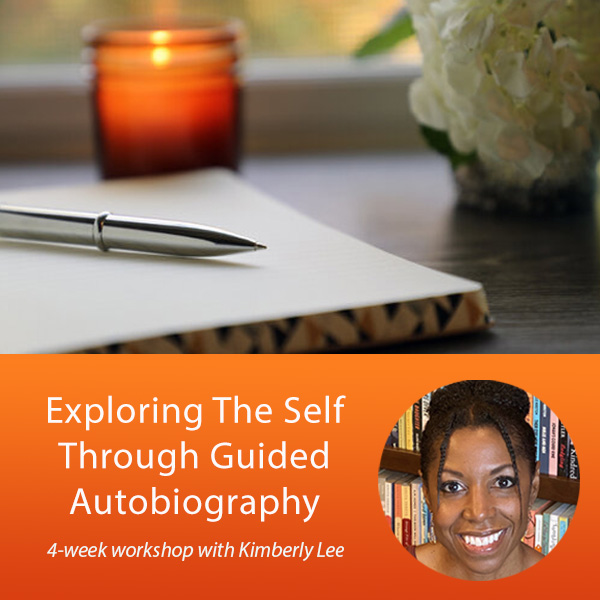
Exploring The Self Through Guided Autobiography
4 weeks starting February 3
Discover the power of your personal narrative through the insightful Guided Autobiography method. This unique reflective writing practice provides a holistic approach to memoir, self-discovery, and personal growth. This process helps integrate and make sense of one's past in order to recognize patterns, gain insights, and foster connections. With engaging readings and discussions, themed exercises, and inspiring prompts, participants will write and share short stories in a supportive online setting. Led by Kimberly Lee!
Class Details
| | |
|
Empower Your Muse, Empower Your writing Self
4 weeks starting February 3
Learn how to tap into the power of your subconscious mind to achieve writing success. Fee includes EITHER a free critique of any genre, up to 10 pages, or a 15 minute one-on-one phone consultation with the instructor on any topic related to writing (must be scheduled prior to the end of class). Led by Kelly L. Stone, the author of Time to Write: Professional Writers Reveal How to Fit Writing into Your Busy Life, Thinking Write: The Secret to Freeing Your Creative Mind, and Living Write: The Secret to Inviting Your Craft Into Your Daily Life.
Class Details
| | |
|
Hooked on Ekphrasis: Creative Writing From Visual Art
4 weeks starting February 4
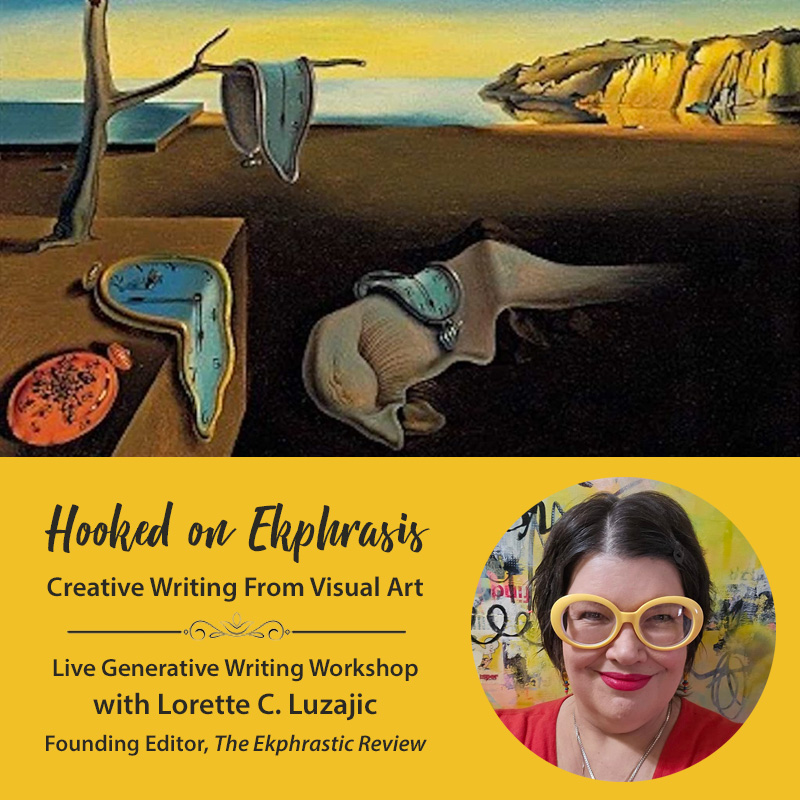
Ekphrastic writing is the practice of creative writing from visual art. People who love ekphrasis describe being hooked once they start, because it is a wonderful way to expand our imagination, grow our writing, and learn more about visual art. In this class, we will look at the 3000-year history of ekphrasis, and explore fun ways to create our own. We will read inspiring examples, find ideas through brainstorming and writing exercises, and talk about how and where to submit our ekphrastic poetry and stories. Led by Lorette C. Luzajic, founding editor of The Ekphrastic Review!
Class Details
| | |
|
Writing the Hermit Crab Essay and Other Related Creative Nonfiction Forms
4 weeks starting February 10
Non-fiction writing can be structured by borrowing a form we are familiar with from other writings that are not considered essays: prayers, bus schedules, recipes, how-to manuals or tv scripts to name a few possibilities. The idea is that by borrowing the structure (braiding, collaging, poetic language in related novel essay forms) and filling it with what we want to evoke about our personal experience we come upon surprises we might not have found otherwise. In this course, we will read a variety of essays and participants will write one of their own each week for response from the instructor and classmates. Led by Sheila Bender!
Class Details
| | |
On Submission with The Write Launch | |
|
A few months ago, a friend suggested I submit one of my short stories to the monthly literary journal The Write Launch. While I’ve entered many writing contests over the years, I haven’t spent as much time checking out the numerous online journals currently seeking submissions. I’m not sure why, because being published in literary journals is a great way to gain additional exposure, potentially attract the attention of literary agents, learn about book publishing contests, and enhance your writing portfolio and resume. WOW’s Markets Newsletter highlights so many good journals, and I’m always inspired after reading the call for submissions.
I wasn’t sure how my short story, about a writer on a deadline haunted by literal ghosts from her past, would be received. But I was pleasantly surprised to hear from the editor just a few short weeks later and found the editing process seamless and pleasant! The Write Launch features such an eclectic array of writing—I’ve read essays about a heartwarming dog rescue (“Pandemic Dog”) to a heartbreaking description of a woman’s final moments with her beloved husband (“Go Now”) before he passed away. Short stories feature memorable characters like a verbose history professor in “A Life Made of Words” who ended up teaching his student more about family and personal relationships than he’d ever imagined, and one poet describes a core memory in “Shopping with My Mother” and how she wishes she had been more empathetic as an adolescent.
The Write Launch was born several years ago after originally featuring original writing on the website bookscover2cover.com. It now features the writing of authors and poets, with their Mission Statement reading, in part:
We are writers whose passion begins with the Imagination. Who believe Creativity resides in all humans. As writers, we are committed to building up our common humanity through the written word. To shine a light on the values that connect us with each other. Fairness, insight, compassion, integrity, self-reflection.
This month we are excited to welcome Sandra Fluck, the founder of The Write Launch and the bookscover2cover, LLC to learn more about the website’s vision and what they are looking for in submissions.
| |
|
WOW: Thank you for being here today, Sandra! You are the founder of the website bookscover2cover.com and The Write Launch. Can you tell us a little about how you got the idea to create bookscover2cover.com?
Sandra: I had taught English Literature to college and high school students and missed the classroom. In 2012, I had what could be called an “epiphany” that began our journey to publish a literary website. We consulted with experts about the design and structure of the website, including our concern: what to name our vision. It took us a few months through plenty of conversations and a lot of thought, but finally, the website found us. Thus, bookscover2cover.com was born.
WOW: The website features book reviews, essays about writing and reading, and author interviews. How do you select what books to review and which authors you choose to interview?
Sandra: Between 2013 and 2024, we have published reviews and essays on a selection of books in nonfiction, fiction, and poetry that have met the criteria we established when we first considered a website for books: intellectual, knowledgeable, literary, bookish. In the nonfiction category, for example, book titles such as The New Jim Crow, Liu Xiaobo: No Enemies, No Hatred, The 1619 Project, and The Death of a Jaybird have been reviewed. In the fiction category, highlights include The Tiger’s Wife, The Sound of Things Falling, White Dancing Elephants, and Sic Transit Gloria Mundi, More or Less.
We also have a series of longform reviews that allow for an in-depth analysis of selected books through a close reading of the text. Books such as God Help the Child, The Warmth of Other Sun, Hip Set, and The Serpent Papers were read and reviewed in such a manner. There is a good essay on bookscover2cover that delves into what the longform book review is and how it fits our mission.
We began the interview category in 2016 and invited writers whose work we had published and were eager to talk about their work: Reyna Marder Gentin, Dera Willliams, Steve Jones, Chaya Bhuvaneswar, Carol Ann Wilson, Michael Fertik, Jeff Schnader, Julie Benesh, Patrick Reardon and more.
WOW: While working on bookscover2cover.com, what made you decide to then create The Write Launch, which publishes monthly?
Sandra: The website designer was the push behind a website for book reviews and a separate website for original writing. I agreed that we could handle two websites, and we worked for six months to separate book reviews from a writers’ only website. In the four years between 2013 and 2017, so much had changed with the value and design of websites that we would need a compelling appearance for an all-writing website. We also looked for a name that took us a few months to find, and once we found it, we were ready to take The Write Launch live.
WOW: We always like to share with our readers how journals differentiate themselves. What do you think sets The Write Launch apart? What's your editorial vision?
Sandra: What sets The Write Launch apart from other literary websites? We have a low submission rate ($5); we do not advertise, although we tried it for a few months and didn’t like mingling ads with published work; and we work tirelessly to design a site that invites readers to read and writers to write. Part of this effort includes publishing a literary journal free of errors, and, if errors are found, we correct them asap.
All of the above include the components of our editorial vision: to publish the work of writers and poets in a website that cares about their work, that wants them to succeed in the larger world of publication, and that offers them a literary website where they communicate with like-minded writers and poets. In other words, following our motto: Humanity, Creativity, and the Imagination.
| |
|
“The writers show in their work the following: syntactical flow, correct dialogue, and paragraph coherence. I also look for structure and content to create meaning.”
| |
|
WOW: How often is The Write Launch open for submissions, how many pieces do you publish per year, and what, on average, is your acceptance rate?
Sandra: The Write Launch is open for two weeks beginning the first of the month. We publish twelve issues for each month of the year and publish the content on the 15th of each month. The number of submissions vary from month to month, but the range of these submissions is usually from forty to sixty or seventy, from which we select about one-third. At the beginning of 2024, we published a Winter 2024 quarterly, and although it was successful, we returned to the monthly publication schedule in April 2024.
WOW: Does The Write Launch utilize a team of readers, or do you do most of the reading yourself?
Sandra: I am responsible for reading the submissions and selecting the work for publication in each category. I then edit each accepted submission utilizing track changes and, once complete, I send the edited work to the writer for their review, discussion (if needed), and acceptance. They return it to me on a specified date before publication. I am also responsible for ensuring that the work is “clean,” that is, free of errors, when published online.
WOW: While The Write Launch accepts a variety of creative works, what are some things writers can do to make sure their submissions stand out?
Sandra: The writers show in their work the following: syntactical flow, correct dialogue, and paragraph coherence. I also look for structure and content to create meaning.
WOW: The Write Launch accepts art, poetry, long short story, short story, creative nonfiction, essay, and novel chapters. Novel chapters aren’t something you see accepted often in online literary journals. What made you decide to accept these and what have been some of your favorites?
Sandra: The Novel Chapter was originally called Novel Excerpt, in which we received chapters that were anywhere from four pages to twenty-five. Some of these chapters appeared to be the writers’ first exercise in sending out their work, and others, experienced writers who wanted to attract the interest of agents and publishers. In fact, we have published the chapters of several writers who did receive attention: publishers subsequently picked them up.
The Novel Chapter category is somewhat different from the previous Novel Excerpt. The word “Chapter” seems to attract refined, longer chapters, some up to thirty pages.
WOW: As both a writer and educator who has taught at the college level, why do you feel it is important for artists to have opportunities to have their creative work published online?
Sandra: We have found that our literary website draws writers and poets who want their work to be read in the literary world, and they seem to trust The Write Launch to accomplish this purpose. With the artistic presentation that we publish every month, writers and artists can enjoy reading the work of other writers and poets, as well as sending their poems or stories or novel chapters or creative nonfiction narrative out into the world of social media.
WOW: Your bio mentions how books helped you escape the unpredictability of your life, growing up in a military family and traveling a lot. What was your favorite book or author that you read by flashlight?
Sandra: Little Women by Louisa May Alcott.
WOW: Such a classic, and beloved by so many! Thank you so much for giving us such great insight on The Write Launch and how writers can submit their work. We look forward to diving into all things literary at bookscover2cover.com and The Write Launch.
| |
|
Many thanks again to Sandra Fluck, founder of bookscover2cover, LLC, for agreeing to this interview, and helping to provide a place for writers to convene and share their work.
We all have stories within us, those snapshots of time or imaginary worlds that we use to spread messages of hope, resilience and reflections upon our world past and present. The submission window for the next issue of The Write Launch opens February 1 and runs through February 15, so polish up those poems, short stories, novel chapters, and essays for your chance to be published!
| |
|
Renee Roberson is an award-winning writer and host/creator of the true crime podcast, Missing in the Carolinas. Her short story, “The Monster in the Woods” took 2nd place in the Genre Short Story category of the Writer’s Digest Annual Writing Competition in 2022. She is currently seeking representation for her suspense novel about, what else, a podcaster trying to solve a mystery! You can learn more about Renee at FinishedPages.com.
| |
|
We've Always Done It!: Poems about Wartime Women
Deadline: January 31
Alternating Current Press is seeking poetry about women during times of war, from ancient wars to the War of the Roses to every war of independence to Rosie the Riveter to Afghanistan. Pay: $10 per piece. No word-count or line-count limits. Fee: $2
https://alternatingcurrent.submittable.com/submit/182653/weve-always-done-it-poems-about-wartime-women
2025 College Undergraduate Poetry Competition
Deadline: January 31
Undergraduates working toward a degree in an accredited U.S. college or university during the contest submission period are eligible to enter the CUP Competition. Two winners will be chosen, one receiving the Edna Meudt Memorial Award; the other receiving the Florence Kahn Memorial Award. Prize: $500, 75 copies of the book, invitation to read the work at the 2025 NFSPS Convention, $300 travel stipend, and more. The manuscript must be a single document that contains only your title page and table of contents followed by ten poems. Fee: $10
https://nfsps.submittable.com/submit/313955/2025-college-undergraduate-poetry-competition
National High School Poetry Contest
Deadline: February 1
Entrants must be a high school student or a home-schooled student in grades nine through twelve. Students from anywhere in the United States may enter. Prizes: First Place: $100; Second Place: $75; Third Place: $50; Berwyn Moore Young Erie Poet Award: $50. Submit 1or 2 single-authored original poems as attachment(s) in one document. No fee.
https://www.gannon.edu/academic-offerings/humanities-education-and-social-sciences/department-of-english/writing-contests/national-high-school-poetry-contest/
The Wednesday Club of St. Louis Poetry Contests
Deadline: February 1
They offer two poetry contests, one for adults over 18, and one for high school students in grades 9-12, in the St. Louis area. Prizes for the adult contest: $500, $300, $150. Student Prizes: $200, $150, $100, $80, $50. Teacher Awards: $200, $150, $100. Submit two copies of two original poems. No fee.
https://wednesdayclubstlouis.org/poetry-contest/
Humana Obscura
Deadline: February 1
Humana Obscura is now accepting submissions of poetry and art for its next issue: "We’re looking for work that is nuanced, raw, and imagistic with strong elements of the natural world or hints to the human-nature relationship. We tend to favor work that is unexpected, evocative, yet subtle, with a strong sense of place and strong imagery." Submit up to 5 poems (or up to 10 haiku, tanka, or micropoetry 5 lines or less). No fee.
https://www.humanaobscura.com/submit
Claire Keyes Poetry Award
Deadline: February 1
Claire Keyes is a professor emerita at Salem State College, where she taught English for thirty years. Prize: $1,000 and publication in Soundings East. Submit 8 to 10 pages of poetry (no more than one poem per page). Fee: $10
https://salemstateuniversitysoundingseast.submittable.com/submit/39253/claire-keyes-poetry-award
Arc Poem of the Year
Deadline: February 1
Arc’s Poem of the Year contest started in 1995 and is open to submissions from around the world. Prizes: $5,000 for the winning poem, a $500 award for the poem selected as Honorable Mention, and a $250 prize for the Readers’ Choice selection. In addition, all 10 to 12 shortlisted poems receive $250 and publication in Arc and online. Submit a poem no longer than 100 lines. Fee: $40, which includes a subscription to Arc.
https://arcpoetry.ca/contest/poem-of-the-year/
Long Poem Prize
Deadline: February 1
Each entry must be a single poem or cycle of poems that will occupy between 10 and 20 printed pages when published in The Malahat Review. Two winners will receive a prize of CAD $1,250 each and be published in the magazine's summer 2025 issue #231. Fee: CAD $35/$45
https://www.malahatreview.ca/contests/long_poem_prize/info.html
Michael Waters Poetry Prize for Collections
Deadline: February 3
A prize of $6,000 and publication by SIR Press is awarded annually for a collection of poetry written in English. All entries are considered for publication. Submit at least 40 and no more than 120 pages of poetry in 12-point font (no more than one poem per page) per each individual submission. Guest judge: poet Monica Youn. Fee: $35; $17.50 for enrolled grad students.
https://www.usi.edu/sir/michael-waters-poetry-prize
2025 Southern Prize and State Fellowships for Literary Arts: POETRY
Deadline: February 12
The program is open to individual artists who meet all eligibility criteria and live in the South Arts region: Alabama, Florida, Georgia, Kentucky, Louisiana, Mississippi, North Carolina, South Carolina, and Tennessee. A national panel will select one awardee per state, for a group of nine State Fellows based on artistic excellence that reflects the diversity of artistic expression of the region, each of whom will receive a $5,000 award. The nine awarded State Fellows will compete for the Southern Prize for Literary Arts. The $25,000 Southern Prize will be awarded to the literary artist whose work demonstrates the highest artistic excellence, and a finalist will be awarded a $10,000 Prize. Additionally, both Southern Prize awardees will receive a two-week residency at The Writer’s Room at the Betsy, South Beach-Miami, FL. Apply by filling out an application, including no more than 10 pages of material, with a maximum of 5 poems per packet. Fee: $25
https://www.southarts.org/grants-opportunities/southern-prize-and-state-fellowships-literary-arts
2025 CAAPP Poetry Book Prize
Deadline: February 15
The prize is awarded annually to a first or second book by a writer of African descent and is open to the full range of writers embodying African American, African, or African diasporic experiences. The book can be of any genre that is, or intersects with, poetry, including poetry, hybrid work, speculative prose, and/or translation. The winning manuscript will be published by Autumn House Press and its author will be awarded $3,000. Submit a manuscript between 48-168 pages. No fee.
https://www.autumnhouse.org/submissions/caapp-book-prize/
Harold Morton Landon Translation Award
Deadline: February 15
This $1,000 award recognizes the work of a translator for a poetry collection translated from any language into English and published in the previous calendar year. Only books published in the United States during 2024 are eligible for the 2025 prize. Books must be published in a standard edition (48 pages or more). Self-published books are not considered. No fee.
https://poets.org/academy-american-poets/prizes/harold-morton-landon-translation-award
James Welch Prize for Indigenous US Poets
Deadline: February 15
Poetry Northwest’s James Welch Prize is awarded for two outstanding poems, each written by an Indigenous U.S. poet. The prize is open to emerging poets who are community-recognized members of tribal nations within the United States and its trust territories (including American Indians, Alaska Natives, Native Hawaiians, Chamorros, and American Samoans). Only poets who have not published more than one book-length literary work in any genre are eligible. Submit up to three poems in a single submission. Two first-place finalists will be published in Poetry Northwest, each winning a $1,000 prize and an all-expenses-paid trip to read with the judge. No fee.
https://www.poetrynw.org/about/james-welch-prize/
2025 Furious Flower Poetry Prize
Deadline: February 15
Furious Flower invites submissions from emerging writers for its annual poetry prize. Poets with no more than one published book are invited to submit up to three poems (no more than a total of 6 pages) for consideration. The winner and honorable mention receive $1,500 and $750 respectively and will be invited to read James Madison University in Harrisonburg, Va in September 2025. The winner, honorable mention, and finalists will also be published in Obsidian. Winners are announced in April. Fee: $15
https://www.jmu.edu/furiousflower/poetryprize/index.shtml
The Iris N. Spencer Undergraduate Poetry Awards
Deadline: February 17
The annual competition is open to Undergraduate student poets only who are enrolled in a United States College or University. They welcome unpublished, original poems composed in the traditional modes of meter, rhyme and received forms and offers a first prize ($1,500), and a runner-up prize ($500). Limit three poems per category. (For ex., you may submit 3 sonnets, 3 haiku, 3 villanelle, etc.) No fee.
https://www.wcupa.edu/arts-humanities/poetry/contestAwards.aspx
Donald Hall Prize for Poetry (Full-Length)
Deadline: February 28
Prize: $5,500 and publication by the University of Pittsburgh Press. Submit 48 pages minimum. Poems previously published in periodicals are eligible for inclusion in submissions, but manuscripts previously published in their entirety, including self-published manuscripts, are not eligible. As the series is judged anonymously, no list of acknowledgments should accompany your manuscript. 2025 judge: Honorée Fanonne Jeffers. Fee: $20 for members; $30 for nonmembers.
https://awpwriter.secure-platform.com/applications/page/AwardSeries/DonaldHall
3rd Wednesday Poetry Contest
Deadline: February 28
Three Prizes of $100 and publication in Third Wednesday's Spring Contest issue. Submit up to three previously unpublished poems of any style and subject matter. There is no limit on length. Poems should be uploaded as a single .doc or .docx file with no identifying information within the text of the file. Fee: $6
https://thirdwednesdaymagazine.submittable.com/submit/304140/annual-poetry-contest-2025
2025 Charles Causley International Poetry Competition – Theme: Peace
Deadline: February 28
The theme for this contest is Peace. Prizes: £1,000, £200, £100. There will also be two Highly Commended placed poets. Submit poems 40 lines of text maximum, no minimum. The title is not included in the line count. Fee: £8
https://causleytrust.org/competition-2025/
Snowbound Chapbook Award
Deadline: February 28
The Snowbound Chapbook Award includes a cash award of $1,000 in addition to publication by Tupelo Press, 25 copies of the winning title, a book launch, and national distribution with energetic publicity and promotion. Manuscripts are judged anonymously and all finalists will be considered for publication. Submit a previously unpublished, chapbook-length poetry manuscript (20-36 pages) with a table of contents. Fee: $25
https://www.tupelopress.org/snowbound-chapbook-award/
Tupelo Press/Merrill Family Charitable Foundation Writing Fellowship
Deadline: February 28
The Merrill Family Charitable Foundation Writer-in-Residence Program supports a BIPOC Poet residency of two to four weeks with a room in Gentle House, a 130 year old Farm House on the Olympic Peninsula. The fellowship includes the cost of round-trip transportation, daily breakfast and dinner, as well as a small weekly stipend. Submit an artist statement, a sample of your work, and an option Creative/Writing Resume as a PDF (optional). No fee.
https://tupelopress.submittable.com/submit/294583/tupelo-press-merrill-family-charitable-foundation-writing-fellowship
2025 Sijo Competition
Deadline: February 28
Write one sijo in English on a topic of your choice. A title for the sijo is not required. Divisions: adult division (age 19 and older) and pre-college division (age 18 and younger). Prizes: Adult: First $1,000, Second $750, Third $500; Pre-College: First $500, Second $400, Third $300. Honorable Mentions: $50. No fee.
https://www.sejongculturalsociety.org/writing/current/sijo.php
Baltimore Science Fiction Society Poetry Contest
Deadline: March 1
Submit poetry on science fiction/fantasy/horror/science themes. Send poems up to 60 lines. Winners will receive a cash prize, convention membership and be invited to read their winning entries at Balticon. Prizes: $100, $75, $50. No fee.
https://www.bsfs.org/bsfspoetry.htm
| |
|
The Mike Resnick Memorial Award: Best Science Fiction Short Story by a New Author
Deadline: February 1
This is an annual award that celebrates new authors. They define a “new author” as an author who has not had any fiction work published (including short stories, novelettes, novellas, and novels in paper, digital or audio form) that has been paid a per-word rate of 6 cents a word or more or received a payment for any single work of fiction totaling more than $50. This award was created to honor Mike Resnick, who was known for his "Writer Children"—paying it forward by helping new writers start their careers. Prizes: $250, $100, $50. Submit a science fiction story up to 7,499 words. No fee.
https://www.arcmanorbooks.com/resnick
Jim Baen Memorial Short Story Award
Deadline: February 1
Write a short story of no more than 8,000 words that shows the near future (no more than about 50-60 years out) of manned space exploration. Judging will be by Baen Books editors and authors, including Toni Weisskopf and William Ledbetter. The Grand Prize winner will be published as the featured story on the Baen Books main website and paid at the normal paying rates for professional story submittals, currently $0.08/word. The author will also receive an engraved award, free entry into the 2025 International Space Development Conference and a year's membership in the National Space Society. No fee.
https://www.baen.com/contest-jbmssa
$1000 for 1000 Words Writing Contest (Students Grades 6-12)
Deadline: February 1
Open internationally for students grades 6-12. They are looking for an outstanding piece of short fiction that consists of exactly 1000 words. The fiction piece can be on any topic, as long as it is not vulgar or offensive, does not use inappropriate profanity, and is the original work of the entrant not previously published. Prizes: Two $1,000 cash grand prizes will be awarded, one for grades 6-8 and one for grades 9-12. Seven $100 cash prizes will also be awarded for winning entries, one per grade level. Stories selected for publication into Bluefire, but not selected as a grade-level or scholarship winner, will receive a $50 cash prize. No fee.
https://www.bluefire.org/submit/
American Short(er) Fiction Prize
Deadline: February 1
The prize recognizes extraordinary short fiction under 1,500 words. The first-place winner will receive a $1,000 prize and publication. Guest judge is Tony Tulathimutte. Fee: $18
https://americanshortfiction.org/submityourwork/the-shorter-fiction-prize/
Fractured Lit Anthology Prize
Deadline: February 2
Their fifth anthology will showcase today’s best flash fiction writers. $5,000 will be awarded between 20 winners. This year, stories will be selected by Guest Judge Tara Isabel Zambrano, who will choose 20 winners from a shortlist of 40 stories. Submit up to two flash fictions under 1,000 words. Fee: $20
https://fracturedlit.com/anthology-5-prize/
Bath Flash Fiction Award
Deadline: February 2
Guest judge is author Sarah Freligh. Prizes: £1000 first, £300 second, £100 third, two £30 commended. Submit a flash fiction up to 300 words. Fee: £9 GBP
https://www.bathflashfictionaward.com/enter/
Skywave Fiction Contest (Full-Length)
Deadline: February 3
Skywave Fiction Contest winners receive $1500 and more. There will be one winner per contest cycle. The winner's book will be published in Spring, 2027. Skywave winners will be published by HF and receive 25 copies and publication plus film and television agent referrals. Submit a novel or short story collection of 110K words or less. Fee: $35
https://highfrequencypres.submittable.com/submit/256449/skywave-fiction-contest-submission
Criminal Lines (Britain and Ireland)
Deadline: February 7
The prize is open to applicants aged 18 and over born or living in Britain (including the Channel Islands and Isle of Man) and Ireland (Northern Ireland and Republic of Ireland). Entrants must not have previously published a novel or novella although self-published is accepted. Submit the opening 5,000 words of your novel (genres: crime, thriller, mystery, suspense), plus a synopsis of the whole novel of no more than 1,000 words. The winner will receive a cash prize of £3,500 and an offer of representation from A M Heath. No fee.
https://amheath.com/criminal-lines/
Forest Avenue Press: Novel Submissions
Deadline: February 9
Open to US residents, Forest Avenue Press is currently seeking literary novels. Adult literary novels only. The sweet spot is 60,000 – 80,000 words. Pay: royalties. No fee.
https://www.forestavenuepress.com/submissions
Farnham Flash Fiction International
Deadline: February 9
The Farnham Flash Fiction International Competition invites aspiring writers from around the world to submit their stories. There are three prizes of £100, £25, and £25. Participants are challenged to create a compelling narrative in 500 words or less, with the opportunity to win cash prizes and publication in an annual anthology. Fee: £5
https://www.flashfiction500.com
Crimson Quill Quarterly
Deadline: February 15
They are accepting story submissions in the dark fantasy, sword & sorcery, and grimdark subgenres of fantasy. Pay: $35 per piece. Stories should be no longer than 10,000 words. No fee.
https://crimsonquillquarterly.com/#home
Luna Station Quarterly
Deadline: February 15
Luna Station Quarterly publishes speculative fiction written by women-identified authors. They are seeking stories about hope, and stories in the genres of fantasy, science fiction, space opera, new fairy tales, and more. Work count: 500 – 7000 words. Pay: $10 per story. No fee.
https://www.lunastationquarterly.com/submissions/
National Flash Fiction Day Anthology – Theme: Seasons
Deadline: February 15
The theme for this year’s anthology is SEASONS. What does the theme mean to you? It could be seasons of the year evoking tales of spring, summer, autumn and winter, or maybe a season of love, a season of war, a season of… whatever takes your fancy. Or will you take a different route and season food with herbs and spices, or season wood for burning? Feel free to interpret the theme however you wish, in 500 words or fewer. Selected flashes will be published in National Flash Fiction Day's 14th Annual Anthology. Payment is one contributor's copy of the anthology. Two pieces will be chosen for an Editor's Choice Award which comes with a £50 prize. No fee.
https://www.nationalflashfictionday.co.uk/index.php/anthology/anthology-submission-guidelines/
Veterans Writing Award
Deadline: February 15
They invite unpublished, full-length manuscripts for consideration. The award is open to U.S. veterans and active duty personnel in any branch of the U.S. military and their immediate family members. This includes spouses, domestic partners, siblings, parents, and children. Submit a full-length novel, novella, or collection of short stories in manuscript form. Submissions must be double-spaced in a standard twelve-point font (such as Courier or Times New Roman) and should not exceed 90,000 words. The award includes a $1,000 cash prize and a publication contract with Syracuse University Press. No fee.
https://press.syr.edu/veterans-writing-award/
Dave Williamson National Short Story Competition (Canada)
Deadline: February 15
Open to writers across Canada. They actively encourage submissions from all writers who are 18+ years of age, including writers with disabilities; writers in the 2SLGTBQIA+ communities; BIPOC writers; and other under-represented communities. Prizes: $1,000 CAD, $600 CAD, $400 CAD, and memberships. The three prize winners plus (up to four) honourable mentions will be published in the Manitoba Writers’ Guild Beyond Boundaries anthology. Submit stories between 2,500 and 4,500 words in any fiction genre. Fee: $20 CAD
https://mbwriters.ca/programs/short-story-competition/
Mary McCarthy Prize in Short Fiction (Full-Length)
Deadline: February 15
The prize includes $2,000, publication of the full-length collection, and a standard royalty contract, and an introduction written by the guest judge, author Ed Park. Submit a 150 to 250-page manuscript. Agented manuscripts are not eligible. Individual pieces from the manuscript may have been published previously in magazines, chapbooks of less than 48 pages, or anthologies, but the collection as a whole must be unpublished. Sarabande Books considers all finalists for publication. Fee: $34
https://www.sarabandebooks.org/mccarthy/
2025 Montana Prize for Fiction
Deadline: February 15
Once a year, Whitefish Review offers a $1000 prize, winner-takes-all, for the best story submitted to their fiction contest, judged by author Rick Bass. Fee: $25
https://whitefishreview.submittable.com/submit/309436/montana-prize-for-fiction-2025
The Island Prize for Novel Manuscripts
Deadline: February 16
This is for a debut novel from an African writer, regardless of the country of residence, for a debut novel of 35,000-100,000 words. Send the first three chapters, or 10,000 words. There is no restriction as to specific genre—anything from literary fiction to crime thriller is welcome. The winner receives £500. They will work with the winner on their manuscript, helping them to get it to a point where we can assist them in approaching agents and publishers. The two runners-up will each receive £200 and will be given an individual Zoom session with detailed feedback. No fee.
https://www.hhousebooks.com/island-prize-2024-25/
Fiction Potluck Contest – Theme: About an Egg
Deadline: February 20
Open to writers of all ages around the world, the January Fiction Potluck Challenge is: About an Egg. Send your best story in under 5,000 words. This is a fiction-only challenge. A tip from their guest judge, Madelyn Postman: “Your story could be speculative, historical, humorous. The sky (or the shell?) is the limit—anything from well-observed mundane to the bizarre. Perhaps throw in an unreliable narrator for an added twist! Carefully consider your narrative arc: what's changing over the course of the story?” The guest judge chooses three winners, which will be published on their website. The first-place winner of this quarter's challenge receives Duotrope service for free for two years (valued at $100). No fee.
https://www.writersworkout.net/potluck
If I Die Before I Wake, Volume 10: Tales of Cryptid Chaos
Deadline: February 20
Your story must feature a cryptid as a central element of the narrative. While well-known creatures like Bigfoot or the Mothman are welcome, they strongly encourage submissions featuring lesser-known cryptids from various cultures and folklores. The story must be firmly rooted in horror – they’re looking for genuine terror, not just mysterious encounters. Stories must be between 4,000 and 10,000 words. Pay: $40 per story. No fee.
https://www.sinistersmilepress.com/ssp-submissions
2025 Harper's Bazaar Short-Story Competition (UK) – Theme: The Open Road
Deadline: February 23
The competition is open to UK residents only, aged 18 and over, published or unpublished. ‘The eye has to travel,’ the legendary fashion editor of Bazaar Diana Vreeland once said. The magazine has always espoused adventure through stories too, publishing original fiction by intrepid authors including Virginia Woolf and Chimamanda Ngozi Adichie. Inspired by this history, the theme for this year’s short-story competition is 'The open road'. They invite published and non-published authors to submit an original story of up to 2,000 words to shortstory@harpersbazaar.co.uk. The winner will receive a two-night stay at The Double Red Duke in Oxfordshire. No fee.
https://www.harpersbazaar.com/uk/culture/culture-news/a36157/harpers-bazaar-short-story-competition/
Hiding Under the Leaves: A Folk-Horror Anthology
Deadline: February 23 (Opens February 9)
Hiding Under the Leaves, to be published November 2025, will be an anthology of folk-horror short stories. Think curses and cunning folk; superstitions and the old ways; twisted rural landscapes and dark, creeping woodlands. Stories should aim to be 2-9000 words. Pay: 1p a word to a maximum of £50. No fee.
https://theslab.press/calls-for-submission/
Vampire Hunters: An Incomplete Record of Personal Accounts
Deadline: February 25
Vampire Hunters: An Incomplete Record of Personal Accounts will be a collection of found diary/journal entries from vampire hunters throughout history. There would also be illustrations, charts, anatomy sketches and pieces of articles texts etc. interspersed throughout. Submit 1000 - 5000 word Diary/Journal Entry type stories from vampire hunters throughout history. These can be based off real people and characters or entirely made up but the history should be more or less sound. Stories should be formatted like a journal or diary, with a date. There can be one or several telling a story. They would also prefer a line or two (up to a paragraph) of context that would head each story in the anthology as to why this entry is included in the incomplete record. Pay: $0.02 per word; artwork: $20 per piece. No fee.
https://www.speculationpub.com/submissions
Every Day Fiction – Theme: March National Holidays
Deadline: February 25
They are looking for some suitable stories for March 2025, including: Spring Break; International Women's Day; Purim; Daylight Savings; Ides of March; St. Patrick's Day; first day of spring (Vernal Equinox); Feast of the Annunciation. Submit flash fiction up to 1,000 words. Pay: $3 per story. No fee.
https://everydayfiction.submittable.com/submit/76008/march-2025
The Tomorrow Prize & The Green Feather Award (Los Angeles HS Students)
Deadline: February 28
The Omega Sci-Fi Project invites Los Angeles County high school students to submit their short science fiction stories to The Tomorrow Prize. Each student may submit up to 2 stories total between 500 and 1,500 words to either of their general sci-fi categories or their special Green Feather Award, which highlights an environmentally focused sci-fi story. Prizes: $250, $150, and $100. Selected finalists will be chosen to have their stories read in their honor by celebrity guests during the Culminating Event. The first-place winner will be published in L.A. Parent Magazine. No fee.
https://www.lightbringerproject.org/science-fiction-competitions
2025 Anthology Magi
Deadline: February 28
Café Lit is seeking stories between 1000 and 5000 words on the subject of ‘Magi’. This could be retelling of the nativity story, an alternative telling (perhaps the Magi were all women, for instance, or maybe they didn’t give the game away to Herod), or a different interpretation of what ‘Magi’ means. It is fine to concentrate on just one wise person as this will be a collection of stories about Magi. Maybe you can even surprise them with a really quirky definition of the word. Pay: 50% profit share, pro rata, going up to 75% once 200 copies have been sold in any format. No fee.
https://duotrope.com/duosuma/submit/magi-QcfgS
Lured into the Deep - Theme: Mermaids, Kraken
Deadline: February 28
All mermaids (and their kin), kraken (sea monsters), underwater civilizations, etc. stories are welcome. All genres are accepted. Stories should be between 3,000 and 20,000 words. Publication date is May 2025. Pay: royalties. No fee.
https://dragonsoulpress.com/shortstorycalls/
Harvest the Night: An Anthology of Folk Horror
Deadline: February 28
Submit your tales between 2K and 5K words. Send only one story. No reprints. Simultaneous submissions welcome. Pay: $10 per 1k words ($20 - $50 per piece). Submit to nightharvest.editor@gmail.com. No fee.
https://chthonicmatter.wordpress.com/come-october-2/
Margery Allingham Short Mystery Competition 2025
Deadline: February 28
Every year since 2014, the CWA and the Margery Allingham Society have jointly held an international competition for a short story of up to 3,500 words. Prize: £500. Their mission is to find the best unpublished short mystery, and not only that, but one which fits into Golden Age crime writer Margery Allingham’s definition of what makes a great mystery story. Fee: £18
https://thecwa.co.uk/awards-and-competitions/margery-allingham-short-mystery-competition/
Emerging Author Dagger Competition
Deadline: February 28
The Emerging Author Dagger is an international competition, open to anyone in the world writing in English, for a crime novel opening (max. 3,000 words) and synopsis (max. 1,500 words). The crime novel – of any subgenre; including but not limited to thriller, noir, cosy mystery, suspense, police procedural; spy story and crossover of any kind – should be suitable for adults or young adults. Prize: £500. Entries are eligible from writers who have never had a publishing contract for a full-length novel of any kind and who don’t have a literary agent when the competition closes at the end of February. Entrants must not have made this novel or any other piece of their fiction over 20,000 words available on sale to the public within three years of the closing date. Fee: £42
https://thecwa.co.uk/awards-and-competitions/the-daggers/emerging-author-dagger/
Short Stories Competition
Deadline: February 28
They are looking for stories ranging between 1,000 and 3,000 words, with strong characters, a well-crafted plot and realistic dialogue (where used). Prizes: £500, £200, £100. Guest judge: author Wendy Clarke. This is an open-themed competition and we accept all genres, including those written by or for children. Fee: £7
https://flash500.com/short-stories/
Pinch Literary Award in Fiction
Deadline: February 28 (Opens February 1)
The Pinch Literary Award in fiction recognizes the best short stories. All forms and types of fiction are eligible for this prize, so long as they are fewer than 4,000 words, previously unpublished and original. Every submission will be considered for publication in the Pinch and the winner will receive $2,000 in addition to publication in the fall issue. Fee: $28
https://www.pinchjournal.com/contests
Edinburgh Short Story Award 2025
Deadline: February 28
Open to writers worldwide. Prizes: £3,000, £500, £250, as well as additional awards of £300 for unpublished writers, £300 for humour stories, £750 for unpublished writers living in Scotland, and five £100 commendations. They welcome stories in all genres: literary, historic, crime, romance, gritty realism, contemporary, humour and more. Word limit: 2,000 words. Fee: £11
https://www.scottishartstrust.org/short-story
Grace Paley Prize for Short Fiction Collections
Deadline: February 28
Prize: $5,500 and publication by Mad Creek Books, an imprint of The Ohio State University Press. Submit a short story collection 150–300 manuscript pages. Stories previously published in periodicals are eligible for inclusion in submissions, but manuscripts previously published in their entirety, including self-published manuscripts, are not eligible. As the series is judged anonymously, no list of acknowledgments should accompany your manuscript. 2025 judge: Kevin Wilson. Fee: $20 for members; $30 for nonmembers.
https://awpwriter.secure-platform.com/applications/page/AwardSeries/GracePaley
James Alan McPherson Prize for the Novel
Deadline: February 28
Prize: $5,500 and publication by the University of Nebraska Press. Submit at least 60,000 and no more than 110,000 words. 2025 judge: R. O. Kwon. Fee: Fee: $20 for members; $30 for nonmembers.
https://awpwriter.secure-platform.com/applications/page/AwardSeries/JamesAlanMcPherson
Southword – Winter Issue
Deadline: February 28 (Opens February 1)
Southword: New International Writing is a print literary journal published twice a year by the Munster Literature Centre. Submit a short story up to 5,000 words. Pay: €300 per short story. No fee.
https://munsterlit.ie/southword/
Modern Mummies Anthology
Deadline: February 28
Modern Mummies is a new horror anthology looking to update the “mummy genre.” First and foremost, it means stories that take place in the reasonably understood present day. That means a world in which the internet, social media, industrialization, urbanization, etc. exist. They don’t want period pieces that take place in the 1920s or in the far-flung past. Modern mummies could also mean a modern-day person being mummified and its ramifications. Stories should be between 1,500 and 5,000 words. Pay: $0.05 per word. No fee.
https://www.cateyepress.com/submissions
Little Tokyo Short Story Contest
Deadline: February 28
The story must be original, fictional, written in either Japanese or English by the submitting author and never been published. The setting of the story should be in Little Tokyo – either past, present or future. Stories should be 2,500 or less. Prize: $1,000. Submit your story as an e-mail attachment to Imaginelittletokyo@gmail.com (include SHORT STORY in the subject line). No fee.
https://www.littletokyohs.org/imagine-2024
| |
|
Memoir Land/Literary Liberation: Narrative Essays
Deadline: Rolling, or until 100 submissions
Literary Liberation is teaming up with Memoir Land! The editors invite you to submit first person narrative essays that explore writing as a transformative and liberatory practice. They seek to illuminate the ways in which writing can be a powerful tool for personal and collective liberation, challenging oppressive structures and creating new possibilities for understanding, resistance, and healing. Submit 1 essay up to 2,000 words, along with a 100-word author bio and brief abstract to literaryliberation@substack.com. Pay: $150 per essay. No fee.
https://literaryliberation.substack.com/p/submissions-writing-a-liberatory
A Considerable Age: Essays
Deadline: Rolling
The editors are dedicated to sharing stories, be they memoir pieces or personal essays between 750-1,000 words that capture the unique wisdom, compassion and broader perspective that comes with life experience. Think of your story as a conversation with a friend where you share a meaningful moment, person or realization from your life. Tips: Write from your unique “I” perspective, choose a specific moment or theme rather than your whole life story, create emotional or shared connections that resonate with readers, and paint vivid scenes using sensory details and meaningful dialogue. Previously published work is welcome! Submit the entire essay to aconsiderableage@substack.com. No fee.
https://aconsiderableage.substack.com/p/a-call-for-submissions
On Being Jewish Now: Essays
Deadline: Rolling
In 500 to 1,000 words, please share what it means and how it feels to be Jewish now. The team at Zibby Media, founded by Zibby Owens, will curate and edit essays, sending some out in their newsletter and posting others on Substack. They publish a new essay by writers every single day! Submit your original essay in the body of an email and include your name and a 2-3 line bio to submissionsOBJN@zibbymedia.com. No fee.
https://onbeingjewishnow.substack.com/p/coming-soon
Fish Short Memoir Prize
Deadline: January 31
Everyone has a memoir in them. Go for it! Write a piece of your life, send it to Fish. This contest is an opportunity to have your memoir published. Ted Simon (author of memoirs, including Jupiter’s Travels) will select 10 short memoirs to be published in the FISH ANTHOLOGY 2025. Prizes: €1,000, €300, €200. Submit a memoir piece no longer than 4,000 words. Fee: €20
https://www.fishpublishing.com/competition/short-memoir-contest/
Page Prize in Nonfiction
Deadline: January 31
This award is for flash nonfiction 1,000 words or fewer. The winner receives $1,000 and publication in Pinch Journal’s fall issue. All forms and types of nonfiction (essay, lyrics, hybrid, multimodal, hermit-crab, braided, etc.) are eligible for this prize. Fee: $15
https://pinchjournal.submittable.com/submit/180984/1-000-publication-page-prize-in-nonfiction-flash
St. Gallen Symposium Global Essay Competition
Deadline: February 1
Writers must be enrolled in a graduate or postgraduate programme (master level or higher) in any field of study at a regular university and born 1995 or later. Topic: “In recent years and going forward, nations across Asia, Africa and Latin America are emerging as new centres of global power. This shift towards a multipolar world extends across several dimensions, incl. economic, political, technological, societal, cultural and demographic ones. Overall, it represents one of the fundamental trends today’s and tomorrow’s leaders need to grapple with and comprehend.” Submit an essay up to 2100 words on the topic. Prize: CHF 20,000 split amongst the three winners. No fee.
https://symposium.org/initiatives/global-essay-competition/
The Frances “Frank” Rollin Fellowship
Deadline: February 1
The Frances “Frank” Rollin Fellowship awards $5,000 each to two authors working on a biographical work about an African American figure or figures whose story provides a significant contribution to our understanding of the Black experience. Submit a project description (500 words or less), a statement of need (500 words or less), an author bio (500 words or less), and an excerpt from your manuscript (no more than 20 pages). No fee.
https://biographersinternational.org/award/the-frances-frank-rollin-fellowship/#apply
2025 Hurston/Wright Crossover Award in Literary Nonfiction
Deadline: February 3
Open to unpublished, Black writers who are 18 years and older
The Hurston/Wright Crossover Award, sponsored by ESPN’s Andscape, honors probing, provocative, and original new voices in literary nonfiction. Named after the most common dribbling move in basketball, the Crossover Award, aims to highlight an unconventional winner who writes across genres and can effectively crossover between writing styles and techniques. Prizes: $2,000 to one recipient, tuition-free attendance of a 2024 Hurston/Wright summer writer’s workshop, complimentary ticket to the annual Legacy Awards Ceremony in October 2025. Submit up to 20 pages of literary nonfiction. No fee.
https://hurstonwrightfoundation.submittable.com/submit/309427/2025-hurston-wright-crossover-award-sponsored-by-espns-andscape
The Sarabande Prize in the Essay - Full-Length Essay Collections
Deadline: February 15
Selected by author Leslie Jamison, the prize includes $2,000, publication of the full-length collection, and a standard royalty contract. This contest is open to any nonfiction writing in English. Agented manuscripts are not eligible. Individual essays from the manuscript may have been published previously in magazines, chapbooks of less than 48 pages, or anthologies, but the collection as a whole must be unpublished. Translations and previously published collections are not eligible. Manuscripts must be anonymous, and between 100 - 250 pages. Fee: $34
https://sarabandebooks.submittable.com/submit/277967/the-sarabande-prize-in-the-essay-selected-by-leslie-jamison
Griffith Review Nonfiction – Theme: Here Be Monsters
Deadline: February 16
Portent, symbol, metaphor: from the Bunyip of Aboriginal folklore to the Slenderman of social media, from Count Dracula to the (far more sinister) emotional vampire, monsters of all forms have offered us ways to express and exorcise our fears for thousands of years. This edition of Griffith Review surveys beasts and bogeymen past and present, real and imagined, to peel back the layers of our social and cultural anxieties. What are we most afraid of? When is monstrosity alluring rather than frightening? And what form might the monsters of the future take? Nonfiction pieces should be no longer than 4,000 words. Pay: AUD $200. No fee.
https://www.griffithreview.com/for-writers/
Matthew Power Literary Reporting Award
Deadline: February 19
The Matthew Power Literary Reporting Award is a grant of $12,500 to support the work of a promising early-career nonfiction writer on a story that uncovers truths about the human condition. The judges will be interested in perpetuating Power’s legacy, as his former editor Roger Hodge put it, of “strong, character-driven narratives with detailed scene writing and lyrical description.” Submit a proposal. No fee.
https://journalism.nyu.edu/about-us/awards-and-fellowships/matthew-power-literary-reporting-award/
Edinburgh Essay Award 2025
Deadline: February 28
Open to writers worldwide and essays on any topic. Announcing a new non-fiction prize for features, memoirs, travelogues, philosophical reflections or insightful analyses of historic or contemporary issues. Prizes: £1,000, £500, £250. Publication will be offered to top 15 essayists in volume 1 of The Edinburgh Essays. Entries should be no more than 2,000 words, excluding the title and captions. Photographs and graphic illustrations within the body of the essay are permitted. Footnotes are not permitted. Fee: £10
https://www.scottishartstrust.org/essay
Sue William Silverman Prize for Creative Nonfiction - Full-Length Collections
Deadline: February 28
$2,500 and publication by the University of Georgia Press. Collections should be between 150 - 300 manuscript pages. Essays previously published in periodicals are eligible for inclusion in submissions, but manuscripts previously published in their entirety, including self-published manuscripts, are not eligible. As the series is judged anonymously, no list of acknowledgments should accompany your manuscript. The guest judge is author Cheryl Strayed. Fee: $20 for members, $30 for nonmembers.
https://awpwriter.secure-platform.com/applications/page/AwardSeries/SueWilliamSilverman
Diana Woods Memorial Prize in Creative Nonfiction
Deadline: February 28 (Opens February 1)
Diana Woods Memorial Award serves as a special opportunity for authors worldwide to be published in the literary journal Lunch Ticket. The reading period for the award is the month of February for the issue that publishes in June. Creative nonfiction authors are invited to submit an essay of up to 3,500 words on the subject of their choice. Winners will receive $250 and their work will be featured in the next issue of Lunch Ticket. No fee.
https://lunchticket.org/contests/dwm/
Sejong 2025 Essay Competition
Deadline: February 28
Open to adult writers age 19-30 years, senior writers grade 8-12, and junior writers grade 8 and younger. Writers will choose one prompt topic or folktale to write about. Essays must not exceed 1,000 words. Prizes: Adult division: First ($1,000), Second ($750), Third ($500); Senior division: First ($500), Second ($400), Third ($300); Junior division: First ($300), Second ($200), Third ($100); Honorable mention (for all divisions listed above): Friends of Pacific Rim Awards ($50 each). No fee.
https://www.sejongculturalsociety.org/writing/current/essay.php
The Memoir Prize for Books 2025
Deadline: February 28
Now in its 5th year, the Annual Memoir Prize awards Memoir and Creative Nonfiction book-length works of exceptional merit in the categories of traditional, self-published, and previously unpublished prose. Prizes: $5,000 in cash prizes for books of memoir in any style, sub-genre, or state of publication to a Grand Prize winner and 3 Finalists. You may submit a full-length book of memoir or creative nonfiction, a collection of essays, or a graphic narrative as a single entry. There are no restrictions on subject matter, page count, age of the author, type of publisher, year of publication, or quantity of authors. Fee: $100 per book.
https://memoirmag.com/contests-and-prizes/the-memoir-prize-for-books/
HerStry – Theme: Women of Faith
Deadline: March 1
They are looking for true stories around 3,000 words. They don’t define faith by the religion you are associated with, but by how you live your life. Maybe your story is about religion, but maybe your story is about a time you had faith in yourself, in those around you, in the human condition in general. However you define your faith, whatever you call your faith, they want your story. Pay: $20 per essay. Fee: $3
https://herstry.submittable.com/submit/303714/women-of-faith-april-2025
2025 Waterman Fund Essay Contest for Emerging Writers
Deadline: March 1
They welcome personal, scientific, adventure, or memoir essays. Writers who have not published a major work of fiction or narrative nonfiction on topics of wilderness, wildness, or the ethics and ecology of environmental issues are eligible. The Waterman Fund provides prize money of $3,000 for the first-place essay selection and $1,000 for a runner-up. Essays should be between 2,000-3,000 words. Please email your submission to the Waterman Fund essay account (essays@watermanfund.org), as well as Appalachia Editor-in-Chief, Christine Woodside (chris@chriswoodside.com). No fee.
https://www.watermanfund.org/essay-contest/enter-essay-contest/
| |
|
Young Romantics Prize
Deadline: January 31
The Young Romantics Poetry and Essay Prize is open to anyone aged 16-18. Winners receive £700. Two highly commended entrants in each category will receive £300. Poetry: submit no more than 30 lines of text in length. The theme of 2024’s Young Romantics Poetry Prize is “Exile.” This has been chosen to mark the 200th anniversary of Lord Byron’s death in Greece. Essays: submit an essay between 750 and 1,000 words, including quotations. Essayists can choose between the following questions: “In what ways are Romantic-period writers relevant today?” or “Mad, bad and dangerous to know: How important is a knowledge of Byron’s life to an understanding of his poetry?” No fee.
https://keats-shelley.org/prizes/young_romantics_prize_2024
Gina Berriault Award 2025
Deadline: January 31
The Gina Berriault Award (GBA) is a national award given to an emerging prose writer for an exemplary work-in-progress. Prize: $1,000. Submit a manuscript at least 50 pages in length, and no more than 150 pages in length. Fee: $10
https://fourteenhills.submittable.com/submit/311597/gina-berriault-award-gba-2025
Barbara Deming Memorial Fund for Nonfiction and Poetry
Deadline: January 31
They provide support grants of $500 to $2,000 to individual feminist women in the arts with primary residence in the US and Canada. To apply submit a project description (400 words max), a description of why you are applying for the fund (100 words), budget, resume, and a project sample between 10 and 15 pages. Fee: $25
https://moneyforwomen.submittable.com/submit
That First Line – Prompt: “Jayce recognized the man right away but couldn't remember his name.”
Deadline: February 1
Fiction: All stories must be written with the first line provided. The story should be between 300 and 5,000 words. Open to all genres. Poetry: They have no restrictions on form or line count, but all poems must begin with the first line provided. Nonfiction: 500-800-word critical essays about your favorite first line from a literary work. Pay: $25-$50 for fiction; $10 for poetry; $25 for nonfiction. No fee.
https://www.thefirstline.com/submission.htm
Hodson Trust-John Carter Brown Library Fellowship
Deadline: February 1
The fellowship is open to writers who are working on significant projects relating to the literature, history, culture, or art of the Americas before 1830. The 2025-26 fellowship award supports two months of research and two months of writing. The stipend is $5,000 per month for a total of $20,000, plus housing and university privileges. Submit a writing sample of no more than 50 pages. No fee.
https://www.washcoll.edu/learn-by-doing/starr/Fellowships/hodson-brown-fellowship.php
Philip Roth Residency in Creative Writing
Deadline: February 1
The Philip Roth Residence in Creative Writing offers up to four months of unfettered writing time for a writer working on a first or second book in any literary genre. The residency provides lodging in Bucknell's "Poets' Cottage" and a stipend of $5,000. The Roth Residency is now open to writers in ANY literary genre: fiction, poetry, creative nonfiction, hybrid works, graphic fiction, etc. No fee.
https://www.bucknell.edu/academics/beyond-classroom/academic-centers-institutes/stadler-center-poetry-literary-arts/programs-residencies/philip-roth-residence-creative-writing
The CutBank Genre Contests
Deadline: February 1
CutBank is accepting entries for its genre contests. One winner from each genre, chosen by our guest judges, will be featured in CutBank’s fall/summer issue along with a $500 prize. For fiction and nonfiction, please send only a single work of no greater than 35 pages. For poetry, submit up to five poems. Please submit only once per genre, though writers are permitted to submit in multiple genres. Fee: $20
https://www.cutbankonline.org/genre-contests/
2025 Slippery Elm Prize
Deadline: February 1
$1,000 prizes in Poetry & Prose; all contestants will receive a copy of the winning issue. 2025 Judges: Timothy Geiger in Poetry; Lara Lillibridge in Prose. Submit up to 3 poems (no line/length limit) or one essay or story (5000 words maximum). Multiple entries are fine. Fee: $15
https://slipperyelm.findlay.edu/submit/contest-guidelines/
Soundings East
Deadline: February 1
Soundings East is the annual literary journal of Salem State University, published with support from the Center for Creative and Performing Arts. Submit: Creative Nonfiction: Previously unpublished creative nonfiction works of up to 3,500 words. Fiction: Previously unpublished fiction works of up to 3,500 words. Poetry: Please submit up to three previously unpublished poems in a single file. Poetry submissions are reviewed blindly. No fee.
https://salemstateuniversitysoundingseast.submittable.com/submit
The Master’s Review Winter Short Story Award for New Writers
Deadline: February 2
Bundle up indoors and keep yourself warm this winter by polishing your manuscript for The Masters Review’s Winter Short Story Award for New Writers! They welcome submissions of previously unpublished fiction or creative nonfiction up to 6,000 words. Bret Anthony Johnston, author of the new novel We Burn Daylight, will select this year’s winners. The first-place winner will receive a $3,000 grand prize, while the second- and third-place winners will receive $300 and $200 respectively. The contest is for emerging writers only. Writers with single-author book-length work published or under contract with a major press are ineligible. Fee: $20
https://mastersreview.com/winter-short-story-award-for-new-writers/
Narrative Tell Me a Story High School Contest
Deadline: February 5
Students from the US and internationally, grades 9–12, are eligible to submit to the contest. Using the prompt “What I Cannot Say, I’ll Say Here” as a springboard, they invite you to go to the places that are vulnerable, messy, authentic. Write a story or essay of no more than 600 words, or a poem of 10 to 50 lines. The winning author will be presented with a $500 award. The second-place winner will receive $250, and the third-place winner will receive $100. Each finalist will receive $50. The schools of winners will also receive special recognition and prizes. The winning works will be published in Narrative. No fee.
https://www.narrativemagazine.com/narrative-for-schools/tenth-annual-contest
Northern Writers’ Awards (Writers Living in the North of England)
Deadline: February 6
Open to writers living in the North of England at the time of entering and planning to remain here for at least another 12 months. In partnership with Northumbria University, New Writing North is offering several contests for works-in-progress in the genres of Fiction, Narrative Nonfiction, Young Adult, and Poetry. Fiction, Narrative Nonfiction, and Young Adult: Submit a sample of 3000–6000 words and a synopsis of up to 600 words. Winners will receive awards of between £2000 and £5000 to support them to develop work in progress and to complete promising manuscripts. They will also be given access to the Northern Writers’ Awards Network. Poetry: Submit up to 30 poems or an equivalent amount of longer sequences. Each submission of work must be accompanied by a commentary of up to 600 words that describes the proposed project. Winning poets will receive awards of between £2000 and £5000 to support them to develop work in progress and to complete promising collections. No fee.
https://newwritingnorth.submittable.com/submit
The Rumpus: Enough
Deadline: February 7
ENOUGH is a Rumpus series devoted to creating a dedicated space for work by women and non-binary people who engage with rape culture, sexual assault, and domestic violence. We want to make sure that this conversation doesn’t stop until our laws and societal norms reflect real change. They consider personal essays, critical essays, poetry, comics, and hybrid work. Prose should be between 1000-3500 words. Poetry: you may submit three poems or five pages of poetry in one submission. Pay: $50 per piece. No fee.
https://therumpus.submittable.com/submit/111183/enough
Libre - Theme: Mental Health
Deadline: February 7
Libre publishes writing about mental health, whether that takes the shape and structure of surrealist short story, true-to-life flash fiction, micro CNF memoir, brief essay, or visual art. They especially love the lyrical turn of phrase & writing that reddens with prophetic wisdom. They’re interested in essays that bravely look beneath the baklavaic nature of genre, that aren’t afraid of light research or the well-placed realist anecdote in mythic context. Fiction and Creative Nonfiction: up to 1,500 words. Poetry: there is no word count, and they consider 5 poems their sweet spot. Pay: $20 per piece. Fee: $2
https://www.librelit.com/submit
Penumbra Literary Magazine Spring Edition
Deadline: February 7
This literary magazine is currently open for submissions for the spring edition of Penumbra! They are accepting submissions in the following forms: poetry, fiction and non-fiction short stories, art, and hybrid art/literature. Submitted poems are limited to 500 words maximum; works of fiction limited to 1500 words maximum. No fee.
https://penumbraliterarymagazine.submittable.com/submit
Highlights Foundation Scholarships
Deadline: February 10
The Highlights Foundation offers scholarships awarded on a yearly basis, which include: in-person programs, online workshops, whole novel workshops, and a personal retreat at the Highlights Foundation’s retreat center at The Barn at Boyds Mills. Travel is not included as part of the scholarships, although they offer a limited number of travel stipends of $500 each. Submit a writing or art sample, along with your seriousness of purpose, including time and effort devoted to the craft of children’s writing, and financial need. No fee.
https://www.highlightsfoundation.org/apply-for-a-scholarship/
The Miracle Monocle Award for Young Black American Writers
Deadline: February 10 (or until 40 submissions have been received)
The winner of the prize will receive a $200 award and publication in Miracle Monocle. They welcome work in the following categories: poetry, prose, and experimental and hybrid literature. Writers must be 25 years old or younger and identify as a Black American writer. This year the prize includes an enhanced package of honors including: publication of the winning piece in an upcoming issue of Miracle Monocle, an official award letter, an audio recording of the piece and/or an interview feature to run concurrently with the winning piece in the journal. No fee.
https://miraclemonocle.submittable.com/submit
The Tom La Farge Award for Innovative Writing, Teaching, and Publishing
Deadline: February 15
This annual award in the amount of $10,000 is designed to encourage and foster literary activity that combines serious play, imagination, erudition and innovative practice. The award may be sought for a project or body of work in writing, publishing, education or any combination of the three. Apply with an introduction of yourself and work (500 words max), a description of the project for which the money will be used (1000 words max), a statement of how the proposal engages with Tom’s work, and a two-page writing sample. No fee.
https://www.thetomlafargeaward.com/
Wildscape Literary Journal: Issue 2
Deadline: February 15
Wildscape literary journal is an online literary & art magazine celebrating poetry, fiction, nonfiction, & art. They are a blend of whimsy & chaos, and are looking for pieces that have strong imagery, creative wordplay, indulgent metaphors, & mic drop endings. Poetry: submit up to 5 poems. Each poem must be two pages or shorter. Fiction/CNF: submit up to 2 pieces 1,500 words and under. No fee.
https://wildscapelit.com/submit/
Beaver Magazine
Deadline: February 15
Beaver Magazine is a literary journal accepting poetry, fiction, nonfiction and art! They love works of any kind. You won’t find a strict, gatekeeping submission guideline in these waters. Writing and reading is for peace, not stress. Poetry: 3-5 poems of any format. Prose: Up to 3 flash pieces of no more than 1,000 words each. Art: Up to 10 pieces of visual art of any media or style. No fee.
https://beavermag.org/submit/
So to Speak Blog – Theme: The Beginnings of Belonging
Deadline: February 15
The So to Speak blog is accepting submissions for their newest limited series, Beginnings of Belonging. They’re looking for interviews, reviews, poetry, fiction, nonfiction, visual art, and musings answering some aspect of this question: When did you first feel like you belonged in your community? Submissions should consist of no more than 2,000 words of prose or 3 poems. Please submit any creative work or craft essays that explore themes of identity and belonging through an intersectional feminist lens. No fee.
https://sotospeak.submittable.com/submit/316530/limited-blog-series-the-beginnings-of-belonging
Stanchion Elegant Variations
Opens: February 15
For the new Stanchion Elegant Variations Online Weekly Featured Writing, the editor is looking for unpublished short stories (1000-ish word max), flash fiction, creative nonfiction, essays, poetry, prose poems, stray thoughts, monologues, interviews with inanimate objects, reviews of everyday items and moments, and the like. Pay: $5 per piece. No fee.
https://www.stanchionzine.com/submissions
The Write Launch
Deadline: February 15 (Opens February 1)
The Write Launch is an independent online literary magazine publishing the original writing of talented authors and poets. Submit poetry, essays, creative nonfiction, short stories, chapter excerpts, along with a brief biographical statement. Fee: $5
https://bookscover2coverllc.submittable.com/submit
Elmbridge Literary Competition – Theme: The River
Deadline: February 21
Whether winding through the great cities of the world, or meandering across quiet country landscapes, Rivers have always fascinated writers and poets. To commemorate the 50th Anniversary of the Death of RC Sherriff and the Anniversary of the publication of ‘Three Men In A Boat’, The 20th Elmbridge Literary Competition is looking for short stories and poems on the theme of ‘The River’. Prizes: Adult Short Story and Poem: £250, £150, £100. Ages 14-18: £35, £30, £25. Ages 11-13: £30, £25, £20. Ages 8-11: £25, £20, £15. Ages 5-7: £20, £15, £10. Short stories: must be in English, previously unpublished and a maximum length of 1000 words (8-13 years) or 1500 words (14+). Poems: must be in English, previously unpublished and a maximum length of 30 lines typed, using Arial font and double-spaced. Little Rhymes and Stories for the 5-7 years: should be no longer than 20 lines (Rhymes) or 500 words (Stories) and can be hand-written (but must be legible). Where possible we suggest a typed copy is attached. Fee: £8 for adults; no fee for under 18.
https://www.rcsherrifftrust.org.uk/elmbridge-literary-competition
Subnivean’s Awards
Deadline: February 21
The Subnivean Awards offer writers the chance to have their work read and blurbed by one of their luminary final judges, and to read at a hallmark virtual event that will be promoted to thousands at SUNY and beyond. Five finalists' work will be forwarded on to a final judge, and published in the summer issue where two winners (one in fiction, one in poetry) will also be announced. Winners will receive blurbs about their writing by the final judge who selected it, as well as $150 each. For the Subnivean Awards in fiction, please submit an original, unpublished story up to 6,000 words. For the Subnivean Awards in poetry, please submit up to six original, unpublished poems, in a single document. Fee: $7
https://www.subnivean.org/submissions
WestWord 2025 Hermit Crab Prize
Deadline: February 23
If you’ve not come across a hermit crab flash before, it’s a story told in the form of something else that’s written — a menu, a list, a quiz, a review, for example. Stories can be in any genre apart from children’s fiction. Submit up to 650 words (excluding the title). Guest judge is Avitus B. Carle. The winning and shortlisted stories will share up to 66% of the entry fees: 1st: 20%; 2nd: £15%; 3rd: £10%; Shortlisted stories (max 7): 3% each. All winning and shortlisted stories will be published in WestWord in May 2024. Fee: £6
https://westword.substack.com/p/hermit-crab-prize
Self as Universe: Mending Our Collective Ecosystem Residencies at A Studio in the Woods
Deadline: February 24
They invite artists to explore the connections within our collective ecosystems and use the power of imagination to heal the wounds in the relationship between ourselves and our communities. Literary, visual, musician/composing, performance, new media, and interdisciplinary artists are eligible to apply. Recipients will be provided $5,000 in artist and supply stipends. Residencies are 6 weeks and will take place between September 2025 and May 2026. They provide full room and board including food, utilities for living, and studio space to selected residents. Apply with a proposal of work, resume, and work samples. Fee: $25
https://astudiointhewoods.org/apply-for-self-as-universe-mending-our-collective-ecosystems-residencies/
Toronto Star 2025 Short Story Contest (Ontario)
Deadline: February 26
The contest, now in its 47th year, also carries one of the biggest prizes in Canada for a short story contest, with the first-place winner receiving $5,000. In addition to seeing their story in the largest newspaper and on one of the most-visited websites in Canada, the winner also gets to study with some of the country’s best creative writing teachers. The second-place winner receives a cash prize of $2,000 and the third-place winner will be awarded $1,000. The competition is open to Ontario residents who are 16 years of age or older. Entrants can write on any topic they want and are limited to one entry per person. Stories must be original, previously unpublished and no more than 2,500 words. No fee.
https://www.thestar.com/contests/2025-toronto-star-short-story-contest-information/article_167c3bfe-9ea4-11ee-a10d-f7d0ec3b48ef.html
Red Hen Press Women's Prose Prize
Deadline: February 28
The Women's Prose Prize is for a previously unpublished (including self-published works), original work of prose. Novels, short story collections, memoirs, essay collections, and all other forms of prose writing are eligible for consideration. Award is $1,000 and publication by Red Hen Press. 25,000 word minimum, 80,000 word maximum. Fee: $25
https://redhenpress.submittable.com/submit/68507/red-hen-press-womens-prose-prize
The Nelligan Review – Theme: Women Who Tell Our Stories
Deadline: February 28
TNR invites to its March issue women whose art, poetry, short stories, reviews and photography tell a story about being a women today. Poems: Five per submission. Prose: 5,000-word limit. Fee: $4
https://theneliiganreview.submittable.com/submit
Wordrunner eChapbooks Annual Anthology
Deadline: February 28
The 2025 issue is unthemed. Fiction: They want emotional complexity and nuanced characters in prose pieces, as well as precise and telling language. They do not want genre fiction. Submit one short story (up to 5,000 words) or up to three flash fictions (500 to 1,000 words each). Pay: $15 for flash fiction, $25 for short stories; one Editor’s Choice will receive $50. Nonfiction: creative nonfiction or memoir on any theme. Submit one essay (up to 5,000 words). Pay: $25 per essay; $50 for Editor’s Choice. Poetry: up to three poems (no longer than a page each). Pay: $10 per poem. Fee: $3
https://echapbook.com/submissions.html#anthology
New Orleans Review
Deadline: February 28
In celebration of Black History Month, there are no submission fees for Black writers for the month of February. Fiction and Nonfiction: up to 5,000 words. Poetry: up to five pages. Pay: $300 for fiction and nonfiction; $100 for poetry. Fee: $3; no fee for Black writers in February.
https://www.neworleansreview.org/submit/
New Myths
Deadline: February 28
New Myths is seeking submissions for its quarterly issue. They like to balance each issue between science fiction and fantasy, dark and light, serious and humorous, hard and soft science fiction, and longer and shorter works. Their readers are not fixated on a single style or tone or genre, but prefer a quality sample of the field. Think tapas or dim sum. Maximum length is 10,000 words. Please keep submissions PG or cleaner. They are also seeking book reviews: reviews should be between 500-1,000 words. They prefer reviews of novels published within the past year but also consider reviews of older works, and reviews of poetry collections, anthologies, and nonfiction works related to fantasy and science fiction. Pay: 3 cents/word with a minimum payment of $50 for all submissions, fiction, flash fiction, nonfiction and poetry. Book reviews pay $50. Art pays $80. No fee.
https://sites.google.com/newmyths.com/newmyths-com-home/submissions
Ninth Letter Literary Magazine - Spring/Summer Print Edition
Deadline: February 28
Ninth Letter is accepting fiction and poetry submissions for their Spring/Summer 2025 print edition. Submit 3-5 poems (max. 8 pages) at a time. Submit one essay up to 8,000 words at a time. Submit one story up to 8,000 words at a time. For flash fiction, you may submit up to 3 pieces with a total word count totaling no more than 4,000 words. Ninth Letter pays $25 per poem and $100 for prose upon publication and two complementary copies of the issue in which the work appears. Fee: $3
https://ninthletter.com/submit/
Hemingway-Pfeiffer Museum and Educational Center: Writer in Residence
Deadline: February 28
The residency will be for June 1-30, 2025, and includes lodging at a beautiful loft apartment on the downtown square in Piggott over the City Market coffee shop. The writer-in-residence will also have the opportunity to work in the studio where Ernest Hemingway worked on A Farewell to Arms during an extended stay with his wife’s family in 1928. The residency includes a $1000 stipend to help cover food and transportation. Candidates with an MA or MFA in a relevant field are preferred. Submission requirements include a writing sample of roughly 20 pages (in any genre). No fee.
https://hemingway.astate.edu/2024/10/21/2025-writer-in-residence-opportunity-announced/
Levitate Literary Magazine - Theme: Censorship
Deadline: February 28
Levitate accepts all genres of fiction, poetry, creative nonfiction, and visual art, and is also accepting work under the theme “Censorship” for their Issue 9 themed dossier. Please upload one prose piece, up to three poems, or up to five artworks per submission. Fiction should be no longer than 5,000 words. They welcome flash fiction, which we define as anything less than 1,000 words. Creative Nonfiction should be no longer than 4,000 words. Poetry submissions should include no more than 3 poems, with no poem longer than 2 pages (no more than 6 pages total). Contributors will receive one copy of the issue. No fee.
https://levitatemagazine.org/submit/
Blue Mesa Review 2025 Contests
Deadline: February 28
Blue Mesa Review is accepting entries for its 2025 contests. Each category includes the following prizes: First place will be awarded $500 and publication in our Spring 2025 issue. Second place will be awarded $100 and publication. Third place winners will receive our standard honorarium of $25 and publication. Fiction: Please send a story of no more than 6,000 words. Nonfiction: Please send a nonfiction piece of no more than 6,000 words. Poetry: Submissions of up to 3 poems are accepted. Please refer to the general guidelines for full instructions. Fee: $15
https://bmr.unm.edu/contest/
Black Caucus of ALA (BCALA) Self-Publishing Literary Awards
Deadline: February 28
Each year, BCALA honors the best self-published eBooks by an African-American author in the United States in the genres of Fiction and Poetry. These awards acknowledge outstanding achievement in the presentation of the cultural, historical, and sociopolitical aspects of the Black Diaspora. Prize: $2,500. No fee.
https://bcala.librariesshare.com/bcala-ebook-contest
Fahmidan Publishing 2025 Chapbooks
Deadline: February 28 (Opens February 1)
Open to POC & Women identifying writers. Submit manuscripts at a maximum of 30 pages for Poetry and 7500 Words for Prose: Short Fiction/Flash Fiction. Pay: royalties. No fee.
https://www.fahmidan.net/publishing-submissions
Farmer-ish: Spring Equinox 2025 – Theme: The Chicken
Deadline: February 28
For this issue, which will publish March 20th, they are looking for chicken stories that highlight the intelligence, resilience, and importance of chickens. They would also love to see educational pieces for those considering keeping chickens or for those who might be new to chicken keeping. And, of course, when you honor chickens, it’s important to honor the egg too. Send them your poetry, stories, essays, recipes, book reviews, or craft pieces on the wonder that is the chicken. General essays/how-to essays: 800 to 1,000 words. Personal essays/memoir: 800 and 2,000 words. Photographs for recipes and how-to essays should be included when submitting. Poetry can be of any length, though they prefer short to medium. No fee.
https://farmerish.net/submissions/
Heartwarming Short Stories: A Mother's Love
Deadline: February 28
This collection seeks to explore the depth and beauty of motherhood, focusing on themes of unconditional love, sacrifice, and the profound bond between mothers and their children. Rather than simply telling readers about a mother’s love, they encourage writers to show these moments through vivid, emotionally charged scenes. Let the strength of a mother’s love be revealed in her actions, her quiet sacrifices, and the moments of tenderness that leave a lasting impact. Fiction and Nonfiction: between 2,500 and 7,000 words. Pay: shared benefits and compensation across the collection series. No fee.
https://duotrope.com/duosuma/submit/form.aspx?id=ny5JjbG-Oas47-0DIGB8p
Humour Me Magazine – Theme: Fresh Starts
Deadline: February 28
They are looking for your funny short stories with the theme ‘fresh starts’ This can be any genre, as long as you have a humour/comedy element and adheres to the theme. Word count: min 500, max 3000. Pay: £12.50 per story. No fee.
https://humourmemag.co.uk/submission-requests/
Yellow Arrow Journal – Theme: Unfurl
Deadline: February 28
The guest editor of the next issue is Sarah J. Streeter, a writer and Korean-American adoptee. Yellow Arrow accepts creative nonfiction and poetry by authors who identify as women. This next issue explores the process people go through when finding and transforming into our authentic selves. UNFURL will be a survey of the unique journeys people take when experiencing and undergoing self-transformation, journeys that all start with a little fire, a desire, deep inside. Creative nonfiction: (1 submission per author per issue) must be between 100 and 2,000 words. Poetry: (up to 2 poems per author per issue, grouped into a single document) may be any length. Pay: $10 per piece. No fee.
https://www.yellowarrowpublishing.com/submissions
Front Strike Press Free Contest: Post Election Emotional Turmoil
Deadline: February 28
A new lit mag dedicated to poetry, micro fiction, and flash fiction. They are holding their first contest on the theme “post election emotional turmoil.” If you went into a depressive spiral in November, you're not alone. Share your grief, your rage, your feelings of helplessness with them. Poetry: up to 4 pieces, no more than 2 pages per poem; Micro non/fiction: up to 4 pieces, no more than 100 words; Flash non/fiction: up to 2 pieces, no more than 1000 words; Visual Art: up to 6 pieces. Winner: $50 (1 written piece and 1 image which will be the cover art); Short Listed: $20 (2-5 written pieces and 2-5 images); Long Listed: our regular $10; All contributors will receive 2 complimentary physical copies once we sort out publication. No fee.
https://frontstrikepress.com/
Writer’s Online: New Year, New You Contest
Deadline: February 28
Write a story (up to 800 words) about someone making a life-changing resolution, and win a cash prize and see your work published. The winner will receive £150 and online publication. No fee.
https://www.writers-online.co.uk/writing-competitions/free-to-enter-new-year-new-you
Deep Wild College Student Contest – Theme: Waking to the Wild
Deadline: March 1
The editors of Deep Wild Journal invite students currently enrolled in undergraduate or graduate studies to submit work to our 2025 College Student Contest. The contest theme is “Waking to the Wild.” They seek work in any genre that conveys the awe, the gratitude, the passion to protect, and/or any other feelings and thoughts that arise when you awaken to the wild world. The 1st Place prize is $200, 2nd Place $100, and 3rd Place $50, and five copies of the journal. Submit up to four pages of poetry or up to 3,000 words of prose. No fee.
https://deepwildjournal.com/submit/
| |
|
WOW! Women on Writing Quarterly Flash Fiction and Creative Nonfiction Contests
Deadlines: January 31 (nonfiction) and February 28 (fiction). Our favorite writing community offers quarterly contests judged blindly with multiple cash prizes and more for 20 winners, up to $1,350 (fiction) and $1,250 plus a gift certificate to CreateWriteNow (nonfiction), an affordable critique option, and an entry limit on each contest. Previously published work is accepted! What’s not to love? This season's guest is Literary Agent Kristina Pérez with Pérez Literary and Entertainment. Fee: $12 (Nonfiction) and $10 (Flash Fiction).
https://www.wow-womenonwriting.com/contest.php
| |
|
National Boy Scouts Day is February 8! To celebrate, consider submitting a short story to Pulp, Pipe, & Poetry’s upcoming anthology for a good cause, The Boys Book of Adventure! Deloitte published a study on the widening gender gap between boys and girls who read, so P3’s mission is to encourage more boys to read and contribute to the canon of fiction. Stories should be between 2,000 – 5,000 words. No specific genre. The editors will take fantasy, science fiction, mystery, westerns, space opera, adventure stories, frontier stories, fables, etc. so long as they display aspirational themes, Christian values, heroes that inspire... You get the idea. Pay is in an equal royalty split. Email submissions with .doc, .docx, or .rtf file extensions to p3publishing23@gmail.com by February 20. No fee.
| |
|
In celebration of Valentine’s Day, why not write your very own Valentine’s poem for your valentine and submit it to Tree2mydoor Valentines Poetry Competition by February 14 (opens February 1)! They want UK citizens to write witty or soppy, romantic or silly Valentine’s Day poems to be published on the Tree2mydoor website on or before Valentine’s Day. Dedicate your poem to your Mr, Miss or Mrs and maybe get it published for an extra Valentine’s Day treat! The winner will receive £100 worth of Tree2mydoor gift vouchers. No fee.
| |
You’re Dumped! How to Avoid Information Dumping in Your Writing | |
|
There’s nothing more distracting than reading a book and finding that there are information dumps, which interrupt the flow of the story. Instead of the plot sweeping you along, you find yourself confronted with a three-page description of the character’s hometown. Then there are several paragraphs, detailing her college crush.
The problem is: Information dumps are easy to drop into a story. They can consist of several pages or paragraphs of information of character backstory, setting, or world-building. They might take the form of an overly long prologue or a long-winded conversation. They might go into too much detail about a place or wax lyrical about a character’s tragic past, listing events that made them who they are.
| |
Information Dumps – Guilty! | |
|
Information dumps can slow the pace of your story or feel like you’re padding the word count just for the sake of it (even if you’re not), and you run the risk of boring your reader from the start, which is something we authors dread!
I have been guilty of incorporating information dumps into my own writing, such as several paragraphs on page three about my protagonist—what she looks like, her working history, and even some lines about her parents. Once my editor pointed this out to me and I re-read it again, I could see that the backstory was disrupting the start of the novel and interfering with the initial flow.
I can still fall into that trap at times. But once my editor made me aware of it, I find I’m less inclined to do it now and am more aware of when I might be on the verge!
So, in order to tackle the problem, you have to be able to identify information dumps in your own writing, which is not easy to do.
They can appear in stilted, unnatural observations, where the writer appears to have crowbarred facts, descriptions, and research. They can be contained in lengthy descriptions of a character’s appearance.
They can literally appear anywhere.
You want to entertain your reader and keep them hooked. By having information dumps, you are risking your reader skimming large chunks of description, or heaven forbid, abandoning your book entirely.
They can slow pace, drag the reader’s attention away, and create an unbelievable angle to your characters and plot, which can leave your readers frustrated and irritated.
So, what can you do to try and mitigate the amount of information dumping in your stories? Some will inevitably creep in from time to time, but by rethinking the way you are introducing your characters, their motivations, conversations, and setting, you’ll produce writing that is much tighter and moves at a faster pace. Once you are more aware of when you might be guilty of information dumps, where and why, you’ll find you are far less likely to introduce them in your books, or they will at least be much less frequent.
To sum up, here are common places to look for info dumps:
- Prologues
- Beginning of your story or novel
- A character’s introduction
| |
Of course you want to provide details for your reader, so they can imagine what your characters look like and what type of background they come from, but you don’t want to bore your readers with every fact, description, and detail within a short space of time. Follow these tips: | |
|
What you can aim to do is essentially “drip” information about your characters, so that the descriptions don’t overwhelm the plot. To make your characters pop from the page, you want to make them real and that includes their personalities, traits, motivations, and careers.
The drip, drip, drip technique of supplying description and information to the reader can establish your characters. So, what do we mean by that?
Essentially, you are threading the information throughout your story in subtle ways, rather than with vast chunks of detail, to achieve a smoother story. You want to weave this information throughout the story, delicately threading it, so that the reader picks up more information in a subtle way, as the plot develops.
For example, your main character has blue eyes and blonde hair. What you could write is: “Annie blinked her navy blue eyes in consternation.” You keep the story flowing, conveying Annie’s feelings, and you also tell the reader the shade of Annie’s eyes.
Then in another part of the story, you could write, “Annie pushed a strand of her corn blonde hair behind one ear.” Again, you are creating pictures for your reader of what Annie looks like by subtly describing the color of her hair. This is gentle description being employed.
| |
|
Research is, of course, important for crafting a believable story and for bringing your writing to life. But, for example, dropping reams of information about how to arrange a vase of flowers can zap the energy from the story.
You want to create pictures in your reader’s mind and trigger their imagination.
Research can definitely show the reader that you have looked into a career and history of an object or profession, for example, this doesn’t mean that you have to drop endless paragraphs of what you’ve learned into your story. Reams of technical jargon won’t mean anything to your reader and will raise questions in their mind about what you are trying to convey—and you can no doubt annoy them as well!
Like the descriptions of what your characters look like, you want to slip these research nuggets into your story.
“Laura arranged her flowers just as she’d been taught during her floristry course, in tiers and a large glass bowl, so that the flowers appeared fuller and with the stems cut at an angle, so they absorb water more easily.”
In these few lines, you’ve let the reader know that Laura studied floristry. You’ve also shown that you have researched how to arrange flowers to their full advantage, and Laura knows what she’s doing! You don’t need to add anything else at this point about what other techniques Laura is employing from her floristry studies.
There’s no need to drop reams of information to stress the point.
| |
|
You can also use a conversation, where one character is asking another character a question, to give details about a character’s actions, details of something that happened, or background of a situation. Perhaps someone asks your hero a specific question and that triggers a memory from their past or a fear of being discovered for something that they’ve done.
However, don’t fall into the trap of creating artificial sounding character reflections on an event. For example; “Do you remember, Fred, when you ran into that burning building and developed a fear of enclosed spaces?”
Instead, you could write, “I think I know why you don’t like enclosed spaces, Fred. Is it because of what happened with that fire?” You’re still supplying background to Fred’s trauma, but you’re leaving room for more emotional exploration rather than making a statement that doesn’t sound like normal speech. The first example will jump off the page for all the wrong reasons.
| |
Implementing description about a past occurrence can also be a trap for an information dump, but not if you use a special time of year, birthday, or anniversary as a device to explain a character’s motivation or give a hint to their back story. Maybe something happened on a relative’s birthday or at Christmas? Is that why your character detests that time of year or acts a certain way in your story? Use the holiday to discuss trauma with another character instead of an information dump. For example, “I watched Fred flinch when I mentioned Christmas. Of course he would. His mother passed away around the holiday last year. ‘Sorry, Fred.’ I sighed.” | |
|
Objects or items are another great way to introduce some backstory or hint at a previous situation, by triggering sentimentality, issues, or memories. A character finding a long-lost piece of jewelry or a vase could be a great way of describing something or someone that has a direct link to your character.
It’s all about nuggets of conversation, description, backstory, and motivation. Tease the reader. Give them glimpses. Let them look into your character’s soul and see something there, what they are like as a person, or what or whom they love. But don’t drop paragraphs or pages of information when characters find a photo of someone they loved, for example, so that the readers then feel overwhelmed—or worse, underwhelmed.
For example, “Susan gazed at the picture of her late grandma. She used to live next door and worked as a seamstress.” These two sentences give details of Susan’s late grandma and an insight into where she lived and what she did as a job without going into endless background detail.
| |
|
It is often said that information dumping tends to be used by new writers or lazy writers. It’s an easy way to impart information rather than threading it through the story and using your creative prowess. Don’t be viewed as a lazy writer.
Use your skills and your love of your story and characters to pull the reader in, keep them entertained, and ask questions of the characters as they read through. Reveal details in drips and threads of what your characters are like as people and why they are who they are without pushing so much information at your reader in one go that they become bemused and then disinterested.
| |
|
Julie Shackman is a feel-good romance author from Scotland and is published with the HarperCollins imprint One More Chapter. Her eleventh novel, A Scottish Island Summer, is out in e-book and paperback on 30 January. Visit her website at julieshackman.co.uk. Connect with her on social media: X @G13Julie, Instagram @juliegeorginashackman, and Facebook @julie.shackman.
| |
|
Why Good Writers Read Bad Books
By Jodi Webb
I've spent the last two weeks thinking about a book I just finished. No, sadly not because it was so great I couldn't wait to tell you all about it. I disliked it so much. This book was a handoff from a friend who gave it to me with the words,
"This isn't the type of thing I read but I thought you..."
She, in turn, was given it by a friend of hers. Are we endlessly pawning off the only sold copy of this title, hoping to find someone who likes it? Ever the optimist, I sloughed through 300+ pages, certain it would ultimately "get better." By the last page I was asking myself why I had finished it. (Of course, the question of why readers finish books we are clearly not enjoying is a subject for another post.)
READ MORE
| |
|
Ask the Book Doctor: Why Did You Change My Writing?
By Bobbie Christmas
Q: Your track changes on my manuscript show that you want me to delete a lot of words from my manuscript. Why did you make that recommendation?
A: Please be assured I didn’t randomly select words to delete, and as you can see, many of the words are the same, meaning they were overused. I also rarely removed entire sentences. First let me address a few of the specific words I’d like to see deleted because they are repetitive, superfluous, and/or redundant. I’ll give examples.
Original: He had objected to her demands when she made them, but she had insisted, and he had relented.
Preferred: He had objected to her demands when she made them, but she insisted, and he relented.
I recommended deleting the second and third use of “had” in the same paragraph (and in this case the same sentence) because one use of “had” sets the scene in past perfect tense. Repeating the word leads to loose writing, and creative writers should write tight.
READ MORE
| |
|
Is a Page a Day Worth the Hype?
By Sue Bradford Edwards
In October, I committed to participate in Write Till Christmas. This is an event sponsored by my writing friend Kelly Sgroi. She started this program in 2023 with the purpose of encouraging us to add to the word count of any project we've been meaning to get to all year.
Anyone who has ever seen my to-do list knows that my list is far too long for anyone to accomplish. Honestly, I'm not sure 3 full time writers could accomplish my list. I had 4 book length projects that I started the year wanting to work on. By October that number had grown to 5. And I had accomplished mere pages.
So I took a hard look at the five projects. I also had numerous paying deadlines to meet so I knew there was no way I could write a full novel without burning out. Instead, I chose an early middle grade project. I had managed to write about 2 and a half pages on it early in the year. That's not even a tiny bit impressive, but I chose this project because I knew that if I stuck with it I would be able to write a full draft between October 1 and Christmas.
How did it work?
READ MORE
| |
|
Surviving a Holiday Marathon
By Jodi Webb
Welcome to the December 30th blog post. I have a sneaky feeling that this should be either about ruminating over the writing accomplishments of 2024 or making writing resolutions for 2025. The problem is, I've read many writing on those exact subjects in the past month and chances are you have also. So let's try something different.
How are you surviving the holiday marathon? Mine started on Thanksgiving and hasn't let up yet. I still have New Year's Eve, New Year's Day dinner, a Waffle Breakfast the first Saturday of 2025 and a visit to Longwood Gardens Christmas display. Don't get me wrong. I love the holidays. Family, friends, fun. And food. Lots of food. But at some point the to-do lists, schedules and seeming never ending events make me want to run away. I've come to believe that my favorite part of the holidays is mid-November. I can enjoy the fun of thinking about the holidays without the pressure of actually making the holidays happen.
READ MORE
| |
|
Don't Let Technology Intimidate You
By Renee Roberson
I’ve always been one of those people who grumbled about keeping up with technology changes. Not to age myself, but when I tell my kids about the gadgets we used as kids and teenagers, such as VCRs, cassette decks, Walkmans (and no, Mom never had a Gameboy!) they are shocked. Heck, I even learned how to type in high school on a typewriter and that’s what I used to create my college applications, Wite-Out and all. E-mail was just becoming a thing when I headed off to college, and while working for the campus newspaper, I either had to pick up the phone and call sources or hike around campus and find them in person.
As you know, technology has become so advanced that we now have phones that serve as mini computers in our hands and give us access to all information we may or may not want at any given time. AI can assist us in polishing our e-mails, writing, or creating artwork. As writers, our clips are found mostly online and not in a hard copy. Over the years, I’ve done my best to keep up with the changes in tech
READ MORE
| |
WOW Classes Starting in March | |
|
Writing is Revising: How to Become a Better Editor
4 weeks starting March 3
Participants will learn and practice different skills, tips, tricks, and perspectives on the process of revising—which isn’t just about commas and grammar rules you learned (and promptly forgot) way back when. Making revisions is its own type of creative process and it’s where the real writing happens. Anyone can write, but the key to being a successful writer, is being a great editor of your own work. Whether publication is your main goal, or perhaps it’s just figuring out how to best convey what goes on inside your head, editing is what separates piles of word vomit from well-polished (and published!) tidy lines of words. Led by Chelsey Clammer!
Class Details
| | |
|
Writing Disabled Characters in Fiction
L6 weeks starting March 4
Students will learn to apply a disability studies methodology to their fiction writing and how disability studies can help shape one’s understanding of fictional narratives. This class will teach students how to write well-rounded, interesting disabled characters without trite, clichéd, or offensive language as well as addressing core concepts in disability studies. By the end of this class, students will have a 3-5-page outline and opening chapters (8-10 pages per chapter or 10-15 pages per chapter) to their novels with disabled characters. Students will also submit a revision of their novel chapters for workshop. Led by Dr. Lara Ameen!
Class Details
| | |
|
Writing Horror and Gothic Fiction
7 weeks starting March 4
Have you always wanted to write scary fiction but need help fine-tuning your idea? Got an idea for a horror novel, but have no idea where to start with the actual writing of your book? Does writing the Gothic appeal to you? In this seven-week course novelist Madeline Dyer will take you through the steps involved in crafting a horror or Gothic novel.
Class Details
| | |
|
How to Write a Dystopian Novel
8 weeks starting March 4
Have you always wanted to write a dystopian novel but need help fine-tuning your idea? Got an idea for a dystopian novel, but have no idea where to start with the actual writing of your book? In this eight-week course dystopian novelist Madeline Dyer will take you through the steps involved in crafting a dystopian novel.
Class Details
| | |
|
Narrative Structures
6 weeks starting March 4
Have you always wanted to write a novel but don’t know where to start? Or maybe you always eagerly begin a manuscript only to lose momentum a couple of chapters later? This Narrative Structures class is aimed at writers of all levels who want to deepen their understanding of plot, narratives, and structures.
Class Details
| | |
|
Writing Prose Poetry
Live Zoom Classes:
4 weeks starting March 6
Many writers find prose poetry liberating to create. Others are surprised at how writing poetry in the prose form improves their writing in general. In this class, we will read, write, submit, and explore prose poetry, briefly looking at its history, its greats, resources, and starting or continuing our own writing practice. Led by Lorette C. Luzajic, founding editor of The Mackinaw: A Journal of Prose Poetry.
Class Details
| | | | | |