February 2026 Markets Newsletter | | |
In this issue:
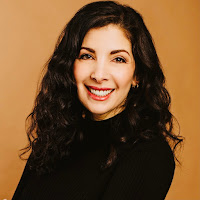
- "Wings to Words: Celebrating Our Avian Friends" by Ashley Harris
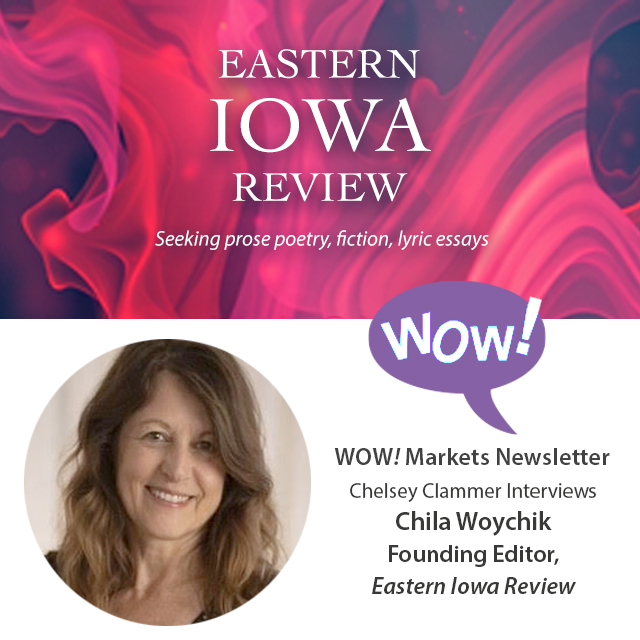
- "On Submission with Eastern Iowa Review: Founding Editor Chila Woychik" by Chelsey Clammer
- Calls from Editors
- February Deadlines: Poetry, Fiction, Nonfiction, Multigenre, Just for Fun
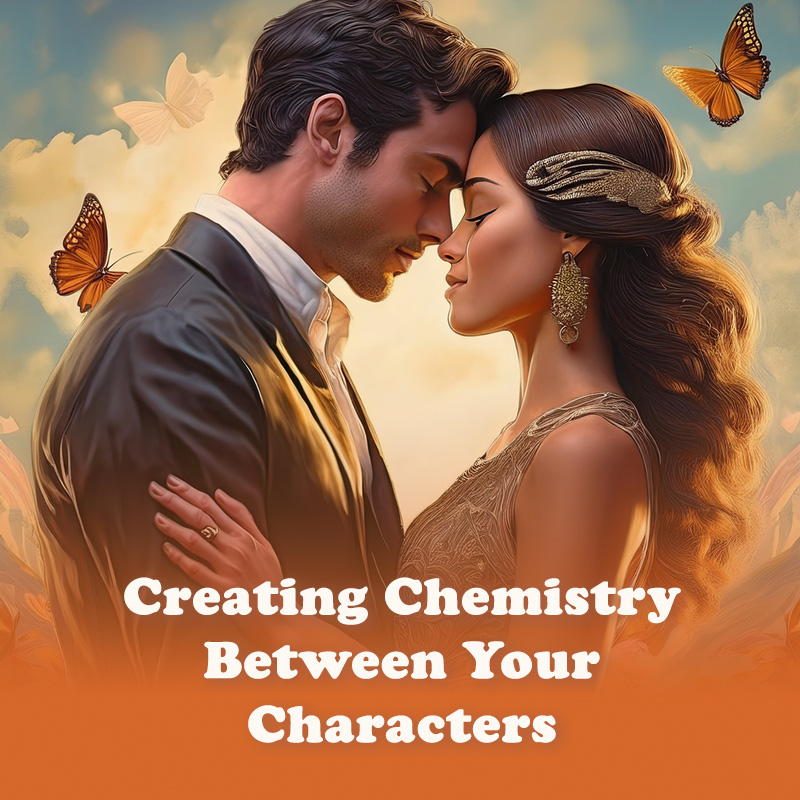
- Craft Corner: "Creating Chemistry Between Your Characters" by Julie Shackman
- Recent WOW features and posts from The Muffin
| | |
Writers!
It’s nearly February, famous for Valentine’s Day, and the official month of Creative Romance! In February we also commemorate Black History, Heart Health and Cancer Prevention, among many other things, including our avian friends. Yes, it’s National Bird Feeding Month!
| | |
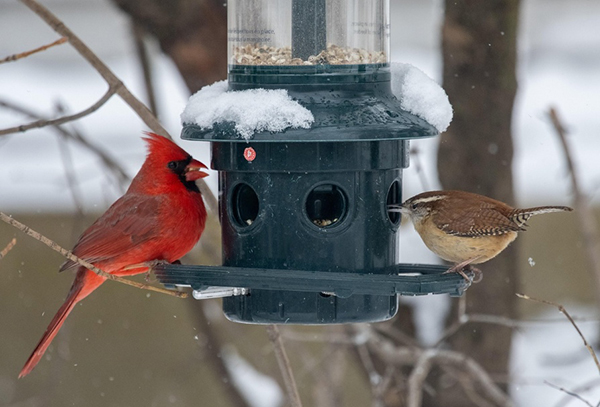
In this cold climate, our backyard birds appreciate the suet cakes and seed we provide for them. A small price to pay for what they give back. The appearance of the cardinal in this barren landscape, with his scarlet plumage and cheerful song, brings joy to a writer’s soul. As the old saying goes, “When cardinals appear, angels are near.”
Where I live, birds such as the cardinal, wren, and titmouse hang around for the winter, while the wood thrush, purple martin and ruby-throated hummingbird, return in the spring. For writers everywhere, birds provide year-round inspiration, whether they’re the focus of our work or whether they simply fly in and enhance it with a note of grace here and there.
| | |
Poets such as John Keats, Edgar Allen Poe, and Mary Oliver famously featured birds such as, respectively, the nightingale, raven and owl in their work. Then there’s the short story “The Birds” by Daphne Du Maurier that inspired Alfred Hitchcock’s movie of the same name. And who can forget The Thorn Birds by Colleen McCullough or the fictional mockingjays in the final book of the The Hunger Games trilogy by Suzanne Collins? And essayists such as CJ Hauser, Lee Zacharias, and Beth Ann Fennelly have memorialized the crane, buzzard, and hummingbird in their work.
As you enjoy the birds in your own world, I hope you’ll consider ways to incorporate them into your writing. In addition to color, sound, and motion, birds can bring deeper meaning and even themes you hadn’t considered before. The tips below might help.
| | |
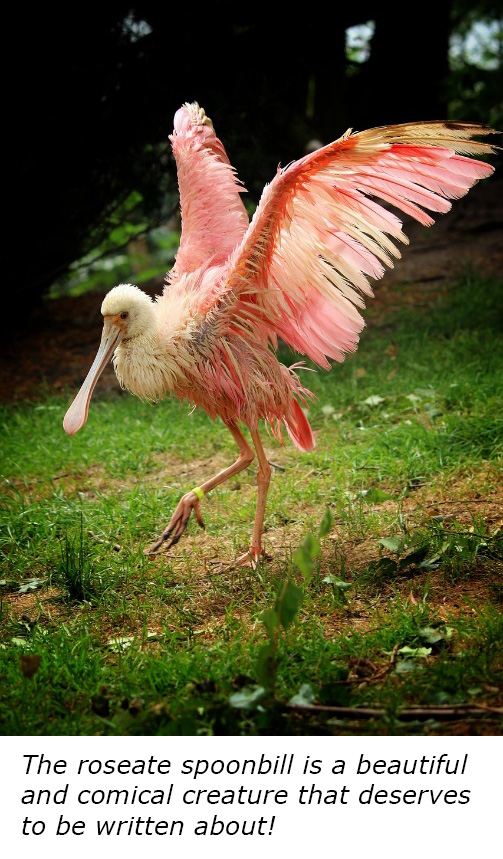
Observe. Birds, like humans, are creatures of habit. Robins wake early, and if you’re willing to rise with them, you’ll be treated to a performance certain to inspire you. In A Bird, Came Down the Walk Emily Dickinson takes observation to a new level, where she brings the ordinary scene of a bird dining on a worm into vivid life. In a recent essay, Christmas in Paradise (Sasee Magazine, December 2025), I mentioned the delayed migration of the roseate spoonbill as a way of setting the scene for my readers.
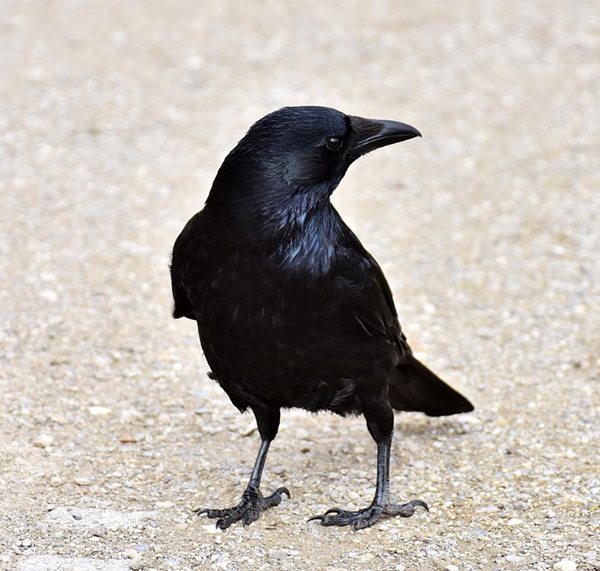
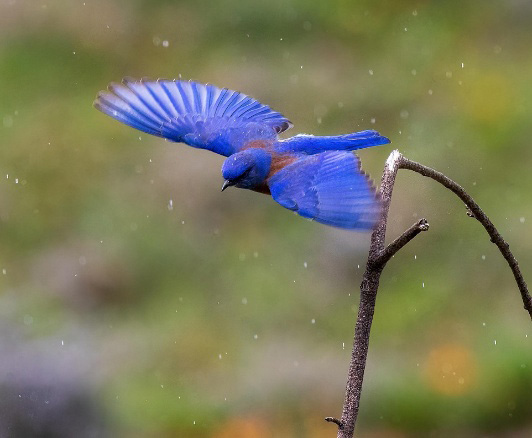
Research. As mentioned, cardinals are associated with angels, but they also represent fidelity. Bluebirds symbolize hope and doves are thought to bring peace. A quick internet search can reveal the folklore tied to the birds in your world, but you can also use your own associations to advance your plot or narrative structure. For example, one writer might use the croak of a crow to signify a warning, and another might use the same sound to symbolize loyalty. The haunting cry of a blue jay at summer’s end, before he migrates, reminds me of sadness and I have used this sound to draw out this emotion in my writing.
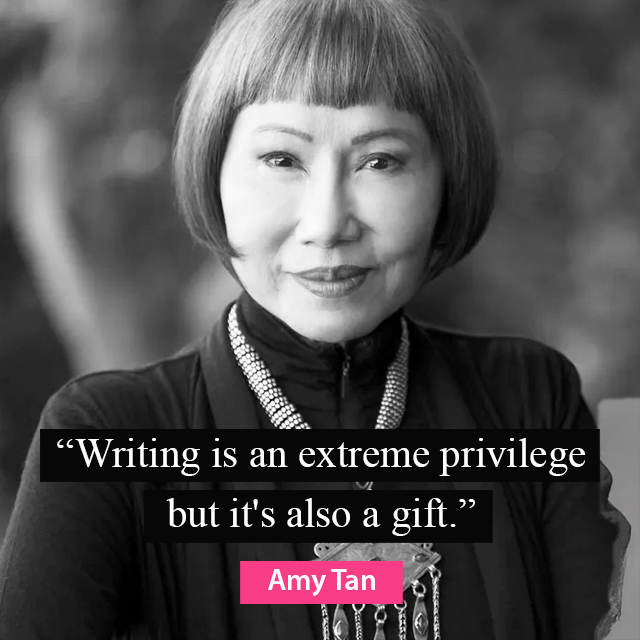
Imagine. The act of flying is perhaps the most envied quality of birds, and a helpful exercise for any writer is to imagine the world above as seen by our feathered friends. This technique is a great way to evoke the omniscient point of view. If you were a bird, what might you see as you fly over a character’s neighborhood? Fields, forests, the ocean. Highways, traffic, urban blight. When I see the long shadow cast by the pileated woodpecker, I love to imagine what he’s thinking as he swoops over my backyard. As author Amy Tan once said: “Feel the bird. Be the bird.”
| |
Study. Read the poems of writers such as Percy Bysshe Shelley, Mary Oliver, or Emily Dickinson, all of whom wrote about birds. Re-read your favorite essays and novels and look for references to birds to learn ways that other authors have used them to convey themes and meaning. You’ll be surprised at how often you’ll find these. If you’re like me, in grade school you might have read The Scarlet Ibis by James Hurst. It may have been the first short story I ever read, but the way Hurst wove the image of this beautiful bird with the themes of pride, vulnerability, and love had such a powerful effect on me that I’ve never forgotten it.
| | |
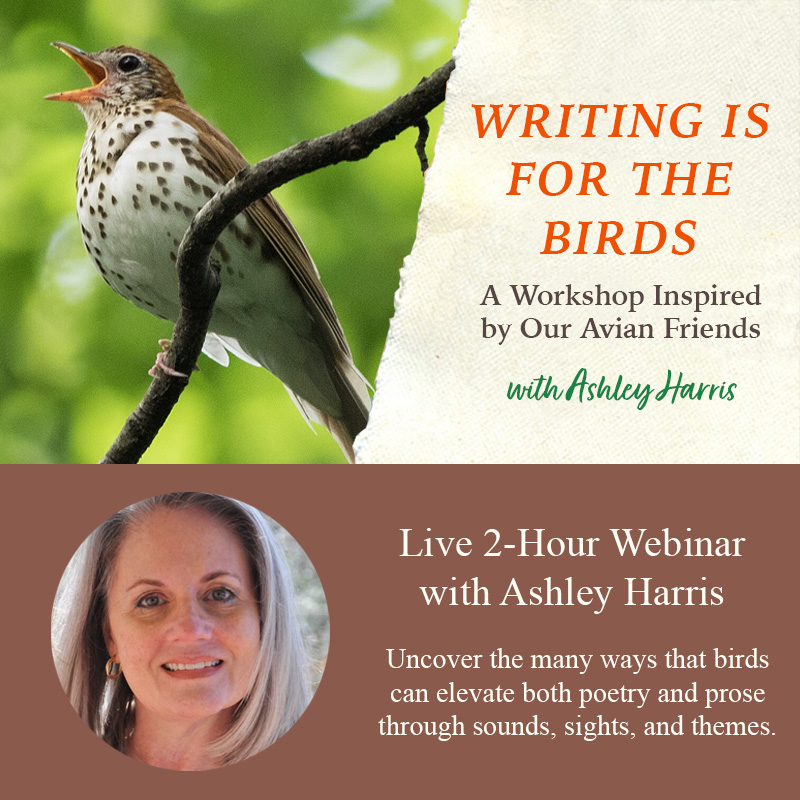
If you’re a bird-loving writer, I hope you’ll consider joining my upcoming class, Writing is for the Birds, on Tuesday, February 17 from 2 pm - 4pm ET. During our time together, we’ll read samples from writers such as Daphne Du Maurier, Jane Kenyon, Sean Flynn, and novelist-turned-birdwatcher Amy Tan. We’ll discuss symbolism and how to weave related themes into your work, and we’ll write to special prompts meant to inspire your own avian fantasies. And throughout our time together I’ll share special publication opportunities so that when you’re ready, you can submit your work and maybe even win a prize.
| | On Submission with Eastern Iowa Review | | A journal that lives and breathes for unique and exquisite lyrical work, Eastern Iowa Review is a hub for lyric essays and prose poems. Even the fiction published in the online (at times in print) journal focuses on how language can influence the reader’s experience of a piece. With such a great focus on language, I, a lyric essay nerd, have always wanted to be published by a journal that supports the type of work that I live for. After one of my essays was accepted last year, I delighted in getting to know the editors and the content of the journal more. I spoke with the journal’s founding editor and nonfiction editor, Chila Woychik, about the journal, the editing process, her own writing, and the larger publishing community. | | |
WOW: How would you describe the overall vibe of Eastern Iowa Review?
Chila: I like to call it “a journal of truth and beauty,” or, as we used to once say, “a journal of good spaces.” The vibe is beautiful language, beautiful (yet truthful) thoughts, never avoiding the hard truths but presenting them wrapped in rose petals. We don’t need more blatant and bloody thorns in what I see as an already hurting world right now.
WOW: You know, I’ve been submitting to the journal since 2015, and all my submission were pretty much full of bloody thorns. So even though I submitted lyric essays, they weren’t quite what you were looking for. So, as a journal that started in 2014, I’m sure you’ve seen numerous submissions as well as a variety of pieces submitted. Out of all these options, can you pinpoint what types and genres EIR prefers?
Chila: I love the lyric essay, which is a bugger to write well. The extended lyric form takes so much work and time, and I’ve met very few that have been correctly named. I find a great prose poem to be a sort of mini-lyric-essay in the sense that they’re likewise not slutty, not easy. They’re hard and demand respect. So I love to read those, and will gladly accept the exceptional ones. Short fiction – I like, but it should be unique and engaging, and creative nonfiction is something everyone takes, so we follow suit. It’s a good form, though too often rather mundane, in my opinion.
WOW: Yeah, I definitely lean more toward the lyric essay. Although creative nonfiction, which I would say is more linear and has more structural and organization elements similar to fiction, can tell a great story in intriguing ways. So considering all of the genres you come across, I’m sure you see a number of interesting pieces each year through your submissions! So, what is the submission process like and what’s the turnaround time for EIR?
Chila: We use Submittable only, no email or postals. Turnaround time is anywhere from 1 day to 1 month or so, depending on our schedules.
WOW: Schedules can be tricky to navigate for the editors of literary journals. With their own writing to do, plus, you know, jobs, it takes a lot of passion and dedication to edit for a journal. What’s your role there?
Chila: I’m the founder and editor-in-chief. I make the final decisions within our very small team, though our fiction editors and nonfiction editor offer good insights for me to consider before saying yea or nay. I couldn’t do it without them, that’s for sure!
| | |
“I find a great prose poem to be a sort of mini-lyric-essay in the sense that they’re likewise not slutty, not easy. They’re hard and demand respect.”
| | |
WOW: It truly takes a village! I’m thinking now about the editing process. I remember when my hermit crab essay, “Dear Dreadlocks,” was published by the journal and I was surprised (if not more than relieved) that the piece wasn’t edited that heavily. Was mine just an oddity or is that what writers can expect with the editing process?
Chila: I’m a very light-handed editor, feeling that a piece needs to pretty much be perfect before the author sends it in. I have neither the time nor the interest to massively edit work submitted to us. If a piece is stellar but has one or two tiny items that need tweaking, I suggest it (and insist if it’s something like a typo, etc.), but other than that, the piece should be ready to go when we get it.
WOW: When I used to edit for some journals, I found that I too preferred pieces that were already polished and shining. For me, I would edit them in my head as I went, and if I found too many errors to keep track of in the first couple of pages, I wouldn’t finish reading the piece. This helped me to become a stronger writer—I edit my pieces to death to make sure they’re perfect when I submit them. How do you think your editing informs your writing?
Chila: Oh my. I’m constantly aware of what I myself write, and am incredibly tough on myself when it comes to writing. I’m sure some of that derives from seeing so many pieces from really great writers over the years. I think I’m a quick learner, and I take mental note of the pieces I love the best, why they work, what makes me love them, and such. Reading wonderful pieces of writing, the best of the best – I recommend it to all writers. Put that mediocre stuff away. Read the good.
WOW: I actually have a sticker that says, “The 6 rules of writing: write write write read read read.” I find that reading really improves my thought process when I write. I read mostly essays and some biographies to really get me thinking and to inform the lyric essays I write. So, with so much inspiration, what type of writing do you do?
Chila: Mostly lyric forms, some fiction, and some longer creative nonfiction. I enjoy writing the occasional prose poem too, but others do it so much better that I usually default to lyric essays instead, and the occasional oddball piece of fiction. Lately, I’ve been focused on the last two books in the Maddie Hill cozy mystery series – a series about, of all things, a small press publisher. (Sound familiar? Ha.)
| | |
“Reading wonderful pieces of writing, the best of the best – I recommend it to all writers. Put that mediocre stuff away. Read the good.”
| | |
WOW: I dabble in some fiction, but I lean toward the lyric essay too. They’ve taught me how to, as I call it, “edit by ear.” That is, soaking in the language has helped me to understand how writing works based on how you hear it. How does your writing practice influence your editing and/or work with EIR?
Chila: When I receive praise from other editors and they say they’d like to publish my work, I can see what worked, what they’re looking for. Conversely, when a piece is declined several times, that usually tells me something too, and I try to learn from that. Every single lesson, every acceptance and decline, helps me know what works and what doesn’t, and I’m sure this crosses over into my editorial work at EIR.
WOW: Circling back to the journal’s mission to provide a space to share engaging and challenging work, it seems like EIR really promotes a writing community where people can come and relish in language. So, along with this, how else do you think EIR contributes to the larger writing community?
Chila: Well, I’m not sure it does to any great extent. That being said, we’ve been quoted in several online articles and at least one doctoral thesis, and some of our authors’ pieces at EIR have been mentioned online by writing outlets, etc., so maybe we are making a small impact. Pushcart’s Board of Contributing Editors nominated a piece or two of ours for inclusion, we’ve published a Best American Essay notable essay and a Best Small Fiction inclusion, and maybe a thing or two more. So yes, maybe we’re making a small impact for the cause of “truth and beauty.” At least, that’s my hope.
WOW: Thank you for your time, Chila!
| | |
Chelsey Clammer is the award-winning author of the essay collections Human Heartbeat Detected (Red Hen Press, 2022; finalist for the Memoir Magazine Book Awards 2023), Circadian (Red Hen Press, 2017; winner, Red Hen Press Nonfiction Manuscript Award), and BodyHome (Hopewell Publications, 2015). Her work has appeared in Salon, The Rumpus, Brevity, and McSweeney’s, among many others. She was the Fall 2019 Jack Kerouac Writer-In-Residence through the Kerouac Project. Chelsey teaches online writing classes with WOW! Women on Writing and is a freelance editor. Visit her website at: www.chelseyclammer.com.
| | |
Dodo Eraser
Deadline: Rolling
Dodo Eraser is a lit mag and reading series, with a primary focus on poetry and creative prose. They are currently seeking poetry, no line limits. Submit 1-5 unpublished poems in a Word doc. Pay: $5 per poem. No fee.
https://dodoeraser.org/72-2/
Claire Keyes Poetry Award
Deadline: February 1
Claire Keyes is a professor emerita at Salem State College, where she taught English for thirty years. Prize: $1,000 and publication in Soundings East. Submit 8 to 10 pages of poetry (no more than one poem per page). Fee: $10
https://salemstateuniversitysoundingseast.submittable.com/submit/39253/claire-keyes-poetry-award
Allen Ginsberg Poetry Awards
Deadline: February 1
Honoring Allen Ginsberg’s contribution to American literature and his Paterson upbringing, this annual poetry competition awards the first prize of $2,000, the second prize of $1,000, and the third prize of $500 for a single poem. Fee: $20
https://www.poetrycenterpccc.com/awards/
Michael Waters Poetry Prize for Collections
Deadline: February 3
A prize of $6,000 and publication by SIR Press is awarded annually for a collection of poetry written in English. All entries are considered for publication. Submit at least 40 and no more than 120 pages of poetry in 12-point font (no more than one poem per page) per each individual submission. Guest judge: Carl Phillips. Fee: $35; $17.50 for enrolled grad students.
https://www.usi.edu/sir/michael-waters-poetry-prize
Red Room Poetry Fellowship
Deadline: February 3
Open to Australian poets 18 and older. This opportunity encourages poets to undertake an intensive period of creative development including a residency at Varuna or remotely, mentorship, as well as a poetic commission to be published as part of Poetry Month in August. Poets receive a $1,000 stipend, a one-week residency, mentoring, online publication of one poem, and travel support for poets who need additional support to get to Varuna. Apply with a project description and three recent poems. No fee.
https://redroompoetry.org/projects/fellowship/
CWC Poetry Contest - 2025-2026
Deadline: February 8
This contest is open to writers living or attending school in North & South Carolina, Georgia, Tennessee and Virginia. Contest is for poetry of fewer than 50 lines; haiku excluded. Prizes: First Place: $125, Second Place: $75, Third Place: $50. Fee: $15
https://charlottewritersclub.submittable.com/submit/335578/cwc-poetry-contest-2025-2026
Tough Poets Review - Spring/Summer 2026
Deadline: February 14
Tough Poets Review is a biannual, print-only literary and arts magazine featuring the work of critically engaged writers and artists. They publish irreverent, unconventional work with the intention of generating conversations that challenge, delight, and provoke. They believe this approach can be applied to collectively confront the world with defiant optimism. Poetry should be limited to five poems, no more than ten pages in total. Pay: $5 and two contributor copies. No fee.
https://www.toughpoetsreview.com/submissions.htm
2026 Yeats Poetry Prize
Deadline: February 15
The WB Yeats Society of NY is pleased to offer this annual competition in honor of their namesake, and to recognize the valuable contributions poets and poetry make to human consciousness and enlightenment. First prize is $1,000; second prize is $500. Submit poetry no more than 60 lines in length. Fee: $15
https://yeats.submittable.com/submit
James Welch Prize for Indigenous US Poets
Deadline: February 15
Poetry Northwest’s James Welch Prize is awarded for two outstanding poems, each written by an Indigenous U.S. poet. The prize is open to emerging poets who are community-recognized members of tribal nations within the United States and its trust territories (including American Indians, Alaska Natives, Native Hawaiians, Chamorros, and American Samoans). Only poets who have not published more than one book-length literary work in any genre are eligible. Submit up to three poems in a single submission. Two first-place finalists will be published in Poetry Northwest, each winning a $1,000 prize and an all-expenses-paid trip to read with the judge. No fee.
https://www.poetrynw.org/about/james-welch-prize/
2026 Furious Flower Poetry Prize
Deadline: February 15
Furious Flower invites submissions from emerging writers for its annual poetry prize. Poets with no more than one published book are invited to submit up to three poems (no more than a total of 6 pages) for consideration. The winner and honorable mention receive $1,500 and $750 respectively and will be invited to read James Madison University in Harrisonburg, VA in September 2026. The winner, honorable mention, and finalists will also be published in Obsidian. Winners are announced in April. Fee: $20
https://www.jmu.edu/furiousflower/poetryprize/index.shtml
The Haiku Society of America Merit Book Awards
Deadline: February 15
The purpose of the Haiku Society of America's Merit Book Awards is to recognize the best haiku and related books of haiku published in a given year in the English language. Books must have been published in 2025 and must clearly contain a printed 2025 copyright. Prize: $250 for first place, $200 for second place and $150 for third. No fee.
https://www.hsa-haiku.org/hsa-contests.htm#meritbook
Poetry Wales Award 2026
Deadline: February 16
The Poetry Wales Award is Poetry Wales magazine's annual single-poem competition. Submit up to 5 unpublished poems. Poems must not exceed 70 lines. This excludes titles and includes line breaks. Prizes: £500, £100, £50. The judge is Bethany Handley. Fee: £5
https://poetrywales.co.uk/award/
Donald Hall Prize for Poetry
Deadline: February 28
Prize: $5,500 and publication by the University of Pittsburgh Press. Submit 48 pages minimum. Poems previously published in periodicals are eligible for inclusion in submissions, but manuscripts previously published in their entirety, including self-published manuscripts, are not eligible. As the series is judged anonymously, no list of acknowledgments should accompany your manuscript. 2026 judge: Maggie Smith. Fee: $20 for members; $30 for nonmembers.
https://awpwriter.secure-platform.com/applications/page/AwardSeries/DonaldHall
Iris N. Spencer Undergraduate Poetry Award
Deadline: February 20
Open to undergraduate poets who are enrolled in a United States College or University. The Spencer Poetry Awards were created at the West Chester University Poetry Center in 2005 by Kean W. Spencer to honor his mother, Iris N. Spencer. This award welcomes unpublished, original poems composed in the traditional modes of meter, rhyme and received forms and offers a first prize ($1,500), and a runner-up prize ($500). Limit of Three poems per Category. (For ex., you may submit 3 sonnets, 3 haiku, 3 villanelle, etc.) No fee.
https://www.wcupa.edu/arts-humanities/poetry/contestAwards.aspx
2026 Sijo Competition
Deadline: February 28
Write one sijo in English on a topic of your choice. A title for the sijo is not required. Divisions: adult division (age 19 and older) and pre-college division (age 18 and younger). Prizes: Adult: First $1,000, Second $750, Third $500; Pre-College: First $500, Second $400, Third $300. Honorable Mentions: $50. No fee.
https://www.sejongculturalsociety.org/writing/current/sijo.php
| | |
Brown Hound Press
Deadline: Rolling
Brown Hound Press is a new publication that will feature one story each week. They like stories that are offbeat, a little different from the norm. Quirky is good. Dark humor is good. Their style is mystery, literary, or Southern Gothic. Submit a story no longer than 3,000 words. Pay: $25 per story. No fee.
https://www.brownhoundpress.com/submit
Curated by Costiuc
Deadline: February 1
Curated by Costiuc is a newsletter of entertaining mystery, thriller, and suspense stories. Word count: 1,000 - 5,000 words. Pay: $25 per story. No fee.
https://costiuc.substack.com/p/submit-a-story
Slush
Deadline: February 1
Open to writer living in Australia or Australians living overseas. Slush seeks previously unpublished (including Substack, Instagram etc.) short fiction of up to 5000 words in length. This includes micro and flash fiction as well as comics, prose poetry, autofiction and other forms. Submit up to three stories. Pay: $100 AUD. No fee.
https://www.slushpress.com/submit
American Short(er) Fiction Prize
Deadline: February 1
The prize recognizes extraordinary short fiction under 1,500 words. The first-place winner will receive a $1,000 prize and publication. Stories must be 1,500 words or fewer. Fee: $18
https://americanshortfiction.org/submityourwork/the-shorter-fiction-prize/
Winter Short Story Award for New Writers
Deadline: February 1
When the temperature drops, their excitement peaks. Submissions must be under 6,000 words. Prizes: $3,000; $300; $200. All pieces will be published online, and winners will also receive agency review from their six partnered agencies. Jim Shepard is guest judge. Fee: $20
https://mastersreview.com/winter-short-story-award-for-new-writers/
Adventitious
Deadline: February 5 (Opens February 1)
“Surprise” doesn’t only mean twists. They want stories that offer a sense of wonder through their language, characters, plots, or all of the above. Sci-Fi, Fantasy, and all speculative/surreal will always be welcomed, but they’re also happy with stories that shock and delight right here on this plane of existence. Flash Fiction (including Micro): Up to 1,000 words. Fiction: 1,000 – 6,000 words. Novelette: 6,000 – 17,000 words. Pay: $0.08 USD per word; reprints: $0.01 per word. No fee.
https://www.adventitious.net/submission-guidelines/
Abyss & Apex
Deadline: February 7 (Opens February 1)
Their mission is to publish the finest in human-written (no AI!) speculative and imaginative fiction and poetry, with special attention to character-driven stories that examine the depths and heights of emotion and motivation from a broad variety of cultural and social perspectives. Flash fiction: up to 1,000 words. Short Stories: up to 10,000 words. Pay: $.08/word up to 1,000 words, and a flat payment of $80.00 for longer stories. No fee.
https://www.abyssapexzine.com/submissions/
Sci Phi Journal
Deadline: February 12
Sci Phi Journal is a volunteer-run, semi-pro webzine dedicated to the intersection of Philosophy and Science Fiction. They publish concept-heavy, idea-driven (as opposed to 'character-driven') short stories and essays, across a wide variety of sub-genres from alternate history to hard sci-fi, from artefact fiction (or fictional non-fiction) to theological fantasy. Submit one work of fiction up to 2,000 words. Pay: 3 (Euro) cents per word for original fiction and 1 (Euro) cent per word for translations of fiction into English. No fee.
https://www.sciphijournal.org/index.php/submission-guidelines/
The Maine Review Fiction
Deadline: February 13
The Maine Review is dedicated to making contemporary literature accessible and to supporting representation, innovation, and literary artistry. One piece of 3,000 words or fewer (though they will consider longer works of exceptional merit) or three flash pieces no more than 1,000 words each. Pay: $25 honorarium per flash (1,000 words or fewer) and a $50 honorarium for work 1,001 words or more. No fee.
https://mainereview.submittable.com/submit/154400/fiction-open-submissions
Writers & Artists Yearbook Short Story Competition 2026 – Theme: Play
Deadline: February 13
Open internationally to all ages. Submit an original short story for adults no more than 2,000 words on the theme of “play” for a chance to win a place on an Arvon Residential Writing Week (worth £985) as well as seeing your story published on their site. This year’s judge is author Paul McVeigh. The winner - along with two runners-up - will be announced on the blog pages of their site in March 2026. No fee.
https://www.writersandartists.co.uk/competitions/writers-artists-short-story-competition-2026
The Tomorrow Prize & The Green Feather Award
Deadline: February 13
The Omega Sci-Fi Project invites Los Angeles County high school students to submit their short science fiction stories to The Tomorrow Prize. Each student may submit up to 2 stories total between 500 and 1,500 words to either of their general sci-fi categories or their special Green Feather Award, which highlights an environmentally focused sci-fi story. Prizes: $250, $150, and $100. Selected finalists will be chosen to have their stories read in their honor by celebrity guests during the Culminating Event. The first-place winner will be published in L.A. Parent Magazine. No fee.
https://www.lightbringerproject.org/science-fiction-competitions
The Phantom Pulse
Deadline: February 14
The Phantom Pulse is a biannual speculative fiction magazine of the grey corners of humanity, dread that permeates the skin, and the bizarre. Their pages are haunted by twisted longing, inevitable darkness, and quiet obsession. Submit original fiction up to 3,000 words. They also accept reprints up to 5,000 words. Pay: $0.03 per word for unpublished fiction and $0.01 per word for reprints. No fee.
https://www.thephantompulse.com
100 Foot Crow – Theme: Coffee
Deadline: February 15
They are open for the theme COFFEE as well as un-themed stories. They publish speculative fiction (sci-fi or fantasy, some horror with a speculative element), 100-word drabbles. Pay: $8 per piece. No fee.
https://100footcrow.com/submission-guidelines/
National Flash Fiction Day Anthology – Theme: Bridges
Deadline: February 15
The theme for this year’s anthology is BRIDGES. What does the theme mean to you? Burning bridges, crossing over from one place/time/event to another, a bridge in music, or a visit to the dentist? Or does it conjure up a person with that name, a feat of engineering, or part of a ship? Feel free to interpret the theme however you wish, in 500 words or fewer. Selected flashes will be published in National Flash Fiction Day's 15th Annual Anthology. Contributors will receive a copy of the anthology. Two pieces will be chosen for an Editor's Choice Award which comes with a £50 prize. No fee.
https://www.nationalflashfictionday.co.uk/index.php/anthology/anthology-submission-guidelines/
Tacoma Writes Short Story Contest – Theme: The Origin of Bigfoot
Deadline: February 21
Write a short story about the origin of Bigfoot (it can be spooky, serious, weird or whatever you want, just nothing explicit). It must take place in the Pacific Northwest. Open internationally. Stories should be between 500 and 5000 words. Prizes: $300 for best story, $100 for second and two $50 runner ups. No fee.
https://www.tacomawrites.com/
2026 Harper's Bazaar Short-Story Competition – Theme: The Conversation
Deadline: February 22
The competition is open to UK residents only, 18 and over. The author Ali Smith once said: "With the short story, you are up against mortality. I know how tough they are, but they’re also a total joy." The star entry will be chosen by a judging panel comprising the author Ruth Ozeki, the Fourth Estate editor Michelle Kane and the literary super-agent Caroline Michel, who join Bazaar’s editor-in-chief Lydia Slater, features director Helena Lee and literary editor Erica Wagner. The winner will receive a stay at the iconic Art Deco hotel Burgh Island in Devon – the setting that inspired Agatha Christie's 1939 crime caper And Then There Were None – and the chance to have their story published in the magazine. Submit an original story of up to 2,000 words to shortstory@harpersbazaar.co.uk on the theme of “The conversation.” No fee.
https://www.harpersbazaar.com/uk/culture/a36157/harpers-bazaar-short-story-competition/
Every Day Fiction – Theme: March National Holidays
Deadline: February 25
They are looking for some suitable stories for March 2025, including: Spring Break; International Women's Day; Purim; Daylight Savings; Ides of March; St. Patrick's Day; first day of spring (Vernal Equinox); Feast of the Annunciation. Submit flash fiction up to 1,000 words. Pay: $3 CAD per story. No fee.
https://everydayfiction.submittable.com/submit/76008/march-2026
Margery Allingham Short Mystery Competition 2026
Deadline: February 27
Margery Allingham remarked that: “The Mystery remains box-shaped, at once a prison and a refuge. Its four walls are, roughly, a Crime, a Mystery, an Enquiry and a Conclusion with an Element of Satisfaction in it.” Submit a short story of up to 3,500 words. Prize: £500 and a one year’s membership of the CWA. Their mission is to find the best unpublished short mystery, and not only that, but one which fits into Golden Age crime writer Margery Allingham’s definition of what makes a great mystery story. Fee: £25
https://thecwa.co.uk/awards-and-competitions/margery-allingham-short-mystery-competition/
Short Stories Competition
Deadline: February 28
They are looking for stories ranging between 1,000 and 3,000 words, with strong characters, a well-crafted plot and realistic dialogue (where used). Prizes: £500, £200, £100. Guest judge: author Wendy Clarke. This is an open-themed competition and we accept all genres, including those written by or for children. Fee: £7
https://flash500.com/short-stories/
Pinch Literary Award in Fiction
Deadline: February 28 (Opens February 1)
The Pinch Literary Award in fiction recognizes the best short stories. All forms and types of fiction are eligible for this prize, so long as they are fewer than 4,000 words, previously unpublished and original. Every submission will be considered for publication in the Pinch and the winner will receive $2,000 in addition to publication in the fall issue. Fee: $28
https://www.pinchjournal.com/contests
Fish Publishing Flash Fiction Prize
Deadline: February 28
The Fish Flash Fiction Prize is an opportunity to attempt one of the most interesting and rewarding tasks – to create, in a tiny fragment, a completely resolved and compelling story in 300 words or less. Prize: €1,000. Tania Hershman will judge. Fee: €16
https://fishpublishing.com/competition/flash-fiction-contest/
Screams and Wails: The Rock-Horror Anthology
Deadline: February 28
Screams and Wails, to be published November 2026, will be an anthology of original horror short stories with music at their still-beating heart. Think cursed instruments; songs that drive the listener mad; zombie fans; haunted studios. Submit a story between 2,000 and 9,000 words. Pay: 1p a word to a maximum of £50. No fee.
https://theslab.press/calls-for-submission/
Ruins and Rituals
Deadline: February 28
Indie Bites is a quarterly fantasy magazine that promotes the work of indie authors. They publish fantasy stories with clever hooks, strong characters, and interesting takes on their issue’s themes. Submit a story no longer than 7,500 words on the theme “Ruins & Rituals.” Pay: £5 per piece, plus a share of the donations we have received in the previous quarter. No fee.
https://www.silversunbooks.com/submit
Splash - Theme: Mermaids, Kraken
Deadline: February 28
All mermaids (and their kin), kraken (sea monsters), underwater civilizations, etc. stories are welcome. All genres are accepted. Stories should be between 3,000 and 20,000 words. Publication date is May 2026. Pay: royalties. No fee.
https://dragonsoulpress.com/shortstorycalls/
Nyctalocos: A Collection of Night Terrors
Deadline: February 28
The editors are seeking stories that focus not only on the familiar sleep disorder, but also step outside that box and into the deeper terrors of the night. Authors are asked to submit their tales (between 2K and 6K words) via the email provided below and allow up to two months for a response. Send only one story. No reprints. Simultaneous submissions welcome. Pay: $10 per 1k words ($20 - $50 per piece) and a contributor copy. No fee.
https://chthonicmatter.wordpress.com/themed-anthologies/
Grace Paley Prize for Short Fiction Collections
Deadline: February 28
Prize: $5,500 and publication by Mad Creek Books, an imprint of The Ohio State University Press. Submit a short story collection 150–300 manuscript pages. Stories previously published in periodicals are eligible for inclusion in submissions, but manuscripts previously published in their entirety, including self-published manuscripts, are not eligible. As the series is judged anonymously, no list of acknowledgments should accompany your manuscript. 2026 judge: Weike Wang. Fee: $20 for members; $30 for nonmembers.
https://awpwriter.secure-platform.com/applications/page/AwardSeries/GracePaley
James Alan McPherson Prize for the Novel
Deadline: February 28
Prize: $5,500 and publication by the University of Nebraska Press. Submit at least 60,000 and no more than 110,000 words. 2026 judge: Justin Torres. Fee: Fee: $20 for members; $30 for nonmembers.
https://awpwriter.secure-platform.com/applications/page/AwardSeries/JamesAlanMcPherson
Southword
Deadline: February 28 (Opens February 1)
Southword is a print literary journal published twice a year by the Munster Literature Centre. In February, they are open to fiction up to 5,000 words. Pay: €400 per short story. No fee.
https://munsterlit.ie/southword/
Imagine Little Tokyo Short Story Contest
Deadline: February 28
The purpose of the contest is to raise awareness of Little Tokyo through a creative story that takes place in Little Tokyo. Each category winner will be awarded $500. Submit a story 2,500 words or less. No fee.
https://www.littletokyohs.org/imagine-2024
Who Am I? A Sapphic Spec Fic Anthology of Identity and Purpose
Deadline: February 28
Open to female-identifying and non-binary authors. This anthology aims to explore sapphic identity and purpose through the lens of fantasy and speculative fiction. Give them your adventure, introspection, daring, romance, or conflict! The MC’s queerness must be made clear, but stories do not need to be romantic or sexual. Length: 2,000 - 5,000 words. Pay: $0.10 (AUD) per word, with a maximum payment of $400 (AUD) per story; reprints are capped at $100 (AUD) per story; an additional $50 (AUD) per story will be offered if your story is to be used in whole or in part in the email/social marketing campaigns for the anthology. No fee.
https://www.scyllapublishing.com/anthology-submissions-2025-26
Zooscape: An E-zine of Fantastic Furry Fiction
Deadline: February 28 (Opens February 1)
All stories must be furry. That means an anthropomorphic animal figure should be significantly featured in your story—it could be anthropomorphic in body or only intelligence. They’ll consider any type of furry fiction from secret life of animals to fox in Starbucks. They love science-fiction with animal-like aliens and fantasy with talking dragons, unicorns, or witch familiars. Submit original stories or reprints up to 10,000 words. Pay: $0.08 per word for fiction up to 1,000 words and a flat rate of $80 for longer. $20 for reprints. No fee.
https://zooscape-zine.com/guidelines/
| | |
Open Secrets Magazine – Two Calls for Personal Essays: Black Reproductive Health and ICE Intimidation/Violence
Deadline: Until Filled
Editor-in-Chief Rachel Kramer Bussel is seeking personal essays on experiencing the effects of ICE violence. Essays should have a clear beginning, middle, and end, and shouldn’t simply recount the violence or intimidation, but, as with all their personal essays, include reflections on how the experience changed the author. They are also seeking essays by Black United States-based writers who’ve experienced issues around mistreatment and inequity in healthcare related to reproduction, pregnancy, birthing, and maternal and reproductive health. Personal essays should be 1,000 – 2,500 words. Pay: $200 per essay. No fee.
https://opensecretsmagazine.com/p/essays-wanted-black-maternal-health-ice-violence
Non-Fiction Fellowship Himalayan Writing Retreat
Deadline: February 10
Open to Indian citizens residing anywhere, and to citizens of any country resident in India. The HWR Khozem Merchant Non-Fiction Fellowship gives writers of long-form nonfiction support and mentoring. Penguin Random House India & HWR will make the selection. Selected fellows will attend a 3-day writing masterclass with Jerry Pinto, attend a 21-day writing residency in the Himalayas, receive an award of INR 50,000 and a travel fund of INR 20,000, and Penguin Random House India will look at finished manuscripts and may offer a publishing deal. Nonfiction writers in the following categories can apply: personal narratives, true accounts, lived experiences, biographies, memoirs, history, narrative nonfiction, investigative journalism. Themes related to personal wellbeing will be encouraged. No fee.
https://www.himalayanwritingretreat.com/khozem-merchant-non-fiction-fellowship/
The Sarabande Prize in the Essay - Full-Length Essay Collections
Deadline: February 15
Selected by author Aimee Nezhukumatathil, the prize includes $2,000, publication of the full-length collection, and a standard royalty contract with Sarabande Books. This contest is open to any nonfiction writing in English. Agented manuscripts are not eligible. Individual essays from the manuscript may have been published previously in magazines, chapbooks of less than 48 pages, or anthologies, but the collection as a whole must be unpublished. Translations and previously published collections are not eligible. Manuscripts must be anonymous, and between 150 - 250 pages. Fee: $34
https://sarabandebooks.submittable.com/submit/277967/the-sarabande-prize-in-the-essay-selected-by-aimee-nezhukumatathil
2026 World Press Institute Fellowship Program
Deadline: February 15
WPI empowers journalists worldwide to navigate and excel in a dynamic media landscape, promoting journalistic excellence and the unrestricted flow of ideas. Successful candidates will travel to the United States in August-November and participate in a demanding nine-week cross-country program that begins and ends in the Twin Cities of Minneapolis and St. Paul, Minnesota. Writers receive round-trip airfare, US travel, lodging, and a daily food allowance. Apply with work samples and references. No fee.
https://apply.worldpressinstitute.org/2026
The Sophis Agency
Deadline: February 21
The editors are seeking contributing writers with a gift for storytelling that is literary and purposeful. They are interested in essays that revisit familiar figures, moments of fresh perspectives, reflective, interpretive, or insightful. They welcome submissions that: Examine historical or cultural figures in thoughtful ways; Revisit books, art, or cultural moments with new interpretations; Explore lived experience in relation to larger social or cultural themes; Offer reflective, narrative, or essayistic writing with a clear point-of-view. Submit essays 700 – 1,200 words. Pay: $100 per piece. No fee.
https://www.sophisagency.com/write-for-us/
Matthew Power Literary Reporting Award
Deadline: February 22
The Matthew Power Literary Reporting Award is a grant of $15,000 to support the work of a promising early-career nonfiction writer on a story that uncovers truths about the human condition. The judges will be interested in perpetuating Power’s legacy, as his former editor Roger Hodge put it, of “strong, character-driven narratives with detailed scene writing and lyrical description.” Submit a proposal. No fee.
https://nyujournalism.submittable.com/submit/341429/2026-matthew-power-literary-reporting-award
Sue William Silverman Prize for Creative Nonfiction - Full-Length Collections
Deadline: February 28
$2,500 and publication by the University of Georgia Press. Collections should be between 150 - 300 manuscript pages. Essays previously published in periodicals are eligible for inclusion in submissions, but manuscripts previously published in their entirety, including self-published manuscripts, are not eligible. As the series is judged anonymously, no list of acknowledgments should accompany your manuscript. The guest judge is author Kiese Laymon. Fee: $20 for members, $30 for nonmembers.
https://awpwriter.secure-platform.com/applications/page/AwardSeries/SueWilliamSilverman
Diana Woods Memorial Prize in Creative Nonfiction
Deadline: February 28 (Opens February 1)
Diana Woods Memorial Award serves as a special opportunity for authors worldwide to be published in the literary journal Lunch Ticket. The reading period for the award is the month of February for the issue that publishes in June. Creative nonfiction authors are invited to submit an essay of up to 3,500 words on the subject of their choice. Winners will receive $250 and their work will be featured in the next issue of Lunch Ticket. No fee.
https://lunchticket.org/contests/dwm/
Hippocampus We Love Short Shorts Contest for Flash Creative Nonfiction
Deadline: February 28 (Opens February 1)
In honor of the shortest month of the year which includes the loving-est day of the year, Hippocampus is holding their annual We Love Short Shorts Contest for Flash Creative Nonfiction! Submit short essays (micro memoir) of up to 250 words; there is no theme. Prizes: First: $250, publication + opportunity to serve as opening reader for a future Stories on Sunday event. Two Runners Up: $100 each + publication. One entry per person. Fee: $5
https://www.hippocampusmagazine.com/2025/01/we-love-short-shorts-contest-for-flash-creative-nonfiction-2025/
HerStry – Theme: Burn it Down
Deadline: March 1
They are looking for true stories around 3,000 words. They are looking for stories on how you left it all behind. How you lit a match and let your life/your relationship/your family/your whatever, go up in flames. What happened after? What revolutions did you start? Pay: $20 per essay. Fee: $3
https://herstry.submittable.com/submit/342035/burn-it-down-april-2026
| | |
Paranoid Tree
Deadline: Rolling
Paranoid Tree is an independent, hybrid lit mag/art zine based in Minneapolis, Minnesota. Each month, they create a custom-illustrated zine featuring original fiction or poetry. Submit up to 5 pieces of fiction, creative nonfiction, and poetry, 400 words or fewer. Pay: $50 per piece, plus 5 copies of the final printed zine. No fee.
https://www.paranoidtree.com/submit
ALOCASIA: a journal of queer plant-based writing
Deadline: Rolling
This is a journal about plants, gardens, gardening, parks, and indoor horticulture. They accept all genres of creative writing from queer writers. Max word count for prose is 3,500 words. Pay: $50 per contributor. No fee.
https://alocasia.org/about-send-work/
Vast Chasm Magazine
Deadline: Rolling
Vast Chasm Magazine publishes bold work that explores the expansive human experience, including flash and short fiction, creative nonfiction, poetry, and other nonconforming work. Poetry: submit one poem at a time. Flash Fiction and Flash CNF: up to 1,200 words. Fiction and CNF: 5,000 words max. Pay: $50 per piece. No fee.
https://vastliterarypress.submittable.com/submit
Subnivean
Deadline: Rolling
The stories and poems that we are looking for need not fit into a particular mold; rather, we're seeking work that breaks the mold, grinds it into a fine powder, pours it in a pot of water and brings it to a boil, schleps it up a steep mountainside, drizzles it across the snow and lets it cool, there, into the desired shape. Please submit an unpublished story or standalone excerpt of 6,000 words or less, in a single document or six original, unpublished poems, in a single document. No fee.
https://subnivean.submittable.com/submit
Breath and Shadow
Deadline: February 1
Breath & Shadow only accepts work from people with disabilities. They accept poetry and fiction on any topic. These pieces do not have to relate to disability. Essays, reviews, articles, and other forms of nonfiction must relate to disability in some way. Submit up to 2 pieces per issue with a 3,000-word max per submission. Pay: $40 for long fiction/nonfiction, and $25 for poem/short prose. No fee.
https://www.abilitymaine.org/submission-guidelines
The CutBank Genre Contests
Deadline: February 1
One winner from each genre, chosen by their guest judges, will be featured in CutBank’s fall/summer issue along with a $500 prize. For fiction and nonfiction, please send only a single work of no greater than 35 pages. For poetry, submit up to five poems. Please submit only once per genre, though writers are permitted to submit in multiple genres. Fee: $20
https://www.cutbankonline.org/genre-contests
Slippery Elm Prize
Deadline: February 1
There are $1,000 prizes in Poetry & Prose. All contest entrants will receive a copy of the winning issue and be considered for publication. Submit up to 3 poems (no line/length limit) or one essay or story (5000 words maximum). Multiple entries are fine. 2026 Judges: Jonie McIntire in Poetry; Lawrence Coates in Prose. Fee: $15
https://slipperyelm.findlay.edu/submit/contest-guidelines/
Soundings East
Deadline: February 1
Soundings East is the annual literary journal of Salem State University, published with support from the Center for Creative and Performing Arts. They accept: Creative Nonfiction: Previously unpublished creative nonfiction works of up to 3,500 words; Fiction: Previously unpublished fiction works of up to 3,500 words; Poetry: Please submit up to three previously unpublished poems in a single file. Poetry submissions are reviewed blindly. No fee.
https://salemstateuniversitysoundingseast.submittable.com/submit
The Madison Review Prizes
Deadline: February 1
The Madison Review accepts poetry, fiction, and art submissions. The finest triad of poems will be awarded the $1,000 Phyllis-Smart Young Prize in poetry and publication the spring issue of The Madison Review! Submissions should be double-spaced, with standard 1" margins and should not exceed 15 pages. The finest unpublished short story is awarded $1,000 and publication in the spring issue of The Madison Review! 25-page maximum for short stories. Fee: $10
https://madisonreview.submittable.com/submit
The First Line
Deadline: February 1
Submit a story, poem, or nonfiction piece including their first line: “I flipped through the notebook and found half-finished poems, some drawings, and ______________. [Fill in the blank.].” Fiction: All stories must be written with the first line provided. The line cannot be altered in any way, unless otherwise noted by the editors. The story should be between 300 and 5,000 words (this is more like a guideline and not a hard-and-fast rule; going over or under the word count won't get your story tossed from the slush pile). The sentences can be found on the home page of The First Line's website, as well as in the prior issue. Note: They are open to all genres. Poetry: They do accept poetry, though rarely. They have no restrictions on form or line count, but all poems must begin with the first line provided. The line cannot be altered in any way. Non-Fiction: 500-800-word critical essays about your favorite first line from a literary work. Pay: $25 - $50 for fiction, $10 for poetry, and $25 for nonfiction (all U.S. dollars). No fee.
https://www.thefirstline.com/submission.htm
Hodson Trust-John Carter Brown Library Fellowship
Deadline: February 1
The fellowship is open to writers who are working on significant projects relating to the literature, history, culture, or art of the Americas before 1830. The 2025-26 fellowship award supports two months of research and two months of writing. The stipend is $5,000 per month for a total of $20,000, plus housing and university privileges. Submit a writing sample of no more than 50 pages. No fee.
https://www.washcoll.edu/learn-by-doing/starr/Fellowships/hodson-brown-fellowship.php
Philip Roth Residency in Creative Writing
Deadline: February 1
The Philip Roth Residence in Creative Writing offers up to four months of unfettered writing time for a writer working on a first or second book in any literary genre. The residency provides lodging in Bucknell's "Poets' Cottage" and a stipend of $5,000. The Roth Residency is now open to writers in ANY literary genre: fiction, poetry, creative nonfiction, hybrid works, graphic fiction, etc. No fee.
https://www.bucknell.edu/academics/beyond-classroom/academic-centers-institutes/stadler-center-poetry-literary-arts/programs-residencies/philip-roth-residence-creative-writing
Young Romantics Prizes
Deadline: February 2
The Young Romantics Poetry and Essay Prize began in 2015 to encourage poets and essayists aged 16-18 to respond to the work of the Romantics. Winners receive £700. Two highly commended entrants in each category will receive £300. Winning and highly commended poems will be published in The Keats-Shelley Review and all winning and highly commended essays and poems will also be published on the Keats-Shelley Memorial Association’s website. Poetry: Poets can interpret “Dystopia” or “Utopia” freely. Poems can be serious or comic, experimental or traditional, but the judges advise that works drifting too far from the theme will not be considered. Poems must be no more than 30 lines of text in length. Essay: Young Romantics essayists can choose between the following questions: 1. Mary Shelley’s The Last Man imagines a plague which all but wipes out the human race. What is the appeal of dystopias in literature? 2. ‘The most successful writers are both insiders and outsiders.’ Do you agree? Essays must be no shorter than 750 words and no longer than 1000, including quotations. No fee.
https://keats-shelley.org/prizes/young_romantics_prize_2025_26
Penumbra
Deadline: February 6
Submit poetry, fiction, and nonfiction to Penumbra. Poetry: They like their poems relatively short—say, between haiku length and about 150 lines or so. Falling outside these parameters won’t automatically disqualify a poem but may indeed strain our readers’ patience. Only five submissions total are allowed. Fiction & Nonfiction: A maximum of 1,500 words total. Only five submissions total are allowed. No fee.
https://penumbraliterarymagazine.submittable.com/submit
Highlights Foundation Scholarships
Deadline: February 9
The Highlights Foundation offers scholarships awarded on a yearly basis, which include: in-person programs, online workshops, whole novel workshops, and a personal retreat at the Highlights Foundation’s retreat center at The Barn at Boyds Mills. Travel is not included as part of the scholarships, although they offer a limited number of travel stipends of $500 each. Submit a writing or art sample, along with your seriousness of purpose, including time and effort devoted to the craft of children’s writing, and financial need. No fee.
https://www.highlightsfoundation.org/apply-for-a-scholarship/
Sarabande Annual Literary Prizes
Deadline: February 15
Sarabande is an award-winning, internationally-distributed, nonprofit, independent literary publishing house founded in 1994 in Louisville, Kentucky. Submit to: The Kathryn A. Morton Prize in Poetry is awarded annually to one full-length manuscript of poetry. The Mary McCarthy Prize in Short Fiction is awarded annually to one full-length manuscript of literary fiction: short stories, flash fiction, or novellas in any combination. The Sarabande Prize in the Essay is awarded annually to one full-length manuscript of literary nonfiction: an essay collection or book-length essay. Each prize includes $2,000, publication of the work, a standard royalty contract, and an introduction written by our guest judge. Fee: $34
https://www.sarabandebooks.org/submissions
Griffith Review 93: Into the Archive
Deadline: February 15
The archive has long been a form of collection, preservation and communication. As the internet and social media reshape what, why and how we record information, whether for personal or institutional means, the nature of the archive itself is also in flux. How does the archive mediate the relationship between public and private space? How do archives shape individual and collective memory? Should the archivist preserve without intervention? What will the archives of the future look like? And in what ways do other mediums – bodies, places, cultures – act as their own kinds of archive? This edition of Griffith Review goes on the record to reveal the secrets and surprises of the archive. Fiction and Nonfiction: no longer than 4,000 words. Pay: AUD $0.75 per word; work commissioned for GR Online is paid at AUD $500 per piece. No fee.
https://www.griffithreview.com/for-writers/
Applause
Deadline: February 15
Applause is an annual online (and soon to be physical!) journal staffed by undergraduate students at the University of Arkansas - Fort Smith. Authors must be currently enrolled as undergrads (across the country). Poetry: They want poetry that thrives on the senses, surprises through form, and leaves a lingering voice. Submit 1-5 poems. Prose: They accept all genres of fiction. Send them your stories, your myths, fairy stories, science fiction, folktales, etc. They want your essay, braided, lyrical, memoir, hybrid, experimental. Any true thing you know, and think they need to know, too. Submit one short story (1,000-3,000 words) or 2-3 flash fiction pieces (each <1,000). -OR- Submit one piece of creative nonfiction up to 3,000 words. No fee.
https://applause.submittable.com/submit
Wildscape Literary Magazine – Theme: calm // storm
Deadline: February 15
Submit poetry, fiction, and nonfiction under the spring issue theme of: calm // storm. Their goal with this issue is to create a spectrum of pieces that start with calm/grounded/mindful work and end with pieces that are full of rage, desperate for justice, and a biting fury that fights fiercely for a better future. For fiction and nonfiction, submit up to 2 pieces with a max 1,500 words per piece. For poetry, submit up to 5 poems; each poem must be two pages or shorter. No fee.
https://wildscapelit.com/submit/
Sequestrum - Themes: Nature & Mystery
Deadline: February 15
Sequestrum has two themed issues: Nature ("We want the tense, the imaginative. We want beauty and grace and destruction and sickness and rebirth.") and Mystery ("Regardless of the style, we want mysteries with tension and imagination. We want uncertainty. We want a question to unravel."). Fiction and Creative Nonfiction: up to 12,000 words. Poetry: no more than thirty-five (35) lines. Maximum four (4) poems per submission. Pay: $20 per piece. Fee: $7.15; no fee for subscribers.
https://sequestrum.submittable.com/submit
Furrow
Deadline: February 27
They accept unpublished poetry, fiction, nonfiction, art, and comics by undergraduate students (if you graduated in the fall, that’s fine!). To be eligible for publication in their next issue (May 2026), you must you must be enrolled as an undergraduate at any U.S. college or university during the 2025-2026 academic year. (If you graduate in December, you’re still eligible.) You may submit: one short story (up to 5,000 words, double-spaced); one work of creative nonfiction (up to 5,000 words, double-spaced); and up to 5 poems. No fees.
https://duotrope.com/duosuma/submit/furrow-DigkZ
Gabby & Min. – Spring Issue
Deadline: February 28
They will only accept previously unpublished works (this includes digital/online content). Gabby & Min’s Literary Review publishes a very wide range of topics for each issue. However, they love and encourage submissions related to the current issue’s Season. (It is not mandatory to submit a seasonal work.) There is no minimum word count, but please keep your fiction submissions under 3,000 words. Any poetry or prose must be under two typed pages. No fee.
https://gabbyandmin.com/guidelines
Levitate – Issue 10: Lost & Found
Deadline: February 28
At Levitate they are committed to creating a high-quality Literary Magazine filled with unique and thought-provoking works. Submit one prose piece, up to two individual poems, or up to four artworks per submission. Contributors located in the United States will receive one free physical copy of the issue. International contributors will receive a PDF copy of the issue. Fiction should be no longer than 5,000 words. They also welcome flash fiction, which we define as anything less than 1,000 words. Creative Nonfiction should be no longer than 4,000 words. Poetry submissions should include no more than 2 poems, with no poem longer than 2 pages (no more than 4 pages in total). No fee.
https://levitate.submittable.com/submit
Sunspot Literary Prize (Rigel)
Deadline: February 28 (Opens February 1)
Rigel is the brightest star in the Orion constellation. Sunspot Lit is looking for the single short story, novel, novella, artwork, graphic novel, or poem that outshines all the rest. Literary or genre works accepted; the only requirement is quality. Rigel offers a cash prize plus publication to the winner, and offers publication to select finalists. No restrictions on theme or category. The length for prose is restricted to a maximum of 1,500 words for short stories, 14 lines for poetry, and 6 pages for graphic novels. Note that excerpts from longer works are accepted if they stand alone. Prize: $100 cash and publication for the winner; publication offered to runners-up and finalists. Fee: $5
https://sunspotlit.com/contests
e-Chapbook Anthology – Theme: Endings
Deadline: February 28
The theme for the 2026 anthology is ENDINGS. Any kind of ending (love, life, work, friendship). Submit up to three poems (no longer than a page each) or three flash fictions (500 to 1,000 words each), or one short story, novel or CNF/memoir excerpt, or a personal essay (up to 5,000 words). Pay: $10 for poems, $15 (flash fiction) to $25 for stories and essays. The Editor’s Choice prose piece will be paid $50. Fee: $3
https://echapbook.com/submissions.html#anthology
Ninth Letter
Deadline: February 28
For poetry, please submit 3-5 poems (max. 8 pages) at a time. For fiction and creative nonfiction, submit one story or essay up to 8,000 words at a time. For flash, you may submit up to 3 pieces with a total word count totaling no more than 4,000 words. Ninth Letter pays $25 per poem and $100 for prose upon publication and two complimentary copies of the issue in which the work appears. Fee: $3
https://ninthletter.com/submit/
Hemingway-Pfeiffer Museum and Educational Center: Writer in Residence
Deadline: February 28
The residency will be for June 2026, and includes lodging at a beautiful loft apartment on the downtown square in Piggott, Arkansas, over the City Market coffee shop. The writer-in-residence will also have the opportunity to work in the studio where Ernest Hemingway worked on A Farewell to Arms during an extended stay with his wife’s family in 1928. The residency includes a $1,000 stipend to help cover food and transportation. Candidates with an MA or MFA in a relevant field are preferred. Submission requirements include a writing sample of roughly 20 pages (in any genre). No fee.
https://hemingway.astate.edu/2025/10/13/2026-writer-in-residence-opportunity-announced/
Memezine
Deadline: February 28
Send any traditional or hybrid pieces that directly or indirectly engage with memes, political/current events, viral content, trends, social media, pop/internet culture, technology, and any other work that blurs the lines between art, literature, and content. Gift them your best and your worst because they want to explore all facets of participation in this digital landscape. Poetry and Prose: submit 1-3 pieces in one document, at a maximum of 5 pages total. Pay: $10 per piece. No fee.
https://www.memezinelit.com/submit
Yellow Arrow Journal – Theme: Wonder
Deadline: February 28
The guest editor of the next issue is Heather Brown Barrett, an award-winning poet. Yellow Arrow accepts creative nonfiction and poetry by authors who identify as women. This next issue will explore the interplay between curiosity and creativity and how it informs discovery in the personal creative process and encourages artistry and fulfillment for women-identifying writers. Creative nonfiction: (1 submission per author per issue) must be between 100 and 2,000 words. Poetry: (up to 2 poems per author per issue, grouped into a single document) may be any length. Pay: $10 per piece. No fee.
https://www.yellowarrowpublishing.com/submissions
The Ranger’s Almanac
Deadline: February 28
An annual literary journal for stories, poems, artwork, photography, and music from rangers and nature enthusiasts nationwide. Share your stories, poems, artwork, photographs, or music inspired by any national or state forest or park. No limit on genre, so long as the location serves a prominent role. Short stories: 500–10,000 words. Pay: $25 artwork; $10 music or original audio pieces; $5 poems, photos, or reprints; $5 per 500 words for stories. No fee.
https://www.andrew-akers.com/rangersalmanac
| | |
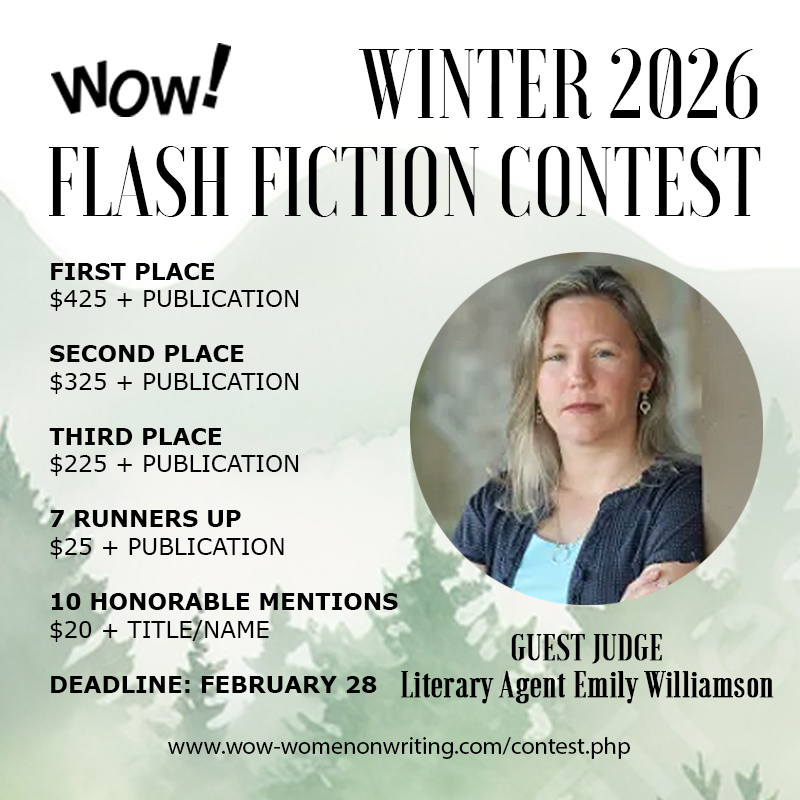
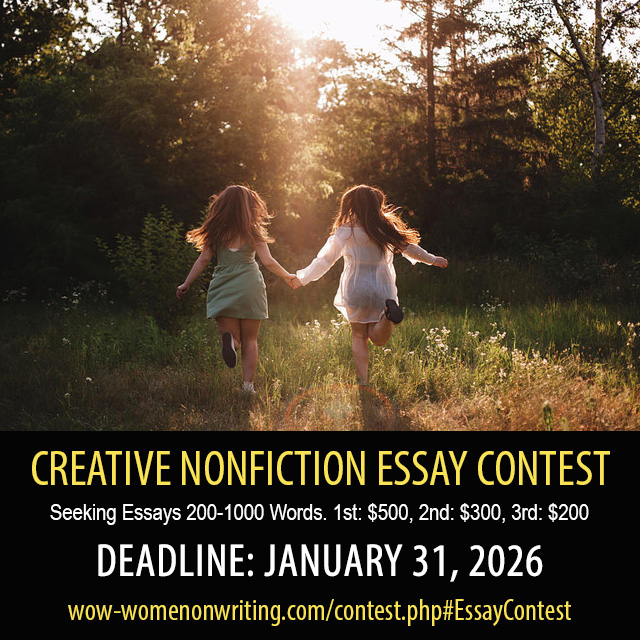
WOW! Women on Writing Quarterly Flash Fiction and Creative Nonfiction Contests
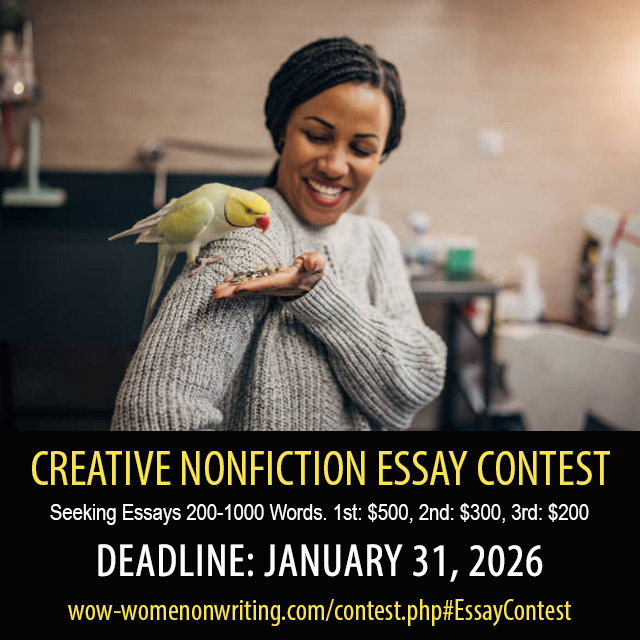
Deadlines: January 31 (nonfiction) and February 28 (fiction). Our favorite writing community offers quarterly contests judged blindly with multiple cash prizes and more for 20 winners, up to $1,350 (fiction) and $1,175 plus a gift certificate to CreateWriteNow (nonfiction), an affordable critique option, and a 300-entry limit on each contest. Previously published work is accepted! What’s not to love? This season's guest judge is Literary Agent Emily Williamson. Fee: $10 (Flash Fiction) and $12 (Nonfiction).
https://www.wow-womenonwriting.com/contest.php
| | |
In celebration of Black History Month, there are no submission fees for Black writers for the month of February at New Orleans Review! Fiction and Nonfiction: up to 5,000 words. Poetry: up to five pages. Pay: $300 for fiction and nonfiction; $100 for poetry. Submit your best!
| | |
Creating that romantic, passionate spark between your characters is vital, especially when writing romance. If there’s no chemistry between the two, how can you expect your readers to believe that they find each other attractive and can fall in love?
Making that passion and attraction spring from the page, so that your readers believe it, is necessary, if you want them to keep on reading and be invested in the story.
But how can you achieve this chemistry between your characters? In the month of February, what better time to look at creating chemistry?
After all, it’s almost Valentine’s Day…
| | |
All romance novels (or novels with a romance built in) need their two main characters to feel an immediate spark—even if they try to deny it themselves! Whether it’s a mutual attraction, a flicker of interest, or an immediate dislike (enemies to lovers is my favorite trope), there has to be something there to trigger their initial feelings.
Perhaps your characters clash over an item in a shop that’s for sale or bang into one another on the street, when one of them isn’t paying attention to where they’re going. You might have them staring at one another, before they both realize they want that last, much sought-after gift on Christmas Eve, and they rush forward at the same time to grab it.
There has to be some sort of initial “bringing together” that ignites the start of their romantic story.
| | |
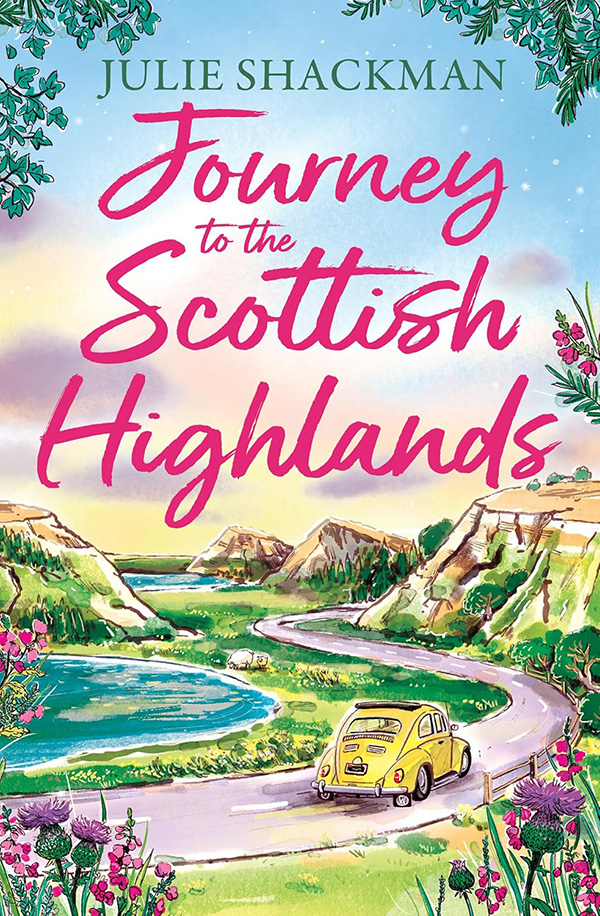
In my latest book, Journey to the Scottish Highlands, my two main characters Daisy and Evan find themselves in close proximity when Daisy drives them to the Scottish Highlands.
This enabled me to essentially trap these two strong characters together in Daisy’s daffodil yellow, secondhand Volkswagen Beetle and begin to create stirring emotions and flirtations between both of them—even if they were trying to not only deny it, but refuse to acknowledge this growing attraction even existed in the first place!
| | |
Bringing your two characters into a similar situation allows you to use a romantic trope (enemies to lovers, meet-cute, friends to lovers, etc.) to good effect.
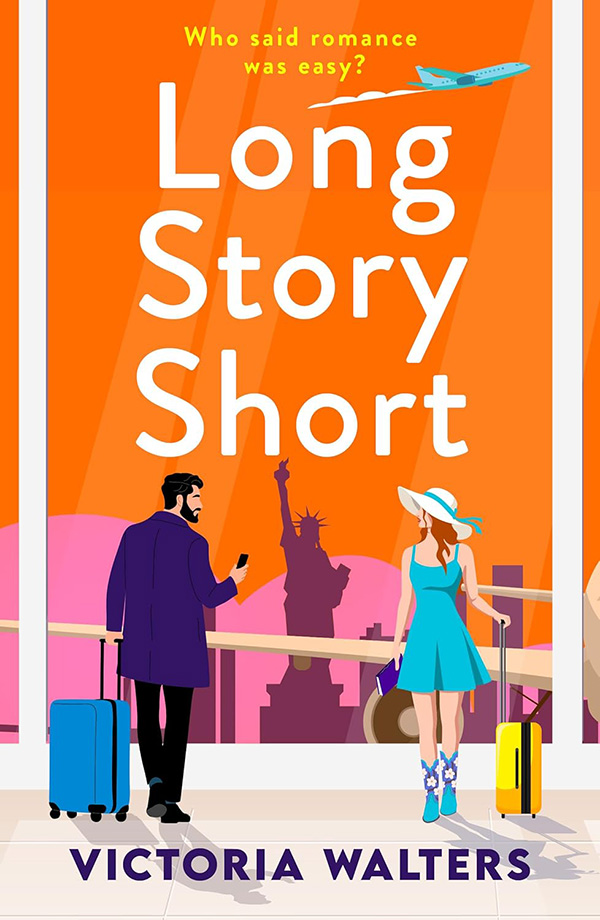
One of the best books I read this year, which created that close proximity sexiness to wonderful effect, was Victoria Walters’ Long Story Short about an ambitious young woman, who wants to become a literary agent. She’s given the task of trying to resurrect the fading career of a gorgeous, grumpy romance author and is sent to New York with him to try and do just that.
| | |
It’s often said that opposites attract, so perhaps you create one of your characters as a book lover and the other only interested in gadgets. Or maybe one is obsessed with Christmas and their love interest is a Grinch?
This is a perfect way to develop both your love interests and carve out room for character growth.
You can show the reader the effect they have on one another and how this changes each of them for the better as the story progresses.
Look at this example:
Liam hated Christmas. The thought of it made his stomach twist. But Maisie’s joyful expression, as she admired the fairy lights, made his lips tremble with a ghost of a smile.
| | |
Using dialogue to show relationship development is also an excellent way to illustrate how your characters are growing closer to each other.
You can bring in revelations, like when they speak to each other, revealing secrets that they’ve never told anyone else, so that the reader witnesses firsthand how your characters are developing trust and intimacy with each other. This shows they are prepared to open up to one another.
This method is especially effective if one character tends to be very private and closed-off.
| | Actions Speak Louder Than Words | | That said, action over dialogue is more important in my opinion. The old adage of “actions speak louder than words” is true when writing chemistry between two characters. So, use your writing skills and show with action how your characters are growing closer. There are several ways to show readers what’s happening between the two characters: innocent (or not so innocent) flirting, hands accidentally brushing against one another, or breath catching in their throats. An extremely shy woman smiles when she doesn’t smile much or one of them thanks the other when he is grumpier. Your reader will be able to appreciate the intimacy and immediacy of these actions and relate straightaway! | | |
This ties in nicely with the previous advice. Everyone tells writers to show and not tell when writing, and writing romantic scenes is perfect for this.
Show through descriptions of the chemistry between your two love interests: flickering gazes; shy smiles; ragged breaths; the blossoming, shocking realization that one of them is crazy about the other. It’s all about sensations, feelings, tumbling emotions, realizing the depth of feelings that sweep them off their feet. It’s the idea that they can’t control how much they are thinking about and want that other person.
Here’s an example:
Liam appreciated the sparkle in Maisie’s bottle green eyes. His stomach flipped like a circus acrobat. God, she was gorgeous!
| | Channel how you feel when you fall in love and bring that screaming headfirst into your story! One of the best books to read, which illustrates this perfectly, is the wonderful The Wake-Up Call by Beth O’Leary. This book uses an enemies to lovers trope at its finest and builds gradually from intense disdain to full-blown passion and love. Please read it! | | |
Falling in love is the most wonderful sensation—it’s also chaotic, mind-blowing, and surprising!
Very often, there are bumps in the road, too, involving misunderstandings or conflict.
You can’t have a story where everything goes well and where your love interests fall in love and live happily every after.
To get there, they have to experience the ups and downs like we do—and it makes a much better, more satisfying, and compelling story!
There has to be a bit of a rollercoaster for them, not just in terms of emotions and feelings. Maybe there is some major misunderstanding between them that threatens to break them up? Then you can have fun solving their problems and reuniting them again for their happy ever after.
| | |
Think about the fizzing in your chest when you see that special someone or even your inability to sleep. All these vivid, exhilarating emotions and sensations have to come together and spill over. Describe how this is making your characters feel about themselves and each other.
Do that, and your reader will be able to relate to these highs (and the lows) and urge your characters to reach the happiness they deserve.
| | |
Think about the feelings of love and attraction and the imagery, colors, and sensations they paint when you do.
It’s powerful, complicated, and consuming!
So, you want to use words and language that convey all this to your reader.
You want your characters’ romantic journey to draw in your reader, as they traverse the path of true love with their choices.
Blood rushing in her chest, her heart charging, excited breath catching in his throat—her skin sizzles at the sensation of his touch…
Bring power and descriptive scenes whenever your two love interests meet, kiss, are in close proximity, argue, and flirt. Basically, whenever they are together! Make their interactions sizzle, and your reader will be desperate to read on.
For example:
Maisie couldn’t stop staring at the generous curve of Liam’s mouth. She wondered what his kisses tasted like.
| | |
Verbal flirting between your characters will create tension, deepen the intimacy, and create intrigue and anticipation.
It will also stir up the possibility of “will-they-won’t-they" in your story and make your reader keen for these two characters to stop dancing around one another and kiss!
You could use subtle double meanings, jokes, or banter here. This will show the growing bud of attraction and will make your reader wonder when these characters will get together as your story develops.
Using your own personal experiences of falling in love and feeling attraction will bring an even more realistic and romantic angle to your story, enchanting your reader. They too will almost more than likely fall in love with your characters because of it!
Happy reading and have a very flirty, fun and romantic February 14th!
| | |
Julie Shackman’s latest feel-good romance, Journey to the Scottish Highlands, is out now in e-book, paperback, and audio from the HarperCollins imprint, One More Chapter. Visit her website: julieshackman.co.uk. Connect with her on social media: X @G13Julie, Instagram @juliegeorginashackman, and Facebook @julie.shackman.
| | |
Hate Resolutions? Me, Too!
By Sue Bradford Edwards
I’m doing 2026 my way. I’d like to encourage you to do the same. Yes, you can read this if you are into resolutions. I’m not here to stop you. After all, I’m not your mom. And maybe resolutions work for you. After all, how could they be such a strong part of our culture if they work for no one? But they don’t do a lot for me.
If I’m feeling profoundly optimistic, I’d estimate that I meet annual goals maybe half the time. Maybe.
So, what might I do instead? I’ve done some reading on alternatives to resolutions and given them a writer’s twist. Here are a few suggestions.
READ MORE
| | |
Returning to What Works in 2026
By Nicole Pyles
In 2025, I learned a lot about stress and how I handle it (the good and the bad). There were plenty of rises and falls as I lost writing gigs, gained lots of stress-inducing clients, and battled a woe-is-me perspective throughout it all.
With 2026 on the rise, I was wary of taking on any official resolutions (as Sue said recently in her blog post, I'm not a big fan of them either). They end up feeling like false attempts at starting something that just doesn't work out. Yet, as January rolled around and the year's momentum began, I decided: why not try again?
READ MORE
| | |
Ready, Set, Write: What I Accomplished During a Five-Day Writing Sprint
By Renee Roberson
I’ve mentioned here before that I’m most productive during writing sprints. While I write non-fiction almost daily (thanks to my blog and true crime podcast), I struggle to set time aside for my fiction projects. I blame at lot of that on fatigue—as I’m getting older, I’m not as motivated to write late into the night. I have more physical and creative energy during the daylight hours. But because I’m on a weekly schedule for my podcast, I prioritize the research and writing in the non-fiction space.
Last week I looked at my calendar and noticed I had a five-day block where I didn’t have to work much at my part-time job and I’m currently taking a short break from the podcast. I told myself I would finally try to make progress on my next novel, a contemporary time-loop story targeted at women in their late 40s, which I outlined with the help of a critique partner last year. I didn’t have a set goal of words I wanted to write other than I simply wanted to break past my writer’s block and make progress, any progress!
READ MORE
| | |
Go to Head of the Class
By Jodi Webb
How much spare time do you have? Raise your hand if it feels like zilch, nada, not one extra second. Me too! Between family, work, volunteering, juggling starting a new creative piece while shopping around a finished novel and every women's magazine insisting that I somehow must squeeze in eight hours of sleep and 30 minutes of exercise each day, I'm beginning to feel that somehow shrinkflation has attacked the hours in a day. Are there still 24?
So what can a writer do?
Start a new project, of course.
READ MORE
| | |
Going Analog in 2026?
By Sue Bradford Edwards
About a week ago, I listened to the radio as I drove home from yoga. “This is the analog year!” said the DJ. “I’m amazed how much better I feel since I’ve decided to go analog. I use an alarm clock instead of grabbing my phone first thing every morning. You can read an actual physical book like my husband. Check out what’s available at the library.”
I have a shelf in my office where the library books go. It keeps them from getting shuffled around and lost amid my own books. Still, I wondered what had led to this analog push, so I did some research. Ironically enough, I did the research online.
I found that multiple factors led to this push. Part of it is the concern over AI.
READ MORE
| | |
Friday Speak Out!: An Academic Gets Creative
By Rebecca Knuth
Trading an academic writing style for a creative one has been such a relief. The holistic permission that is retirement allowed me to cast off my straightjacket and write something I hadn’t even known existed—creative nonfiction. Finding a voice and writing with enthusiasm was hard, but oh so satisfying. I claimed myself as a writer and a woman.
READ MORE
| | |
Friday Speak Out!: Are You Writing an Autobiography or a Memoir?
By Ronit Plank
One of the first topics I cover in my memoir writing classes is the difference between autobiography and memoir. Because they share the same Dewey Decimal call numbers in libraries and are often grouped together in bookstores, there is a tendency to think of these two kinds of first-person nonfiction narratives as the same. But they are quite different and when we better understand what sets memoir apart, we can write and revise our manuscripts that resonate and shimmer.
READ MORE
| | |
Friday Speak Out!: What Newspapers Taught Me About Writing Fiction
By Fran Hawthorne
Who? What? When? Where? Why?
For 30 years, that list was drummed into me and my colleagues by the editors at the newspapers and magazines where we worked: Give your readers the facts. Provable facts. No highfalutin' language. No opinions. The facts will tell the story.
READ MORE
| | | | |