In this issue:
- Markets Column by Ashley Memory
-
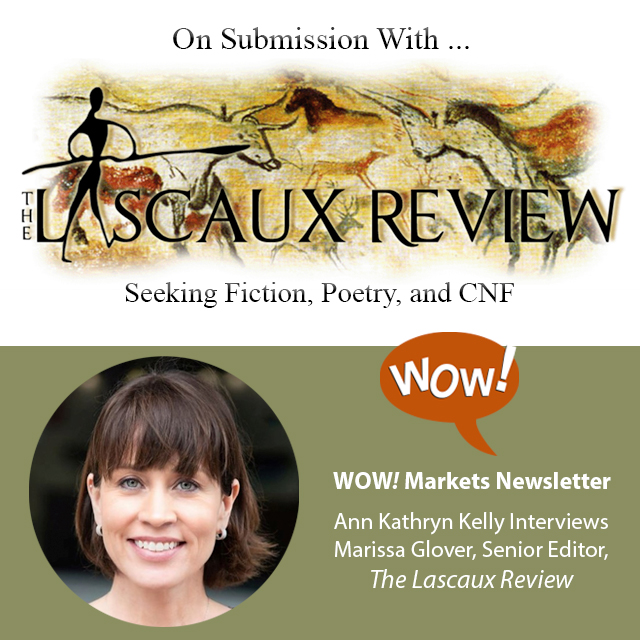
On Submission with... The Lascaux Review: Interview with Senior Editor Marissa Glover by Ann Kathryn Kelly
- February Deadlines: Poetry, Fiction, Nonfiction, Multigenre
- Success Stories from the WOW community! Column by Margo L. Dill
|
|
One of the things I love most about Valentine’s Day is the fact that it falls in winter. Who couldn’t use a little love to warm up these dreary days? Especially in light of the recent violence at the Capitol.
This turmoil makes the timing of Valentine’s Day even more important. The subject of love has generated literature across the ages—from the poetry of ancient Egyptians to the scribblings of contemporary authors. Let’s draw from this powerful wellspring to generate words of love and kindness to help each other heal.
|
|
The commercialization of Valentine’s Day makes the holiday feel a little corny sometimes, but the theme of love offers countless avenues of expression. Soothe your soul by penning your own poem, story, essay (or hybrid form) about some form of love, the connection we all so desperately crave. Below are some suggestions.
First Love. Write about your first love. Vladimir Nabokov did just that, in the eponymous classic short story “ First Love.” But your tale doesn’t have to be based on a childhood sweetheart. “Puppy” love is about as real as it gets, so if you’d rather write about a puppy (or a kitten) do that instead!
First Heartbreak. Will anything sting as much as the time your sweetheart told you that they just wanted to be “friends?” Take your inspiration from the famous jilting in Jane Austen’s novel Sense & Sensibility and recall your own heartbreak. Try telling it through letters.
Star-Crossed Love. The most famous tale of ill-fated love is Shakespeare’s “Romeo and Juliet,” and then there’s Mary Robison’s “ Yours,” one of my favorite modern stories about love found too late. Do you have a story of doomed love? Better hurry; the clock is ticking.
Everlasting (Creepy) Love. Take a walk on the wild side of love, in the style of Edgar Allan Poe in “ Ligeia.” Warning: don’t read this story late at night, but then again, if you do, it might help you write yours!
Imaginary Love. Did I make that up? Think fanatic obsession just like Shirley Jackson’s “ The Daemon Lover” or Sylvia Plath’s “ Mad Girl’s Love Song.” Pull a story or poem from your dreams.
Crazy Love. Tales of love in unlikely places continue to rivet audiences. One of my favorites is the hilarious short fiction “ My Date with a Neanderthal Woman” by David Galef. In a similar vein, conjure up your own fantasy date.
True Love. “The course of true love never did run smooth,” said Shakespeare, who might have added, “but oh, how we adore the plot twists and turns!” For an unusual take on true love, read the poem “ Valentine” by Carol Ann Duffy. Then take a look at an unusual object – another vegetable! – and write your own love poem or story.
|
We at WOW are in love, too, with the incredible array of markets and special themes this month. Whether you write and submit a love story or something else entirely, we just know that you’ll find the perfect home for a piece of your own heart. |
Ashley Memory
For a forkful of the literary life, follow Ashley's blog, Cherries and Chekhov, or find her on Twitter @memoryashley. |
Free Training: How to Become an In-Demand SEO Writer |
Free Training on Becoming an SEO Writer: Watch by January 31st
In this recorded webinar, WOW's friend Carol Tice and go-to SEO expert, Heather Lloyd-Martin, answer questions on How to Become an In-Demand SEO Writer. You'll learn what SEO writing is, how writers are making 9k/month from one client and how to get these high-paying clients, what keywords are getting used today, how to set yourself apart from the pack, and more.
|
Save the Cat! Cracking the Beat Sheet Course |
In the Cracking Your Beat Sheet workshop, you'll start with an idea for a novel or film and leave with the 15 key beats that will become the backbone of your story. |
With the popular Save the Cat! approach, you’ll discover the language of storytelling and the universal story structuring principles that are widely used by successful screenwriters and novelists.
You'll turn an idea into a story by learning to:
- Create a solid beat sheet that will serve as the blueprint, road map, and “backbone” of your story
- Identify and know the key components of your story genre
- Learn the clichés of your genre so that you can break them like an artist
- Plot your hero’s “transformation”
- Troubleshoot your story idea for viability
- Write a compelling logline or elevator pitch
- Develop a title to your story that anyone can visualize
Led by award-winning writer Jennifer Zhang.
|
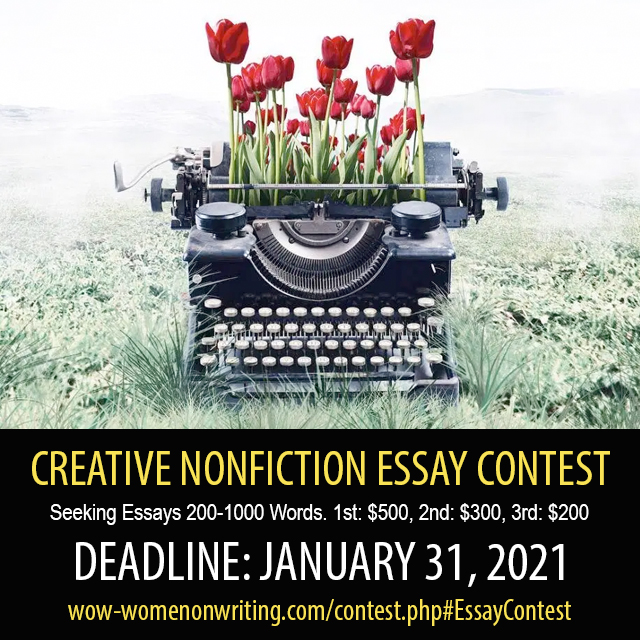
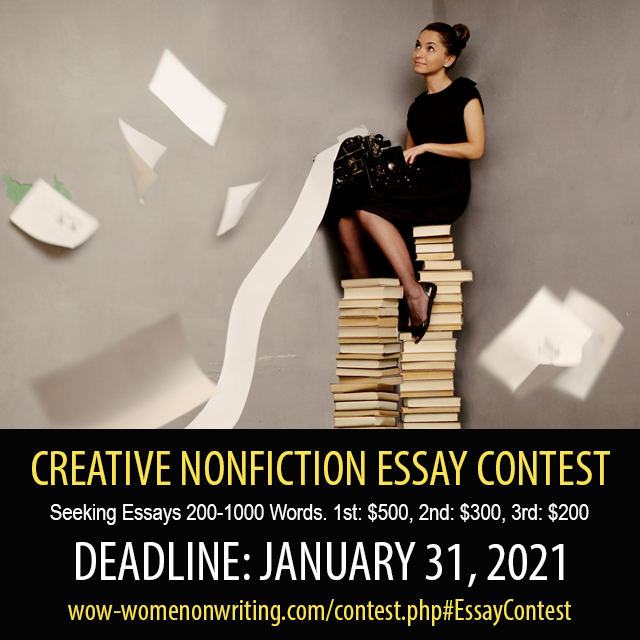
WOW Creative Nonfiction Essay Contest Deadline: January 31
1st Place: $500
|
|
Pitches & Opps
Yes! Magazine
For our Plastics issue, we're looking for stories on solutions that involve the wellbeing of our planet, economic recovery, accountability for Big Oil, and repair for marginalized communities. 50¢ per word. Guidelines. Pitch by Feb 5: submissions@yesmagazine.org
Poetry Foundation
We're seeking several freelance writers to review poetry books and a news curator to aggregate poetry-related news for the Poetry Foundation’s blog, Harriet! $175-$300 per piece + $35/hour for meetings. Details.
The Believer
Editor Kristen Radtke is looking for writers for schema, which is a spread that categorizes something cultural in an uncommon way. 500-1,000 words, flat rate is $500. ( Example. Example. Just text, not graphics.) Send a 2-3 sentence pitch to kristen@believermag.com.
Loverly
Covers all things wedding (news and tips, listicles, celebrity engagements, how-tos, and gift guides). They are building out their 2021 freelance network and are seeking writers, bloggers, and other wedding experts for their News & Tips section. SEO experience will be a big plus. They will pay $50 for short-form (500-750 words) and $100 for long-form content. Email: emily@engagemedia.io.
Daye - womxn's health
Editor Liv Cassano is commissioning for: long form features on sustainability, reproductive/menstrual/sexual health issues with a focus on identity & culture, and research-based gynae health pieces. Pay £200 for 800 - 1,000. Pitch liv@yourdaye.com.
Lady Science
A monthly magazine about “women and gender in the history and popular culture of science, technology, and medicine.” They are open for pitches. Editor-in-chief, Leila A. McNeill, says they are seeking “features, essays, reviews of your favorite new books on women, gender, & science.” Pay $150 per piece. They especially encourage BIPOC, LGBTQ+, and writers with disabilities to pitch them. Pitch here.
The Discoverer
Editor Kristin Magaldi is looking for freelancers who want to write about their favorite clever, useful, or under-the-radar travel products. Pay: $50 - $200. Guidelines.
Pop Dust
"We're currently accepting pitches, with openings for regular freelancers! $100 - $150. Send us your most creative takes on music, pop culture, social issues, weird internet niches, memes." Email pitches to info@popdust.com.
Sixty Inches From Center
The Margins
Seeking pitches in the following categories: author interviews; critical books essays; and essays on writing craft. Pay: $150 to $300. Pitch here.
Apartment Therapy
Editor Savannah West is seeking pitches on home decor inspiration, decorating trends, stylish storage solutions. Pay: $100 - $150. Send your pitches to savannah@apartmenttherapy.com.
Slate
Editor Susan Matthews is looking for a woman who's left the workforce because of the pandemic and wants to write about it. Pay roughly 25¢ per word. Pitch guide. Pitch susan.matthews@slate.com.
Sasee: Women Owned Business Guide – The Best Is Yet To Be
They want first-person, non-fiction material that is for or about women, of 500-1,000 words. Essays, humor, satire, personal experience, and features on topics relating to women are their focus areas. Deadline is Feb 15. Guidelines.
Bitch Media: Plastic
This magazine looks at pitches that offer a feminist analysis of culture. For the Plastic-themed issue, they have extensive guidelines, including: “This issue seeks to examine plastic as both a generative material and a societal condition, interpreting this theme through an assortment of lenses.” Key words include environment, debt, pools, cosmetic surgery, credit cards, Silicon Valley, frenemies, Instagram, girlbosses, Barbies, shopping, imposter syndrome, and brands. The sections are features, culture, and front-of-book (see guidelines). Features pay $700-1,000, dispatches pay $350, and culture pieces pay $250-700. Deadline is Feb 21. Regular pitches for the website are accepted on an ongoing basis. Guidelines.
|
|
On Submission With ... The Lascaux Review
|
|
By Ann Kathryn Kelly
Ah, a new year. New resolutions and opportunities. The blank page awaits.
If you’ve been following our monthly “On Submission With …” columns, we hope you’re enjoying the different angles we strive to bring you each month. We also promise to keep highlighting some of the fantastic writing our guest editors come across in their roles. We at WOW! love promoting work from writers and poets, so you can count on seeing inspiring examples in each of these columns.
This month, we’re bringing you an exciting angle that looks at how one journal handles contests and … wait for it! … reprints! You heard me right. Reprints! (Yep, it deserves that second exclamation point.) Reprints in the literary journal world are almost as rare as unicorns, so you’ll want to hear what our next guest has to say. Please give a warm welcome to Marissa Glover, Senior Editor with The Lascaux Review, a wonderful journal with an interesting name. The journal is kind enough to help us get our tongues around it, with the following phonetical rhyme on their website clearing things up.
How to pronounce Lascaux:
Escargot
In a row
Moving slow
And away we go … into our interview!
***
|
|
WOW: Hi, Marissa! Thanks for joining us, and Happy New Year! The Lascaux Review includes lovely photos of oil paintings and watercolors with selections of fiction, poetry, and creative nonfiction. I appreciate the old-world feeling this brings to the reading experience. Readers, you can find more about their submissions guidelines here. So, Marissa, how long have you been a senior editor?
Marissa: Thank you so much for your interest in The Lascaux Review and for taking the time to interview me. I’m delighted.
I discovered TLR when it was the featured magazine on Duotrope (my favorite writer’s tool) and fell in love with the journal. The art, the writing, the aesthetic—all of it. I met the editor-in-chief, Stephen Parrish (a writer himself), at an AWP conference when I went to their booth to thank the team for publishing my work. TLR published my poem, Some Things Are Decided Before You Are Born, in 2018 and later nominated it for a Pushcart Prize. Awhile after that Steve asked me to join the team as a reader, and I jumped at the chance. I served in that capacity for a while and was eventually asked to be a senior editor. I still don’t think I deserve the title, but I’m very grateful to be on such a generous team of folks who do good work and truly care about writers. My experiences with TLR and the masthead have made me a better writer and a better person.
WOW: Oh, your poem is lovely and bittersweet. I especially love this line: “The thing that kills a man is watching his star slowly drop from the sky.” There’s a world of truth and pain in that sentence. Tell us, what do you most love about your role with TLR?
Marissa: Thank you for your kind words! I love getting to read such fine pieces and discover new writers, even if they are just new to me. I love being able to publish folks and reward them for their hard work and excellent writing. I often feel both nervous and honored that people trust their creations and artistry to me. I read general submissions, I judge for contests, I consult on items and ideas, and I offer edits for publications. I don’t take any of these responsibilities lightly. But what I love most is probably the encouragement I’ve received from Steve, as well as the kindness the other editors (especially Wendy Russ and Camille Griep) have shown to me. I wouldn’t be where I am without them. In fact, I’m indebted to Steve for this very interview—he taught me everything I know about TLR.
WOW: OK, turning to reprints. Writers and poets put so much effort into their work, and reprints are a wonderful way to breathe new life into these pieces and introduce the work to audiences who may not have seen something the first time around. One of the first questions we’re eager to discuss is, in your opinion why do you think so many journals are adamantly not open to reprints?
Marissa: Most journals want to be first to publish. I’m not sure where this originates, but it appears to be industry zeitgeist; almost all submission guidelines insist the work not have appeared anywhere before, and some go so far as to exclude personal blogs as well. I guess I can understand wanting to be first, especially in a culture based on competition, but does it really matter? Maybe … when it comes to contests or awards, or when magazines are trying to go viral with unique content. It probably helps the financial bottom line. But there’s not much reader overlap from journal to journal, and even if you run into the same piece twice, we think that’s awesome. Awesome for you as a reader, to revisit the work, to go deeper with it—and awesome for the writer to have their work read again. We believe a great story, essay, or poem deserves as much visibility as it can get.
WOW: I love this paranoid FAQ your journal shares. It’s funny, but there’s also an uncomfortable truth to it on the angst writers and poets feel around the whole waiting game, as well as the sensitivity around reprints. I wish more journals were this laid-back, to be honest! Because TLR stands apart in this way, can you tell us more about why the journal made this decision?
Marissa: Most of our staff are writers who have the same ambitions and endure the same frustrations as those submitting work to us. So, we try to follow the Golden Rule and provide the experience we’d like to have when we’re submitting. No submission fee. Payment upon acceptance. Simultaneous submissions okay. Reprints welcome. Prompt response. Feedback, on request. Respectful treatment. Author has final say over content. Author retains all rights to her work, at all times.
Writers endure enough stress as it is; everyone does. It’s a stressful world! We figured a laid-back approach would be a nice change in the literary world. Besides, journals don’t really compete with one another, any more than writers do. They compete with movies, video games, and the myriad distractions of the internet. Journals can get lost among books, and are read mainly by writers seeking places to publish their work. At TLR, we often recommend other markets and selectively alert contributors to open contests, calls for submission, and other opportunities. We’re all in this together.
|
|
[Regarding reprints]: “I guess I can understand wanting to be first, especially in a culture based on competition, but does it really matter? We believe a great story, essay, or poem deserves as much visibility as it can get.”
~ Marissa Glover, Senior Editor, The Lascaux Review
|
|
WOW: That’s a refreshing and welcomed point of view. So, what should writers and poets keep in mind, if they’re considering submitting a reprint to TLR? Is there a suggested time period that is considered good taste? Is six months too soon, and two years too late? Does a particular type of writing or word count stand a better chance at being accepted?
Marissa: It’s funny you should ask, because we get reprint requests from writers whose submissions haven’t yet appeared in another journal. On the other hand, we’ve waited as long as a year for such first appearances to occur. But no, we don’t evaluate previously published submissions any differently than unpublished or even exclusive submissions, and there’s no statute of limitations. If we love it, we buy it.
WOW: OK, now to the topic of contests! Some people love ’em (me), some people ignore ’em. The contests page for TLR mentions four: poetry, flash fiction, short fiction, and creative nonfiction, with a fee of $15 for each. Approximately how many writers or poets enter these, on average? How often is each offered? I know it’s hard to pin down response times, especially when the number of entrants fluctuates, but how long (ballpark) does it take for the staff and judges to get through entries for any given contest?
Marissa: We run each contest once a year, during each of the four seasons. We currently receive 600 or more submissions per contest, although that number continues to rise, year to year. Incidentally, it’s easier to get published as a contest finalist than via general submissions, where we receive over 5,000 submissions annually. Our goal is to finish judging a contest within three months of its closing date. As for regular submissions, we aim to respond within 30 days. In both cases, we usually make our goal.
WOW: The cash prizes—$1,000 to a winner in each of the four contests, along with a bronze medallion—is very nice! Do you rotate in new guest judges for each cycle?
Marissa: There’s no rule. A typical group of judges will consist of the journal leadership, along with at least one additional staff member and sometimes an outsider not on the masthead. We’ve had as many as seven people arm wrestling (not literally) over their favorites. The final decisions are made during group Skype calls and are democratic, so even the editor-in-chief doesn’t always get what he wants. The result is diversity of content and style. And by the way, those bronze medallions are even more impressive in person. Trust me, you want one.
WOW: I sure do! I’ve already tried your CNF contest once, and I’ll be back! OK, what types of writing techniques or approach stands out for you in a fiction or nonfiction contest and makes a submission a clear contender? How about for poetry? Do you read and judge across all four contests?
Marissa: I don’t read for every contest and I don’t read every general submission. In addition to my role at TLR, I also volunteer with Orange Blossom Review, so I have to carefully balance my responsibilities. For TLR, I read and judge as necessary, happily completing every assignment I’m given. But regardless of the assignment or genre of writing, “clear contenders” all have the same thing in common: they make me want to keep reading. They grab me early and don’t let go. They say something new, even if the topic is familiar or as old as dirt. They stay with me after I’ve read them. Days after. Weeks.
|
|
“We currently receive 600 or more submissions per contest, although that number continues to rise, year to year. Incidentally, it’s easier to get published as a contest finalist than via general submissions, where we receive over 5,000 submissions annually.”
~ Marissa Glover, Senior Editor, The Lascaux Review
|
|
WOW: I saw where contest winners and runners-up are published both online and in print, which leads to my next question. With so many journals having an online-only footprint these days, what do you think of print journals, personally? Is there still a certain prestige to them, in your opinion, or do you agree with many people that online is more accessible both as a writer or poet, and as a reader?
Marissa: Online content is clearly more accessible: potentially, everyone on the planet with internet access can read it. But writers still tend to favor seeing their work in print, probably because the digital era is still in its infancy. It also feels nice to have a book in your hands. So, in keeping with our already mentioned Golden Rule philosophy, we do both. The print editions are reincarnations of previous prize anthologies. We don’t do print editions to make money. In fact, we give most of them away, both print and digital editions. We provide downloads of our publications to contest entrants and to submitters who make a tip jar donation. It’s great to hold a print edition in your hand, but it’s also great to share a link to your publication with your family and friends—so, why not do both?
WOW: Outside of contests, I saw where TLR accepts regular submissions year round through Submittable, and there’s no fee. Do you have a maximum word count for fiction and CNF? Does the journal pay for accepted pieces?
Marissa: No fee, and we pay a minimum of $100 for everything we publish. There’s no word count limit—we’ll even serialize a novel, if the right one comes along—but here’s a dose of reality: a few short decades ago a story was long if it exceeded 8,000 words. That number is closer to 3,000 today. Remember the zeitgeist I mentioned earlier? Attention spans are decreasing, Twitter rules social media, and a piece over 5,000 words is going to have to grab us from the first word to the last. Likewise, for “epic” poetry. But, it happens. In TLR Issue 7, which published in December 2020, we included an 8,400-word story.
WOW: What’s the journal’s acceptance rate (approximate is fine), and how often do you publish? What’s the turnaround for regular subs?
Marissa: If you don’t get a response to a regular sub within 30 days, it’s because someone has COVID. I’m not kidding; it happened. Work is published in the online edition on a rolling basis. We’ve published pieces two days in a row, and we’ve waited as long as three months between publications. It all depends on the submissions. The print edition appears once a year, and it includes everything that appeared online during the previous year. The acceptance rate is about a half of a percent for contest submissions and about a quarter of a percent for regular submissions. That sounds scarier than it is because submitting is free, simultaneous submissions are welcome, you’ll hear back relatively quickly, and we love you even if we don’t publish you.
WOW: I know our readers will appreciate TLR’s relatively quick response, and we all love free subs! Can you share with us some of your favorite pieces published in TLR?
Marissa: There are many. I’ll start with two that were recent reprints, since reprints are a focus of this interview: Nevermore, a poem by Katie Manning, and Elegy for a Living Mother, a poem by Renee Agatep.
Other staff favorites include Heaven, a CNF piece by Mike O’Mary. We love Sunday, a CNF piece by Lee Martin, as well as Give Me Your Wife, a poem by Tony Hoagland. Then there’s This Isn’t Silverlake Anymore, a poem by Andrew McCarthy, and The Spoken World, a CNF piece by Brett Garcia Rose. Finally, we really enjoyed The Burning Girl, a story by Davin Malasarn, and Günther’s Tree, a poem by Lois P. Jones—the first poem we ever accepted.
WOW: Oh, those first two poems! Katie Manning packs a punch in so few words! And Renee Agatep’s third stanza—ooof, right in the gut. Her final stanza: heartbreaking. OK, turning the tables from the journal to you personally. Describe a day in the life at Marissa’s writing desk. Put us in scene. What’s your routine, and what are you currently working on?
Marissa: Well, nothing feels routine right now. Like most people at this time, I struggle to identify or define “normal.” When it comes to the stuff I’m required to do, I do it the best or only way I know how based on whatever is happening at the moment. Currently, I’m working my full-time paying job, as teaching faculty at Saint Leo University, and my full-time non-paying job as partner, parent, and manager of the home. When these demands are complete enough to turn my attention elsewhere, I’m busy writing, editing, sending, reading, publishing. Before entering academia, I worked as a professional editor and writer for 15 years. Even now, I continue doing freelance work for clients. Interested folks can learn more about what I do at my website.
WOW: Tell us about your first publication. The thrill of it. Where was it published? We’d love to read it, so share a link if you have it!
Marissa: My first poetry publication, The Happy Hour of Assault, was in a journal called Rat’s Ass Review. At the time, I didn’t know much about literary journals or the publishing process, but the name of the magazine cracked me up so I decided to give it a go. Editor-in-chief Roderick Bates was very kind to me and my work, patiently answering several of my novice questions. I don’t have an MFA, and most of what I know now has been through self-directed research or trial and (embarrassing) error, as well as through generous education from folks like Steve Parrish and other editors and writers. I remain thankful to RAR and Mr. Bates for publishing me and making me feel like this was something I could do.
WOW: LOL, I love the irreverence in that journal’s name! And so, besides your editorial duties with TLR, what are some other creative projects you’re pursuing? What does downtime look like for you?
Marissa: Downtime—what’s that? Do women and mothers and workers and writers and … have downtime? Seriously, though, my full-length poetry collection, Let Go of the Hands You Hold, is forthcoming from Mercer University Press on April 1, 2021. I’m so grateful to my publisher, Marc Jolley, and his incredible team. You can find more about the collection here.
Also, I very recently completed my next poetry manuscript and hope to have details on its publication soon. Oh, wait! We just adopted a puppy. That’s my creative project right now. Wish me luck!
WOW: A final question: Longhand or typing?
Marissa: Typing, always. Unless I’m in the car driving, in which case I use my voice recorder on my phone. Or I’m sleeping, in which case I wake up and furiously scribble in the journal on the nightstand. Or I’m in the shower, in which case I lose most of the thoughts that came to me—and they’re always my best ones!
Thank you again for this opportunity. I wish you and your readers well.
***
|
|
My thanks to Marissa Glover, Senior Editor with The Lascaux Review, for chatting with me. Is 2021 the year you try a contest? Do you have a treasured reprint in your computer’s folder that you think might like to take another stroll in the world? Consider submitting it to them!
Until next time!
|
|
|
|
Ann Kathryn Kelly lives and writes in New Hampshire’s Seacoast region. She’s an editor with Barren Magazine, a columnist with WOW! Women on Writing, and she works in the technology sector. Ann leads writing workshops for a nonprofit that offers therapeutic arts programming to people living with brain injury. Her essays have appeared in a number of literary journals. https://annkkelly.com/
|
|
Sheila-Na-Gig Online 2021 Poetry Submissions
Deadline: February 2
Sheila-Na-Gig online publishes well-crafted free verse poetry. We especially seek poems with excellent imagery and a strong sense of voice. Please submit 3 previously unpublished poems as one file (.doc, .docx) via the Submittable link. Include a brief bio in the cover note field. Simultaneous submissions are accepted. Fee: $7.
The New York Quarterly – Theme: “Without a Doubt”; Poems Illuminating Faith
Deadline: February 2
“Faith is personal. Faith is quiet. Faith is without a doubt. Faith is. Does faith even exist? We are seeking poems that experience faith rather than tell--the word "faith" may not even appear in your poem. We seek poems that demonstrate a new and fresh understanding of faith. Poems that climb through the fog to the mountain top. Poems that rise above religion and redefine spirituality. Submit between 3 and 5 poems of any style or form in one document (.doc, .docx, and .pdf). Fee: $3. https://newyorkquarterly.submittable.com/submit/168441/without-a-doubt-poems-illuminating-faith-anthology
Gordon Square Review - Cleveland Humanities Festival Crowdsourced Poem: Identity Theme
Deadline: February 8
Literary Cleveland and the CSU Poetry Center invite writers who have a connection to Northeast Ohio to submit a poem on the theme of identity. “Your work will be considered for inclusion in the 2021 Cleveland Humanities Festival. We will be creating a crowdsourced, collectively written poem that will be performed on video and shared online. Submissions are limited to poetry and should be less than 1,000 words.” No fee.
Lantern Review: Theme: “Asian American Futures”
Deadline: February 11
Berkeley Poetry Review: Issue 51
Deadline: February 15
Berkeley Poetry Review seeks language-based and/or experimental writing, translations, art, and (less frequently) essays and interviews. “We are particularly interested in work that complicates prevailing conceptions of race, gender, sexuality, poetic form, and narrative voice. Send us writing that expands. Submit no more than 5 previously unpublished poems with a cover letter, including your name, contact information, and a brief bio. Please submit your poems in a single document. Do not submit more than once over the course of a single reading period.” No fee.
Sarabande Books: Kathryn A. Morton Prize in Poetry
Deadline: February 15
The prize includes a $2,000 cash award, publication of a full-length collection of poetry, and a standard royalty contract. Kathryn A. Morton was a published author and devotee of fine literature, especially poetry. The judge for the 2020 Kathryn A. Morton Prize in Poetry is Victoria Chang! Minimum length 48 pages. Fee: $29
Frontier Poetry 2021 Contest: New Voices
Deadline: February 15
“The new year is here! We want to open up 2021 with a great opportunity for an up-and-coming poet, judged by Donika Kelly. This New Voices Contest will offer $3,000 to the author of the judge's favorite poem. 2nd and 3rd place will receive $300 and $200 respectively. We're looking to shine a light on newer poets—only authors with no more than two full length collection currently published may submit. No more than three poems per submission. There is no line-limit. Poems may be any length, any style, or any subject.” Fee: $20.
Milkweed Editions: Ballard Spahr Prize for Poetry
Deadline: February 15
The Ballard Spahr Prize for Poetry supports outstanding poets from the upper Midwest and brings their work to a national stage. Formerly known as the Lindquist & Vennum Prize for Poetry, which was established in 2011, this prize awards $10,000 and publication by Milkweed Editions to a poet residing in Minnesota, Iowa, North Dakota, South Dakota, Wisconsin, or Michigan. Poets may submit one complete, book-length collection, defined as a manuscript of forty-eight or more pages. The submitted manuscript must be previously unpublished, though individual poems included may have been previously published in periodicals, chapbooks or anthologies. This is not exclusively a first book contest; poets may be at any stage in their career. No fee.
Quarterly West – Theme: “Domestication”
Deadline: February 16
Submissions are open for a special issue on the themes of domestication and feralization. We welcome poems on nonhuman animals, but the theme also encompasses the ways humans relate to our domestic spaces, or the comforts and constraints of domesticity. How do domestic spaces shape us, shelter us, turn against us, cast us out--especially at this time of staying home? We are excited to read work that approaches domestication and feralization creatively, applying these terms to humans and nonhumans. Submit up to five poems per entry. No fee.
Kallisto Gaia Press: 2022 Texas Poetry Calendar
Deadline: February 20
The Texas Poetry Calendar has been an iconic staple of the poetry community in Texas since 1998, publishing Texas Poets Laureate and Pushcart winners alongside emerging poets from the vast cultural diaspora culminating in this great state. Submissions are accepted annually from December 1 through February 20 of the following year. Submit 1-3 poems in a single document. Begin each poem on a separate page. Do not make more than one submission per year. Limit poems to 35 lines including title and spaces. We recommend submitting at least 1 short poem of 10 lines or less. We welcome haiku, tanka, and other short forms. Note: Your poems should have a Texas connection. Fee: $3.
|
|
Ruminate Magazine: William Van Dyke Short Story Prize
Deadline: February 4
We invite you to enter the William Van Dyke Short Story Prize 2021. Kelli Jo Ford is the final judge. As with all our submissions, we highly recommend reading a copy of the magazine to better understand what we are looking for. The 2020 winning story appears in Issue 56: Expression. You may submit one story per contest entry fee and it must be 5,500 words or less. There is no limit on the number of entries per person.” Fee: $20. https://ruminatemagazine.submittable.com/submit/8439/william-van-dyke-short-story-prize-2021
Luna Station Quarterly
Deadline: February 15
Luna Station Quarterly publishes speculative fiction written by women-identified authors.” We think women write awesome characters and really cool stories and we want to show it to the world. We will consider stories submitted by any woman writer, regardless of experience or writing resume. If you consider yourself on the woman end of the gender spectrum in any significant capacity, you’re welcome here! Stories should be 500 to 7,000 words in length. We may publish longer or shorter works, but the greater your story is above or below limit, the less likely we are to publish it. No poetry please. Submit only one story per submission period. We do not accept multiple submissions.” NOTE: We are no longer accepting simultaneous submissions. Do not submit a story to us if you have submitted it elsewhere. No fee. Pays $5 per story.
Sarabande Books: The Mary McCarthy Prize in Short Fiction
Deadline: February 21
The prize includes a $2,000 cash award, publication of the winning manuscript, and a standard royalty contract. The judge for the 2020 Mary McCarthy Prize in Short Fiction is Danielle Evans! This contest is open to any short fiction writer of English. Manuscript must be ANONYMOUS—the author’s name or address must not appear anywhere on the manuscript (title page should contain the title only). Must be typed, standard font, 12 pt., double-spaced; if printed must be on standard white printer paper, unbound (binder clip or rubber bands preferred). Length: Between 150-250 pages. Fee: $29
Novel Slices: 2021 Winter Novel Excerpt Contest
Deadline: February 28
“Enter the ‘Novel Slices Contest’ for a chance to be one of the 5 winners published in the second issue of Novel Slices in May, 2021. Each winner will receive $150, a copy of the winning print issue, and prime literary agent & publisher exposure.” All novel genres welcome. Excerpts should be approximately 4,000 to 6,000 words in length (do not send us your entire manuscript). Fee: $20.
Little Tokyo Short Story Contest
Deadline: February 28
The Little Tokyo Historical Society seeks fictional short stories for its eighth annual Imagine Little Tokyo short story contest. The story has to be fictional and set in a current, past or future Little Tokyo in the City of Los Angeles, California. Each category winner will be awarded $500 in cash with their short story being published in The Rafu Shimpo, Discover Nikkei and Little Tokyo Historical Society website. Submitted manuscript should be 2,500 words or less for English, or 5,000 ji or less for Japanese and have a title. No fee. Read the guidelines, and submit to Imaginelittletokyo@gmail.com (include SHORT STORY in the subject line). |
|
Her Stry - Theme: Family Secrets (March 2021 Theme)
Deadline: February 1
“What does it mean to keep a secret? How do secrets change our families? Us? We're looking for stories about family secrets. Secrets you're keeping, secrets someone kept from you. All stories should be true and about you.” Length: 500-3,000 words. Fee: $3.
Months to Years
Deadline: February 1
We welcome previously unpublished creative nonfiction up to 2,500 words that explore mortality, death, and dying-related topics. No fee.
Wanderlust 2021: A Collection of Travel Essays
Deadline: February 2
“Are you inspired to travel again as soon as it's safe? Do you want to read other people's trips, see their photos, explore the world as they experienced it? Wanderlust is looking for a range of essays from across the world for our annual collection. With the pandemic having shut down most of our travels from 2020, let's start fresh with a new eye on people and places we know or want to. Read the website for a sense of the aesthetics. Be kind. Be generous. Bring us with you.” Accepting essays of up to 1,000 words, double spaced, no extra line breaks between sentences only sections. Fee: $6.50.
Creative Nonfiction: Submissions from 60+ Writers
Deadline: February 22
Creative Nonfiction is currently seeking submissions of new nonfiction work by older (60+) writers. “We’re looking for personal essays/memoir, experimental work, science writing, profiles, historical nonfiction, lyric essays … any kind of lively fact-based writing. Your work might directly address issues related to age/aging, but there is absolutely no requirement that it do so.” 4,000 words max. Fee: $3 (free for subscribers).
|
|
Please See Me: Second Annual Mental Health Awareness Writing Contest
Deadline: January 31
“The winning submission in all 3 written genres will receive $250 for a story or narrative that raises awareness on any of the issues surrounding or relating to mental health, such as: bias and stigma, homelessness, missed or delayed diagnosis, or loss (of family, husband/wife, jobs). We also welcome stories of triumph over illness of any kind, and that show our resilience in the face of illness.” Poetry: One poem of any length for the contest. Fiction: Submit short stories up to 4,000 words in length. Flash fiction is welcome and encouraged. Creative Nonfiction: Submit nonfiction pieces up to 4,000 words in length. Fee: $10
The Rumpus
Deadlines: January 31 (Fiction) and February 28 (Essays)
Fiction: Please submit a short story between 1200–5000 words as a Word doc or PDF, accompanied by a brief cover letter and third-person bio. If you are sending flash fiction (under 1200 words), you’re welcome to submit up to three pieces for consideration as one submission. Essays: 1,500 – 4,000 words. No fee.
Room
Deadline: January 31
Room Magazine invites unpublished writing for its “Indigenous Brilliance” issue 44.3, edited by the Indigenous Brilliance team Karmella Cen Benedito De Barros, Emily Dundas Oke, Patricia Massy, jaye simpson, and Jessica Johns. This issue is to hold space for Indigenous writers to tell their stories. Indigenous is used to refer broadly to peoples of long settlement and connection to specific lands who have been adversely affected by incursions by industrial economies, displacement, and settlement of their traditional territories by others. All contributors will be paid upon publication: $50 CAD per page (up to a maximum of $200). Accepts up to 5 poems and fiction and nonfiction up to 3,500 words. Fee: We do not charge for general submissions, with the exception of our annual contests.
Ilanot Review. Theme: “Delight”
Deadline: January 31
“For our ‘Delight issue’ (spring 2021), we are interested in that which gives great pleasure. We’re in love with “the Old French delit…from delitier ‘please greatly, charm,’ from Latin delectare ‘to allure, delight, charm, please,’ frequentative of delicere ‘entice’ (see delicious). Tell us how it’s ‘spelled delite until 16c.’ and that ‘the modern unetymological form is by influence of light, flight, etc.’ We’d also be pleased and delighted to read works of delight and light and peace and contentment inspired by Germanic, Slavic, Semitic, Chinese, and all other world etymologies of this pleasantness, and all the permutations of enjoyment. Delight!” Poetry: Submit up to 5 poems, not exceeding 7 pages, in a SINGLE Word file. Each poem should begin on a separate page. Fiction: Please submit one short story, up to 2,500 words long, or up to 3 flash pieces, no longer than 1,500 words total. Creative Nonfiction: Submit one piece of creative nonfiction, preferably no more than 3,000 words long, or up to 3 flash pieces, no longer than 1,500 words total. Please include a brief bio with your submission. Fee: $3.
Lunch Ticket, Issue 19. Various Themes:
Poetry: Poetry Theme for Lunch Ticket, Issue 19: "Hopeful Futures"
Deadline: January 31
This cycle, our section is seeking poetry that ruminates on a hopeful future, whether this means imagining one or wrestling with the changes of the past year. We invite strong imagery and unique voices. Submit up to 3 poems per cycle, each in a separate document.
Fiction: Theme for Lunch Ticket, Issue 19: "The Vivid, the Unusual, That Which Lingers"
Deadline: January 31
This cycle, our section is seeking vivid, unusual, and poignant tales. Send us stories that we can't forget. We no longer accept submissions longer than 3,500 words. If your piece is 750 words and under, please submit it to the Flash Prose category.
Flash Prose: Theme for Lunch Ticket, Issue 19: “Satire.”
Deadline: February 14
This cycle, our section is seeking stories infused with satire - wry humor and wit aimed to reveal the peculiarities of human behavior. Submit one flash piece of prose that is 750 words or less.
Creative Nonfiction: Theme for Lunch Ticket, Issue 19: “Openings.”
Deadline: February 14
2020 foreclosed a lot of possibilities, so we’re looking to the new year for doors, windows, and crawl spaces we might slip through in search of new passages that emerge. Send us your memoir, personal essays, and flash nonfiction that meets, exceeds, or explodes our expectations of how openings look, feel, and sound. Word Limit: 3,500 words. If your piece is 750 words and under, please submit it to the Flash Prose category. Also reading for the Diana Woods Memorial Prize in Creative Nonfiction. DWM winners receive $250 and publication. Two finalists will also be published. No fee.
CutBank Prizes
Deadline: February 1
The Montana Prize in Fiction and Nonfiction and the Patricia Goedicke Prize in Poetry highlight work that showcases an authentic voice, a boldness of form, and a rejection of functional fixedness. The winner in each category will be featured in CutBank 95 and receive $500. All pieces will be considered for print publication. We look forward to reading your work! Poetry: Submit Up to 5 poems. Fiction and nonfiction: Please send only a single work of no greater than 35 pages. Please submit only once per genre - writers are permitted to submit in multiple genres. Fee: $20.
The Normal School
Deadline: February 1
Poetry: Up 5 poems. Fiction: Up to 2,500 words max. Nonfiction: For the current Submission Period, we will consider brief essays, memoir, and other forms of creative nonfiction of NO MORE than 1,000 words, with contemporary styles and an attention to language, form, and consciousness.
Fee: $2.
Fatal Flaw Vol. 3 Theme: (UN)CONFINED
Deadline: February 5
Fatal Flaw is an international online magazine publishing unexpected, topical writing and photography that considers the world through a cracked lens. Show us the fatal flaw and the beauty inherent within it. The paradox of the human condition is that we are both limited and infinite. In theory, we can live any sort of life, yet we are all confined by circumstance, pressures, expectations, and the choices we make in our limited time on this earth. For this issue, we wish to examine the idea of confinement. This can mean literal confinement—walls, institutions, the body, the written page—or abstract confinement—ideologies, psychologies, relationships, gender, societal constructs, etc. Poetry: Submit up to 3 poems (no more than 6 pages). Flash Fiction: 100-1,000 words. Fiction and Nonfiction: 1,000-7,000 words. Fee: $3.
Penumbra Spring 2021 Issue
Deadline: February 6
Accepting a maximum of 1,000 words total across multiple submissions. No limits on form or content. Poetry: A maximum of five poems per individual. Fiction: A maximum of 1,000 words total, whether in the form of one long piece or several flash fiction pieces. Only five submissions total allowed. Nonfiction: A maximum of 1,000 words total, whether in the form of one long piece or several shorter pieces. Hybrid: A maximum of 1,000 words total, whether in the form of one long piece or several shorter pieces. Only five submissions total allowed. No fee.
First Pages Prize Entry
Deadline: February 7
Malasaña arts & letters
Deadline: February 9
“We accept prose (both fiction and nonfiction), poetry, and visual art submissions. For prose, please submit up to 2,500 words. We will occasionally accept a longer piece if we really feel it fits with our intent.” For poetry, please submit three to five poems, all in a single document. Translations of poems and flash fiction are welcome. Translator should have written permission from original author. Fee: $3.
The Halcyone/the Black Mountain Press: HerWords: A quarterly literary magazine for Women: Now Reading for 1st quarter 2021
Deadline: February 10
Coffee People Zine
Deadline: February 12
Coffee People Zine celebrates the creativity of the coffee community. We showcase the multi-dimensionality of folx who work in and around the coffee industry. Through our seasonal submission-based zine, we publish art and articles, poetry and photography, music and musings, doodles and drawings, and other creative works by baristas, roasters, and other coffee professionals around the world. Rules: 1. If you work in the coffee industry, your submission can be anything. 2. If you do not work in the coffee industry, your submission must be about coffee in some way. No fee.
Multiplicity Magazine – Theme: “Starting Over”
Deadline: February 12
“The theme for our Spring 2021 Issue is ‘Starting Over.’ We are looking for fresh, original creative nonfiction—from 500 to 5,000 words—as well as poetry (up to 5 poems) and photography on the theme of beginning again. Have you started over in a new relationship, in a new career, or a new country? Come out of the closet or come back from a war? Have you fought your way back after an illness or trauma? We welcome memoir pieces and essays, reported narratives, profiles, poetry, photography, and experimental forms of creative nonfiction. Tell us your stories of change, whether radical or subtle, internal or external.” Fee: $3.
Coffin Bell – Theme: “Labryinths”
Deadline: February 14
Coffin Bell is a quarterly online journal of dark literature. “Seeking poetry, flash fiction, short stories, creative nonfiction, essay, and short criticism that explore dark themes. Send us your darkness! Submissions for issue 4.2 ("Labyrinths," 4.1.2021) are now open! In the mythical story, King Minos of Crete commissioned Daedalus to create a structure to contain the Minotaur, to hide its existence from the world. The Labyrinth today is frequently used to evoke the Jungian concept of the ‘collective unconscious,’ with the Minotaur at the center being symbolic of the shadow self”. Submit 1-5 flashes in a single file, up to 5 poems in a single file, and up to 7,500 words in prose. Fee optional.
The Armistad
Deadline: February 14
The Amistad is Howard University’s literary arts journal. “Our goal is to elevate the creative voices of the Black diaspora through poetry, fiction, interviews, and art. We strive to publish the best up-and-coming voices in conjunction with local and established writers to create a journal that speaks directly to the black community. The Amistad is seeking previously unpublished work that speaks to our mission statement.” Encourages multiple submissions in different genres (12 pt, double-spaced and Times New Roman). Poetry: 3-5 poems (no more than seven pages); Fiction: 5,000 words, maximum; Flash Fiction: 1000 words; or Essays: 2,000 words. No fee. https://theamistad.submittable.com/submit/
Humber Literary Review: Spring/Summer 2021 Issue
Deadline: February 14
“The Humber Literary Review, a literary and arts magazine, is currently seeking submissions of original, unpublished writing and art: please send us your best short fiction, personal essays, poetry, artwork, and comics for our upcoming spring/summer print issue, scheduled for release in the spring of 2021. We pay $100 each for essays, fiction, reviews, and for 2-3 poems. We also pay our feature and comics artists. Contributors will receive two copies of the issue in which their work appears plus a one-year subscription to the HLR.” Fee: $4.
The Greensboro Review
Deadline: February 15
“We are open for submissions! Please submit your fiction, poetry, and flash fiction.” Poetry entries can include up to 10 pages, but we recommend 5 to 7 poems per submission. (Please note that we rarely publish individual poems that exceed 2 pages.) Submit only once per genre during each submission period. Fiction: No more than 7,500 words or 25 typed, double-spaced pages for fiction. Flash fiction entries may be up to 500 words. Fee: $2-$3 (free for subscribers).
Lambda Literary Awards
Deadline: February 15
The 2021 Randall Kenan Prize for Black LGBTQ Fiction, the 2021 Judith A. Markowitz Award for Emerging LGBTQ Writers, the 2021 Jim Duggins Outstanding Mid-Career Novelists' Prize and the Jeanne Córdova Prize for Lesbian/Queer Nonfiction offer cash prizes ranging from $1,000 - $5,000 to eligible writers. See the website below for more details. No fee.
Denver Quarterly
Deadline: February 15
Denver Quarterly is the literary journal housed in the Department of English & Literary Arts at the University of Denver, currently in its 55th year of consecutive print publication. Founded by novelist John Williams in 1966, the journal has had work honored in the Pushcart Anthology, The PEN/O. Henry Prize Stories, The Best American Essays, The Best American Short Stories, and The Best American Poetry. Poetry: Submissions should be comprised of three to five poems, submitted all together in one file. Prose: Submissions of fiction, creative nonfiction, and all manuscripts in-between, should generally consist of no more than 4,000 words of a single work or 3-5 flash / micro / short form pieces compiled into a single document. No fee.
Sierra Nevada Review
Deadline: February 15
Accepting fiction and nonfiction up to 4,000 words, and flash submissions in each genre. Please send only one submission per reading period, in one genre only. Submitting in more than one genre will automatically disqualify all submissions. No fee.
The Boiler
Deadline: February 16
Seeking new and emerging writers. Poetry: 3-5 poems. Fiction: short stories or excerpts of up to 3,500 words. Creative Non-Fiction: pieces up to 3,500 words. No fee.
Plants & Poetry Journal Seventh Issue: “Rituals & Remedies”
Deadline: February 20
“Plants & Poetry Journal is an online nature inspired literary journal publishing poetry, prose, & art by writers and artists. For every submission, the plants & poetry team will plant a tree or other vegetation in our Food Forest. The theme of the seventh issue explores how we begin our days. Do you have any rituals or remedies that allow you to reimagine your week? The steam beaming off of a hot pot of water after 5 long minutes, the crunch sound of mint leaves, dipping your spoon in an upcycled honey jar for the nightly cup of tea. Submit your work in word or PDF with a photo of yourself and a short biography.” This can be a poem, a short story, or a photograph. Fee: $15.
Eastern Iowa Review –Theme: “Winter”
Deadline: February 20
“We are primarily seeking lyric essays & prose poetry, though we'll also consider creative nonfiction. Please, no standard poetry, journalistic essays, book reviews, etc. If you've not read Annie Dillard, you may not have discovered the kind of lyricism we especially love.” (Hint: For an example of work they love, read “ Happy Sobriety Birthday” by our very own Ang!) “If you're not sure about a work or a topic, please send it anyway. Send winter-themed submissions only. What we seek: 1. Some tie-in to the theme of "winter," though the connection may be understated or oblique. We welcome many interpretations of "winter." 2. Essays up to 1,500 words each. Send up to three in the same document. 3. NO FICTION THIS TIME AROUND. 4. Prose poems up to 250 words each. Send up to three in the same document. NOTE: We consider a prose poem to be like a paragraph of text. That is, NO line breaks at all and no block text. No slashes, no extra spaces, etc. Your prose poem should look like a paragraph of text you'd find in a book or newspaper BUT it should sound poetic and be tight and surprising in the language. No journal entries, please. No standard narrative-speak. It must be poetic in sound, prose in form. 5. Only submit in one genre at a time until you hear back from us. 6. No reading fee. No payment this time for accepted work except for the Editor's Choice Award which will be announced in March or April. Award will be $50. For more, see the link below. https://easterniowareview.submittable.com/submit/180332/issue-13-the-theme-is-winter-creative-nonfiction-or-prose-poetry
AWP Prizes for Poetry, Novel, Short Fiction and Nonfiction
Deadline: February 28
AWP Donald Hall Prize for Poetry awards $5,500 and publication
AWP Grace Paley Prize for Short Fiction awards $5,500 and publication
AWP Prize for the Novel awards $2,500 and publication
AWP Prize for Creative Nonfiction awards $2,500 and publication
Fee: $20 (members) or $30 (nonmembers) for each entry. See details for submission at the link below.
Tiferet: Promoting Peace Through Literature and Art
Deadline: February 28
TIFERET publishes fiction, nonfiction, poetry, interviews, and art. “We look for high-quality creative work that expresses spiritual experiences and/or promotes tolerance. Our mission is to help raise individual and global consciousness, and we publish writing from a variety of religious and spiritual traditions.” Poetry: Submit between 3-5 poems. Fiction and Nonfiction: Please make sure your manuscript does not exceed 3,000 words (this will often, but not always be about 12 double spaced pages). Manuscripts that are over this cap will not be read. Fee: $3.
Sunspot Literary Journal
Deadline: February 28
Sunspot Literary Journal is dedicated to amplifying diverse multinational voices. We offer an Editor's Prize of $50 for the annual edition. Visit SunspotLit to download digital editions for free. All types of prose from flash fiction and poetry to stories and essays, including scripts and screenplays, are welcome. We also accept long-form, novelette, and novella length works up to 49,000 words. Poetry can be up to 1,250 lines. Translations welcome. One piece per prose submission. Poets can submit up to 2 poems using the appropriate forms. Use the correct form according to the length of your prose and poetry. Works longer than allowed by the form used will be declined unread. Fee: Varies.
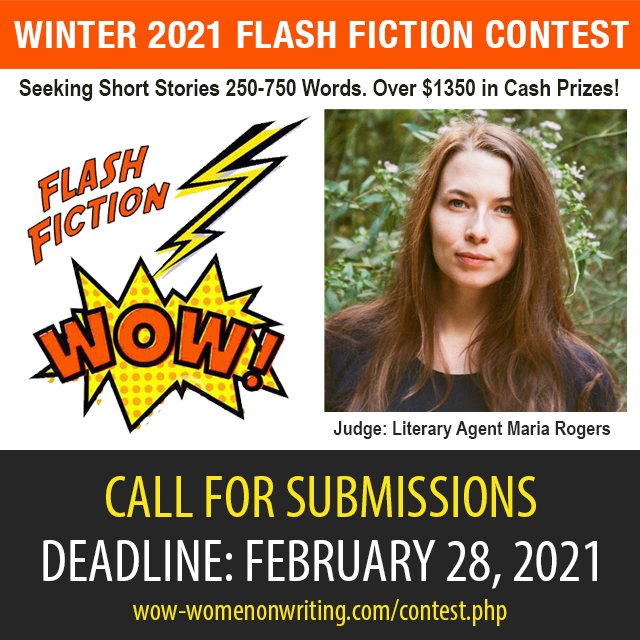
WOW! Women on Writing Quarterly Flash Fiction and Creative Nonfiction Contests - Deadlines: January 31 (Creative nonfiction) and February 28 (Fiction). Our favorite writing community offers quarterly contests judged blindly with multiple cash prizes and more for 20 winners, up to $1,350 (fiction) and $1,175 plus a gift certificate to CreateWriteNow (nonfiction), an affordable critique option, and a 300-entry limit on each contest. What’s not to love? This season's guest judge is Literary Agent Maria Rogers with The Tobias Literary Agency. Fee: $10 (Flash Fiction) and $12 (Nonfiction).
|
|
February is National Heart Month! In celebration of the metaphorical “heart,” submit to Fiction International for their “Compassion” theme. They accept fiction, non-fiction, and indeterminate prose texts of up to 5,500 words as well as visuals which address "Compassion." Deadline: February 1. No fee.
|
|
February 26 is National Tell a Fairy Tale Day! Celebrate by submitting a story to the Fractured Lit Ghost, Fable, and Fractured Fairy Tales Prize. Deadline: February 15. “We're excited to offer the winner of this prize $3,000 and publication, while the 2nd and 3rd place winners will receive publication and $300 and $200, respectively. All entries will be considered for publication. Fractured Lit is looking for stories of ghosts, fables, allegory, and fractured fairy tales in 1,000 words or less. Using these genre themes please remember that we're searching for flash that investigates the mysteries of being human, the sorrow, and the joy of connecting to the diverse population around us.” Fee: $20. https://fracturedlit.submittable.com/submit/181614/fractured-lit-ghost-fable-and-fairy-tales-prize-3000-judged-by-kevin-brockme
Upon a Twice Time is looking for fairy tale mashups! Theme: Fairy Tales - choose two of your favorite fairy tales, and a genre of your choice, and mash them up to make something new. Stories may be of any genre as long as they incorporate two fairy tales. We are open to Grimdark, New Weird, Science Fiction, Fantasy, Dying Earth and genre bending/breaking. Basics: themed speculative fiction, 1,000 - 3,000 words, pays $.08/word, no reprints. No fee. Deadline: February 28. Submit to info@aanpress.com. Guidelines: http://aanpress.com/submissions.html
|
|
February 18 is National Drink Wine Day! Celebrate the joy of the vine by submitting any genre of work (on any theme) to After Happy Hour: A Journal of Literature and Art. Deadline: February 28. Poetry: Send up to 3 poems in a single document. Fiction: There is no hard word count, but works over 5,000 words must be truly exceptional to merit consideration. If you write short (under 1,000 words) you can send up to 3 stories in a single document. Otherwise, send one story at a time and wait until you hear back to send another. Creative Nonfiction: Send one piece up to 6,000 words, double-spaced. For flash essays and micro-essays (under 1,000 words) you can send up to 3 in a single document, which can be single- or double-spaced. No fee.
|
|
Success Stories from the WOW Community: |
|
Column by Margo L. Dill
In the column below, we are thrilled to present to you so many success stories from our WOW! community that came to us through email, Facebook, Twitter, and Instagram. Every time I put this column together, I’m inspired and motivated by each small or big success—and the enthusiasm and pride that comes through each message. Reading these successes below can give you some ideas for markets, ways to promote yourself, and maybe even a new project you hadn’t thought of before. If you have a success story, please feel free to email me at margo@wow-womenonwriting.com with Success Story in the subject line.
Besides success stories, we also have words of the year included in this column. This is based on the book One Word That Will Change Your Life by Jon Gordon, Jimmy Page, and Dan Britton. It’s about adopting one word for 2021 that will be a theme in your life, and your goals wrap themselves into that word—it’s helpful for people, like me, who are overwhelmed by S.M.A.R.T. goals or too many resolutions not fulfilled. This year, I shared on The Muffin and social media that my word of the year is FINISH, and my daughter’s word is EXPAND. Some of you shared your words, too, and those are listed below also!
Email Success Stories:
Carrie Jade Williams writes, "I just wanted to send a quick email to say thank you! I entered and shortlisted for one of your competitions this year [in 2020]—was the first thing I ever wrote—and I thought I’d let you know that due to your encouragement, I entered the Financial Times essay writing competition for 2020 and won.
"I have Terminal Huntington’s Disease—got diagnosed at the start of this year [2020] and never in a million years did I think that by the end of the year I would have agents and major publishers contacting me! I also have it on my blog ( https://www.instagram.com/carriejadewrites/) which I started after your encouragement about being in an inter-abled relationship, so you guys really got me advocating through my writing! Thank you for helping me find my voice!”
Dorit Sasson writes, “Here's a success story from a lead I got through the WOW! markets eNewsletter. Back in July 2020, there was a call for stories for Taproot: Inspiration for Makers, Doers and Dreamers. Not a day goes by when I long to return to our heart-home of Israel, so I pitched, ‘The Israel Cooking Project: How I Was Able to Bring My Daughter Closer to Her Roots,’ and the day before Thanksgiving, I received my contributor copies. The illustrations are simply gorgeous. I couldn't be more pleased, and it's all because of the great work you put into this newsletter!”
Jen Knox writes, “As both a professor and creativity coach, I work with writers to story-tell and share their unique perspectives with the world. Over the course of 2020, while teasing out new routines and navigating endless bad news, as the world often seemed to be falling apart at the seams, I found solace in watching writers I worked with blossom; meanwhile, something felt off. It dawned on me that though I was encouraging others, I wasn't writing myself, and I surely wasn't sharing my voice. As I often tell my clients, sometimes just a few words a day can make all the difference. So I began to pick up my writing practice again over the late summer and returned to a novel that I abandoned for many years. I also started writing short work. And not only have I found renewed energy to work with clients and teach, I now have agent interest, and a new flash piece I wrote ‘ Dandelion Ghosts’ just won the Flash Fiction Magazine's Fall 2020 competition. Even those of us who teach others to create need to feed our own creativity. I am excited to take this momentum and newly found dedication into 2021. I just revamped my writing site to prove it to myself.”
Facebook Success Stories:
Wendy Brown-Baez writes, “My CNF story, ‘Weathering the Storm,’ will be published in February by Mom Egg Review. I am running a Short Story Subscription—stories with themes of love, beauty, magic, healing, and hope, available as print or pdfs—through my website: www.wendybrownbaez.com.”
Roberta Codemo writes, “I am a new contributing writer to a new website called One Village.”
Patricia White Gable writes, “True story accepted by Guideposts magazine.”
Mary Jo Thayer writes, “[A] Comment about my novel Close to the Soul (available in May) from NYT's best-selling author, Lori Nelson Spielman, ‘Such a wonderful story!’”
Word of the Year from Facebook:
Rosie MacLeod: “Focus.”
Angie Beacher: “Start.”
Jacqueline Dailey: “Unity.”
Patricia White Gable: “Harmony.”
Twitter Success Stories
Britt Haines writes, “My guest post was accepted for Funds For Writers May issue.”
Teri Liptak writes, “My essay, ‘Thank You, Mr. Rogers,’ was published in the anthology, Living on COVID Time, available at Amazon and Barnes & Noble.”
Instagram Success Stories
@christina_rauh_fishburne writes, “I won Sunspot Lit’s Culmination contest.”
@deborah_l_burns writes, “Isolation granted me the time and space to jumpstart my next book, now publishing in April!”
@annkkelly writes, “I’m not sure if you’re looking for recent success stories, or a yearly wrap-up. If yearly, here goes! In 2020, I had 9 CNF essays and/or flash nonfiction published. I was nominated for a Pushcart Prize. I built a website. I became a WOW! columnist (yay!). I finished a round of developmental edits on my memoir, wrote a 50-page proposal ... and participated in my first PitMad in December. Bring on 2021!”
@peaceloveandpress writes, “I started a writing club during quarantine, and we had such a fun time. I learned a lot and got to read wonderful stories every week. It helped take our minds off of coronavirus. I also published my first children’s book in December 2020 titled If Grandma Were Here. It’s something I never dreamed I’d do! Ifgrandmawerehere.com.”
@blynngoodwin writes, “Had Talent republished (Koehler Books), and I hope they will want the sequel. Hope you will Google Talent + Goodwin. Also Writer Advice, is running a Flash Memoir Contest.”
@cheriepostill writes, “Launching my nonfiction book for writers this weekend! Thanks for all the support and encouragement of the #writingcommunity. You got this! How to Train a Beta Reader and Sell More Books available SOON.”
@authorkristabeucler writes, “Had my first two publications—short stories (one of them won the Julia Peterkin Award).”
@rosie.macleod.3 writes, “I finished my journal article about Freudian psychology on New Year’s Eve at 23:59. I had had the idea since 2011. When I'm feeling, I will reference and submit to publications. (For now I am focusing on my 'Year of Creativity.')”
@judithshaw_writer writes, “Hi, guys, In 2018, at age 72, I finished and published my first novel, Charley’s Horse, which won eight national awards. I’m 3/4 of the way through the first draft of novel two, and I’m only 74!”
@laura_is_writing writes, “Published my first book which includes a runner-up essay from a WOW contest. Thank you for that!”
Instagram Word of the Year:
@gandtiff writes, “Mine is emerge.”
@dwc.osa_777 writes, “RESILIENT!”
@lesfroo writes, “Optimism!”
|
|
WOW Workshops Starting Soon: |
|
 |
Research: Prepping to Write Nonfiction for Children and Young Adults
4 weeks: Feb 1 - Feb 28
Nonfiction for young readers line the bookshelves of libraries and bookstores, fills magazines and is used in classrooms around the world. Learn how to do the research.
|
|
|
|
Writing Nonfiction for Children and Young Adults
4 weeks: Feb 1 - Feb 28
Biographies, science, history, how-to, and more. Learn how to write nonfiction with Sue Bradford Edwards, author of over 25 nonfiction books for young readers.
|
|
|
|
|
Motherhood Essays: Write & Receive Personal Feedback
3 weeks: Feb 3 - Feb 23
Mommas, this class is for you! Learn to write essays for publications like Motherwell and Literary Mama or create a treasured keepsake with editor Kandace Chapple.
|
|
|
|
The Pizzazz of Writing: Clever Tricks to Take Your Prose from Boring to Dazzling
5 weeks: Feb 8 - Mar 8
There are easy ways to spice up your writing—nifty little techniques guaranteed to excite your readers. Videos led by Barbara Noe Kennedy!
|
|
|
|
|
Not What But How: Improving Essays with a Focus on Craft, Not Content
4 weeks: Feb 22 - Mar 21
You have a story to tell, but what's the best way to tell it? Learn how to structure and organize your essays, decide on a point of view, and practice craft techniques with editor Chelsey Clammer! 1 spot left!
|
|
|
|
Writing with Transitions: How to Keep Readers Close While Moving Them Through Time and Space
6 weeks: Mar 1 - Apr 12
Learn how to lead readers from scene to scene smoothly when it requires a change in time or space, large and small - with award-winning instructor Sheila Bender.
|
|
|
|
|
Creating an Online Creative Writing Class for Fun and Profit
4 weeks: Mar 5 - Apr 2
Explore step-by-step the route from generating an online class idea to finding your target audience of students, through crafting a writer-friendly syllabus to launch a successful class online with Melanie Faith!
|
|
|
|
The Women Writers' Book Group: Crazy Good Writing
4 weeks: Mar 29 - Apr 25
Using the memoir Madness by Marya Hornbacher as a guide, writers will explore how to write about mental illness in a way that is insanely good! Look at narrative arc, structure, pace, rhythm and more with editor Chelsey Clammer.
|
|
|
|
Happy Valentine’s Day from all of us at WOW. As you can see from the colossal list of markets above, more publishers than ever are seeking your writing. They love you as much as we do. In fact, they depend on you to keep their magazines, websites and blogs alive. Show them a little love and submit your writing today. Your words could be just what someone in the world needs to hear.
~ Ashley & Team WOW!
|
|
|
|
|
|
|