|
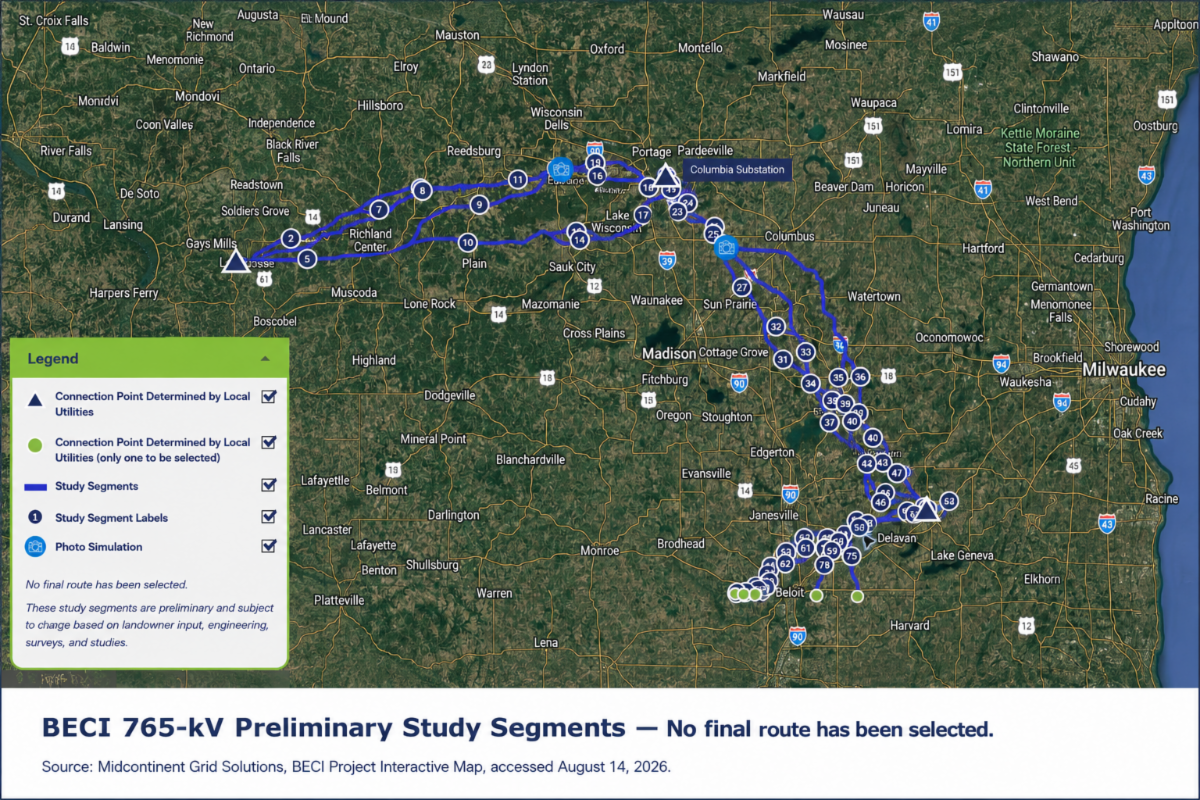
Landowners across southern Wisconsin are discovering that their farms, fields and rural communities may be in the path of a massive new 765-kilovolt transmission line. The proposed Bell Center–Columbia–Illinois/Wisconsin State Line project (BECI) would extend approximately 190 miles from Crawford County to Walworth County and the Illinois state line, using some of the largest high-voltage transmission infrastructure ever proposed in Wisconsin.
There Are Multiple Red Flags. Let’s Start With This One...
For many affected families, the first meaningful notice arrived only weeks before the developer’s initial comment deadline. Midcontinent Grid Solutions publicly launched its routing process on August 5, scheduled eight information sessions for August 24 to 27 and requested comments by September 7. The company intends to file its application with the Public Service Commission of Wisconsin in early 2027.
That is an astonishingly compressed timeline for a $1.2 billion project that could permanently alter family farms, property values and rural landscapes across nine counties.
If you Liked That, You'll Love This...
Wisconsin law establishes a siting priority for new transmission facilities: existing utility corridors first, followed by highway and railroad corridors, and new “greenfield” corridors last. No final route has been selected, but the developer’s preliminary map shows dozens of possible study segments. Many do not follow existing power lines, highways or other established corridors. Instead, they cut directly across open farmland and crop fields, potentially dividing working farms with new easements and towering structures.
These farmers, including many WPT members, are rightfully outraged and have yet to receive a clear answer about why these proposed segments depart from existing corridors. What existing routes were evaluated, and why were they rejected before someone’s farm was placed in the crosshairs?
How Did We Get Here?
For years, federal policy used extraordinarily valuable tax credits to accelerate construction of wind and solar projects. When Congress moved to terminate those credits early for many projects, developers faced a July 4, 2026, deadline to begin construction or risk losing eligibility. Even the IRS issued rules intended to prevent the “artificial acceleration” of projects seeking to beat that deadline.
The result was predictable: developers scrambled to get subsidized generation projects underway before the federal window closed. That rush added to a larger problem years in the making. Generation and transmission were not responsibly coordinated. Policymakers subsidized the generation first and left the transmission consequences for later.
Now the regional grid is being redesigned to move electricity from those scattered and weather-dependent facilities to where it is needed. MISO, the regional grid operator that approved BECI, openly describes its larger transmission plan as enabling future generation while shifting the region toward a new energy portfolio.
In other words, taxpayers helped subsidize a rush to build a scattered network of renewable generation, and now ratepayers are being asked to finance the enormous transmission network needed to stitch it together.
Whether one supports renewable energy or not, this is no excuse for irresponsible routing. A government-approved project should not take the path of greatest convenience for its developer while treating productive farmland and private-property rights as secondary concerns. The public should not be given a few weeks to react to a project of this magnitude after years of planning occurred elsewhere.
Attend an Information Session
According to the developer, there will be no formal presentation. Attendees may arrive at any time during the scheduled session, and the same general information will be available at each location.
- Richland County: Monday, August 24, 10 a.m. to 1 p.m.
- Richland Center High School, 1996 US-14 W, Richland Center
- Crawford County: Monday, August 24, 4 to 7 p.m.
- Gays Mills Community Center, 16381 WI-131, Gays Mills
- Sauk County: Tuesday, August 25, 10 a.m. to 1 p.m.
- UW-Platteville Baraboo, Lange Center, 1006 Connie Road, Baraboo
- Columbia County: Tuesday, August 25, 4 to 7 p.m.
- Whispering Pines, 101 Bethel Drive, Poynette
- Jefferson County: Wednesday, August 26, 10 a.m. to 1 p.m.
- County Fairgrounds Activity Center, 503 N. Jackson Avenue, Jefferson
- Dane and Dodge Counties: Wednesday, August 26, 4 to 7 p.m.
- The Round Table, 1611 N. Bristol Street, Sun Prairie
- Walworth County: Thursday, August 27, 10 a.m. to 1 p.m.
- Lake Lawn Resort, 2400 E. Geneva Street, Delavan
- Rock County: Thursday, August 27, 4 to 7 p.m.
- Woodman’s Center, 2510 Milton Avenue, Janesville
What WPT Members and Concerned Citizens Should Do Now
Do not assume that someone else will speak up. Even members outside the proposed corridor should pass this information to farmers, landowners, local officials and rural businesses throughout southern Wisconsin.
- Review the preliminary route and county map books at the BECI project website.
- Attend an information session. Bring your parcel number, identify the study segments near your property and ask why existing utility, highway or railroad corridors were not used.
- Submit written feedback to Midcontinent Grid Solutions by September 7 through the project’s interactive map and comment page or by emailing Connect@MGSWisconsin.com. A conversation at an open house is not a substitute for putting your objections in writing.
- Save copies of your comments, maps, photographs and correspondence. Be specific about crop production, drainage, conservation practices, buildings, aerial applications, field access and how a line or easement would interfere with the operation of the property.
- Prepare to submit those concerns to the Public Service Commission. Because the BECI application has not yet been filed, there is not currently a BECI docket accepting PSC comments. Once the case opens, use the PSC’s public-comment portal to comment on whether the project is needed, whether its costs are justified and whether less disruptive alternatives were properly considered.
This is the moment to organize, not after the preferred routes have been selected and the application has been filed. Please share this alert widely. A project this large should not be hurried through at the expense of taxpayers, ratepayers and the property rights of Wisconsin landowners.
|