July 2026 Rules v2026.1.2

Effective 7/13/2026

This mid-year rules update comes at the halfway point of the 2026 WRL season - WRL always works hard in the offseason to establish a ruleset that requires minimum mid-year change but will make adjustments when opportunities to improve parity & competition without requiring significant changes to competitor vehicles arise.


Below you will find individual rule update language along with a description of each change and why the change was made. These updates are now reflected in the 2026 rules on the WRL website, WRL app and are effective immediately.


We appreciate your continued support of WRL - achieving the level of performance balancing and parity we enjoy in WRL is no easy task and your feedback and input is appreciated. If you have any questions or comments please direct them to race@racewrl.com - your feedback is appreciated!


WRL 2026 Rules v.2026.1.2

Adjustments / additions include:

Sensor Manipulation
Front and Rear Fill Systems / restrictor diameter

Automatic Trans modifier (6 or fewer forward gears)
Aftermarket ABS system modifier

Sensor Manipulation


APPX.A-B.5 - "Sensor Manipulation: External, in-line devices that intercept, modify and/or manipulate engine sensor signals to alter factory or flashed ECU parameters, boost pressure, fuel mapping or the way engine variables are logged in data are not permitted (IE: “Piggyback” devices, etc). Alteration or interruption of any ECU input / output by physical switch or other method to reduce engine output on the dyno or any other scenario is strictly prohibited and categorized as intentional cheating. The presence of these devices in any WRL vehicle without approval will result in penalties ranging from immediate DQ up to suspension or series ban. For older cars where “piggyback” devices are the only method of tuning the factory ECU teams must petition WRL for use and the implementation of the device must be detailed in an attachment to the disclosure worksheet and data acquisitions systems must monitor and record the modified output parameters of the device. If you have any device, switch, etc between the ECU and engine you must contact WRL prior to running in any official session - email race@racewrl.com for clarification."


Description: In-line devices that intercept and modify engine sensor signals to “fool” the factory ECU are difficult or impossible to detect via data review by design as their purpose is to allow the engine to operate outside the ECU’s boundaries without the ECU (and by extension, CAN connected data logging devices) knowing changes are being made to avoid trouble codes or warranty violation in street cars. This means that the ECU is being fed manipulated sensor data by the device, including boost pressure and other critical variables to appear slightly low forcing the engine to increase output “out of sight” of the ECU. This rule also clarifies that ECU manipulation by more rudimentary methods like switched circuits, etc in attempts to fool the dyno are also not permitted. For older cars where piggyback tuning is among the only reasonable methods of tuning or detuning teams may petition WRL for their use but data loggers must record actual engine parameters NOT modified values being sent to the ECU by the piggyback device. If approved, the implementation must be detailed in an attachment to the disclosure worksheet. We do not anticipate many scenarios in the WRL paddock where these devices would be needed but do not want to discourage participation of older platforms.

Front and Rear Fill systems


D.3.n - "Front & Rear Fill Systems: Any cars utilizing a front hood or rear trunk refueling system must follow all requirements of D.3.l and D.3.m but may utilize a 1.200” inside diameter restrictor made of a solid material. To be eligible the fill port must be within 4.00” of the centerline of the vehicle as viewed from the front / back."


Description: This adjustment to the fueling rules is a step in the direction of additional parity in the area of fueling and total pit-stoppage times across the field. Hood and trunk fill systems require additional transit time to-and-from the pit wall during refueling and typically do not benefit from the same continuous column hydrostatic (head) pressure of a side fill location due to the reduced distance to a hood area or trunk mounted fuel cell or auxiliary fuel tank. This change is driven by time studies of WRL pit stops and fluid dynamics analysis of these systems. We will continue to monitor and adjust as needed.

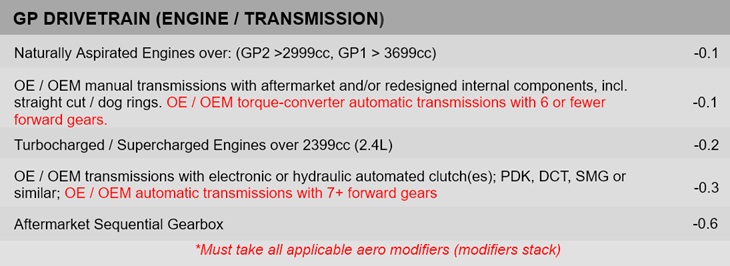
Auto Transmission GP Modifiers

GP Modifier Table - "OE/OEM torque-converter automatic transmissions with 6 or fewer forward gears -0.1"

Description:
Separation of automatic transmissions with 7+ forward gears and automatic transmissions with fewer than 6 forward gears in the GP modifier table. Reduction of modifier for transmissions with 6 or fewer forward gears, no change for transmissions with 7 or more forward gears.


Automatic transmission technology has advanced rapidly in recent years with the ZF8 and similar 8+ speed auto transmissions benefiting from shift times and gear spacing similar to or better than DSG or PDK transmissions. Since the implementation of this modifier we’ve further reviewed the performance of 5 and 6 speed torque converter equipped automatic transmissions that have raced with us in that time and have noted that both shift speed (particularly downshifts) and gear spacing is much less desirable than more modern 8+ speed automatic transmissions. These transmissions still have parasitic loss, weight, heat and other inherent shortcomings but provide benefit enough that a modifier is warranted. With this in mind we have reduced the modifier to a -0.1 and will continue to monitor performance and adjust as necessary.

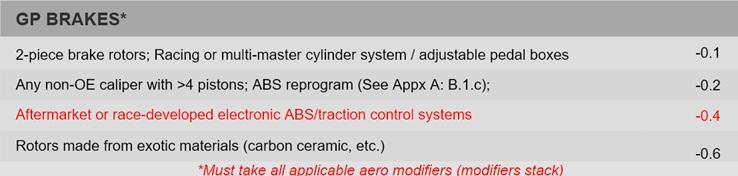
Aftermarket ABS GP Modifier

GP Modifier Table - "Aftermarket or race-developed electronic ABS/traction control systems modifier reduced from -0.6 to -0.4"


Description: The aftermarket ABS modifier has been .6 since its introduction more than 7 years ago. This modifier was driven primarily by cost and performance relative to the status-quo and complexity of installation/tuning. As time progressed ABS module swaps to better factory systems have become more prevalent, aftermarket solutions have become more affordable and an endurance-focused spec tire has been introduced. With the reduced peak grip vs. super-200 and slick tires the benefit of an aftermarket race-developed system has changed since 2018. With this in mind, the modifier will be reduced from .6 to .4 - this change will be monitored and additional adjustments will be made as necessary. This change is not to encourage the installation of race-derived systems - this modifier is still heavy vs. the real benefit based on series observation. The goal is to reduce the inherent penalty that some petitioned and permitted factory race cars in the GP categories are carrying to improve competition and parity. 


Note:
MANY factory race cars utilize OEM ABS/TC including but not limited to M2CS, M240ir, etc and will see no change with this modifier adjustment. An example of a car that utilizes motorsports traction control is the Toyota GR86 Cup.