Wednesday, July 22, 2026

STATE NEWS

Reminder: Explore Manure Technologies Before Dairy Plus Applications Close

Applications for CDFA's Dairy Plus Program are open through September 14, and this is anticipated to be the final funding opportunity available to help producers implement advanced manure management technologies.


To help producers evaluate their options and make informed decisions, CDQAP is hosting two educational events focused on manure management technologies eligible for Dairy Plus funding.


Field Day: Advanced Separation with Flocculants System

Thursday, July 23

10:00 a.m. - 12:00 p.m.

Lunch to follow


Hear directly from a dairy producer and technology provider about an advanced solids separation system that uses flocculants. The field day will be held in Stanislaus County. The dairy location will be shared with registered attendees.


Register HERE.


Webinar: Considerations for Choosing the Right Technology for Your Farm

Thursday, July 30

11:00 a.m. - 12:00 p.m.


Join Dr. Deanne Meyer as she discusses the key questions producers should consider when evaluating manure management technologies and planning for long-term success on their operations.


Register HERE.


Want to learn more?

Paul Sousa recently discussed the final round of Dairy Plus funding, program eligibility, and what producers should consider before applying on the latest episode of Seen & Herd. Listen to the episode HERE.


Best Information Resources for Screwworm

By Dr. Michael Payne, UCD School of Vet Med and Director CDQAP and Dr. Nicki Humphrey, Cattle and Swine Specialist, Animal Health Branch, CDFA | Originally published in CDQAP's July Newsletter


As of this writing, 37 animal cases of New World Screwworm, NWS, have been reported in the U.S. Of these 37 cases, 17 are “active,” meaning there are ongoing treatment and wound management efforts on individual animals. An additional 20 cases are classified as inactive, meaning that treatment or other mitigation, such as carcass disposal, has been effective in resolving the case. All active cases are currently limited to 7 counties in Texas. The single New Mexico case, now inactive, involved a dog that may have traveled to Texas. So far, no wildlife cases have been identified, only domestic animals including cattle, goats, sheep, and three dogs.


California livestock producers are understandably concerned about potential spread of the pest out of the Southwest into our state. Producers, however, have been barraged with so much information, it’s been akin to drinking from a fire hose.


Working with our colleagues at CDFA, we’ve curated the following list of Screwworm resources, to provide producers with guidance for their specific information needs.


CDFA’s Screwworm Home Page – CDFA’s homepage for all things NWS. Includes up-to-the-minute news & updates, current movement requirements, infographics, webinar recordings and much more.


Movement Requirements into California – Producers purchasing, receiving or arranging transport of cattle into California, from infested zones or states with infested zones will find detailed information here. Includes a special section on dairy heifers. Producers with questions regarding movement permits and requirements, can contact CDFA via email or phone (909-247-8789).


Determine if a Texas Facility is in an Infested or Surveillance Zone – To determine whether the premises of origin you are looking to move cattle from is within a zone in Texas, use this mapping tool.


Determine if a New Mexico Facility is in an Infested or Surveillance Zone – To determine whether the premises of origin you are looking to move cattle from is within a zone in New Mexico, use this mapping tool.


Current California Statewide Quarantine Order – Although no NWS cases have been detected in California, CDFA has used its Quarantine Authority to implement various protective safeguards. This links to the complete 8-page text describing current quarantine actions and movement requirements from states with infested zones.


Current NWS Status in U.S. – Find the most current information on the location and number of cases identified throughout the U.S.


Current NWS Status in Mexico – See the current Mexico infestation status.


Current Status of Sterile Fly Facilities – Follow the progress of sterile fly production and dispersal facilities in both the U.S. and Mexico.


UC Riverside NWS Entomology Webpage – From UC Riverside’s Murillo Research Laboratory comes this comprehensive review of NWS biology.


Manual for New World Screwworm Care – From our colleagues at Zoetis Animal Health comes this comprehensive manual on how to treat infested livestock, something we are hoping no California producers will have to do. The manual is also available in Spanish.


MARKET UPDATE

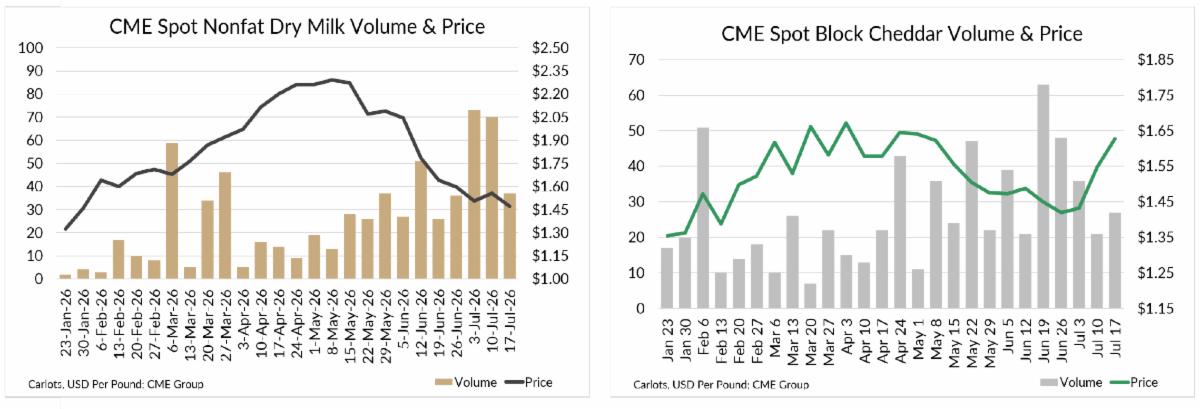
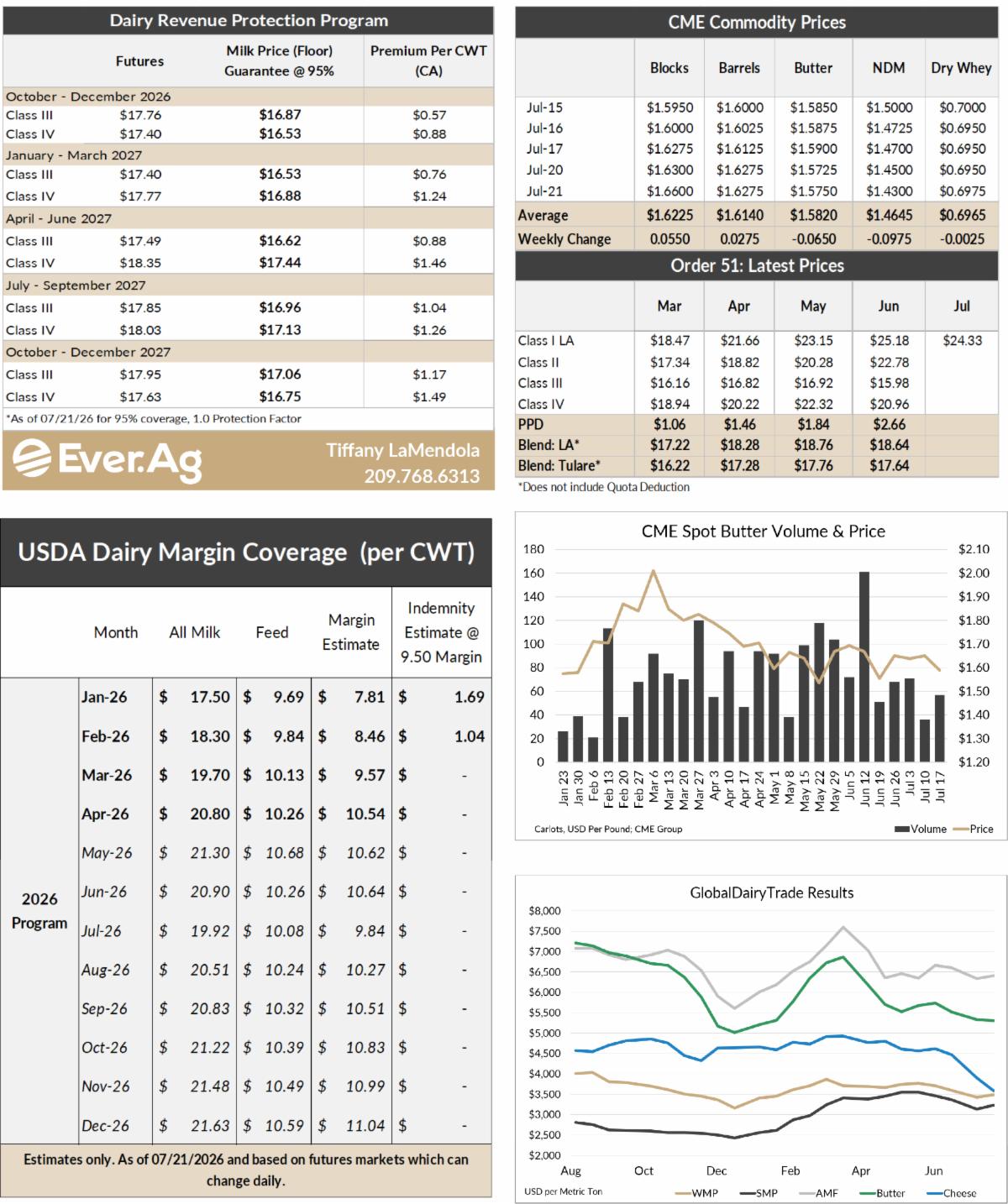
The CME nonfat dry milk market fell farther from its historic highs, dropping to the low-$1.40s — a level last seen in January. Earlier supply limitations have been resolved and there’s plenty of product coming to the market. On July 21 alone, 25 lots changed hands at the CME. 

  • Milk powder prices rose higher at this week’s Global Dairy Trade auction, with skim milk powder up 3.2% to $1.47 per pound. This helps with the convergence between US and global prices that has been underway. Butter eased just 0.6% to $2.41 per pound. While cheddar fell 8.1% to $1.63 per pound, mozzarella ticked up 1.1% to $1.79. 


  • Spot block prices continue to rise as hot weather in the US and Europe raises concerns about milk flows. The spot price advanced to the mid-$1.60s, its highest level since early May. But domestic demand at retail and restaurants is still relatively soft, so it remains to be seen how far the recent rally can go before the market hits resistance. 


  • After reaching the mid-$1.60s early last week, the CME butter market slipped back into the $1.50s. Cream is getting seasonally tighter, while demand from ice cream manufacturers and end users remains strong. But the market also feels well supplied. That’s keeping things balanced as the market searches for a definitive direction. 
  • Turmoil in the Black Sea region gave wheat and corn markets a bump, while hopes for additional purchases from China supported soybeans. Otherwise, markets continue to watch the weather. According to USDA, corn and soybean crop conditions are close to the five-year average. The September corn contract hovers around $4.50 per bushel and August soybeans jumped to around $12.20. 


  • USDA releases its June Milk Production report Wednesday and Cold Storage on Friday. Those reports will likely provide markets with more direction moving into next week. 


THANK YOU TO OUR CURRENT SPONSORS


Facebook  Instagram  LinkedIn  Web