Wednesday, May 27, 2026

ASSOCIATION NEWS

New on Seen & Herd: Worms at Work - How Vermifiltration Is Changing the Way California Dairies Handle Wastewater

BioFiltro is back on Seen & Herd, and this time the update comes with a deadline.


Paul Sousa sits down with Bio Filtro's Steve Rowe and Sanjar Taromi for a status report on vermifiltration in the Central Valley. Four systems are operating. Four more are under construction. And Dairy Plus grant applications are expected to open in June, with this as the last round of that $85 million program.


The system addresses water quality, methane reduction, nitrogen control, odor, and even cow health outcomes with a single technology. BioFiltro covers nearly all of the cost. The conversation you have before the application window opens is worth more than the one you have after it opens.


STATE NEWS

Got CDQAP Certification/Recertification? Schedule Evaluations Now

Originally Published in CDQAP's May Newsletter


CDQAP Environmental Certification provides piece of mind that you are in compliance with all local, state and federal regulations, helps show customers that California dairy cares about the environmental stewardship and earns the facility a 50% reduction in water quality fees for up to 5 years with continued regulatory compliance.


CDQAP certification is easy and voluntary. It’s a simple three-step process:

  1. Complete educational classes (6 hours of water quality and 2 hours of air quality). The educational component is available online.
  2. Complete required record keeping for water and air quality.
  3. Complete an on-farm, third-party evaluation.


Evaluations cost $550 per facility. To learn more about CDQAP Environmental Certification, your class completion status, or to schedule an evaluation, call (530) 574-0524. Evaluations are scheduled on a first-come, first-served basis. Call soon to schedule your evaluation. The deadline for certification is September 30, to be eligible for a 50% discount on water quality fees for the 2026-27 billing cycle.


Evaluations for 2026 must be scheduled before September 1 to ensure that it can be completed before the deadline.


Spring Into Fly Control

By Dr. Deanne Meyer, Ph.D., Livestock Waste Management Specialist, UC Davis & UC ANR | Originally Published in CDQAP's May Newsletter


Spring started with intermittent late rains and cool nights for much of California. Winter forage is being harvested as weather permits. Manure solids and slurries are being hauled from corrals to fields. This is also the official start of fly season.

  • Key maintenance items play a role to keep fly populations down as temperatures rise.
  • Double-check fence lines and under waterers to be sure manure was removed.
  • Repair leaky waterers to minimize moist areas.
  • Watch for and repair leaky soaker nozzles.
  • Regularly groom corrals.
  • Manage separated solids to expedite drying.
  • Manage wet feeds to minimize fly breeding areas.
  • Establish regular fly control procedures (fly tape, spray, etc.)


May the summer be relatively mild and the flies minimal!


MARKET UPDATE

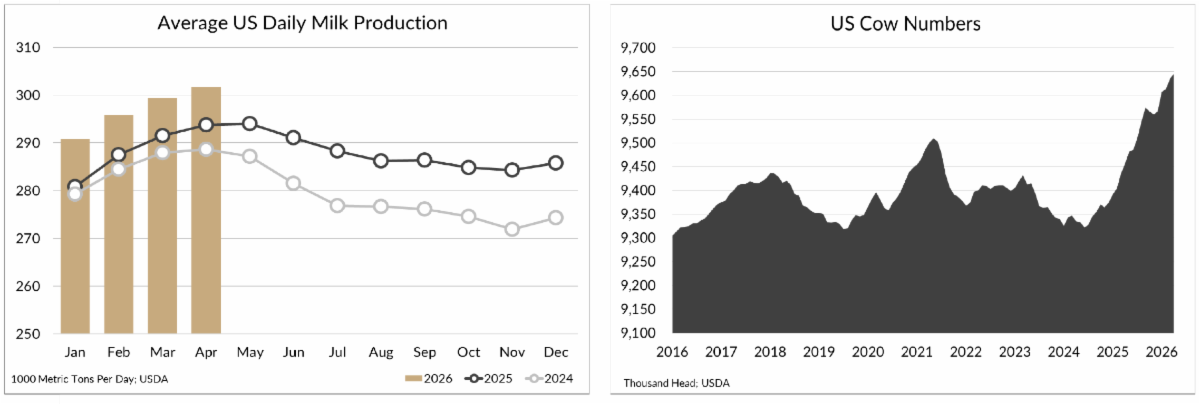
US milk production totaled nearly 20.0 billion pounds in April, up 2.7% year-over-year and ahead of predictions. California output was ahead of expectations as well, up 2.3% versus 2025. USDA also revised its March total for California from +0.8% to +1.8%. 

  • Valuable calves are encouraging dairy farmers to hold onto cows longer, maintaining a historically large US dairy herd. In April, cow numbers reached a new 30-year high of 9.645 million head, up 10,000 on the month and +190,000 year-over-year. With so many dairy cows, milk flows are likely to remain strong in the months ahead.


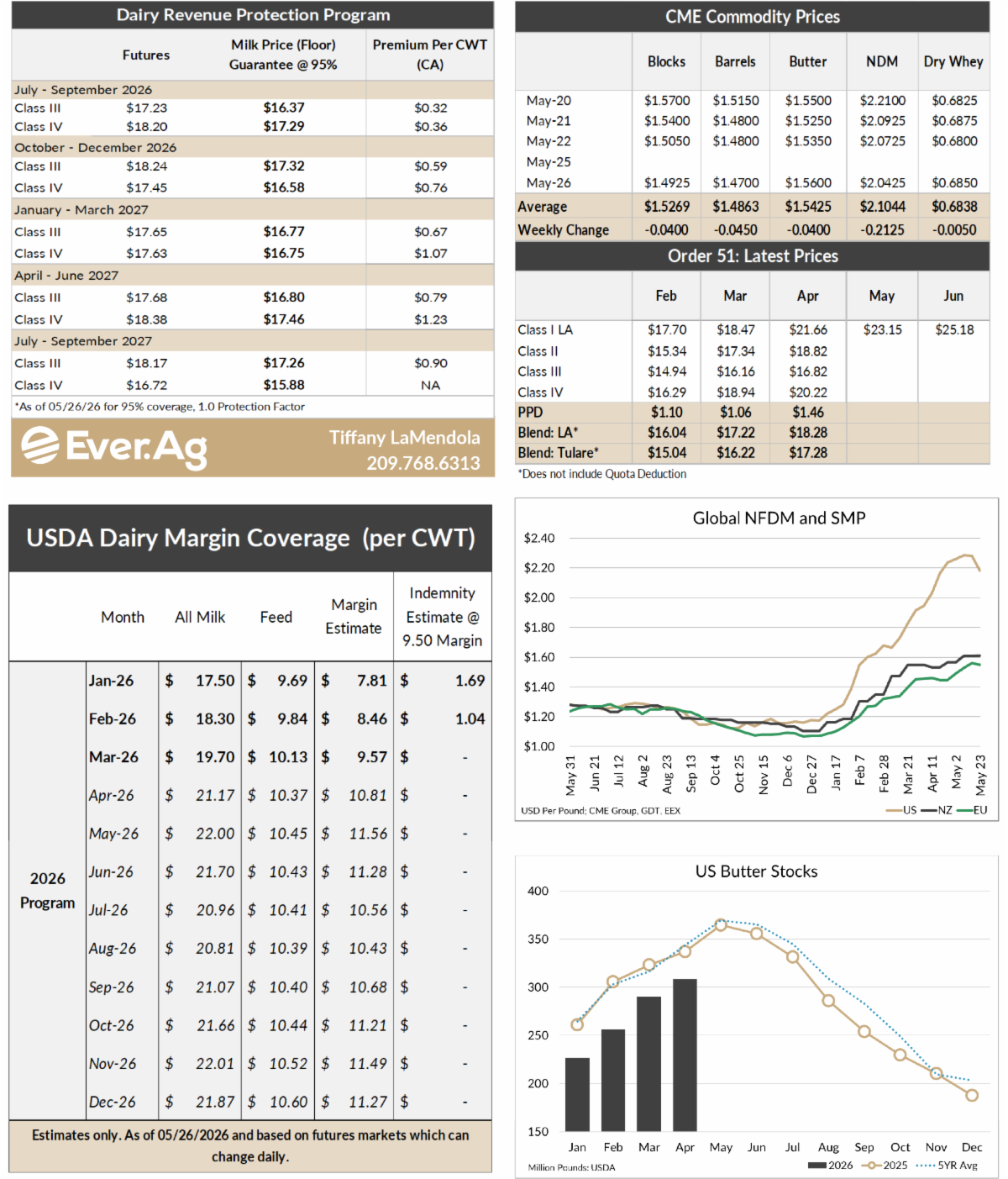
  • After weeks of record-high prices, the CME nonfat dry milk market began to plunge. On May 21 alone, the spot price fell almost 12 cents, the largest single-day decline since 2008. The market now sits in the low-$2.00s.


  • Milk powder prices also dropped at the Global Dairy Trade Pulse event, with skim milk powder slipping to $1.55 per pound and whole milk powder down to $1.68.


  • USDA’s April Cold Storage report brought few surprises. While the month-to-month butter stock increase was below the five-year average, the gap between 2025 and 2026 levels narrowed. And cheese inventories increased at an average pace.
  • Trading volume is still heavy in the CME butter market. For the week ending May 22, 118 lots changed hands and the year-to-date total stands at 1,460 loads. The spot price tumbled to a four-month low before rebounding to the mid-$1.50s.


  • The spot block market is searching for direction, declining, jumping, and slipping again. But the overall trend is lower, with the spot price ultimately dropping below $1.50 per pound for the first time since February. Class III futures in third quarter have been on the decline for weeks now, losing about a dollar since the beginning of the month.


THANK YOU TO OUR CURRENT SPONSORS


Facebook  Instagram  LinkedIn  Web