Wednesday, June 17, 2026

ASSOCIATION NEWS

The Wins You Don't Always See

Many of Western United Dairies' biggest victories never become headlines.


Over the past year, WUD worked behind the scenes to stop proposals that would have increased costs, added regulations, and weakened dairy's position in California.


Among those efforts:

  • Preventing additional bird flu regulations after demonstrating the effectiveness of the dairy industry's HPAI response.
  • Defeating anti-dairy legislation that would have created new regulatory burdens.
  • Stopping a proposal seeking $60 million in taxpayer-funded promotion of plant-based competitors.


These outcomes matter because every regulation avoided is time, money, and uncertainty kept off the dairy.


Advocacy isn't only about passing legislation. Often, it's about preventing harmful policies before they ever reach your operation.


STATE NEWS

State Water Board Issues Final-Draft Remand Order for Central Valley Dairy Regulations

By Paul Sousa, Director of Regulatory & Environmental Affairs


After almost 18 months since comments closed on the initial draft remand order, the State Water Resources Control Board (State Board) has released its final-draft remand order directing the Central Valley Regional Water Quality Control Board (Regional Board) to revise its Dairy Orders. The State Board is accepting comments on the final draft for 45 days, until noon on July 30.


This order will affect all dairies operating in the Central Valley, including dairies that have expanded and those with anaerobic digesters. Unlike earlier drafts, the final order is focused solely on Central Valley dairies and does not apply statewide.


What Does This Mean for Dairy Producers?

A significant change is that implementation will occur in phases. Rather than waiting for one comprehensive revised Dairy General Order, the State Board is now directing the Regional Board to develop interim requirements followed by a final order. This means some requirements will be implemented sooner than previously expected.


The State Board continues to emphasize that nitrate impacts to groundwater from dairies are an urgent concern. The order acknowledges that most nitrogen loading to groundwater from dairies comes from cropland applications rather than manure storage lagoons. As a result, additional emphasis is placed on improving nitrogen management on dairy cropland.


At the same time, the order includes several significant lagoon-related requirements that will be costly and challenging for some operations.


Increased Focus on Whole-Farm Nitrogen Management

The current applied-versus-removed nitrogen accounting system remains in place, but the order adds a broader whole-farm nitrogen accounting approach. Under this concept, regulators will evaluate the manure nitrogen generated on the dairy, nitrogen that can be applied to cropland while being protective of groundwater, and nitrogen exported off the dairy. This concept looks to minimize the amount of unaccounted nitrogen managed by dairies.


The order also incorporates the broader CV-SALTS framework and requires that groundwater nitrogen objectives be achieved as quickly as practicable, with a maximum compliance period of 35 years. But don’t let the 35 years fool you, most requirements appear to be on a much faster track than 35 years.


In addition, the order introduces the concept of a nitrogen discharge limit, similar to approaches already used in the Irrigated Lands Regulatory Program. These limits are intended to prevent dairy operations from causing or contributing to groundwater nitrate exceedances.


Expanded vs. Existing Dairies

The order has different timelines for compliance for “new” versus “existing” dairies and it establishes a complex distinction between existing and expanded dairy operations. In some cases, cows within the same herd may be treated differently depending on the number of animals previously reported to the Regional Board in Reports of Waste Discharge. Manure from the “new” cows will be regulated differently than manure from the “existing” cows even if that manure is comingled. It will be interesting to see how the Regional Board implements this requirement.


New Measurement and Reporting Requirements

Within one year of the order's adoption, the Central Valley Water Board must issue directives establishing more precise methods for measuring and reporting manure nitrogen applications and crop nitrogen removal. One example of this is that the order requires installation of electronic flow meters to improve measurement of liquid manure applications to cropland.


Lagoon Requirements

Although the State Board acknowledges that cropland is by far the largest source of dairy-related nitrogen loading to groundwater, the order places significant attention on earthen manure lagoons that may be hydraulically connected to groundwater.


Key requirements include:

  • Within 90 days of adoption of the Remand Order, the Central Valley Water Board must require dairies to submit a good-faith estimate of the depth of the lowest point of each lagoon.
  • Dairies will have six months to provide this information.
  • The Water Board will evaluate local groundwater depths and identify facilities with the least separation between lagoon bottoms and groundwater.
  • Within one year of adoption, the Regional Board is to begin issuing letters, on a prioritized basis, requiring dairies to prove that their ponds are not connected to groundwater or submit plans for lagoon reconstruction.


For lagoons not connected to groundwater, the order requires evaluation of lagoon seepage rates. Lagoons that meet a seepage standard of 0.9 millimeters per day will receive lower priority. However, the order directs the Central Valley Water Board to eventually develop requirements and compliance schedules for all lagoons to meet groundwater nitrate discharge objectives, which could include future liner requirements.


What Happens Next?

The regulatory landscape for Central Valley dairies continues to evolve through both the CV-SALTS process and this remand order. While the State Board recognizes that implementation will require significant time, investment, and operational changes, several requirements are expected to move forward on an accelerated timeline. Western United Dairies will be reviewing the order and preparing comments. A workshop is scheduled for July 8, with a hearing anticipated in September. We will continue to provide updates as additional details become available. If you have questions about how these changes may affect your operation, please reach out to me.


REMINDER: Upcoming Workshops: Modesto Nitrogen Management Zone Regulatory Changes

The California Dairy Quality Assurance Program (CDQAP) is hosting workshops this June on the regulatory changes in the Modesto Nitrogen Management Zone. The Central Valley Water Board recently released a draft basin-specific order to reduce nitrate levels in water discharges, and similar orders are expected to follow in other regions. The order would make the provisions of Management Zone Implementation Plans (MZIPs) enforceable, including the commitment to achieve a whole-farm balance of nitrogen within 10 years.


Two workshops are available for dairy producers:

  • In-Person: Thursday, June 11, 3:00 to 5:00 pm Stanislaus County Ag Center, HI Room 3800 Cornucopia Way, Modesto
  • Virtual: Friday, June 19, 10:00 am to 12:00 pm Via Zoom Webinar (registration required in advance)
  • Workshops: will cover the details of the Modesto Order, the status of the CVDRMP Data Management Tool and Reporting Portal, and steps producers can take now to prepare.


Questions? Contact Denise Mullinax at (209) 585-6744 or mullinax@cdrf.org.


Dairy Plus Program is OPEN - Submit Your Application

The Dairy Plus Program, led by the California Department of Food and Agriculture's (CDFA) Office of Agricultural Resilience and Sustainability (OARS), provides competitive grants to help California dairy farms adopt advanced manure management practices. These sustainable strategies aim to reduce methane emissions, manage nitrogen and salt levels, and address key environmental challenges in dairy production.


In 2022, the California Dairy Research Foundation (CDRF), in partnership with CDFA and others, secured an $85 million award through the USDA Advancing Markets for Producers initiative (formerly the Partnerships for Climate-Smart Commodities program). Over five years, this investment will fund on-farm improvements, technical support, emissions monitoring, and the development of markets for sustainable dairy products. Of the total, approximately $75 million is being distributed through the Dairy Plus Program, which began accepting applications in 2023.


Eligible Practices: the Dairy Plus Program supports certain emerging technologies and practices that can be quantified using the Benefits Calculator Tools from the Alternative Manure Management Program (AMMP) and Dairy Digester Research and Development Program (DDRDP). Projects are often larger both in scale and their potential benefits for reducing emissions and protecting water quality by building on alternative manure management practices or treating digestate. Eligible practices include weeping walls, vemifiltration, advanced solid-liquid separation with flocculants and/or bead filters, and centrifuge separation. They may be accompanied by secondary practices such as subsurface drip irritation or aerated composting.


FEDERAL NEWS

New World Screwworm UPDATE: New Entry Requirements

CDFA has issued a Statewide Quarantine Order effective June 12, 2026. All animals entering California from an NWS-infested zone, NWS-surveillance zone, or State with an active NWS Infested Zone are now subject to enhanced entry requirements. See details below.


The California Department of Food & Agriculture (CDFA) Animal Health Branch is issuing this updated notification to California livestock producers, veterinarians, and animal owners in response to the confirmed detection of New World Screwworm (Cochliomyia hominivorax, NWS) in the United States and subsequent expansion of confirmed cases.


On June 3, 2026, the United States Department of Agriculture (USDA) Animal and Plant Health Inspection Service (APHIS) confirmed the presence of NWS in Zavala County, Texas. The affected animal was a 3-week-old calf with larvae identified in its umbilical area — the first confirmed detection of NWS in domestic animals in the continental United States since eradication. Since that initial detection, additional cases have been confirmed in Texas and New Mexico.


SITUATION STATUS

At this time, there are NO confirmed detections of New World Screwworm in California. CDFA is coordinating closely with USDA APHIS, the Texas Animal Health Commission (TAHC), and neighboring state animal health officials to monitor the evolving situation. All California dairies, livestock operations, and animal owners are encouraged to maintain heightened vigilance.


In response to the ongoing outbreak, the California State Veterinarian has issued a Statewide Quarantine Order (#STATEWIDE.HQ.NWS) effective June 12, 2026, at 9:00 a.m. New mandatory entry requirements apply to all warm-blooded animals entering California from affected areas.


For the latest updates, please visit the following resources:

• CDFA New World Screwworm webpage: bit.ly/CDFA_NWS

• USDA APHIS Current NWS Status: screwworm.gov

• USDA NWS Zone Map: bit.ly/USDA_NWSzones

• Texas Animal Health Commission: www.tahc.texas.gov

• New Mexico webpage: https://screwwormnm.org/


NEW MANDATORY CALIFORNIA ENTRY REQUIREMENTS

Effective June 12, 2026, the following requirements apply to all warm-blooded animals entering California from affected areas, pursuant to the State Veterinarian's Quarantine Order and California Food and Agricultural Code, Sections 9562 and 9564. These requirements are in addition to all standard California and federal entry requirements.


Animals known or reasonably suspected to be infested with NWS may not enter California unless specifically authorized by CDFA.


Dairy Calves (6 months of age or younger) from Infested or Surveillance Zones

  • Individual inspection within 5 days prior to arrival
  • eCVI with required NWS statement (valid for 5 days)
  • Treatment with an approved systemic avermectin product (no more than 14 days prior to arrival)
  • Navels of calves less than 3 weeks of age must be treated with an EPA-approved product
  • California Entry Permit — permit request with required documentation at least 24 hours before movement (72 hours preferred)


HOW TO OBTAIN A CALIFORNIA ENTRY PERMIT

Email: NWSpermitting@cdfa.ca.gov | evet@cdfa.ca.gov

Phone: (909) 247-8789


Submit permit requests at least 48 hours before movement (72 hours preferred). Dairy calf movements require documentation at least 24 hours in advance.


MARKET UPDATE

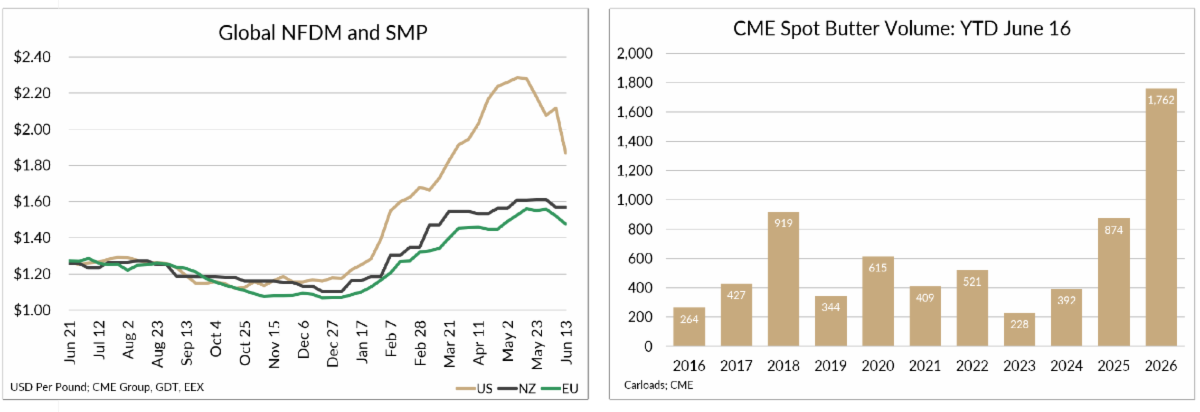
Butter trading volume at the CME remains historically heavy. On June 12, a record 60 lots changed hands, bringing the weekly total to 161, the largest weekly volume since October 2024. The spot price has been relatively quiet, staying largely in the $1.60s. 

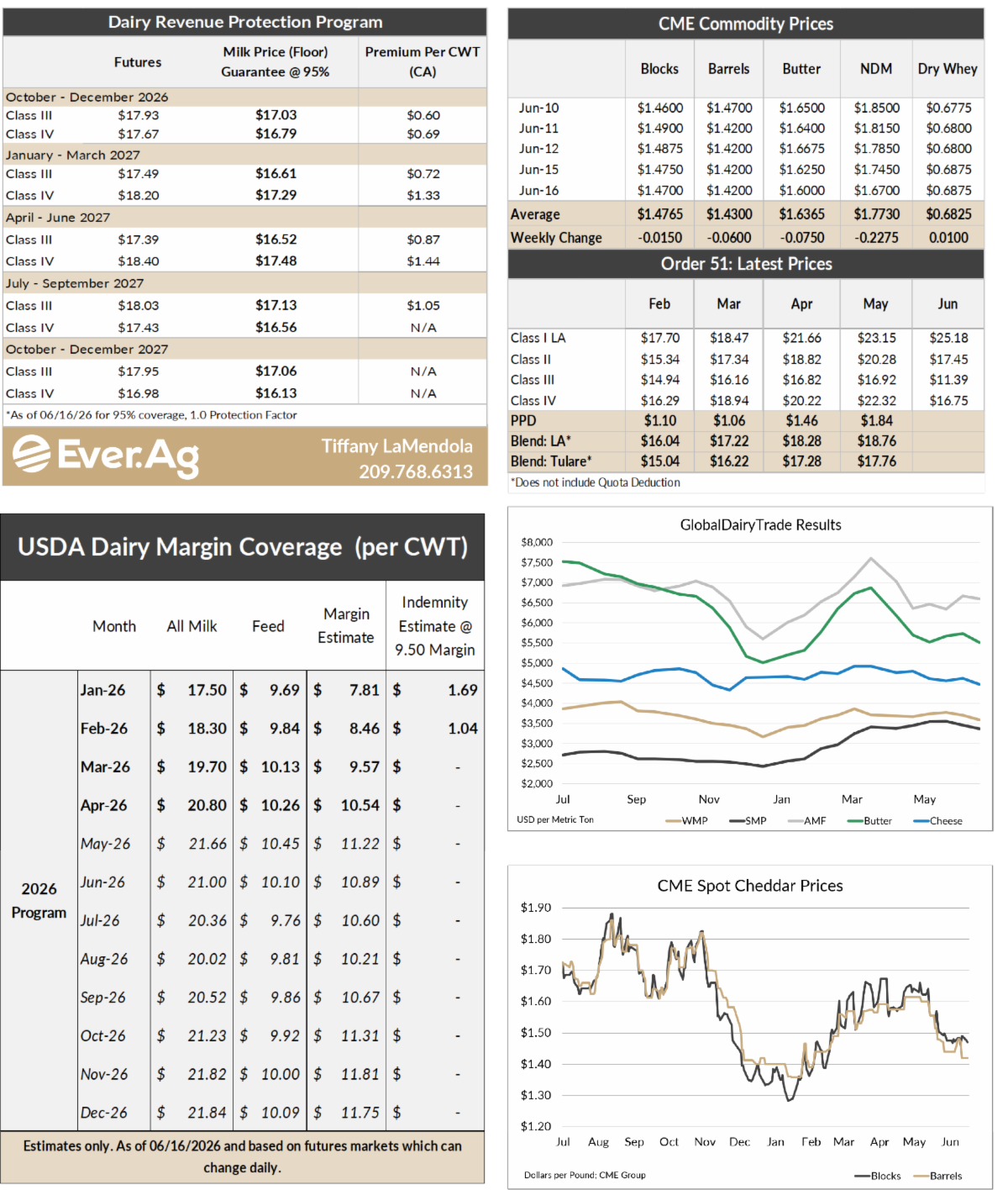
  • The spot nonfat dry milk market continued to fall, dropping to the $1.60s for the first time since March. That’s down over 62-cents from the early May high. While the decline has helped bridge that gap with international price levels, the US still maintains a premium. And with Oceania and European prices softening some in recent reports, there may be more downside for US NDM. 


  • At this week’s Global Dairy Trade event, milk powder prices declined again, with whole milk powder down 3.2% to $1.63 per pound and skim milk powder falling 2.6% to $1.53. Butter slipped 3.8% to $2.50 per pound. Cheddar declined 3.2% to $2.03 per pound, while mozzarella dropped 4.9% to $1.70. 


  • Block cheese prices remain depressed, unable to get out of the $1.40s. Production is building, so there is plenty of cheese to go around. Domestic demand remains soft as consumers react to high gas prices by pulling back on restaurant and grocery spending. But record-setting export business is keeping some support under the market. 
  • There were no surprises in USDA’s June World Agricultural Supply and Demand Estimates report. Corn ending stocks increased slightly on the month, while soybean inventories were unchanged. 


  • After plunging the previous week, nearby corn and soybean contracts continued to decline, but at a slower pace. Markets are closely watching the weather and waiting for USDA’s Acreage and quarterly Grain Stocks reports at the end of the month. 


  • Next Monday brings USDA’s May Milk Production report. Analysts predict output will increase versus prior-year levels. 


THANK YOU TO OUR CURRENT SPONSORS


Facebook  Instagram  LinkedIn  Web