Board Approves New Membership Dues Structure Effective July 2026 | |
At its April 2026 Board Meeting, the WUD Board of Directors voted to approve a change to the membership dues structure, effective with July invoices for June's milk. Members will receive a letter in the mail with full details and a selection form.
The updated structure gives each member the option to choose from four payment tiers, so you can select what makes the most sense for your operation. Please review your options and return the completed selection form by July 1, 2026.
Questions about the new structure? Contact Anja Raudabaugh at anja@wudairies.com.
| | | Upcoming Workshops: Modesto Nitrogen Management Zone Regulatory Changes | |
The California Dairy Quality Assurance Program (CDQAP) is hosting workshops this June on the regulatory changes in the Modesto Nitrogen Management Zone. The Central Valley Water Board recently released a draft basin-specific order to reduce nitrate levels in water discharges, and similar orders are expected to follow in other regions. The order would make the provisions of Management Zone Implementation Plans (MZIPs) enforceable, including the commitment to achieve a whole-farm balance of nitrogen within 10 years.
Two workshops are available for dairy producers:
-
In-Person: Thursday, June 11, 3:00 to 5:00 pm Stanislaus County Ag Center, HI Room 3800 Cornucopia Way, Modesto
-
Virtual: Friday, June 19, 10:00 am to 12:00 pm Via Zoom Webinar (registration required in advance)
-
Workshops: will cover the details of the Modesto Order, the status of the CVDRMP Data Management Tool and Reporting Portal, and steps producers can take now to prepare.
Questions? Contact Denise Mullinax at (209) 585-6744 or mullinax@cdrf.org.
| | | CDFA Dairy Farm Inspection Fees Increasing July 1 | |
California Department of Food and Agriculture (CDFA) is raising quarterly dairy farm inspection fees by 3.1% effective July 1, 2026, part of an annual adjustment the department has made for several years to address rising costs and an ongoing fiscal deficit.
The new rate is $0.17 per hundredweight (cwt) on the first 482,000 lbs. of milk produced per quarter, with a maximum of $819.95 per quarter and a minimum of $250. For farms at or above the volume cap, that works out to an increase of roughly $24.66 per quarter.
Fees collected under the new rate for the July 1 through September 30, 2026 quarter will be due October 1, 2026.
This increase applies to dairy farms in CDFA State Established Inspection Areas. It does not affect farms inspected by county Approved Milk Inspection Services in Fresno, Imperial, Kings, Marin, San Joaquin, Sonoma, Stanislaus, or Tulare counties, though those county programs may choose to adjust their own fees independently.
Questions can be directed to CDFA's Milk and Dairy Food Safety Branch at (916) 900-5008.
| | | Former WUD Director of Sustainability Nominated to Lead Bureau of Reclamation | | | |
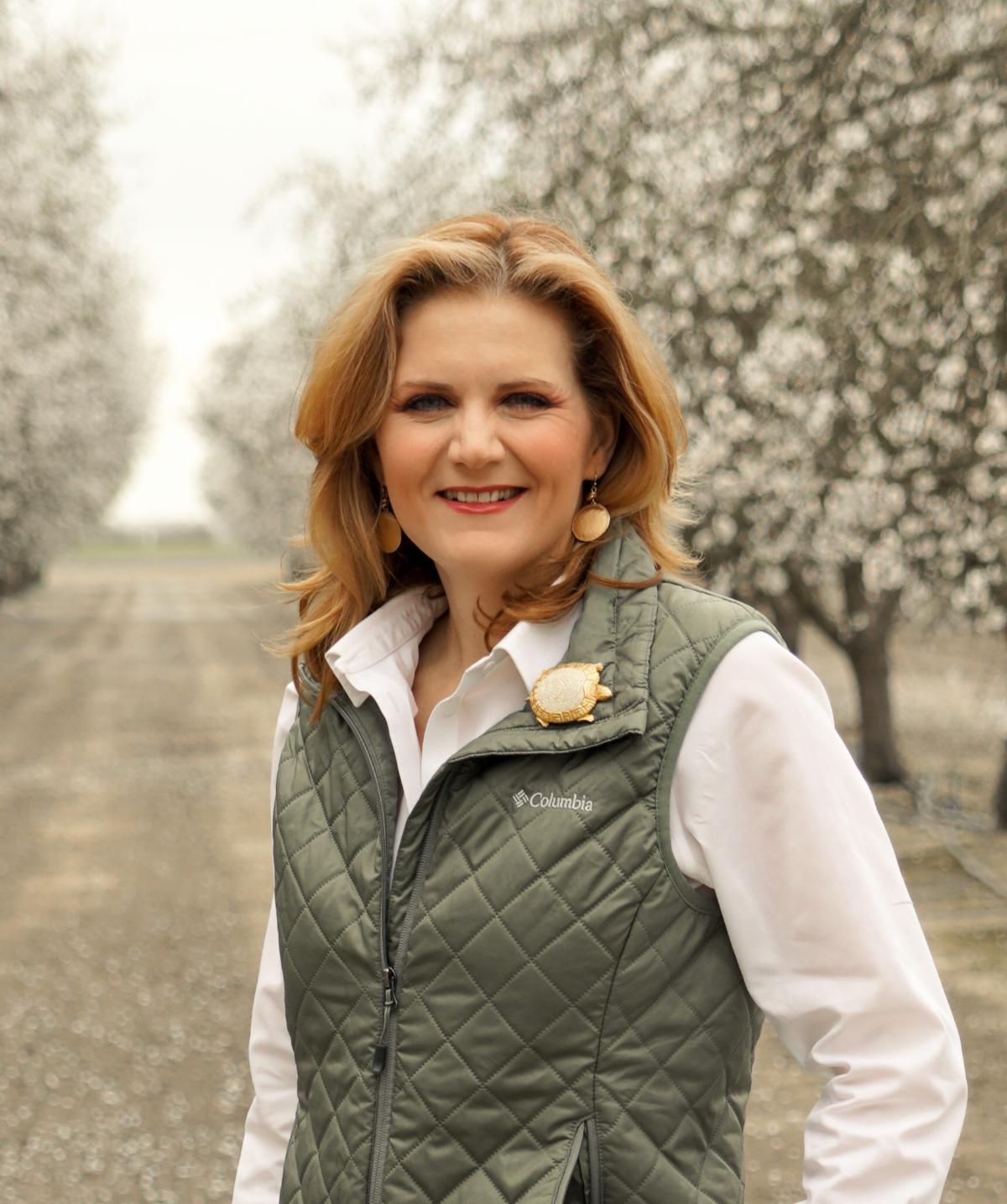
A familiar name is taking on a new role in Washington. Aubrey Bettencourt, who served as WUD's Director of Sustainability before going on to lead the Almond Alliance as president, has been nominated by the Trump administration to serve as Commissioner of the Bureau of Reclamation.
Bettencourt is no stranger to federal service. Most recently, she served as Chief of the Natural Resources Conservation Service (NRCS) at the USDA before stepping down in May. Prior to that, she directed government and external affairs for Netafim, a drip irrigation company, and during the first Trump administration she served as deputy assistant secretary of water and science at the Interior Department, which is the parent agency of the Bureau of Reclamation.
If confirmed by Congress, she would step into one of the most consequential water management roles in the country at a particularly difficult moment. Colorado River negotiations among the seven basin states have stalled, Lake Mead levels are in freefall, and the Trump administration is widely expected to impose a water-sharing deal that could mean significant cuts for agricultural users across some of the most productive farming regions in the nation.
Bettencourt brings a grounded, agriculture-first perspective to the role. She is a third-generation California Central Valley farmer, and WUD knows firsthand the caliber of professional she is. We will be watching her confirmation closely.
| | | New Episode of Seen & Herd | | | |
WUD CEO Anja Raudabaugh is back on the podcast with updates on three fronts.
First, New World Screwworm. A confirmed detection in Zavala County, Texas, has California on alert. If you move animals in or out of Texas, movement restrictions are currently in effect. Anja breaks down what's required, what to watch for on your operation, and whom to contact if something looks off. No confirmed cases in California, but this situation is moving fast, and farmers need to be prepared.
Anja also introduces Western's two new State Farmer Field Representatives: Jimmy Burrows, covering the North State, and Andrew Brazil, covering the South Valley. Both are former dairymen with deep roots in the industry and hands-on expertise in the water quality and compliance issues facing California producers today.
Finally, a state budget reality check. With the state running a multi-billion dollar deficit, key funding decisions are being pushed to late August and September. Anja covers what WUD is watching and what it means for members.
| | | CV-Salts Process Takes an Important Step | | | |
By Paul Sousa, Director of Regulatory & Environmental Affairs
On June 3, 2026, the Central Valley Regional Water Quality Control Board held a hearing to consider approval of the Modesto Management Zone Implementation Plan (MZIP) and amendments to water quality permits for operations in the Modesto groundwater subbasin. This action applied to irrigated agriculture, food processors, municipal wastewater treatment plants, bovine feedlots, as well as dairy operations. At the end of the day, the Board approved the resolution as presented by staff without making any changes.
This was an important step in the CV-Salts process that started almost two decades ago. With this action, the Regional Board officially provided a 35-year exception to meeting the nitrate drinking water standard in groundwater. This was in exchange for permit holders funding replacement drinking water for those whose wells are impacted by nitrates, something that has already been happening in the Modesto Management Zone for about five years. This hearing now sets the stage for the remaining Priority 1 management zones (Turlock, Chowchilla, Kings, Kaweah, and Tule) to move through this same process.
The 35-year timeline does not mean that permit holders can sit on their hands. There are interim targets that must be met along the way, including those listed below. A new annual reporting tool is being developed to augment the current field-scale nitrogen accounting by adding a whole-farm nitrogen accounting component. It will also be able to show aggregated trends within the individual management zones. These are requirements of the newly adopted MZIP. The Central Valley Dairy Representative Monitoring Program (CVDRMP) is currently working on this tool.
At 10 years, there is a milestone requiring dairies to achieve a whole-farm nitrogen balance, meaning the nitrogen available in the manure and imported as fertilizer is balanced with what is used by crops and exported off the dairy. A component of this will include a comparison of the amount of nitrogen in lagoon water to the land available to receive lagoon water. This is going to be a heavy lift for many dairies. Continued monitoring along the way will also be required to show that we are actually making progress.
Overall, this was a positive step for dairies and other permit holders in providing additional time, but the process will also bring new urgency to addressing nitrate issues as local stakeholders work together to identify and address local nitrate sources. The dairy industry has already started this process, with changes rolling out over the next couple of years.
This should not be confused with a separate process that will soon restart. The State Water Resources Control Board recently sent an email stating that its Remand Order on the Central Valley Water Board’s dairy permit is expected to be released on or around June 15th. The State Board anticipates holding a workshop on July 8th and a hearing to adopt the order on September 15th. Once I have reviewed the Remand Order, I will update our members on its contents and keep you informed as we move through this process.
These are two separate actions, but there is a common message. Dairy water quality regulations in the Central Valley will be changing, and dairies need to be aware of the changes. Knowing what is coming can help dairies prepare. As always, if you have any questions on these or other environmental issues, please contact me.
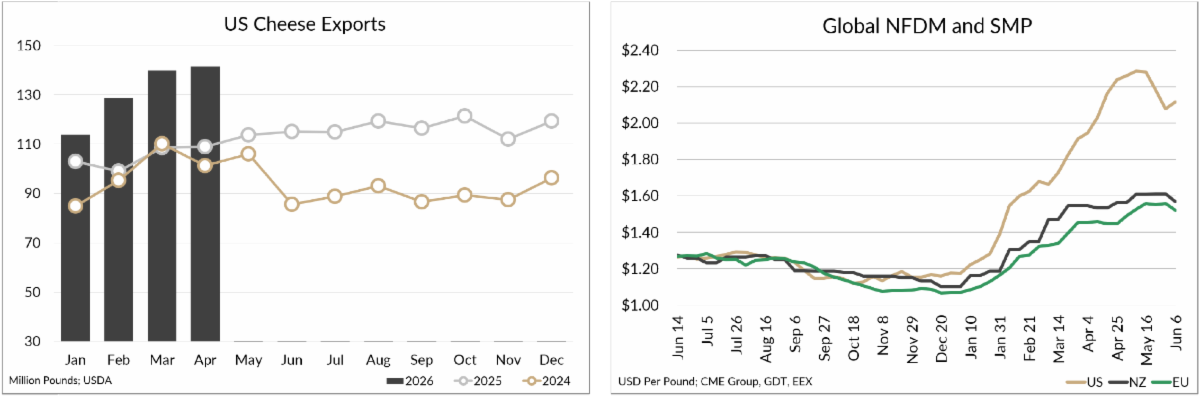
| | | In April, US dairy export volume climbed year-over-year across all categories. Outbound cheese volume totaled 141.5 million pounds, a new monthly record. Butter exports surged more than 100% versus prior-year levels. Skim milk powder shipments rose 9% over 2025. | |
|
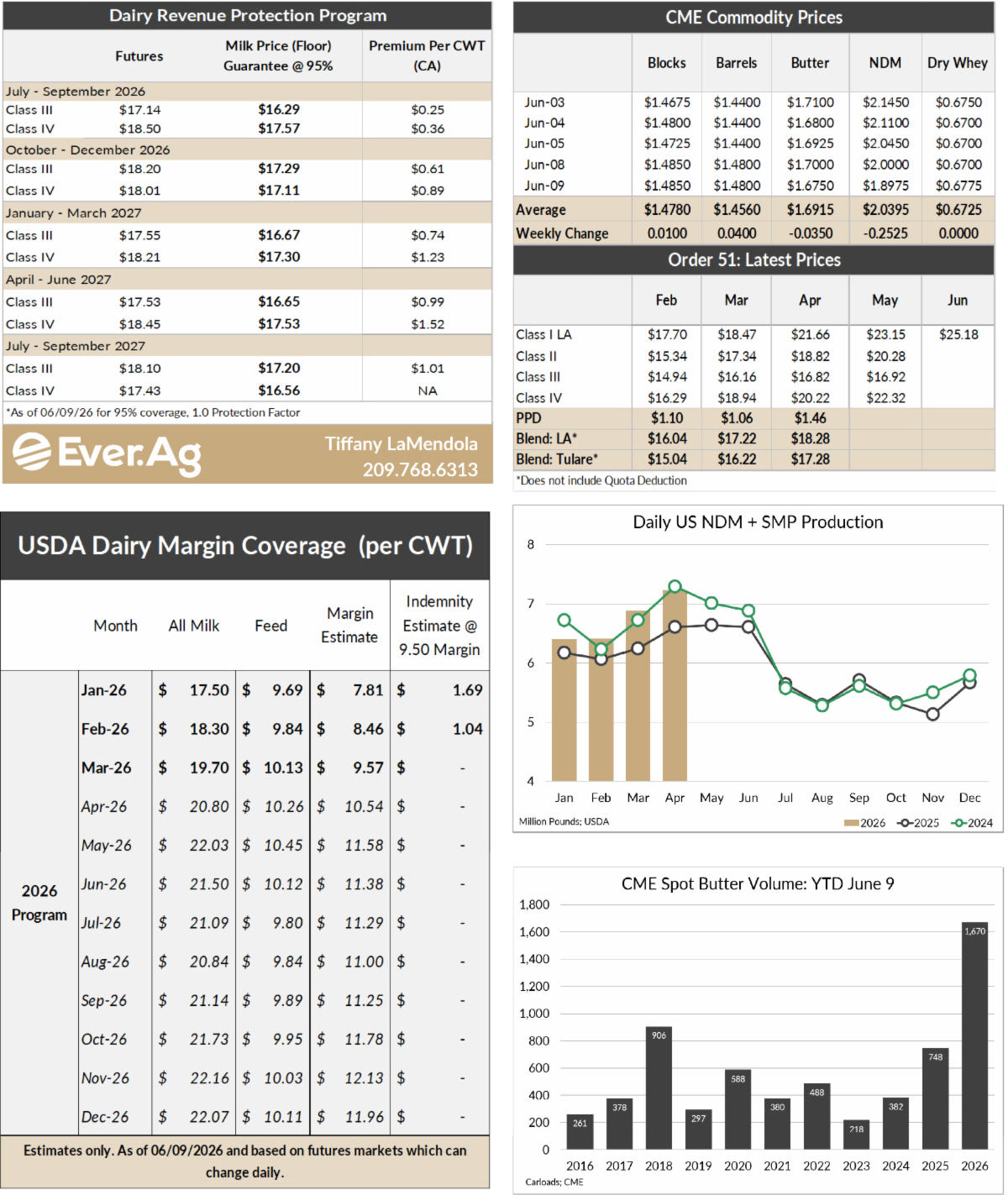
- The spot nonfat dry milk market remains volatile, with prices climbing to the $2.10s before tumbling to the $1.80s for the first time since March. Product feels more available now, taking some support away from prices.
- According to USDA’s Dairy Products report, NDM and SMP production was above prior-year levels. Stocks were still down on the year, but the gap narrowed. Butter and cheese output both climbed year-over-year.
- Prices tumbled across the board at this week’s Global Dairy Trade Pulse event. SMP fell 6.1% to $1.49 per pound and WMP dropped 3.9% to $1.61. Butter slid 7.0% to $2.59 per pound.
- Buyers are still eagerly snatching up butter at the CME. On June 18, 51 loads changed hands, the most in a single day since August 2024. The spot price keeps pushing to $1.70 per pound, only to run out of steam and return to the $1.60s.
| |
|  |
- Volatile spot butter and NDM prices carried over to futures, with third quarter Class IV rising as high as $20.02 per hundredweight, then falling as low as $18.85.
- The spot block market remains depressed, with the price staying below the $1.50- per-pound mark. Reports suggest there’s plenty of product out there to meet soft domestic demand. With such high gas prices, consumers continue to pull back on restaurant spending.
- Nearby grain futures tumbled hard last week. With strong stocks and weak seasonal trends, corn prices fell roughly 50 cents versus mid-May. Favorable weather also drove soybeans sharply lower.
| |
| THANK YOU TO OUR CURRENT SPONSORS | | | |
Our Company | Contact Us | FAQs | Privacy Policy |
| | | |