Wednesday, April 22, 2026

STATE NEWS

Iran Launches Cyber-Attacks On U.S. Infrastructure

By Dr. Michael Payne, School of Vet Med and Director CDQAP and Chad Beever, Cyber Intelligence Analyst, Central California Intelligence Center | Originally published in the CDQAP Newsletter


Iran-linked hackers are reported to have successfully disrupted multiple US oil, gas and water sites in recent weeks. While the attacks are not known to have included agricultural or food processing targets, they are a stark reminder that food and ag has been targeted in the past and remains susceptible in the future.


In concert with our law enforcement partners CDQAP has previously summarized cybersecurity recommendations. Here are some of the highlights:


  • When purchasing or updating computer systems, particularly systems accessible through the internet, producers should thoroughly discuss cyber-security with vendors.


  • When installing and maintaining computer systems, particularly those accessible through the internet, it is important to have robust passwords. Make sure to change the default password on any new system since those passwords are easily accessible on the internet.


  • Ideally there should be a hard separation between a facility’s management network (emails, documents, marketing) and its operations network (machine operations, remote cow monitoring etc.)


  • Frequent software scanning and updates can help prevent hacks and continuous data backups make recovery more efficient and less expensive.


  • Employees can be trained on how to resist “phishing” attempts for company information when using facility computers.


Dairies interested in a vulnerability analysis of their computer systems can coordinate with their local CISA representative. For both producers and processors there are a variety of resources available to evaluate or improve their cyber security. These include Vulnerability and Penetration Testing (VAPT), software scanning, threat alerts and incident reporting assistance.


For producers or processors interested in learning more about cybersecurity resources or CDQAP’s partnership with law enforcement contact Dr. Michael Payne at mpayne@ucdavis.edu.


It’s Time to Sample Forages and Manure

By Dr. Deanne Meyer, Ph.D., Livestock Waste Management Specialist, UC Davis & UC ANR | Originally published in the CDQAP Newsletter


The winter crop knows summer is here. Choppers are going full throttle. That

means it’s time to record harvested forage weights and sample forages from each field where manure was applied. Shortly after harvest many producers will apply liquid manure, slurry from the bottom of ponds or solid manure. Here too there is a need to record the amount of manure applied and take samples for nutrient composition. Be sure to keep your nutrient management team apprised of your harvest and manure application schedule if they are tasked with taking samples.


Forages: The amount of nutrients harvested is calculated as the tons of forage harvested multiplied by its nutrient composition. You can visibly see differences in tonnage yield while crops are standing in the field. Keeping detailed records of harvested forage and associated nutrient composition allows you to precisely track your nutrient management data.


Manure: More important than taking a manure sample for regulatory reasons is

to use data to make fertilizer application decisions. As fuel prices increase, so too

will fertilizer prices. Work with your nutrient management team to fully understand the nutrient value of your manure. Be sure to notify them if you are having tankers truck pond water to an adjacent field. These atypical applications need to be accounted for.


In summary, weigh or estimate volume of everything harvested and applied. Collect a representative sample from each field.


MARKET UPDATE

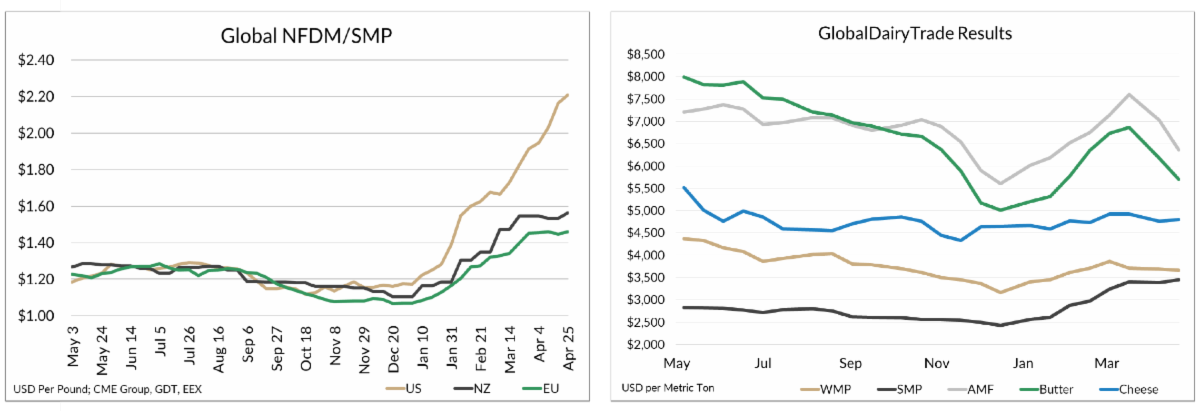
Nothing seems to be slowing down the CME nonfat dry milk market—at least for now. The spot price reached a new all-time high of $2.2150 per pound this week. Supplies are still tight, but how long can the US price stay at such a premium to global levels before coming under pressure?

  • Soaring US NDM prices are giving global prices room to rise. At this week’s GlobalDairyTrade event, skim milk powder ticked up 2.0% to $1.56 per pound, while whole milk powder dipped 0.6% to $1.66 per pound. Butter tumbled, down 7.7% to $2.59 per pound.


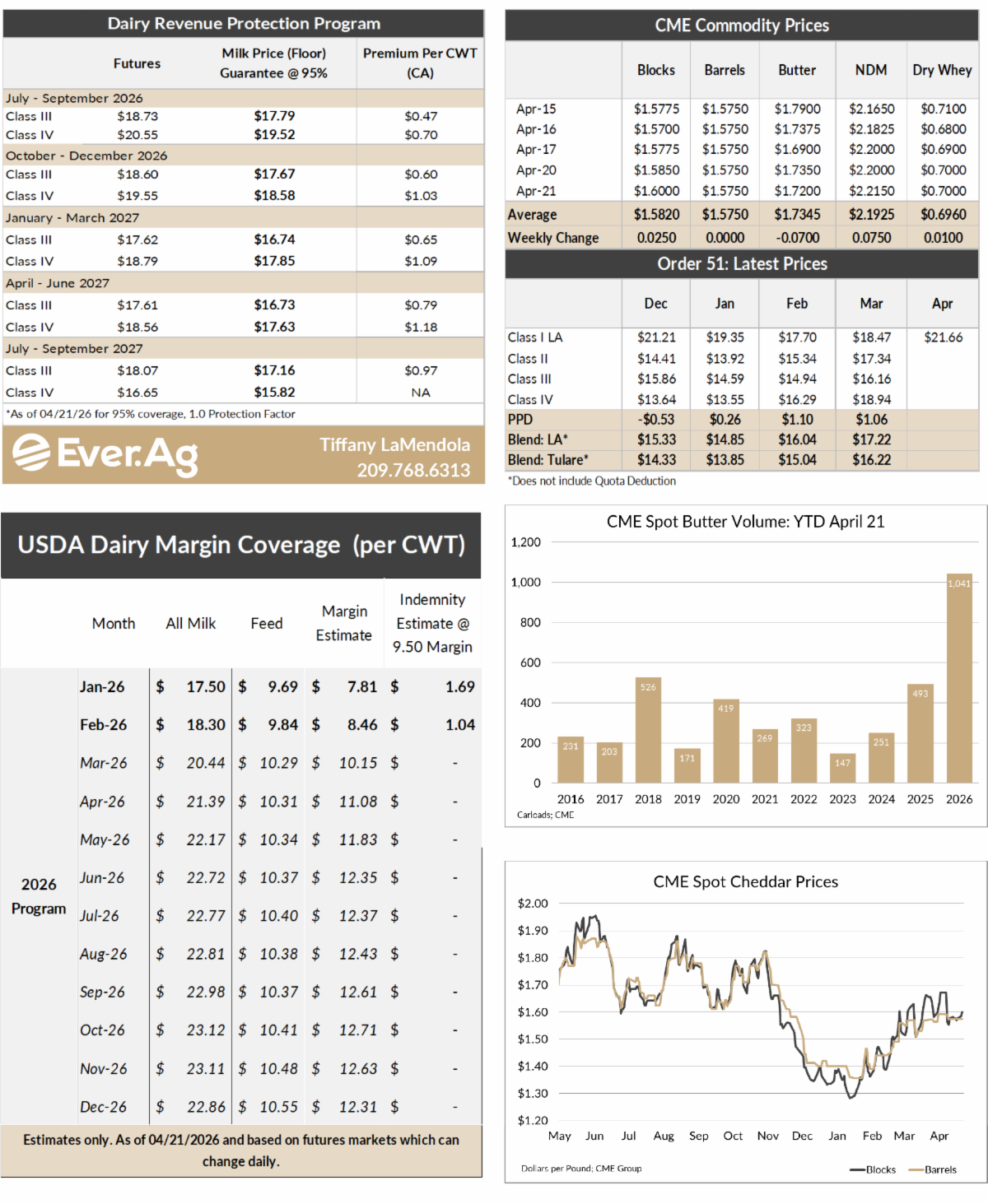
  • There’s still a lot of butter changing hands at the CME, with both buyers and sellers eager to make deals. On April 20 alone, 49 lots traded, the biggest single-day volume since August 2024. The spot price tumbled to the $1.60s before rebounding slightly to the low- $1.70s.


  • Spot blocks are still range bound, remaining close to the $1.60-per-pound mark. But declining prices in Europe could cut into US export business and put pressure on prices. There are still concerns that high gas prices created by the conflict in Iran could impact consumer demand, particularly in the restaurant space.
  • High NDM prices are lending some support to Class IV futures, with third quarter contracts in the $20.50s per hundredweight. Class III futures are in the $18.70s.


  • Planting season is well underway for corn and soybeans, with farmers getting both crops in the ground at an above-average pace. Weather remains a concern, with drought conditions in many parts of the US.


  • USDA’s March Milk Production and Cold Storage reports are due later this week. Expectations call for US milk output to increase 2.3% year-over-year. Both reports should provide new direction for markets in the days ahead.


THANK YOU TO OUR CURRENT SPONSORS


Facebook  Instagram  LinkedIn  Web