Wednesday, February 4, 2026

STATE NEWS

CDFA Holds a Dairy Double Header

By Paul Sousa, Director of Regulatory and Environmental Affairs


On Monday, February 2, Punxsutawney Phil predicted six more weeks of winter. While Phil was focused on the weather, the California Department of Food and Agriculture (CDFA) was busy holding two virtual meetings on California dairy issues.


The first meeting was a Producer Review Board (PRB) meeting. After the meeting was called to order, CDFA addressed board vacancies. The call for nominations remains open due to multiple vacancies, some resulting from recent resignations. Members of the dairy community were encouraged to apply or nominate qualified candidates.


The discussion then turned to remaining funds in the former Pooling and Marketing branches of the state milk marketing order, which were left over after the transition to the California Federal Milk Marketing Order. CDFA has been providing updates on these funds for several years in preparation for their eventual release. At this meeting, CDFA reported that updated accounting showed lower balances than previously announced: approximately $2.053 million in the former Pooling Division and $2.6 million in the former Marketing Division, down from earlier estimates of about $3.5 million in each account.


CDFA explained that it is conducting a transaction-by-transaction audit of the originating accounts to confirm the final balances, but indicated that the figures presented at this meeting were believed to be accurate. The PRB focused on the former Pooling Division funds, while the Marketing Division funds were scheduled to be discussed in a separate meeting later that afternoon.


Related to this discussion, CDFA announced that the Quota Implementation Program (QIP) administrative fee was reinstated effective February 1, 2026, due to low account balances and the need to fund administrative operations, including development of a new QIP software tool.


CDFA presented two options for use of the former Pooling Division funds. One option, previously discussed, was to refund the funds directly to individual dairy producers, though CDFA noted that administrative costs would significantly reduce the amount returned. A second option, newly identified by CDFA, but offered by Western United Dairies Board in January of 2024, would use the former Pooling Division funds to cover QIP administrative costs, eliminating the need to charge producers the QIP administrative fee for more than a year.


The PRB adopted resolutions recommending that the Secretary of Agriculture move the former state pooling funds into a separate account to improve transparency and use the funds to support QIP administration. Later in the meeting, the board also approved a resolution to suspend the QIP administrative fee assessment effective March 1, meaning producers will be assessed the fee for February only.


The agenda then moved to hardship petitions, with 16 requests before the board. CDFA legal staff recommended tabling hardship requests from four dairies involved in ongoing litigation against the Department and individual board members; the board approved this recommendation.


The board denied the first hardship request, submitted by a raw milk producer citing bird flu impacts. At this point, several other petitioners, or their attorneys, requested continuances to allow more time for preparation, which the board approved. As the meeting approached 1:00 p.m.—when the next CDFA meeting was scheduled—the board moved more quickly through the remaining items and another hardship was denied. CDFA had deemed four of the hardship requests incomplete. The board took up all four in one motion and denied them due to insufficient information. Another request was tabled due to time constraints, and the meeting adjourned at 1:05 p.m.


The second meeting focused on funds from the former Marketing Division. CDFA referenced a prior meeting in which approximately $3.5 million had been discussed as potential funding for industry grants benefiting both producers and processors. At that earlier meeting, there was broad agreement by the industry that the California Dairy Research Foundation (CDRF) would be an appropriate entity to administer those funds.


At this meeting, CDFA clarified that the available funding was actually $2.6 million, reflecting the updated accounting. CDFA also explained that it could not issue the funds to CDRF as a block grant because CDFA grants must be issued on a reimbursement basis for projects already underway or completed. Meeting participants suggested that the funds be treated as a refund to the industry rather than a grant, since the money originated from producer and processor assessments. CDFA expressed openness to this approach but indicated that further review would be needed. CDFA concluded by stating that it will continue working with industry representatives to determine the most appropriate and effective use of the former Marketing Division funds, with further discussion to follow.


Punxsutawney Phil may be calling for six more weeks of winter, but he does not have the insight of seeing the bees show up in California from all over the nation as an indicator that Spring is just around the corner and almond blossoms will soon be here.


INDUSTRY NEWS

Watch for Nesting Tricolored Blackbirds

Nesting season for the threatened tricolored blackbird occurs in late February through early June. As wetlands have continued to disappear, dairy forage fields have become a favorite nesting place. Typically, large colonies of thousands of birds will make their nests on a dozen or more dairies across the Central Valley. In more recent years, the birds have been nesting in smaller colonies across more dairies. The birds’ nesting in forage fields coincides with harvest season, forcing delay or cancellation. A nesting colony may occupy a field for 45-90 days, depending on how synchronized the birds are.


Think You Might Have the Birds?: Since tricolored blackbirds are listed as threatened, it is unlawful to harm or harass the birds. If you believe you might have tricoloreds in your fields, you can contact NRCS or Audubon California to arrange a confidential assessment. Since 2015, through partnership with dairy and conservation groups, NRCS has provided funding to help recoup some of the financial losses to dairies. Feel free to contact Ian Souza-Cole with questions: ian.souzacole@audubon.org. You can also contact your trade association or cooperative field representative.


New World Screwworm: What Has Changed and What California Dairy Producers Should Know

By: Nick Kimutis, MPH, Livestock Programs, & Dr. Nicki Humphrey, Cattle & Swine Specialist, Animal Health Branch, CDFA | Originally Published in CDQAP's January 2026 Newsletter


New World Screwworm (NWS) has been the subject of recent CDQAP newsletter updates as detections in Mexico move northward. Earlier articles described what NWS is and what producers should look for. This update focuses on what has changed and what California dairy producers need to know.


NWS is not currently present in California or the United States.


Where Things Stand in Mexico: As of January 29, the most recent confirmed detections of NWS in Mexico have been reported in the state of Tamaulipas, approximately 187 miles from the United States border. None of the animals associated with these cases had any reported history of movement outside of Tamaulipas. The United States Department of Agriculture (USDA) is working closely with Mexico’s National Service for Agro-Alimentary Health, Safety, and Quality (SENASICA) to gather additional information and assess these cases.


In total, there are currently 8 active cases reported in Tamaulipas and approximately 870 active cases reported across Mexico involving animals. Individual case counts change over time. The broader trend remains important and reflects continued northward movement of NWS from areas where it had been successfully controlled for decades. Updated information is available through the USDA’s NWS website.

Government Response and Surveillance Efforts: United States ports remain closed to imports of cattle, bison, and horses from Mexico. These restrictions are intended to reduce the likelihood that NWS could be introduced into the United States through the movement of animals before infestations are detected and treated. Movement controls and sterile fly technique remain the most effective tools for limiting NWS spread. Because NWS most often spreads long distances through the movement of infested animals, these controls remain a cornerstone of containment efforts.


Mexican authorities recently reported that construction of a sterile fly production facility in Metapa, Mexico is on track to come online by mid-summer. The facility will initially produce approximately 60 million sterile flies per week, with plans to gradually increase output to its full capacity of 100 million flies per week. This expansion will complement existing sterile fly production in Panama.


Progress continues on U.S. operations at Moore Airbase in Texas. In the near term, the facility is being prepared to serve as a sterile fly dispersal site. USDA expects to move into the building by the end of the month, which will allow the facility to receive pupae produced in Panama and begin staff training for fly dispersal operations.


Looking ahead, Moore Airbase is also planned to transition into a sterile fly production facility. USDA anticipates awarding a contract for production between early February and late March, with sterile fly production targeted to begin in 2027. Production is expected to start at lower volumes and gradually scale up over time as operations are established.


Additional information on sterile fly production and dispersal facilities is found here.

To enhance early detection, CDFA and the USDA initiated active NWS surveillance along the California-Mexico border in October 2025 with the placement of eight fly traps. Four Swormlure traps were placed in Imperial County and four in San Diego County. Swormlure traps use an attractant that mimics the scent of animal wounds to lure adult screwworm flies. CDFA continues to monitor these traps and submit collected flies for identification twice weekly as conditions permit.


What CDFA Is Doing for California Producers: CDFA continues to coordinate closely with federal partners and other states. CDFA convened an NWS workgroup to develop a response plan and other draft guidance documents. Current resources include infographics comparing NWS to other flies, protocols on NWS disposal and cleaning for livestock and horses, sample collection procedures, and a NWS fact sheet. Additional materials, including Spanish translations, are under development.


What to Expect: If California confirms a case of NWS, movement controls will require animals leaving infested zones to undergo thorough inspection and, if necessary, treatment. Animals must have proper documentation, which includes inspection certificates for in-state movement and certifications of veterinary inspection for interstate movement. Any animals found to be infested with NWS will not be permitted to move until they have been treated and cleared of NWS infestation.


Recent detections in Mexico have included neonatal calves, highlighting the importance of early wound management. In affected areas, producers would likely be advised to apply prophylactic treatment to newborn calves and use dipping or spray with Catron IV or another topical insecticide labeled for NWS to promote rapid drying of the umbilical area and reduce the risk of infestation.


Treatment Considerations: Treatment options for New World screwworm have expanded, but important limitations remain. As of today, two products currently have conditional approval from the FDA for use against NWS larvae in cattle.


Dectomax CA1, a doramectin injectable solution, is conditionally approved for the prevention and treatment of infestations caused by Cochliomyia hominivorax larvae and for prevention of reinfestation for up to twenty-one days in cattle.


Exzolt Cattle CA1 is conditionally approved for the prevention and treatment of NWS larvae and for treatment and control of cattle fever tick, with use limited to beef cattle two months of age and older and replacement dairy heifers less than twenty months of age.


Treatment options for lactating dairy cattle remain limited due to milk residue and withdrawal considerations, and all applications must follow label directions and veterinary guidance. CDFA recommends producers work with their veterinarian now to develop treatment plans should they end up having an NWS infestation. The most current information on approved and conditionally approved treatments is available from the FDA here.


What Producers Should Be Doing Now: For California dairy producers, the current risk of NWS remains low. However, preparedness and awareness are essential. Producers are encouraged to monitor alerts from the CDFA and USDA, maintain strong fly control and wound management practices, be mindful of animal movement especially from affected regions, and report any unusual wounds or maggots promptly to their herd veterinarian or CDFA Animal Health Branch District Office.


Learn More: For the latest updates, guidance, and producer resources related to NWS, please visit the CDFA NWS website.


ASSOCIATION NEWS

Come See Us at the World Ag Expo

World Ag Expo is right around the corner, and we encourage WUD members to stop by and see us in the Dairy Pavilion. Throughout the week, WUD staff and partners will be hosting booth conversations on markets, environmental policy, labor law, and innovative solutions impacting dairy operations. It’s a great opportunity to ask questions, connect with the team, and catch up while you’re on the Expo grounds.


And yes, members who stop by can pick up WUD swag! Check out the full booth schedule below and find us at Booth #6503.


BioFiltro at the World Ag Expo

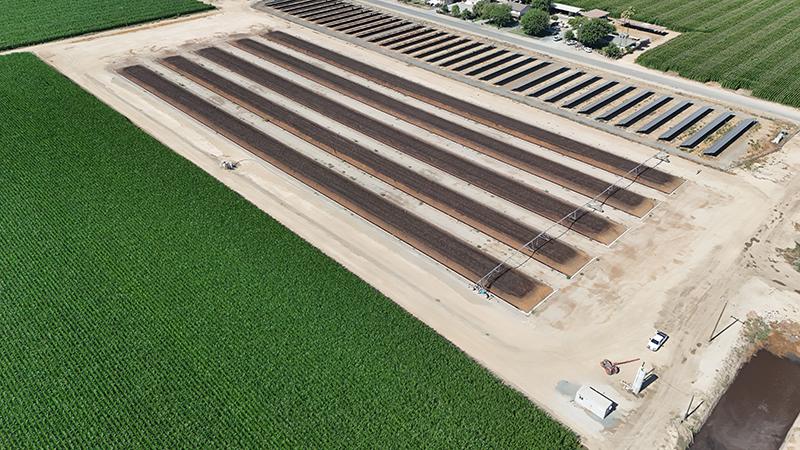
BioFiltro is excited to announce open tours of our vermifiltration system at Henry and Rick Garcia Dairy in Tulare, CA, coinciding with the World Ag Expo from February 10-12th. The dairy is located less than 5 minutes away and will be staffed by the BioFiltro team for the convenience of attendees who wish to see the system before or after their visit to the Expo.


The Garcia dairy system is one of many vermifiltration systems operating or under construction across the Central Valley. These dairies range in size from 1,000-10,000 milking heads.


You will also find BioFiltro staff walking the Dairy Pavilion of the Expo and hanging out at the Western United Dairies booth.


The vermifiltration system is located at 19705 Ave 124, Tulare, CA 93274


Directions from World Ag Expo (signs will direct you from Ave 200):

  1. South on Laspina Street
  2. Left/East on Hosfield Dr/Ave 200
  3. Right/South on Rd 124
  4. Take a left on the dirt path before the solar panels until you see the system on your right


  • The parking area will be clearly marked
 

MARKET UPDATE

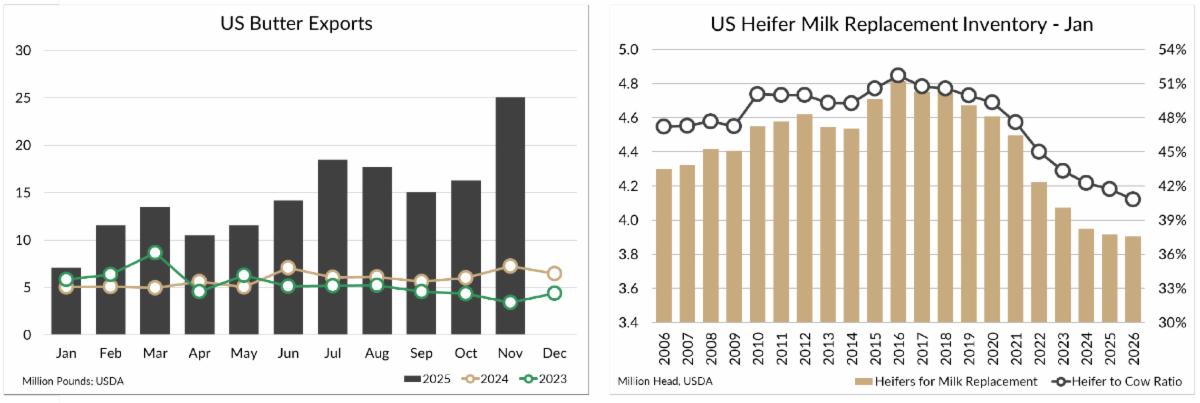
US cheese exports remained strong in November, with outbound volume up 28% (+25 million pounds) versus 2024. Butter was also popular with global buyers, with exports up 245% (+18 million pounds) year-over-year. Milk powder exports were virtually unchanged on the year.

  • In its January Cattle report, USDA reported there are more cows but fewer heifers on US dairies. It pegged dairy heifer numbers at 3.90 million head, the smallest total since 1978. Heifers expected to calve declined to 2.50 million head, the lowest in more than 25 years. Milk cow numbers reached 9.57 million, the highest level since 1993. 


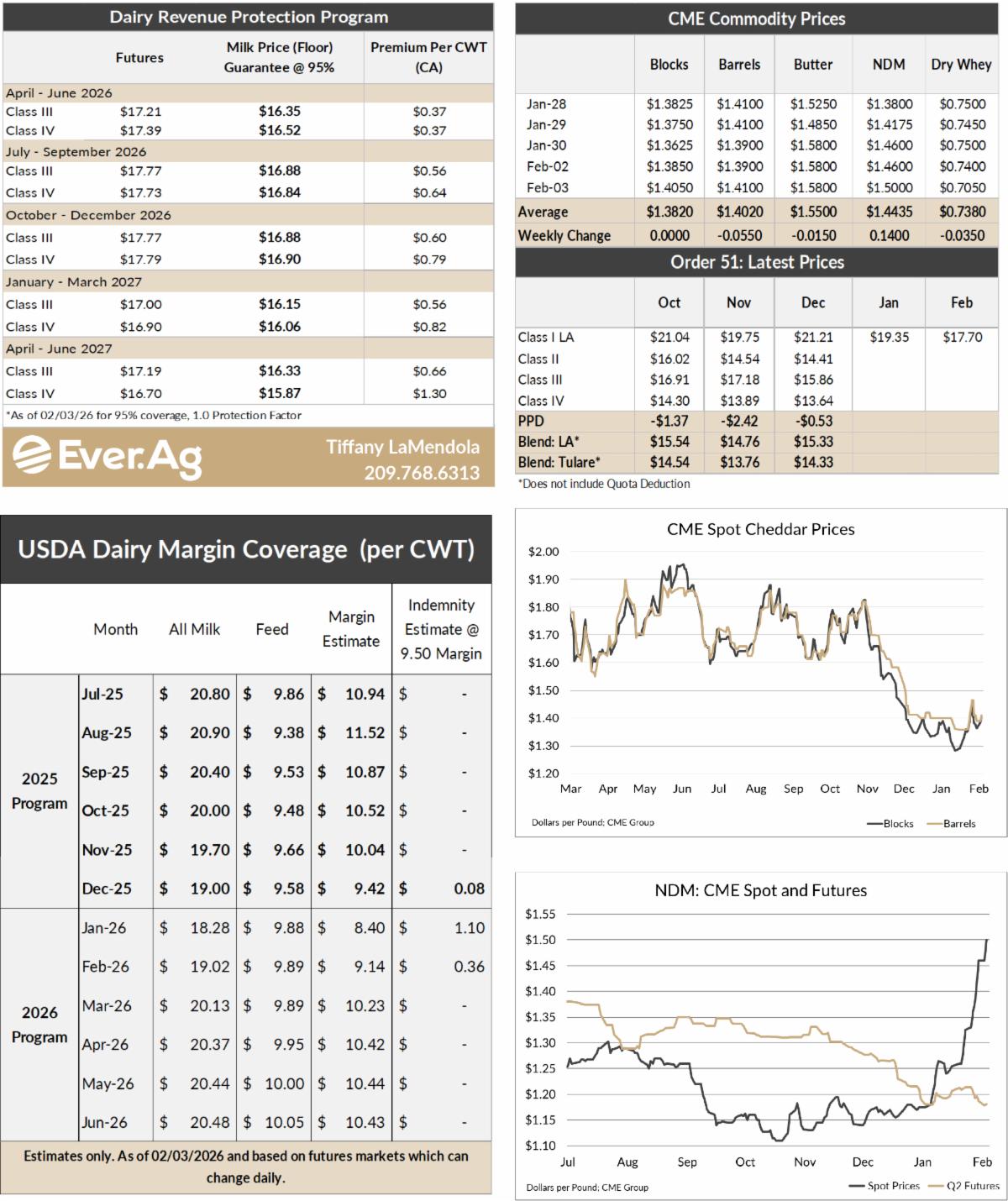
  • After winter storm-related disruptions helped drive prices to the mid-$1.40s, CME cheese markets slipped to the $1.30s. But decent demand is giving blocks and barrels enough support to climb into the low-$1.40s. Block trading volume is healthy, with 22 loads changing hands so far this week. 


  • Volatility continued in the butter market last week, with the spot price tumbling, then leaping again. While cream remains readily available, reports suggest demand is also strong. Currently, spot butter sits in the upper-$1.50s. 
  • Contacts report milk powder supplies are tight, and that continues to drive spot nonfat dry milk to new multi-year highs. The CME NDM market reached $1.50 per pound for the first time since October 2022. 


  • Prices moved higher across the board at today’s GlobalDairyTrade event, as was expected by analysts ahead of the event. 


  • China fulfilled its promise to buy US soybeans, but the total is well below China’s average annual purchase. Strong crush rates are keeping some support under futures. March soybeans are hovering around the $10.60-per-bushel mark. Corn demand is decent, especially exports, with the March price in the $4.20s. 


THANK YOU TO OUR CURRENT SPONSORS


Facebook  Instagram  LinkedIn  Web