Hello, just a reminder you are receiving this email because you expressed an interest in the West Virginia Primary Care Association. Don't forget to add paula.beasley@wvpca.org to your address book, so you don't miss any issues of the WVPCA Weekly Outlook! |
|
WVPCA Weekly Outlook
A Newsletter on Community Centered Healthcare
|
|
Emergency Management News - WVPCA News - Outreach and Enrollment News - State News - National News - Funding Opportunities
Upcoming Training Opportunities - What We're Reading
|
|
Shenandoah Community Health Foundation
A Prescription for Good Health
|
|
The Shenandoah Community Health Foundation is a 501 ( c ) 3 charitable organization that supports the work of Shenandoah Community Health (SCH). The SCH Foundation works to ensure successes in achieving their mission: To provide the highest quality medical care and improve the health of our community in alliance with our medical staff.
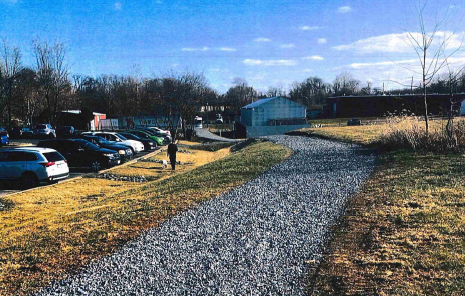
SCH Foundation is a Be Active Mini-Grant Program 2020 Success Story. SCH Foundation restored a deteriorated 2006 walking trail and installed exercise stations located adjacent to the trail. The project is the catalyst to promote on-site activity options for patients and staff at the SCH multi disciplinary facility in Martinsburg, WV. SCH launched a "prescription initiative"-- pre-printed prescriptions for activity and health education sessions distributed by clinicians to their patients. Patients are invited to accompany clinicians for a periodic "Walk with a Provider" sessions and with nurse health educators for health education combined with a demonstration of the importance of physical activity to establish and maintain good health.
Be Active Mini-Grant Program is funded by the West Virginia Bureau of Public Health, Division of Health Promotion and Chronic Disease, the Center for ActiveWV at WVU College of Physical Activity and Sports Sciences and their partners are working to improve state and local programs/systems to increase access to physical activity.
|
|
Community health centers to receive millions in American Rescue Plan funding
Read the entire article from Charleston Gazette Mail here.
Johnson & Johnson takes responsibility for Baltimore vaccine mix-up
Read the entire article from WCHSTV here.
HIV outbreak prompts Kanawha County to request CDC inquiry
Read the entire article from WOWKTV here.
A City wrestled down an addiction crisis. Then came COVID-19
Read the entire article from WVNEWS here.
|
|
|
|
Boosting Patient Engagement:
A Framework for Meaningful Engagement
|
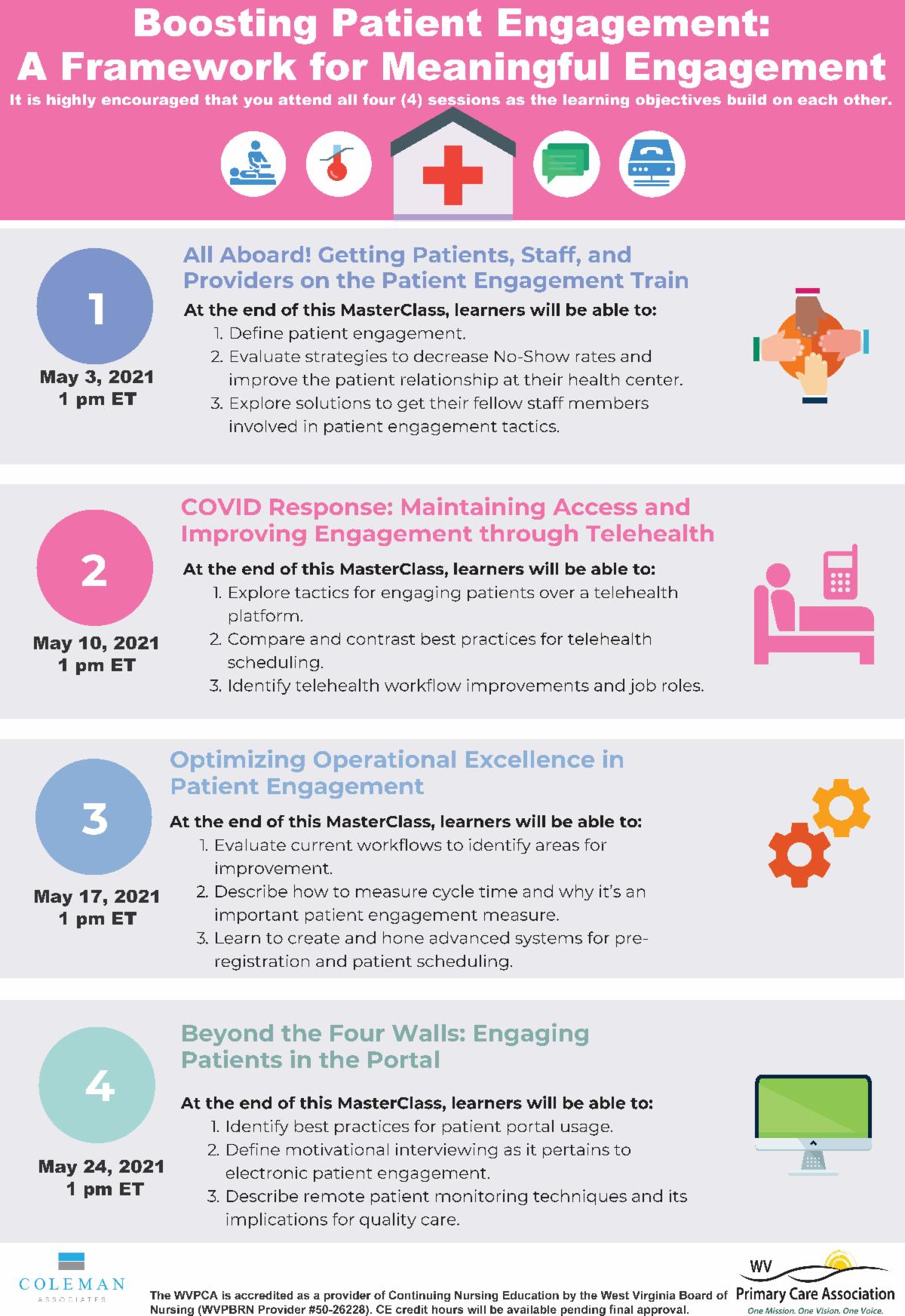
Please join the WVPCA and Coleman Associates, as we are excited to offer our members a four (4) part webinar series that will assist you in learning how to increase patient engagement in your health center. The webinar series will cover topics important to today's healthcare landscape, and focus on ways to improve productivity (i.e., the capacity to see patients), increase patient access, reduce patient waiting time, develop teamwork, improve staff satisfaction, further patient-centered medical homes, prepare for inevitable evolutions in health care reimbursement and optimize the use of technology wisely. |
|
All Health Centers Eligible to Order Vaccine Doses |
U.S. Senator Joe Manchin announced that all Health Resources and Services Administration (HRSA) funded health centers and look-alike health centers in West Virginia have been invited to participate in the COVID-19 Vaccine Program, which allows the 31 health centers in West Virginia to order COVID-19 vaccine doses directly from the federal government, increasing West Virginia’s overall dose allocation. Additionally, West Virginia will receive an increase of 2,340 Pfizer doses, with the state receiving 53,820 first and second Pfizer doses, 38,600 first and second Moderna doses, and 3,300 Johnson & Johnson doses next week.
“We are thrilled that all community health centers are now able to participate in HRSA’s Vaccine Program to receive shipments of COVID-19 vaccine directly,” said Sherri Ferrell, CEO of the West Virginia Primary Care Association. “The direct allocation of vaccine allows health centers to focus their efforts on vaccinating their patients ages 16 and older and ensure they receive other necessary health care services. Community Health Centers serve nearly 480,000 West Virginians, at 400 locations across the state, providing access and outreach to rural and vulnerable populations. Health centers have been a key partner in West Virginia’s COVID-19 vaccine success since December 2020, helping to vaccinate their patients and general public, alike. We applaud HRSA and our representatives’ continued trust and confidence in health centers being an essential part of our state’s COVID-19 response.”
“While the community vaccination clinics have been effective in reaching populations with access to transportation, it is vital that federally qualified health centers have vaccines available for their more vulnerable patients without reliable travel opportunities. In addition, some with access to vaccination sites have heard misinformation about vaccines but may be more willing to vaccinate after consultation with their family medical provider,” said Rick Simon, CEO, Community Care of WV.
“Change, Inc. has been on the front lines with COVID testing and administering vaccines for the community; however, our patient footprint extends beyond our WV state border. This has created difficulty with hand selecting who can have the vaccine and who cannot based on their address. We serve the most vulnerable population throughout the Ohio Valley. We have three main sites and 10 School-Based Health Centers. Having access to direct federal vaccines will allow us to administer vaccines to all we serve,” said Judy Raveaux, CEO, CHANGE, INC.
“With the availability of vaccines through the Federal program, health centers are able to better plan vaccinating vulnerable populations such as those who are homebound, homeless, and that may have other things going on that make it difficult to vaccinate at the county vaccine events that have been going on in recent months. We are grateful that our government representatives and HRSA have confidence in health centers to complete this important work,” said Kristi Atha-Rader, CEO, Rainelle Medical Center.
|
|
More Than 500,000 Americans Have Enrolled in Marketplace Coverage During SEP |
The U.S. Department of Health and Human Services (HHS) Secretary Xavier Becerra announced that more than half a million consumers have already signed up for health insurance through HealthCare.gov as a result of the Biden Administration’s Special Enrollment Period (SEP) for the COVID-19 Public Health Emergency. The SEP, along with the additional financial assistance afforded by the American Rescue Plan (ARP), offers the opportunity for individuals and families to take advantage of significantly reduced premiums, increased savings, and quality, affordable health coverage through the Marketplaces using the Federal Platform.
“Access to quality, affordable health care is essential – especially as we tackle the COVID-19 pandemic and its aftermath,” said HHS Secretary Xavier Becerra. “Since the beginning of this Special Enrollment Period’s availability on HealthCare.gov, more than 500,000 Americans have already signed up for coverage on HealthCare.gov. Now, thanks to the American Rescue Plan, health care coverage is more affordable and millions of Americans are seeing their premiums reduced. At HHS, we are going to build on the Affordable Care Act (ACA) and work tirelessly to ensure Americans have the chance to sign up for quality, affordable health care coverage that meets their needs.”
|
|
WV Teens to Get the ‘tea’ on Challenges, Opportunities Posed by the Pandemic |
Youth voices offer unique perspectives, innovative ideas and valuable insights. As West Virginia continues to move through the pandemic, teens want to know more about issues surrounding the public health crisis – now and in the future. A panel of experts will give young people the “tea” (teen slang for “the scoop”) on a host of topics surrounding the pandemic during a special panel discussion on April 12, 2021, at 4 p.m.
The WVU Extension Service 4-H Youth Development Teen Council, in partnership with West Virginia State University and the West Virginia Joint Interagency Task Force for COVID-19 vaccines, will host “Here’s the Tea: Where do we go from here,” a virtual panel discussion for West Virginia youths and young adults ages 12 to 21. The panel will feature experts who will answer questions from teens on a variety of topics, including the science behind COVID testing, vaccinations, future pandemics, economy implications, education and other issues related to the pandemic. The event will be moderated by members of 4-H’s Teen Council and Collegiate 4-H members from WVU and WVU Tech.
|
|
'We’re Not Out of the Woods Yet': Health Officials Discuss COVID-19 Variants in WV |
The state’s COVID-19 czar warned about the risks of the B.1.1.7 variant of SARS-CoV-2, which originated in the United Kingdom and is spreading in West Virginia.
Dr. Clay Marsh reiterated that the variant spreads more easily, causes more negative health outcomes and is already having a significant impact in other countries, as well as in some U.S. states, such as Michigan.
“What this says to us in West Virginia as the most highly vulnerable population ... is that we’re not out of the woods yet,” Marsh said.
|
|
How Does Reimbursement for
the COVID-19 Vaccine Work?
|
COVID-19 vaccine is provided at 100% no cost to the vaccine recipient. COVID-19 vaccination providers cannot charge vaccine recipients for the vaccine (which is provided free by the U.S. government to enrolled providers) or charge recipients any administration fees, copays, or co-insurance. COVID-19 vaccination providers cannot deny vaccination to anyone who does not have health coverage, is underinsured, or is out of network.
If a vaccine recipient has health coverage, providers may seek appropriate reimbursement from the recipient’s plan or program (e.g., private health insurance, Medicare, Medicaid) for a vaccine administration fee.
However, providers cannot balance bill the recipient. Providers may also seek reimbursement for uninsured vaccine recipients from the Health Resources and Services Administration’s COVID-19 Uninsured Program. COVID-19 vaccination providers cannot charge an office visit or other fee to the recipient if the only service provided is a COVID-19 vaccination. Additional healthcare services can be provided at the same time and billed as appropriate.
However, providers cannot require additional services in order for a person to receive a COVID-19 vaccine.
|
|
Federal COVID-19 Report Shows West Virginia Still Increasing in New Cases, Hospitalizations
|
New cases of COVID-19 and new hospital admissions of patients with the disease are still on the rise in West Virginia, according to a federal report released this week.
The report is compiled by the U.S. Department of Health and Human Services and released weekly. It shows data for a seven-day period, comparing it to the previous week’s data, overall national data and data for West Virginia’s HHS/Federal Emergency Management Agency region (which also includes Delaware, Maryland, Pennsylvania, Virginia and Washington, D.C.).
The state reported 2,982 new COVID cases in the last seven-day period, according to the report. Measuring as a proportion of population, that is 166 new cases per 100,000 residents. That rate is up 18% compared to the prior week’s report. West Virginia’s rate is lower than the region’s (175) but higher than the nation’s (134).
|
|
Mountaineer Health Initiative-Building Child Resilience After COVID-Panel Discussion |
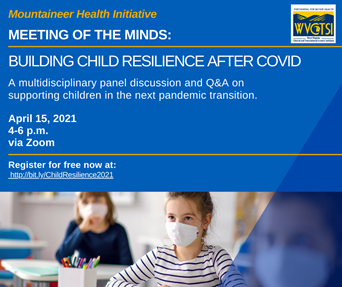
The Mountaineer Health Initiative and WV Clinical and Translational Science Institute will convene a virtual panel focusing on child development, nutrition, mental health, education, and physical activity for the Spring 2021 Meeting of the Minds: Building Child Resilience After COVID. The panel composed of experts and those working on the front of lines with children will be held on Thursday, April 15th from 4-6 p.m.
|
|
HHS Expands the Health Center COVID-19 Vaccine Program |
HHS Secretary Xavier Becerra announced today that all HRSA-funded health centers and Health Center Program look-alikes (LALs) will now be invited to participate in the Health Center COVID-19 Vaccine Program. These health centers will have the opportunity to join the program as soon as they are ready, increasing the total number of health centers that have been invited to 1,470 nationwide.
This expansion of the Health Center COVID-19 Vaccine Program is part of President Biden’s commitment to ensuring that all of the nation’s underserved communities and those disproportionately affected by COVID-19 are equitably vaccinated. To date, 500 participating health centers have ordered more than 2.5 million doses for nearly 1,500 sites across the country.
If your health center had not been invited previously:
We emailed your Project Director yesterday to invite you (subject line: “BPHC Bulletin: Invitation to the Health Center COVID-19 Vaccine Program”). The email includes instructions on how to participate.
The most important first step is to identify two individuals from your health center who will serve as the main points of contact (POCs) for this program and have them complete self-registration for access to the Health Center COVID-19 Vaccine Program Online Community (VPC) as soon as possible.
Submit questions to Health Center Program Support. Select “Health Center COVID-19 Vaccine Program”—the fourth option on the “Health Center Program Questions” screen. Then select “COVID-19 Vaccine Program General Inquiry.” You can also call Health Center Program Support at 877-464-4772, option 2, 8:00 a.m. to 8:00 p.m. ET, Monday-Friday (except federal holidays).
|
|
Talking to People with Medicare about the COVID-19 Vaccine from CMS |
The Centers for Medicare & Medicaid Services (CMS) is taking action to protect the health and safety of our nation’s patients and providers in the wake of the 2019 Coronavirus (COVID-19) outbreak.
CMS has compiled this resource to help inform people with Medicare about the COVID-19 vaccine.
|
|
2021 NHSC Scholarship Program Application Cycle Open |
About the Program:
The NHSC Scholarship Program applicants include health professional students studying to become physicians, dentists, nurse practitioners, nurse midwives or physician assistants with a commitment to practice in underserved communities. In exchange, they commit to serve a minimum of two years in high-need, underserved communities. Scholars receive one year of financial support (up to four years) for each year of service at an NHSC-approved site. Accepting applications through May 11, 2021 at 7:30 PM EST.
|
|
 |
Funding and Financial Opportunities |
|
|
|
Reimbursement for COVID-19 Vaccine Administration Fees |
Health centers, as you engage in efforts to support vaccine distribution, are asked by to HRSA to consider HRSA’s COVID-19 claims reimbursement program for uninsured patients. Through this program, healthcare providers who have conducted COVID-19 testing or provided treatment for uninsured individuals with a primary COVID-19 diagnosis can request claims reimbursement. Providers can also request reimbursement for COVID-19 vaccine administration to the uninsured. See FAQs about the program.
|
|
PPP Application Deadline Moving to May 31 |
Applications for the Paycheck Protection Program (PPP) will now be accepted through May 31, 2021. The extension from the original March 31 deadline was passed by the House and Senate and has moved on to President Biden for signature. Health centers are eligible for First Draw PPP Loans if they have 500 or more employees but fewer than 500 employees per location. Existing PPP borrowers that did not receive loan forgiveness by Dec. 27, 2020, can reapply for a First Draw PPP loan.
If borrowers previously returned some or all of their First Draw PPP loan funds, they may request to modify their First Draw PPP loan amount if they did not accept the full amount for which they were eligible. Second Draw PPP Loans are only available to entities that have received, plan to use, or have used the First Draw PPP loan for authorized uses in its entirety. Entities must have no more than 300 employees per location and can demonstrate at least a 25 percent reduction in gross receipts between comparable quarters in 2019 and 2020.
|
|
Emergency Broadband Benefit Program |
HRSA has an exciting opportunity to help health center patients obtain the internet access they need to connect with virtual health care, jobs, and education. Eligible health center patients may apply for the Federal Communications Commission (FCC) Emergency Broadband Benefit (EBB) program when it opens in late April. This bulletin provides background information, ideas on how you can prepare to help, and resources.
The EBB program lowers the cost of high-speed internet service to ensure people have the connectivity they need during the ongoing COVID-19 public health emergency. By the end of April, $3.2 billion in funding will be available to provide qualifying households discounts on their internet service bills and an opportunity to receive a discount on a computer or tablet. The EBB program is similar to the Lifeline program with expanded eligibility, vendors, and subsidies. This benefit is available directly to eligible consumers on a first come, first served basis. For more information, see the recorded technical assistance webinars and other materials from the FCC-supported technical assistance provider Universal Service Administrative Company.
How You Can Help
- Share information about the EBB program with patients.
-
FCC’s EBB webpage (note that the content is available in several languages)
- Fact sheet
- Provide access to the internet at your health center and basic technical support so that patients can complete the application.
HRSA encourages you to develop your plan now to support patients to apply promptly after the application period is announced; funds are expected to go quickly. Health Center Program strategic partners (Health Center Controlled Networks, National Training and Technical Assistance Partners, and Primary Care Associations) can support health centers in their efforts.
|
|
HRSA Healthy Grants Workshop Registration |
The Health Resources and Services Administration (HRSA) has announced that registration for the 2021 Healthy Grants Workshop – Presented as a Web Series, in now open. Register now for up to eight sessions.
There is no cost to attend and you can attend as many sessions as you would like.
The first session begins in May, followed by a new session every two weeks through August 24. Each session includes two to three topics, from grants policies, financial monitoring, and grant budgeting, to Prior Approvals, an Electronic Handbooks overview, and more.
|
|
|
Upcoming Training Opportunities |
|
|
|
MAI Series: Impact of Racism on Health Inequities |
Join the University of Maryland Regional Partner of the MAAETC.The Third in the MAAETC's Minority AIDS Initianvie (MAI) virutal event series.
The objectives of this event include: discuss the history of health inequities within minority communities, describe how ethnicity/cultural orientation and other social determinants of health (SDOH) increases the likelihood of BIPOC experiencing poorer health outcomes with infectious diseases such as HIV, and identify specific strategies to employ in addressing healthcare disparities in vulnerable patient populations.
Wednesday, April 14, 2021
2:00 PM EST
|
Impact of Racism on
Health Inequities
|
Join the University of Maryland Regional Partner of the MAAETC. The Third in the MAAETC's Minority AIDS Initianvie (MAI) virutal event series.The objectives of this event include: discuss the history of health inequities within minority communities, describe how ethnicity/cultural orientation and other social determinants of health (SDOH) increases the likelihood of BIPOC experiencing poorer health outcomes with infectious diseases such as HIV, and identify specific strategies to employ in addressing healthcare disparities in vulnerable patient populations.
Wednesday, April 14, 2021
2:00 PM EST
|
Hot Topics HIV 2021 Prevention and Reproductive Choices for Women- Virtual |
Join the West Virginia Regional Partner of the MAAETC. This virtual conference will focus solely on HIV and Women. According to CDC 2016 data more than 7,000 women received an HIV diagnosis in 2016. Black/African American women are disproportionately affected by HIV, compared with women of other races/ethnicities. Conference attendees will gain knowledge of issues related to women with HIV and women without HIV as well as issues related to pregnancy options and referrals.
Thursday, April 14, 2021
10:15 PM EST
|
Taming the Treponeme: Syphilis Screening,
Diagnostic Considerations, Treatment, and
Partner Management
|
Join the Maryland Department of Health’s Center for STI Prevention for a free, CME, lunch-time Syphilis Webinar Series this April, provided in collaboration with our clinical training partners, the STD/HIV Prevention Training Center at Johns Hopkin. Presenters are faculty in the departments of Medicine, Gynecology & Obstetrics, and Pediatrics at the Johns Hopkins
University School of Medicine.
Intended audience: clinicians and other staff in internal medicine, family practice, Ob/Gyn, perinatology, pediatrics and adolescent medicine, emergency medicine, infectious diseases, dermatology, public health, substance
use treatment and more.
Continuing Medical Education Credits available.
Wednesday, April 14, 2021
12:00 PM EST
|
|
The Health Information Technology, Evaluation, and Quality (HITEQ) Center Highlights: Measuring Telehealth Success: You Can't Achieve it if You Can't Measure It
|
In this presentation, Christian Milaster of Ingenium Digital Health Advisors will lead attendees through a series of pragmatic concepts on how to set an organization’s telehealth success targets, what and how to measure telehealth performance, the Physician Bill of Telehealth Rights and how to leverage telehealth to achieve strategic success.
Thursday, April 15, 2021
1:00 PM EST
|
The Intersection of Public Health and Motivational Interviewing during COVID-19 |
This webinar aims to introduce healthcare practitioners to the usefulness of motivational interviewing (MI) in fostering collaborative conversations promoting public health behaviors, such as mask wearing and vaccine uptake, and navigating uncertainty in the midst of the COVID-19 pandemic. MI has been defined as person-centered method of guiding to elicit and strengthen personal motivation for change. It is designed to help people change a desired behavior by leveraging their own values and beliefs. MI is an egalitarian, empathetic "way of being". It is a collaborative communication style that uses specific strategies such as reflective listening, shared decision-making, and eliciting change talk. This interactive webinar will discuss how practicing MI can help practitioners cope better with the “new normal,” support patients in practicing public health behaviors, and address the challenges of the impact of the pandemic.
Thursday, April 15, 2021
2:00 PM EST
|
Join Jim to hear the latest information on funding, the Health Center COVID-19 Vaccine Program, and more.
Thursday, April 15, 2021
2:00 PM EST
|
Syphilis Complications, Unusual Presentations,
and Clinical Grey Areas
|
Join the Maryland Department of Health’s Center for STI Prevention for a free, CME, lunch-time Syphilis Webinar Series this April, provided in collaboration with our clinical training partners, the STD/HIV Prevention Training Center at Johns Hopkin. Presenters are faculty in the departments of Medicine, Gynecology & Obstetrics, and Pediatrics at the Johns Hopkins
University School of Medicine.
Intended audience: clinicians and other staff in internal medicine, family practice, Ob/Gyn, perinatology, pediatrics and adolescent medicine, emergency medicine, infectious diseases, dermatology, public health, substance
use treatment and more.
Continuing Medical Education Credits available.
Thursday, April 20, 2021
12:00 PM EST
|
|
|
Frontline healthcare workers are burnt out from responding to the coronavirus pandemic, a nationwide “Washington Post”-Kaiser Family Foundation poll found. Nearly two-thirds of respondents said worry or stress related to COVID-19 negatively affected their mental health. More than half of respondents described feeling burned out going to work.
The vaccination rate of staff working at long-term care facilities continues to lag countrywide. The Pew Charitable Trusts’ journalism wing “Stateline” reported on some of the barriers to vaccinating these staff. The vaccination rate of long-term care staff nationally is about 50%.
“Time” magazine published an in-depth look at people experiencing homelessness during the pandemic. A reporter and photographer spent time in Wheeling, WV, in Ohio County exploring various encampments and speaking with people experiencing homelessness and those who serve them.
If you come across something worth sharing, please feel free to forward to Joshua Austin, WVPCA Policy and Communications Director at joshua.austin@wvpca.org.
|
|
|
Community Health Center Resources |
|
|
|
Jackson Kelly attorneys provide limited consultation to all members of the WVPCA at no charge, as part of the WVPCA contract. There is no limit to the number of calls which any member may make. All inquiries within the scope of professional competence of firm attorneys will be addressed. Inquiries which require expertise not available through the firm will be promptly identified and, when requested, Jackson Kelly will assist in referring the matter to accounting firms, insurance agents, or others as circumstances warrant.
All inquiries, responses and consultation services provided by the firm lawyers will be provided without additional charge beyond the retainer amount, except for matters which require formal opinions, representation of record in litigation, transactional work, e.g. the purchase or sale of real property, or matters which require continued representation, research or consultation beyond a single inquiry or document review.
Justin M. Harrison is a labor & employment lawyer with Jackson Kelly PLLC. He is available for consultation through a special retainer relationship with the WVPCA. Justin can be reached at 304.340.1358 and via email at justin.harrison@jacksonkelly.com.
|
|
Pandemic Operational Recovery Guide |
Operational disruptions to ambulatory care during and after a pandemic are significant. These disruptions may change many aspects of care delivery in ways that impact providers, staff, and patients alike.
Care may be temporarily limited or delivered in nontraditional ways, and recovery of operations may represent a "new normal."
The handbook contains links to tools as well as links to additional resources for a more comprehensive discussion of individual topics. Readers can refer to descriptive "Strategy" headings in each section, and consult the recommendations, tools, and resources that follow for more detailed information. Although some tools and resources focus on the COVID-19 pandemic, they can be adapted to respond to other public health emergencies.
|
|
Risk Management Manual for Health Centers Now Available! |
The Risk Management Manual for Health Centers is now available on the ECRI Institute Clinical Risk Management Program website! Designed to support a proactive approach to risk management at health centers and free clinics, the Manual provides background, tips, and how-tos in a manageable format.
Specific areas that are covered include:
Risk Management Programs & Plans
Claims and Lawsuits
Role of the Risk Manager
Patient Grievances and Complaints
Communication with Patients
Credentialing and Privileging
Communication among Providers, Staff, and Community Partners
Tracking Systems for Diagnostic Tests, Referrals, and Hospitalizations
|
|
|
Debra Boyd | Chief Financial/Chief Operations Officer
|
|
|
|
To sign up to receive the WVPCA Weekly Newsletter: |
|
1700 MacCorkle Avenue, SE
Charleston, WV 25314
Phone: 304.346.0032
Toll Free: 1.877.WVA HLTH
|
|
|
This project is/was supported partially/fully by the Health Resources and Services Administration (HRSA) of the U.S. Department of Health and Human Services (HHS) under grant number U58CS06834 State and Regional Primary Care Associations. This information or content and conclusions are those of the author and should not be construed as the official position or policy of, nor should any endorsements be inferred by HRSA, HHS or the U.S. Government. |
|
|
|
|
|
|