Water Under the Bridge
Needham is Circled by the River
|
|
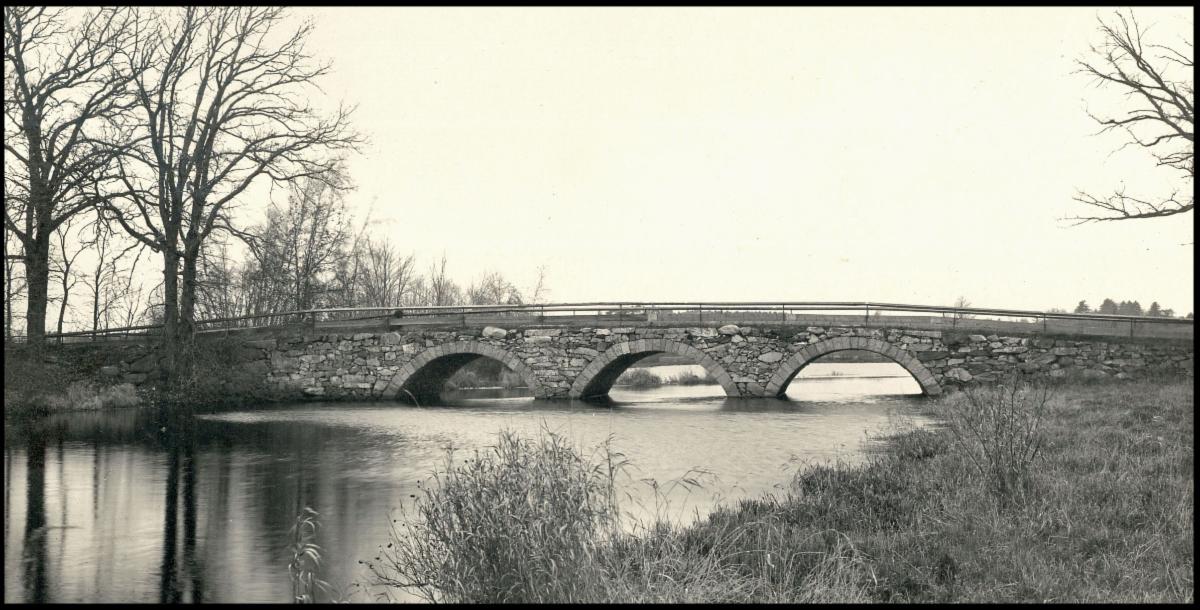
Fisher’s Bridge (Central Avenue to Dover) is the oldest bridge still standing in Needham, and its most beautiful. It was built in 1847 has remained basically unchanged since.
|
|
Dear Readers,
After this week I will be going on a summer schedule. This column will appear every other week through July and August, then back to weekly in September. Enjoy the summer!
|
|
|
|
Water Under the Bridge
The recent renovation of Cook’s Bridge, and the current reconstruction of the Highland Avenue Bridge – and the resulting traffic headaches – has us thinking about the importance of our local bridges.
If it seems to you that the Charles River is everywhere you go in Needham, you’d be right. Needham is in a loop, and nearly every exit from town requires you to cross a bridge. In fact, unless you are going to Wellesley via Great Plain Avenue, it is relatively difficult to leave Needham without crossing water. And it was worse when we still owned Wellesley.
There are now nine bridges out of Needham (there were once eleven, when Wellesley was still the West Parish). Two are named after the roads that run over them; the rest are named for the families that once owned the land (and who were often responsible for the upkeep of the bridge). The dates below record when the bridge was first built, though nearly all were preceded by a footbridge or other smaller structure, and later rebuilt in the 19th century.
Cook’s Bridge – Central Ave to Upper Falls (first built 1720). Cook’s Bridge is the oldest of Needham’s bridges, and was first built in 1720 on land belonging to Captain Robert Cook. Cook was one of Needham’s early residents, and a signer of the Petition that separated Needham from Dedham in 1711. The original bridge was a timber foot bridge, but was strengthened in the late 1700s with stone footings. The bridge was rebuilt in stone in 1857, and widened in 1897 by adding a cantilevered sidewalk on the north side. Cook’s Bridge is the last bridge built by the noted stonemason, Nathan Crafts of Newton. Crafts was, sadly, killed in an accident on the bridge during its construction. The bridge stands (more than 150 years later!) as a monument to his work. It is also a relic of the time prior to the Civil War when stonework was the province of skilled masons, and not civil engineers. Crafts built several other bridges in the area, though no others in Needham.
Kendrick’s Bridge – Kendrick Street to Newton (1716). This was built on the land of Capt. Caleb Kendrick of Newton, providing access to a small boat landing (still familiar to anyone who rents canoes). The original wooden bridge, rebuilt several times, was washed away entirely in the flood of February 1886, and again (still wood) in 1902. The wooden bridge was finally replaced by a concrete bridge in 1925; the current structure was built in 1959.
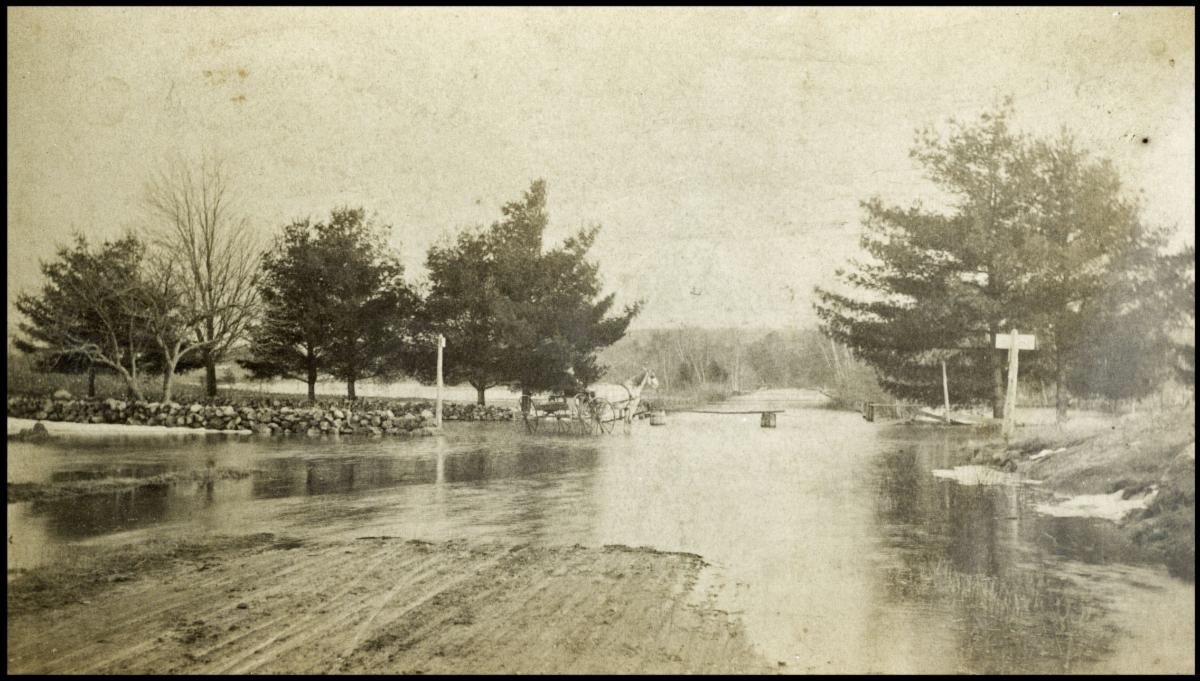
The floods of February 11, 1886 resulted from a two-day rainfall of nearly 8 inches that fell on (and thawed) an already deep snowpack. Flooding was widespread in New England, and the Charles River rose to its highest-ever recorded flood level. Needham lost several bridges during this event.
Lyon’s Bridge – Greendale Avenue to Dedham (1740). This was originally known as New Bridge, because it was the new bridge between Needham and Dedham, replacing the ancient Causeway route (Great Plain Avenue). It later became known as Lyon’s Bridge because it lay near Elisha Lyon’s property. The current bridge is a single-arch stone structure built in 1877 by engineer John Harris and contractor William Ward. Though it has been overshadowed by the highway running alongside, the bridge is still the route between Greendale and Dedham Avenues, via Lyon Street. It is just visible from the highway as you pass.
Day’s Bridge – Chestnut St. to Dover (1750). This wooden bridge was built on John Day’s property, where the road (now Chestnut Street) crossed into Dover. It was apparently not well built, and needed significant repairs and was even rebuilt several times in the 1800s before it was washed away entirely in 1886. The bridge was rebuilt in concrete in 1922, and the current reinforced concrete bridge was built in 1977.
|
|
The intersection of South Street and Dedham Avenue on 16 February 1886, five days after the storm. The Dedham Avenue bridge is still washed out, and the street has been blocked off. |
|
Fisher’s Bridge – Central Ave. to Dover (before 1763). Fisher’s Bridge is the oldest standing and the most beautiful of Needham’s bridges. It was built on the land of Deacon John Fisher, and included “wharfage” to land cargo (the current canoe launch?). The old wooden bridge was replaced by the current three-arch stone bridge in 1847 by Haselton and Fuller. It originally formed a pair, with nearby Newell’s Bridge (see below). It has not been significantly altered since 1847.
Newell’s Bridge –South Street to Dover (before 1763). The river beside this bridge had been used for manufacturing since the 18th century, and the bridge’s many names – Mill Bridge, Bleachery Bridge, Cochrane’s Bridge – reflect its industrial past. Both “Mill Bridge” and “Newell’s Bridge” refer to the iron rolling and slitting mill operated by Josiah Newell at this site in the 1790s. The wooden bridge was replaced by a three-arch stone bridge, also built by Haselton and Fuller in 1847. Newell’s Bridge was built in the same year and to the same pattern as the adjacent Fisher’s Bridge, and until the 1930s, the two were nearly identical. Though this is not entirely clear, it seems that the current single-arch span was created by filling the two side arches and widening the center when the bridge was rebuilt in 1930. Newell’s Bridge was repaired and widened a few years ago; to do so, the engineers removed and recorded the stone facings, widened the bridge, and then replaced the stones – retaining its historic appearance.
Pierce’s Bridge – Charles River St. to Dover / S. Natick (1855). Prior to 1855, Charles River Street ended short of the Charles River. That year, the road was extended and a wooden bridge, known as Peirce’s Bridge for the local landowner, was built to connect Charles River Street to the Dover Road. Like several others, it was damaged in 1886 and rebuilt. The current structure, cast concrete with a steel structure, was built in 1927.
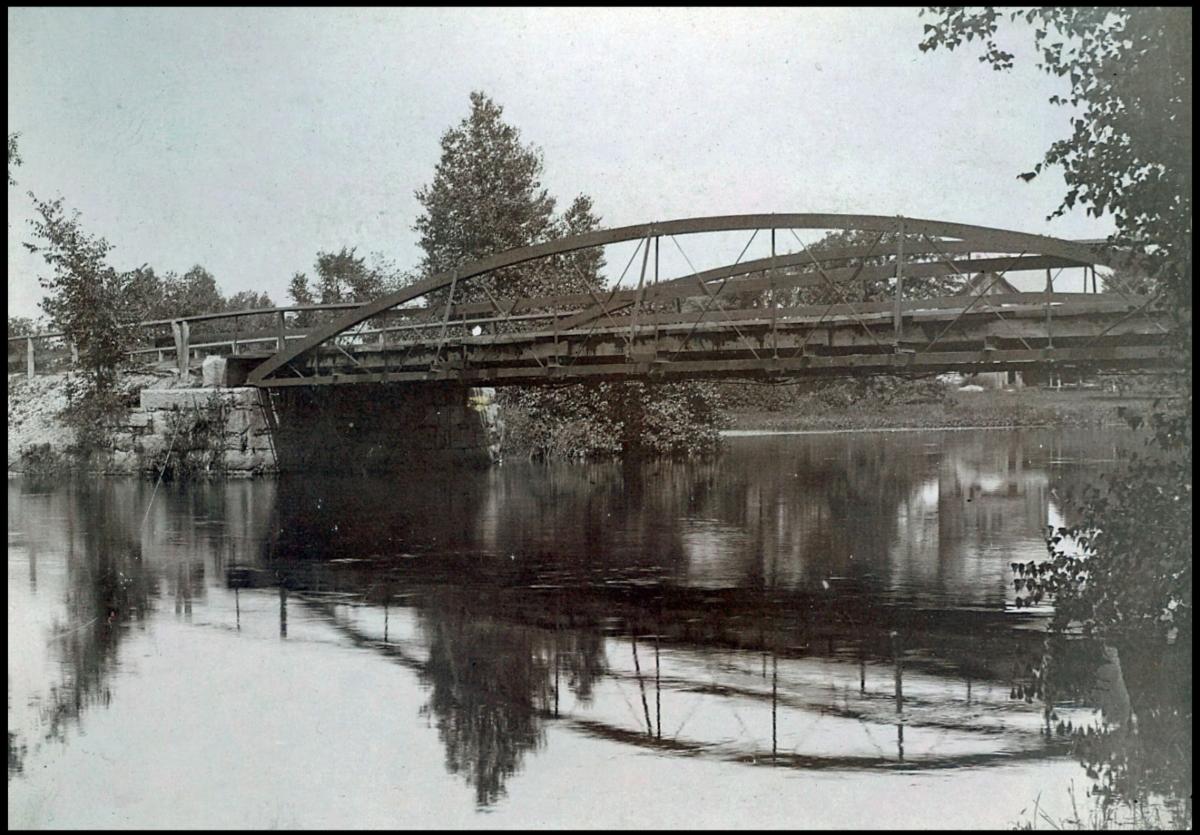
Dedham Avenue Bridge – Dedham Avenue to Dedham (1873). Originally known as Iron Bridge, because unlike its wood or stone fellows, it was framed in iron with wooden decking. This bridge, like Kendrick’s Bridge, was severely damaged in the 1886 floods. The iron bridge was replaced in 1910 by the current two-arch concrete bridge.
Highland Avenue Bridge – to Newton (1875). This three-arch bridge was built by John Harris and William Ward, who also built Lyon’s Bridge. Until then, Highland Avenue ended at the Webster Street intersection, so the project included the extension of Highland Avenue to the bridge and the Newton line. The bridge has remained sound and essentially unchanged over the years. The current Needham Street Corridor project, however, has made it necessary to widen the old bridge. The plan is to widen and strengthen the structure, and replace the old facings (as was done with Newell’s and Cook’s Bridges) so that the new bridge will meet current needs while retaining its historic character.
Gloria Polizzotti Greis is the Executive Director of the Needham History Center & Museum. For information, see our website at www.needhamhistory.org.
|
|
The Iron Bridge, now the Dedham Avenue Bridge. This was originally framed in iron, rather than wood, but that did not save it from the flood of 1886. |
|
We are Open - Summer Hours
The Needham History Center is again open to the public. Appointments not necessary – come see us! We’ve missed you, and will be so happy to see you here again. We are on a Spring/Summer schedule for now:
- Mondays, 10 am to 4 pm
- Tuesdays Closed.
- Wednesdays and Thursdays, 12 to 4pm
- Fridays by appointment
To make an appointment, to ask a question, or for any other information, please contact Gloria at 781-455-8860 or greis@needhamhistory.org.
|
|
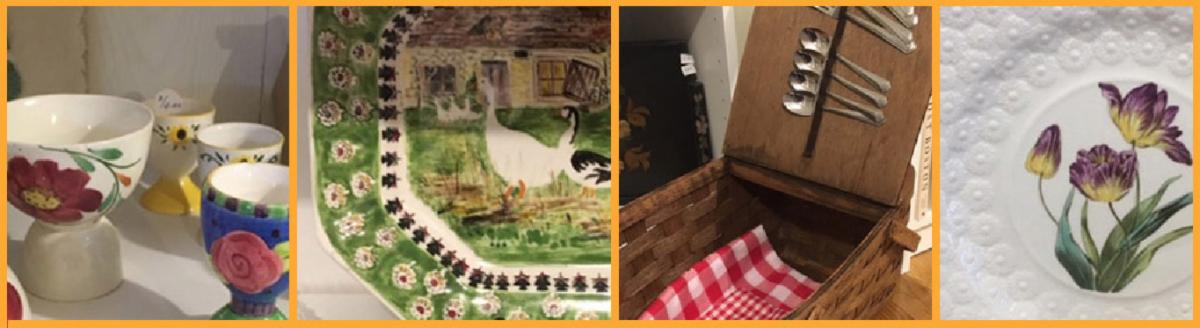
Find your new treasure in the Heirloom Shoppe!
Household goods, decorative items, and all kinds of vintage treasures - with new and wonderful items arriving every week! We just got a large donation of decorative and table ware, so there is a lot of new goodies to check out. For details and hours, visit our new Heirloom Shoppe page.
|
|
Stay up-to-date - follow us on Instagram and Facebook!
|
|
Calendar and Events
Join us (via Zoom) - Registration is free and open to all.
We have completed our program schedule for the season, but please view recordings of previous programs.
Missed any?
Previous programs, when recorded, are posted on the
|
|
Community Events
Other events of interest from around the town.
Blue Lotus Healing Arts will be holding yoga classes outside on our lawn this summer. Contact Astrid for more information ( yoga@bluelotushealingarts.com)
The Needham Farmer's Market is reopening for the summer. The market will be held on Garrity Way in front of Town Hall on Sundays from 12-4 pm, from June 13th until October 31st. . Information at https://needhamfarmersmarket.org/contact/.
The Needham Community Theatre is presenting “A Midsummer’s Night Dream” on Saturday July 18th & Sunday July 19th at 6:30pm. It will be held outside at the Hyde Playground stage at 90 Lincoln Street in Newton Highlands. www.NeedhamTheatre.org
|
|
We thank our Corporate Sponsors
for their generous and ongoing support!
.
Lead Sponsor - The Needham Bank
Exhibits Sponsor - BID-Needham
The Dedham Inst. for Savings . The Middlesex Bank
Louise Condon Realty . Petrini Corporation . The Vita Needle Company
The Needham Women's Club . JC Timmerman, Inc.
|
|
The Needham History Center & Museum
781-455-8860 / www.needhamhistory.org
|
|
|
|
|
|
|