Weekly update from the National Housing Conference | | News from Washington | By Brittany Webb | | |
CFPB proposal would reverse 50 years of fair housing protections
The Consumer Financial Protection Bureau (CFPB) proposed a new rule that would overhaul Regulation B of the Equal Credit Opportunity Act, weakening existing fair housing protections and making substantial changes to long term policies that enable homeownership for protected classes. The proposed rule makes three major changes: eliminating the disparate impact provision, narrowing the scope of what is considered “discouragement” standards of potential borrowers, and stopping lenders from establishing Special Purpose Credit Programs (SPCPs). Advocates quickly denounced the proposal, noting that each of the changes limits credit opportunities for women and underserved communities, particularly for rural residents and communities of color in the South. Disparate impact, which holds businesses liable for practices that result in discriminatory outcomes regardless of intent, has previously been criticized by the Trump administration through executive action. SPCPs are widely supported across the housing industry and have reportedly provided $82 million in reduced costs to 57,282 borrowers of all races from 2022 to 2024.
“These actions ignore mounds of evidence revealing ongoing lending bias, are an assault on decades of settled fair lending law and would promote discrimination in our credit markets. They are a continuation of this administration’s attack on protections against redlining. For these reasons and more, this rule must never be promulgated,” said Lisa Rice, President and CEO of the National Fair Housing Alliance (NFHA). Rice emphasized the impact on lenders as well as consumers. “The proposed rule changes are a death knell for lenders. Disparate impact is a business-growth engine and any company that wants to remain viable and competitive will continue to use this critical tool. Disparate impact helps businesses grow and expand their products and services by revealing and removing unnecessary barriers that arbitrarily limit customer reach, suppress innovation, and constrain business opportunities,” Rice said.
The proposal notes that the CFPB offered to consult with appropriate agencies regarding consistency with prudential, market, or systemic objectives administered by such agencies, but stops short of confirming such consultation occurred. Comments are due by December 15.
| | | |
Time is Running Out to Attend THE Housing Event of the Year
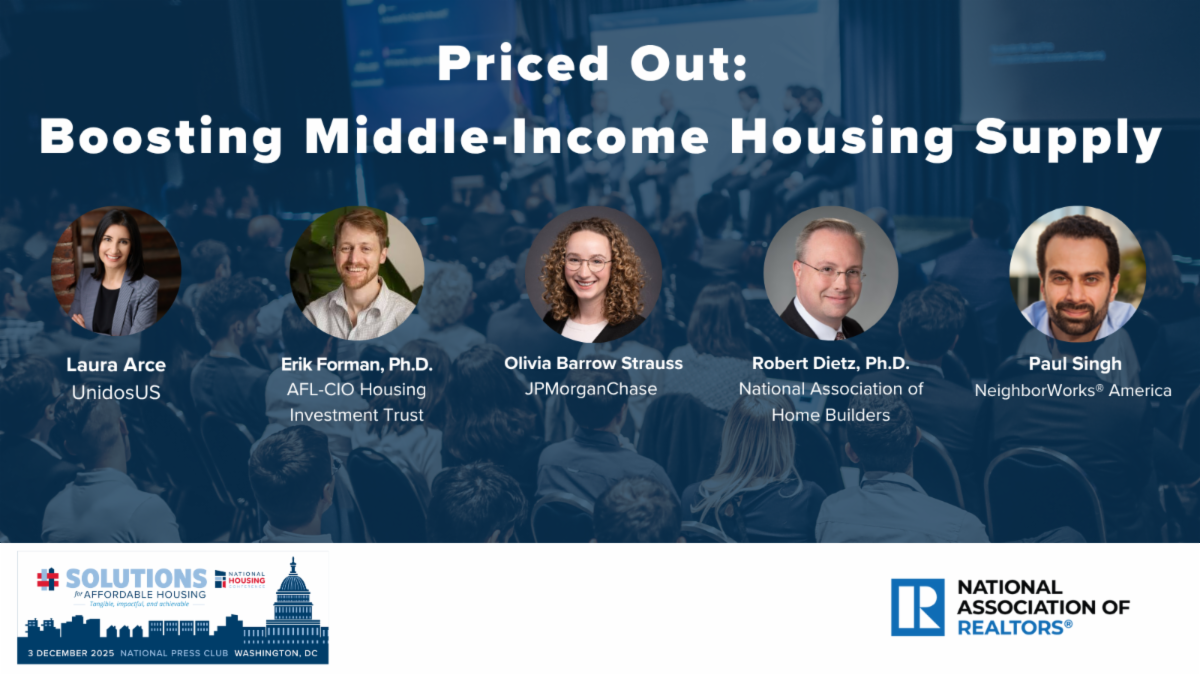
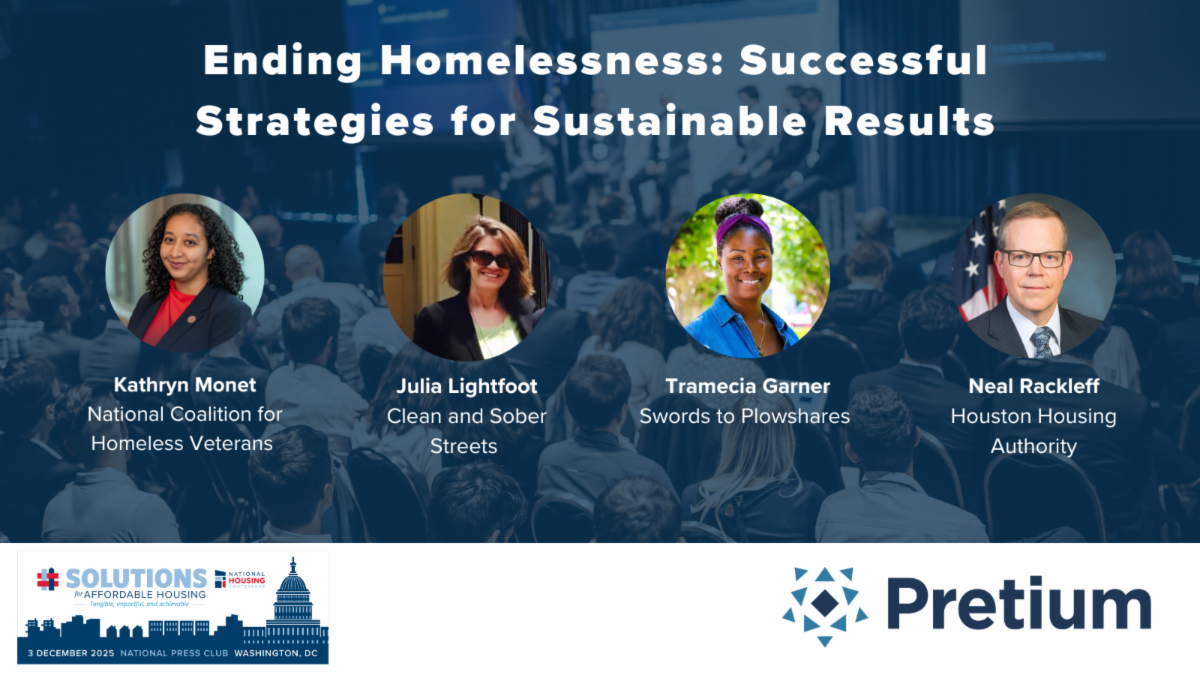
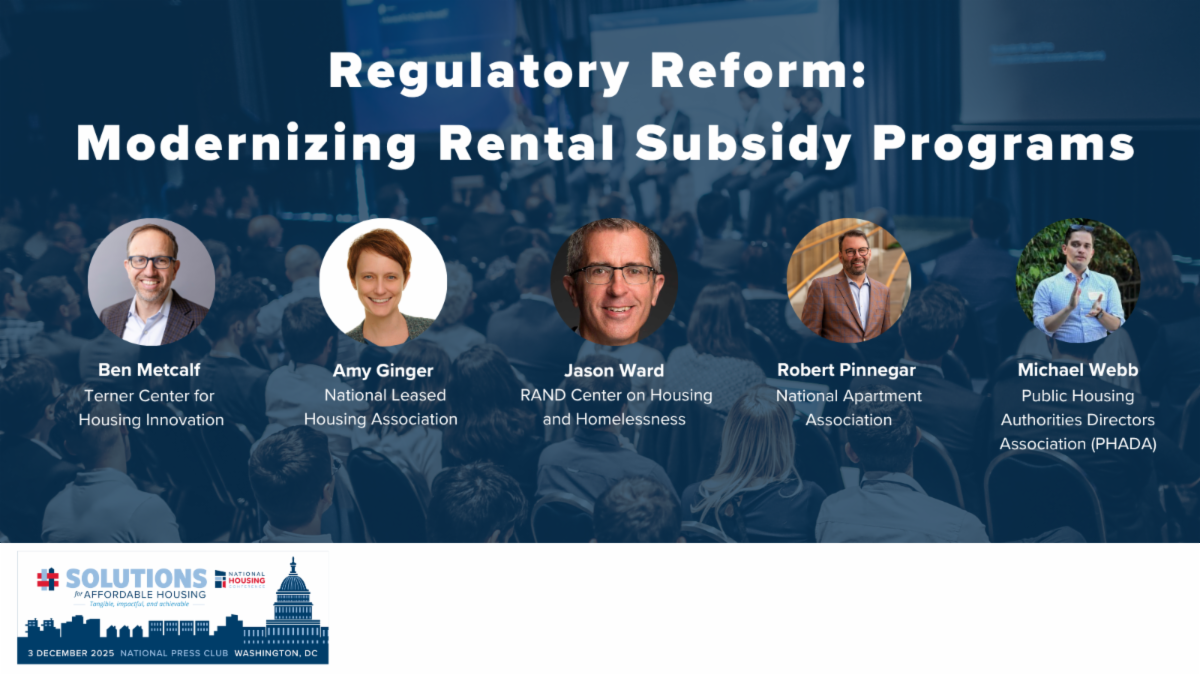
This year's sessions will focus on key housing challenges, including affordability, supply, access, and policy reforms that shape the future of rental, ownership, and subsidy programs. Experts will also explore innovative solutions such as new housing models, rural and middle-income strategies, homelessness prevention, and resilience in the property insurance market.
Sponsorships Still Available
Elevate your organization's profile and actively participate in the conversations that are shaping the future of housing by sponsoring NHC’s Solutions for Affordable Housing convening. We offer sponsorship levels tailored to fit every organization’s needs, starting at $1,000. Click here to learn more.
| | |
In-Person Tickets
$200*
(Non member rate $250)
*Use Code: Member2025
| |  | |
Virtual Tickets
$150*
(Non member rate $175)
*Use Code: MemberVirtual2025
| | |
Record government shutdown ends
On Wednesday evening, the government officially reopened after being shutdown for a record 43 days. Eight Democratic Senators voted with the Republican majority to send a short-term Continuing Resolution (CR) to the House of Representatives. Six Democrats joined with the Republican majority in the House to push the bill over the finish line with a vote of 222 to 209, reopening the government through January 30, 2026. The bill funds three agencies through September 2026: Military Construction-VA, Agriculture, and the Legislative Branch. The nine remaining funding bills will need to be negotiated before the end of January. The CR further restores employment for all federal employees that received Reduction in Force (RIF) notices during the shutdown, prohibiting any new RIFs through January. Affordable Care Act subsidies, which became the core issue of the shutdown, were not extended. Rather, a vote on the issue will be scheduled in the Senate in mid-December. Key economic data released from the Bureau of Labor Statistics are also in question after the White House press secretary claimed that they are “permanently impaired”, provoking some questions of when inflation and employment data for the lapsed shutdown reporting will be available.
Critical housing programs, including vouchers, public housing, and the National Flood Insurance Program, will resume normal operations despite concerns of another potential shutdown in January.
| |
CFPB funding again called into question
The Trump administration declared the Consumer Financial Protection Bureau’s (CFPB) funding structure unlawful in its latest attempt to shutter the consumer watchdog. In a court filing opinion, the administration asserts that the CFPB cannot continue its current funding mechanism of drawing money from the Federal Reserve (the Fed). The Justice Department’s Office of Legal Counsel argues that the agency cannot draw additional funds because the CFPB is only entitled to draw from “combined earnings” of the Fed, which the Justice Department now says refers only to bank surpluses. The Federal Reserve has reportedly had negative earnings since 2022, according to the same filing. It further claims that the CFPB has sufficient operating funds through the end of this year, but “anticipates exhausting its currently available funds in early 2026.” The move is the latest in a series of attempts by the Trump Administration, and more directly, White House Budget Director and Acting CFPB Director Russell Vought, who has not requested any funding this year for the CFPB and has been exceptionally public about his desire to eliminate the agency.
“We don’t have anyone working there except our Republican appointees and a few career that are doing statutory responsibilities while we close down the agency,” he stated last month on a podcast. “We want to put it out — and we will be successful probably within the next two, three months.” The CFPB cannot be eliminated entirely without Congressional action.
“This absurd maneuver by Russ Vought is plainly illegal, and federal judges have already rejected his fringe theory. If the courts continue to uphold the law, Vought will fail again.…Donald Trump will do anything to try to kill an agency that has returned more than $21 billion to scammed Americans, but he will not do anything to lower costs for American families,” stated Senator Elizabeth Warren (D-Mass.) in a press release.
The development introduces significant uncertainty for the Bureau’s oversight of mortgage lending, servicing practices, and other consumer-finance functions that intersect with housing affordability. A prolonged funding interruption could slow enforcement actions and limit federal supervision at a time of heightened financial strain for households. Consumer advocates and several lawmakers have criticized the administration’s interpretation, while others have suggested Congress may need to reevaluate the CFPB’s structure and consider alternative funding mechanisms.
| | | |
Bipartisan opposition to Trump administration mortgage proposals
Director of the Federal Housing Finance Agency (FHFA) Bill Pulte announced via social media that FHFA is considering new mortgage products to reduce the cost of home purchases. The proposals included creation of a 50-year mortgage that was defended by President Trump but broadly opposed by a wide range of experts across the political spectrum. Pulte also promoted conventional, conforming assumable loans that would allow a buyer to take over an existing mortgage, and portable loans that would allow a buyer to move their existing mortgage from property to property.
The proposal for a 50-year mortgage was met with strong opposition on FOX News, The Wall Street Journal, and Bloomberg news service. President Trump dismissed the concerns as “not a big deal.” While the longer loan term decreases the monthly cost of the mortgage, it comes at the expense of significantly reduced equity earned by the homeowner and higher interest paid. “The benefits of the longer term are far outweighed by the harm that it causes,” said NHC President and CEO David Dworkin. “A 50-year mortgage dramatically depreciates the biggest value of homeownership — wealth building. Over time, the loss of equity quickly overcomes any savings on payment,” Dworkin said.
Housing industry groups expressed previous interest in assumable mortgages, but portable loans draw less optimism. Assumable loans are currently available under the Federal Housing Administration (FHA) and the U.S. Department of Veterans Affairs (VA) homeownership programs. They are rarely utilized, however, because the blended rate on the current and second mortgage don’t provide enough benefit to justify the getting two mortgages instead of one. Few people can afford to buy a new home with only the assumable mortgage.
Portable mortgages have never been attempted as the mortgage is directly tied to a property’s location and value, the foundation of mortgage lending. “So how do you lift and modify a note to another property? I don’t believe there’s an actual vehicle or mechanism that would be within the director’s power or ability to even make a mortgage fully portable,” said the CEO of Absolute Home Mortgage Corp Matthew VanFossen. “We have a mechanism for that now. It’s called paying off your current mortgage and applying for a new mortgage.”
| |
HUD moves to slash permanent-housing funding in homelessness grants
The U.S. Department of Housing and Urban Development (HUD) issued its largely anticipated Continuum of Care (CoC) Notice of Funding Opportunity (NOFO) that constitutes a significant change in fund allocation, shifting homelessness services focus away from permanent supportive housing toward transitional housing with work or service conditions. The $3.9 billion NOFO reportedly risks displacing 170,000 individuals at risk of falling back into homelessness due to the changes. HUD’s stance is that the policy “restores accountability” while cracking down on “DEI, gender ideology extremism, and the misuse and abuse of taxpayer dollars on illegal aliens.” Internal documents show that while about 87% of current funding supports permanent housing, this share would drop to around 30%. At the same time, more than one-third of existing projects are set to expire between January and June 2026, raising the possibility that people could lose access to support just as the winter season begins.
“Our philosophy for addressing the homelessness crisis will now define success not by dollars spent or housing units filled, but by how many people achieve long-term self-sufficiency and recovery,” said HUD Secretary Scott Turner. “We are stopping the Biden-era slush fund that fueled the homelessness crisis, shut out faith-based providers simply because of their values, and incentivized never-ending government dependency. These long-overdue reforms will promote independence and ensure we are supporting means-tested approaches to carry out the President’s mandate, connect Americans with the help they need, and make our cities and towns beautiful and safe.”
Letters from both political parties have been sent to Secretary Turner regarding the changes, urging him to implement any changes carefully to avoid destabilizing programs that serve individuals with disabilities, chronic health conditions, and substance abuse disorders.
“It’s terrible policy and really irresponsible administration of the program,” said Ann Oliva, CEO of the National Alliance to End Homelessness. “Putting out a grant opportunity with a tight turnaround and massive changes, knowing that you can’t get awards out until at least mid-year just is deeply irresponsible. They are setting communities up for failure.”
| | | |
Post pandemic migration reverses population losses in rural America
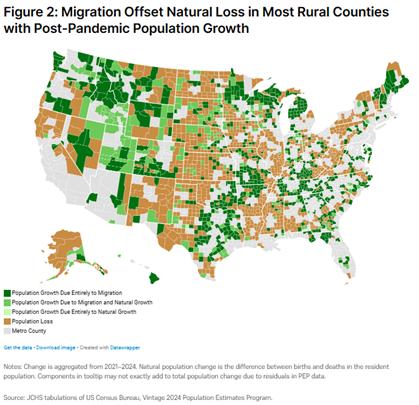
New research from the Harvard Joint Center for Housing Studies reveals that migration completely offset natural population loss in many areas that experienced post-pandemic population growth from 2021-2024. This was true for three quarters of non-metropolitan counties with population growth after the pandemic, illustrating a reversal from the pre-pandemic period when rural areas had a net aggregate loss of 60,000 people (2017-2020). Rural counties have faced natural population decline due to their older median age of the population, which in turn drives higher mortality rates and lower birth rates. However, the sharp increase in domestic migration from a net outflow of 100,000 people pre-pandemic to a net inflow of 670,000 post-pandemic has changed that norm, alongside international migration, effectively making migration a critical lifeline for rural population stability.
| | |
U.S. Mortgage Insurers (USMI) published a policy brief arguing that the FHA’s 35-year-old requirement to maintain a 2% capital ratio is inadequate when compared to modern risk-based capital standards developed after the 2008 financial crisis. According to analysis by actuarial firm Milliman, FHA would have to face a capital shortfall of approximately $32 billion under the Private Mortgage Insurer Eligibility Requirements and would need $50 billion more to meet the Enterprise Regulatory Capital Framework standards that apply to Fannie Mae and Freddie Mac. The brief recommends that Congress replace the outdated 2% requirement with updated stress-based, loan-level risk-weighted standards to ensure FHA can fulfill its critical countercyclical role in the housing market during economic downturns.
NPR reports that climate change driven extreme weather is making home insurance increasingly unaffordable and unavailable across the U.S., forcing families to make difficult financial decisions as insurers raise prices or withdraw from high-risk areas. Investment firm DeltaTerra Capital estimates that approximately one in five American communities will need to see home values decline by around 30% in coming years to accommodate rising insurance costs, which could trigger mortgage defaults when homeowners owe more than their properties are worth. The crisis extends beyond traditional disaster zones, with community leaders nation-wide sounding alarms about this growing problem that experts expect will worsen as climate change intensifies hurricanes, floods, wildfires, and even hailstorms in regions previously considered safe.
WBUR’s On Point with Meghna Chakrabarti featured National Housing Conference President and CEO David Dworkin in a discussion about employer-assisted down payment programs that help workers afford homes in increasingly expensive markets across America. Dworkin explained how these programs, pioneered by Fannie Mae in 1991, often pay for themselves by reducing employee turnover and can work for employers of any size. The episode explores examples from San Mateo County to Baltimore to Jackson Hole, demonstrating how municipalities and employers are innovating to attract and retain essential workers. Rising housing costs have pushed the average first-time homebuyer age to 40, making these programs increasingly critical for teachers, nurses, firefighters, and other professionals who can no longer afford to live in the communities they serve.
| | |
Monday, November 17
2025 CRE Private Credit Finance Summit, 9 AM – 5 PM ET
OPTECH 2025 | NMHC, November 17-19
AHF Live, November 17-19
Tuesday, November 18
NCST Homeownership Policy Symposium, 8:30 AM – 5 PM ET
Wednesday, November 19
Senate Banking, Housing and Urban Affairs Committee Executive Session - Pending Nominees, 10:30 AM ET
Making Missing Markets: Connecting Communities and Capital, 1:30 – 5:40 PM ET
Enterprise 2025 New York Gala, 6 – 10 PM
Virginia Governor's Housing Conference, November 19-21
MBA's Accounting and Financial Management Conference, November 19-21
Thursday, November 20
No events posted.
Friday, November 21
No events posted.
| | The National Housing Conference is a diverse continuum of affordable housing stakeholders that convene and collaborate through dialogue, advocacy, research, and education, to develop equitable solutions that serve our common interest. | | Defending Our American Home since 1931 | | Copyright © 2024. All Rights Reserved. | | | | |