Weekly update from the National Housing Conference | | News from Washington | By Brittany Webb | | |
DHS funding spurs short government shutdown
The federal government entered into a partial shutdown as of Saturday morning, though it could only be in effect for a short period of time as the House returns to consider the legislation as soon as Monday. The Senate passed a spending bill on Friday to fund most remaining agencies for FY2026, including Transportation, Housing and Urban Development (THUD) that would provide $77.3 billion for the U.S. Department of Housing and Urban Development (HUD). Other agencies funded include Defense; Labor, Health and Human Services; Education; State; and Financial services and general government.
The deal, if passed by the House, will fully fund the government through September, with the exception of funding for the Department of Homeland Security (DHS) which oversees Immigration and Customs Enforcement (ICE) and U.S. Customs and Border Protection. ICE funding has drawn increased attention following controversial developments in Minneapolis, with Democrats seeking to respond to expansive concerns over ICE conduct. Under the agreement, DHS will receive two weeks of funding as Congress continues to negotiate reforms for ICE.
Members of the House of Representatives are due to return on Monday with an anticipated quick uptake of the spending package. Some Members on both sides of the aisle have expressed opposition to or concerns with the new package, but President Trump has endorsed it in order to avoid another lengthy government shutdown.
| | | |
Take advantage of early bird pricing
On April 8, 2026, the National Housing Conference will convene housing communications leaders from across the country for Solutions for Housing Communications, hosted at the National Press Club in Washington, D.C.
Panel discussions will spotlight strategies for clearly communicating complex and technical housing issues, working effectively with housing reporters, and understanding how technology and AI are reshaping public discourse. Sessions will also highlight the power of intergenerational storytelling, best practices for communicating before, during, and after natural disasters, and practical tools to help participants engage confidently across media platforms.
Whether you’re shaping narratives, influencing policy, or engaging the media, this convening offers practical insights and valuable connections to strengthen housing advocacy through effective communications.
Members of the media receive complimentary registration.
Please contact kbeigay@nhc.org for more information.
| | |
New chair nominated as Fed holds rate steady
President Trump has nominated Kevin Warsh to serve as the next Chairman of the Federal Reserve. Warsh is a former Fed governor who worked under George W. Bush and has argued for more rate cuts, as well as the belief that tariffs do not cause inflation. Current Chairman Jerome Powell’s term expires in May.
Meanwhile, the Federal Reserve Board of Governors’ Federal Open Markets Committee (FOMC) voted to hold the current target federal funds rate steady at 3.5-3.75%. It was previously lowered in December by a quarter point and remains at its lowest since November 2022. Two governors, Stephen Miran and Christopher Waller, voted against the action, seeking another quarter point cut.
"Available indicators suggest that economic activity has been expanding at a solid pace. Consumer spending has been resilient, and business fixed investment has continued to expand. In contrast, activity in the housing sector has remained weak,” said Chairman Powell during a press conference.
The decision comes amidst continued political turmoil over the Fed’s independence. Chairman Powell did not respond to questions about his remaining term or the Department of Justice investigation, though he did explicitly blame tariffs for overruns in the cost of goods. He further noted that data showed indications of lessening tensions between employment and inflation.
| | | |
HUD demands recheck of immigration status of PHA residents
The U.S. Department of Housing and Urban Development (HUD), in coordination with the Department of Homeland Security (DHS), has directed all Public Housing Authorities (PHAs) verify the immigration status of every household in federally funded housing. The directive gives PHAs 30 days to review a new report available in the Enterprise Income Verification (EIV) system, called the EIV-Systematic Alien Verification for Entitlements (SAVE) Tenant Match report, to verify eligibility and take corrective actions. PHAs already collect documentation of residents’ citizenship status of more than 2.2 million people nationwide.
A letter previously sent to PHAs included additional guidance and an introduction of the EIV-SAVE report. It also threatened sanctions against those PHAs who failed to comply within 30 days. HUD stated in its press release, titled “Cleaning House: HUD Orders Immediate Citizenship Verification for All Tenants in HUD-Funded Housing Nationwide,” that it found 200,000 tenants that require a new eligibility verification, as well as 25,000 deceased tenants and 6,000 ineligible noncitizen tenants. The audit was not made public.
| | | |
Over 80% of mortgages come from IMBs
Independent mortgage banks (IMBs) continued to dominate the mortgage market, according to a new report from the Community Home Lenders of America (CHLA). The report finds that IMBs accounted for roughly three-quarters of all mortgage originations in 2024 and over 84% of home purchase loans, reflecting a long-term shift away from depository institutions. CHLA attributes this trend to IMBs’ specialization in mortgage lending and their ability to adapt more quickly to changing interest rates and market conditions.
The report highlights the central role IMBs play in supporting housing affordability, noting that independent lenders originated more than 89% of FHA loans, 94% of VA loans, 75% of Fannie Mae and Freddie Mac loans, and 94% of the market share of Ginnie Mae issuance – all programs that disproportionately serve first-time and lower-income borrowers. CHLA argues that as IMBs carry a growing share of government-backed lending, maintaining stable liquidity and regulatory frameworks for such programs will remain critical to preserving access to affordable homeownership amid elevated rates and ongoing supply constraints.
| |  | |
GAO advises HUD to improve CoC data quality rationale
A new report from the Government Accountability Office (GAO) finds that data quality and transparency issues may affect the reliability of federal estimates used to track homelessness through Continuums of Care (CoC). Each year, the Department of Housing and Urban Development (HUD) publishes national estimates based on data submitted by roughly 400 local CoCs, which coordinate homelessness services and collect information from shelters. GAO notes that these estimates are central to evaluating the effectiveness of federal homelessness programs and directing billions of dollars in shelter and prevention funding.
GAO found that HUD’s process for determining whether CoC data are usable lacks clear, documented criteria, relying in part on professional judgment that GAO was unable to replicate. The report also found that when CoC data are excluded, HUD does not consistently communicate the rationale to local providers, limiting their ability to improve data quality. GAO issued three recommendations, including calling on HUD to increase transparency in its data quality determinations, reevaluate its statistical estimation methods, and better communicate usability decisions to CoCs. HUD concurred with all recommendations.
| | | |
Multifamily housing stock influenced by OZ markets
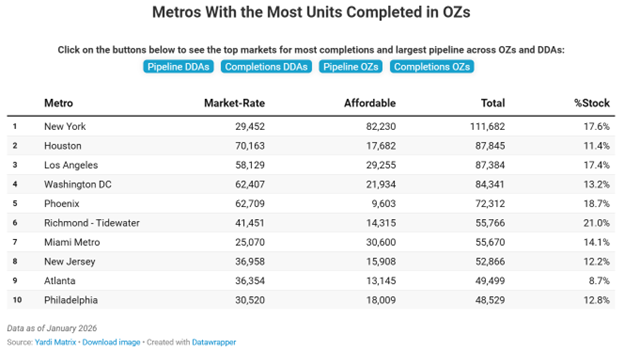
New analysis from Yardi Matrix highlights where recent federal incentives for development in Opportunity Zones (OZs) are most visible in the multifamily stock. According to their January 2026 Affordable Housing Market Report, a total of 5.1 million units in OZs are market rate and 1.3 million are affordable rental. New York leads all metros with about 111,700 units completed in OZs, including more than 82,000 affordable units, representing 17.6% of its apartment stock. Houston and Los Angeles follow, each with more than 87,000 OZ units and double-digit shares of total rental inventory. New York and Miami are the only two of the top ten areas where affordable completions make up a larger share of OZ units compared to market rate, however, recent policy changes for OZs may be reflected in upcoming pipelines.
| | |
Opportunity Insights’ new study, “Creating High-Opportunity Neighborhoods: Evidence from the HOPE VI Program,” revisits whether place-based investments can transform deeply distressed public housing developments into ladders of upward mobility for residents. Analyzing $17 billion in HOPE VI revitalization across 262 sites, the authors find that while neighborhood poverty rates fell as higher-income households moved in, adult public housing residents saw no measurable earnings gains even as their children experienced higher incomes, greater college attendance, and reduced incarceration later in life. The study suggests that physically reconnecting isolated public housing to surrounding communities can be a cost-effective way to create high-opportunity neighborhoods.
An article in USA Today highlights recent comments from President Trump doubling down on his recent comments on homeowner wealth. "I don't want to drive housing prices down. I want to drive housing prices up for people that own their homes… And they can be assured that's what's going to happen,” Trump said during a Cabinet meeting. The President claimed that home prices can come down by lowering interest rates without impacting accumulated wealth of current homeowners. "Existing housing, people that own their homes, we're going to keep them wealthy," Trump said. "We're going to keep those prices up. We're not going to destroy the value of their homes so that somebody who didn't work very hard can buy a home.
In a guest essay for The New York Times, Senators Tim Sheehy (R-Mont.) and Sheldon Whitehouse (D-R.I.) warn that intensifying floods, wildfires, and other extreme weather events pose a systemic threat to the housing, insurance, and mortgage sectors that could rival the 2008 financial crisis if left unaddressed. They highlight how rising seas, stronger storms, and year-round wildfire seasons are driving insurers to raise premiums, cut coverage, or exit high-risk markets altogether. The piece calls for a proactive, federally led resilience strategy, including a new U.S. Wildland Fire Service to standardize and speed wildfire response and stronger building codes that reward mitigation among other recommendations.
A recent feature from Military.com profiles Army veteran and DePaul graduate student Chad King, who is harnessing artificial intelligence to help fellow veterans cut through the red tape that often stands between them and stable housing. Drawing on his own experience with homelessness, King developed “Chief Bud,” a conversational AI tool that guides users through a brief “eligibility snapshot” and then translates their answers into a clear, tailored roadmap of VA housing, benefits, and supportive services they may qualify for. By pairing culturally specific design with rigorous testing in partnership with DePaul’s Homeless Advocacy, Research and Collaboration Lab, the tool aims to bridge the gap between complex program rules and veterans’ real-world needs to help more Veterans access assistance.
| | The National Housing Conference is a diverse continuum of affordable housing stakeholders that convene and collaborate through dialogue, advocacy, research, and education, to develop equitable solutions that serve our common interest. | | Defending Our American Home since 1931 | | Copyright © 2024. All Rights Reserved. | | | | |