#19


Missed a Digest?

Read #17 here

Read #18 here

Updates

Managing difficult situations in the classroom

The classroom should be a safe place for all. It is important to start any conversation with a student in a professional and service-focused manner. To make it easier to handle unexpected situations in class, you can follow the steps from the list below.


Inappropriate talk / topic


  • Thank the student for sharing


  • Acknowledge the contribution with stating an opinion


  • Ask the student to stop talking in an offensive or aggressive way


  • Bring their focus back to the target language and move on


  • Mute the student's microphone if it continues


Inappropriate messages


  • Ask the student to stop using the chat in a way that is offensive to others


  • Take a screenshot of any offensive message


  • Disable the chat for the student by clicking on the three dots next to the message


For both Group and Private Lessons, a student's microphone and/or camera can be turned off when there is a distracting background noise or the student has not changed behaving inappropriately after being asked to do so. Before disabling student media, there should be both written and verbal explanations to avoid any misunderstandings.

Managing sensitive topics in the classroom

On any given day, there are events happening around the world that may trigger a reaction for you or your students. Therefore, it is best to keep the focus on the lesson material.


If you feel uncomfortable with a student who does not follow your guidance or persists with topics or behavior that is inappropriate for class, please submit a case.

Shared accounts

EF Teach Online's policy is that there is one learner per account.


There are times when multiple students try to use the same login for lessons. This could happen across several lessons in which students alternate taking classes, or two students use the same login at the same time in one class.


If you find that more than one student shows up for a lesson, please take the following steps once confirming with the learner that account is indeed shared:


  • Explain to the learner that the account should only be used by one learner. Reinforce your request by writing it in the Chat Pod.


  • Gently ask the non-account owner(s) to leave the class. In a PL, you can turn off your camera and mute your microphone until it is only the registered student in the classroom. Do not leave the class to ensure you are paid for the full lesson.


  • In a GL, turn off the student’s microphone and camera, if applicable, and apologize to other students before continuing the lesson.


  • Ask them to communicate via the Chat Pod when they are ready to proceed.


  • Complete the ACR as usual if the account owner returns with adequate time to provide an assessment for the lesson. If the student fails to return to the lesson or there was not enough time to assess the learner, provide a grade of 60 for a GL, 0 for a PL40, or Unable to Assess for a PL20.


  • Submit a Shared Account case via Contact Us.

Academic Webinar Reminder

In case you missed it, you're invited to join us for an Academic Webinar on 22 May 2025, 11h00 where we will discuss strategies to improve your teaching!


Please click here to view the full mailer and share what you would like to discuss in the Academic Webinar.

Recruitment - Mandisa Mondlane

Academic Corner

Introduction to CEFR and EF Stages

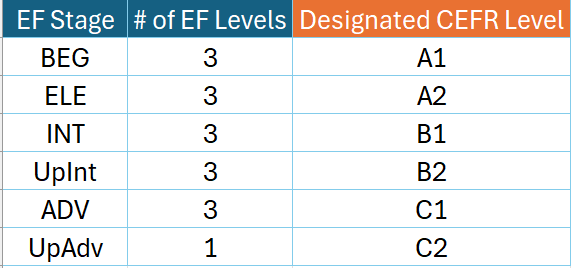
EF students are grouped into 6 different stages that loosely correspond to levels in the Common European Framework of Reference for languages (CEFR). 


Why is the CEFR important for you as an instructor? 


  • As the CEFR levels roughly correspond to EF stages, you will find references to the CEFR throughout your EF experience.  


  • In certain scenarios, it can help you to choose and prepare lesson content for your students. 


  • Overall, familiarity with the CEFR will increase your confidence in dealing with students at any stage of their English learning journey. 


In future academic corner articles, we’ll explore the main characteristics and general expectations of each EF Stage-CEFR Level. In the meantime, any extra support that can be provided, please feel comfortable to create an academic case.

About the Digest
The Weekly Digest is from the EF Teach Online to provide important, center-specific updates, platform updates, and best practice articles related to teaching on the platform or using the scheduling systems.
Facebook  Instagram  Linkedin  Youtube