February 6, 2026

Week four of the 2026 Legislative Session focused on two of the Legislature’s self-imposed “cutoff” deadlines, revenue proposals, and continued work on to elevate the needs of public education to lawmakers.


It's "Cutoff" Time

The first half focused on policy committees as their deadline to pass bills from their committees (house of origin policy committee cutoff) was Wednesday. WSSDA Bill Watch has been updated as a number of bills that we were tracking did not progress out of their initial policy committee. The second half focused on budget committees as their deadline to pass bills from their committees (house of origin fiscal committee cutoff) is coming up on Monday, February 9. As of now, we have not seen many education bills be scheduled in those committees, and the Senate has canceled its Saturday Ways & Means Committee session.


This could suggest that many bills may not move forward, especially in the context of continuing budget challenges our legislators are navigating. We will have to wait and see what gets added to Monday's list. During this time, it will be vitally important to connect with your legislators to remind them of your priorities and share feedback as to how their decisions stand to impact students and schools.


Let's Talk About Revenue Proposals

Earlier this week, Democrats introduced a proposal they call the "millionaires tax", which aims to levy an income tax on individuals earning more than $1 million annually. This tax assumes to generate approximately $3.5 billion in annual revenue. Governor Ferguson is supportive of the concept, but does not support its current version as he wants to see more direct benefit to lower-income Washingtonians. If the bill passes, as many expect, it would not generate revenue until April 2029, meaning it would do little to address the immediate budget shortfall. Read more details from The Seattle Times here.


State Superintendent of Public Instruction, Chris Reykdal, held a press conference on Thursday calling for $1.6 billion of the proposed revenue from the above tax to be dedicated toward education, alongside $1.4 billion in property tax reductions. To learn more, you can watch the press release or read their one-page summary.


What to Expect Next?

Week five is set to bring us one day of budget committee hearings on Monday, followed by a seven day sprint of floor activity leading into week six. During that time, legislators will be "on the floor" as a full respective House and Senate bodies debating bills to advance through the final stage of their respective processes. We'll continue to update our bill watch and list of 2026 bills that include unfunded mandates as things progress.


Short sessions move fast. Here are the deadlines to watch:

  • February 4 - Policy Committee Cutoff
  • February 9 - Fiscal Committee Cutoff
  • February 17 - House of Origin Cutoff
  • February 25 - Opposite House Policy Committee Cutoff
  • March 2 - Opposite House Fiscal Committee Cutoff
  • March 6 - Opposite House Cutoff
  • March 12 - Sine Die


We’re here to help you navigate the process and answer questions along the way. Don’t hesitate to reach out to strategicadvocacy@wssda.org for guidance, questions, or feedback. 


HB 2257, concerning taxes administered by the department of revenue, passed this week through the House Finance Committee with a very important amendment. Thanks to the leadership of Chair April Berg, the substitute bill now contains a full exemption for K-12 schools, school districts, and educational service districts for any new service taxes created by last year's ESSB 5814 (2025).


We are beyond appreciative that Chair Berg and the Legislature took the time to revisit the unintended consequences of ESSB 5814 (2025) and its impact on public schools.


The bill now sits in the House Rules Committee, and will need to be passed through their and debated on the Floor by February 17 in order to remain in action. Watch for an action alert from us during the next week to encourage your action to help keep the bill moving.


by Tricia Lubach, WSSDA Executive Director

Last week, I joined twelve Washington state school board members – including all four WSSDA officers – for several days in snowy Washington DC. to learn about the current federal education landscape and practice our advocacy skills. Then we put our learning into practice on Tuesday and Wednesday as we met with ten of our state representatives (or their staff) and both WA senators, Sen. Murray and Sen. Cantwell. We also visited with three agencies with significant roles in K-12 education – U.S. Department of Education (ED), U.S. Dept. of Agriculture (USDA), and the Federal Communications Commission (FCC). In each case, we shared with them how federal policy and funding – and the services each agency is tasked with – impact our schools in Washington state. 


Our timing was prescient, as H.R 7148 was passed on Tuesday, providing appropriations to several federal departments and agencies for Fiscal Year 2026, including the Dept of Education. In general, 2026 funding for education is flat, which while not ideal, is considerably better than the initial proposed budget. Several education programs proposed to be slashed were not, and Education Week notes that lawmakers “approved a fiscal 2026 budget that maintains level funding for virtually every existing K-12 program.”


We covered a variety of topics with lawmakers and agency staff, including the importance of IDEA, Title 1 and 2, Impact Aid, school nutrition programs, E-Rate, student mental health and wellness supports, CTE, workforce development programs, investing in educators, and the potential impacts of the federal tax credits for private schools. Most of all, we continued to build relationships with our policymakers in “the other Washington.”

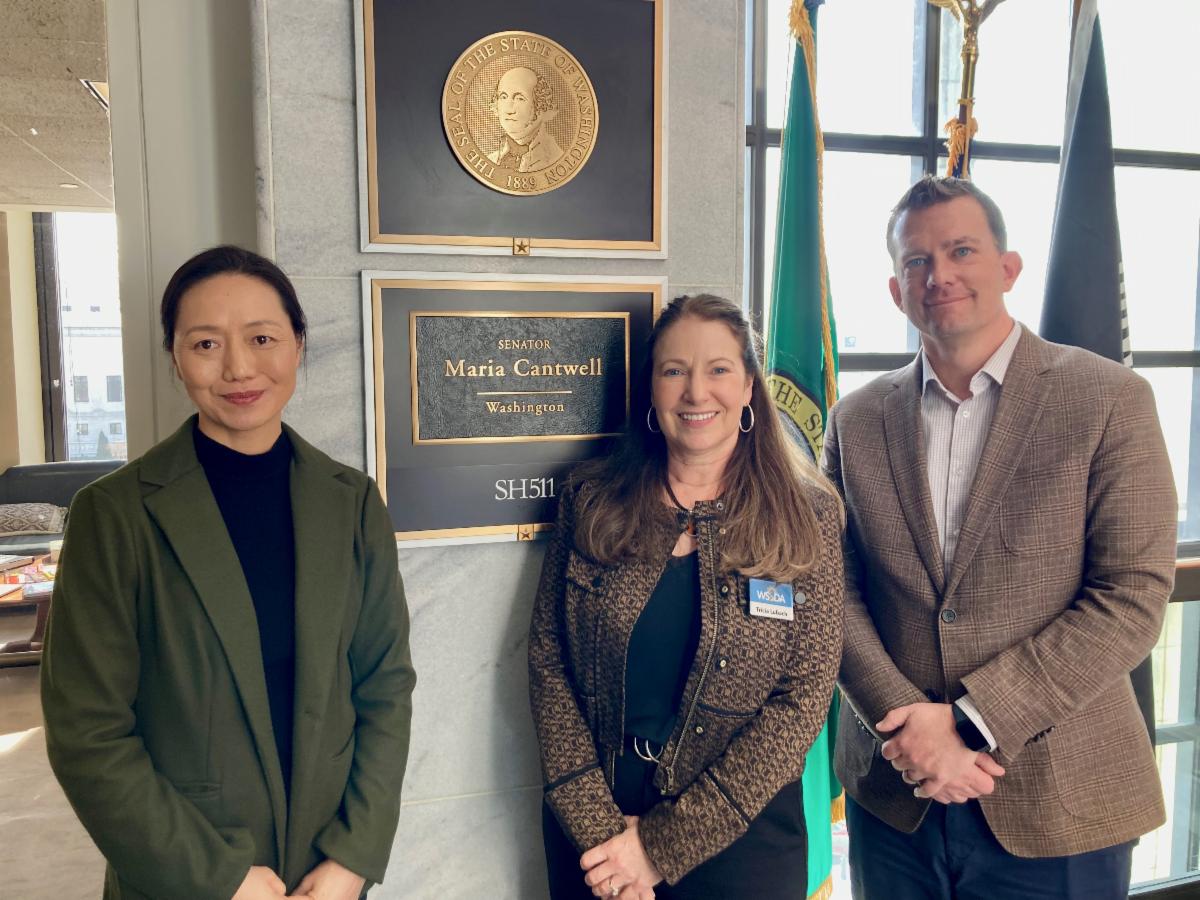
Above: Jane Aras (WSSDA Federal Relations Vice Chair & Bellevue School District Director), Tricia Lubach (WSSDA Executive Director), and Derek Sarley (WSSDA Immediate Past President & Walla Walla School District Director) pose for a photo before meeting with United States Senator Maria Cantwell.


WSSDA staff carefully considers each education bill and identifies one or more member-adopted positions to determine a position before weighing in. Additionally, the Legislative Committee, each member representing their Director Area (DA), meets every week to sift through some of the most challenging issues and brings forward perspectives that can be shared during testimony or in written comments. Below are the options available to "weigh in."


Sign In

  • State WSSDA's position for the record as Pro, Con, or Other.
  • WSSDA has a legislative and/or permanent position that aligns with or connects to the bill, but it is not a priority this session.


Testify

  • This bill is likely one of WSSDA's priorities or of deep concern.
  • If we are con or other, we inform the bill sponsor in advance.
  • State our position during a live hearing, which is also recorded for the record.


Written Comments

  • We may submit our position on a bill via email and/or through the online system for the record.


No Position

  • WSSDA will not weigh in on a bill if there is no clearly related member-adopted legislative or permanent position.
 

Guided by WSSDA's member-adopted positions, we weighed in on the following bills this week:


Senate Early Learning & K-12 Education | February 4, 2026

  • SB 5849 - Making financial education a graduation requirement in Washington state. (Testified CON, Sandy Hayes, Northshore School District Director & Past WSSDA President)


House Appropriations | February 5, 2026

  • HB 2116 - Concerning school enrichment funding. (Signed in OTHER)
 

Want a tutorial or refresher on how to best prepare for testimony? If yes, we invite you to join WSSDA's next Advocacy Action Network meeting re-scheduled for February 12, 2026 from 12:00-1:00pm. Any currently seated school directors are welcome to join. You can get on the meeting RSVP list by sending an email to strategicadvocacy@wssda.org.


WSSDA, the Washington State Legislature, and TVW offer several tools and resources to help you navigate the legislative session: 

Ways to Stay "In the Know"


Ways to Participate


Logan Noel-Endres

Director of Strategic Advocacy

360-742-4435

l.noelendres@wssda.org

Cynthia Tamayo

Legislative Policy Specialist

360-522-0903

c.tamayo@wssda.org

Strategic Advocacy Consultants

Kyla Shkerich Blair

Capitol Path Consulting


Daniel Pailthorp

Capitol Path Consulting


WSSDA Communications and Data Experts

Sean Duke

Communications Officer

s.duke@wssda.org


Daniel Lunghofer

Accountant & Data Analyst

d.lunghofer@wssda.org

Instagram  Facebook  LinkedIn  YouTube