RBGWA - Logo - Full Color.png
 

RBG Wealth Weekly

March 3, 2023


Ladies and gentlemen, the weekend! In this space each week, Greg and I share some of our favorite articles, notes, and graphics from the past week along with our commentary. Please feel free to provide feedback and forward along to others if you enjoy. We appreciate you taking the time to read. 


If you are a client, we truly appreciate your business. If you are not a client, please click below to learn more about our firm and contact us.

Visit our Website
 

Articles of the Week

February 2023 Market Summary


“Stocks took a breather in February after a strong start to the year. The NASDAQ dipped 1%, the S&P 500 fell 2.4%, and the Dow Jones Industrial Average sank 3.9% following the conclusion of [4th quarter] 2022 earnings season. February was the second straight month in which the NASDAQ outperformed other major US indices, signaling renewed strength in growth stocks. The small-cap Russell 2000 index fell 1.7%, also outperforming the large-cap S&P 500 and blue-chip Dow Jones indices for the second month in a row…


US Unemployment fell to its lowest level in over 50 years and labor force participation increased month-over-month. Inflation came in about flat at 6.41% while the Consumer Price Index and Personal Spending logged their highest monthly advances in several months. The US ISM Manufacturing PMI also bucked eight straight monthly declines in February. Lastly, the housing market continued its cooldown, as [monthly] US Existing Home Sales fell for the 12th-straight month and the US median existing home price dipped another 2%.


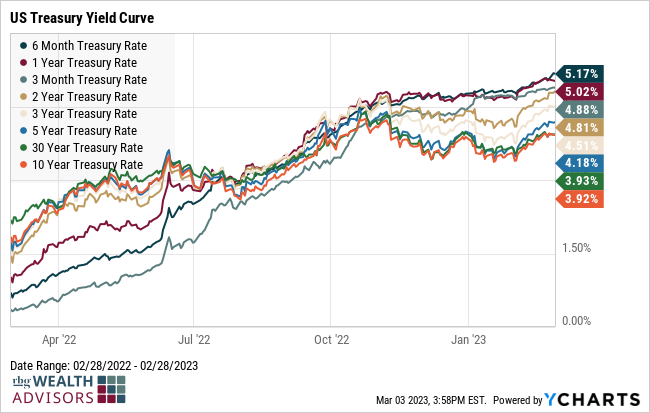
US Treasury yields eclipsed 5% for the first time since July 2007. Rates on the 6-Month and 1-Year Treasury Bills at the end of February were 5.17% and 5.02%, respectively. The 10-Year Rate was the lowest on the yield curve for the second straight month, but its 3.92% yield as of February’s end represents an 11.4% month-over-month increase.”

Warren Buffett’s Annual Letter to Berkshire Hathaway Inc. Shareholders


“One advantage of our publicly-traded segment is that – episodically – it becomes easy to buy pieces of wonderful businesses at wonderful prices. It’s crucial to understand that stocks often trade at truly foolish prices, both high and low. “Efficient” markets exist only in textbooks. In truth, marketable stocks and bonds are baffling, their behavior usually understandable only in retrospect.


Controlled businesses are a different breed. They sometimes command ridiculously higher prices than justified but are almost never available at bargain valuations. Unless under duress, the owner of a controlled business gives no thought to selling at a panic-type valuation…


I have been investing for 80 years – more than one-third of our country’s lifetime. Despite our citizens’ penchant – almost enthusiasm – for self-criticism and self-doubt, I have yet to see a time when it made sense to make a long-term bet against America. And I doubt very much that any reader of this letter will have a different experience in the future.”


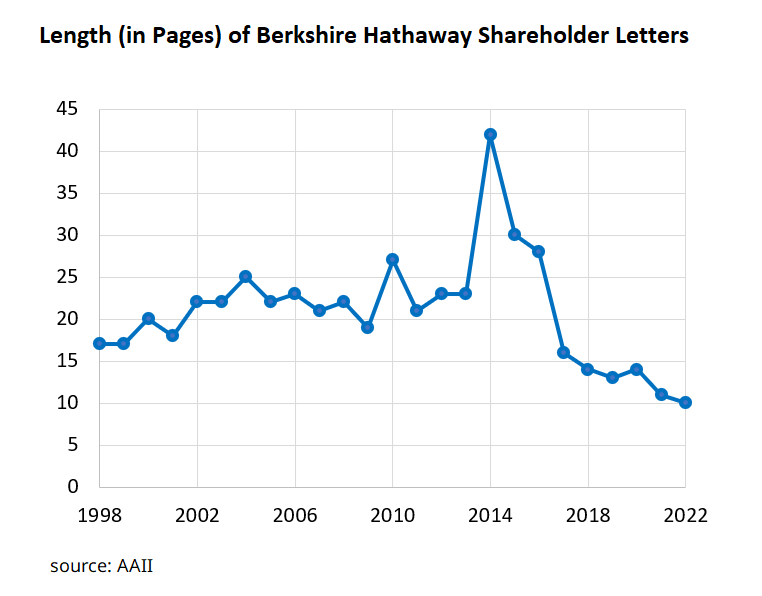
Warren Buffett released his annual letter to shareholders this past week. It has been trending notably shorter in the past few years (see graph below), but there are still good nuggets of wisdom from the Oracle of Omaha. This year he tackled stock buybacks (can be value-accretive), allocating capital in market duress, deceptive corporate earnings practices, and finding a good business partner. 

Will The Labor Market Inoculate the US Against Recession?


“The poster boy for growth and thinking positively is the labor market, which continues to post strong gains – far stronger than suggested by other indicators that in previous decades offered relatively reliable business-cycle signals.


The debate is whether the surprisingly robust gains in payrolls of late are due to extraordinary one-time factors linked to the ongoing effects of the pandemic. So-called labor-hoarding is one theory. If there’s something different this time, can it reverse suddenly? Or is it persistent?


Regardless of the explanation (and the staying power, or lack thereof), there’s no denying the numbers. US unemployment remains low and payrolls are rising at a strong pace: payrolls rose 517,000 in January, the highest monthly gain since July. Meanwhile, the jobless rate ticked down to 3.4%, the lowest since the 1950s.


Other key areas of the economy are strong as well. Notably, consumer spending, although wobbly in recent months, shows a strong ability to bounce back. Personal consumption expenditures surged 1.8% in January, the most in nearly two years.


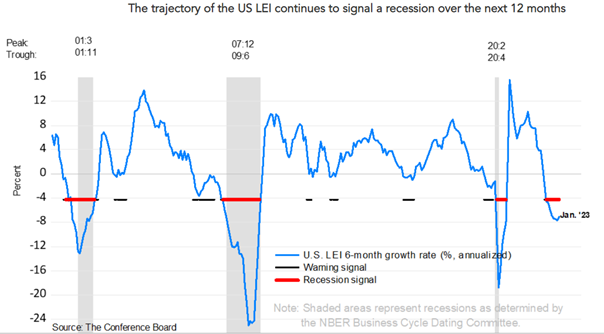
Definitions of recession vary, but it’s a safe assumption that the economy will almost certainly avoid contraction if payrolls and consumer spending are robust. That doesn’t change the fact that key indicators otherwise continue to flash warnings. The inverted Treasury yield curve, for example. Rising interest rates and unusually steep declines in money supply are other portents.


In fact, several broad-minded measures of the business-cycle look downright ominous. The Conference Board’s Leading Economic Index in January, for instance, paints a dark profile.”

Read More
 

Graph of the Week

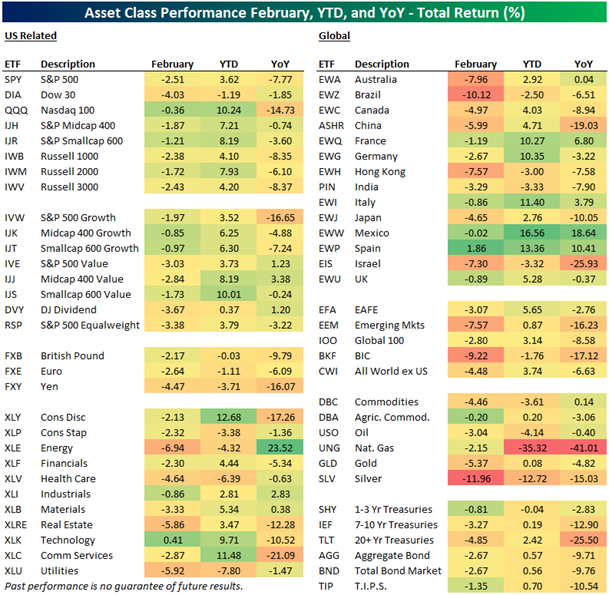
Nearly every asset class, sector, and region of the market posted losses in February; however, the hot start in January leaves most asset classes with moderate year-to-date gains.

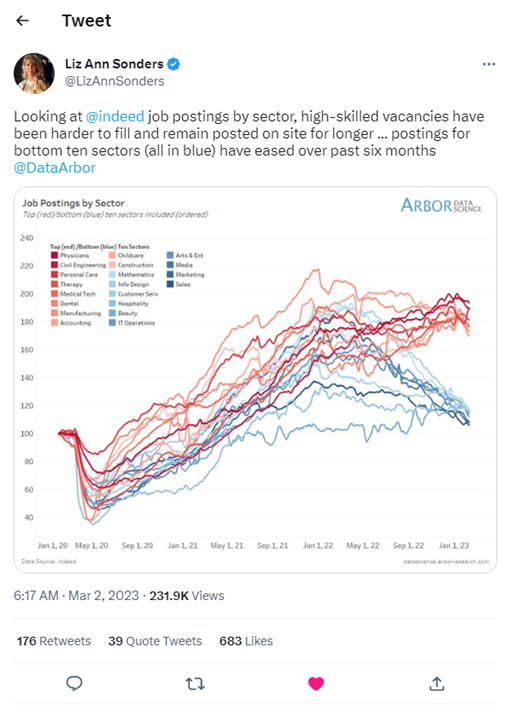
Tweet of the Week

Thanks for reading. Have a great weekend!


Guidance for today. Growth for tomorrow.


RBGWA - Logo - Full Color.jpg

Tim Ellis, CPA/PFS, CFP®

CIO and Wealth Advisor

RBG Wealth Advisors

M: 901.682.2431 | C: 662.444.1415

E:  tellis@rbgwa.com

A:  5100 Wheelis Dr., Ste. 300, Memphis, TN 38117

W: rbgwa.com

LinkedIn  Twitter  Facebook

RBG Wealth Advisors LLC is a registered investment adviser. Information presented is for educational purposes only and does not intend to make an offer or solicitation for the sale or purchase of any specific securities, investments, or investment strategies. Investments involve risk and, unless otherwise stated, are not guaranteed. Be sure to first consult with a qualified financial adviser and/or tax professional before implementing any strategy discussed herein. Past performance is not indicative of future performance.